Chapter 13 – Chromosomes, Mapping, and the Meiosis-Inheritance Connection
more desirable result?
53. In the fruit fly Drosophila, there is a dominant gene for normal wings and its recessive
allele for vestigial wings. At another gene locus on the same chromosome, there is a dominant
gene for red eyes and its recessive allele for purple eyes. A male that was heterozygous at
both gene loci was mated with a female that was homozygous for both recessive alleles and
the following results were observed among the offspring:
Normal wings and red eyes – 420
Vestigial wings and red eyes – 80
Normal wings and purple eyes – 70
Vestigial wings and purple eyes – 430
According to these data, what is the distance, in centimorgans, between these 2 gene loci?
(Enter the number only without the units. For example, 100 cM would be entered as 100)
Chapter 13 – Chromosomes, Mapping, and the Meiosis-Inheritance Connection
Clarify Question
•
What is the key concept addressed by the question?
•
What type of thinking is required?
•
What key words does the question contain?
Gather Content
•
What do you already know about linkage mapping by recombination?
Consider Possibilities
•
What other information is related to the question? Which information is most useful?
Choose Answer
•
Given what you now know, what information and/or problem solving approach is most
likely to produce the correct answer?
Reflect on Process
•
Did your problem-solving process lead you to the correct answer? If not, where did the
process break down or lead you astray? How can you revise your approach to produce a
more desirable result?
Chapter 13 – Chromosomes, Mapping, and the Meiosis-Inheritance Connection
54. In fruit flies (Drosophila melanogaster) there is a dominant allele for red eyes and a
recessive allele for white eyes. These alleles are located on the X chromosome. If a
heterozygous red-eyed female is mated with a white-eyed male, what percentage of the
offspring are expected to be white-eyed females? ( Enter the number only without the percent
sign. For example, enter 100% as 100 and enter 12.5% as 12.5 )
Chapter 13 – Chromosomes, Mapping, and the Meiosis-Inheritance Connection
Clarify Question
•
What is the key concept addressed by the question?
•
What type of thinking is required?
•
What key words does the question contain?
Gather Content
•
What do you already know about X-linked inheritance?
Consider Possibilities
•
What other information is related to the question? Which information is most useful?
Choose Answer
•
Given what you now know, what information and/or problem solving approach is most
likely to produce the correct answer?
Chapter 13 – Chromosomes, Mapping, and the Meiosis-Inheritance Connection
Reflect on Process
•
Did your problem-solving process lead you to the correct answer? If not, where did the
process break down or lead you astray? How can you revise your approach to produce a
more desirable result?
55. At an autosomal gene locus in humans, the allele for brown eyes is dominant over the
allele for blue eyes. At another gene locus, located on the X chromosome, a recessive allele
produces colorblindness while the dominant allele produces normal color vision. A
heterozygous brown-eyed woman who is a carrier of colorblindness has children with a blue-
eyed man who is not colorblind. What is the probability that their first child will be a blue-
eyed female who has normal color vision? (Enter the probability as a percent. Enter the
number only without the percent sign. For example, enter 100% as 100 and enter 12.5% as
12.5)
Chapter 13 – Chromosomes, Mapping, and the Meiosis-Inheritance Connection
Clarify Question
•
What is the key concept addressed by the question?
o This question addresses both X-linked and autosomal inheritance.
•
What type of thinking is required?
•
What key words does the question contain?
Gather Content
•
What do you already know about X-linked and autosomal inheritance?
Consider Possibilities
•
What other information is related to the question? Which information is most useful?
Choose Answer
•
Given what you now know, what information and/or problem solving approach is most
likely to produce the correct answer?
Chapter 13 – Chromosomes, Mapping, and the Meiosis-Inheritance Connection
Reflect on Process
•
Did your problem-solving process lead you to the correct answer? If not, where did the
process break down or lead you astray? How can you revise your approach to produce a
more desirable result?
56. At an autosomal gene locus in humans, the allele for brown eyes is dominant over the
allele for blue eyes. At another gene locus, located on the X chromosome, a recessive allele
produces colorblindness while the dominant allele produces normal color vision. A
heterozygous brown-eyed woman who is a carrier of colorblindness has a child with a blue-
eyed man who is not colorblind. An ultrasound test shows that the child is a girl. What is the
probability that she will be colorblind? (Enter the probability as a percent. Enter the number
only without the percent sign. For example, enter 100% as 100 and enter 12.5% as 12.5)
Chapter 13 – Chromosomes, Mapping, and the Meiosis-Inheritance Connection
Clarify Question
•
What is the key concept addressed by the question?
•
What type of thinking is required?
•
What key words does the question contain?
Gather Content
•
What do you already know about X-linked and autosomal inheritance?
Consider Possibilities
•
What other information is related to the question? Which information is most useful?
Choose Answer
•
Given what you now know, what information and/or problem solving approach is most
likely to produce the correct answer?
Reflect on Process
Chapter 13 – Chromosomes, Mapping, and the Meiosis-Inheritance Connection
•
Did your problem-solving process lead you to the correct answer? If not, where did the
process break down or lead you astray? How can you revise your approach to produce a
more desirable result?
Multiple Choice Questions
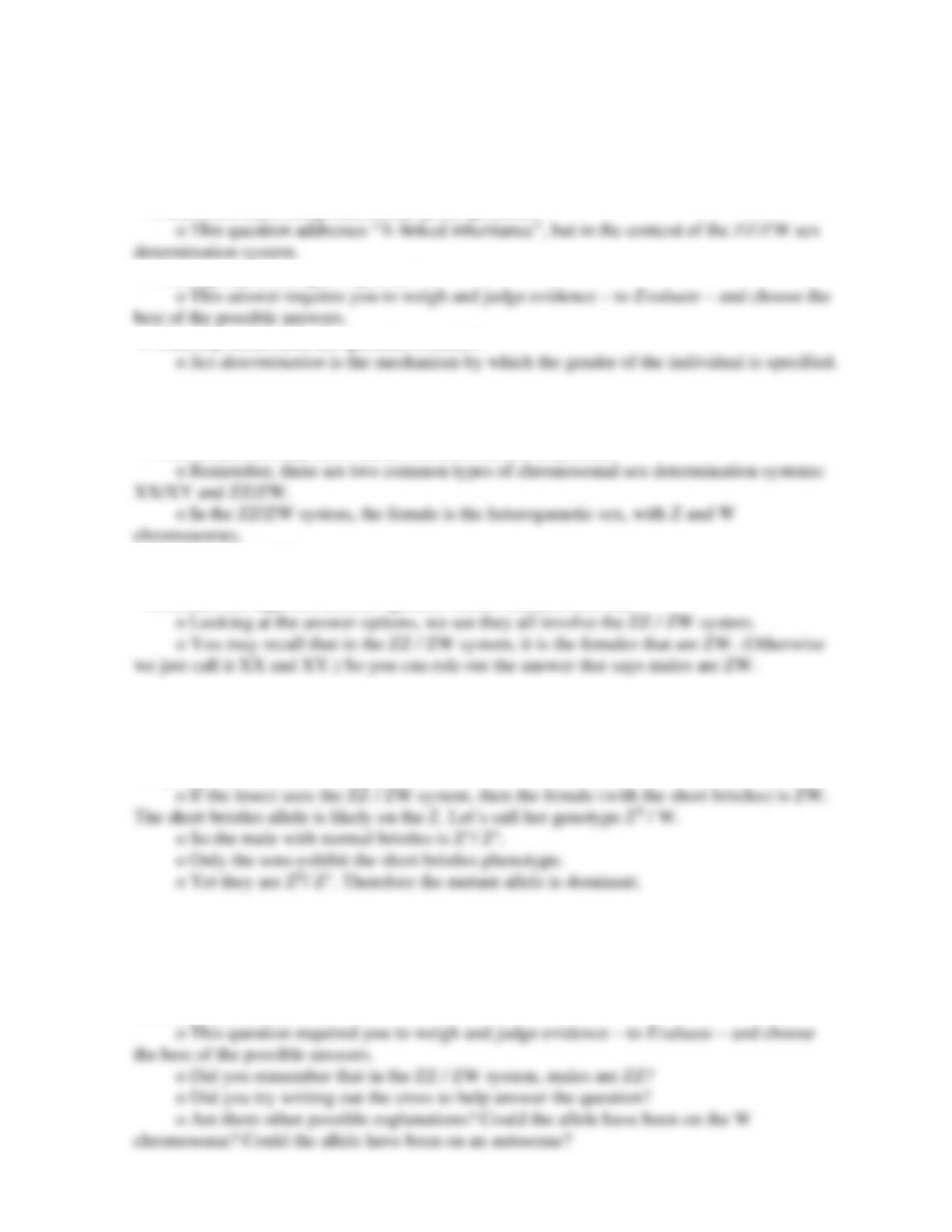
57. Suppose you are carrying out a series of crosses with an insect where the mechanism of
sex determination is unknown. You discover a mutant female with short bristles and decide to
cross it with a wild type male that has normal bristles. Half of the F1 progeny have short
bristles but all of these short-bristled F1 progeny are males. Based on these results, a valid
hypothesis would be
Chapter 13 – Chromosomes, Mapping, and the Meiosis-Inheritance Connection
Clarify Question
•
What is the key concept addressed by the question?
•
What type of thinking is required?
•
What key words does the question contain?
Gather Content
•
What do you already know about sex determination systems?
Consider Possibilities
•
Consider the different answer options. Which can you rule out?
Choose Answer
•
Given what you now know, what information and/or problem solving approach is most
likely to produce the correct answer?
Reflect on Process
•
Did your problem-solving process lead you to the correct answer? If not, where did the
process break down or lead you astray? How can you revise your approach to produce a
more desirable result?
Chapter 13 – Chromosomes, Mapping, and the Meiosis-Inheritance Connection
58. In 1910, Morgan did a series of experiments with the fruit fly Drosophila, an organism
where females are XX and males are XY. When a mutant male fly with white eyes was
crossed with a wild type female with red eyes, none of the F1 progeny had white eyes but 18%
of the F2 progeny had white eyes. Unexpectedly, all of these white-eyed F2 flies were males.
Based on these results, Morgan concluded that white eyes is caused by a recessive X-linked
allele. Suppose Morgan had found that half of the F1 progeny had white eyes but all of these
white-eyed F1 flies were females. In this case, a valid hypothesis would be
Chapter 13 – Chromosomes, Mapping, and the Meiosis-Inheritance Connection
Clarify Question
•
What is the key concept addressed by the question?
•
What type of thinking is required?
Gather Content
•
What do you already know about X-linked inheritance?
Consider Possibilities
•
Consider the different answer options. Which can you rule out?
Choose Answer
•
Given what you now know, what information and/or problem solving approach is most
likely to produce the correct answer?
Reflect on Process
•
Did your problem-solving process lead you to the correct answer? If not, where did the
process break down or lead you astray? How can you revise your approach to produce a
more desirable result?
Chapter 13 – Chromosomes, Mapping, and the Meiosis-Inheritance Connection
59. Genetic maps are based on recombination frequencies. Because both odd and even
numbers of crossovers can occur between any two gene loci, as the physical distance between
two loci increases, the maximum recombination frequency levels off at 50%. However,
suppose you discovered a species where only an even number of crossovers can occur
between any two gene loci. In this case, as the physical distance between two loci increases,
you would expect the maximum recombination frequency to
Chapter 13 – Chromosomes, Mapping, and the Meiosis-Inheritance Connection
Clarify Question
•
What is the key concept addressed by the question?
•
What type of thinking is required?
•
What key words does the question contain?
Gather Content
•
What do you already know about recombination frequency?
Consider Possibilities
•
What other information is related to the question? Which information is most useful?
Choose Answer
•
Given what you now know, what information and/or problem solving approach is most
likely to produce the correct answer?
Chapter 13 – Chromosomes, Mapping, and the Meiosis-Inheritance Connection
Reflect on Process
•
Did your problem-solving process lead you to the correct answer? If not, where did the
process break down or lead you astray? How can you revise your approach to produce a
more desirable result?