Page 1
1.
Market structures are categorized by:
A)
the number and size of the firms.
B)
whether products are differentiated and the extent of advertising.
C)
the number of firms and whether products are differentiated.
D)
the size of the firms and the extent of advertising.
2.
Which of the following statements about the differences between monopoly and perfect
competition is INCORRECT?
A)
A monopolist has market power, while a perfect competitor does not.
B)
Unlike a perfectly competitive firm, a monopoly can make positive economic
profits in the long run.
C)
A monopoly will charge a higher price and produce a smaller quantity than a
competitive market with the same demand and cost structure.
D)
Monopoly profits can continue in the long run because the monopoly produces
more and charges a higher price than a comparable perfectly competitive industry.
3.
Which of the following statements concerning monopoly is TRUE?
A)
Monopoly firms are always larger than perfectly competitive firms.
B)
A monopoly has no rivals.
C)
Barriers to entry do not prevent other firms from entering a monopolized industry.
D)
Monopolists produce more output than a competitive market with the same demand
and cost structure.
4.
_____ firms have the most market power.
A)
Monopoly
B)
Duopoly
C)
Oligopoly
D)
Monopolistic competition
5.
An industry with a single producer that sells a single product with no substitutes is a:
A)
perfectly competitive industry.
B)
monopoly.
C)
oligopoly.
D)
monopolistically competitive industry.
Page 2
6.
An industry with a firm that is the only producer of a good or service for which there are
no close substitutes and for which entry by potential rivals is prohibitively difficult is:
A)
a duopoly.
B)
a monopoly.
C)
an oligopoly.
D)
perfect competition.
7.
A monopoly is a market characterized by:
A)
a single seller.
B)
a product with many close substitutes.
C)
a large number of small firms.
D)
a small number of large firms.
8.
A monopoly:
A)
produces a product with no close substitutes.
B)
is composed of a single buyer and several sellers.
C)
is composed of a large number of small firms.
D)
is composed of a small number of large firms.
9.
Diamond rings are relatively scarce because:
A)
according to geologists, diamonds are less common than any other gem-quality
stone.
B)
the demand for diamonds is so high.
C)
diamond producers limit the quantity supplied to the market.
D)
of monopolistic competition.
10.
De Beers became a monopoly by:
A)
establishing control over diamond mines.
B)
use of economies of scale.
C)
use of technological superiority.
D)
ownership of a patent.
11.
A monopolist is likely to produce _____ and charge _____ than a comparable perfectly
competitive firm.
A)
more; more
B)
less; more
C)
more; less
D)
less; less
Page 3
12.
In contrast with perfect competition, a monopolist:
A)
produces more at a lower price.
B)
produces where MR > MC, and a perfectly competitively firm produces where P =
MC.
C)
may have economic profits in the long run.
D)
earns zero economic profits in the long run.
13.
Because of monopoly, consumers experience _____ than with perfect competition.
A)
more choices
B)
larger quantities
C)
higher quality
D)
higher prices
14.
The ability of a monopolist to raise the price of a product above the competitive level by
reducing the output is known as:
A)
product differentiation.
B)
barrier to entry.
C)
market power.
D)
patents and copyrights.
15.
Most electric, gas, and water companies are examples of:
A)
unregulated monopolies.
B)
natural monopolies.
C)
restricted-input monopolies.
D)
sunk-cost monopolies.
16.
Suppose that you build a high-speed, magnetically powered transportation system from
New York to Los Angeles, and you are the only firm providing this service. High fixed
costs resulting from the enormous quantity of capital used in this system enable
decreasing average cost for any conceivable level of demand. Your monopoly would
result from:
A)
control of a scarce resource or input.
B)
technological superiority.
C)
increasing returns to scale.
D)
government-set barriers.
Page 4
17.
If your farm had the only known source of a rare cocoa bean needed to make
chocolate-covered peanuts, your monopoly would result from:
A)
control of a scarce resource or input.
B)
technological superiority.
C)
increasing returns to scale.
D)
government-set barriers.
18.
If you had a license for the exclusive right to sell breakfast bagels in your community,
your monopoly would result from:
A)
control of a scarce resource or input.
B)
technological superiority.
C)
increasing returns to scale.
D)
government-set barriers.
19.
The De Beers company is described as a monopolist in the production of:
A)
diamonds.
B)
software.
C)
oil.
D)
beer.
20.
You own a lemonade stand in a competitive market, and as such, you are a price-taking
firm. Which of the following events would most likely increase your market power?
A)
The government abolishes the system of patents and copyrights.
B)
A booming economy increases the demand for lemonade and attracts entry into the
market.
C)
The average total cost curve for firms in the industry is horizontal.
D)
You own exclusive rights to harvest lemons from all domestic citrus orchards.
21.
Conditions that keep new firms out of a monopoly market are:
A)
barriers to entry.
B)
terms of sale.
C)
labor market stipulations.
D)
production controls.
Page 5
22.
A natural monopoly exists whenever a single firm:
A)
is owned and operated by the government.
B)
is investor owned but has been granted the exclusive right by the government to
operate in a market.
C)
has economies of scale over the entire range of production that is relevant to its
market.
D)
has gained control over a strategic input of an important production process.
23.
Natural monopolies are likely to include all of the following EXCEPT:
A)
a diamond mining company.
B)
a gas company.
C)
an electricity company.
D)
railways.
24.
Suppose that you build a new jumbo jet that can carry five times more passengers than
any other competitor. You have high fixed costs due to the quantity of capital used to
build the jets, and average cost is decreasing for all levels of demand. In this case, your
monopoly would result from:
A)
sunk costs.
B)
location.
C)
economies of scale.
D)
government restrictions.
25.
A firm that has economies of scale:
A)
at low output and but diseconomies of scale at high output is a natural monopoly.
B)
over the entire range of output demanded is a natural monopoly.
C)
at any particular level of output is a natural monopoly.
D)
has a continually rising long-run average cost curve.
26.
The land you own has the only known source of aloe needed to make anti-itch lotion. In
this case, your monopoly results from:
A)
government restrictions.
B)
location.
C)
sunk costs.
D)
ownership of scarce inputs.
Page 6
27.
If the state government gave you the exclusive right to sell cement to municipalities,
your monopoly would result from:
A)
sunk costs.
B)
government restrictions to entry.
C)
economies of scale.
D)
location.
28.
A monopoly is most likely to be temporary if the monopoly power is derived from:
A)
high barriers to entry.
B)
a lack of substitutes for the monopolist’s product.
C)
economies of scale.
D)
technological change.
29.
If a product’s usefulness increases with the number of users, it:
A)
has network externalities.
B)
is a monopoly.
C)
is a conglomerate.
D)
has an exclusive franchise.
30.
Which of the following is (are) barrier(s) to entry?
A)
control of scarce resources
B)
economies of scale
C)
patents and copyrights
D)
control of scarce resources, economies of scale, and patents and copyrights
31.
Critics of the National Collegiate Athletic Association (NCAA) argue that the NCAA
monopolizes college athletics and prevents student–athletes from earning money while
in college. If this is true, what type of entry barrier does the NCAA have?
A)
a patent
B)
a copyright
C)
control of a scarce resource or input
D)
economies of scale
32.
Lenoia runs a natural monopoly producing electricity for a small mountain village. The
barrier preventing other firms from competing with her is:
A)
her control of scarce natural resources.
B)
economies of scale.
C)
her technological superiority.
D)
a government-set barrier.
Page 7
33.
Which of the following is NOT a barrier to entry?
A)
control of an input essential for production
B)
government-set barriers such as patents
C)
a ban on certain kinds of advertising
D)
the existence of significant economies of scale
34.
Microsoft and its operating system are often cited as an example of a company that grew
into a monopolist through:
A)
ownership of a resource.
B)
patents.
C)
network externalities.
D)
large economies of scale.
35.
Network externalities exist when a good’s value to the consumer rises as:
A)
the number of people who use the good increases.
B)
the number of people who use the good decreases.
C)
the number of people who use the good remains constant.
D)
technology improves.
36.
A monopoly is an industry structure characterized by:
A)
a single buyer and several sellers.
B)
a product with many close substitutes.
C)
a large number of small firms.
D)
barriers to entry and exit.
37.
The large barriers to entry are a reason a monopoly:
A)
earns an economic profit in the long run.
B)
produces at the minimum average total cost in the long run.
C)
produces with no fixed costs in the long run.
D)
maximizes its profits by producing where P = MC.
38.
The demand curve facing a monopolist is:
A)
horizontal, the same as that facing a perfectly competitive firm.
B)
downward-sloping, the same as that facing a perfectly competitive firm.
C)
upward-sloping, the same as that facing a perfectly competitive firm.
D)
downward-sloping, unlike the horizontal demand curve facing a perfectly
competitive firm.
Page 8
39.
Which of the following is TRUE?
A)
A monopoly firm is a price taker.
B)
MR > P if the demand curve is downward-sloping.
C)
MR = MC is a profit-maximizing rule for any firm.
D)
In monopoly P = MC when profits are maximized.
40.
The demand curve for a monopoly is:
A)
the sum of the supply curves of all of the firms in the monopoly’s industry.
B)
the industry demand curve.
C)
horizontal because no one can enter.
D)
perfectly elastic.
41.
A firm that faces a downward-sloping demand curve is a:
A)
price setter.
B)
quantity minimizer.
C)
quantity taker.
D)
price taker.
42.
Because monopoly firms are price setters:
A)
they can sell more only by lowering price.
B)
they sell more at higher prices than at lower prices.
C)
they take the market-determined price as given and sell all they can at that price.
D)
they charge the highest possible price.
43.
Wendy has a monopoly in the retailing of motor homes. She can sell five per week at
$21,000 each. If she wants to sell six, she can charge only $20,000 each. The quantity
effect of selling the sixth motor home is:
A)
$20,000.
B)
$10,000.
C)
$15,000.
D)
$21,000.
44.
Wendy has a monopoly in the retailing of motor homes. She can sell five per week at
$21,000 each. If she wants to sell six, she can only charge $20,000 each. The price
effect of selling the sixth motor home is:
A)
$20,000.
B)
–$15,000.
C)
–$5,000.
D)
$25,000.
Page 9
45.
After the first unit sold, the marginal revenue a monopolist receives from selling one
more unit of a good is less than the price of that unit because of:
A)
diminishing marginal returns.
B)
increasing marginal cost.
C)
a downward-sloping demand curve.
D)
declining average fixed cost.
46.
Mr. Porter sells 10 bottles of champagne per week at $50 per bottle. He can sell 11
bottles per week if he lowers the price to $45 per bottle. The quantity and the price
effects on total revenue would be, respectively, an increase of _____ and a decrease of
_____.
A)
$450; $500
B)
$495; $550
C)
$45; $5
D)
$45; $50
47.
One of the major differences between a monopolist and a purely competitive firm is that
the monopolist has a _____ demand curve, while the purely competitive firm has a
_____ demand curve.
A)
downward-sloping; perfectly elastic
B)
perfectly inelastic; perfectly elastic
C)
downward-sloping; perfectly inelastic
D)
perfectly elastic; downward-sloping
48.
The demand curve for a monopoly is:
A)
the MR curve above the AVC curve.
B)
the MR curve above the horizontal axis.
C)
the entire MR curve.
D)
above the MR curve.
49.
Suppose that a monopoly computer chip maker increases production from 10
microchips to 11 microchips. If the market price declines from $30 per unit to $29 per
unit, marginal revenue for the eleventh unit is:
A)
$1.
B)
$9.
C)
$19.
D)
$29.
Page 10
50.
Marginal revenue for a monopolist is:
A)
equal to price.
B)
greater than price.
C)
less than price.
D)
equal to average revenue.
51.
A downward-sloping demand curve will ensure that:
A)
P = MR.
B)
P > MR.
C)
P < MR.
D)
P = MC.
52.
Which of the following is TRUE?
A)
Instead of applying the marginal decision rule, monopoly firms just set the price as
high as possible.
B)
If demand is downward-sloping, P = MR.
C)
If demand is downward-sloping, P = ATC.
D)
If demand is downward-sloping, P > MR.
53.
The demand curve for a monopoly is:
A)
above the marginal revenue curve.
B)
below the marginal revenue curve.
C)
horizontal because of economics of scale.
D)
infinitely elastic.
54.
The demand curve facing a monopolist is:
A)
downward-sloping.
B)
vertical.
C)
horizontal.
D)
upward-sloping.
55.
The demand curve facing a monopolist is always:
A)
the same as the industry’s demand curve.
B)
perfectly elastic.
C)
unit-elastic.
D)
perfectly inelastic.
Page 11
56.
The demand curve facing a monopolist is:
A)
vertical, the same as that facing a perfectly competitive firm.
B)
perfectly inelastic, the same as that facing a perfectly competitive firm.
C)
upward-sloping, the same as that facing a perfectly competitive firm.
D)
downward-sloping, like the industry demand curve in perfect competition.
57.
The demand curve for a monopoly is:
A)
the MC curve above the AVC curve.
B)
the MR curve above the horizontal axis.
C)
identical to the MR curve.
D)
also the industry demand curve.
58.
Marginal revenue for a monopolist is:
A)
equal to price.
B)
greater than price.
C)
less than price.
D)
the change in total revenue plus the change in output.
59.
If a firm faces a downward-sloping demand curve, it will ensure that:
A)
P = ATC.
B)
P > MR.
C)
P < MC.
D)
P = MC.
60.
A monopolist’s marginal cost curve shifts up, but the firm’s demand curve remains the
same and the firm does not shut down. Compared to the condition before the increase in
marginal costs, the monopolist will _____ its price and _____ its level of production.
A)
raise; decrease
B)
not change; decrease
C)
raise; increase
D)
lower; increase
61.
Suppose a monopoly is producing output so that marginal revenue equals marginal cost.
If the monopolist reduces output, it:
A)
can charge a higher price.
B)
will increase profits.
C)
will decrease marginal revenue.
D)
can charge a higher price and it will increase profits.
Page 12
62.
At a monopoly’s profit-maximizing level of output:
A)
marginal revenue equals marginal cost.
B)
marginal revenue is greater than marginal cost.
C)
marginal revenue is less than marginal cost.
D)
price is less than marginal cost.
63.
A monopoly is producing output so that average total cost is $30, marginal revenue is
$40, and the price is $50. If ATC is at its minimum level and the ATC curve is U-shaped,
to maximize profits this firm should:
A)
increase output.
B)
reduce output.
C)
do nothing; it is already maximizing profits.
D)
shut down.
64.
If a monopolist is producing a quantity that generates MC = P, then profit:
A)
is maximized.
B)
is maximized only if MR = P.
C)
can be increased by increasing production.
D)
can be increased by decreasing production.
65.
If a monopolist is producing a quantity that generates MC > MR, then profit:
A)
is maximized.
B)
is maximized only if MC = P.
C)
can be increased by increasing production.
D)
can be increased by decreasing production.
66.
Which of the following is TRUE?
A)
Profit-maximizing behavior occurs only in perfectly competitive markets.
B)
Additional units of a good should be produced as long as MR < MC.
C)
The profit-maximizing solution occurs where MR = MC.
D)
The profit-maximizing solution occurs where MR > MC.
67.
A monopolist responds to an increase in demand by _____ price and _____ output.
A)
increasing; decreasing
B)
increasing; increasing
C)
decreasing; increasing
D)
decreasing; decreasing
Page 13
68.
A monopolist responds to a decrease in demand by _____ price and _____ output.
A)
increasing; decreasing
B)
increasing; increasing
C)
decreasing, increasing
D)
decreasing; decreasing
69.
A monopolist responds to an increase in marginal cost by _____ price and _____ output.
A)
increasing; decreasing
B)
increasing; increasing
C)
decreasing; increasing
D)
decreasing; decreasing
70.
A monopoly responds to a decrease in marginal cost by _____ price and _____ output.
A)
increasing; decreasing
B)
increasing; increasing
C)
decreasing; increasing
D)
decreasing; decreasing
71.
The GoSports Company is a profit-maximizing firm with a monopoly in the production
of school team pennants. The firm sells its pennants for $10 each. We can conclude that
GoSports is producing a level of output at which:
A)
average total cost equals $10.
B)
average total cost is greater than $10.
C)
marginal revenue equals $10.
D)
marginal cost equals marginal revenue.
72.
Suppose that a profit-maximizing monopoly firm undergoes a substantial technological
change that reduces its marginal and average total costs by $40. If in response to its
reduction in cost the firm changes its price in a profit-maximizing way, then we can
predict that its total economic profit will:
A)
fall.
B)
remain unchanged.
C)
rise.
D)
It is not possible to make a determination from the information given.
Page 14
73.
Suppose that a profit-maximizing monopoly firm undergoes a substantial technological
change that reduces its marginal and average total costs by $40. If in response to its
reduction in cost the firm changes its price in a profit-maximizing way, then we can
predict that its total output will:
A)
rise.
B)
fall.
C)
remain unchanged.
D)
It is not possible to make a determination from the information given.
74.
Suppose that a monopoly firm is required to pay a new annual license fee to do business
in its city and that the fee is somewhat less than the economic profit the firm is now
earning. In response to the increase in fees, the firm will:
A)
raise its price by less than the amount of the license fee.
B)
raise its price by the amount of the license fee.
C)
raise its price by somewhat more than amount of the license fee.
D)
not change its price.
75.
An increase in the fixed costs of a monopoly firm would _____ price and _____
quantity in the short run.
A)
increase; decrease
B)
increase; increase
C)
not change; not change
D)
decrease; decrease
76.
If a monopolist is producing a quantity that generates MC > MR, then profit:
A)
is maximized.
B)
is maximized only if MC = P.
C)
can be increased by increasing price.
D)
can be increased by decreasing price.
77.
If a monopolist is producing a quantity that generates MC < MR, then profit:
A)
is maximized.
B)
is maximized only if MC = P.
C)
can be increased by increasing production.
D)
can be increased by decreasing production.
Page 15
78.
If a monopolist is producing a quantity that generates MC = MR, then profit:
A)
is maximized.
B)
is maximized only if MC = P.
C)
can be increased by increasing production.
D)
can be increased by decreasing production.
79.
Suppose that the Yankee Cap Company is a profit-maximizing firm with a monopoly in
the production of baseball caps. The firm sells its baseball caps for $25 each. For this
information, we can assume that the Yankee Cap Company is producing a level of
output at which:
A)
marginal revenue equals $25.
B)
marginal cost equals marginal revenue.
C)
average total cost equals $25.
D)
average total cost is greater than $25.
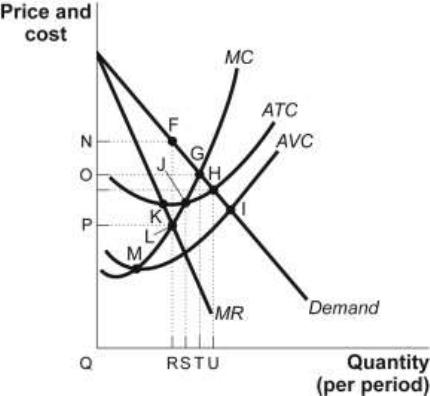
Use the following to answer questions 80-83:
Figure: Short-Run Monopoly
80.
(Figure: Short-Run Monopoly) Look at the figure Short-Run Monopoly. The
profit-maximizing rule is satisfied by the intersection at point:
A)
G.
B)
H.
C)
J.
D)
L.
Page 16
81.
(Figure: Short-Run Monopoly) Look at the figure Short-Run Monopoly. The
profit-maximizing quantity of output is quantity:
A)
Q.
B)
R.
C)
S.
D)
T.
82.
(Figure: Short-Run Monopoly) Look at the figure Short-Run Monopoly. The
profit-maximizing price is price:
A)
N.
B)
O.
C)
P.
D)
Q.
83.
(Figure: Short-Run Monopoly) Look at the figure Short-Run Monopoly. The marginal
cost of producing the profit-maximizing quantity is cost:
A)
N.
B)
O.
C)
P.
D)
Q.
84.
The monopoly firm’s profit-maximizing price is:
A)
given by the point on the ATC curve for the profit-maximizing quantity.
B)
given by the point on the demand curve for the profit-maximizing quantity.
C)
determined for the quantity of output at which MR > MC by the greatest amount.
D)
found where MR > MC at the monopolist’s profit-maximizing quantity of output.
85.
A monopolist _____ than a perfectly competitive industry.
A)
produces a larger quantity
B)
charges a higher price
C)
charges a lower price
D)
earns less profit in the long run
86.
Bob owns a trout farm with monopoly power in North Carolina. Bob’s optimal output
occurs where marginal revenue _____. Because of monopoly power, Bob’s supply curve
_____.
A)
equals marginal cost; does not exist
B)
exceeds marginal cost; does not exist
C)
equals marginal cost; is upward-sloping
D)
exceeds marginal cost; is perfectly inelastic
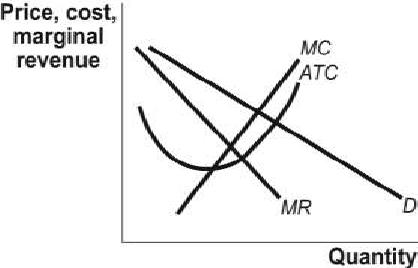
Page 17
87.
Which of the following statements about monopoly equilibrium and perfectly
competitive equilibrium is INCORRECT?
A)
Price is greater than marginal cost in monopoly, and price equals marginal cost in
perfect competition.
B)
When a monopoly exists, the consumer surplus is less than if the market were
perfectly competitive.
C)
Monopoly output will be less than the output of a comparable perfectly competitive
industry.
D)
In the long run, economic profits are driven to zero in both a monopoly and a
perfectly competitive market.
Use the following to answer question 88:
Figure: Perfect Competition
88.
(Figure: Perfect Competition) Look at the figure Perfect Competition. A perfectly
competitive industry’s total output is given by the intersection of:
A)
marginal revenue and marginal cost.
B)
demand and marginal cost.
C)
demand and marginal revenue.
D)
marginal revenue and average total cost.
89.
A statement that best reflects an evaluation of monopoly firms is that:
A)
they are economically inefficient.
B)
they have little or no market power.
C)
consumers are given more choices, lower costs, and higher quality.
D)
competition should replace all monopolies.
Page 18
90.
In perfect competition, the firm produces the output such that _____, and in monopoly,
the firm produces the output such that _____.
A)
P > MR = MC; P = MR = MC
B)
P = MR = MC; P < MR = MC
C)
P = MR = MC; P > MR = MC
D)
P = MR = MC; P = MR = MC
91.
Which of the following is TRUE?
A)
A monopoly firm is a price maker.
B)
MR = P if the demand curve is downward-sloping.
C)
MR = MC is a profit-maximizing rule for firms in perfect competition only.
D)
Monopolies tend to charge lower prices than perfectly competitive firms.
92.
The profit-maximizing rule MR = MC is:
A)
followed by a monopoly but not by a perfectly competitive firm.
B)
followed by a perfectly competitive firm but not by a monopoly.
C)
followed by all types of firms.
D)
not followed by a monopoly because it would reduce economic profit to zero.
93.
Assume a monopoly is currently earning economic profits. If a change in fixed cost
raises average total cost above the demand curve:
A)
price and output will remain unchanged.
B)
more monopolies will enter.
C)
the monopoly will go out of business.
D)
marginal cost will be greater than marginal revenue.
Page 19
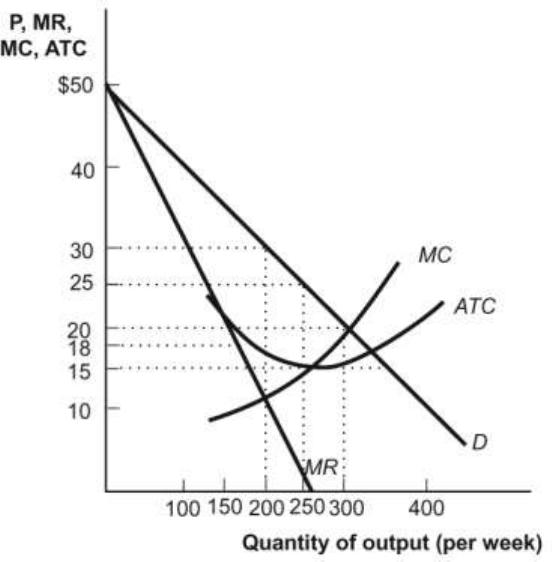
Use the following to answer questions 94-97:
Figure: A Profit-Maximizing Monopoly Firm
94.
(Figure: A Profit-Maximizing Monopoly Firm) Look at the figure A Profit-Maximizing
Monopoly Firm. The firm in this figure will produce _____ units of output per week.
A)
150
B)
200
C)
250
D)
300
95.
(Figure: A Profit-Maximizing Monopoly Firm) Look at the figure A Profit-Maximizing
Monopoly Firm. This firm’s cost per unit at its profit-maximizing quantity is:
A)
$8.
B)
$15.
C)
$18.
D)
$20.
Page 20
96.
(Figure: A Profit-Maximizing Monopoly Firm) Look at the figure A Profit-Maximizing
Monopoly Firm. This firm’s price per unit is:
A)
$20.
B)
$25.
C)
$30.
D)
$35.
97.
(Figure: A Profit-Maximizing Monopoly Firm) Look at the figure A Profit-Maximizing
Monopoly Firm. This firm’s profit per unit is:
A)
$5.
B)
$12.
C)
$15.
D)
$20.
98.
In the short run, a monopoly will stop producing if:
A)
P < ATC.
B)
P < AVC.
C)
P > MR.
D)
P > ATC.
99.
In a monopoly in the long run:
A)
economic profits will be eliminated by the entry of rival firms.
B)
economic profits will be reduced but not eliminated by the entry of rival firms.
C)
entry by other firms will not occur.
D)
the price will be the same as in a perfectly competitive market.
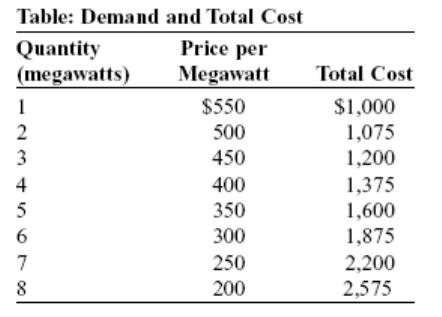
Use the following to answer questions 100-104:
Page 21
100.
(Table: Demand and Total Cost) Look at the table Demand and Total Cost. Lenoia runs
a natural monopoly producing electricity for a small mountain village. The table shows
Lenoia’s demand and total cost of producing electricity. The price effect of increasing
production from 3 megawatts to 4 megawatts is:
A)
–$150.
B)
$500.
C)
$450.
D)
–$50.
101.
(Table: Demand and Total Cost) Look at the table Demand and Total Cost. Lenoia runs
a natural monopoly firm producing electricity for a small mountain village. The table
shows Lenoia’s demand and total cost of producing electricity. To maximize profits,
Lenoia should charge a price of:
A)
$350.
B)
$400.
C)
$450.
D)
$500.
102.
(Table: Demand and Total Cost) Look at the table Demand and Total Cost. Lenoia runs
a natural monopoly producing electricity for a small mountain village. The table shows
Lenoia’s demand and total cost of producing electricity. The marginal revenue of the
fourth unit of production is:
A)
$200.
B)
$250.
C)
$450.
D)
$500.
103.
(Table: Demand and Total Cost) Look at the table Demand and Total Cost. Lenoia runs
a natural monopoly producing electricity for a small mountain village. The table shows
Lenoia’s demand and total cost of producing electricity. The profit-maximizing quantity
of electricity for her to produce is _____ megawatts.
A)
2
B)
3
C)
4
D)
5
Page 22
104.
(Table: Demand and Total Cost) Look at the table Demand and Total Cost. Lenoia runs
a natural monopoly producing electricity for a small mountain village. The
accompanying table shows Lenoia’s demand and total cost of producing electricity. The
maximum profit Lenoia can make is:
A)
$225.
B)
$425.
C)
$400.
D)
$1,800.
105.
If a monopoly has a linear demand curve and is producing at the profit-maximizing level
of output, at that level of output, demand is:
A)
price-elastic.
B)
price-inelastic.
C)
perfectly price-inelastic.
D)
price unit-elastic.
106.
In 1999, a judge declared that Microsoft was a monopolist. Assuming that Microsoft has
a linear demand curve and that it is maximizing its profits at its current level of output,
we may conclude that if Microsoft were to increase its price, its total revenue would:
A)
rise.
B)
fall.
C)
remain unchanged.
D)
There is insufficient information to make a determination.
Page 23
Use the following to answer questions 107-110:
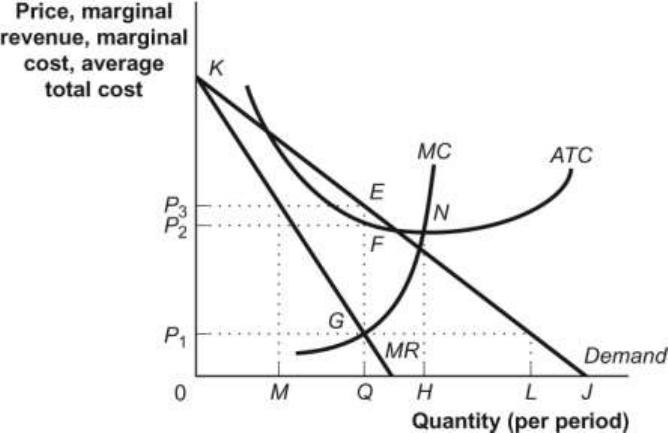
Figure: Computing Monopoly Profit
107.
(Figure: Computing Monopoly Profit) Look at the figure Computing Monopoly Profit.
The profit-maximizing price is _____ and will generate total economic profit of _____.
A)
P2; EF
B)
P3; the rectangle P1P2FG
C)
P3; the rectangle P2P3EF
D)
P3; EF
108.
(Figure: Computing Monopoly Profit) Look at the figure Computing Monopoly Profit.
Producing at point N would:
A)
result in MR = MC.
B)
result in positive economic profits.
C)
never be profit-maximizing, since at this output MR < 0 and MC > 0.
D)
result in the firm breaking even.
109.
(Figure: Computing Monopoly Profit) Look at the figure Computing Monopoly Profit.
At the profit-maximizing output, total cost is:
A)
P10QG.
B)
P30QE.
C)
P20QF.
D)
FQ2.
Page 24
110.
(Figure: Computing Monopoly Profit) Look at the figure Computing Monopoly Profit.
To obtain maximum profits, the monopoly should produce the output determined by
point:
A)
G.
B)
N.
C)
H.
D)
K.
Use the following to answer questions 111-116:
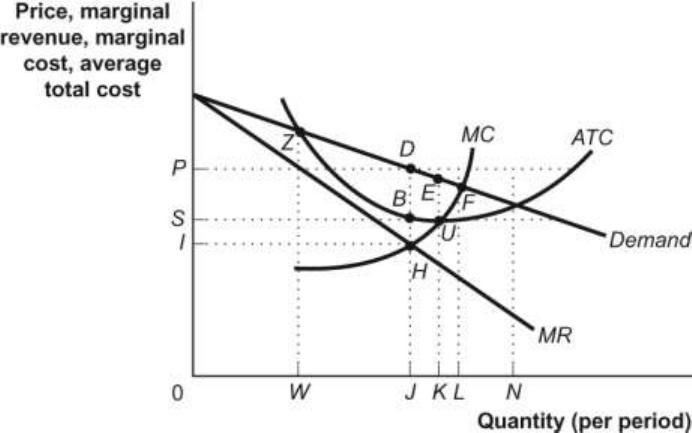
Figure: Monopoly Model
111.
(Figure: Monopoly Model) Look at the figure Monopoly Model. The profit-maximizing
quantity is at point:
A)
W.
B)
J.
C)
K.
D)
L.
112.
(Figure: Monopoly Model) Look at the figure Monopoly Model. The profit-maximizing
price is:
A)
Z.
B)
P.
C)
S.
D)
I.
Page 25
113.
(Figure: Monopoly Model) Look at the figure Monopoly Model. When the firm is in
equilibrium (that is, maximizing its economic profit), its total cost is the area of
rectangle:
A)
0PDJ.
B)
0IHJ.
C)
IPDH.
D)
0SBJ.
114.
(Figure: Monopoly Model) Look at the figure Monopoly Model. When the firm is in
equilibrium (that is, maximizing its economic profit), its total revenue is the area of
rectangle:
A)
SPDB.
B)
IPDH.
C)
0SBJ.
D)
0PDJ.
115.
(Figure: Monopoly Model) Look at the figure Monopoly Model. When the firm is in
equilibrium (that is, maximizing its economic profit), its profit is the area of rectangle:
A)
SPDB.
B)
IPDH.
C)
ISBH.
D)
0PDJ.
116.
(Figure: Monopoly Model) Look at the figure Monopoly Model. When the firm is in
equilibrium (that is, maximizing its economic profit), its total cost is the area of
rectangle _____ and its total revenue is the area of rectangle _____.
A)
0PDJ; SPDB
B)
0IHJ; IPDH
C)
IPDH; 0SBJ
D)
0SBJ; 0PDJ
117.
Suppose the GoSports pennant monopoly is broken up and the pennant industry
becomes perfectly competitive. We would expect the _____ to increase and _____ to
decrease after the breakup.
A)
producer surplus; consumer surplus and total surplus
B)
consumer surplus; producer surplus and total surplus
C)
consumer surplus and total surplus; producer surplus
D)
producer surplus and total surplus; consumer surplus
Page 26
118.
If the government allowed only one airline to serve the entire U.S. market, there would
be a _____ loss associated with _____ efficiency in the airline industry.
A)
marginal; reduced
B)
deadweight; reduced
C)
total; increased
D)
deadweight; increased
119.
In contrast to perfect competition, a monopoly:
A)
produces more at a lower price.
B)
produces where MR > MC.
C)
may have lower economic profits in the long run.
D)
produces less at a higher price.
120.
In monopoly:
A)
a basic condition for efficiency is violated because P > MC.
B)
consumers are confronted with a price that is lower than marginal cost.
C)
consumers will buy more of the good than is economically efficient.
D)
consumers are confronted with a price that is lower than average total cost.
121.
The pricing in monopoly prevents some mutually beneficial trades. The value of these
unrealized mutually beneficial trades is called:
A)
sunk costs.
B)
opportunity costs.
C)
deadweight loss.
D)
inequity.
122.
Which of the following is TRUE?
A)
Monopolies produce too much and charge too much from the standpoint of
efficiency.
B)
Monopolies usually are economically efficient because they have economic profits
with which to work.
C)
Monopolies produce too little and charge too much from the standpoint of
efficiency.
D)
Monopolies cause an efficiency problem but are not associated with a deadweight
loss.
Page 27
123.
Suppose a perfectly competitive market is suddenly transformed into one that operates
as a monopoly market. We would expect price to _____, output to _____, consumer
surplus to _____, producer surplus to _____, and deadweight loss to _____.
A)
rise; fall; rise; rise; fall
B)
rise; fall; fall; fall; rise
C)
rise; fall; fall; rise; rise
D)
fall; rise; rise; fall; fall
124.
Suppose a perfectly competitive industry is suddenly transformed into a monopoly
industry. We can assume that monopoly output will be _____ than the competitive
output and that _____.
A)
higher; deadweight loss will emerge
B)
lower; consumer surplus will increase
C)
lower; deadweight loss will emerge
D)
higher; consumer surplus will decrease
125.
When a monopoly maximizes profit, the loss of surplus by consumers is _____ the
monopolist’s gain in profit.
A)
less than
B)
equal to
C)
more than
D)
sometimes more than and sometimes less than
Use the following to answer questions 126-136:
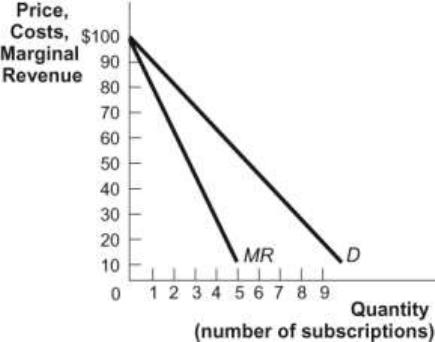
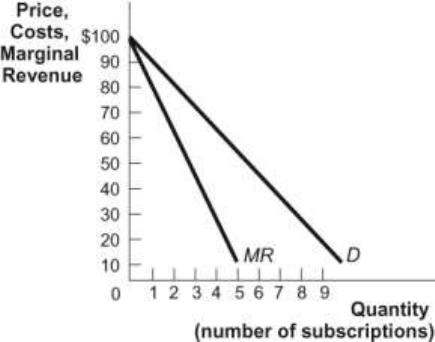
Figure: PPV
Page 28
126.
(Figure: PPV) Look at the figure PPV, which shows the demand and marginal revenue
for a pay-per-view football game on cable TV. Assume that the marginal cost and
average cost are a constant $20. If the cable company is in a perfectly competitive
industry, how many subscriptions will it sell?
A)
2
B)
4
C)
6
D)
8
127.
(Figure: PPV) Look at the figure PPV, which shows the demand and marginal revenue
for a pay-per-view football game on cable TV. Assume that the marginal cost and
average cost are a constant $20. If the cable company is in a perfectly competitive
industry, what price will it charge?
A)
$20
B)
$40
C)
$60
D)
$100
128.
(Figure: PPV) Look at the figure PPV, which shows the demand and marginal revenue
for a pay-per-view football game on cable TV. Assume that the marginal cost and
average cost are a constant $20. If the cable company is in a perfectly competitive
industry, how much is consumer surplus?
A)
$0
B)
$320
C)
$160
D)
$500
129.
(Figure: PPV) Look at the figure PPV, which shows the demand and marginal revenue
for a pay-per-view football game on cable TV. Assume that the marginal cost and
average cost are a constant $20. If the cable company is in a perfectly competitive
industry, how much is producer surplus?
A)
$0
B)
$320
C)
$160
D)
$500
Page 29
130.
(Figure: PPV) Look at the figure PPV, which shows the demand and marginal revenue
for a pay-per-view football game on cable TV. Assume that the marginal cost and
average cost are a constant $20. If the cable company is in a perfectly competitive
industry, how much is deadweight loss?
A)
$0
B)
$320
C)
$160
D)
$500
131.
(Figure: PPV) Look at the figure PPV, which shows the demand and marginal revenue
for a pay-per-view football game on cable TV. Assume that the marginal cost and
average cost are a constant $20. If the cable company is a monopoly, how much will it
produce?
A)
2
B)
4
C)
6
D)
8
132.
(Figure: PPV) Look at the figure PPV, which shows the demand and marginal revenue
for a pay-per-view football game on cable TV. Assume that the marginal cost and
average cost are a constant $20. If the cable company is a monopoly, what price will it
charge?
A)
$20
B)
$40
C)
$60
D)
$100
133.
(Figure: PPV) Look at the figure PPV, which shows the demand and marginal revenue
for a pay-per-view football game on cable TV. Assume that the marginal cost and
average cost are a constant $20. If the cable company is a monopoly, how much is
consumer surplus when the monopolist maximizes profit?
A)
$20
B)
$40
C)
$80
D)
$160
Page 30
134.
(Figure: PPV) Look at the figure PPV, which shows the demand and marginal revenue
for a pay-per-view football game on cable TV. Assume that the marginal cost and
average cost are a constant $20. If the cable company is a monopoly, how much is
producer surplus when the monopolist maximizes profit?
A)
$0
B)
$20
C)
$80
D)
$160
135.
(Figure: PPV) Look at the figure PPV, which shows the demand and marginal revenue
for a pay-per-view football game on cable TV. Assume that the marginal cost and
average cost are a constant $20. If the cable company is a monopoly, how much is
deadweight loss when the monopolist maximizes profit?
A)
$0
B)
$20
C)
$80
D)
$160
136.
(Figure: PPV) Look at the figure PPV, which shows the demand and marginal revenue
for a pay-per-view football game on cable TV. Assume that the marginal cost and
average cost are a constant $20. If the cable company is a monopoly, how much is total
surplus when the monopolist maximizes profit?
A)
$240
B)
$160
C)
$100
D)
$320
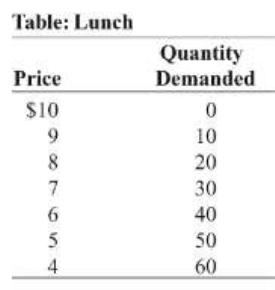
Use the following to answer questions 137-146:
Page 31
137.
(Table: Lunch) Look at the figure Lunch. Joe makes and sells picnic lunches to people
taking all-day rafting trips on the river. The marginal cost and average cost of each
lunch are a constant $4. If Joe is one of many firms in a competitive industry, how many
lunches will he produce in the long run?
A)
0
B)
20
C)
40
D)
60
138.
(Table: Lunch) Look at the figure Lunch. Joe makes and sells picnic lunches to people
taking all-day rafting trips on the river. The marginal cost and average cost of each
lunch are a constant $4. If Joe is one of many firms in a competitive industry, what price
will he charge for a lunch in the long run?
A)
$10
B)
$8
C)
$6
D)
$4
139.
(Table: Lunch) Look at the figure Lunch. Joe makes and sells picnic lunches to people
taking all-day rafting trips on the river. The marginal cost and average cost of each
lunch are a constant $4. If Joe is one of many firms in a competitive industry, what is
consumer surplus in the long run?
A)
$4
B)
$10
C)
$180
D)
$360
140.
(Table: Lunch) Look at the figure Lunch. Joe makes and sells picnic lunches to people
taking all-day rafting trips on the river. The marginal cost and average cost of each
lunch are a constant $4. If Joe is one of many firms in a competitive industry, what is
producer surplus in the long run?
A)
$0
B)
$4
C)
$180
D)
$360
Page 32
141.
(Table: Lunch) Look at the figure Lunch. Joe makes and sells picnic lunches to people
taking all-day rafting trips on the river. The marginal cost and average cost of each
lunch are a constant $4. If Joe is one of many firms in a competitive industry, what is
deadweight loss in the long run?
A)
$0
B)
$4
C)
$180
D)
$360
142.
(Table: Lunch) Look at the figure Lunch. Joe makes and sells picnic lunches to people
taking all-day rafting trips on the river. The marginal cost and average cost of each
lunch are a constant $4. If Joe is a monopolist, how many lunches will he produce in the
long run?
A)
0
B)
10
C)
20
D)
30
143.
(Table: Lunch) Look at the figure Lunch. Joe makes and sells picnic lunches to people
taking all-day rafting trips on the river. The marginal cost and average cost of each
lunch are a constant $4. If Joe is a monopolist, what price will he charge for a lunch in
the long run?
A)
$9
B)
$7
C)
$5
D)
$3
144.
(Table: Lunch) Look at the figure Lunch. Joe makes and sells picnic lunches to people
taking all-day rafting trips on the river. The marginal cost and average cost of each
lunch are a constant $4. If Joe is a monopolist, what is consumer surplus in the long
run?
A)
$45
B)
$90
C)
$180
D)
$360
Page 33
145.
(Table: Lunch) Look at the figure Lunch. Joe makes and sells picnic lunches to people
taking all-day rafting trips on the river. The marginal cost and average cost of each
lunch are a constant $4. If Joe is a monopolist, what is producer surplus in the long run?
A)
$45
B)
$90
C)
$180
D)
$360
146.
(Table: Lunch) Look at the figure Lunch. Joe makes and sells picnic lunches to people
taking all-day rafting trips on the river. The marginal cost and average cost of each
lunch are a constant $4. If Joe is a monopolist, what is deadweight loss in the long run?
A)
$45
B)
$90
C)
$180
D)
$360
147.
In general, economists are critical of monopoly where there is (are):
A)
no natural monopoly.
B)
a natural monopoly.
C)
only a few firms.
D)
persistent economies of scale.
148.
Public policies toward monopoly in the United States often consist of:
A)
laws outlawing all of them.
B)
the regulation of natural monopolies.
C)
government takeover if monopoly profit exceeds a certain level.
D)
forcing monopoly industries to become perfectly competitive.
149.
Amtrak is a publicly owned company that provides rail service. This means that
Amtrak’s prices tend to be _____ than if it were a private company, and the quality of
service tends to be _____ than if it were a private company.
A)
higher; worse
B)
higher; better
C)
lower; worse
D)
lower; better
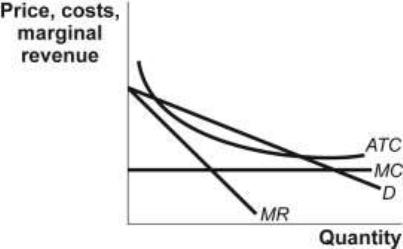
Page 34
150.
In an industry characterized by extensive economies of scale:
A)
small companies are more profitable than large companies.
B)
large companies are more profitable than small companies.
C)
small and large companies are equally profitable.
D)
small companies will drive out large companies.
151.
A natural monopoly is one that:
A)
monopolizes a natural resource such as a mineral spring.
B)
is based on control of something occurring in nature (such as diamonds).
C)
has increasing returns to scale over the entire relevant range of output.
D)
typically has low fixed costs, making it easy and “natural” for it to shut out
competitors.
152.
One government policy for dealing with natural monopoly is to:
A)
impose a price floor to eliminate the deadweight loss.
B)
impose a price ceiling to reduce economic profit.
C)
break it up into smaller firms.
D)
impose fines on the monopolist.
Use the following to answer question 153:
Figure: Total Surplus with a Regulated Natural Monopolist
Page 35
153.
(Figure: Total Surplus with a Regulated Natural Monopoly) Look at the figure Total
Surplus with a Regulated Natural Monopolist. The natural monopoly:
A)
would incur an economic profit if regulated to produce where price is less than
marginal cost.
B)
would incur an economic profit if regulated to charge a price equal to average total
cost.
C)
generates more consumer surplus than an unregulated monopolist if regulated to
produce where price equals average total cost.
D)
generates more consumer surplus than an unregulated monopolist if regulated to
produce where price is above the average total cost.
154.
If the regulation of a monopoly results in a price equal to marginal cost but the price is
below average total cost:
A)
the firm can still make an economic profit.
B)
the firm will earn only a zero economic profit.
C)
efficiency in allocation will be less.
D)
the firm will need subsidies to stay in business.
155.
In the short run, if a monopoly is forced to charge a price equal to marginal cost:
A)
output will fall.
B)
the deadweight loss will decrease.
C)
consumer surplus will decrease.
D)
other firms will enter the industry.
Page 36
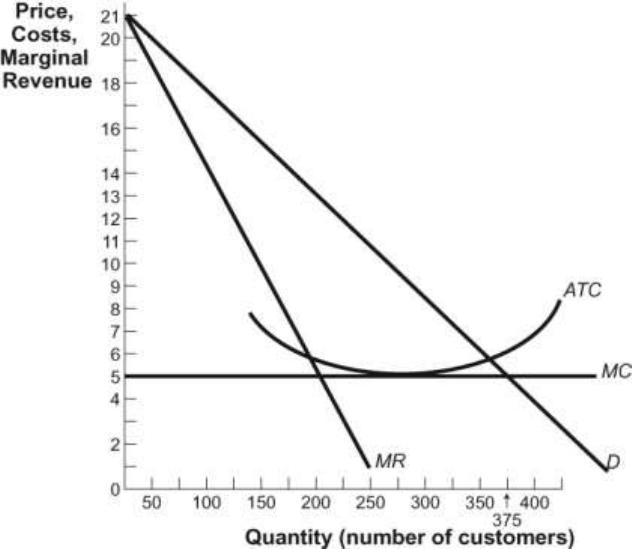
Use the following to answer questions 156-167:
Figure: Water Works
156.
(Figure: Water Works) Look at the figure Water Works, which describes a small town’s
water works, a natural monopoly. If the water works is unregulated and maximizes
profit, how many customers will it serve?
A)
200
B)
300
C)
375
D)
400
157.
(Figure: Water Works) Look at the figure Water Works, which describes a small town’s
water works, a natural monopoly. If the water works is unregulated and maximizes
profit, what price will it charge to each customer?
A)
$21
B)
$13
C)
$6
D)
$5
Page 37
158.
(Figure: Water Works) Look at the figure Water Works, which describes a small town’s
water works, a natural monopoly. If the water works is unregulated and maximizes
profit, consumer surplus will be:
A)
$6,400.
B)
$3,200.
C)
$1,600.
D)
$800.
159.
(Figure: Water Works) Look at the figure Water Works, which describes a small town’s
water works, a natural monopoly. If the water works is unregulated and maximizes
profit, how much profit will it earn?
A)
$1,600
B)
$1,400
C)
$1,000
D)
$800
160.
(Figure: Water Works) Look at the figure Water Works, which describes a small town’s
water works, a natural monopoly. If regulators want to maximize efficiency, the
monopolist will be allowed to charge a price of:
A)
$5.
B)
$6.
C)
$13.
D)
$21.
161.
(Figure: Water Works) Look at the figure Water Works, which describes a small town’s
water works, a natural monopoly. If regulators require the water works to charge the
price that eliminates deadweight loss, the water works will serve _____ customers.
A)
200
B)
300
C)
375
D)
400
162.
(Figure: Water Works) Look at the figure Water Works, which describes a small town’s
water works, a natural monopoly. If regulators require the water works to charge the
price that eliminates deadweight loss, the water works will:
A)
earn profits.
B)
break even.
C)
incur losses.
D)
have a large producer surplus.
Page 38
163.
(Figure: Water Works) Look at the figure Water Works, which describes a small town’s
water works, a natural monopoly. If regulators require the water works to charge the
price that eliminates deadweight loss, consumer surplus will be:
A)
$1,600.
B)
$1,400.
C)
$1,000.
D)
$800.
164.
(Figure: Water Works) Look at the figure Water Works, which describes a small town’s
water works, a natural monopoly. If regulators want the monopolist to cover average
total cost, the monopolist will be allowed to charge a price of:
A)
$5.
B)
$6.
C)
$13.
D)
$21.
165.
(Figure: Water Works) Look at the figure Water Works, which describes a small town’s
water works, a natural monopoly. If regulators allow the monopolist to charge a price
that just covers average total cost, the water works will serve _____ customers.
A)
200
B)
300
C)
375
D)
400
166.
(Figure: Water Works) Look at the figure Water Works, which describes a small town’s
water works, a natural monopoly. If regulators require the water works to charge the
price that just covers average total cost, the water works will:
A)
earn profits.
B)
break even.
C)
incur losses.
D)
have a large producer surplus.
167.
(Figure: Water Works) Look at the figure Water Works, which describes a small town’s
water works, a natural monopoly. If regulators allow the water works to charge the price
that covers average total costs, consumer surplus will be:
A)
$1,600.
B)
$1,400.
C)
$1,000.
D)
$2,812.50.
Page 39
Use the following to answer questions 168-171:
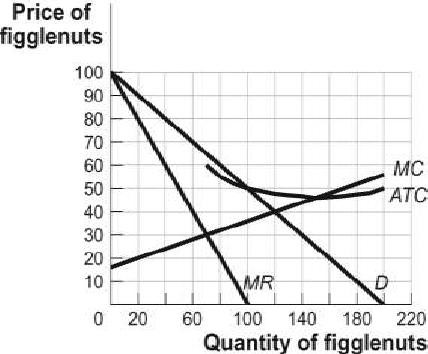
Figure: Demand, Revenue, and Cost Curves
168.
(Figure: Demand, Revenue, and Cost Curves) Look at the figure Demand, Revenue, and
Cost Curves. Figglenuts-R-Us is a monopolist in the figglenut market. Figglenuts-R-Us
will sell _____ figglenuts and set a price of _____ to maximize profits.
A)
70; $65
B)
100; $50
C)
120; $40
D)
150; $46
169.
(Figure: Demand, Revenue, and Cost Curves) Look at the figure Demand, Revenue, and
Cost Curves. Figglenuts-R-Us is a monopolist in the figglenut market. If the government
wanted to regulate Figglenuts-R-Us such that the entire deadweight loss would be
eliminated in the short run, it would impose a price ceiling of:
A)
$40.
B)
$46.
C)
$50.
D)
$65.
170.
(Figure: Demand, Revenue, and Cost Curves) Look at the figure Demand, Revenue, and
Cost Curves. Figglenuts-R-Us is a monopolist in the figglenut market. If the government
wanted to regulate Figglenuts-R-Us such that it would minimize the deadweight loss
while allowing the firm to break even, it would impose a price ceiling of:
A)
$40.
B)
$46.
C)
$50.
D)
$65.
Page 40
171.
(Figure: Demand, Revenue, and Cost Curves) Look at the figure Demand, Revenue, and
Cost Curves. Figglenuts-R-Us is a monopolist in the figglenut market. If the government
regulated the figglenut market by setting a price ceiling of $40, Figglenuts-R-Us might:
A)
produce 60 figglenuts to maximize profit.
B)
produce 120 figglenuts to maximize profit.
C)
shut down in the long run.
D)
increase the price to $60.
172.
The practice of charging different prices to different customers for the same good or
service, even though the cost of supplying those customers is the same, is:
A)
privatization.
B)
monopolization.
C)
output competition.
D)
price discrimination.
173.
Price discrimination is the practice of:
A)
charging different prices to buyers of the same good.
B)
paying different prices to suppliers of the same good.
C)
equating price to marginal cost.
D)
equating price to marginal revenue.
174.
The practice of selling the same product at different prices to different consumers,
without corresponding differences in costs, is:
A)
price discrimination.
B)
privatizing.
C)
monopolizing.
D)
output prioritizing.
175.
If a firm wants to charge different customers different prices, it must be:
A)
a price taker.
B)
in perfect competition.
C)
a price setter.
D)
a price setter in perfect competition.
Page 41
176.
_____ is the practice of selling _____ product(s) at different prices to different
consumers, without corresponding differences in costs.
A)
Price discrimination; the same
B)
Privatizing; the same
C)
Monopolizing; similar
D)
Price fixing; different
177.
Price discrimination can occur in all of the following market structures EXCEPT:
A)
perfect competition.
B)
monopolistic competition.
C)
oligopoly.
D)
monopoly.
178.
Price discrimination can occur if:
A)
there are many firms in the industry, all producing the same identical good.
B)
producers are price takers.
C)
all consumers have the same willingness to pay for the good.
D)
the market structure is a monopolistic competition.
179.
When price discrimination occurs, the producer’s profit is _____ if the producer charges
each customer the same profit-maximizing price where marginal revenue equals _____
cost.
A)
the same as; marginal
B)
more than; marginal
C)
less than; marginal
D)
the same as; average total
180.
A monopolist or an imperfectly competitive firm practices price discrimination
primarily to:
A)
increase profits.
B)
expand plant size.
C)
lower total costs.
D)
reduce marginal costs.
181.
To engage in price discrimination a firm must be:
A)
a price taker.
B)
a price setter.
C)
able to identify consumers whose elasticities differ.
D)
a price setter, and it must be able to identify consumers whose elasticities differ.
Page 42
182.
The main reason a monopoly engages in price discrimination is that:
A)
it wants to discriminate against a particular ethnic group.
B)
doing so increases its profits.
C)
it wants to discourage potential competitors.
D)
by charging a lower price to some people, it may succeed in discouraging efforts to
regulate it.
183.
When a monopolist practices price discrimination, compared to a single-price
monopolist, consumer surplus will:
A)
remain the same.
B)
increase.
C)
decrease.
D)
increase initially, and then return to its original level.
184.
When a monopolist practices price discrimination, compared to a single-price
monopolist, producer surplus will:
A)
remain the same.
B)
increase.
C)
decrease.
D)
increase initially, and then return to its original level.
185.
When a monopolist practices price discrimination, compared to a single-price
monopolist, monopoly profits will:
A)
remain the same.
B)
increase.
C)
decrease.
D)
increase initially, and then return to their original level.
186.
When a monopolist practices price discrimination, compared to a single-price
monopolist, deadweight loss will:
A)
remain the same.
B)
increase.
C)
decrease.
D)
increase initially, and then return to its original level.
187.
Price discrimination leads to a _____ price for consumers with a _____ demand.
A)
higher; less elastic
B)
higher; more elastic
C)
higher; perfectly elastic
D)
lower; less elastic
Page 43
188.
Price discrimination leads to a _____ price for consumers with a _____ demand.
A)
higher; more elastic
B)
higher; perfectly elastic
C)
lower; more elastic
D)
lower; less elastic
189.
Price-discriminating firms will impose a price structure that offers customers with a
_____ demand a _____ price and offers customers with a(n) _____ demand a _____
price.
A)
less elastic; lower; more elastic; higher
B)
less elastic; higher; more elastic; lower
C)
lower; higher; higher; lower
D)
seasonal; lower; unchanging; higher
190.
Because tourist demand for airline flights is relatively _____, small _____ in ticket price
will result in relatively _____ in additional tourists.
A)
inelastic; reductions; small increases
B)
elastic; reductions; large increases
C)
inelastic; increases; small decreases
D)
elastic; increases; small increases
191.
A price-discriminating firm will adjust prices so that customers with more _____
demand pay _____ than (as) customers with _____ elastic demand.
A)
inelastic; less; less
B)
elastic; less; less
C)
elastic; the same; more
D)
elastic; more; less
192.
The city bus system charges lower fares to senior citizens than to other passengers.
Assuming that this pricing strategy increases the profits of the bus system, we can
conclude that senior citizens must have a _____ demand for bus service than other
passengers.
A)
greater
B)
lower
C)
more elastic
D)
less elastic
Page 44
193.
The municipal swimming pool charges lower entrance fees to local residents than to
nonresidents. Assuming that this pricing strategy increases the profits of the pool, we
can conclude that nonresidents must have a _____ demand for swimming at the pool
than residents.
A)
greater
B)
lower
C)
more elastic
D)
less elastic
194.
To practice effective price discrimination, a monopolist must be able to:
A)
estimate its own production and cost functions.
B)
avoid detection by government regulatory agencies.
C)
prevent the resale of goods among groups of buyers.
D)
calculate the utility level of each buyer in the market.
195.
To maximize profits, an airline will offer _____ prices to customers with _____
demand.
A)
higher; inelastic
B)
higher; elastic
C)
lower; inelastic
D)
the lowest; the least
196.
Because business travelers’ demand for airline flights is relatively _____, small
increases in price will result in relatively _____ decreases in additional business
travelers.
A)
price-inelastic; small
B)
price-elastic; large
C)
price-inelastic; large
D)
price-elastic; small
197.
A firm that can price-discriminate should adjust prices so that customers with _____
demand pay _____ prices than (as) those with _____ demand.
A)
price-inelastic; lower; elastic
B)
price-inelastic; the same; elastic
C)
price-elastic; lower; inelastic
D)
price-elastic; higher; inelastic
Page 45
198.
Amtrak charges lower fares to students than to its other passengers. This pricing strategy
increases Amtrak’s profits. From this information, we can conclude that students must
have a _____ demand for Amtrak train service than other passengers.
A)
more price-elastic
B)
lower
C)
greater
D)
less price-elastic
199.
A community college charges lower tuition fees to town residents than to nonresidents.
This pricing strategy increases the profits of the community college. Using this
information, we can conclude that nonresidents must have a _____ demand for
attending the community college than residents.
A)
less price-elastic
B)
greater
C)
lower
D)
more price-elastic
200.
Suppose the price elasticity of demand for coffee at the CoffeeBarn equals 1.71 for
women and 0.55 for men. A successful price discrimination strategy would lead to
_____ prices for men and _____ prices for women _____.
A)
lower; lower; in any circumstances
B)
lower; higher; in any circumstances
C)
lower; higher; as long as men can’t resell drinks to women
D)
higher; lower; as long as women can’t resell drinks to men
201.
Suppose a monopoly can separate its customers into two groups. If the monopoly
practices price discrimination, it will charge the lower price to the group with:
A)
the higher price elasticity of demand.
B)
the lower price elasticity of demand.
C)
the fewer close substitutes.
D)
The answer cannot be determined with the information given.
202.
A Japanese steel firm sells steel in the United States and in Japan. Since the United
States buys steel from a number of sources, the U.S. demand for Japanese steel is more
price-elastic than the Japanese demand for Japanese steel. If the Japanese steel firm
wishes to maximize its profits, it should:
A)
charge the same price in both countries (after adjusting for transportation costs).
B)
charge a higher price in the United States and a lower price in Japan; otherwise it
would be accused of unfair trade practices.
C)
charge a lower price in the United States and a higher price in Japan.
D)
figure out which market is more profitable and sell only in that market.
Page 46
203.
Airlines that engage in price discrimination charge higher prices to business travelers
because their _____ is more _____ than that of other travelers.
A)
demand; elastic
B)
demand; inelastic
C)
supply; elastic
D)
supply; inelastic
204.
Airlines that engage in price discrimination charge lower prices to vacation travelers
because their _____ is more _____ than that of other travelers.
A)
demand; elastic
B)
demand; inelastic
C)
supply; elastic
D)
supply; inelastic
205.
Suppose the elasticity of demand for tickets to Broadway shows is 2.0 for men and 0.3
for women. To use price discrimination to increase profits, the producers should charge
higher prices to _____ because their demand is _____.
A)
men; elastic
B)
men; inelastic
C)
women; elastic
D)
women; inelastic
206.
Suppose the elasticity of demand for tickets to Broadway shows is 2.0 for men and 0.3
for women. To use price discrimination to increase profits, the producers should charge
lower prices to _____ because their demand is _____.
A)
men; elastic
B)
men; inelastic
C)
women; elastic
D)
women; inelastic
207.
Which of the following is NOT an example of price discrimination?
A)
Students receive a discount at the ice cream store when they show their college ID
cards.
B)
Women receive free admission to a nightclub, while men must pay a cover charge.
C)
A country club requires members to pay annual dues, but members receive
discounted prices to golf.
D)
Street vendors increase the price of umbrellas when it is raining.
Page 47
208.
Many hotel chains offer discounts to senior citizens. This is an example of _____ that is
_____ in the United States.
A)
market power; illegal
B)
single-price monopoly power; legal
C)
price discrimination; illegal
D)
price discrimination; legal
209.
If a monopolist can engage in perfect price discrimination:
A)
it produces at the socially efficient level.
B)
consumer surplus is maximized.
C)
producer surplus is minimized.
D)
the government may impose fines on the monopolist.
Use the following to answer question 210:
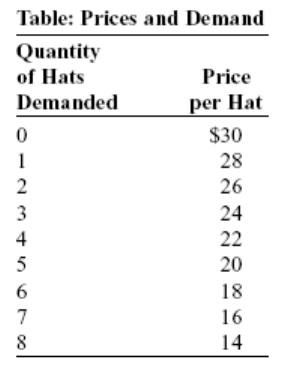
210.
(Table: Prices and Demand) Look at the table Prices and Demand. Professor
Dumbledore has a monopoly on magic hats. The marginal cost of producing a hat is
$18. Suppose Dumbledore can perfectly price-discriminate. How many hats will he
produce?
A)
3
B)
4
C)
5
D)
6
Page 48
211.
Sadia wants to practice price discrimination in her bakery. Which of the following
techniques should Sadia NOT use?
A)
discounts for people who buy a large volume of bread
B)
higher prices for people who buy bread on the day it is baked and lower prices for
people who place advance orders
C)
an annual fee for customers who want to shop at a discount in her store
D)
the same price for all consumers for freshly baked goods
212.
All of the following are examples of price discrimination EXCEPT:
A)
discounts for senior citizens at the movies.
B)
discounts for families with young children at motels.
C)
generally lower prices at Walmart than at Target.
D)
cheaper air fares if the traveler stays over a Saturday.
213.
Which of the following is NOT an example of price discrimination?
A)
a Fourth of July sale
B)
a coupon in the newspaper offering a 10% discount on a product
C)
a higher price for front row seats at a concert than for seats at the back
D)
a lower price charged to the grandfather who bought his airline ticket to Chicago
three weeks in advance and will stay over a Saturday night than to the
businesswoman who bought her ticket the day of the flight and will not stay over
Saturday night
Use the following to answer questions 214-221:
Figure: PPV
Page 49
214.
(Figure: PPV) Look at the figure PPV, which shows the demand and marginal revenue
for a pay-per-view football game on cable TV. Assume that the marginal cost and
average cost are a constant $40. If the cable company is a single-price monopoly, to
maximize profit it will sell _____ subscriptions and charge _____ per subscription.
A)
8; $20
B)
6; $40
C)
3; $70
D)
2; $80
215.
(Figure: PPV) Look at the figure PPV, which shows the demand and marginal revenue
for a pay-per-view football game on cable TV. Assume that the marginal cost and
average cost are a constant $40. If the cable company is a single-price monopoly and
maximizes profit, consumer surplus will be:
A)
$0.
B)
$45.
C)
$70.
D)
$90.
216.
(Figure: PPV) Look at the figure PPV, which shows the demand and marginal revenue
for a pay-per-view football game on cable TV. Assume that the marginal cost and
average cost are a constant $40. If the cable company is a single-price monopoly and
maximizes profit, producer surplus will be:
A)
$0.
B)
$45.
C)
$70.
D)
$90.
217.
(Figure: PPV) Look at the figure PPV, which shows the demand and marginal revenue
for a pay-per-view football game on cable TV. Assume that the marginal cost and
average cost are a constant $40. If the cable company is a single-price monopoly and
maximizes profit, deadweight loss will be:
A)
$0.
B)
$45.
C)
$70.
D)
$90.
Page 50
218.
(Figure: PPV) Look at the figure PPV, which shows the demand and marginal revenue
for a pay-per-view football game on cable TV. Assume that the marginal cost and
average cost are a constant $40. If the cable company practices perfect price
discrimination, then it will sell _____ subscriptions.
A)
10
B)
8
C)
6
D)
0
219.
(Figure: PPV) Look at the figure PPV, which shows the demand and marginal revenue
for a pay-per-view football game on cable TV. Assume that the marginal cost and
average cost are a constant $40. If the cable company practices perfect price
discrimination, consumer surplus will be:
A)
$180.
B)
$100.
C)
$40.
D)
$0.
220.
(Figure: PPV) Look at the figure PPV, which shows the demand and marginal revenue
for a pay-per-view football game on cable TV. Assume that the marginal cost and
average cost are a constant $40. If the cable company practices perfect price
discrimination, producer surplus will be:
A)
$180.
B)
$100.
C)
$40.
D)
$0.
221.
(Figure: PPV) Look at the figure PPV, which shows the demand and marginal revenue
for a pay-per-view football game on cable TV. Assume that the marginal cost and
average cost are a constant $40. If the cable company practices perfect price
discrimination, deadweight loss will be:
A)
$180.
B)
$100.
C)
$40.
D)
$0.
Page 51
Use the following to answer questions 222-224:
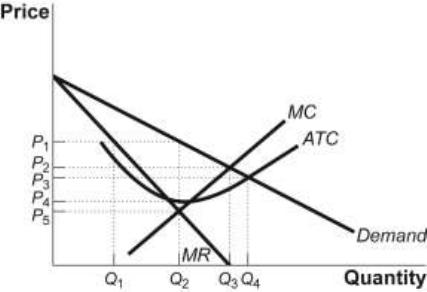
Figure: A Rock Climbing Shoe Monopoly
222.
(Figure: A Rock Climbing Shoe Monopoly) Look at the figure A Rock Climbing Shoe
Monopoly. If the firm acts to maximize profit, the firm will sell _____ pairs of shoes at
_____ per pair.
A)
Q2; P1
B)
Q2; P5
C)
Q3; P2
D)
Q4; P3
223.
(Figure: A Rock Climbing Shoe Monopoly) Look at the figure A Rock Climbing Shoe
Monopoly. If the firm acts to maximize profit, the firm will earn profit equal to:
A)
(P1 – P5) × Q2.
B)
(P1 – P4) × Q2.
C)
(P4 – P5) × Q2.
D)
(P2 – P3) × Q3.
224.
(Figure: A Rock Climbing Shoe Monopoly) Look at the figure A Rock Climbing Shoe
Monopoly. If the firm is regulated such that it earns zero economic profit, the firm will
sell _____ pairs of shoes at a price of _____ per pair.
A)
Q1; P1
B)
Q2; P1
C)
Q4; P3
D)
Q3; P2
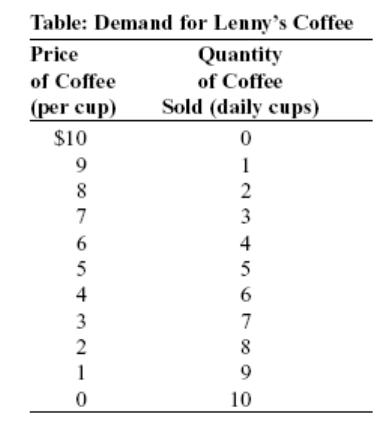
Page 52
Use the following to answer questions 225-228:
225.
(Table: Demand for Lenny’s Coffee) Look at the table Demand for Lenny’s Coffee.
Lenny’s Café is the only source of coffee for hundreds of miles in any direction. If
Lenny increases the quantity sold from five cups to six, his marginal revenue will be:
A)
$4.
B)
$24.
C)
–$1.
D)
$5.
226.
(Table: Demand for Lenny’s Coffee) Look at the table Demand for Lenny’s Coffee.
Lenny’s Café is the only source of coffee for hundreds of miles in any direction. Lenny
is selling two cups of coffee. If he lowers the price and sells three cups of coffee, the
_____ effect will dominate the _____ effect, and total revenue will _____.
A)
quantity; price; decrease
B)
price; quantity; increase
C)
price; quantity; decrease
D)
quantity; price; increase
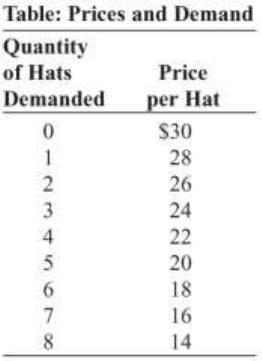
Page 53
227.
(Table: Demand for Lenny’s Coffee) Look at the table Demand for Lenny’s Coffee.
Lenny’s Café is the only source of coffee for hundreds of miles in any direction. If
Lenny’s marginal cost of selling coffee is a constant $2, his profit-maximizing level of
output is _____ cups at _____ per cup.
A)
four; $6
B)
eight; $3
C)
five; $5
D)
three; $7
228.
(Table: Demand for Lenny’s Coffee) Look at the table Demand for Lenny’s Coffee.
Lenny’s Café is the only source of coffee for hundreds of miles in any direction. If
Lenny’s marginal cost of selling coffee is a constant $2 and the government forces
Lenny to charge a price that eliminates deadweight loss, Lenny will charge _____ per
cup and sell _____ cups.
A)
$0; 10
B)
$2; 8
C)
$4; 6
D)
$5; 5
Use the following to answer questions 229-242:
Page 54
229.
(Table: Prices and Demand) Look at the table Prices and Demand. The New Orleans
Saints have a monopoly on Saints logo hats. The marginal cost of producing a hat is
$18. How many hats should the Saints produce, and what price should the organization
charge to maximize its profits?
A)
1; $28
B)
2; $26
C)
3; $24
D)
4; $22
230.
(Table: Prices and Demand) The New Orleans Saints have a monopoly on Saints logo
hats. The marginal cost of producing a hat is $18. If the Saints increase the number of
hats they sell from four to five, their total revenue changes from _____ to _____.
A)
$88; $100
B)
$22; $20
C)
$88; $80
D)
$110; $100
231.
(Table: Prices and Demand) The New Orleans Saints have a monopoly on Saints logo
hats. The marginal cost of producing a hat is $18. If the Saints increase the number of
hats they sell from four to five, the quantity effect is a(n) _____ in total revenue of
_____.
A)
decrease; $20
B)
increase; $20
C)
decrease; $8
D)
increase; $8
232.
(Table: Prices and Demand) The New Orleans Saints have a monopoly on Saints logo
hats. The marginal cost of producing a hat is $18. If the Saints increase the number of
hats they sell from four to five, the price effect is a(n) _____ in total revenue of _____.
A)
decrease; $20
B)
increase; $20
C)
decrease; $8
D)
increase; $8
233.
(Table: Prices and Demand) The New Orleans Saints have a monopoly on Saints logo
hats. The marginal cost of producing a hat is $18. If the Saints increase the number of
hats they sell from four to five, marginal revenue is:
A)
$20.
B)
$22.
C)
$8.
D)
$12.
Page 55
234.
(Table: Prices and Demand) Look at the table Prices and Demand. The New Orleans
Saints have a monopoly on Saints logo baseball hats. The Saints sell at most one hat to
each customer, and the table shows each customer’s willingness to pay. The marginal
cost of producing a hat is $18, and there are no fixed costs. How much is the Saints’
profit at the profit-maximizing output?
A)
$24
B)
$18
C)
$12
D)
$30
235.
(Table: Prices and Demand) Look at the table Prices and Demand. The New Orleans
Saints have a monopoly on Saints logo hats. The marginal cost of producing a hat is
$18. How much is consumer surplus at the Saint’s profit-maximizing output?
A)
$24
B)
$18
C)
$12
D)
$9
236.
(Table: Prices and Demand) Look at the table Prices and Demand. The New Orleans
Saints have a monopoly on Saints logo hats. The marginal cost of producing a hat is
$18. How much is producer surplus at the Saint’s profit-maximizing output?
A)
$24
B)
$18
C)
$12
D)
$9
237.
(Table: Prices and Demand) Look at the table Prices and Demand. The New Orleans
Saints have a monopoly on Saints logo hats. The marginal cost of producing a hat is
$18. How much is deadweight loss at the Saint’s profit-maximizing output?
A)
$24
B)
$18
C)
$12
D)
$9
Page 56
238.
(Table: Prices and Demand) Look at the table Prices and Demand. The New Orleans
Saints have a monopoly on Saints logo hats. The marginal cost of producing a hat is
$18. If the Saints were a perfectly competitive firm in a perfectly competitive industry,
their profit-maximizing price and output, respectively, would be:
A)
$24 and 3.
B)
$30 and 0.
C)
$18 and 6.
D)
$8 and 6.
239.
(Table: Prices and Demand) Look at the table Prices and Demand. The New Orleans
Saints have a monopoly on Saints logo hats. The marginal cost of producing a hat is
$18. If the Saints were a perfectly competitive firm in a perfectly competitive industry,
at their profit-maximizing price and output, consumer surplus would be:
A)
$24.
B)
$30.
C)
$18.
D)
$36.
240.
(Table: Prices and Demand) Look at the table Prices and Demand. The New Orleans
Saints have a monopoly on Saints logo hats. The marginal cost of producing a hat is
$18. If the Saints were a perfectly competitive firm in a perfectly competitive industry,
at their profit-maximizing price and output producer surplus would be:
A)
$0.
B)
$12.
C)
$18.
D)
$24.
241.
(Table: Prices and Demand) Look at the table Prices and Demand. The New Orleans
Saints have a monopoly on Saints logo hats. The marginal cost of producing a hat is
$18. If the Saints were a perfectly competitive firm in a perfectly competitive industry,
at their profit-maximizing price and output deadweight loss would be:
A)
$0.
B)
$12.
C)
$18.
D)
$24.
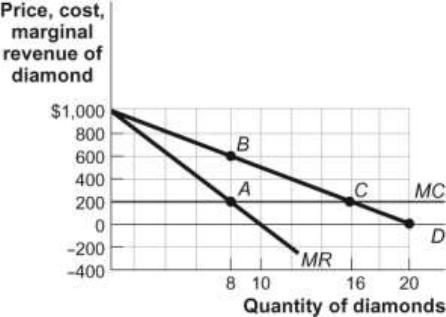
Page 57
242.
(Table: Prices and Demand) Look at the table Prices and Demand. The New Orleans
Saints have a monopoly on Saints logo hats. The marginal cost of producing a hat is
$18. The Saints sell at most one hat to each customer, and the table shows each
customer’s willingness to pay. If the Saints were a perfectly competitive firm in a
perfectly competitive industry, at their profit-maximizing price and output total surplus
would be _____. If the Saints were a profit-maximizing monopoly, at their
profit-maximizing price and output total surplus would be _____.
A)
$0; $0
B)
$27; $36
C)
$36; $27
D)
$18; $27
Use the following to answer questions 243-256:
Figure: The Profit-Maximizing Output and Price
243.
(Figure: The Profit-Maximizing Output and Price) Look at the figure The
Profit-Maximizing Output and Price. Assume there are no fixed costs and AC = MC. At
the profit-maximizing quantity of production for the monopolist, total revenue is _____,
total cost is _____, and profit is _____.
A)
$600; $200; $400
B)
$1,600; $3,200; $1,600
C)
$4,800; $3,200; $1,600
D)
$4,800; $1,600; $3,200
Page 58
244.
(Figure: The Profit-Maximizing Output and Price) Look at the figure The
Profit-Maximizing Output and Price. A perfect competitor would produce at a price of
_____ and output of _____ units.
A)
$600; 8
B)
$200; 8
C)
$200; 16
D)
$600; 16
245.
(Figure: The Profit-Maximizing Output and Price) Look at the figure The
Profit-Maximizing Output and Price. Assume that there are no fixed costs and AC = MC
= $200. The profit-maximizing output for a monopolist is:
A)
0.
B)
8.
C)
16.
D)
20.
246.
(Figure: The Profit-Maximizing Output and Price) Look at the figure The
Profit-Maximizing Output and Price. Assume that there are no fixed costs and AC = MC
= $200. The profit-maximizing price for a monopolist is:
A)
$800.
B)
$200.
C)
$600.
D)
$1,000.
247.
(Figure: The Profit-Maximizing Output and Price) Look at the figure The
Profit-Maximizing Output and Price. Assume that there are no fixed costs and AC = MC
= $200. At the profit-maximizing output and price for a monopolist, consumer surplus
is:
A)
$0.
B)
$600.
C)
$1,000.
D)
$1,600.
248.
(Figure: The Profit-Maximizing Output and Price) Look at the figure The
Profit-Maximizing Output and Price. Assume that there are no fixed costs and AC = MC
= $200. At the profit-maximizing output and price for a monopolist, producer surplus is:
A)
$3,200.
B)
$6,400.
C)
$1,000.
D)
$1,600.
Page 59
249.
(Figure: The Profit-Maximizing Output and Price) Look at the figure The
Profit-Maximizing Output and Price. Assume that there are no fixed costs and AC = MC
= $200. At the profit-maximizing output and price for a monopolist, deadweight loss is:
A)
$3,200.
B)
$6,400.
C)
$1,000.
D)
$1,600.
250.
(Figure: The Profit-Maximizing Output and Price) Look at the figure The
Profit-Maximizing Output and Price. Assume that there are no fixed costs and AC = MC
= $200. At the profit-maximizing output and price for a monopolist, total surplus is:
A)
$3,200.
B)
$4,800
C)
$1,000.
D)
$1,600.
251.
(Figure: The Profit-Maximizing Output and Price) Look at the figure The
Profit-Maximizing Output and Price. Assume that there are no fixed costs and AC = MC
= $200. At the profit-maximizing output and price for a perfectly competitive industry,
profit is:
A)
$0.
B)
$200.
C)
$1,600.
D)
$3,200.
252.
(Figure: The Profit-Maximizing Output and Price) Look at the figure The
Profit-Maximizing Output and Price. Assume that there are no fixed costs and AC = MC
= $200. At the profit-maximizing output and price for competitor perfectly competitive
industry, consumer surplus is:
A)
$0.
B)
$6,400.
C)
$1,600.
D)
$3,200.
Page 60
253.
(Figure: The Profit-Maximizing Output and Price) Look at the figure The
Profit-Maximizing Output and Price. Assume that there are no fixed costs and AC = MC
= $200. At the profit-maximizing output and price for a perfectly competitive industry,
producer surplus is:
A)
$0.
B)
$200.
C)
$1,600.
D)
$3,200.
254.
(Figure: The Profit-Maximizing Output and Price) Look at the figure The
Profit-Maximizing Output and Price. Assume that there are no fixed costs and AC = MC
= $200. At the profit-maximizing output and price for a perfectly competitive industry,
deadweight loss is:
A)
$0.
B)
$200.
C)
$1,600.
D)
$3,200.
255.
(Figure: The Profit-Maximizing Output and Price) Look at the figure The
Profit-Maximizing Output and Price. Assume that there are no fixed costs and AC = MC
= $200. At the profit-maximizing output and price for a perfectly competitive industry,
total surplus is:
A)
$200.
B)
$1,600.
C)
$3,200.
D)
$6,400.
256.
(Figure: The Profit-Maximizing Output and Price) Look at the figure The
Profit-Maximizing Output and Price. Assume that there are no fixed costs and AC = MC
= $200. The monopolist who can use price discrimination perfectly will produce an
output of _____ diamonds.
A)
0
B)
6
C)
16
D)
20
257.
Of the four market structures, the only one that is characterized by product
differentiation is oligopoly.
A)
True
B)
False
Page 61
258.
A producer is a monopoly if it is the sole supplier of a good that has no close substitutes.
A)
True
B)
False
259.
A monopoly increases price by limiting the quantity supplied to a market.
A)
True
B)
False
260.
To maintain profits in the long run, a monopoly must be protected by barriers to the
entry of other firms into the industry.
A)
True
B)
False
261.
A monopoly may continue to make economic profits in the long run because of the
barriers to entry.
A)
True
B)
False
262.
The government can reduce the inefficiency associated with a monopoly through a
system of patents and copyrights.
A)
True
B)
False
263.
A natural monopoly has small fixed costs, which allows it to produce at lower cost than
potential competitors.
A)
True
B)
False
264.
Suppose a monopolist reduces its price in an effort to expand output. If the price effect
equals the quantity effect, then the marginal revenue will be zero.
A)
True
B)
False
265.
The marginal revenue curve for a monopolist is always less than the price because of the
price effect.
A)
True
B)
False
Page 62
266.
If a firm has market power, the marginal revenue curve always lies below the demand
curve.
A)
True
B)
False
267.
A monopoly can choose the price or it can choose the quantity, but it cannot choose
price and quantity independent of each other.
A)
True
B)
False
268.
A monopoly’s short-run supply curve is upward-sloping because of diminishing
marginal returns.
A)
True
B)
False
269.
A monopoly’s short-run supply curve is its marginal cost curve above the minimum
average variable cost.
A)
True
B)
False
270.
A monopoly’s short-run marginal cost is constant at $10. This implies that its average
variable cost is also constant and equal to $10.
A)
True
B)
False
271.
A profit-maximizing monopoly will never set price in the inelastic region of the demand
curve.
A)
True
B)
False
272.
Monopoly is inefficient because some consumer surplus is transferred to producer
surplus.
A)
True
B)
False
273.
Compared to perfect competition, monopoly produces a net welfare gain for society.
A)
True
B)
False
Page 63
274.
Consumer surplus in monopoly is smaller than in perfect competition.
A)
True
B)
False
275.
Producer surplus in monopoly is smaller than in perfect competition.
A)
True
B)
False
276.
Deadweight loss in monopoly is smaller than in perfect competition.
A)
True
B)
False
277.
When regulating a natural monopoly, the government always sets a price ceiling where
marginal cost intersects the demand curve.
A)
True
B)
False
278.
When a natural monopoly is regulated to charge a price equal to average total cost,
consumer surplus increases, but total surplus decreases.
A)
True
B)
False
279.
When a natural monopoly is regulated to charge a price equal to average total cost,
producer surplus decreases, but total surplus increases.
A)
True
B)
False
280.
A natural monopoly has increasing returns to scale, so that a large producer has a
relatively low average total cost.
A)
True
B)
False
281.
Usually when a monopoly that isn’t a natural monopoly is broken up, the losses to the
producer outweigh the gains to consumers.
A)
True
B)
False
Page 64
282.
The advantage of public ownership of a monopoly is that prices can be based on
efficiency rather than profit maximization.
A)
True
B)
False
283.
A disadvantage of public ownership of a monopoly is that publicly owned firms have
relatively little incentive to keep costs low or offer high-quality products.
A)
True
B)
False
284.
A monopolist that charges each customer a different price based on the customer’s
individual willingness to pay is called a single-price monopolist.
A)
True
B)
False
285.
Monopolists are engaging in price discrimination when they charge all customers the
same price.
A)
True
B)
False
286.
Price discrimination can never occur in perfect competition.
A)
True
B)
False
287.
Price discrimination may occur in monopoly.
A)
True
B)
False
288.
Price discrimination can never occur in oligopoly.
A)
True
B)
False
289.
Although price discrimination never occurs in perfect competition, it may occur in
monopolistic competition.
A)
True
B)
False
Page 65
290.
To practice price discrimination, the producer must have some control over the price of
the product.
A)
True
B)
False
291.
A monopolist who practices price discrimination can increase sales but can never
increase profits above the level that would pertain if the single price was set so that
marginal revenue and marginal cost are equal.
A)
True
B)
False
292.
For a monopolist to practice price discrimination successfully, its customers must all
have the same willingness to pay for the good.
A)
True
B)
False
293.
To increase profits with price discrimination, different groups of an oligopolist’s
customers must respond differently to prices of the good.
A)
True
B)
False
294.
When a monopolist practices price discrimination, consumer surplus will be higher than
the consumer surplus in a single-price monopoly.
A)
True
B)
False
295.
When a monopolist practices price discrimination, producer surplus will be higher than
in a single-price monopoly.
A)
True
B)
False
296.
When a monopolist practices price discrimination, the monopolist’s profits will be lower
than in a single-price monopoly.
A)
True
B)
False
Page 66
297.
When a monopolist practices price discrimination as opposed to setting a single price,
the monopolist increases its profits by capturing consumer surplus.
A)
True
B)
False
298.
When a monopolist practices price discrimination as opposed to setting a single price,
the monopolist increases its profits by decreasing producer surplus.
A)
True
B)
False
299.
When a monopolist practices price discrimination as opposed to setting a single price,
deadweight loss decreases.
A)
True
B)
False
300.
When a monopolist practices price discrimination as opposed to setting a single price,
efficiency decreases.
A)
True
B)
False
301.
When a monopolist practices price discrimination as opposed to setting a single price,
the monopolist sells less but increases profits.
A)
True
B)
False
302.
When a monopolist practices price discrimination as opposed to setting a single price,
the monopolist sells more and increases profits.
A)
True
B)
False
303.
An oligopoly that engages in price discrimination will charge higher prices to customers
with the most elastic demand.
A)
True
B)
False
Page 67
304.
An oligopoly that engages in price discrimination will charge higher prices to customers
with the most inelastic demand.
A)
True
B)
False
305.
Children’s price elasticity of demand for hot chocolate is 0.5. Adults’ price elasticity of
demand for hot chocolate is 1.5. If the concession stand selling the hot chocolate wants
to practice price discrimination, it should charge higher prices to adults.
A)
True
B)
False
306.
Children’s price elasticity of demand for hot chocolate is 0.5. Adults’ price elasticity of
demand for hot chocolate is 1.5. If the concession stand selling the hot chocolate wants
to practice price discrimination, it should charge higher prices to adults.
A)
True
B)
False
307.
A monopolist who engages in perfect price discrimination charges each consumer a
price equal to the consumer’s willingness to pay.
A)
True
B)
False
308.
In perfect price discrimination, consumer surplus is larger than in a single-price
monopoly.
A)
True
B)
False
309.
Consumer surplus is higher under a single-price monopoly than under a perfectly
price-discriminating monopoly.
A)
True
B)
False
310.
If the local phone company, a monopolist, perfectly price-discriminated, it would have
lower total surplus than a monopolist that doesn’t use price discrimination.
A)
True
B)
False
Page 68
311.
If a monopoly can engage in perfect price discrimination, then its marginal revenue is
equal to price, in contrast to the usual situation for a monopoly, in which price is higher
than marginal revenue.
A)
True
B)
False
312.
What are the fundamental differences between the perfect competition and monopoly
market structures?
313.
What makes a natural monopoly a distinct form of monopoly? Use an example of a
natural monopoly in your explanation.
314.
Years ago, Callaway Golf patented its signature Big Bertha line of drivers. Today the
company spends a lot of money prosecuting individuals that try to sell knock-off Big
Bertha drivers to the public. What is the purpose of the patent, and why do companies
like Callaway Golf fight those that try to imitate their products?
315.
Why is the demand curve for a monopolist downward-sloping, while the demand curve
for the perfectly competitive firm is horizontal?
316.
Explain why the marginal revenue curve lies below the monopolist’s demand curve.
317.
It is often said that the monopolist will never set the price in the inelastic range of the
demand curve. Why?
318.
Suppose a perfectly competitive industry is suddenly transformed to a monopoly
industry. What will happen to price, output, consumer and producer surplus, and
deadweight loss?
319.
Suppose the government is considering how to regulate a monopolist. An economist
argues that the price should be regulated to maximize total welfare. The monopolist
argues that the price should be regulated so that it can just cover all of its opportunity
costs. Are they basically arguing the same point? How do they differ?
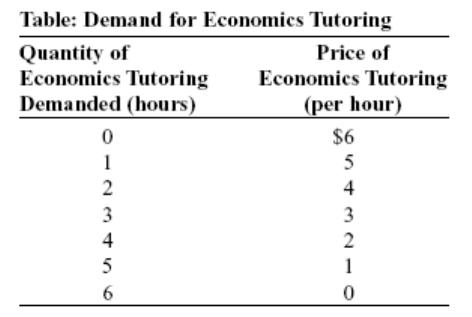
Page 69
Use the following to answer questions 320-321:
320.
(Table: Demand for Economics Tutoring) Look at the table Demand for Economics
Tutoring. Suppose Eric is the only economics tutor in town and therefore holds a
monopoly. Eric can offer additional hours of tutoring at a constant marginal cost of $2
per hour, and he has no fixed costs.
A) If Eric acts as a monopolist, how many hours will he offer and what price will he
charge?
B) Calculate Eric’s monopoly profit.
321.
(Table: Demand for Economics Tutoring) Look at the table Demand for Economics
Tutoring. Suppose Eric is the only economics tutor in town. Eric can offer additional
hours of tutoring at a constant marginal cost of $2 per hour, and he has no fixed costs.
Suppose Eric can perfectly price-discriminate by charging his customers exactly their
willingness to pay. How many hours will he offer, and how much profit will he earn by
price-discriminating?
322.
An oligopoly is characterized as an industry in which:
A)
there are few firms, each producing a differentiated or similar product.
B)
there are many firms, each producing a similar product.
C)
all market participants are price takers.
D)
only one firm produces a very differentiated product.
323.
A monopolistically competitive industry is made up of:
A)
a few firms, each producing a very differentiated good.
B)
one firm that produces a standardized good.
C)
market participants who are all price takers.
D)
many firms producing a differentiated product.
Page 70
324.
Entry barriers:
A)
exist in all market structures.
B)
exist in perfect competition and monopolistically competitive markets.
C)
do not exist in any market structures; otherwise nothing would be produced.
D)
exist in monopoly and oligopoly markets.
325.
Control of a scarce resource or input, economies of scale, technological superiority, and
government-set rules and regulations are forms of:
A)
market structure.
B)
pricing behavior.
C)
barriers to entry.
D)
public policy.
326.
When a firm finds that its ATC of production decreases as it increases production, this
firm is said to be experiencing:
A)
profit maximization.
B)
economic profit.
C)
economies of scale.
D)
a barrier to entry.
327.
If large fixed costs result in ATC falling as output increases and this occurs over the
relevant range of output, this industry is a:
A)
constant-cost industry.
B)
natural monopoly.
C)
network externality.
D)
profit maximizer.
328.
A natural monopoly exists when:
A)
a few firms collude to make one large firm.
B)
economies of scale provide large cost advantages to having one firm produce the
industry’s output.
C)
firms naturally maximize profit regardless of market structure.
D)
firms enter the industry as a result of profit incentives.
329.
Goods that are subject to network externalities tend to be ones:
A)
for which the value of the good to an individual is lower when more people use it.
B)
that are land-intensive.
C)
for which the value of the good to an individual is higher when more people use it.
D)
for which one person owning the good enhances its value because it’s the only one.
Page 71
330.
Temporary monopolies via the provision of sole ownership rights to profit from the
production, use, or sale of a good are provided by:
A)
patents and copyrights.
B)
natural monopolies.
C)
profit-maximizing behavior.
D)
network externalities.
331.
For a monopolist, the market demand curve:
A)
is also the demand for the monopolist’s product.
B)
is equal to the monopolist’s MR curve.
C)
must be horizontal.
D)
is not important, since the monopolist is the only producer.
332.
For a monopolist with a downward-sloping demand curve, the quantity effect dominates
the price effect at:
A)
low levels of production.
B)
all levels of production.
C)
high levels of production.
D)
levels at which elasticity is unit-elastic.
333.
At the profit-maximizing level of production, a perfectly competitive industry will
produce an _____ level of production, and a monopolist produces an _____ level of
production.
A)
efficient; efficient
B)
inefficient; efficient
C)
inefficient; inefficient
D)
efficient; inefficient
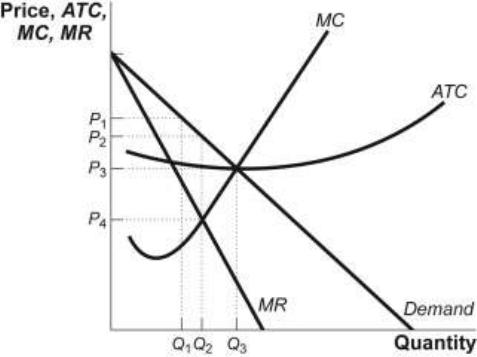
Page 72
Use the following to answer questions 334-336:
Figure: The Monopolist
334.
(Figure: The Monopolist) Look at the figure The Monopolist. If this monopolist
attempts to profit-maximize, it will produce _____ units and sell them at _____.
A)
Q1; P1
B)
Q2; P4
C)
Q2; P2
D)
Q3; P3
335.
(Figure: The Monopolist) Look at the figure The Monopolist. At the profit-maximizing
level, this monopolist will:
A)
incur a loss equal to the area (P1 – P4) Q1.
B)
earn a profit equal to the area (P2 – P4) Q2.
C)
earn a profit equal to the area (P2 – P3) Q2.
D)
break even.
336.
(Figure: The Monopolist) Look at the figure The Monopolist. If this monopolist were
forced to act like a perfect competitor, it would produce _____ units and sell at _____.
A)
Q1; P1
B)
Q2; P2
C)
Q3; P3
D)
Q2; P4
Page 73
Use the following to answer questions 337-340:
Scenario: Monopolist
The demand curve for a monopolist is P = 75 – 0.5Q, and the monopolist has the following MC
expressed as P = 2Q. Assume also that ATC at the profit-maximizing level of production is equal
to $12.50.
337.
(Scenario: Monopolist) Look at the scenario Monopolist. The MR curve is:
A)
P = 150 – 0.5Q.
B)
P = 75 – Q.
C)
P = 150 – Q.
D)
P = 225 – Q.
338.
(Scenario: Monopolist) Look at the scenario Monopolist. The profit-maximizing output
is _____ units and the profit-maximizing price is _____.
A)
25; $75.00
B)
20; $62.50
C)
25; $75.50
D)
25; $62.50
339.
(Scenario: Monopolist) Look at the scenario Monopolist. The total profit–maximizing
level of profit per unit is:
A)
$62.50.
B)
$0.00
C)
$75.00.
D)
$50.00.
340.
(Scenario: Monopolist) Look at the scenario Monopolist. The deadweight loss from this
monopolist’s production is:
A)
$31.25.
B)
$12.50.
C)
$0.00
D)
$30.00.
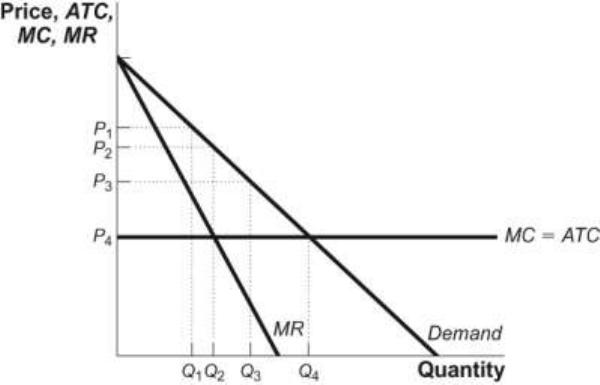
Page 74
341.
If a monopolist knows its price elasticity of demand is greater than one, then a(n) _____
in price will _____ total revenue.
A)
increase; increase
B)
decrease; increase
C)
decrease; decrease
D)
increase; not change
342.
A monopolist with a linear demand curve will:
A)
not produce in the inelastic portion of its demand curve.
B)
produce regardless of elasticity, since it is a monopolist.
C)
not produce in the elastic portion of its demand curve.
D)
produce only at the unit price-elastic portion of its demand curve.
343.
If a monopoly market structure is transformed to a perfectly competitive one, price will
_____ and output will _____.
A)
fall; fall
B)
fall; increase
C)
increase; increase
D)
increase; fall
Use the following to answer question 344:
Figure: The Monopolist II
Page 75
344.
(Figure: The Monopolist II) Look at the figure The Monopolist II. The deadweight loss
associated with this monopoly can be measured as the area:
A)
0.5(P1 – P2)(Q2 – Q1).
B)
0.5 (P2 – P4)(Q4 – Q2).
C)
0.5 (P1 – P3)Q3.
D)
0.5 (P1 – P3)Q2.
345.
A firm that is a natural monopoly will:
A)
attempt to break even, not profit-maximize.
B)
maximize profit by producing where MR = MC.
C)
face increasing costs of production.
D)
face greater market instability than a regular monopoly.
346.
A natural monopolist that is price-regulated at the marginal cost output level will:
A)
produce the optimal level of output and earn a normal profit.
B)
eventually incur losses if MC is less than ATC.
C)
be producing at the same output and price that an unregulated natural monopolist
would choose.
D)
produce the optimal level of output and earn an economic profit greater than zero.
347.
When firms price-discriminate, people with _____ price elasticity of demand will pay
_____ prices relative to those purchasing the same product who have a _____ price
elasticity of demand.
A)
higher; higher; lower
B)
lower; lower; higher
C)
lower; higher; higher
D)
higher; the same; lower
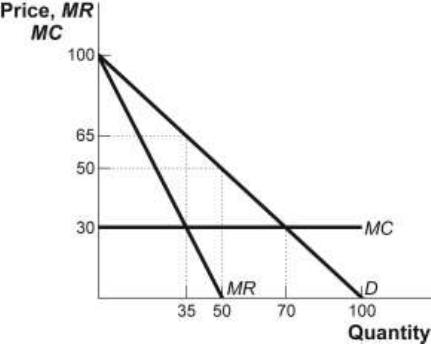
Page 76
Use the following to answer question 348:
Figure: The Monopolist III
348.
(Figure: The Monopolist III) Look at the figure The Monopolist III. If this monopolist
perfectly price-discriminates, then it will produce _____ units. This will lead to
producer surplus equal to _____, consumer surplus equal to _____, and a deadweight
loss equal to _____.
A)
70; $2,450; $0; $0
B)
50; $1,225; $0; $0
C)
35; $1,225; $612.50; $612.50
D)
100; $1,500; $612.50; $612.50
Use the following to answer questions 349-351:
Scenario: A Small-Town Monopolist
A monopolist sells cable subscriptions in a small town and finds that it can sell 100 subscriptions
when the price is $15 a week and an additional 75 subscriptions when the price is $10 a week.
The MC for the provision of the cable is $5 a week. There are no fixed costs.
349.
(Scenario: A Small-Town Monopolist) Look at the scenario A Small-Town Monopolist.
If this monopolist chooses to sell subscriptions at one price, it will sell _____ units at a
price of _____ and earn economic profits equal to _____.
A)
75; $10; $500
B)
100; $15; $1,000
C)
175; $15; $1,000
D)
100; $10; $750
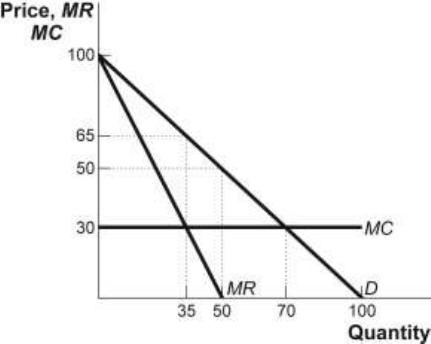
Page 77
350.
(Scenario: A Small-Town Monopolist) Look at the scenario A Small-Town Monopolist.
If the company is allowed to offer different prices for its good, what is the maximum
amount of profit this company can earn?
A)
$1,000
B)
$750
C)
$1,375
D)
$1,520
351.
(Scenario: A Small-Town Monopolist) Look at the scenario A Small-Town Monopolist.
Compared to charging a single price, the deadweight loss:
A)
increases when this monopolist price-discriminates.
B)
decreases when this monopolist price-discriminates.
C)
stays the same when this monopolist price-discriminates.
D)
is equal to zero.
Use the following to answer question 352:
Figure: The Monopolist III
352.
(Figure: The Monopolist III) Look at the figure The Monopolist III. If this monopolist
profit-maximizes, it will produce _____ units and charge a price equal to _____. Its
producer surplus will be _____, its consumer surplus will be _____, and the deadweight
loss is _____.
A)
50; $30; $1,200; $600; $100
B)
35; $65; $1,225; $612.50; $612.50
C)
100; $65; $1,500; $615.50; $1,000
D)
70; $35; $1,225; $615.50; $615.50
Page 79
Page 80
Page 81
Page 82
Page 83
Page 84
Page 85
Page 86