53) Public housing is
A) a conversion of low-income housing to middle-class housing.
B) illegally established low-income housing.
C) housing that has changed from single-family owner occupancy to abandonment.
D) low-income government-owned housing.
E) buildings housing public services, such as government agencies.
54) Gentrification
A) is the process by which lower-class people move into deteriorated middle-income
neighborhoods and subdivide the housing.
B) allows lower income families to remain in their homes through public subsidies.
C) is the process by which upper-class people move into deteriorated middle-income
neighborhoods and subdivide the housing so that lower-income people can move in.
D) is the process by which middle-class people move into deteriorated inner-city neighborhoods
and renovate the housing.
E) has almost no influence on housing prices and taxes.
55) A process of converting a neighborhood from low-income to middle-class or upper-class is
A) blockbusting.
B) filtering.
C) gentrification.
D) redlining.
E) zoning.
56) Megalopolis refers to
A) adjacent, overlapping Metropolitan Statistical Areas.
B) central cities.
C) consolidated Metropolitan Statistical Areas and their CBDs.
D) central cities plus urbanized areas.
E) regional government federation.
57) Under certain conditions, according to U.S. law when a family is forced by a city to relocate,
A) old houses are renovated for them, and the government must help them find new jobs.
B) moving expenses and rent increases are paid by the government for up to four years.
C) new public housing is built for them in a neighborhood of their choosing.
D) middle-class families are attracted to the inner-city by government policies for four years.
E) public transportation is provided for up to four years unless they have wealthy relatives.
58) The underclass is characterized in part by high rates of
A) drug addiction and illiteracy.
B) employment and illiteracy.
C) fire protection and police protection.
D) literacy and education.
E) social mobility and government services.
59) In U.S. cities, the underclass is largely
A) clustered in inner-city neighborhoods.
B) dispersed throughout the city.
C) clustered in suburbs.
D) distributed even between the suburbs and the city.
E) distributed across the commuter zone.
60) Compared to whites, African Americans in U.S. cities are more likely to be
A) clustered in inner-city neighborhoods.
B) dispersed throughout the city.
C) clustered in suburbs.
D) distributed uniformly in the city.
E) distributed across the commuters zone.
61) The U.S. government estimated in 2011 that the number of homeless people on any given
night was about
A) 636,000.
B) 836,000.
C) 216,000.
D) 10,116,000.
E) 2,436,000.
62) Most people are homeless because they
A) cannot afford housing and lack a regular source of income, perhaps because of job loss,
mental illness, or family problems.
B) cannot afford medicine and lack a middle-class source of income, usually because of mental
illness, pregnancy, and family problems.
C) fail to achieve the level of “survival of the fittest” as prescribed by social Darwinism.
D) cannot afford a college education, which is required in order to obtain and maintain a steady
job in the United States.
E) are lazy or lack the kind of work ethic that wealthy people have.
63) About ________ of the homeless people in the United States are single men, and the
remainder are women and children.
A) two-fifths
B) nine-tenths
C) one-tenth
D) three-fourths
E) half
64) U.S. inner cities face fiscal problems because
A) federal and state funds are available.
B) low-income people are concentrated there.
C) middle-class families are attracted there.
D) redlining is no longer legal.
E) blockbusting has strengthened ethnic neighborhoods.
65) Because so few people live in the CBD, urban areas are characterized by a high degree of
A) blockbusting.
B) commuting.
C) threshold.
D) skyscrapers.
E) restrictive zoning.
66) The process of legally adding land area to a city in the United States is
A) annexation.
B) accreditation.
C) an application of eminent domain.
D) defined by urbanized area.
E) zoning.
67) The attractions of shopping malls include all but which of the following?
A) frequent concerts and exhibitions
B) generous parking lots
C) place to meet friends
D) sheltered environments
E) walking distance from homes
68) In the early 1900s most people in the world lived in rural communities.
69) A central city and its contiguous built-up suburbs is called a metropolitan statistical area.
70) The basic building block for MSAs is the county, because of the ease of obtaining data.
71) Relatively wealthy individuals live in the center of most cities in the world outside of North
America.
72) Cities in less developed countries have eliminated most signs of European colonial rule.
73) One should be careful when attempting to apply the three models of urban structure outside
of the United States because those in other countries may have different reasons for selecting
neighborhoods.
74) The density gradient in American and European cities is becoming flatter.
75) Suburban sprawl has resulted in the loss of most of the prime agricultural land in the United
States.
76) The supply of land for new housing is more severely restricted outside European cities than
U.S. cities.
77) Most urban residents in the United States live in central cities rather than suburbs.
78) In general, higher status families in the United States are more likely to live farther away
from a city center while lower status people tend to live closer to the city center.
79) The future health of urban areas depends on relieving traffic congestion by increasing road
capacity and increasing the demand for people to visit, work, and live in urban areas.
80) While public transportation ridership has declined in the United States, a number of cities
have invested in new public transportation systems.
81) Land is more intensively used in the center of the city than elsewhere.
82) Public housing comprises a large percentage of housing in Britain but only a small
percentage in the United States.
83) Public housing accounts for approximately 30% of all dwellings in the United States,
whereas in the United Kingdom it is as high as 11%.
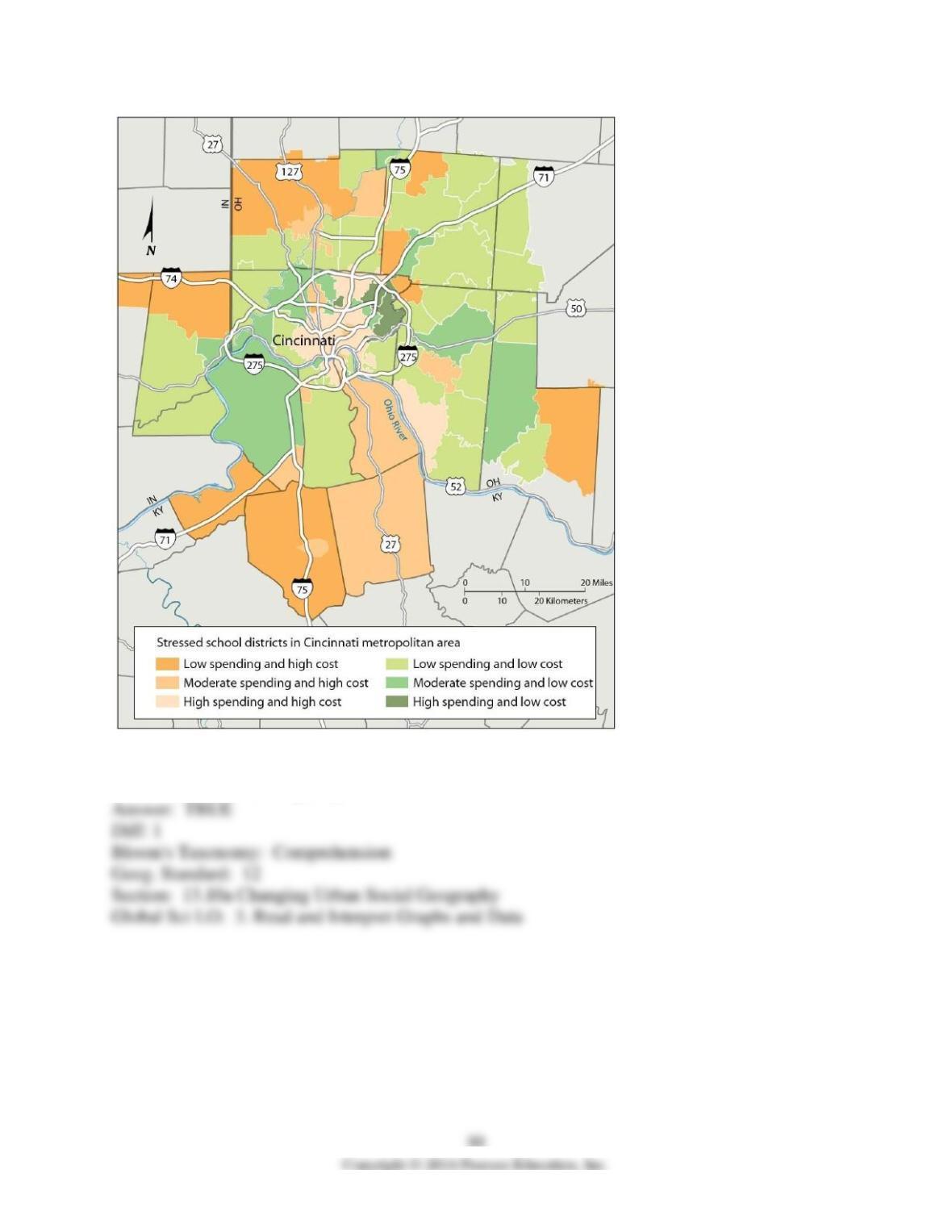
84) According to this map, Cincinnati-area school districts experience stress largely as a result of
economic and social inequality, as well as urban transition.
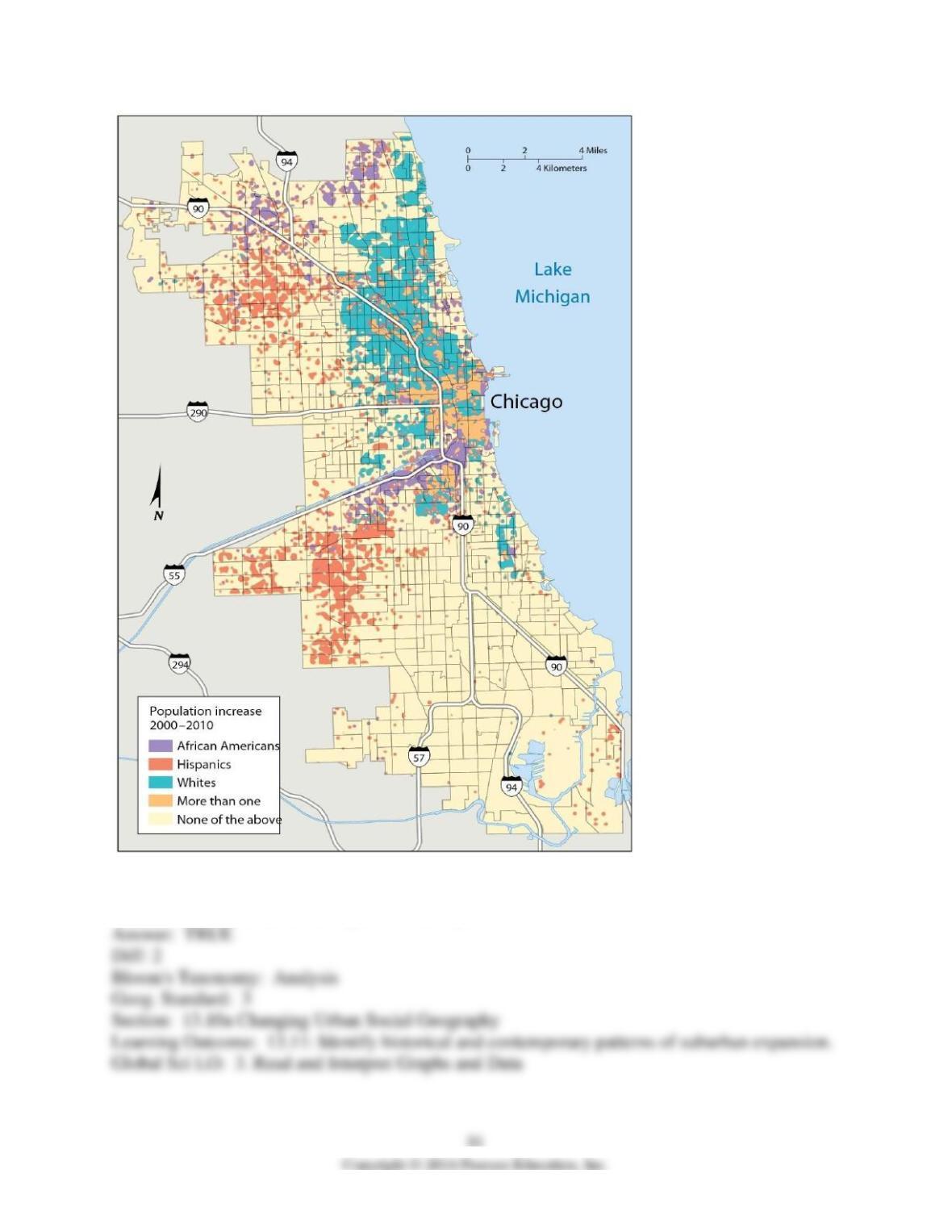
85) This map of Chicago indicates that large concentrations of Hispanics reside in the
northwestern and southwestern parts of the city.
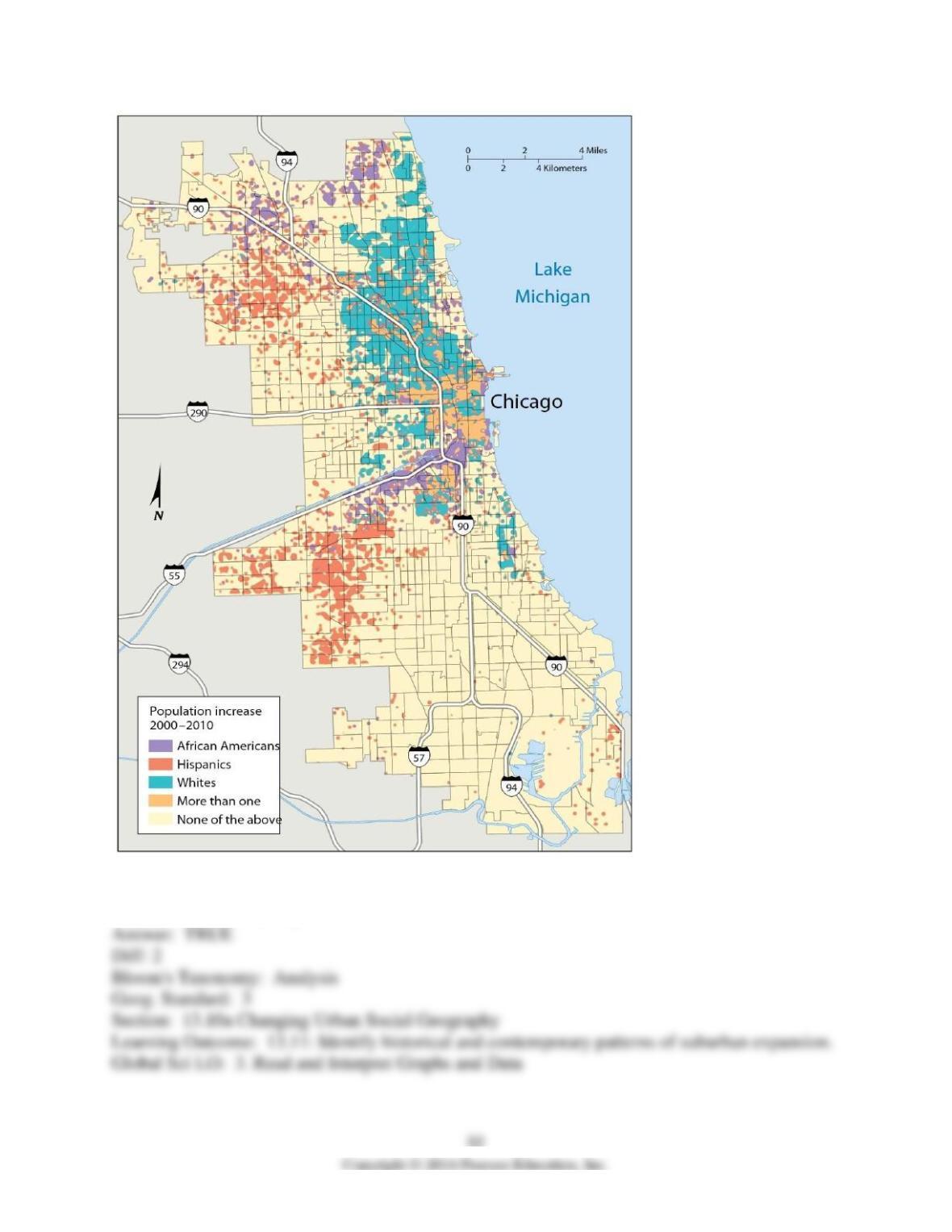
86) This map of Chicago indicates that the African American population has increased in some
neighborhoods of the city.