Chapter 13: Financial Statement Analysis
204. The Stockholders’ Equity section of the balance sheet for Calhoun Industries at the end of 2016 is as follows:
12.5%, $10 par, cumulative preferred stock, 500,000 shares authorized, 200,000 shares issued
and outstanding
$2,000,000
Additional paid-in capital on preferred
7,500,000
Common stock, $1 par, 2,500,000 shares authorized, 2,000,000 shares issued and outstanding
2,000,000
Additional paid-in capital on common
21,000,000
Retained earnings
25,500,000
Total stockholders’ equity
$58,000,000
The lower portion of the 2016 income statement indicates the following:
Net income before tax
$12,500,000
Income tax expense (30%)
(3,750,000)
Income before extraordinary items
$8,750,000
Extraordinary loss from tornado
$(5,000,000)
Less related tax effect (30%)
1,500,000
(3,500,000)
Net income
$5,250,000
Assume that the number of shares outstanding did not change during the year.
REQUIRED:
1. Compute earnings per share before extraordinary items.
2. Compute earnings per share after the extraordinary loss.
3. Which of the two EPS ratios is more useful to management? Explain your answer. Would your answer be
different if the ratios were to be used by an outsider, like a potential stockholder? Why or why not?
Chapter 13: Financial Statement Analysis
205. Some ratios are more useful for management, whereas others are better suited to the needs of outsiders, such as
stockholders and bankers. What is an example of a ratio that is primarily suited to management use and why? What
ratio is more suited to use by outsiders and why?
206. Your supervisor asks you to compare the company’s results for the year, as measured by various ratios, with one of
the published surveys that arranges information by industry classification. What difficulties might you encounter when
making comparisons using industry standards?
207. For what purpose is horizontal analysis used by management? Is this information provided to stockholders? If so, in
what form? If not, why?
208. The Starch Company experiences a 20% increase in sales over the previous year. However, gross profit actually
decreased by 10% from the previous year. What are some of the possible causes for an increase in sales but a
decline in gross profit?
209. Why is liquidity important for businesses?
Chapter 13: Financial Statement Analysis
210. What situations could cause a decrease in the current ratio, but an increase in the acid-test ratio? If this happens, is
management to be commended or is a problem evident? Explain
211. What is meant by the concept of “activity” as it relates to turnover ratios? Explain.
212. What makes the analysis of a service company different from the analysis of a merchandising company?
213. Service-oriented companies have different needs than product-oriented companies when analyzing financial
statements.
REQUIRED: Why is this true? Give an example of a financial ratio that is meaningless to a service business.
214. Would a banker be more interested in the liquidity or the profitability of a company? Explain.
215. What is meant by a company’s “long-term financial health“? Which side of the balance sheet is more informative for
this issue? Explain.
216. What is the best way to assess solvency? Explain.
Chapter 13: Financial Statement Analysis
217. Ware Company has a return on assets of 15% and a return on common stockholders’ equity of 10%. John Ware,
the president of the company, has asked you to explain the reason for this difference. What causes the difference?
How is the concept of financial leverage involved?
218. What importance is placed on a company‘s stock price in the ratio analysis of a company? Explain.
219. What do profitability ratios measure? Explain.
220. Ranier Parts Company has a return on assets of 12% and a return on common stockholders‘ equity of 15%. What
causes the difference in the two returns?
221. Discuss the common reporting characteristics of discontinued operations and extraordinary items in the financial
statements.

Chapter 13: Financial Statement Analysis
Select the term below most properly satisfies each statement.
a. Total assets
b. Horizontal analysis
c. Vertical analysis
d. Net sales
222. A comparison of financial statement items within a single period
223. A comparison of financial statement items over a period of time
224. When using vertical analysis, accounts on the balance sheet should be stated as a percentage of this amount
225. When using vertical analysis, accounts on the income statement should be stated as a percentage of this amount
For each of the following sentences, select the phrase or group of words that best completes the statement.
a. Earnings per share
b. Dividend yield ratio
c. Dividend payout ratio
d. Leverage
e. Return on assets ratio
f. Return on common stockholders’ equity ratio
g. Debt-to-equity ratio
h. Price/earnings ratio
226. The percentage of earnings paid out as dividends.
227. A measure of a company‘s success in earning a return for all providers of capital.
228. The relationship between dividends and the market price of a company’s stock.

Chapter 13: Financial Statement Analysis
229. The measure of a company’s success in earning a return for the common stockholders.
230. A company‘s bottom line stated on a per-share basis.
Indicate the type of each ratio listed below.
a. Liquidity ratio
b. Solvency ratio
c. Profitability ratio
231. Current ratio
232. Debt-to–equity ratio
233. Earnings per share
234. Gross profit ratio
235. Dividend payout ratio
236. Inventory turnover ratio
237. Times interest earned ratio
238. Return on assets ratio
239. Profit margin ratio

Chapter 13: Financial Statement Analysis
240. Price/earnings ratio
For each ratio listed, select whether an increase or decrease in the ratio is generally considered to be
better.
a. increase
b. decrease
241. Current ratio
242. Dividend yield ratio
243. Asset turnover ratio
244. Number of days’ sales in receivables
245. Times interest earned ratio
Select the ratio that each statement below most properly satisfies.
a. Dividend yield ratio
b. Cash flow from operations to capital expenditures ratio
c. Debt service coverage ratio
d. Return on common stockholders’ equity ratio
e. Times interest earned ratio
f. Asset turnover ratio
g. Debt-to-equity ratio
h. Dividend payout ratio
i. Price/earnings ratio
246. A measure of a company‘s success in earning a return for the common stockholders
247. The relationship between net sales and total assets

Chapter 13: Financial Statement Analysis
248. The relationship between dividends and the market price of a company’s stock
249. An income statement measure of the ability of a company to make its interest payments
250. A measure of the ability of a company to finance long-term asset acquisitions from cash from operations
251. The selection of a particular inventory valuation method has a significant effect on certain key ratios.
a. True
b. False
252. Various organizations publish summaries of selected ratios organized by industry for a sample of U.S. companies.
a. True
b. False
253. The definition of a conglomerate is a company that operates in one industry and uses different inventory valuation
techniques.
a. True
b. False
254. Since inflation is an important consideration in analyzing financial statements, the FASB requires the submission of
all financial statements in an inflation-adjusted format to the SEC.
a. True
b. False
255. Kingston Company’s accounts receivable turned over nine times during the year. This translates into strict
adherence of the company’s net/30 credit terms by Kingston‘s customers.
a. True
b. False
Chapter 13: Financial Statement Analysis
256. Use the current asset section of the balance sheets of the Breeze Company as of June 30, 2016 and 2015
presented below to prepare a horizontal analysis.
2016
2015
Cash and cash equivalents
$ 16,000
$ 20,000
Accounts receivable, net
40,000
30,000
Inventory
30,000
50,000
Prepaid Rent
18,000
12,000
Total current assets
$ 104,000
$ 112,000
Land
$150,000
$150,000
Plant and equipment
800,000
600,000
Accumulated Depreciation
(130,000)
(60,000)
Total long-term assets
$820,000
$690,000
Total assets
$924,000
$802,000
REQUIRED:
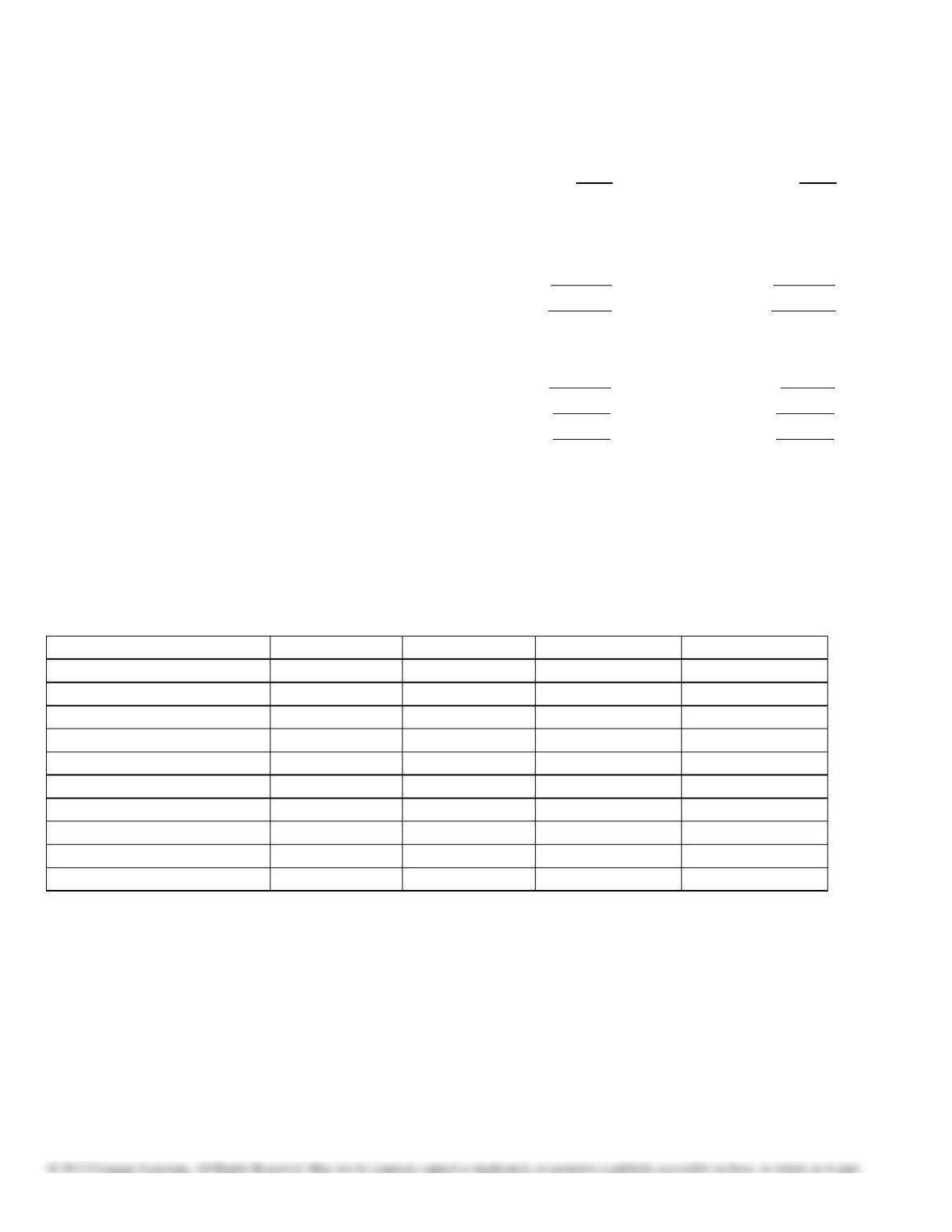
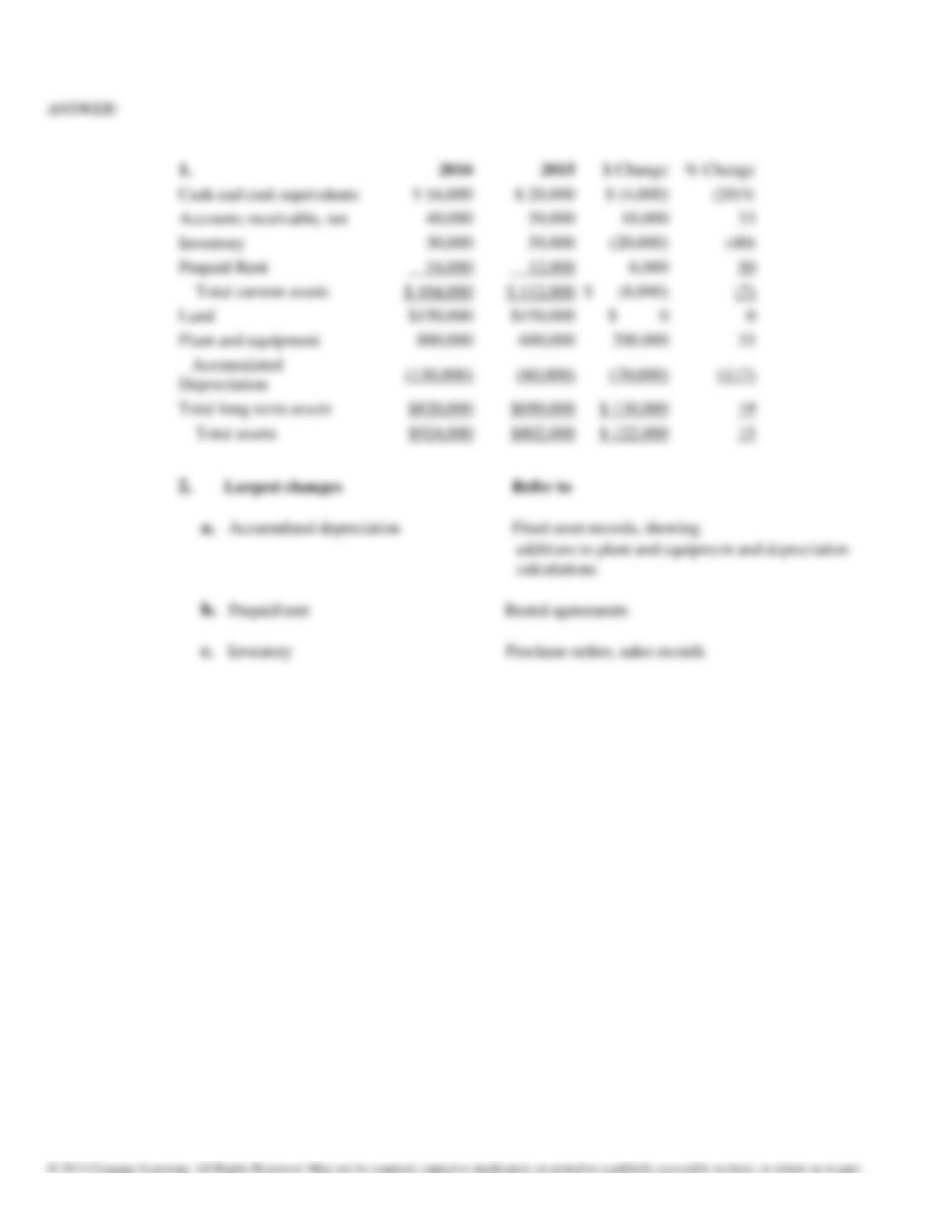
1. In the spaces provided below, complete a horizontal analysis of the current asset section of Breeze Company’s
balance sheets for 2016 and 2015. Your answers should be rounded to the nearest percentage. Show decreases in
parentheses.
2. Identify the three items in the current asset section that experienced the largest change from one year to the
next. For each of these items, explain where you would look to find additional information about the change.
2016
2015
$ Change
% Change
Chapter 13: Financial Statement Analysis
Chapter 13: Financial Statement Analysis
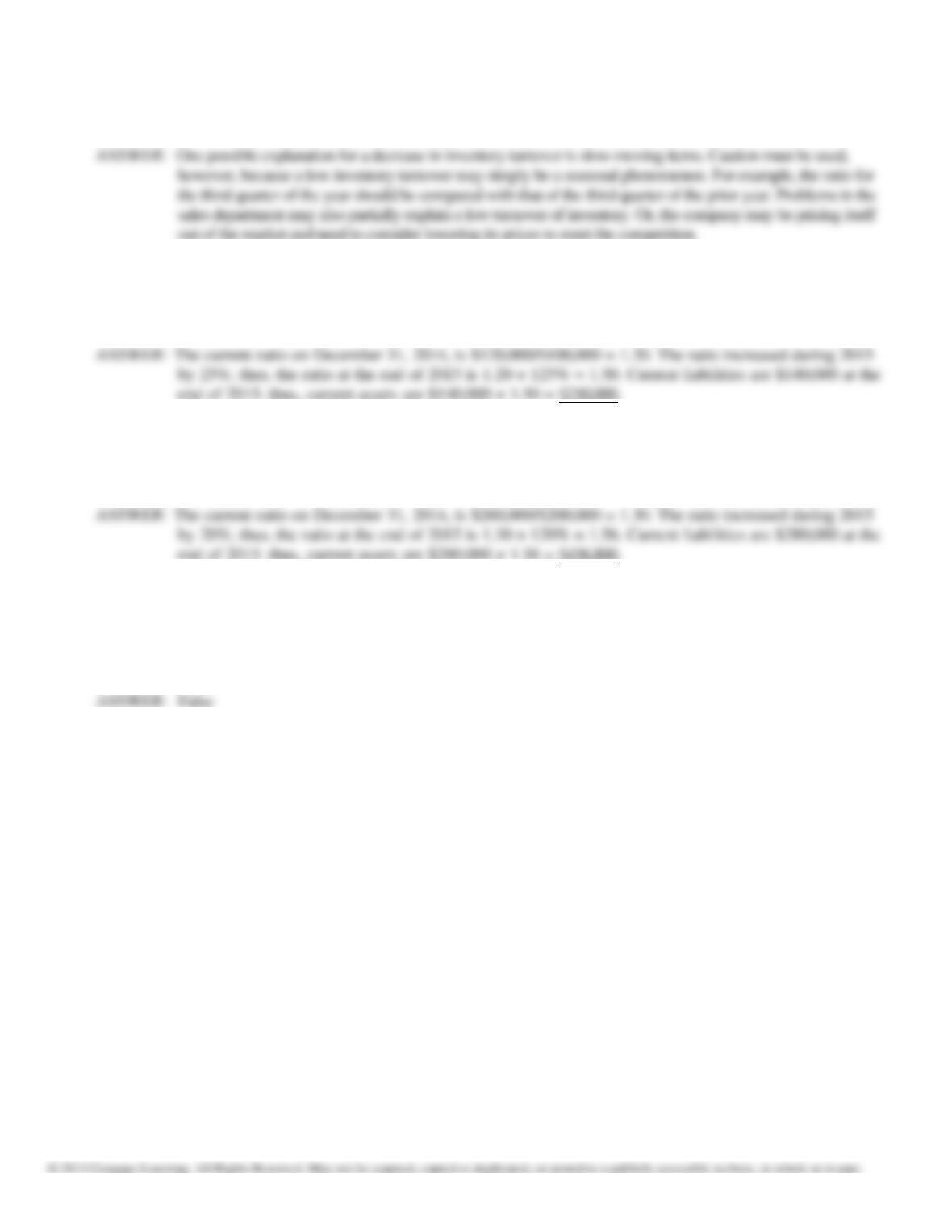
257. What would be at least three reasons for a decrease in inventory turnover? Explain.
258. Lockhart Corp.’s December 31, 2014, balance sheet reported current assets of $120,000 and current liabilities of
$100,000. The current ratio increased by 25% one year later, on December 31, 2015. Current liabilities on this date
were $140,000. Determine current assets on December 31, 2015.
259. Shoreville Corp.’s December 31, 2014, balance sheet reported current assets of $260,000 and current liabilities of
$200,000. The current ratio increased by 20% one year later, on December 31, 2015. Current liabilities on this date
were $280,000. Determine current assets on December 31, 2015.
260. Since almost all debts require payment with quick assets, the quick ratio is more useful than the cash flow from
operations to current liabilities ratio.
a. True
b. False