Chapter 13 – Investments and Long–Term Receivables
100. On January 1, 2017, Lightner bought 20,000 shares (5% ownership) of Winter Corp. common stock for $360,000. On
May 3, 2017, Winter declared and distributed a 50% stock dividend. On September 1, 2017, Lightner sold 2,000
shares of its investment in Winter stock for $21,400.
Required:
Compute the amount of gain (loss) on the sale of this stock.
101. On July 1, Sleepy, Inc. purchased 100 of Rabbit Co.’s 6%, $1,000 bonds. The bonds, which pay interest on March 1
and September 1, were purchased at 102 plus accrued interest to yield 4%. The investment was classified as held-to–
maturity securities. Effective interest amortization is used.
Required:
Prepare journal entries for
a.
July 1
b.
September 1
c.
December 31
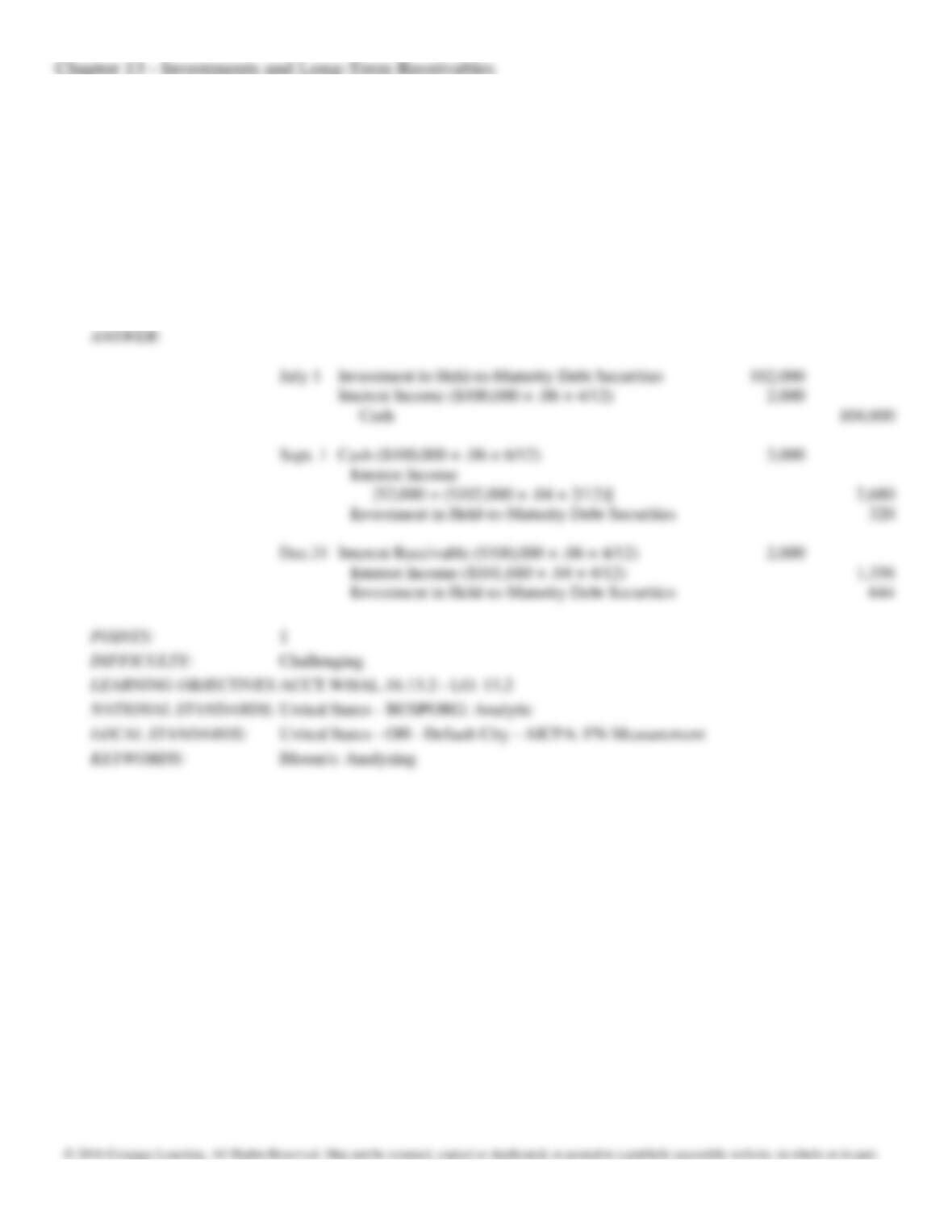
July 1
Investment in Held-to-Maturity Debt Securities
Interest Income ($100,000 × .06 × 4/12)
Cash
Sept. 1
Cash ($100,000 × .06 × 6/12)
Interest Income
[$2,000 + ($102,000 × .04 × 2/12)]
Investment in Held-to–Maturity Debt Securities
Dec.31
Interest Receivable ($100,000 × .06 × 4/12)
Interest Income ($101,680 × .04 × 4/12)
Investment in Held-to–Maturity Debt Securities
102. On September 1, 2018, WV, Inc., bought $60,000 of MD Printer’s 20-year, 6% bonds dated January 1, 2017, for
$56,920 plus accrued interest. The bonds pay interest annually and are classified as held-to-maturity. On September
1, 2028, WV sold one-fourth of these bonds for $15,000 plus accrued interest. No entries relating to the bonds had
been made since December 31, 2027. Straight-line amortization was used.
Required:
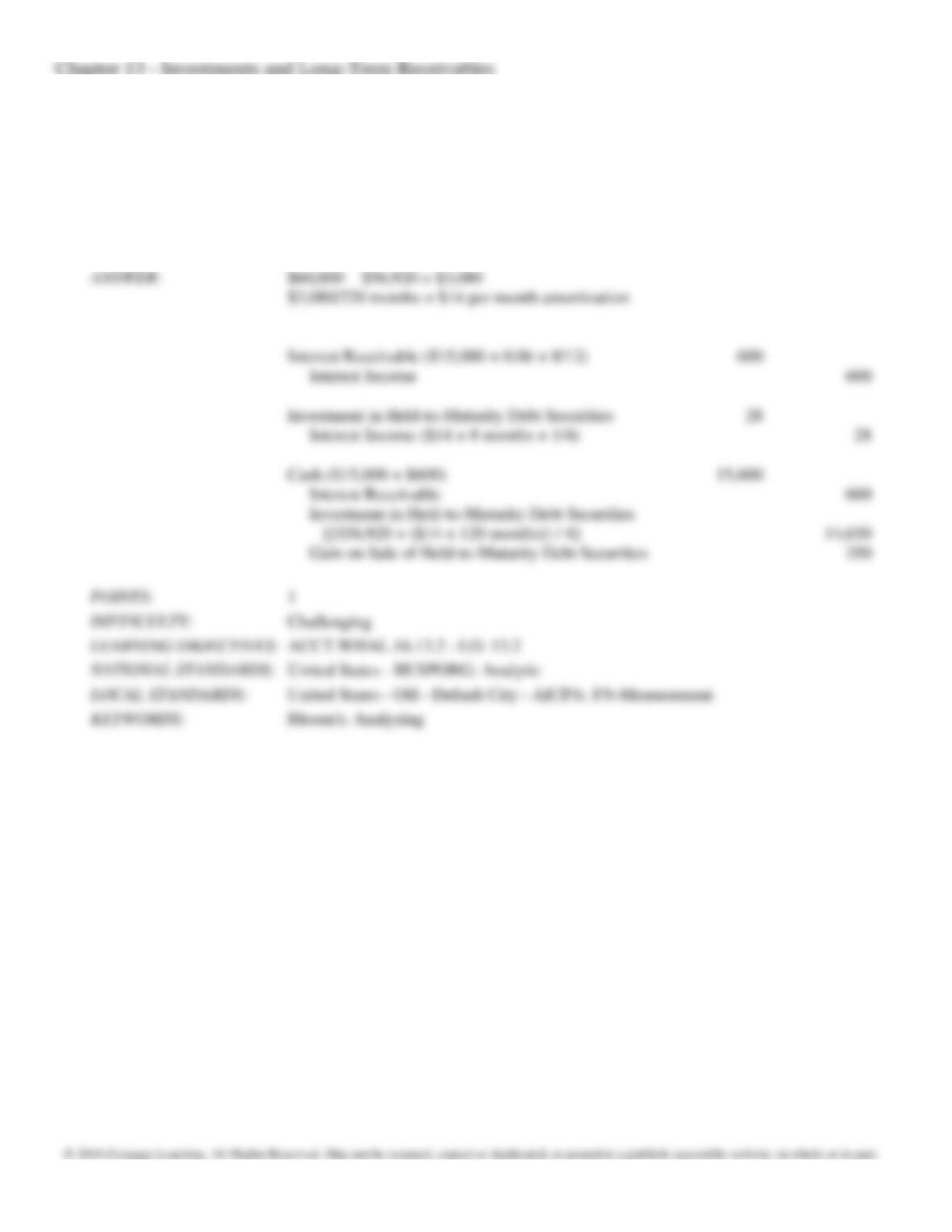
Record the sale of these bonds.
103. On January 2, 2017, Mark Company acquired, as a held-to-maturity investment, bonds with a face value of $500,000
for $562,300. The bonds carry a stated interest rate of 12% and an effective yield of 10%. Interest is paid on June 30
and December 31, and the bonds mature on December 31, 2026.
Required:
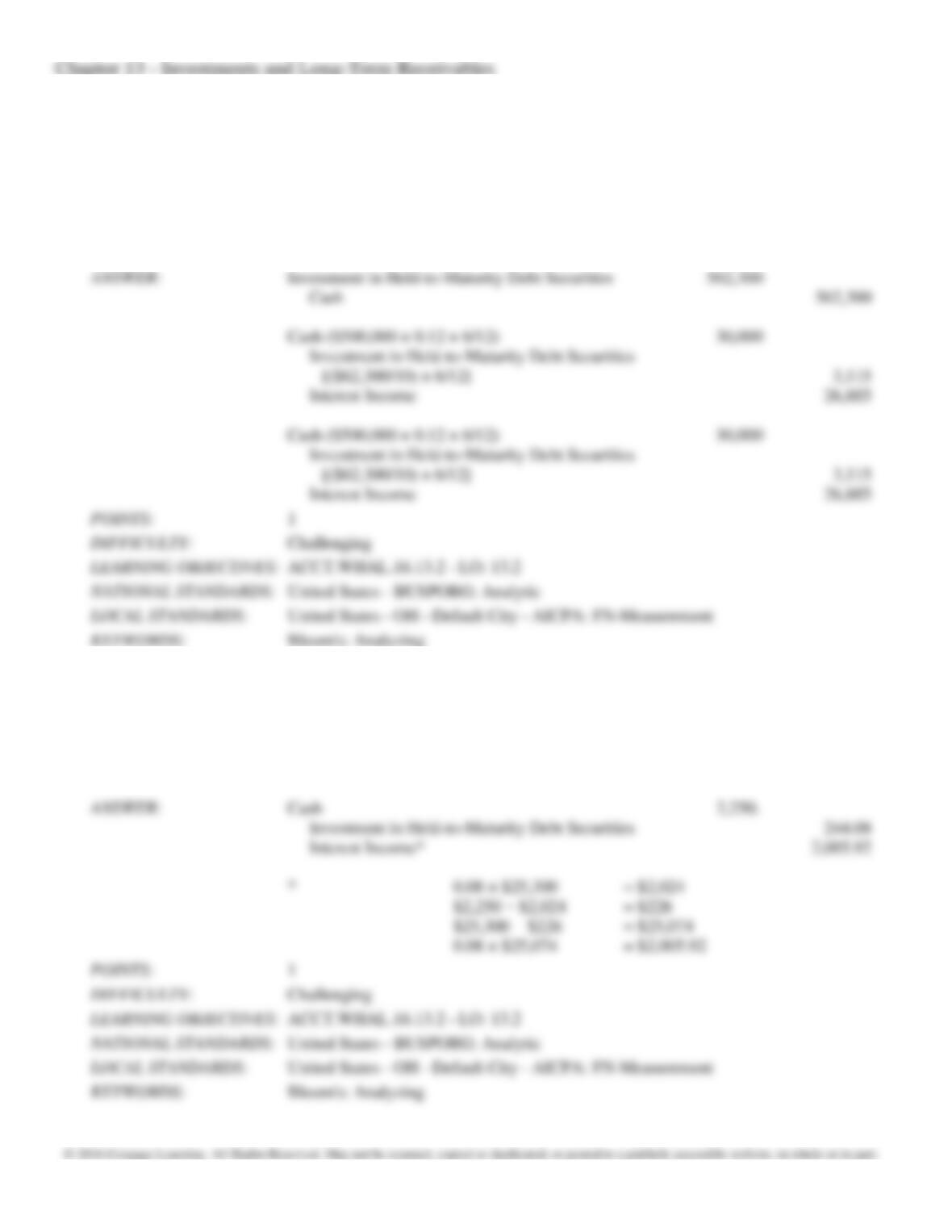
Prepare the journal entries necessary to record the purchase of the bonds and the first two interest receipts using the
straight-line method of amortization.
104. On January 1, 2017, Waters Corp. bought $25,000 of Violet Co.’s 9% ten-year bonds for $25,300 to yield 8%. The
bonds pay interest annually and are classified as held-to-maturity.
Required:
Using the effective interest method, journalize the receipt of the interest and amortization at December 31, 2018.
105. On January 1, 2017, Brewster’s, Inc. bought $50,000 of 10% ten-year bonds of Chocolate Co. for $56,795 to yield
8% annually. The bonds pay interest semiannually and are classified as held-to-maturity. Interest is paid on June 30
and December 31.
Required:
Using the effective interest method, journalize the receipt of the interest and amortization at December 31, 2017.
106. On January 1, 2017, Garcia Company acquired bonds with a face value of $80,000 for $76,066. The bonds carry a
stated interest rate of 8% and an effective yield of 10%. Interest is payable on June 30 and December 31, the bonds
mature on December 31, 2018, and they are classified as held-to–maturity.
Required:
Prepare the journal entries necessary by Garcia to record the purchase of bonds and the first two interest receipts
using the effective interest method of amortization. Round to the nearest dollar.
107. Jupiter Bank decides to invest in trading securities in order to take advantage of short term gains. The bank
purchased the following securities for the year 2017.
Jan. 15, 2017
Purchased 1,000 shares of Corbin Company common stock for $89 per share
May 23, 2017
Purchased 1500 shares of Petro Company common stock for $75 per share
At the end of 2017 Corbin Company’s common stock was trading on the market at $93 per
share, and Petro’s common stock had a market price of $70 per share.
Required:
1.)
Prepare journal entries to record the preceding information.
2.)
What is the unrealized holding gain or loss and where is it reported on the 2014
financial statements?
1.)
2017
Jan. 15
Investment in Trading Securities
Cash (1,000 ×$89)
May.2
Investment in Trading Securities
Cash (1,500 ×$75)
Dec.12
Unrealized Holding Gain/Loss
Trading Securities
Investment in Trading Securities
1
Challenging
United States – BUSPORG: Analytic
United States – OH – Default City – AICPA: FN-Measurement
Bloom’s: Analyzing
108. First Bank purchased the following securities during 2017 and classified them all as trading securities.
Purchased 500 shares of Duke Company’s common stock for $55 per share
Purchased 2,000 shares of Queen Company’s common stock for $45 per share
Purchased 1,000 shares of Prince Company’s preferred stock at $120 per share.
Received $3,000 of dividends during 2017 related to the common stock investments
Fair Value at
Security
Cost
12/31/2017
500 shares of Duke common stock
$ 27,500
$ 30,000
2,000 shares of Queen common stock
90,000
105,000
1,000 shares of Prince preferred stock
120,000
115,000
Totals
$ 237,500
$ 250,000
1.)
Prepare journal entries to record the preceding information.
2.)
What is the unrealized holding gain or loss and where is it reported on the
2017 financial statements?
3.)
Prepare the journal entry to record the unrealized holding gain or loss.
4.)
How would the bank report these securities on its balance sheet for the year
ended 2017?
1.)
Investment in Trading
Cash (500 × $55)
Investment in Trading
Securities
×$45)
Investment in Trading
Securities
$120)
Cash
Dividend Income
2.)
Security
Cost
500 shares of Duke common
2,000 shares of Queen common stock
1,000 shares of Prince preferred stock
Totals
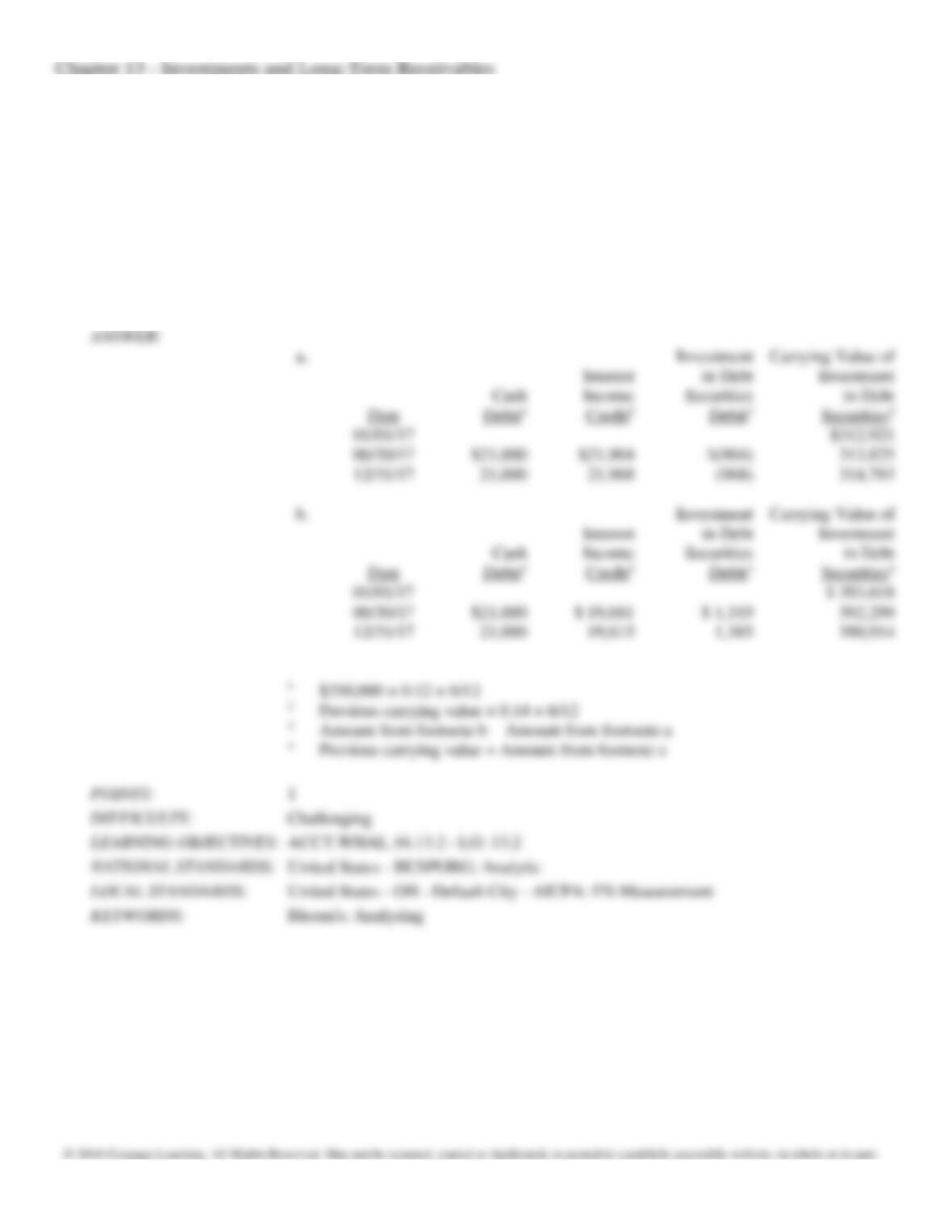
109. On January 1, 2017, the Widner Company acquired 12% bonds with a face value of $350,000 and classified them as
held-to-maturity. The bonds pay interest on June 30 and December 31, and mature on December 31, 2026.
Required:
a.
Assume the bonds were acquired for$312,921 to yield 14%. Prepare an investment
discount amortization schedule for the first year of the investment, using the effective
interest method. Round all calculations to the nearest dollar.
b.
Assume the bonds were acquired for $393,618 to yield 10%. Prepare an investment
premium amortization schedule for the first year of the investment using the effective
interest method. Round all calculations to the nearest dollar.
b.
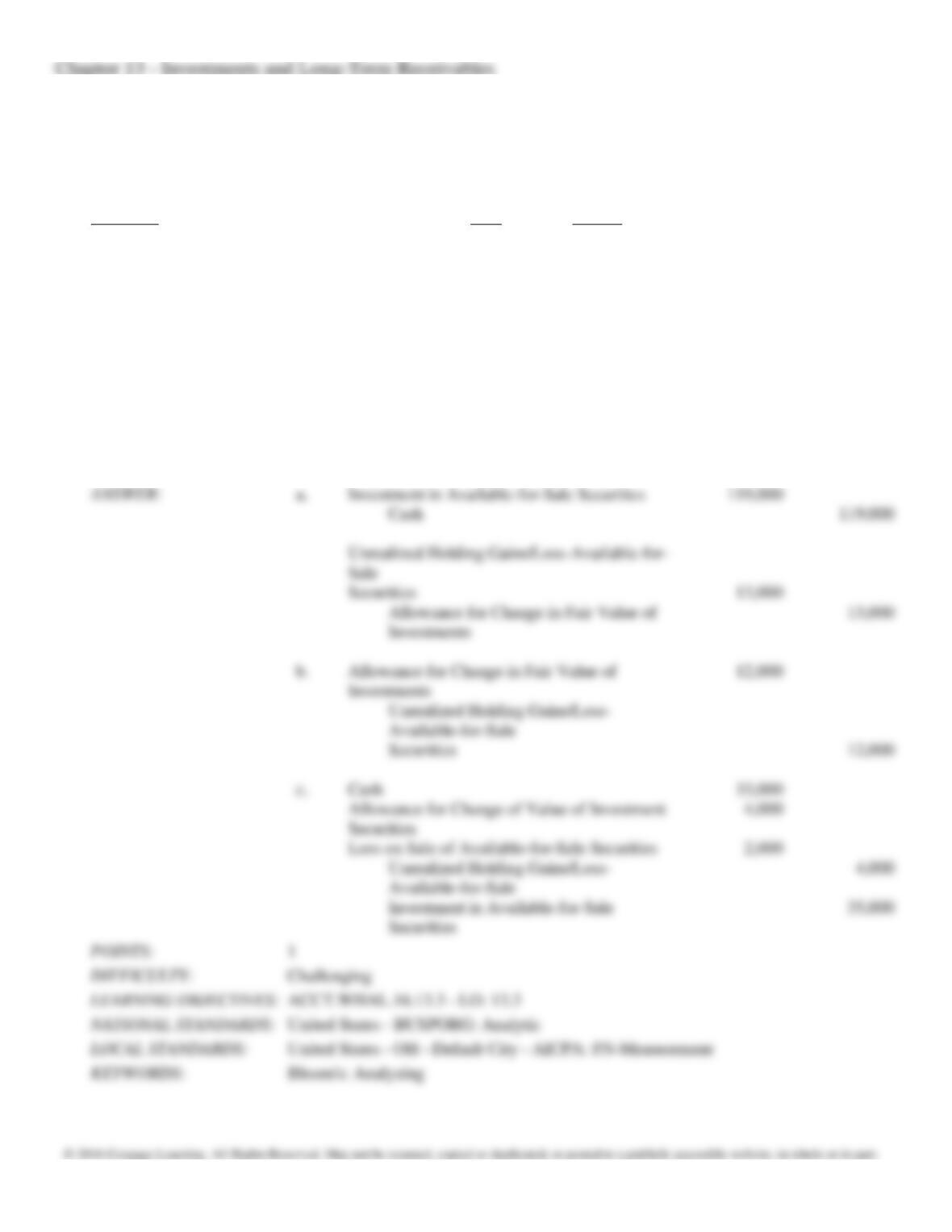
110. During January 2017, Long Corporation for the first time decided to acquire some equity securities as a means of
putting some of its idle cash to work. The securities are classified as investments available-for-sale. At March 31,
when Long prepares its first quarter financial statements, the following information about the acquired securities is
available:
Securities
Cost
Market
1
$52,000
$50,000
2
32,000
29,000
3
35,000
27,000
Required:
a.
Prepare the journal entries to record the acquisition in January and valuation at the end of
the first quarter of 2017.
b.
Assume that on June 30, 2017, the company still has this same portfolio. The market value
of 1 is $57,000, 2 is $30,000, and 3 is $31,000. What journal entry, if any, should be
prepared at the end of the second quarter?
c.
On August 15, 2017, Long Corporation sold Security 3 for $33,000. Prepare the journal
entry to record this transaction.
United States – OH – Default City – AICPA: FN-Measurement
111. In 2017, Bucky Corporation, for the first time, invested some idle funds in a variety of securities classified as
available-for-sale, as described below:
Purchase
Per Unit
Sept. 30, 2017
Number of Shares
Security
Date
Cost
Quoted Market
or $1,000 Bonds
Common stock A
March 10
$ 26
$ 24
300
Common stock B
15
15
16
100
Common stock C
17
20
20
200
8% bonds
April 1
990
970
10
The company’s year ends on December 31 and the bonds pay interest semiannually on January 1 and July 1.
Required:
Answer each of the following questions about Bucky Corporation’s investments:
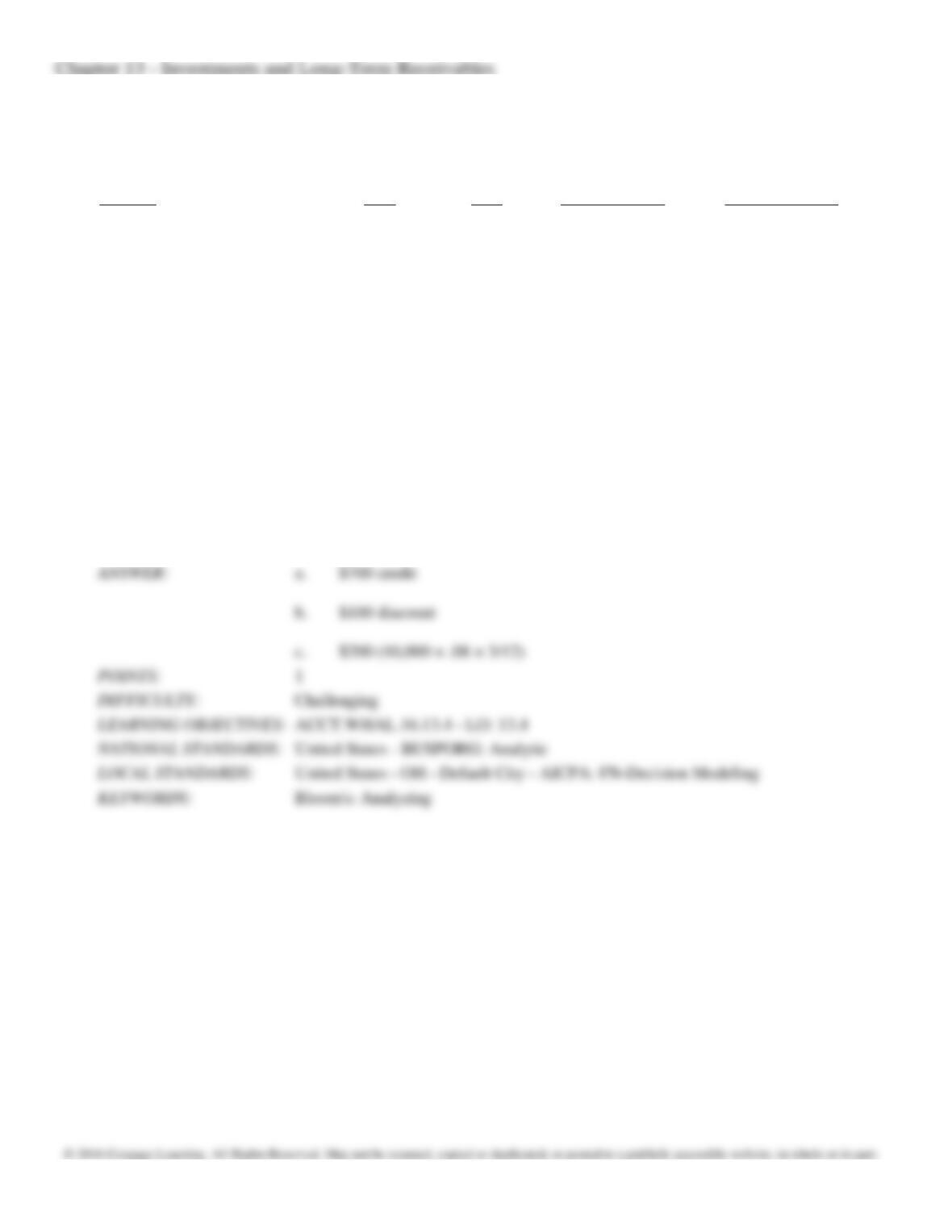
a.
Calculate the balance that should be in Allowance for Change in Fair Value of Investments
to value the securities in the portfolio properly at the end of the third quarter, and indicate
whether the balance will be a debit or credit balance.
b.
What was the amount of the discount or premium involved in the company’s purchase of
the bonds?
c.
Ignoring amortization, how much did Bucky record as Interest Income on the bond
investment during the third quarter of 2017?
b.
112. On January 3, 2017, Nancy Corporation purchased the following equity securities as an investment:
Number of
Cost of
Total
Company
Shares
Share
Cost
A
400
$20
$ 8,000
B
2,000
12
24,000
C
800
22
17,600
These securities are classified as available-for-sale.
Required:
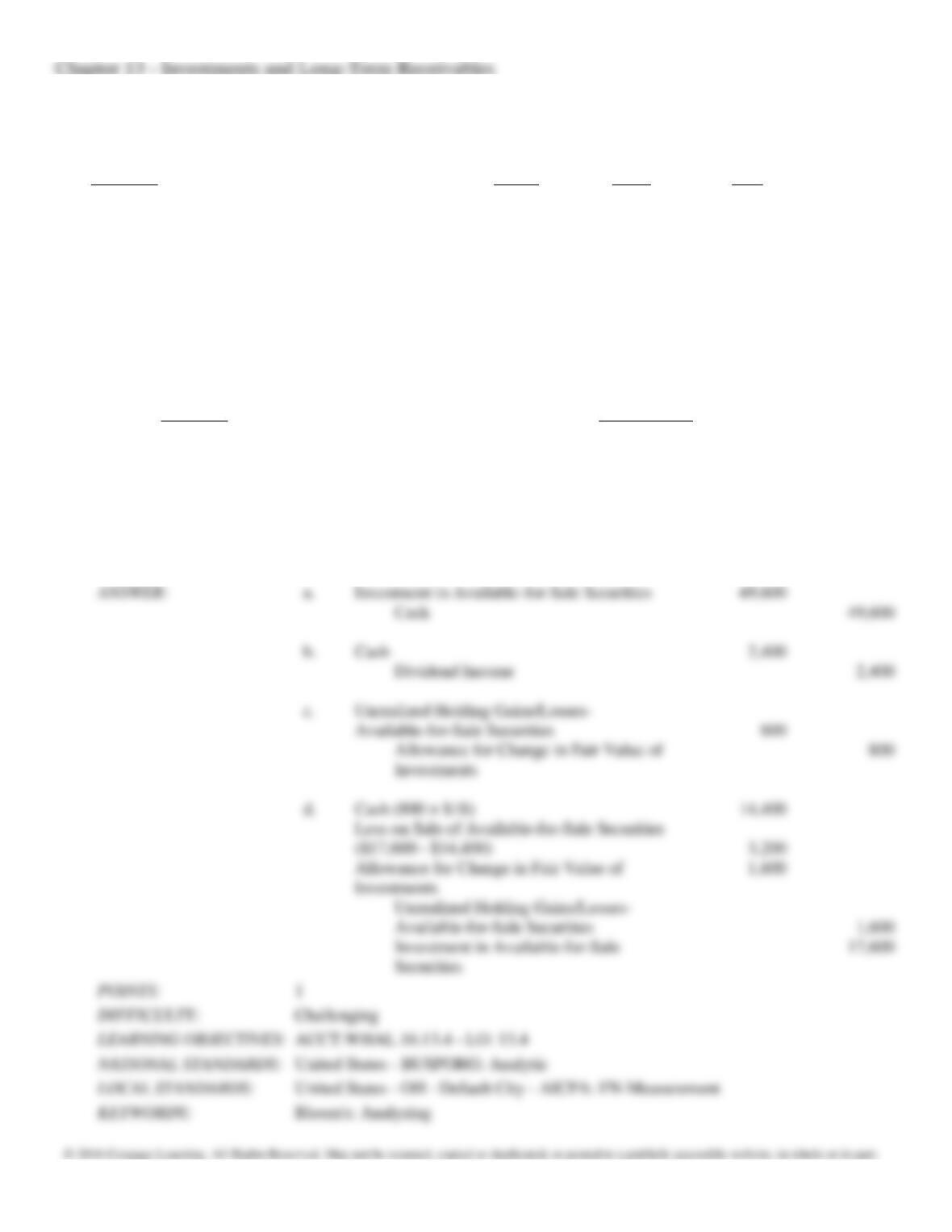
a.
Prepare the journal entry to record the acquisition of the stock.
b.
On June 30, 2017, C Company paid dividends of $3.00 per share. Prepare the journal entry that
would be used by Nancy to record the dividend receipt.
c.
On December 31, 2017, the market values per share were:
Company
Market Value
A
$22
B
12
C
20
Prepare any journal entry or entries necessary to record these changes in market value.
d.
On March 14, 2017, Nancy sold 800 shares of C Company for $18 per share. Prepare the
journal entry to record the sale.
a.
Investment in Available-for-Sale Securities
Cash
b.
Cash
Dividend Income
c.
Unrealized Holding Gains/Losses-
Available-for-Sale Securities
800
Allowance for Change in Fair Value of
d.
Cash (800 × $18)
Loss on Sale of Available-for-Sale Securities
($17,600 – $14,400)
Allowance for Change in Fair Value of
Investments
Unrealized Holding Gains/Losses-
Available-for-Sale Securities
Securities
ACCT.WHAL.16.13.4 – LO: 13.4
United States – BUSPORG: Analytic
113. At December 31, 2017, Isotope Co. held the following investments in stock that are classified as available-for-sale
securities. All investments were acquired in December 2017.
Security
Cost
Market Value
B
$1,500
$1,350
C
3,000
3,050
Changes in fair value were considered to be temporary. On March 1, 2018, half of the B Company stock was sold for
$650. Isotope Co. acquired additional security C stock during 2018. At December 31, 2018, the following
investments in stock were held by Isotope:
Security
Cost
Market Value
B
$ 750
$ 550
C
3,500
3,850
Changes in fair value again were considered to be temporary.
Required:
Prepare journal entries for
a.
December 31, 2017
b.
March 1, 2018
c.
December 31, 2018
114. At December 31, 2015, Williams had the following portfolio of securities available-for-sale:
Cost
Market Value
Jacob Co. bonds
$30
$32
Nathan Co. stock
90
84
Assume there was no previous balance in the Allowance for Change in Fair Value of Investments account.
Required:
a.
Assuming any gain or loss is considered to be temporary, prepare the adjusting entry at
December 31, 2015, required under current GAAP.
b.
Assuming that, in 2016, Williams sold the Nathan Co. stock for $83, prepare the entry to record
the sale.
c.
Assuming that at the end of 2016 the portfolio of securities available for sale is composed of the
following holdings, prepare any necessary entry.
Cost
Market Value
Jacob Co. bonds
$30
$32
Eric Co. stock
70
59
d.
Assuming that at the end of 2017 the portfolio of securities available for sale is composed of the
following holdings, prepare any necessary entry.
Cost
Market Value
Jacob Co. bonds
$100
$95
Eric Co. stock
70
63
Elizabeth Co. bonds
30
35
e.
Assuming that, in 2018, the Jacob Co. bonds were reclassified as held-to–maturity when the
market value was $94, prepare any necessary entry.
Unrealized holding gains/losses-
Available-for-Sale Securities
Allowance for Change in Fair Value of
b.
Cash
Loss on Sale of Available-for-Sale Securities
Allowance for Change in Fair Value of
Unrealized Holding Gains/Losses-
Available-for-Sale Securities
Investment in Available-for-Sale
Unrealized Holding Gains/Losses-
Available-for-Sale Securities
Allowance for Change in Fair Value of
Investments
115. Stuart Corp. purchased 100 shares of Dumb Co. stock for $8 per share and 200 shares of Silly Inc. stock for $12 per
share. The Dumb Co. stock will be held for at least 3 years and is classified as available-for-sale; the Silly, Inc. stock
is classified as trading. As of December 31, the Dumb Co. stock is selling for $9 per share and the Silly Inc. stock is
selling for $13 per share. Stuart had net income of $10,000 before reporting the impact of investment transactions.
Required:
a.
Record the December 31 adjusting entries for investments.
b.
What is Stuart Corp.’s net income after adjusting for investments?
c.
What is the appropriate balance sheet classification for each investment?
1
Challenging
ACCT.WHAL.16.13.4 – LO: 13.4
United States – BUSPORG: Analytic
United States – OH – Default City – AICPA: FN-Measurement
Bloom’s: Analyzing
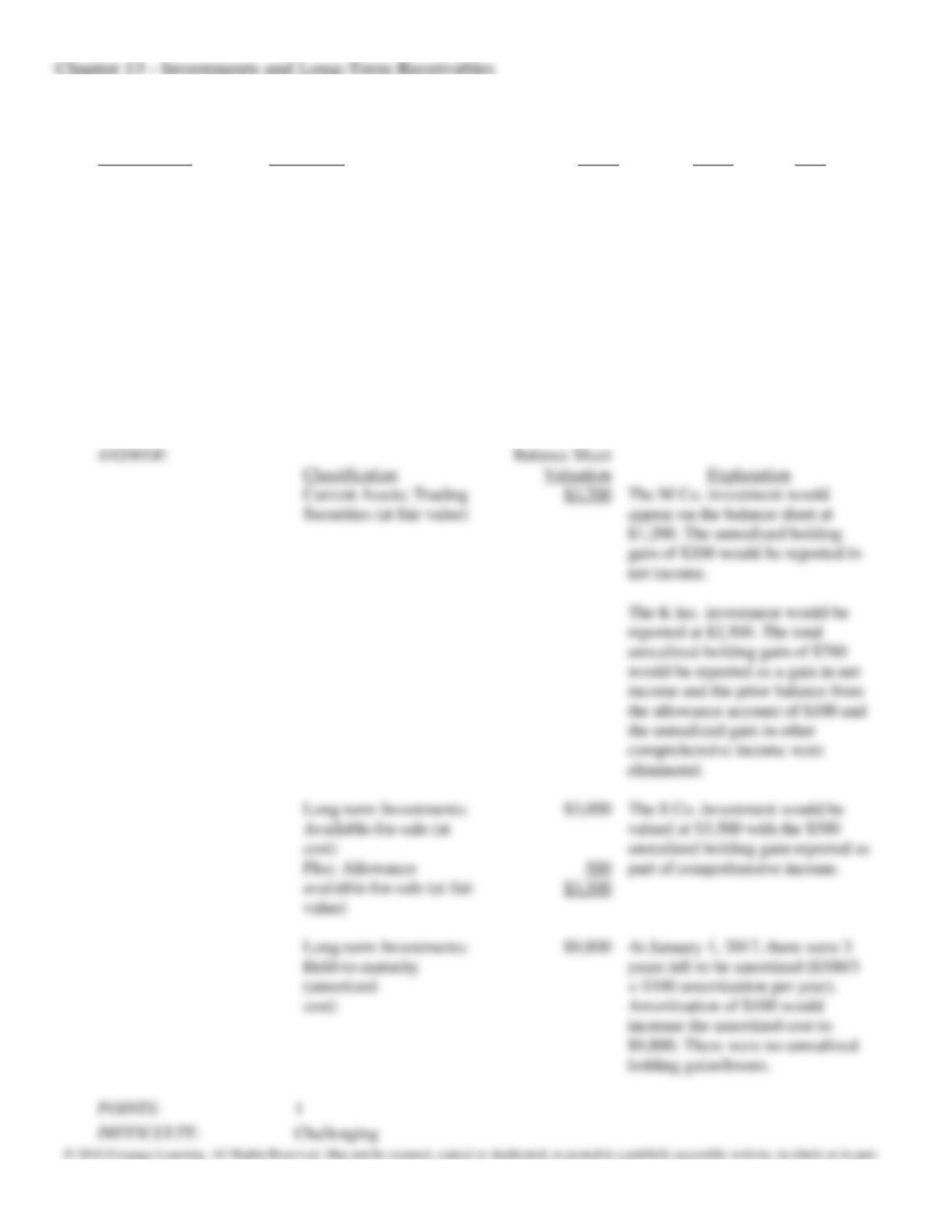
116. On January 1, 2017, A Corp. had the following investments:
Market
Maturity
Classification
Investment
Value
Value
Cost
available-for-sale
K Inc. stock
$1,900
$1,800
available-for-sale
S Co. stock
3,100
3,000
held-to-maturity
G Inc. bonds (due 12/31/2019)
$10,000
9,700
During the year, A Corp. acquired M Co. stock for $1,000 and classified it as trading. At year-end, the M Co. stock
has a fair market value of $1,200. The K Inc. investment was transferred from AFS to trading on December 31
when the fair market value was $2,500. The S Co. investment had a December 31 market value of $3,500, and the G
Inc. bonds had a December 31 market value of $9,850. A Corp. intends to hold all of its available-for-sale
investments for at least one more year.
Required:
Indicate the balance sheet classification, valuation amount(s) and where unrealized holding gains/losses would
appear on the December 31, 2017 financial statements for each investment.
Valuation
117. On January 1, 2017, Trevor bought 6% of Joseph Company’s common stock for $20,000. During 2017, Joseph
earned $6,000 of net income and distributed $4,400 of dividends. On January 1, 2018, Trevor bought an additional
35% of Joseph Company’s common stock. The fair value of the Joseph shares owned by Trevor was $21,000 on
December 31, 2017. Assume that the Joseph stock had been classified as available-for-sale during 2017, and the
acquisition of the additional 35% of Joseph at the beginning of 2018 gave Trevor significant influence.
Required:
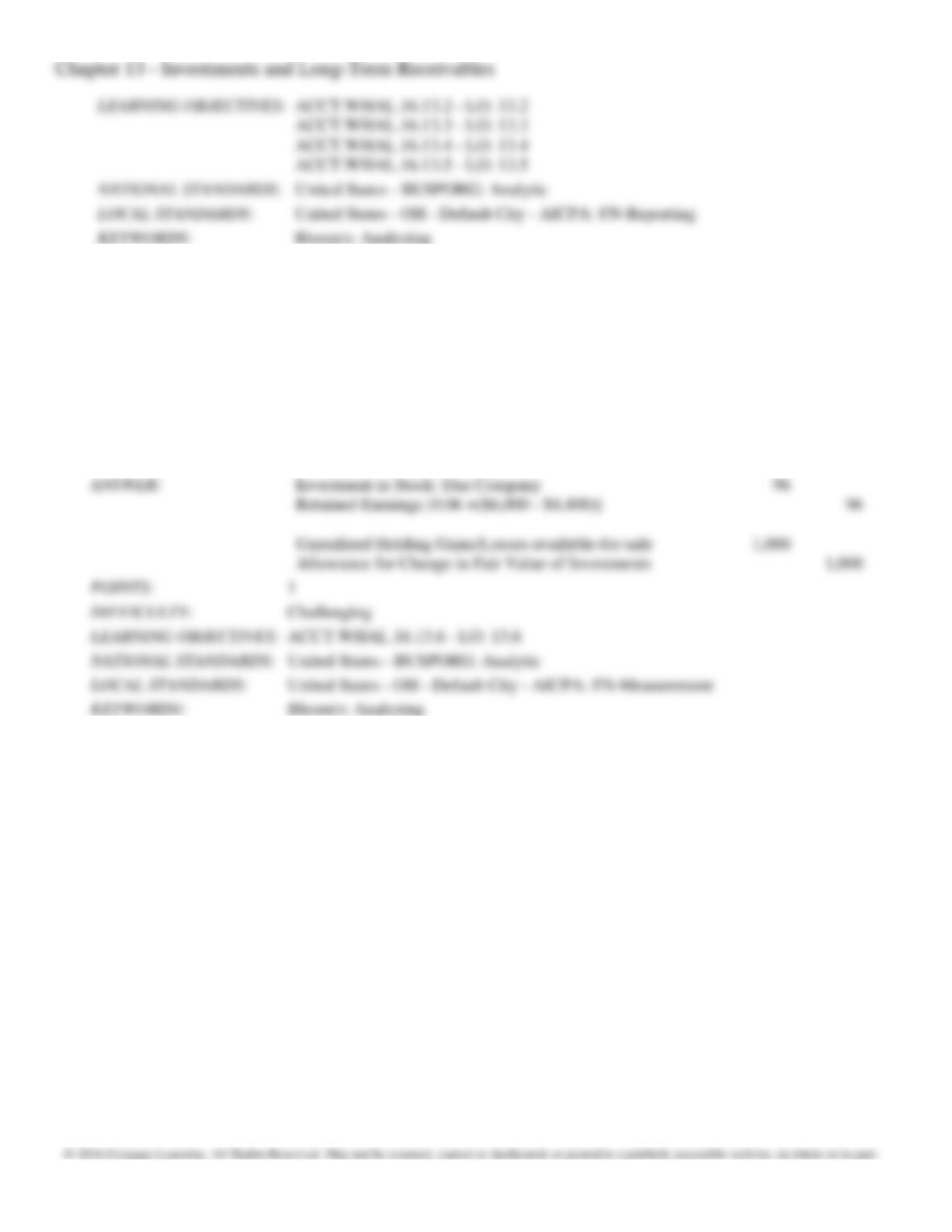
Prepare the appropriate entries for Trevor on January 1, 2018, as a result of the additional acquisition and change in
ownership classification.