Chapter 13: Corporations: Organization, Stock Transactions, and Dividends
118.
In which section of the financial statements would Paid-In Capital from Sale of Treasury Stock be reported?
a.
other expense on income statement
b.
intangible asset on the balance sheet
c.
stockholders’ equity on balance sheet
d.
other income on income statement
119.
Which of the following is not classified as paid-in capital on the balance sheet?
a.
common stock
b.
common stock distributable
c.
excess of issue price over par
d.
treasury stock
120.
All of the following are normally found in a corporation’s stockholders‘ equity section except
a.
Common Stock
b.
Paid-In Capital in Excess of Par
c.
Dividends in Arrears
d.
Retained Earnings
Chapter 13: Corporations: Organization, Stock Transactions, and Dividends
121.
Which of the following amounts should be disclosed in the stockholders’ equity section of the balance sheet?
a.
the number of shares of common stock outstanding
b.
the number of shares of common stock issued
c.
the number of shares of common stock authorized
d.
all of the above
122.
Significant changes in stockholders’ equity are reported in
a.
income statement
b.
retained earnings statement
c.
statement of stockholders’ equity
d.
statement of cash flows
123.
Retained earnings
a.
is the same as contributed capital
b.
cannot have a debit balance
c.
changes are summarized in the retained earnings statement
d.
is equal to cash on hand
Chapter 13: Corporations: Organization, Stock Transactions, and Dividends
124.
Which of the following would appear as a prior period adjustment?
a.
loss resulting from the sale of fixed assets
b.
difference between the actual and estimated uncollectible accounts receivable
c.
error in the computation of depreciation expense in the preceding year
d.
loss from the restructuring of assets
125.
A restriction/appropriation of retained earnings
a.
decreases total assets
b.
increases total retained earnings
c.
decreases total retained earnings
d.
has no effect on total retained earnings
126.
The Dayton Corporation began the current year with a retained earnings balance of $32,000. During the year, the
company corrected an error made in the prior year, which was a failure to record depreciation expense of $3,000
on equipment. Also, during the current year, the company earned net income of $12,000 and declared cash
dividends of $7,000. Compute the year-end retained earnings balance.
a. $34,000
b. $37,000
c. $41,000
d. $44,000
Chapter 13: Corporations: Organization, Stock Transactions, and Dividends
127.
What is the total stockholders’ equity based on the following data?
Common Stock $360,000
Excess of Issue Price Over Par 735,000
Retained Earnings (Deficit) (56,000)
a. $1,095,000
b. $1,151,000
c. $1,039,000
d. $679,000
128.
The two main sources of stockholders’ equity are
a.
investments by stockholders and net income retained in the business
b.
investments by stockholders and dividends paid
c.
net income retained in the business and dividends paid
d.
investments by stockholders and purchases of assets
129.
Treasury stock should be reported in the financial statements of a corporation as a(n)
a.
investment
b.
liability
c.
current asset
d.
deduction from stockholders’ equity
Chapter 13: Corporations: Organization, Stock Transactions, and Dividends
130.
A reduction of par or stated value of stock results from a
a.
liquidating dividend
b.
stock split
c.
stock option
d.
preferred dividend
131.
A corporation has 50,000 shares of $25 par stock outstanding. If the corporation issues a 3-for-1 stock split, the
number of shares outstanding after the split will be
a.
150,000 shares
b.
50,000 shares
c.
100,000 shares
d.
16,666 shares
132.
When a corporation completes a 3-for-1 stock split
a.
the ownership interest of current stockholders is decreased
b.
the market price per share of the stock is decreased
c.
the par value per share is decreased
d.
b and c
Chapter 13: Corporations: Organization, Stock Transactions, and Dividends
133.
A corporation has 50,000 shares of $28 par stock outstanding that has a current market value of $150 per share. If
the corporation issues a 4-for-1 stock split, the market value of the stock will fall to approximately
a. $7.00
b. $112.00
c. $37.50
d. $600.00
134.
The primary purpose of a stock split is to
a.
increase paid-in capital
b.
reduce the market price of the stock per share
c.
increase the market price of the stock per share
d.
increase retained earnings
135.
Which of the following statements is not true about a 2-for-1 split?
a.
Par value per share is reduced to half of what it was before the split.
b.
Total contributed capital increases.
c.
The market price will probably decrease.
d.
A stockholder with ten shares before the split owns twenty shares after the split.
Chapter 13: Corporations: Organization, Stock Transactions, and Dividends
136.
A corporation has 50,000 shares of $25 par stock outstanding that has a current market value of $150 per share. If
the corporation issues a 5-for-1 stock split, the market value of the stock after the split will be approximately
a. $25
b. $150
c. $5
d. $30
137.
A corporation has 50,000 shares of $25 par stock outstanding that has a current market value of $120. If the
corporation issues a 5-for-1 stock split, the par value of the stock after the split will be
a.
$5
b.
$60
c.
$25
d.
$24
138.
Nevada Corporation has 30,000 shares of $25 par stock outstanding that has a current market value of $120. If the
corporation issues a 5-for-1 stock split, the number of shares outstanding will be
a. 60,000
b. 6,000
c. 150,000
d. 15,000
Chapter 13: Corporations: Organization, Stock Transactions, and Dividends
139.
Earnings per share
a.
is the net income per common share
b.
must be reported by public company
c.
helps compare companies of different sizes
d.
all of the answers are correct
140.
Oregon, Inc. reported net income of $105,000. During the current year, the company had 5,000 shares of $100 par,
5% preferred stock and 10,000 of $5 par common stock outstanding. Oregon’s earnings per share is
a. $8.00
b. $18.00
c. $5.08
d. $5.00
141.
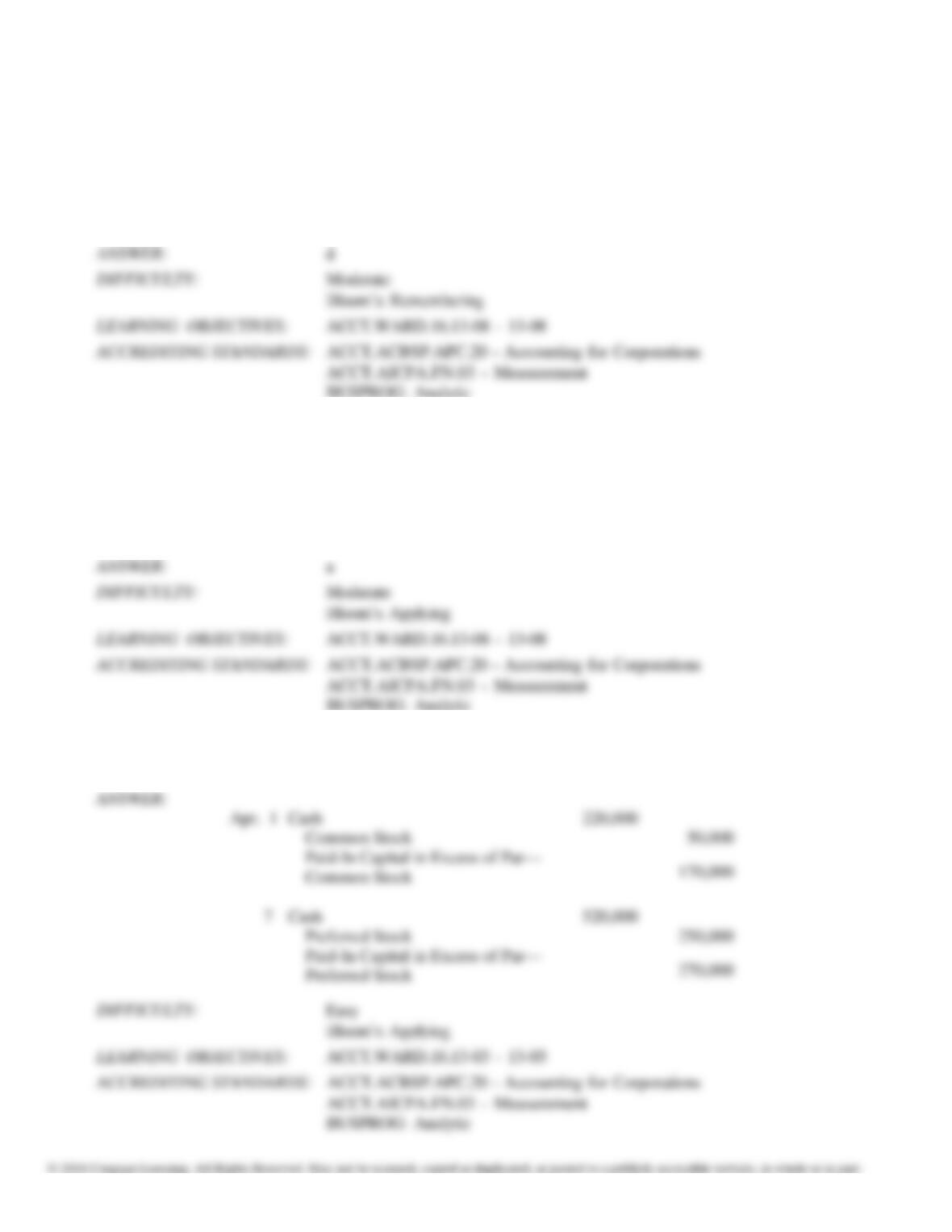
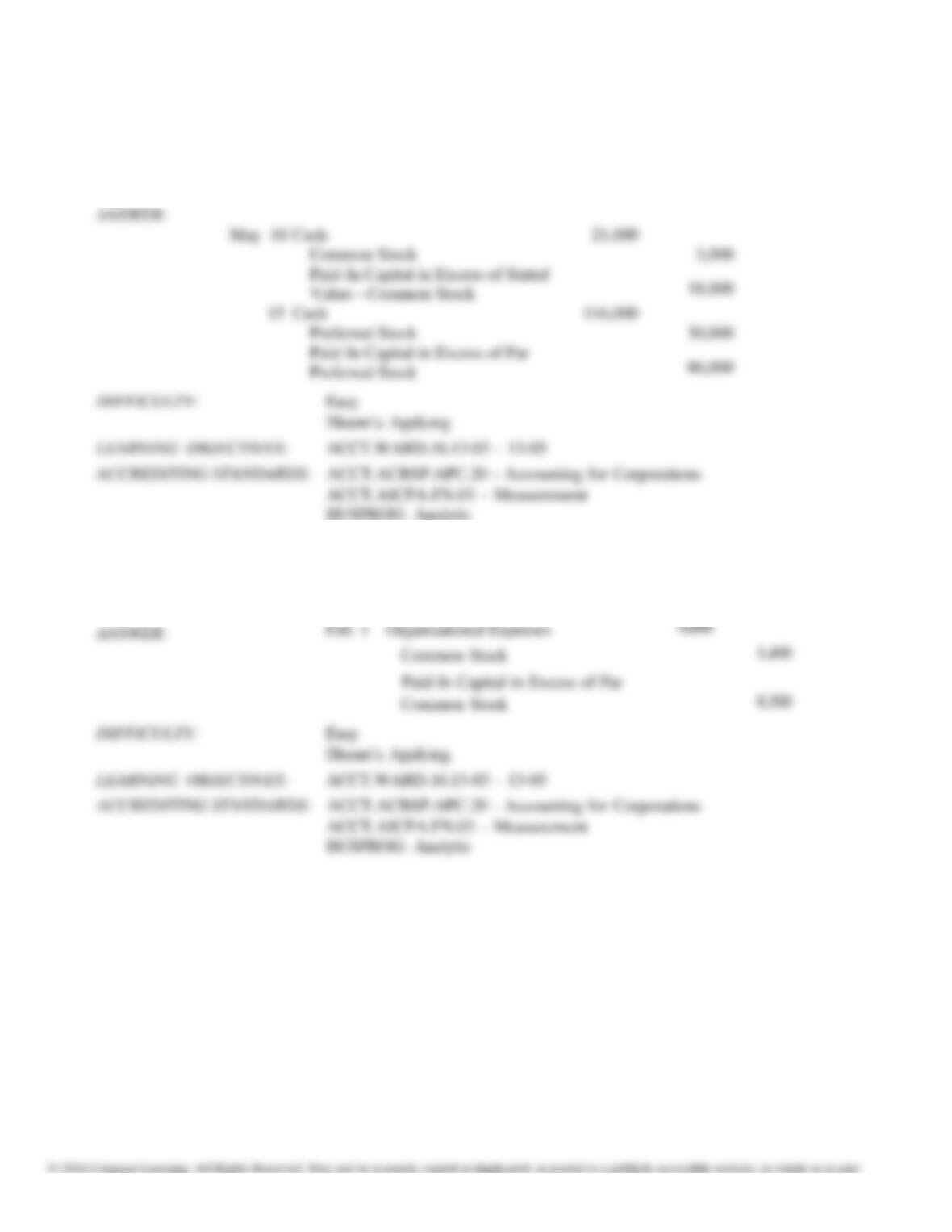
On April 1, 10,000 shares of $5 par common stock were issued at $22, and on April 7, 5,000 shares of $50 par
preferred stock were issued at $104. Journalize the entries for April 1 and 7.
Chapter 13: Corporations: Organization, Stock Transactions, and Dividends
142.
On May 10, a company issued for cash 1,500 shares of no-par common stock (with a stated value of $2) at $14,
and on May 15, it issued for cash 2,000 shares of $15 par preferred stock at $58.
Journalize the entries for May 10 and 15, assuming that the common stock is to be credited with the stated value.
143.
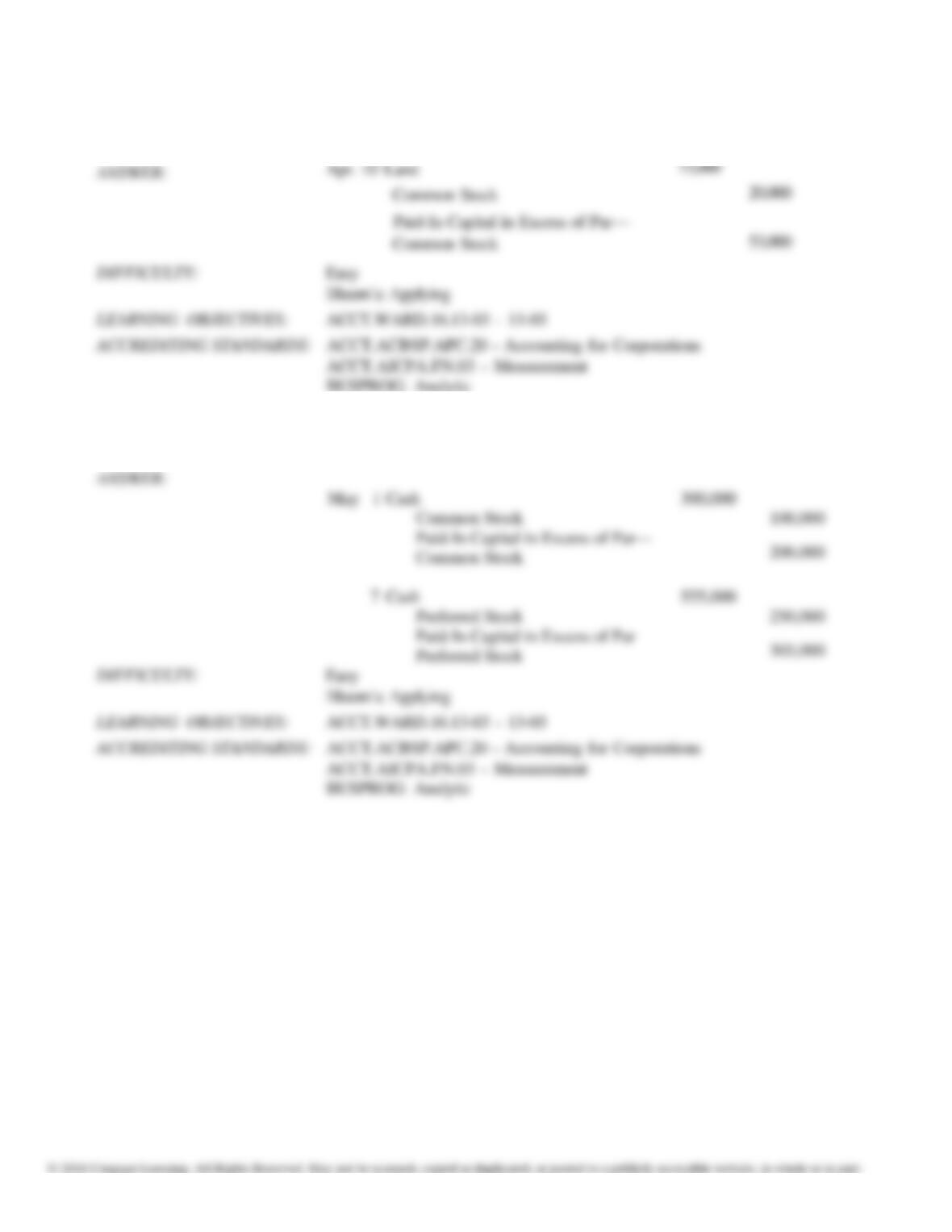
On February 1 of the current year, Motor, Inc. issued 700 shares of $2 par common stock to an attorney in return
for preparing and filing the articles of incorporation. The value of the services is $9,600. Journalize this
transaction.
Chapter 13: Corporations: Organization, Stock Transactions, and Dividends
144.
On April 10, a company acquired land in exchange for 1,000 shares of $20 par common stock with a current
market price of $73. Journalize this transaction.
145.
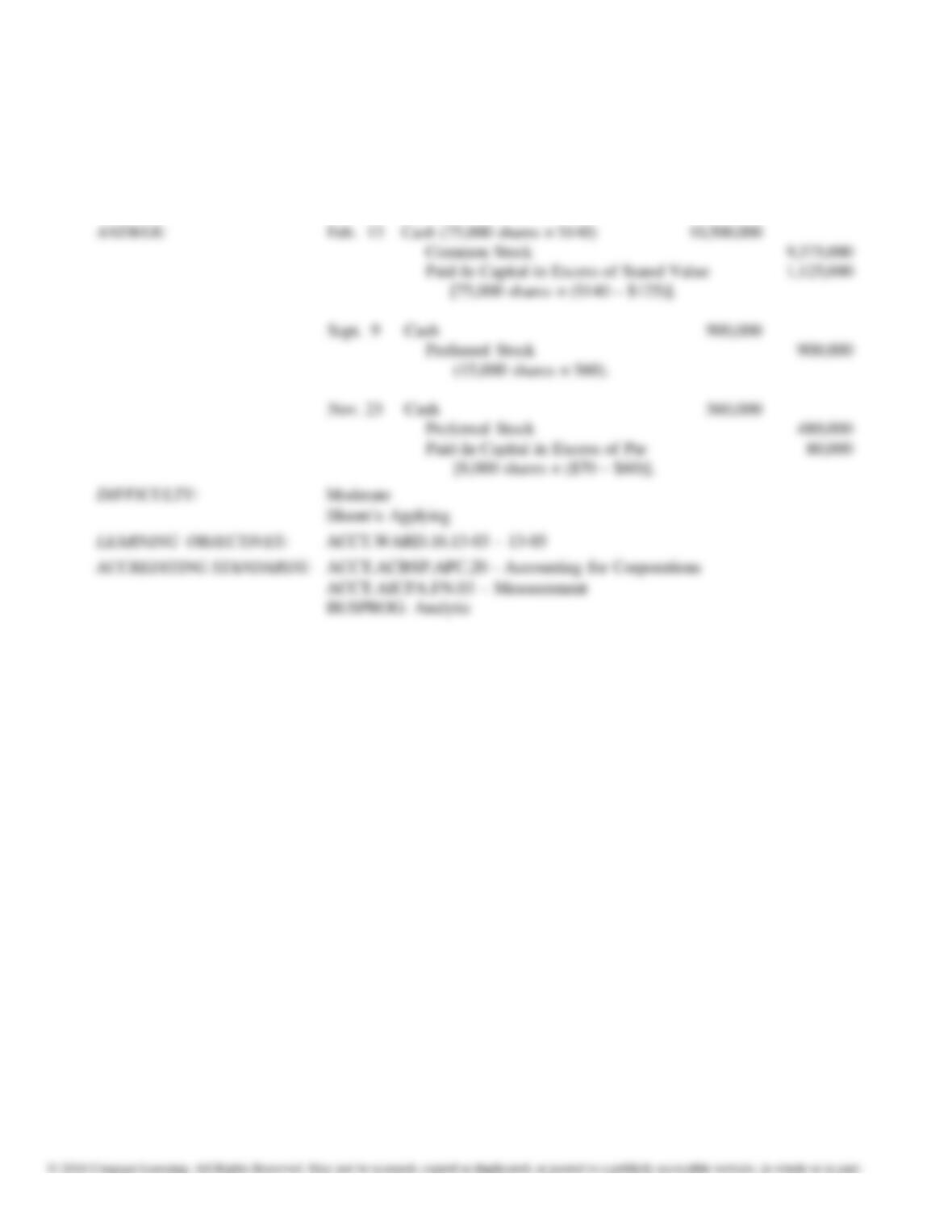
On May 1, 10,000 shares of $10 par common stock were issued at $30, and on May 7, 5,000 shares of $50 par
preferred stock were issued at $111. Journalize the entries for May 1 and May 7.
Chapter 13: Corporations: Organization, Stock Transactions, and Dividends
146.
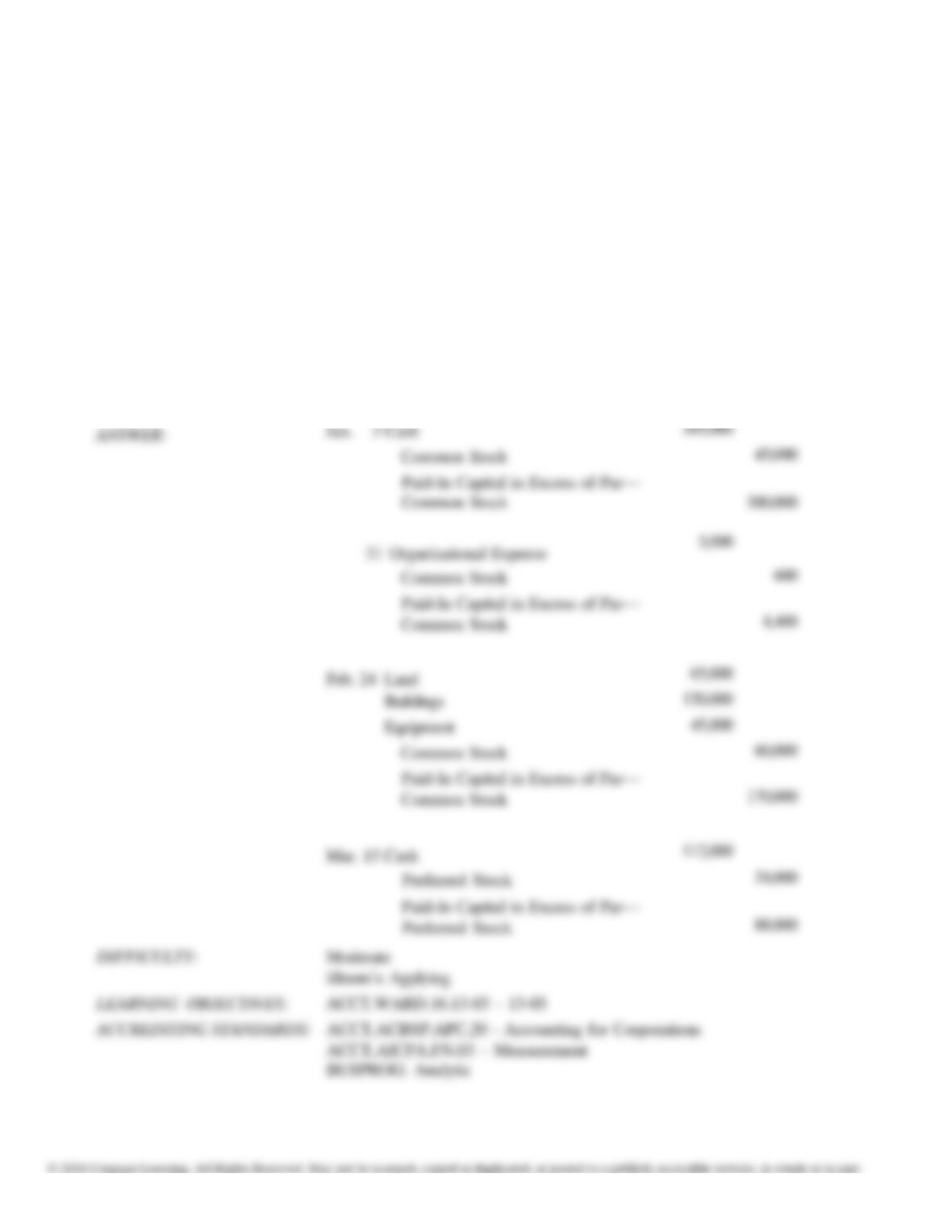
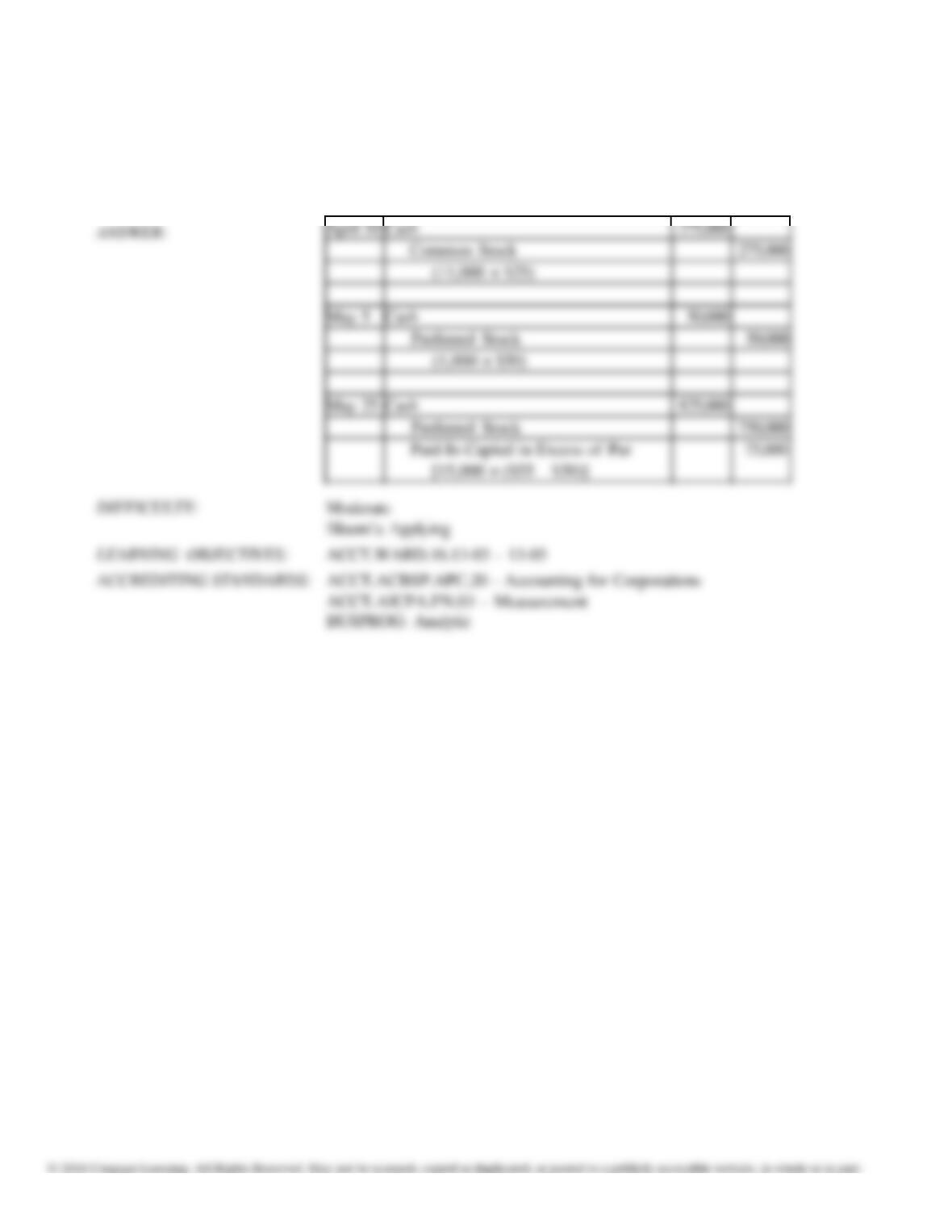
On February 13, Epperson Company issue for cash 75,000 shares of no-par common stock (with a stated value
of $125) at $140. On September 9, Epperson issued at par 15,000 shares of 1%, $60 par preferred stock at par
for
cash. On November 23, Epperson issued for cash 8,000 shares of 1%, $60 par preferred stock at $70.
Required: Journalize the entries to record the February 13, September 9 and November 23 transactions.
Chapter 13: Corporations: Organization, Stock Transactions, and Dividends
147.
A corporation was organized on January 1 of the current year, with an authorization of 20,000 shares of 4%, $12
par preferred stock, and 100,000 shares of $3 par common stock.
The following selected transactions were completed during the first year of operations:
Jan. 3 Issued 15,000 shares of common stock at $23 per share for cash.
31 Issued 200 shares of common stock to an attorney in payment of legal fees for
organizing the corporation. The value of the stock at the time of payment was $25
per share.
Feb. 24 Issued 20,000 shares of common stock in exchange for land, buildings, and
equipment with fair market prices of $65,000, $120,000, and $45,000 respectively.
Mar. 15 Issued 2,000 shares of preferred stock at $56 for cash.
Journalize the transactions.
Chapter 13: Corporations: Organization, Stock Transactions, and Dividends
148.
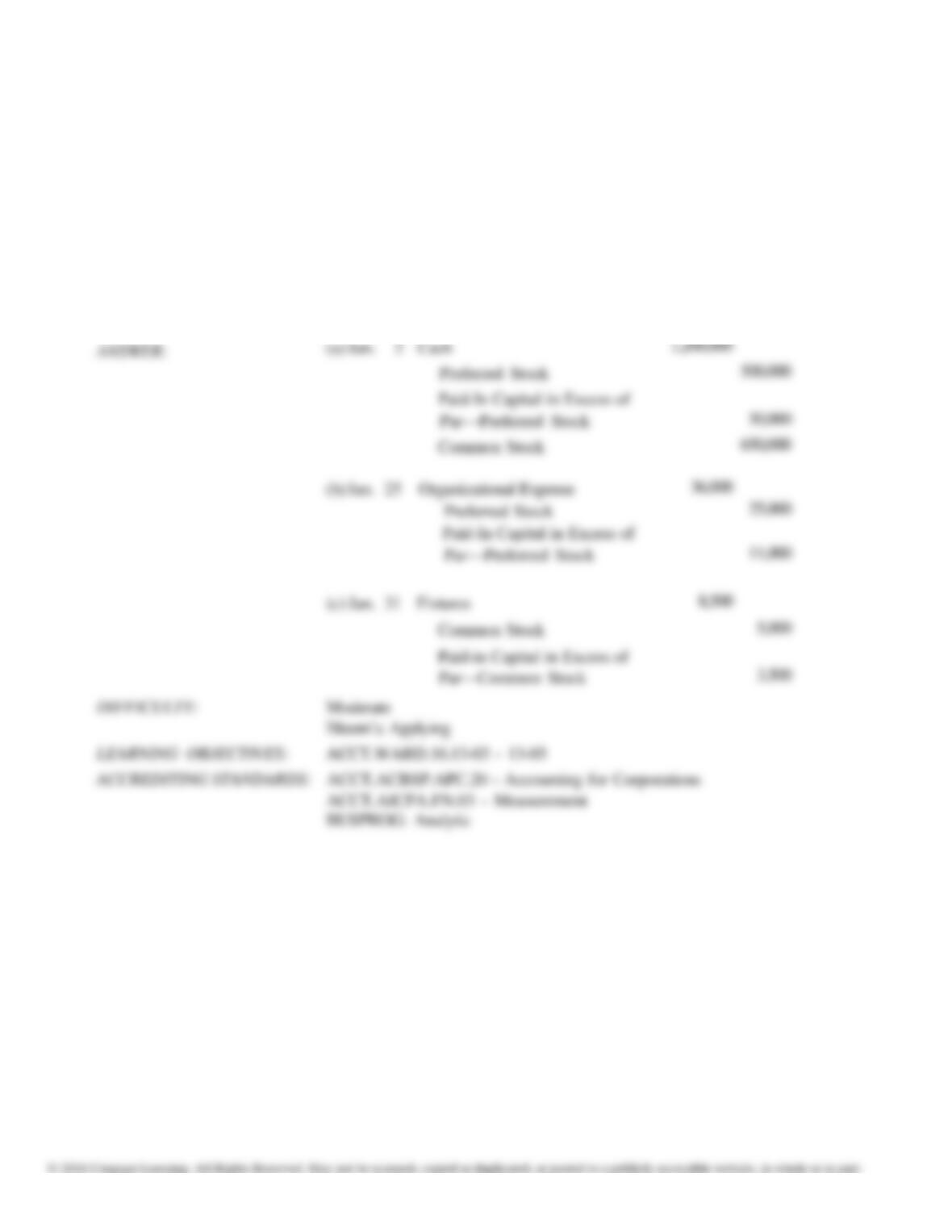
On April 10, Maranda Corporation issued for cash 11,000 shares of no-par common stock at $25. On May 5,
Maranda issued at par 1,000 shares of 4%, $50 par preferred stock for cash. On May 25, Maranda issued for cash
15,000 shares of 4%, $50 par preferred stock at $55.
Journalize the entries to record the April 10, May 5, and May 25 transactions.
Chapter 13: Corporations: Organization, Stock Transactions, and Dividends
149.
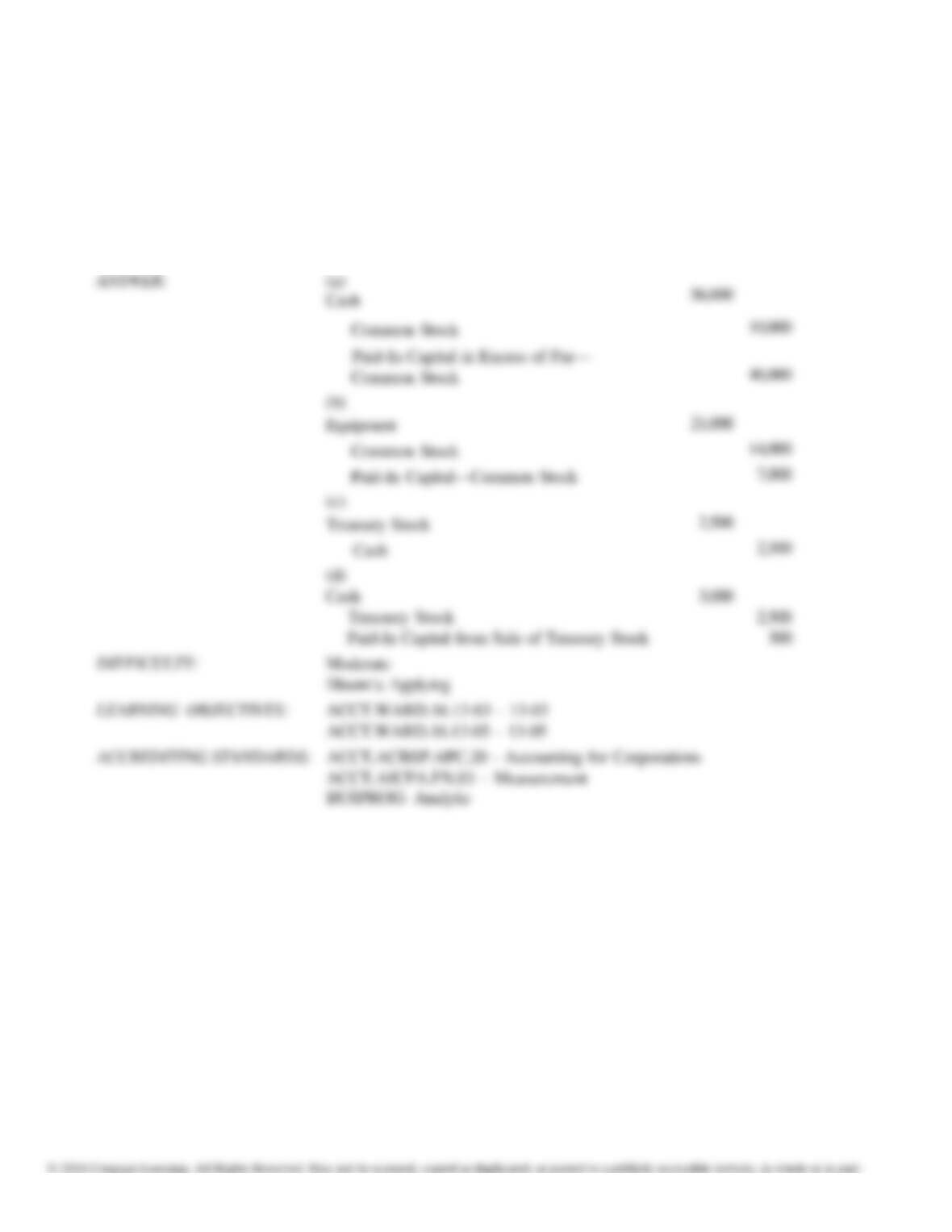
Wonder Sales is authorized to issue 100,000 shares of 2%, $100 par preferred stock and 1,000,000 shares of $10
par common stock. Journalize the following transactions.
(a)
On January 2, Wonder Sales issues 5,000 shares of preferred stock for $110 per share and 65,000 shares of
common stock at $10 per share.
(b)
On January 25, Wonder Sales issued 250 shares of preferred stock to a Morton Law Firm for settlement of a
$36,000 invoice for incorporation services.
(c)
On January 31, Wonder Sales issues 500 shares of common stock to Setup Inc. for fixtures that have a fair
market value of $8,500.
Chapter 13: Corporations: Organization, Stock Transactions, and Dividends
150.
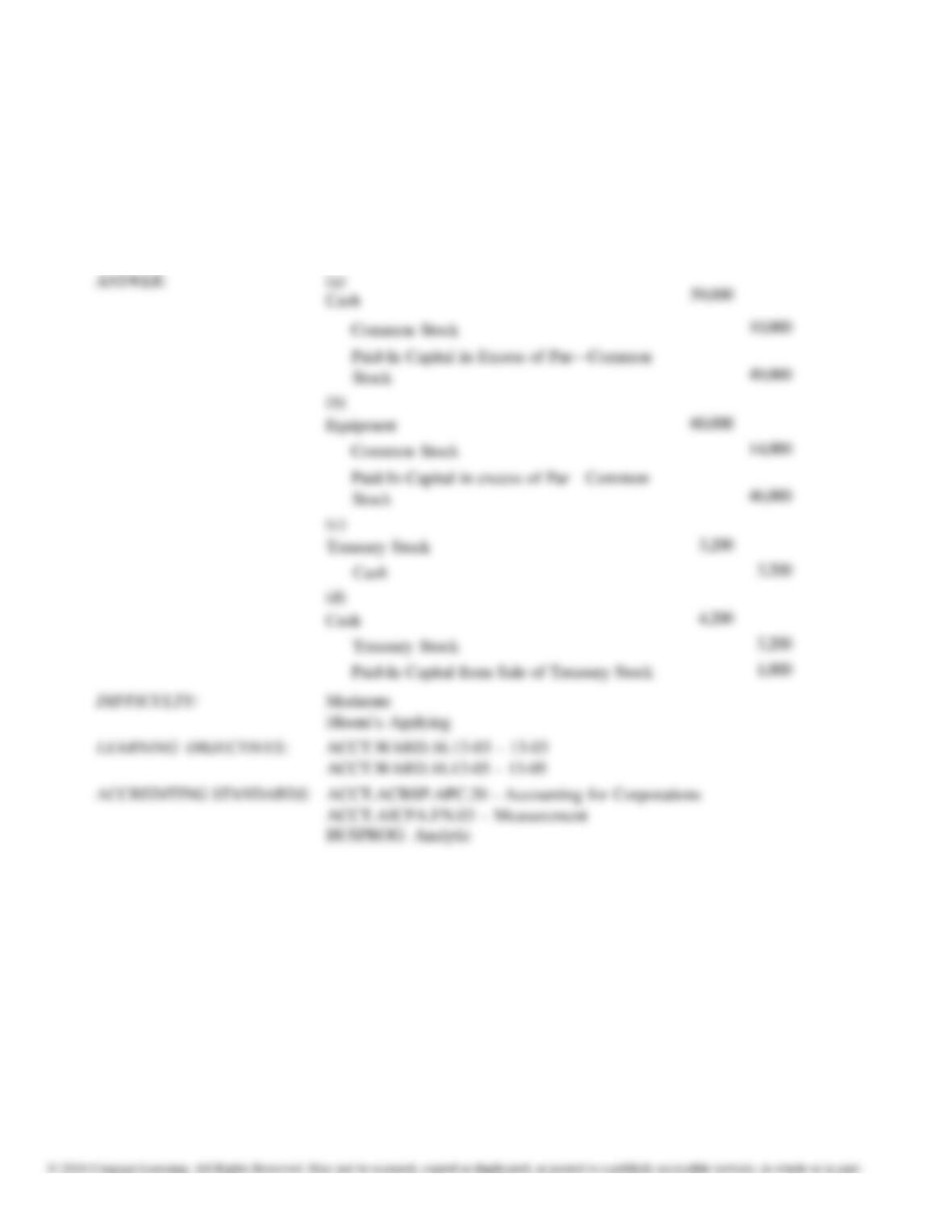
Prepare entries to record the following:
(a)
Issued 1,000 shares of $10 par common stock at $56.
(b)
Issued 1,400 shares of $10 par common stock in exchange for equipment with a fair
market price of $21,000.
(c)
Purchased 100 shares of treasury stock at $25.
(d)
Sold the 100 shares of treasury stock purchased in (c) at $30.
Chapter 13: Corporations: Organization, Stock Transactions, and Dividends
151.
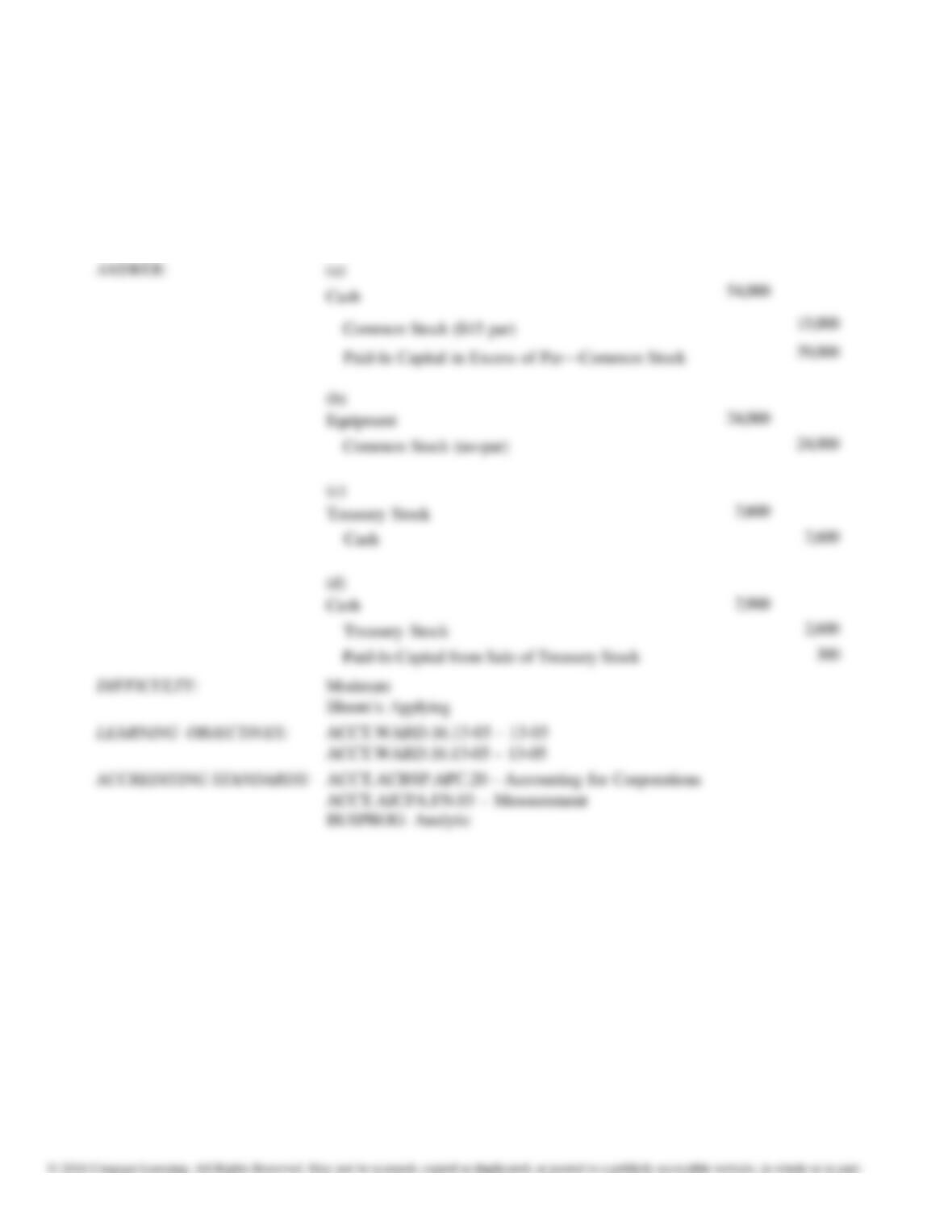
Prepare entries to record the following:
(a)
Issued 1,000 shares of $10 par common stock at $59 for cash.
(b)
Issued 1,400 shares of $10 par common stock in exchange for equipment with a fair
market price of $60,000.
(c)
Purchased 100 shares of treasury stock at $32.
(d)
Sold the 100 shares of treasury stock purchased in (c) at $42.
Chapter 13: Corporations: Organization, Stock Transactions, and Dividends
152.
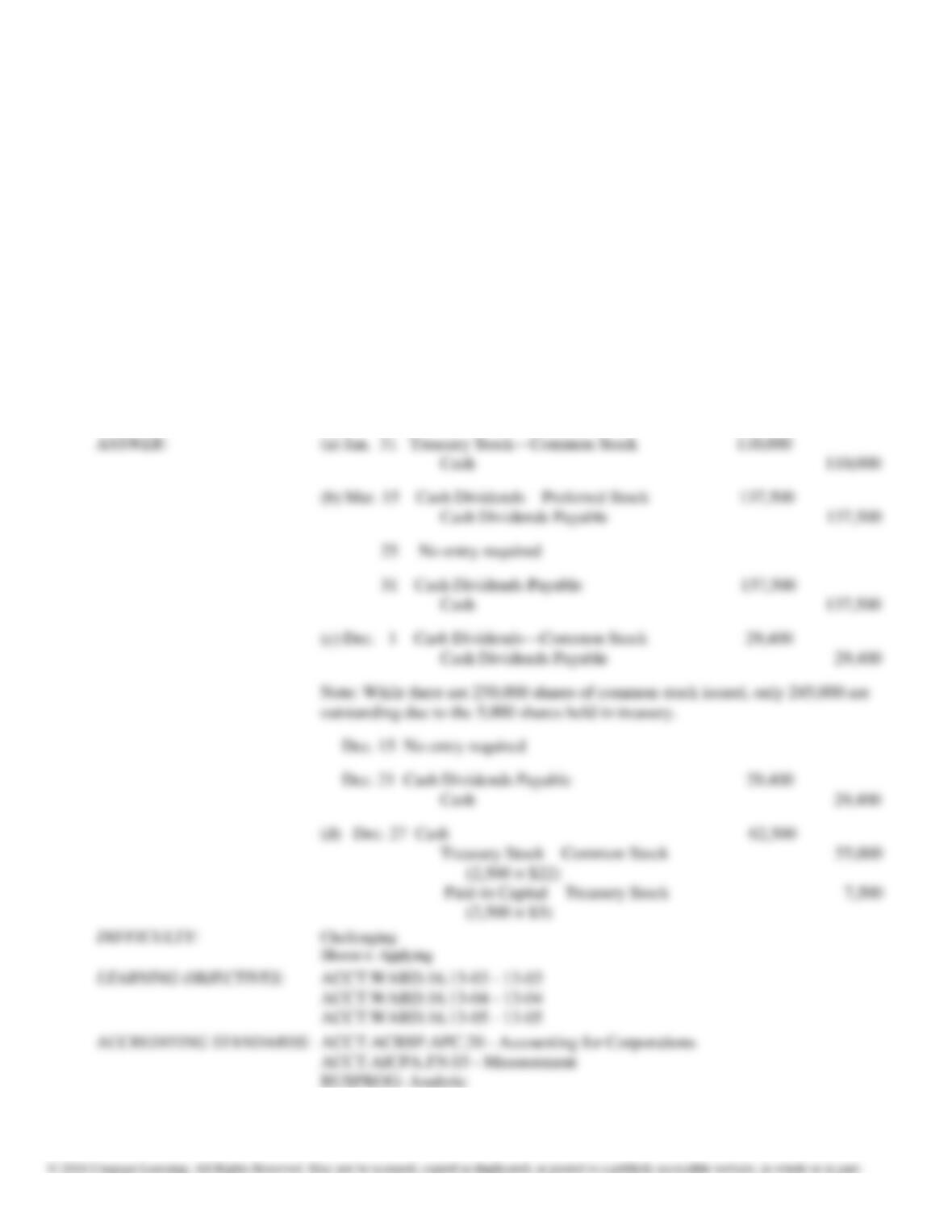
Prepare entries to record the following:
(a)
Issued 1,000 shares of $15 par common stock at $54 for cash.
(b)
Issued 1,400 shares of no-par common stock in exchange for equipment with a fair
market price of $24,000.
(c)
Purchased 100 shares of treasury stock at $26.
(d)
Sold 100 shares of treasury stock purchased in (c) at $29.
Chapter 13: Corporations: Organization, Stock Transactions, and Dividends
153.
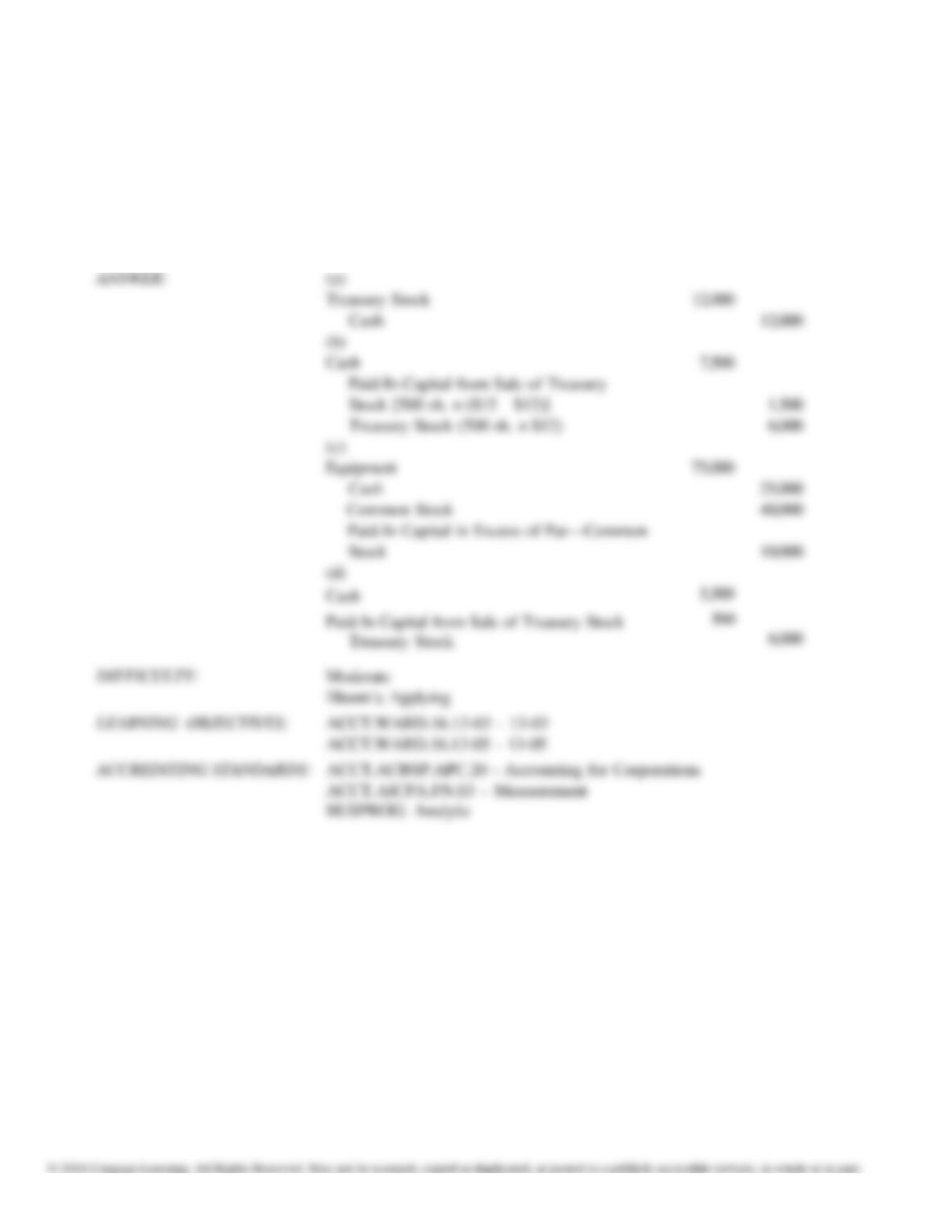
Carmen Company is a corporation that has issued both preferred and common stock. As of January 1, it had 50,000
shares of 2.75% $100 par, preferred stock outstanding and 250,000 shares of $10 par common stock outstanding.
Journalize the following transactions.
(a)
On January 31, the board of directors issues a requirement to purchase 5,000 shares of its common stock at
market price. The shares are purchased at a market price of $22 per share.
(b)
On March 15, Carmen declares a dividend on preferred stock of $2.75 per share. The date of record is
March 25 and the date of payment is March 31.
(c)
On December 1, Carmen declares a cash dividend on common stock of $0.12 per share. The date of record is
December 15 and the date of payment is December 21.
(d)
On December 27, the board orders that 2,500 shares of the treasury stock purchased in (a) be sold. The sale
price is $25 per share.
154.
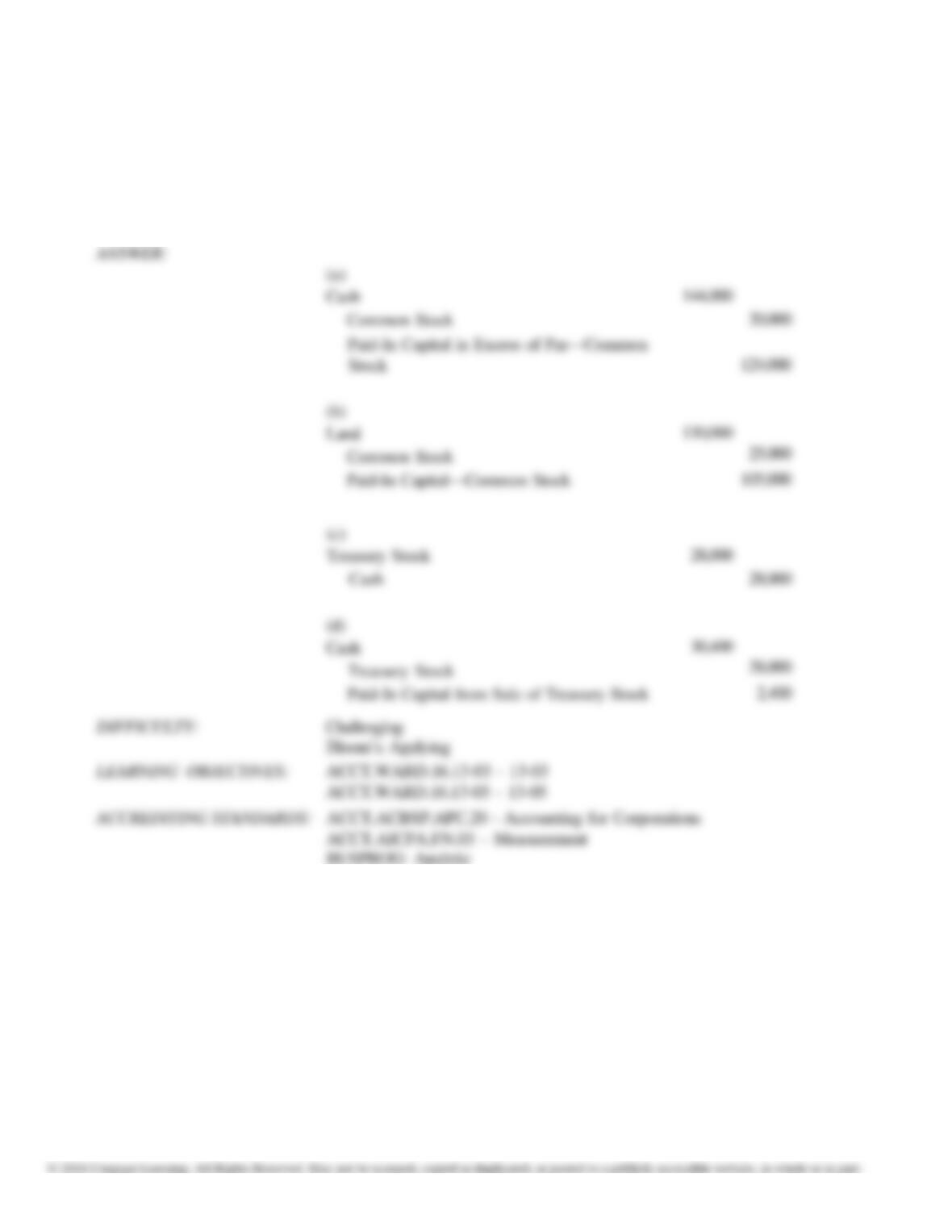
A company has 10,000 shares of $10 par common stock outstanding. Prepare entries to record the following:
Chapter 13: Corporations: Organization, Stock Transactions, and Dividends
(a)
Purchased 1,000 shares of treasury stock at $12. The treasury stock is accounted for by the
cost method. There were no previous purchases of treasury shares.
(b)
Sold 500 shares of treasury stock at $15.
(c)
Purchased equipment for $75,000, paying $25,000 in cash and issuing 4,000 shares of
common stock for the remaining.
(d)
Sold 500 shares of treasury stock at $11.
Chapter 13: Corporations: Organization, Stock Transactions, and Dividends
155.
Prepare entries to record the transactions for Maine Corp.:
(a)
Issued 2,000 shares of $10 par common stock at $72 for cash.
(b)
Issued 2,500 shares of common stock in exchange for land with a fair market price of
$130,000.
(c)
Purchased 400 shares of treasury stock at $70.
(d)
Sold the 400 shares of treasury stock purchased in (c) at $76.