Chapter 13 – Statement of Cash Flows
121. Income tax expense was $175,000 for the year. Income tax payable was $30,000 and $40,000 at the beginning and
end of the year, respectively. Cash payments for income tax reported on the statement of cash flows using the direct
method is
a.
$175,000
b.
$165,000
c.
$205,000
d.
$215,000
for the year – Ending income tax payable = $30,000 + $175,000 – $40,000 = $165,000
122. Free cash flow is
a.
all cash in the bank
b.
cash from operations
c.
cash from financing less cash used to purchase fixed assets to maintain productive capacity and cash used for
dividends
d.
cash flow from operations less cash used to purchase fixed assets to maintain productive capacity
123. Free cash flow is flow cash from operations less cash used for
a.
investments in PP&E needed to maintain current operations
b.
dividends and cash to redeem bonds payable
c.
investments in PP&E needed to achieve desired future operations
d.
fixed assets needed to maintain current operations and cash to redeem bonds payable
124. The operating cash flow available for company use after purchasing the fixed assets that are necessary to maintain
current operations is called the
a.
free cash flow
b.
modified cash flow
c.
PPE cash flow
d.
restricted cash flow
125. The cost of goods sold during the year was $45,000. Inventories were $13,500 and $10,500 at the beginning and end
of the year, respectively. Accounts payable (all owed to merchandise suppliers) were $7,000 and $5,000 at the beginning
and end of the year, respectively. Using the direct method of reporting cash flows from operating activities, cash
payments for merchandise total
a.
$46,000
b.
$44,000
c.
$50,000
d.
$40,000
year – Ending accounts payable = $7,000 + $42,000 – $5,000 = $44,000
126. When using the Spreadsheet (work sheet) method to analyze noncash accounts, it is best to start with
a.
cash
b.
net income
c.
retained earnings
d.
revenue
Chapter 13 – Statement of Cash Flows
127. When using the spreadsheet (work sheet) for the statement of cash flows, indirect method, entries made on the
spreadsheet are
a.
not recorded in the journal or posted to the ledger
b.
recorded in the journal and posted to the ledger
c.
recorded in the journal but not posted to the ledger
d.
not recorded in to the journal but are posted to the ledger
DIFFICULTY:
Bloom’s: Remembering
Easy
FNMN.WARD.17.13-APP1 – LO: 13–APP1
ACCREDITING STANDARDS:
ACCT.ACBSP.APC.24 – Statement of Cash Flows
ACCT.AICPA.FN.03 – Measurement
BUSPROG: Analytic
For each of the following activities that may take place during the accounting period, indicate the effect (a–g) on the
statement of cash flows prepared using the indirect method. Choices may be selected as the answer for more than one
question.
a.
Increase cash from operating activities
b.
Decrease cash from operating activities
c.
Increase cash from investing activities
d.
Decrease cash from investing activities
e.
Increase cash from financing activities
f.
Decrease cash from financing activities
g.
Noncash investing and financing supplement
DIFFICULTY:
Bloom’s: Remembering
Moderate
LEARNING OBJECTIVES:
FNMN.WARD.17.13-01 – LO: 13–01
FNMN.WARD.17.13-02 – LO: 13–02
FNMN.WARD.17.13-03 – LO: 13–03
FNMN.WARD.17.13-04 – LO: 13–04
ACCREDITING STANDARDS:
ACCT.ACBSP.APC.24 – Statement of Cash Flows
ACCT.AICPA.FN.03 – Measurement
BUSPROG: Analytic
128. Purchase of equipment
129. Repayment of long-term note payable
DIFFICULTY:
Bloom’s: Remembering
FNMN.WARD.17.13-APP1 – LO: 13–APP1
Chapter 13 – Statement of Cash Flows
130. Amortization of intangible assets
131. Exchange of land for common stock
132. Payment of dividends
133. Sale of land
134. Gain on sale of investments
135. Acquisition of treasury stock
136. Increase in accounts receivable balance
137. Decrease in accounts payable balance
Identify the section of the statement of cash flows (a–d) where each of the following items would be reported.
a.
Operating activities
b.
Financing activities
c.
Investing activities
d.
Schedule of noncash financing and investing
DIFFICULTY:
Bloom’s: Remembering
Easy
LEARNING OBJECTIVES:
FNMN.WARD.17.13-01 – LO: 13–01
FNMN.WARD.17.13-02 – LO: 13–02
FNMN.WARD.17.13-03 – LO: 13–03
FNMN.WARD.17.13-04 – LO: 13–04
ACCREDITING STANDARDS:
ACCT.ACBSP.APC.24 – Statement of Cash Flows
ACCT.AICPA.FN.03 – Measurement
BUSPROG: Analytic
138. Increase in income taxes payable
139. Dividends received on investment
140. Sale of machinery held for use by the company
Chapter 13 – Statement of Cash Flows
141. Issuance of bond payable
142. Purchase of the stock of another company as investment
143. Decrease in inventory
144. Exchange of land for note payable
145. Payment of dividends to stockholders
146. Increase in accounts receivable
147. Loss on sale of equipment
148. For each of the following, identify whether it would be disclosed as an operating (O), financing (F), or investing (I)
activity on the statement of cash flows under the indirect method.
a.
purchased buildings
b.
sold patents
c.
net income
d.
issued common stock
e.
paid cash dividends
f.
depreciation expense
a.
I – investing
b.
I – investing
c.
O – operating
d.
F – financing
e.
F – financing
f.
O – operating
Chapter 13 – Statement of Cash Flows
149. State the section(s) of the statement of cash flows prepared by the indirect method (operating activities, investing
activities, financing activities, or not reported) and the amount that would be reported for each of the following
transactions:
(a)
Received $120,000 from the sale of land costing $70,000
(b)
Purchased investments for $75,000
(c)
Declared $35,000 cash dividends on stock. $5,000 dividends were payable at the beginning
of the year, and $6,000 were payable at the end of the year
(d)
Acquired equipment for $64,000 cash
(e)
Declared and issued 100 shares of $20 par common stock as a stock dividend, when the
market price of the stock was $32 a share
(f)
Recognized depreciation for the year, $37,000
(g)
Issued 85,000 shares of $10 par common stock for $25 a share, receiving cash
(h)
Issued $500,000 of 20-year, 10% bonds payable at 99
(i)
Borrowed $43,000 from Regional Bank, issuing a 5-year, 8% note for that amount
(a)
Investing activities, $120,000 ($50,000 gain on the sale would be deducted from
net income in determining the cash flows from operating activities)
(b)
Investing activities, ($75,000)
$5,000 + $35,000 – $6,000 = $34,000
(d)
Investing activities, ($64,000)
(e)
Not reported
Operating activities, $37,000 (addition to net income in determining cash flows
from operating activities)
(h)
Financing activities, $495,
Cash from financing activities = $500,000 × (99 / 100) = $495,000
(i)
Financing activities, $43,000
Chapter 13 – Statement of Cash Flows
150. Identify which section the statement of cash flows (using the indirect method) would present information regarding
the following activities. (Use O for operating, I for investing, or F for financing).
a. Issued common stock
b. Redeemed bonds
c. Issued preferred stock
d. Purchased patents
e. Net income
f. Paid cash dividends
g. Purchased treasury stock
h. Sold long-term investment
i. Sold equipment
j. Purchased buildings
k. Issued bonds
k. F
151. For each of the following, identify whether it would be disclosed as an operating (O), financing (F), or investing (I)
activity on the statement of cash flows under the indirect method.
a.
Purchased treasury stock
b.
Sold equipment at book value
c.
Net income
d.
Sold long-term investments
e.
Issued common stock
f.
Depreciation expense
a.
F – financing
b.
I – investing
c.
O – operating
d.
I – investing
e.
F – financing
f.
O – operating
Chapter 13 – Statement of Cash Flows
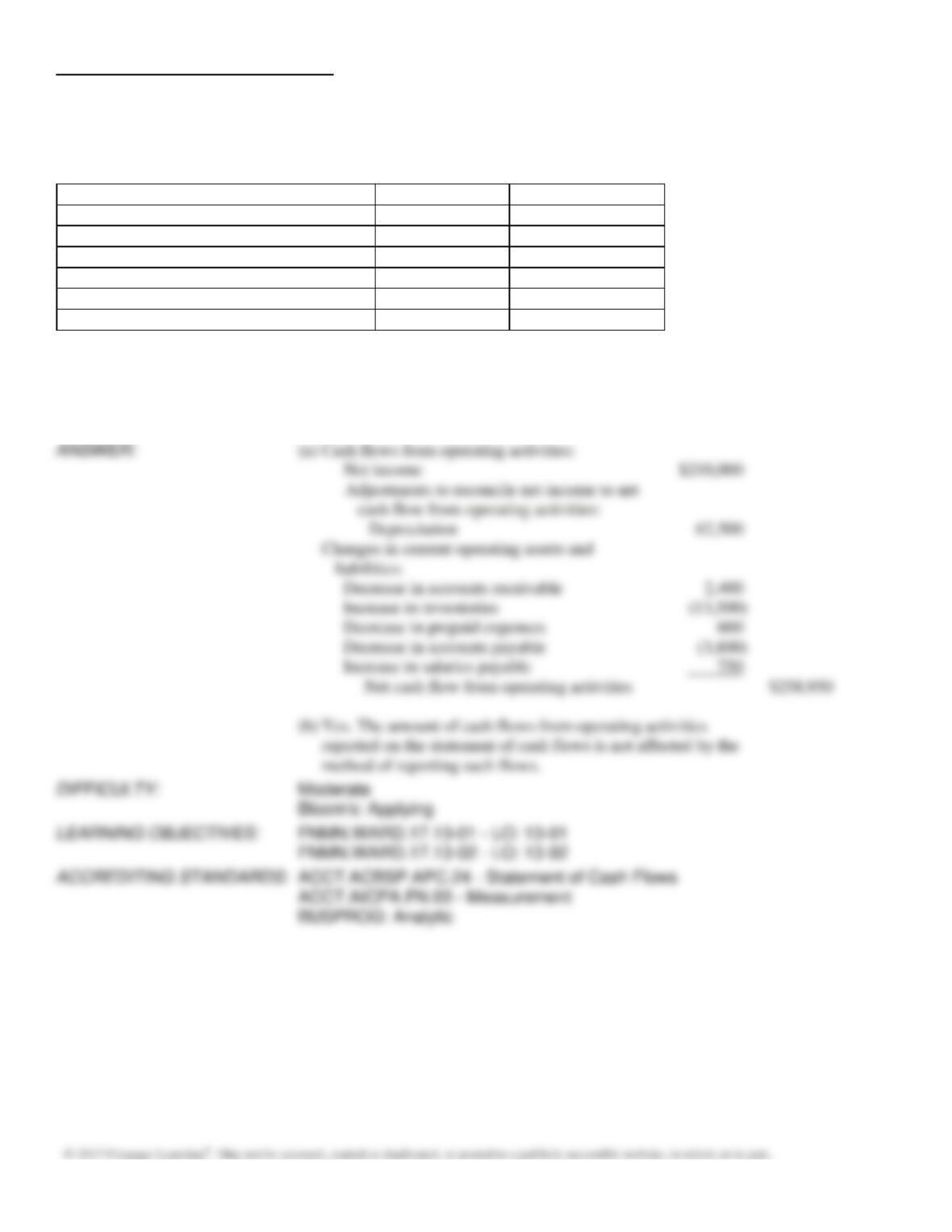
152. The net income reported on the income statement for the current year was $210,000. Depreciation recorded on
equipment and a building amount to $62,500 for the year. Balances of the current asset and current liabilities accounts at
the beginning and end of the year are as follows:
End of Year
Beginning of Year
Cash
$ 56,000
$ 59,500
Accounts receivable (net)
71,000
73,400
Inventories
140,000
126,500
Prepaid expenses
7,800
8,400
Accounts payable (merchandise creditors)
62,600
66,400
Salaries payable
9,000
8,250
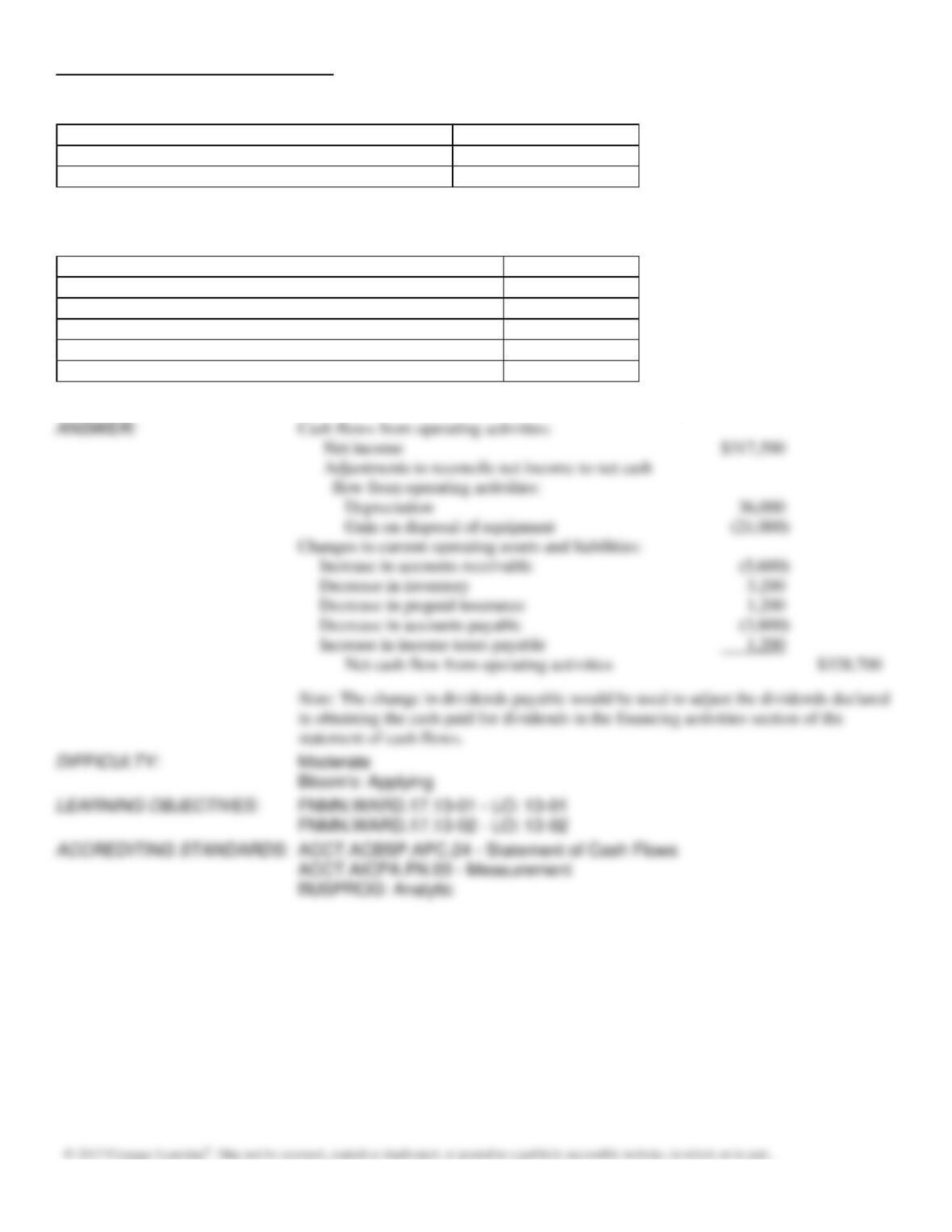
(a)
Prepare the cash flows from operating activities section of the statement of
cash flows, using the indirect method.
(b)
If the direct method had been used, would the net cash flow from operating
activities have been the same? Explain.
(a)
Cash flows from operating activities:
Depreciation
Changes in current operating assets and
Decrease in accounts receivable
Increase in inventories
Decrease in prepaid expenses
Decrease in accounts payable
Increase in salaries payable
Net cash flow from operating activities
reported on the statement of cash flows is not affected by the
Chapter 13 – Statement of Cash Flows
153. The income statement disclosed the following items for the current year:
Depreciation expense
$ 36,000
Gain on disposal of equipment
21,000
Net income
317,500
Balances of the current assets and current liabilities accounts changed between December 31, last year, and December 31,
this year, as follows:
Increase in accounts receivable
$5,600
Decrease in inventory
3,200
Decrease in prepaid insurance
1,200
Decrease in account payable
3,800
Increase in income taxes payable
1,200
Increase in dividends payable
850
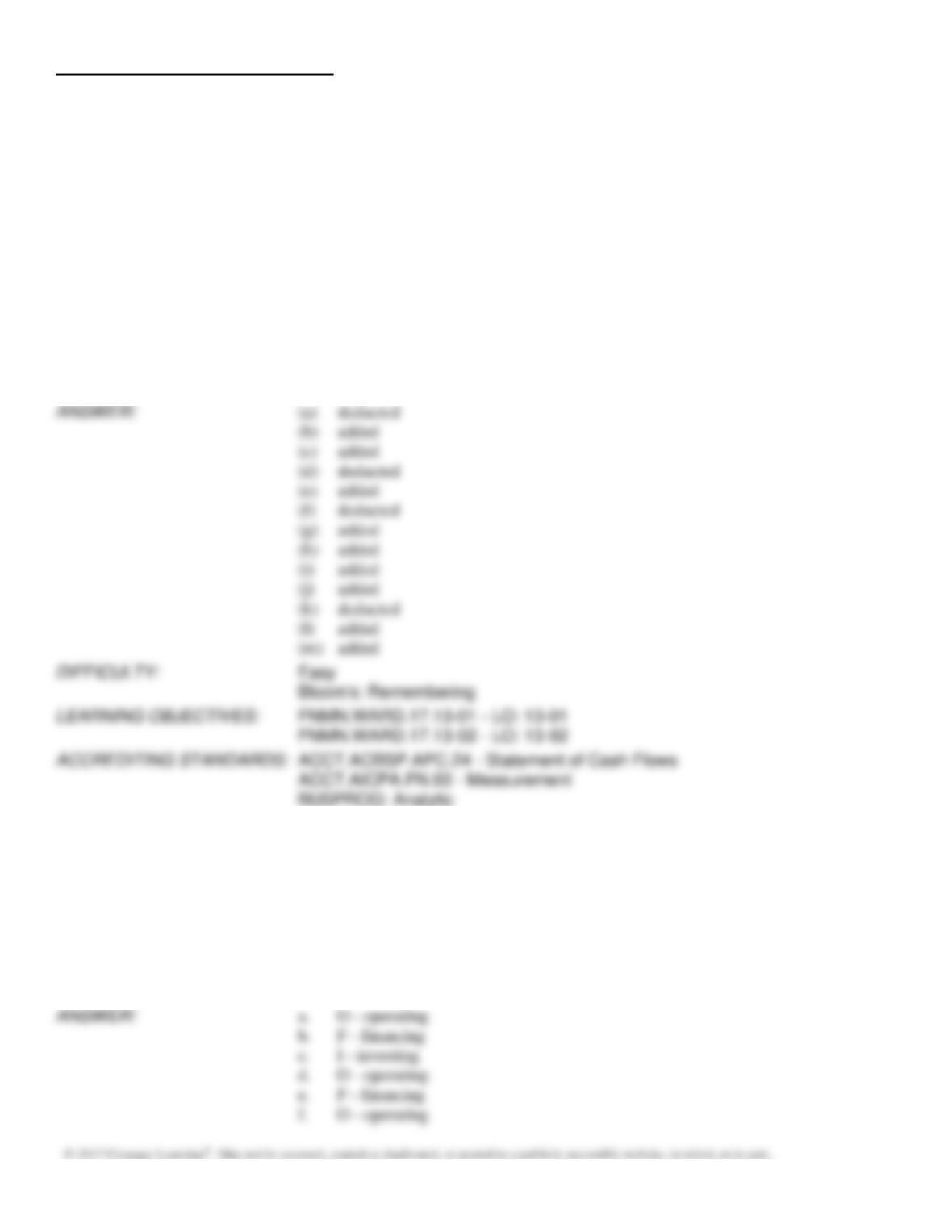
Prepare the cash flows from operating activities section of the statement of cash flows using the indirect method.
Cash flows from operating activities:
Net income
Adjustments to reconcile net income to net cash
flow from operating activities:
Depreciation
Gain on disposal of equipment
Changes in current operating assets and liabilities:
Increase in accounts receivable
Decrease in inventory
Decrease in prepaid insurance
Decrease in accounts payable
Net cash flow from operating activities
Chapter 13 – Statement of Cash Flows
154. Indicate whether each of the following would be added to or deducted from net income in determining net cash flow
from operating activities by the indirect method:
(a)
Increase in prepaid expenses
(b)
Amortization of patents
(c)
Increase in salaries payable
(d)
Gain on sale of fixed assets
(e)
Decrease in accounts receivable
(f)
Increase in notes receivable due in 60 days
(g)
Amortization of discount on bonds payable
(h)
Decrease in inventory
(i)
Depreciation of fixed assets
(j)
Loss on retirement of long-term debt
(k)
Decrease in accounts payable
(l)
Increase in notes payable due in 30 days
(m)
Increase in income taxes payable
(a)
deducted
(b)
added
(c)
added
(d)
deducted
(e)
added
(f)
deducted
(g)
added
(h)
added
(i)
added
(j)
added
(k)
deducted
(l)
added
(m)
added
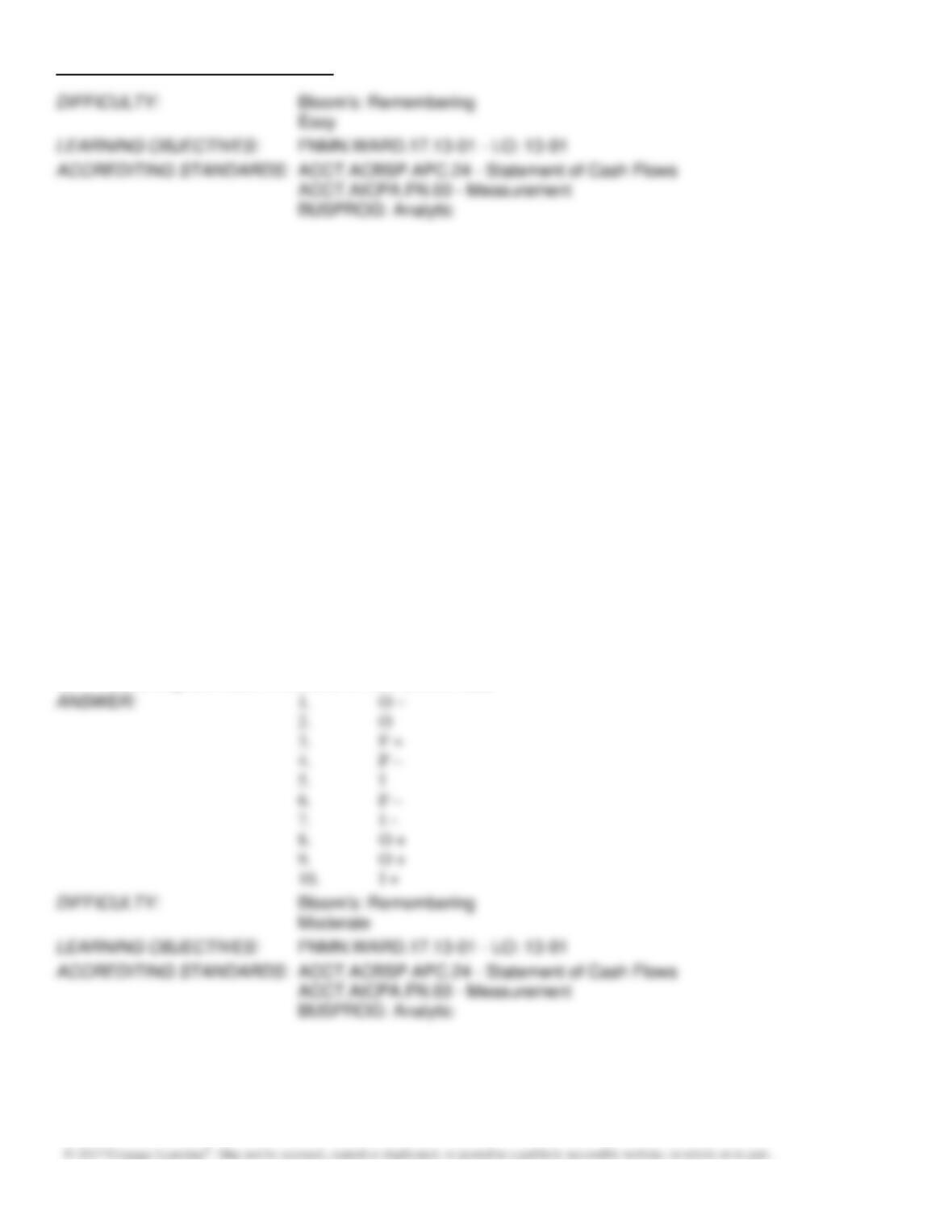
155. For each of the following, identify whether it would be disclosed as an operating (O), financing (F), or investing (I)
activity on the statement of cash flows under the indirect method.
a.
Received dividends
b.
Paid of dividends
c.
Purchase of equipment
d.
Net income
e.
Issued company’s common stock
f.
Amortization expense
a.
O – operating
b.
F – financing
c.
I – investing
e.
F – financing
f.
O – operating
Chapter 13 – Statement of Cash Flows
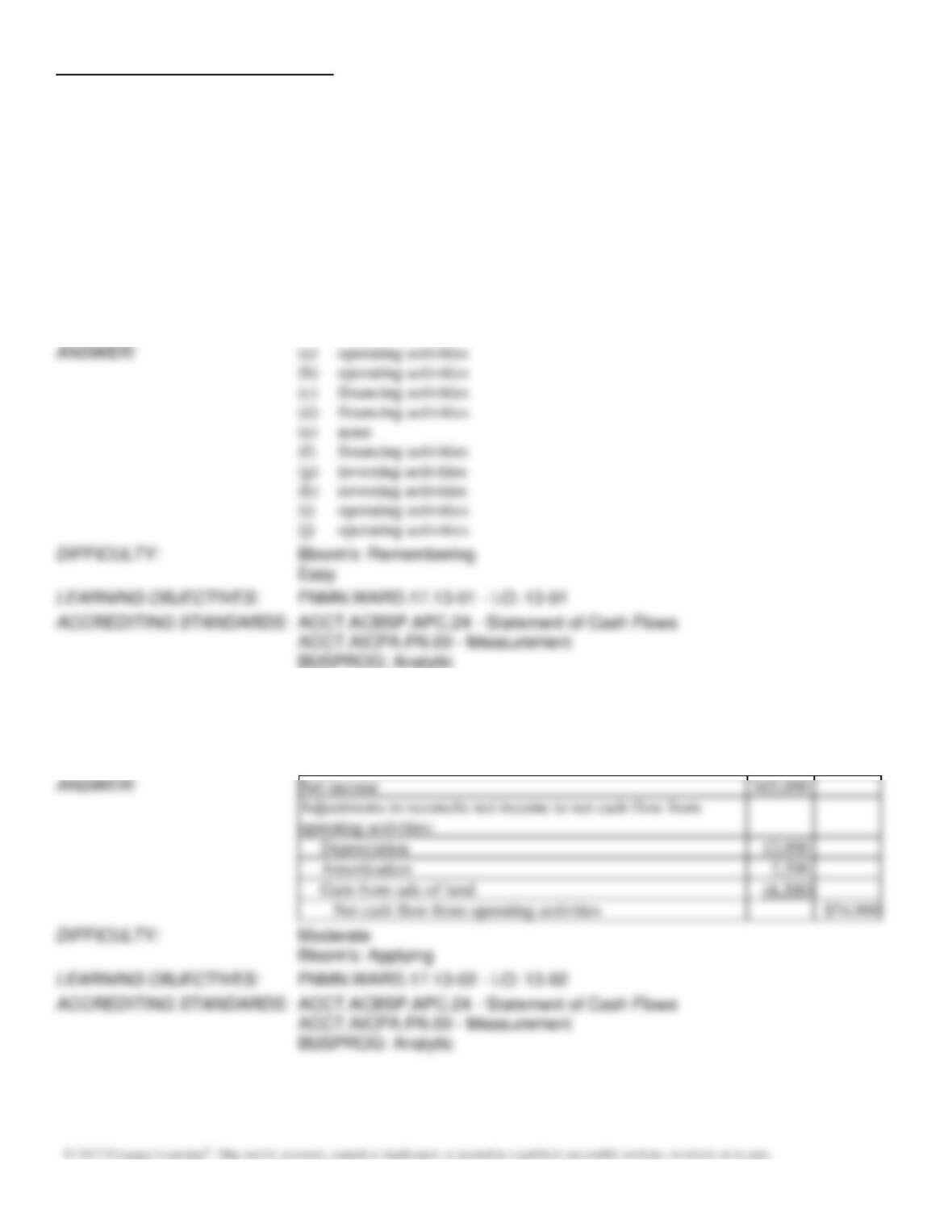
156. Each of the events below may have an effect on the statement of cash flows. Designate how the event should be
reported within the statement of cash flows using the codes provided below. Codes may be used more than once, or not at
all.
Codes:
I +
investing activity; cash inflow
I –
investing activity; cash outflow
F +
financing activity; cash inflow
F –
financing activity; cash outflow
O +
operating activity; cash inflow
O –
operating activity; cash outflow
NC
noncash investing and financing activity
Events:
1.
Paid the weekly payroll
2.
Paid an account payable
3.
Issued bonds payable for cash
4.
Declared and paid a cash dividend
5.
Paid cash for a new piece of equipment
6.
Purchased treasury stock for cash
7.
Paid cash for stock in another company
8.
Received interest on a long-term bond investment
9.
Received cash for sales
10.
Sold a long-term stock investment for cash at book value
1.
O –
2.
O –
3.
F +
4.
F –
5.
I –
6.
F –
7.
I –
8.
O +
9.
O +
10.
I +
Chapter 13 – Statement of Cash Flows
157. Indicate the section (operating activities, investing activities, financing activities, or none) in which each of the
following would be reported on the statement of cash flows prepared by the indirect method:
(a)
Gain on sale of fixed assets
(b)
Net income
(c)
Retirement of long-term debt
(d)
Sale of capital stock
(e)
Distribution of stock dividends
(f)
Payment of cash dividends
(g)
Purchase of fixed assets
(h)
Sale of fixed assets
(i)
Receipt of interest revenue
(j)
Payment of interest expense
(a)
operating activities
(b)
operating activities
(c)
financing activities
(d)
financing activities
(e)
(f)
financing activities
(g)
investing activities
(h)
investing activities
(i)
operating activities
(j)
operating activities
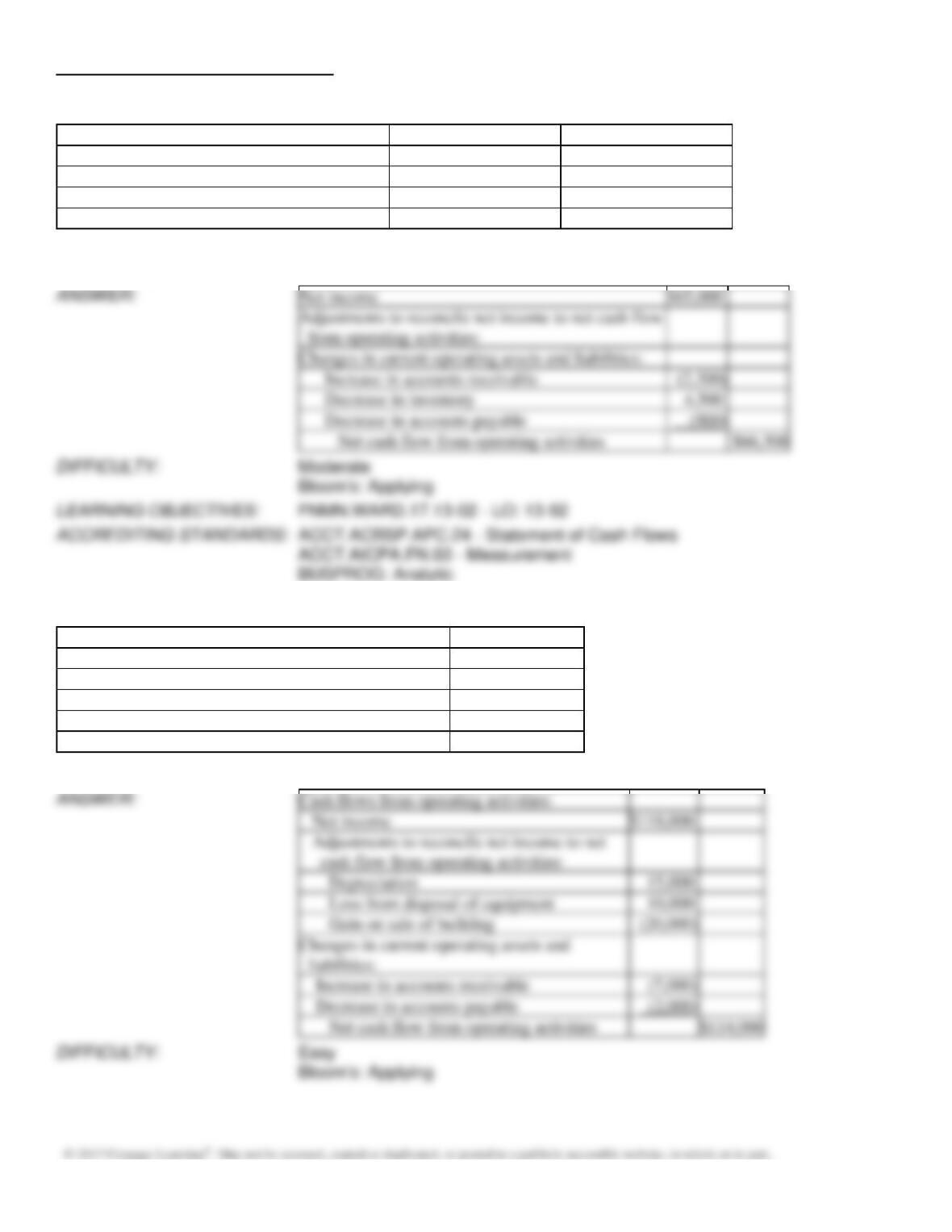
158. Durrand Corporation’s accumulated depreciation increased by $12,000, while patents decreased by $2,200 between
consecutive balance sheet dates. There were no purchases or sales of depreciable or intangible assets during the year. In
addition, the income statement showed a gain of $4,300 from sale of land. Reconcile a net income of $65,000 to net cash
flow from operating activities.
Net income
Depreciation
Amortization
Gain from sale of land
Net cash flow from operating activities
Chapter 13 – Statement of Cash Flows
159. Fortune Corporation’s comparative balance sheet for current assets and liabilities was as follows:
Dec. 31, Year 2
Dec. 31, Year 1
Accounts receivable
$ 7,500
$ 5,200
Inventory
11,500
16,000
Accounts payable
4,300
5,200
Dividends payable
4,000
3,000
Adjust Year 2 net income of $65,000 for changes in operating assets and liabilities to arrive at cash flows from operating
activities using the indirect method.
Net income
$65,000
Changes in current operating assets and liabilities:
Increase in accounts receivable
Decrease in inventory
Decrease in accounts payable
Net cash flow from operating activities
$66,300
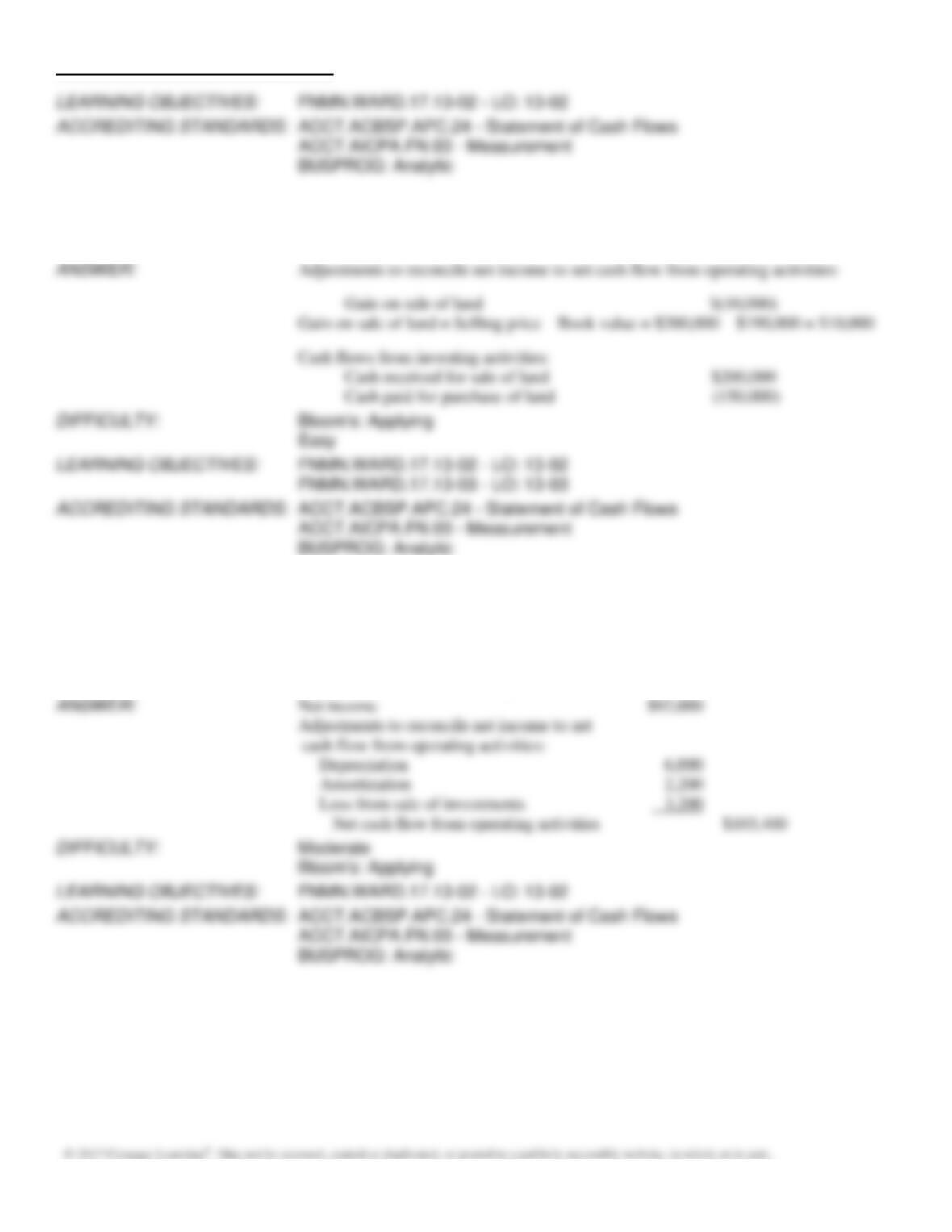
160. Kennedy, Inc. reported the following data:
Net income
$118,000
Depreciation expense
15,000
Loss on disposal of equipment
(10,000)
Gain on sale of building
20,000
Increase in accounts receivable
7,000
Decrease in accounts payable
(2,000)
Prepare the cash flows from operating activities section of the statement of cash flows using the indirect method.
Cash flows from operating activities:
$118,000
Depreciation
Loss from disposal of equipment
Gain on sale of building
Increase in accounts receivable
Decrease in accounts payable
$114,000
Chapter 13 – Statement of Cash Flows
161. Lamar Corporation purchased land for $150,000. Later in the year, the company sold land with a book value of
$190,000 for $200,000. Show how the effects of these transactions are reported on the statement of cash flows using the
indirect method.
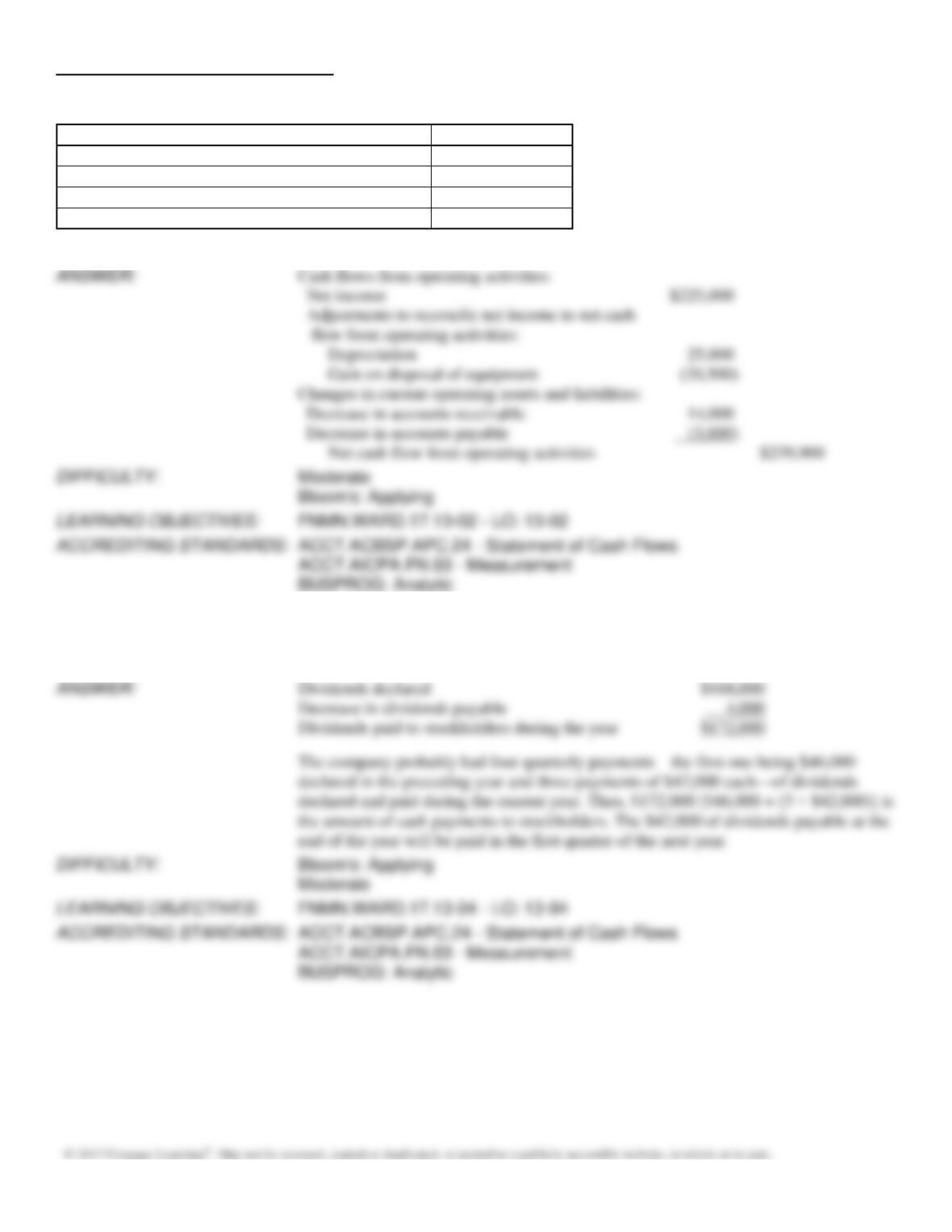
162. Samuel Company’s accumulated depreciation—equipment increased by $6,000, while patents decreased by $2,200
between balance sheet dates. There were no purchases or sales of depreciable or intangible assets during the year. In
addition, the income statement showed a loss of $3,200 from the sale of investments. Assume no changes in noncash
current assets and liabilities.
Reconcile a net income of $92,000 to net cash flow from operating activities.
Chapter 13 – Statement of Cash Flows
163. Dorman Company reported the following data:
Net income
$225,000
Depreciation expense
25,000
Gain on disposal of equipment
20,500
Decrease in accounts receivable
14,000
Decrease in account payable
3,600
Prepare the cash flows from operating activities section of the statement of cash flows using the indirect method.
Cash flows from operating activities:
Net income
Adjustments to reconcile net income to net cash
flow from operating activities:
Depreciation
Gain on disposal of equipment
Changes in current operating assets and liabilities:
Decrease in accounts receivable
Decrease in accounts payable
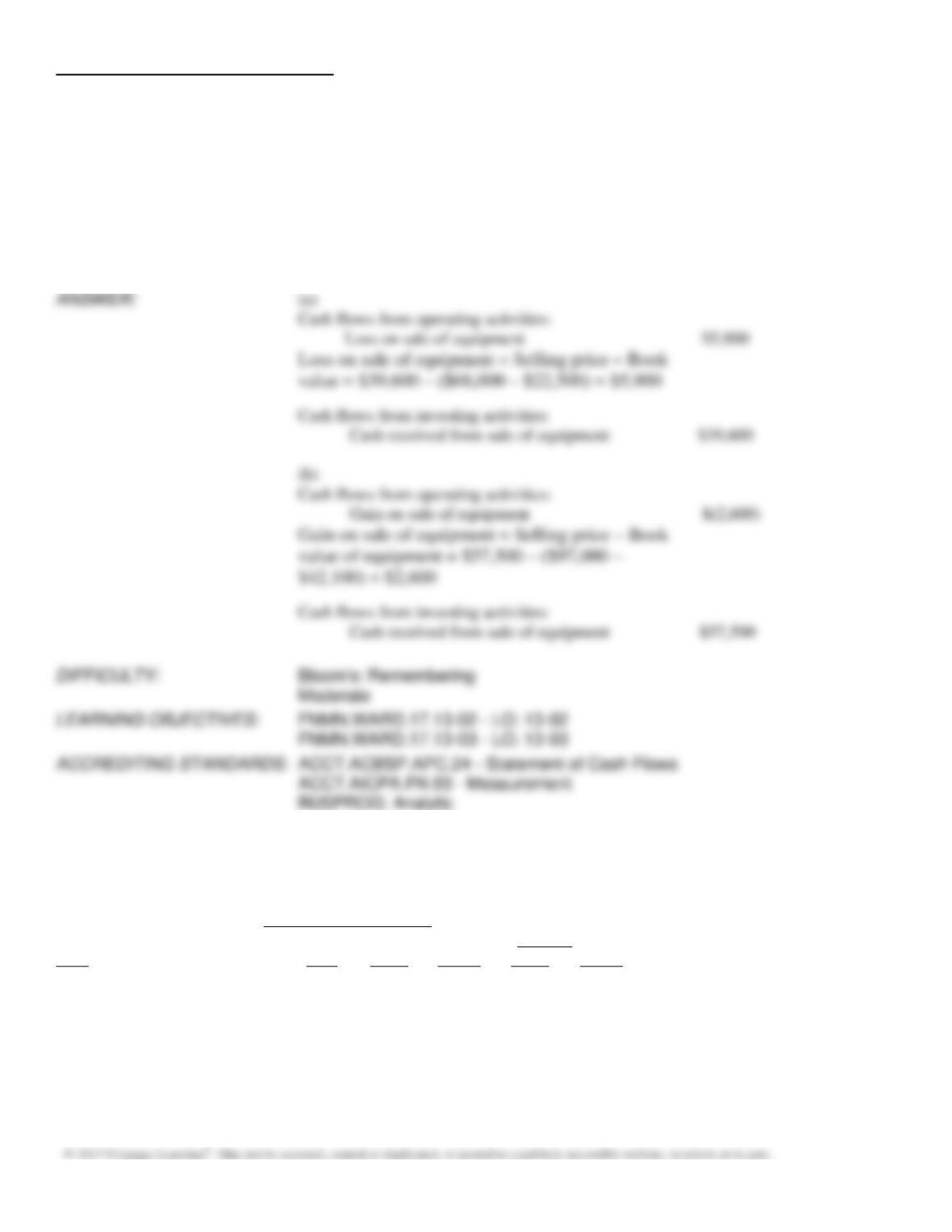
164. The board of directors declared cash dividends total $168,000 during the year. The comparative balance sheet
indicated dividends payable of $46,000 at the beginning of the year and $42,000 at the end of the year. What was the
amount of cash payments to stockholders during the year?
Dividends declared
Decrease in dividends payable
Dividends paid to stockholders during the year
Chapter 13 – Statement of Cash Flows
165. The following two scenarios are independent of one another.
(a)
An analysis of the general ledger accounts indicates that office equipment was
sold for $39,600 during the year. The equipment originally cost $68,000 and
had accumulated depreciation of $22,500 on the date of sale. Indicate how the
elements of this transaction would be reported on the statement of cash flows
using the indirect method.
(b)
An analysis of the general ledger accounts indicates that delivery equipment,
which cost $97,000 and on which accumulated depreciation totaled $42,100 on
the date of sale, was sold for $57,500 during the year. Using this information,
indicate the items to be reported on the statement of cash flows.
(a)
Cash flows from operating activities:
Loss on sale of equipment
Cash flows from investing activities:
Cash received from sale of equipment
(b)
Cash flows from operating activities:
Gain on sale of equipment
Cash flows from investing activities:
Cash received from sale of equipment
166. On the basis of the details of the common stock account presented below, calculate the total amount to be recorded in
financing section of the statement of cash flows. Assume any stock issues were at par.
Indicate whether the amount results in an increase or decrease in cash.
Common Stock, $10 Par
Balance
Date
Item
Debit
Credit
Debit
Credit
Jan. 1
Balance, 50,000 shares
—
—
—
$500,000
Mar. 7
5,000 shares issued at
par for cash
—
—
$50,000
550,000
Sept. 20
2,500-share stock
dividend
—
—
25,000
575,000
Dec. 10
2,000 shares issued at
$20 for cash
—
—
40,000
615,000
Chapter 13 – Statement of Cash Flows
Cash flows from financing activities:
Cash received from sale of common stock
167. The net income reported on an income statement for the current year was $63,000. Depreciation recorded on fixed
assets for the year was $24,000. Balances of the current asset and current liability accounts at the end and beginning of
the year are listed below. Prepare the Cash Flows from Operating Activities section of the statement of cash flows using
the indirect method.
End
Beginning
Cash
$65,000
$ 70,000
Accounts receivable (net)
70,000
57,000
Inventories
86,000
102,000
Prepaid expenses
4,000
4,500
Accounts payable (merchandise creditors)
51,000
58,000
Cash dividends payable
4,500
6,500
Salaries payable
6,000
7,500
Cash flows from operating activities:
Net income
Depreciation
Increase in accounts receivable (net)
Decrease in inventories
Decrease in repaid expenses
Decrease in accounts payable
Decrease in salaries payable
Net cash flow from operating activities
168. The board of directors of Kendall Co. declared cash dividends totaling $390,000 during the current year. The
comparative balance sheet indicates dividends payable of $58,000 at the beginning of the year and $73,000 at the end of
the year. What was the amount of cash payments Kendall Co. made to stockholders during the year?
Dividends declared
Increase in dividends payable
Dividends paid to stockholders during the year
Chapter 13 – Statement of Cash Flows
169. An analysis of the general ledger accounts indicates that equipment, with an original cost of $200,000 and
accumulated depreciation of $170,000 on the date of sale, was sold for $20,000 during the year. Using this information,
indicate the items to be reported on the statement of cash flows using the indirect method.
Cash flows from operating activities:
$10,000
Cash flows from investing activities:
$20,000
170. On the basis of the following data for Larson Co. for the year ending December 31 Year 2, and the preceding year
ended December 31 Year 1, prepare a statement of cash flows. Use the indirect method of reporting cash flows from
operating activities. In addition to the balance sheet data, assume that:
Equipment costing $125,000 was purchased for cash.
Equipment costing $85,000 with accumulated depreciation of $65,000 was sold for $15,000.
The stock was issued for cash.
The only entries in the retained earnings account were net income of $51,000 and cash dividends declared of $13,000.
Year 2
Year 1
Cash
$100,000
$ 78,000
Accounts receivable (net)
78,000
85,000
Inventories
101,500
90,000
Equipment
410,000
370,000
Accumulated depreciation
(150,000)
(158,000)
$539,500
$465,000
Accounts payable (merchandise creditors)
$ 58,500
$ 55,000
Cash dividends payable
5,000
4,000
Common stock, $10 par
200,000
170,000
Paid-in capital in excess of par—common stock
62,000
60,000
Retained earnings
214,000
176,000
$539,500
$465,000
Chapter 13 – Statement of Cash Flows