b.
cue
c.
beacon
d.
sensor
e.
code
33. Wendy generally buys tuberoses as their smell freshens up her room. She purchases them even though
they are not as pretty as some other flowers. However, when she buys flowers for her friends, she
generally chooses ornamental orchids and anthuriums, although they don’t smell sweet. Which of the
following is most likely responsible for Wendy’s choice of flowers?
a.
Social influences
b.
Online resources
c.
Product knowledge
d.
Expert opinions
e.
Situational influences
34. Henry has a penchant for furniture. When he bought a new sofa, he focused on features such as size,
fabric, cushions, and padding, and ignored any information irrelevant to the actual purchase. Which of
the following factors contributed to Henry’s selection of the sofa?
a.
Social influences
b.
Online resources
c.
Product knowledge
d.
Situational influences
e.
Financial concerns
35. Lisa wanted everything to be perfect when she organized a homecoming party for her husband, a
soldier who was stationed in Afghanistan. Lisa consulted a well-known food critic for the menu to be
served in the party. Which of the following factors is/are most likely associated with Lisa’s choice of
menu to be served in the party?
a.
Social influences
b.
Situational influences
c.
Product knowledge
d.
Expert opinions
e.
Online resources
36. When James and his wife were looking for a new house, they acknowledged the fact that they would
each consult their parents and then decide on the house to buy. Which of the following factors
contribute to their evaluation of alternatives?
a.
Marketing communications
b.
Product knowledge
c.
Expert opinions
d.
Social influences
e.
Online sources
37. When Kylie bought her laptop, she searched for product information at various retail sites on the
Internet which helped her decide the attributes she was looking for in a laptop. This is an example of
product choice influenced by _____.
a.
situational influences
b.
financial considerations
c.
online sources
d.
social influences
e.
marketing communications
38. Sam always makes it a point to have his coffee at Tans, a coffee shop that claims to use “authentic
Tanzanian peaberry coffee.” This is an example of product choice influenced by _____.
a.
situational influences
b.
expert opinions
c.
online sources
d.
social influences
e.
marketing communications
39. Mental assessments of the presence of attributes and the benefits associated with those attributes are
known as _____.
a.
judgments
b.
schemas
c.
maps
d.
scripts
e.
stereotypes
40. When John bought himself a phone with a camera, he chose the one that could take 12-megapixel
pictures over the one that could take 8-megapixel pictures. According to John, the picture resolution of
the one he bought was much better than the alternative choice. In buying the camera phone with a
better picture resolution, John’s judgment is most likely affected by _____.
a.
just noticeable difference
b.
attribute correlation
c.
brand name associations
d.
consumer personality
e.
financial considerations
41. The practice of offering essentially identical products with different model numbers or names is
known as _____.
a.
branded valuation
b.
branded variants
c.
brand equity
d.
brand extension
e.
brand diversification
42. The perceived relationship between the features or characteristics of products is known as _____.
a.
attribute hierarchy
b.
attribute filter
c.
attribute correlation
d.
attribute network
e.
attribute agreement
43. The actual quality of a product that can be assessed through industry specification or expert rating is
known as _____ quality.
a.
absolute
b.
objective
c.
perceived
d.
subjective
e.
specified
44. Which of the following statements is true about the issues that affect consumer judgments?
a.
Consumer judgments based on the perceived relationship between attributes of products
always lead to negatively biased implications about the product.
b.
Brand names have an impact on consumer judgments.
c.
If consumers cannot tell the difference between two options, then their judgments about
the products are highly accurate.
d.
Consumers who are highly impulsive make the best judgments.
e.
Brand inertia is often used by consumers as a signal of quality.
45. Which of the following is used to understand the attributes that guide preferences by having consumers
compare products across levels of evaluative criteria and the expected utility associated with the
alternatives?
a.
Cluster analysis
b.
Conjoint analysis
c.
Regression analysis
d.
Factor analysis
e.
Time series analysis
46. _____ rules allow consumers to select products that may perform poorly on one attribute by
compensating for the poor performance by good performance on another attribute.
a.
Conjunctive
b.
Disjunctive
c.
Compensatory
d.
Lexicographic
e.
Ordinate
47. A consumer who uses strict guidelines set prior to selection, and eliminates any option that fails to
meet the specifications from consideration is employing a(n) _____ rule.
a.
compliance
b.
elimination
c.
noncompensatory
d.
superordinate
e.
subordinate
48. Which of the following statements is true of noncompensatory models?
a.
Following the lexicographic rule, the consumer sets a minimum mental cutoff point for
various features and rejects any product that fails to meet or exceed this cutoff point across
all features.
b.
With the conjunctive rule, the cutoff point is usually high. The product that meets or
exceeds this cutoff on any feature is selected.
c.
These models allow consumers to select products that may perform poorly on one attribute
by compensating for the poor performance on another attribute.
d.
Following the subordinate rule, the consumer sets a minimum mental cutoff point for
various features and rejects any product that fails to meet or exceed this cutoff point across
all features.
e.
They are often used in low-involvement situations because these rules allow consumers to
simplify their thought processes.
49. The attitude-toward-the-object model represents a _____ approach.
a.
noncompensatory
b.
superordinate
c.
conjunctive
d.
disjunctive
e.
compensatory
50. When Carla had to select one among three vacation destinations, she ended up choosing the one that
actually scored low on an important attribute of being tourist friendly. She chose a location that was
least expensive and the most convenient to travel compared to the other two. Which of the following
decision rules is most likely to have influenced Carla’s choice?
a.
Conjunctive rule
b.
Lexicographic rule
c.
Exception rule
d.
Compensatory rule
e.
Compliance rule
51. Carl wants to buy either an XBox 360, a PS3, or a Nintendo Wii. He has identified two important
attributes to compare, price and game options. Carl decided that he would reject the ones that failed to
meet the minimum cutoffs he sets on both the attributes. Which of following decision rules is Carl
employing to choose a video game console?
a.
Conjunctive rule
b.
Ordinate rule
c.
Lexicographic rule
d.
Compensatory rule
e.
EBA rule
52. Serena is evaluating three different models of hair dryers, Model A, Model B, and Model C. She
assigns belief ratings from 1= very poor to 10= very good and importance ratings from 10= most
important to 1=least important. She sets a minimum mental cutoff point of 5 for all the features.
According to the conjunctive rule, which of the following is true?
Attributes
Importance
Model A
Model B
Model C
Belief ratings
Belief ratings
Belief ratings
Low price
8
7
4
3
Styling
9
6
7
4
Power efficiency
6
8
10
2
a.
She selects Model A, as all the features surpass 5.
b.
She selects Model B, as it has the highest power efficiency of 10.
c.
She selects Model C, as all the features score lower than the mental cutoff.
d.
She selects Model B, as it scores the highest on the styling criterion which is also the most
important criterion.
e.
She selects Model A, as it scores highest on the low price attribute.
53. Melissa wants to buy a new hair dryer. She considers five models and assigns them belief ratings from
1= very poor to 10= very good and importance ratings from 10= most important to 1=least important.
She sets a mental cutoff of 5 in order for the model to be selected. According to the conjunctive rule,
which of the following models would she select?
Attribute
Importance
Model A
Model B
Model C
Model D
Model E
Belief
ratings
Belief
ratings
Belief
ratings
Belief
ratings
Belief
ratings
Low price
8
7
4
3
1
3
Power
efficiency
6
6
6
5
8
2
Styling
9
8
7
6
7
9
a.
Model A
b.
Model B
c.
Model C
d.
Model D
e.
Model E
54. Melissa wants to buy a new hair dryer. She considers five models and assigns them belief ratings from
1= very poor to 10= very good and importance ratings from 10= most important to 1=least important.
She wants the model to excel at any one of the three features. She sets a mental cutoff, which is equal
to the highest importance rating. According to the disjunctive rule, which of the following models
would she select?
Attribute
Importance
Model A
Model B
Model C
Model D
Model E
Belief
ratings
Belief
ratings
Belief
ratings
Belief
ratings
Belief
ratings
Low price
8
7
4
3
1
3
Power
efficiency
6
6
6
5
8
2
Styling
9
8
7
6
7
9
a.
Model A
b.
Model B
c.
Model C
d.
Model D
e.
Model E
55. When a consumer selects a product that he or she believes performs best on the most important
feature, the consumer is employing the _____ rule.
a.
conjunctive
b.
disjunctive
c.
lexicographic
d.
subordinate
e.
compensatory rule
56. Lisa plans to buy herself a sewing machine for sewing dresses for her daughters. She evaluates
different brands of the product and decides that she should get the one which makes the least noise as
that would allow her to work while her children are asleep. She finally buys the one which makes the
least noise. Which of the following is most likely to account for Lisa’s choice of sewing machine?
a.
Compensatory rule
b.
Conjunctive rule
c.
Lexicographic rule
d.
Elimination-by-aspects (EBA) rule
e.
Disjunctive rule
57. Melissa wants to buy a new hair dryer. She considers five models and assigns them belief ratings from
1= very poor to 10= very good, and importance ratings from 10= most important to 1=least important.
She sets a mental cutoff of 5 as a selection criterion for the model. According to the lexicographic rule,
which of the following models would she select?
Attribute
Importance
Model A
Model B
Model C
Model D
Model E
Belief
ratings
Belief
ratings
Belief
ratings
Belief
ratings
Belief
ratings
Low price
8
7
4
3
1
3
Power
efficiency
6
6
6
5
8
9
Styling
9
6
7
8
7
2
a.
Model D
b.
Model B
c.
Model C
d.
Model A
e.
Model E
58. John is evaluating four brands of 3D televisions and has decided that picture quality is the most
important attribute. As all of the alternatives exceeded his minimum cutoff for picture quality, he then
compared them on price. An option which John perceived as too expensive was eliminated from
further consideration as it exceeded the price cutoff he had set. He then compared the remaining three
alternatives in terms of the number of HDMI inputs and eliminated one which did not possess the
minimum number of inputs. He continued in this manner until he was left with only one of the
alternatives which he finally decided to purchase. Which of the following rules did John employ to
decide on his purchase?
a.
Conjunctive rule
b.
Disjunctive rule
c.
Compensatory rule
d.
Lexicographic rule
e.
EBA rule
59. Melissa wants to buy a new hair dryer. She considers five models and assigns them belief ratings from
1= very poor to 10= very good and importance ratings from 10= most important to 1=least important.
She sets a mental cutoff of 5 as a selection criterion for the model. According to the elimination-by-
aspects rule, which of the following models would she select?
Attribute
Importance
Model A
Model B
Model C
Model D
Model E
Belief
ratings
Belief
ratings
Belief
ratings
Belief
ratings
Belief
ratings
Low price
8
7
4
3
6
3
Power
efficiency
6
4
6
7
8
2
Styling
9
8
7
6
7
9
a.
Model D
b.
Model B
c.
Model C
d.
Model A
e.
Model E
ENERGY BAR SCENARIO
Nutrition labels on products provide considerable information for consumers. For example, a
consumer deciding among the many brands of energy bars might compare three offerings: Crayton
Bar, Goodie-meal Bar, and Snacky-Bar. The most important attribute for this consumer is protein
content, followed by calories, taste, sugar, price and fat content. This consumer would like an energy
bar with high-protein content but low in calories, sugar, fat, and price, and also one that tastes good.
Information for all the attributes is found on the product nutrition label except for the taste attribute.
This information is summarized in the following table:
Attributes in order of importance
Crayton
Bar
Goodie-meal
Bar
Snacky-
Bar
Protein
10 grams
5 grams
8 grams
Calories
250
350
190
Taste
?
?
?
Sugar
14 grams
17 grams
13
grams
Price
$1.13
$1.05
$2.50
Fat
5 grams
3 grams
8 grams
60. Refer to Energy Bar Scenario. This consumer is evaluating the three brands across a set of features or
characteristics for each different brand of the energy bar. In doing so, the consumer is employing a(n)
_____ evaluation.
a.
affect-based
b.
attribute-based
c.
belief-based
d.
satisfaction-based
e.
benefit-based
61. Refer to Energy Bar Scenario. The consumer also evaluated the three bars along the criterion of
product price. Product price is an example of a(n) _____ attribute.
a.
underlying
b.
experience
c.
perceptual
d.
objective
e.
primary
62. Refer to Energy Bar Scenario. According to product categorization, energy bars are an example of
_____ categories.
a.
subordinate
b.
primary
c.
ordinate
d.
tertiary
e.
secondary
63. Refer to Energy Bar Scenario. The consumer is unaware of the taste of the three bars. Taste is an
example of a(n) _____ attribute.
a.
search
b.
perceptual
c.
underlying
d.
content
e.
determinant
64. Refer to Energy Bar Scenario. Using the lexicographic rule, the consumer is most likely to select
_____.
a.
Crayton Bar as it has the highest protein content
b.
Goodie-meal Bar as it has the lowest fat content
c.
Snacky-Bar as it has the lowest sugar content
d.
Goodie-meal Bar as it has the highest sugar content
e.
Snacky-Bar as it has the lowest calorie count
LAWN SPRINKLER SCENARIO
Mathew recently installed a new water sprinkler for his lawn. He had to purchase a new sprinkler to
replace the old, broken one. The new sprinkler came with an automated sensor that controlled the
amount of water as well as pressure depending on the humidity and temperature on a given day. This
saved Mathew the hassle of putting on a timer. He no longer worried on his way to work over whether
he turned the sprinkler on or not. The sprinkler did the needful automatically.
65. Refer to Lawn Sprinkler Scenario. The new sprinkler came with an automated sensor that could detect
the humidity as well as temperature in the environment. This automated sensor is a(n) _____ of the
sprinkler.
a.
feature
b.
benefit
c.
criterion
d.
objective
e.
goal
66. Refer to Lawn Sprinkler Scenario. The new sprinkler was easy to use and time-efficient. It also
maintained the balance of water and pressure and hence carefully tended the lawn. All these represent
the _____ of the sprinkler.
a.
features
b.
benefits
c.
elements
d.
criteria
e.
specifications
67. Refer to Lawn Sprinkler Scenario. Mathew bought the new sprinkler because it came with an
automated sensor that controlled the amount of water as well as pressure depending on the humidity
and temperature on a given day. Which of the following criteria is most likely responsible for
Mathew’s purchasing decision?
a.
Relative criteria
b.
Rational criteria
c.
Hedonic criteria
d.
Egalitarian criteria
e.
Utilitarian criteria
68. Refer to Lawn Sprinkler Scenario. Mathew bought the new sprinkler because it came with an
automated sensor that controlled the amount of water as well as pressure depending on the humidity
and temperature on a given day. Which of the following evaluations is Mathew most likely to have
employed while making his purchase decision?
a.
Affect-based evaluation
b.
Attribute-based evaluation
c.
Content-based evaluation
d.
Hedonic-based evaluation
e.
Belief-based evaluation
69. Refer to Lawn Sprinkler Scenario. Mathew had to purchase a new sprinkler to replace the old, broken
one. He chose one with an automated sensor that controlled the amount of water as well as the pressure
depending on the humidity and temperature during the day. This way he wouldn’t have to set the timer
manually. In this scenario, Mathew’s purchase is most likely informed by _____.
a.
social influences
b.
online resources
c.
market communications
d.
expert opinions
e.
situational influences
ESSAY
1. Define evaluative criteria and determinant criteria. Identify the determinant criteria you used for a
recent purchase.
2. Explain affect-based and attribute-based evaluations. Give an example of each using one of your
recent purchase decisions.
3. What are product categories? Give an example of superordinate and subordinate product categories.
4. List the factors that determine the type of evaluative criteria that consumers use.
5. Name and describe the four types of noncompensatory decision rules.
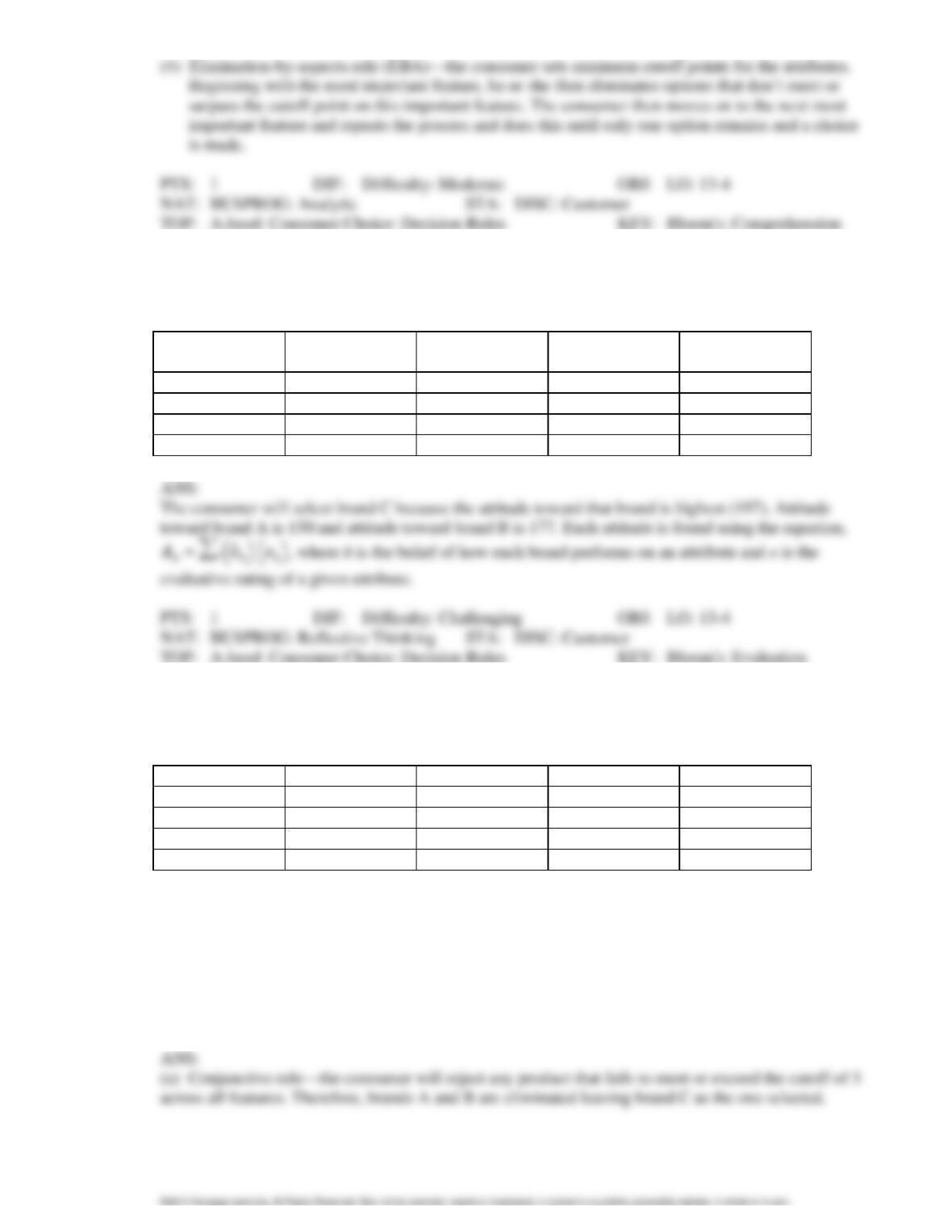
6. A consumer wants to purchase a new television. He has identified four determinant attributes for three
brands he is considering and has given belief ratings for each. The evaluative ratings are indicated in
the following table. Using a compensatory approach, determine the brand this consumer should select.
Attribute
Evaluative
ratings
Brand A
Brand B
Brand C
Picture quality
10
5
10
6
Low price
7
8
3
7
Warranty
5
4
4
8
Service
6
4
6
8
7. A consumer wants to purchase a television. He has identified the determinant attributes and their
importance as well as his beliefs of how the three brands he’s considering perform on each attribute.
Using the information given below, answer the following questions.
Attribute
Importance
Brand A
Brand B
Brand C
Picture quality
10
5
10
6
Low price
7
8
3
7
Warranty
5
4
4
8
Service
6
4
6
8
(a) Assuming a minimum cutoff point of 5, use the conjunctive rule to determine the brand that will
be selected. Explain your answer.
(b) Assuming a minimum cutoff point of 9, use the disjunctive rule to determine the brand that will be
selected. Explain your answer.
(c) Use the lexicographic rule to determine the brand that will be selected. Explain your answer.
(d) Assuming a minimum cutoff point of 5, use the elimination-by-aspects rule (EBA) to determine
the brand that will be selected. Explain your answer.