Exam
Name___________________________________
MULTIPLE CHOICE. Choose the one alternative that best completes the statement or answers the question.
1)
Which of the following is an action local people in Ache, Indonesia, have taken to help reduce the
impact of a future tsunami?
1)
A)
Remove barrier islands
B)
Drain coastal wetlands
C)
Construct jetties
D)
Plant mangroves
2)
A terrace is
2)
A)
an erosional surface created by a massive tsunami.
B)
an uplifted sea stack.
C)
an uplifted foreshore dune.
D)
an uplifted wave–cut platform.
D
3)
In deep water, a wave is not really migrating but is transferring energy through the water in simple
cyclic undulations. These waves are called
3)
A)
tidal waves.
B)
waves of transition.
C)
waves of translation.
D)
swells.
B
4)
Coral bleaching refers to
4)
A)
the killing of coral formations by chlorine bleach pollution.
B)
the loss of algae from the coral.
C)
the process whereby coral change color to avoid detection by predators.
D)
the replacement of normal, colored algae by white algae.
B
D
5)
Seawater with less than 3.5% is termed
5)
A)
brackish.
B)
metahaline.
C)
freshwater.
D)
brine.
6)
On average, ocean water is
6)
A)
very acidic (low pH).
B)
slightly basic.
C)
very basic (high pH).
D)
mildly acid (a pH slightly less than 7).
B
Explanation:
7)
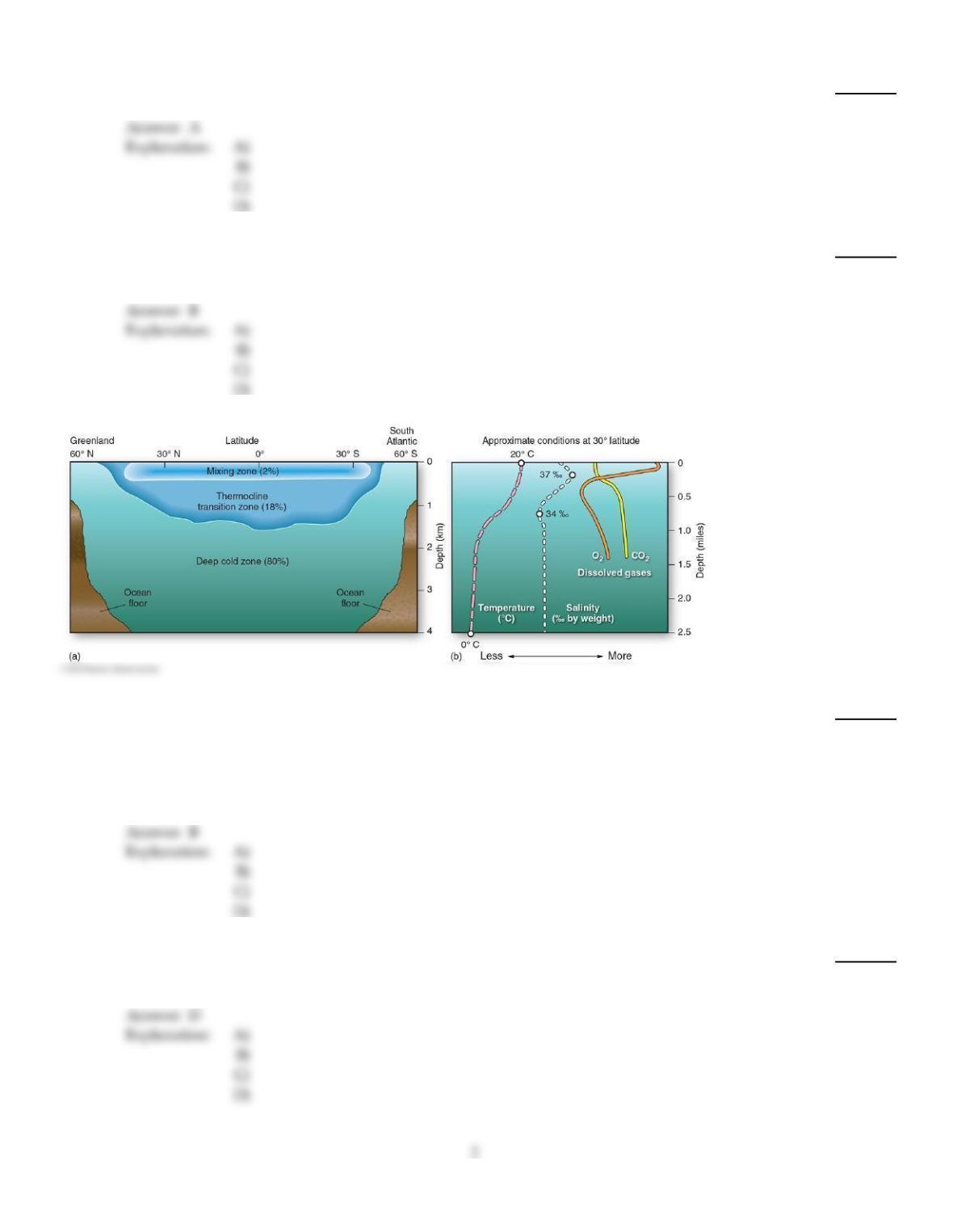
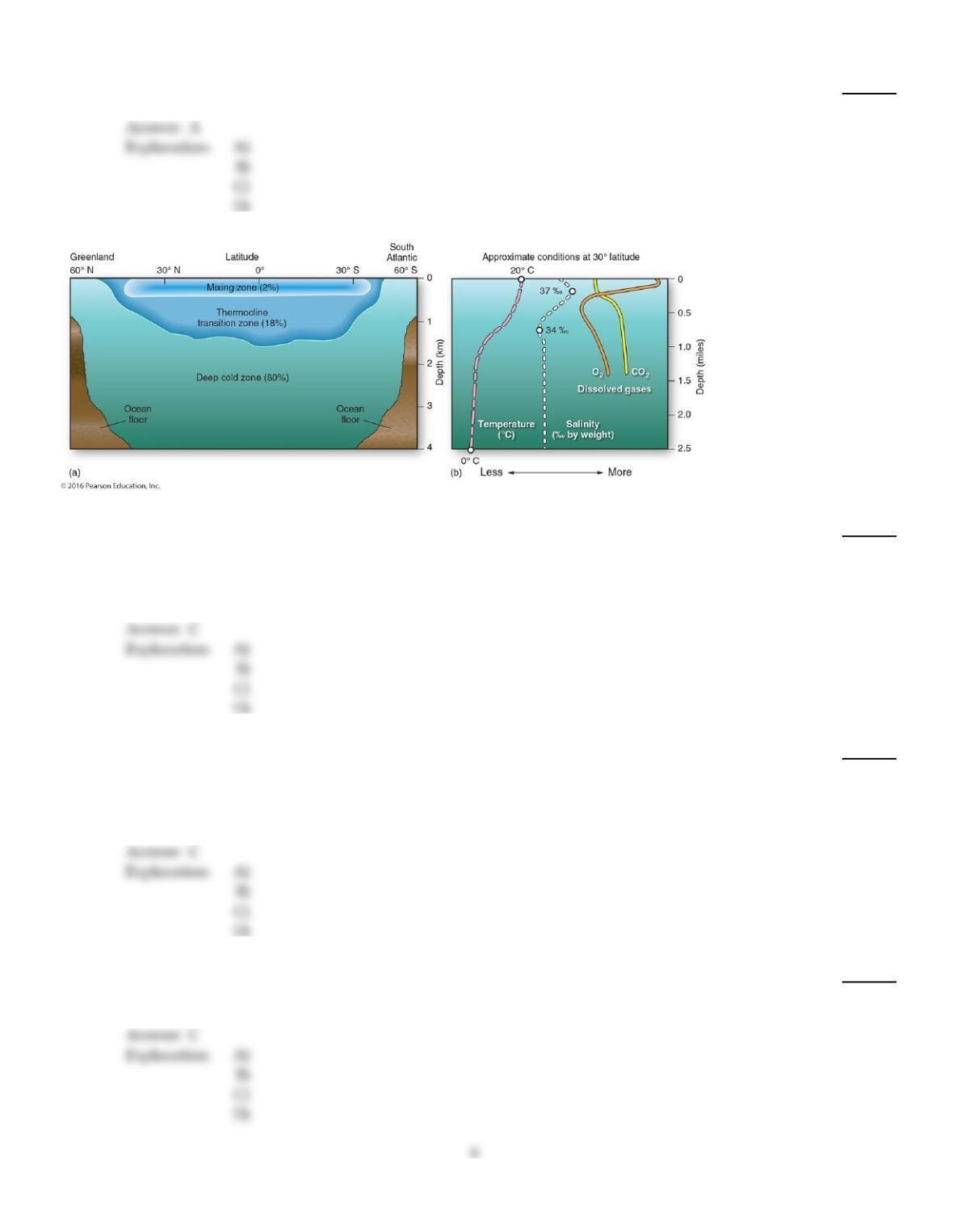
According to the figure above, within the mixing zone and thermocline, the average temperature
and salinity
7)
A)
increase with depth.
B)
decrease with depth.
C)
remain fairly constant with depth.
D)
decrease within the mixing zone, but increase the thermocline.
B
Explanation:
8)
When coral expel their own nutrient–supplying algae, a phenomena called ________ often follows.
8)
A)
massive coral mortality (mcm)
B)
symbiosis
C)
coloration
D)
bleaching
D
Explanation:
A
Explanation:
9)
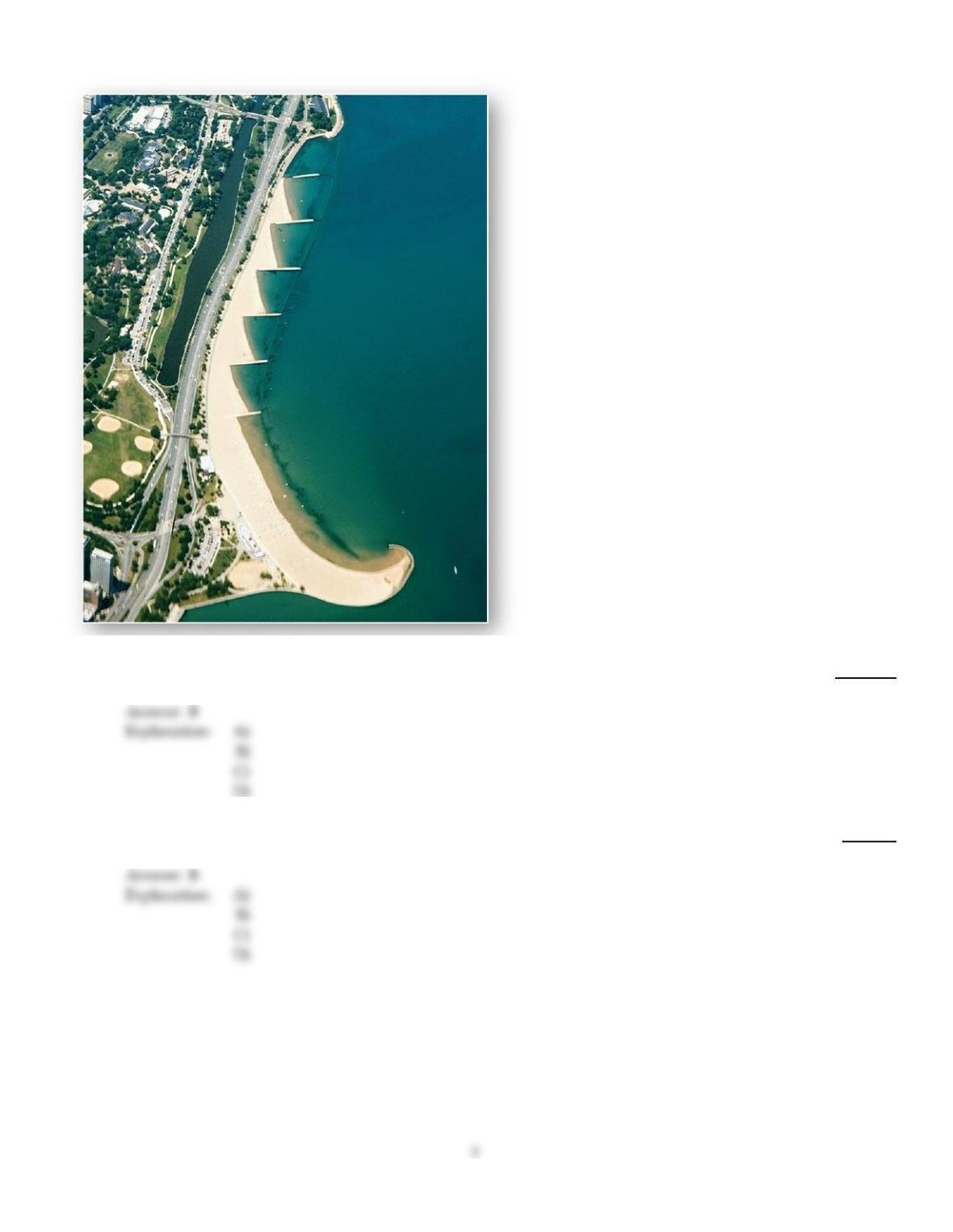
These features on the shore of Lake Michigan disrupt sediment movement along a coast.
9)
A)
Breakwaters
B)
Groins
C)
Jetties
D)
Tombolos
10)
The removal and lifting of individual loose particles by the wind is termed
10)
A)
saltation.
B)
deflation.
C)
abrasion.
D)
deposition.
B
B
11)
Which of the following is CORRECT regarding mean sea level?
11)
A)
A consistent value has yet to be determined due to all the variables involved in producing the
tides.
B)
It is at the same level along the entire North American coast.
C)
It has very little variability across all ocean basins and, therefore, is treated as an absolute
value.
D)
It is calculated based on average tidal levels recorded hourly at a given site over a period of
many years.
12)
An earthquake, a submarine landslide, or a volcanic eruption is capable of producing a
12)
A)
wave in the open ocean of great height.
B)
tsunami.
C)
slow–moving giant swell.
D)
tidal wave.
B
13)
Pebbles can be moved by ________ in a process known as ________.
13)
A)
saltating particles; deflation
B)
saltating particles; surface creep
C)
deflation; saltation
D)
deflation; surface creep
B
14)
Which of the following is NOT a general shape that scientists use to classify dunes?
14)
A)
Star
B)
Rectilinear
C)
Linear
D)
Crescentic
B
15)
When the Sun and Moon are on the same side Earth or on opposite sides of earth, the ________ tide
occurs and results in the ________ tidal range between low and high tides.
15)
A)
spring; lowest
B)
neap; lowest
C)
spring; greatest
D)
neap; greatest
C
D
16)
Which of the following is an example of a coastal wetland?
16)
A)
Playa lake
B)
Saltwater marshes
C)
Mangrove swamp
D)
Both mangrove swamp and saltwater marsh
E)
Playa lake, mangrove swamp, and saltwater marsh
17)
When the Sun and Moon are neither in conjunction or opposition, the ________ tide occurs and
results in the ________ tidal range between low and high tides.
17)
A)
spring; lowest
B)
neap; greatest
C)
spring; greatest
D)
neap; lowest
18)
A longshore current involves all of the following EXCEPT
18)
A)
waves of transition.
B)
effective wave direction.
C)
effective wind direction.
D)
transportation of large amounts of sand and coastal materials.
19)
As a wave approaches the shoreline and enters shallower water, energy and water move forward
causing the water to rise and cascade down from the wave crest as a breaker. These waves are
called
19)
A)
swells.
B)
tidal waves.
C)
waves of transition.
D)
waves of translation.
20)
Which of the following terms is NOT a correct reference to desert pavement?
20)
A)
Lag gravels
B)
Reg desert
C)
Gibber plain
D)
Sand seas
21)
Human structures that are built to interrupt beach drift include all of the following EXCEPT
21)
A)
tombolos.
B)
groins.
C)
jetties.
D)
breakwaters.
22)
Within the deep cold zone, average temperature and salinity
22)
A)
increase with depth.
B)
decrease with depth.
C)
remain fairly constant with depth.
D)
decrease within the mixing zone, but increase the thermocline.
C
23)
The term eolian refers to
23)
A)
glacial processes in areas outside polar regions.
B)
weathering and mass movement in humid regions.
C)
erosion, transportation, and deposition by wind.
D)
stream–related processes.
C
24)
The artificial replacement of sand along a beach is called
24)
A)
jetties.
B)
breakwater.
C)
beach nourishment.
D)
groins.
C
A
25)
A coral is a type of ________ that secretes ________ to form a hard external skeleton.
25)
A)
polyp; silica
B)
polyp; calcium carbonate
C)
algae; calcium carbonate
D)
algae; silica
26)
Which of the following is NOT correct regarding coral bleaching?
26)
A)
The warming of sea–surface temperatures is a great threat to coral.
B)
Coral reefs are under pressure from overfishing, pollution, sedimentation, and global
warming.
C)
The 1998 El Niño event caused the die–off of an estimated 30% of the world’s reefs
D)
Scientists have identified the reasons polyps eject their algae.
D
27)
A general term for the coastal area and shallow offshore environment is
27)
A)
littoral zone.
B)
coastline.
C)
shoreline.
D)
coast.
A
28)
Seawater that exceeds the 3.5% average is termed
28)
A)
brine.
B)
brackish.
C)
mesohaline.
D)
freshwater.
A
29)
The worldwide average salinity of seawater is
29)
A)
0.5%.
B)
3.5%.
C)
5.5%.
D)
7.5%.
B
B
30)
The coast extends inland
30)
A)
to the backshore dune.
B)
to the trough between the primary and secondary dune.
C)
to the foreshore dune.
D)
from the high tide level to the first major landform change.
E)
to the highest water line that occurs during a storm.
31)
Barrier beaches and islands occur worldwide, lying offshore of nearly ________ of Earth’s
coastlines.
31)
A)
10 percent
B)
50 percent
C)
70 percent
D)
90 percent
32)
Which of the following is INCORRECT regarding the littoral zone?
32)
A)
In general usage, it only includes the foreshore area of coastal environments.
B)
It spans both land and water.
C)
Landward, it extends to the highest waterline reached on shore during a storm.
D)
Seaward it extends to where water is too deep for storm waves to move sediments.
33)
For purposes of discussing eolian processes, wind acts like a
33)
A)
fluid.
B)
solid.
C)
gas.
D)
plasma.
34)
A major difference between a barrier island and a barrier spit is
34)
A)
barrier spits are anthropogenic, modeled after natural barrier islands.
B)
a barrier spit is a depositional feature that connects the barrier island to the mainland.
C)
one of regional terminology, a barrier island and a barrier spit are the same thing.
D)
a barrier spit is connected to the mainland, whereas a barrier island is not.
35)
Which of the following is TRUE of Earth’s coastlines?
35)
A)
Earth’s coastlines show a remarkable degree of similarity across the planet.
B)
They are relatively young and undergoing continuous change.
C)
There are few inputs that directly affect them beyond tidal action.
D)
They have the oldest landforms on the planet.
36)
The destruction of a mangrove swamp might lead to
36)
A)
the erosion of the coast.
B)
sediment accumulation on nearby reefs, and their consequent death.
C)
the loss of aquatic species.
D)
loss of species and coastal erosion
E)
there is no evidence of the loss of mangrove swamps
D
37)
In the movie The Poseidon Adventure, a cruise ship is overturned by a tsunami while at sea. This plot
is NOT valid because
37)
A)
tsunamis do not form high waves while in the open ocean.
B)
tsunamis do not have the energy to overturn a ship of that size.
C)
tsunamis do not occur in the open ocean.
D)
the tsunami in the movie didn’t occur in a tectonically active area.
A
38)
If the material deposited in a long ridge extending out from a coast grows to completely cut off the
bay from an ocean, it becomes a
38)
A)
barrier spit.
B)
lagoon.
C)
tombolo.
D)
baymouth bar.
D
B
39)
Which of the following affect the chemical composition of seawater?
39)
A)
The atmosphere
B)
Sediments
C)
Minerals
D)
Marine organisms
E)
The atmosphere, marine organisms, minerals, and ocean sediments
40)
Large, lithified formations of calcium carbonate formed from both living and skeletal coral colonies
are called
40)
A)
barrier islands.
B)
atolls.
C)
coral reefs.
D)
tombolos.
41)
On average, the beach zone spans the area
41)
A)
from the high tide line during a spring tide to the low tide line during a neap tide.
B)
between high and low spring tides.
C)
between high and low neap tides.
D)
from several meters above high tide to several meters below low tide.
42)
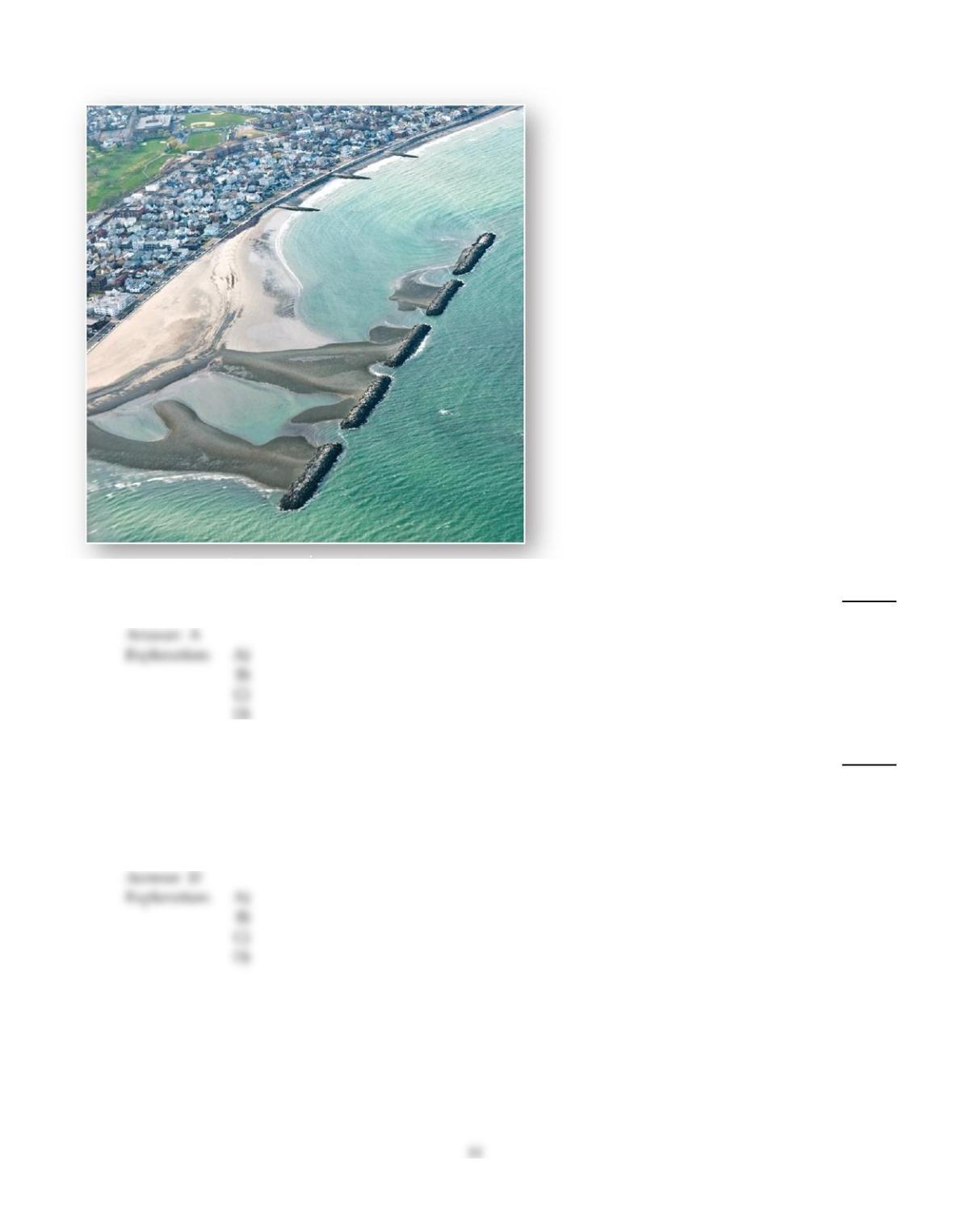
These features create zones of still water near coastlines.
42)
A)
Breakwaters
B)
Groins
C)
Jetties
D)
Tombolos
43)
Which of the following is TRUE of the chemical composition of seawater?
43)
A)
Eighteen elements account for 75% of the dissolved waters in seawater.
B)
Samples of ancient seawater suggest a great deal of chemical variation over Earth’s history.
C)
Seawater is very heterogeneous, varying across the vast oceans of the world.
D)
Seawater contains dissolved gases, suspended and dissolved organic matter, and many trace
elements.
44)
Approximately what percentage of the United States’ population live in coastal areas?
44)
A)
10%
B)
50%
C)
65%
D)
25%
45)
The ability of the wind to move materials
45)
A)
is greater than that of water because of the higher density of air compared to water.
B)
exceeds that of other transporting agents, such as water and ice.
C)
increases with decreased wind speed.
D)
is small compared to other transporting agents, such as water and ice.
D
46)
When the height of a wave exceeds its vertical stability, the wave is called a
46)
A)
rip current.
B)
tidal wave.
C)
wave of transition.
D)
breaker.
D
47)
The smallest features shaped by saltating grains of sand are
47)
A)
reg deserts.
B)
sand seas.
C)
dunes.
D)
ripples.
D
48)
Which of the following is NOT correct regarding tides?
48)
A)
They are influenced by the size, depth, and topography of ocean basins.
B)
They are influenced by shoreline configuration and latitude.
C)
They are produced solely by the gravitational pull of the Sun.
D)
They are complex twice daily oscillations in sea level.
C
B

49)
Which side of a dune typically has a slope angle equal to that of the angle of repose for sand?
49)
A)
Windward
B)
Stoss
C)
Leeward
D)
Top
50)
Material deposited in a long ridge extending out from a coast is called a
50)
A)
lagoon.
B)
tombolo.
C)
barrier island.
D)
barrier spit.
51)
An extensive area of sand and sand dunes is known as a(n)
51)
A)
lag desert.
B)
desert pavement.
C)
erg desert, or sand sea.
D)
reg desert.
52)
Desert pavement refers to
52)
A)
specially constructed roadbeds in dry and hot regions.
B)
deposits of silt and clay.
C)
sand–covered surfaces.
D)
surfaces of concentrated pebbles and gravels.
53)
In which of the following region would you expect to have the highest levels of seawater salinity?
53)
A)
Subtropical oceans
B)
Midlatitude oceans
C)
Polar oceans
D)
Equatorial oceans
54)
Coral formations
54)
A)
tend to occur poleward of 30° latitude.
B)
are made of the skeletons of animals that lived symbiotically with simple algae.
C)
require water that is high in sediment concentration.
D)
survive in a broad ecological range because they are tolerant of temperature, salinity, and
depth variation.
55)
Particles of sand, gravels, and shells that move along the shore form
55)
A)
translation effects.
B)
longshore current.
C)
beach drift.
D)
breakers.
56)
Beaches are
56)
A)
always composed of sand.
B)
places where sediment is stable and unchanging.
C)
places along the coast where sediment is in motion.
D)
permanent coastal features.
57)
Relative to dune movement and form, a dune’s slipface forms on which side?
57)
A)
Freedune side
B)
Windward side
C)
Leeward side
D)
None of the aboveit is not associated with a particular side.
58)
A ________ is deposited sediment that connects a shoreline with an offshore island.
58)
A)
barrier spit
B)
lagoon
C)
tombolo
D)
baymouth bar
59)
The grinding and shaping of rock surfaces by the “sandblasting” action of particles carried by wind
is
59)
A)
saltation.
B)
deposition.
C)
deflation.
D)
abrasion.
60)
Which of the following occurs when the Sun, Moon, and Earth are in alignment (i.e., in opposition
or conjunction)?
60)
A)
A lower tidal range
B)
Neap tides
C)
Ebb tides
D)
Maximum tidal ranges
61)
A shallow saltwater body cut off from the ocean by a bay barrier is known as a
61)
A)
barrier spit.
B)
lagoon.
C)
tombolo.
D)
baymouth bar.
62)
The height of a tsunami grows as it approaches a coastline primarily because
62)
A)
its wavelength shortens.
B)
the height of the surf is added to the height of the tsunami.
C)
its energy level increases.
D)
the height of a tsunami remains constant from the time of its origin.
63)
A depression created by deflation is known as a
63)
A)
bolson.
B)
playa.
C)
structural basin.
D)
blowout
64)
Regular patterns of smooth, rounded waves are called
64)
A)
swells.
B)
wave ripples.
C)
wave trains.
D)
breakers.
65)
A wave–cut platform is the erosional remnant of a
65)
A)
tombolo.
B)
cliff.
C)
barrier island.
D)
spit.
66)
High tides are known as ________ whereas low tides are kown as ________.
66)
A)
neap tides; spring tides
B)
spring tides; neap tides
C)
flood tides; ebb tides
D)
ebb tides; flood tides
67)
Coral and algae have a reciprocal relationship in which the algae perform photosynthesis,
providing the coral with some nutrients and helping with the calcification process. In return, the
coral provide the algae with certain nutrients and a place to live in a lighted environment. This is
an example of a ________ relationship.
67)
A)
parasitic
B)
symbiotic
C)
predator/prey
D)
opportunistic
68)
Which of the following is TRUE about seawater?
68)
A)
The chemical composition of seawater has great spatial variability.
B)
The salinity of seawater is negligible.
C)
Seawater is pure water (H20).
D)
Seawater is a solution.
69)
Wave action works to straighten a coast as wave energy focuses around headlands in a process
called
69)
A)
tidal bore.
B)
breakers.
C)
longshore current.
D)
wave refraction.
70)
Which of the following is NOT a possible cause of the ejection of nutrient–providing algae from
coral?
70)
A)
Warming sea–surface temperatures
B)
Sedimentation
C)
Pollution
D)
Oceanic acidification
E)
Pollution, sedimentation, acidification, and warming temperatures all contribute to this
phenomenon.
71)
The sinuous, branching channels that characterize a salt marsh result from
71)
A)
manmade drainage canals.
B)
storm tracks.
C)
the ebb and flow of tides.
D)
animal paths through the marsh.
72)
An atoll is approximately ________ in shape because it forms ________.
72)
A)
linear; along barrier islands
B)
circular; around seastacks
C)
circular; around submerged volcanic islands
D)
linear; along continental shorelines
73)
What is the difference between an ocean and a sea?
73)
A)
Seas are generally smaller than an ocean and tend to be partially enclosed by land or large,
inland, saline water bodies.
B)
The term sea is used to describe the global, interconnected water body covering 70% of Earth’s
surface, whereas oceans refer to the individual basins within this global sea.
C)
An ocean is a vast body of water encompassing 70% of Earth, whereas a sea refers specifically
to a large, inland, saline body of water.
D)
There is no difference, just a different term for the same physical feature.
74)
Worldwide salinity varies between ________ and ________.
74)
A)
0.5%; 1.0%
B)
3.4%; 3.7%
C)
4.7%; 5.1%
D)
6.5%; 6.7%
75)
Which of the following is NOT an example of a depositional coastal landform?
75)
A)
Wave–built terrace
B)
Wave–cut platform
C)
Barrier spit
D)
Bay barrier
76)
Which of the following is CORRECT regarding waves that travel in wave trains?
76)
A)
They usually form relatively close to the affected coastline.
B)
They are produced in stormy areas far distant from the shores where they may finally break.
C)
They experience refraction by the deep seafloor.
D)
They are called breakers as they travel in the open sea.
77)
Rocks that are pitted, fluted, or polished from eolian erosion are called
77)
A)
pumice.
B)
deflation hollows.
C)
desert pavement.
D)
ventifacts.
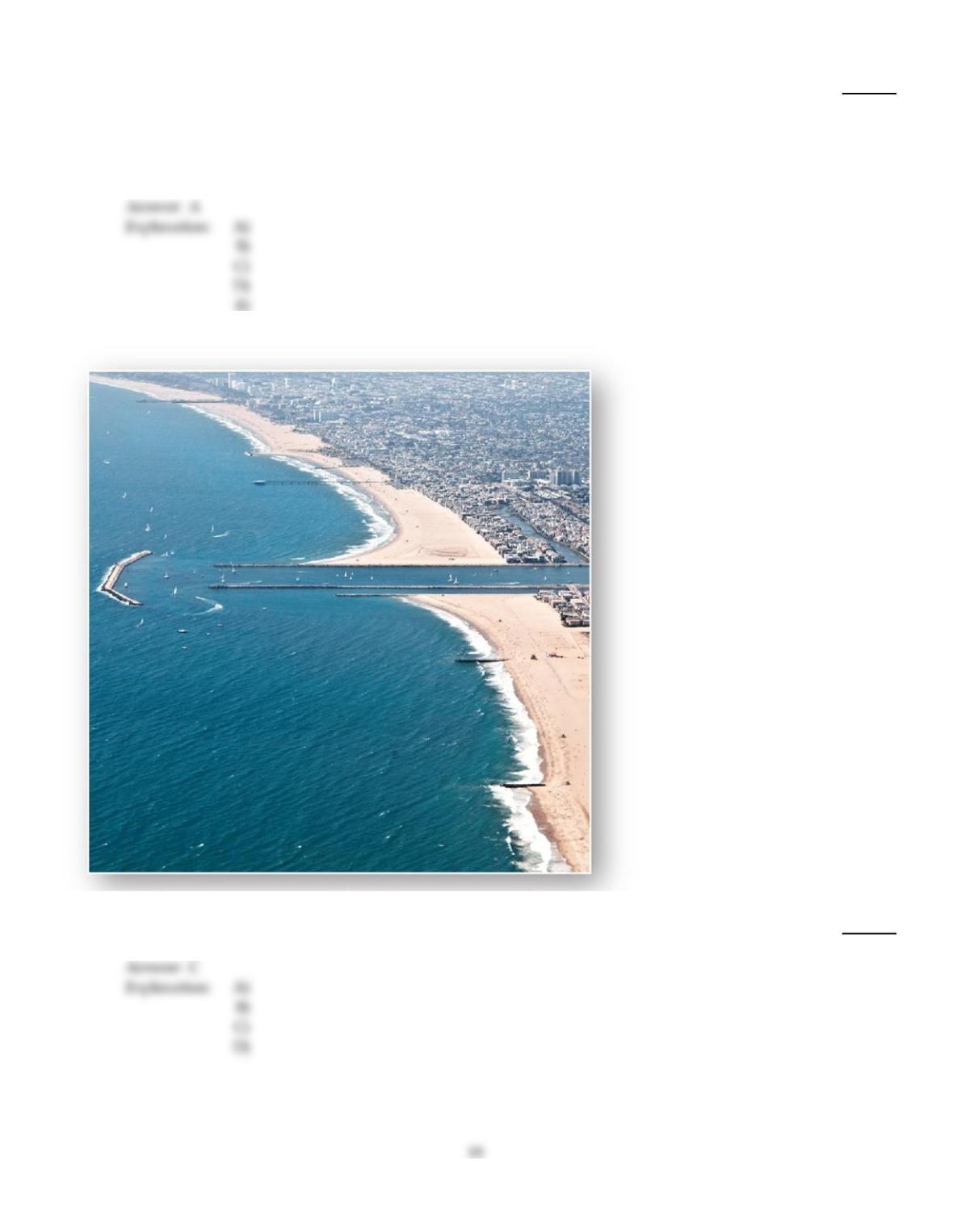
78)
Barrier islands make ________ sites for real estate development because ________.
78)
A)
poor; they can be unstable, mobile, and overrun by storm surges.
B)
good; they provide excellent scenery
C)
poor; they can be overrun by storm surges
D)
good; they are made of rock and are quite stable
E)
poor; they are unstable and often mobile
79)
These features block material from blocking harbor entrances.
79)
A)
Breakwaters
B)
Groins
C)
Jetties
D)
Tombolos
80)
Which of the following is NOT an example of an erosional coastal landform?
80)
A)
Tombolo
B)
Notched cliff
C)
Wave–cut platform
D)
Sea arch
81)
Areas with heavy freshwater runoff and low evaporation will have ________ average salinity.
81)
A)
higher than
B)
lower than
C)
approximately the
82)
Brine water may result from
82)
A)
heavy rainfall and low temperatures.
B)
the influx of river water into the ocean.
C)
high evapotranspiration rates.
D)
stagnation of water in a floodplain swamp.
83)
Elongated, streamlined ridges aligned parallel to the most effective wind direction are called
83)
A)
desert pavements.
B)
alluvial rock structures.
C)
ventifacts.
D)
yardangs.
84)
Undercutting action of the sea results in
84)
A)
lagoons.
B)
sea cliffs.
C)
barrier splits.
D)
tombolos.
85)
Approximately what percentage of the world’s population lives near the ocean?
85)
A)
70%
B)
25%
C)
40%
D)
33%
86)
Long, narrow deposits of sand that form offshore roughly parallel to the coast are called
86)
A)
groins.
B)
barrier beaches.
C)
tombolos.
D)
baymouth bar.
87)
Which of the following is NOT a “hard” shoreline protection measure?
87)
A)
Breakwater
B)
Groins
C)
Beach nourishment
D)
Jetties
88)
Wind is ________ effective at eroding and transporting materials than other geomorphic agents
because its density is ________ that of other geomorphic agents.
88)
A)
more; lower
B)
less; higher
C)
less; lower
D)
more; higher
TRUE/FALSE. Write ‘T’ if the statement is true and ‘F’ if the statement is false.
89)
Although many elements are dissolved in seawater, no gases are.
89)
90)
Approximately 40% of the world’s population lives in or near an ocean coast.
90)
91)
Salinity increases with depth.
91)
92)
The highest salinity values in the ocean are found in equatorial latitudes.
92)
93)
Barrier islands are stable islands that are suitable for development.
93)
94)
The oceans are slightly acidic, with an average pH of about 6.5.
94)

95)
By definition, brackish water has a higher salinity than brine.
95)
96)
The freezing point of seawater is lower than that of freshwater due to the presence of dissolved
salts.
96)
97)
All the nutrition for corals comes from resident algae that live with the coral.
97)
98)
Dunes are the smallest features shaped by the movement of windblown sand.
98)
99)
A wave in the open ocean consists of water molecules traveling in the direction of wave
propagation.
99)
100)
The major erosional processes in deserts are eolian.
100)
101)
Tsunamis generated by earthquakes form giant waves while traveling in the open ocean.
101)
102)
Dune migration threatens human structures and may adversely affect human health.
102)
103)
Coral atolls form around sinking volcanic islands.
103)
104)
A lagoon is a shallow, freshwater body separated from the sea.
104)
105)
A beach acts to stabilize a shoreline by absorbing wave energy, even though materials are in almost
constant motion.
105)
106)
The salinity of seawater averages 3.5%.
106)
107)
The increase in wave height as a tsunami approaches a coast is the result of the shortening of
wavelengths.
107)
108)
The wind has relatively minor effects on weathering and erosion.
108)
ESSAY. Write your answer in the space provided or on a separate sheet of paper.
109)
Describe the three main zones of the ocean.
110)
Describe the causes and consequences of coral bleaching.
111)
How do barrier islands form? What are the hazards associated with them? Why is it generally unwise for
humans to inhabit them?
112)
What are the factors responsible for tides? Describe the conditions that lead to neap and spring tides.
113)
Using outside sources, describe some of the challenges facing coastal environments in the 21st century.
114)
Discuss a how a tsunami is formed, how it behaves in the open ocean, and how it behaves when it contacts the
shore. Include its physical characteristics, travel speed and pattern, and nature of impact with land.
115)
Explain the formation of sand dunes.
116)
Describe the formation and characteristics of salt marshes and mangrove swamps. What are the factors
necessary for the creation of each. What are the spatial extents of each kind?
117)
Describe the eolian processes of deflation and abrasion.
118)
What accounts for the coastal straightening and the formation of a longshore current?
119)
Describe the key features of a typical erosional coast and a typical depositional coast.
120)
Describe the physical composition of seawater.
121)
Describe the process of wave motion.
Answer Key
Testname: C13
Answer Key
Testname: C13
Answer Key
Testname: C13
29
Answer Key
30
31