
Name:
Class:
Date:
chapter 13
Indicate whether the statement is true or false.
1. The proportionality property of LP models means that if the level of any activity is multiplied by a constant factor, then
the contribution of this activity to the objective function, or to any of the constraints in which the activity is involved, is
multiplied by the same factor.
a.
True
b.
False
2. Unboundedness refers to the situation in which the LP model has been formulated in such a way that the objective
function is unbounded – that is, it can be made as large (for maximization problems) or as small (for minimization
problems) as we like.
a.
True
b.
False
3. If an LP model does have an unbounded solution, then we must have made a mistake – either we made an input error
or we omitted one or more constraints.
a.
True
b.
False
4. Reduced costs indicate how much the objective coefficient of a decision variable that is currently 0 or at its upper bound
must change before that the value of that variable changes.
a.
True
b.
False
5. When formulating a linear programming spreadsheet model, we specify the constraints in a Solver dialog box, since
Excel does not show the constraints directly.
a.
True
b.
False
6. When formulating a linear programming spreadsheet model, there is a set of designated cells that play the role of the
decision variables. These are called the objective cells.
a.
True
b.
False
7. When formulating a linear programming spreadsheet model, there is one target (objective) cell that contains the value
of the objective function.
a.
True
b.
False
8. If a solution to an LP problem satisfies all of the constraints, then is must be feasible.
a.
True
b.
False
9. In general, the complete solution of a linear programming problem involves three stages: formulating the model,
invoking Solver to find the optimal solution, and performing sensitivity analysis.
a.
True
b.
False
10. All linear programming problems should have a unique solution, if they can be solved.

Name:
Class:
Date:
chapter 13
a.
True
b.
False
11. Proportionality, additivity, and divisibility are three important properties that LP models possess, which distinguish
them from general mathematical programming models:.
a.
True
b.
False
12. It is instructive to look at a graphical solution procedure for LP models with three or more decision variables.
a.
True
b.
False
13. Shadow prices are associated with nonbinding constraints, and show the change in the optimal objective function
value when the right side of the constraint equation changes by one unit.
a.
True
b.
False
14. All optimization problems include decision variables, an objective function, and constraints.
a.
True
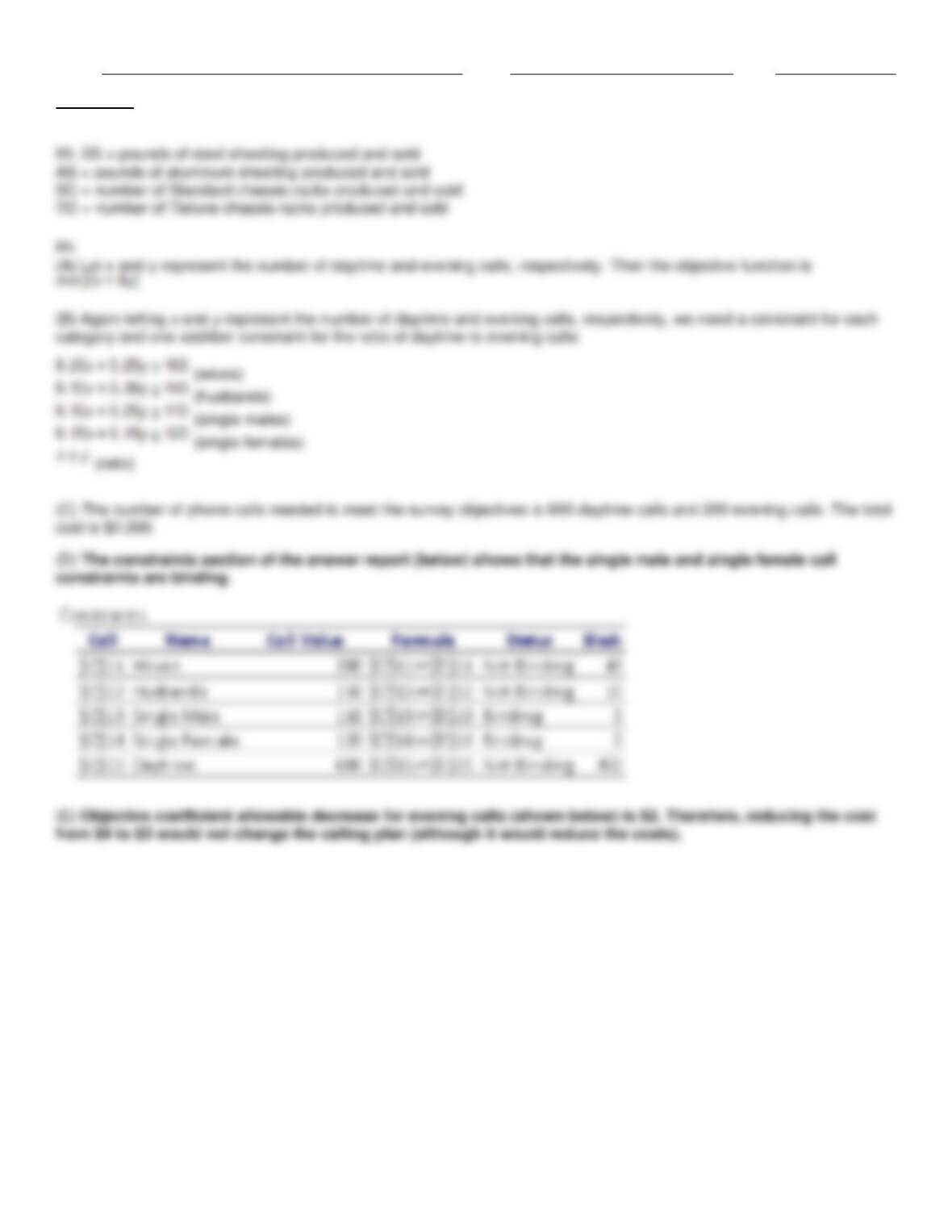
b.
False
15. Linear programming problems can always be formulated algebraically, but not always on spreadsheet.
a.
True
b.
False
16. If a constraint has the equation , then the slope of the constraint line is function line is –2:
a.
True
b.
False
17. There is often more than one objective in linear programming problems
a.
True
b.
False
18. Suppose the allowable increase and decrease for an objective coefficient of a decision variable that has a current
value of $50 are $25 (increase) and $10 (decrease). If the coefficient were to change from $50 to $60, the optimal value of
the objective function would not change.
a.
True
b.
False
19. Suppose the allowable increase and decrease for shadow price for a constraint are $25 (increase) and $10
(decrease). If the right hand side of that constraint were to increase by $10 the optimal value of the objective function
would change.
a.
True
b.
False
20. In determining the optimal solution to a linear programming problem graphically, if the objective is to maximize the
objective, we pull the objective function line down until it contacts the feasible region.
a.
True
Name:
Class:
Date:
chapter 13
b.
False
21. It is often useful to perform sensitivity analysis to see how, or if, the optimal solution to a linear programming problem
changes as we change one or more model inputs.
a.
True
b.
False
22. Nonbinding constraints will always have slack, which is the difference between the two sides of the inequality in the
constraint equation.
a.
True
b.
False
23. The feasible region in a graphical solution of a linear programming problem will appear as some type of polygon, with
lines forming all sides.
a.
True
b.
False
24. When the proportionality property of LP models is violated, then we generally must use non-linear optimization.
a.
True
b.
False
25. There are two primary ways to formulate a linear programming problem, the traditional algebraic way and in
spreadsheets.
a.
True
b.
False
26. Infeasibility refers to the situation in which there are no feasible solutions to the LP model
a.
True
b.
False
27. It helps to ensure that Solver can find a solution to a linear programming problem if the model is well-scaled; that is, all
of the numbers are of roughly the same magnitude.
a.
True
b.
False
28. If the objective function has the equation , then the y-intercept of the objective function line is 40:
a.
True
b.
False
29. The optimal solution to any linear programming model is a corner point of a polygon.
a.
True
b.
False
30. The divisibility property of LP models simply means that we allow only integer levels of the activities.
a.
True
b.
False
Name:
Class:
Date:
chapter 13
31. The additivity property of LP models implies that the sum of the contributions from the various activities to a particular
constraint equals the total contribution to that constraint.
a.
True
b.
False
32. There are generally two steps in solving an optimization problem, model development and optimization.
a.
True
b.
False
33. If a constraint has the equation , then the constraint line passes through the points (0,20) and (30,0):
a.
True
b.
False
34. If the objective function has the equation , then the slope of the objective function line is 2:
a.
True
b.
False
35. The set of all values of the changing cells that satisfy all constraints, not including the nonnegativity constraints, is
called the feasible region.
a.
True
b.
False
Indicate the answer choice that best completes the statement or answers the question.
36. Consider the following linear programming problem:
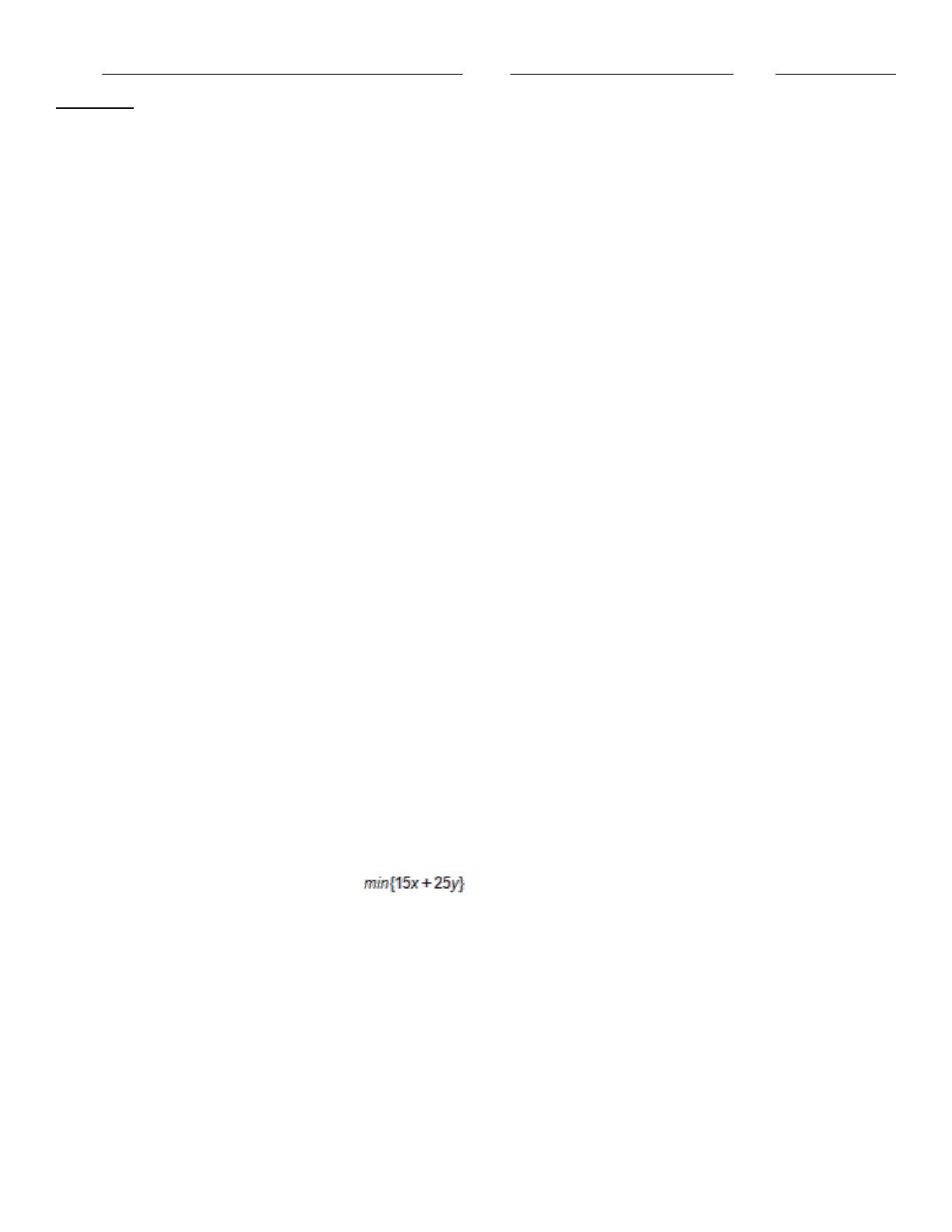
Maximize
Subject to
The above linear programming problem:
a.
has only one optimal solution
b.
has more than one optimal solution
c.
exhibits infeasibility
d.
exhibits unboundedness
37. In using Excel to solve linear programming problems, the target cell represents the:
a.
value of the objective function
b.
constraints
c.
decision variables
d.
total cost of the model
38. The feasible region in all linear programming problems is bounded by:
a.
corner points
Name:
Class:
Date:
chapter 13
b.
hyperplanes
c.
an objective line
d.
all of these options
39. In an optimization model, there can only be one:
a.
decision variable
b.
constraint
c.
objective function
d.
shadow price
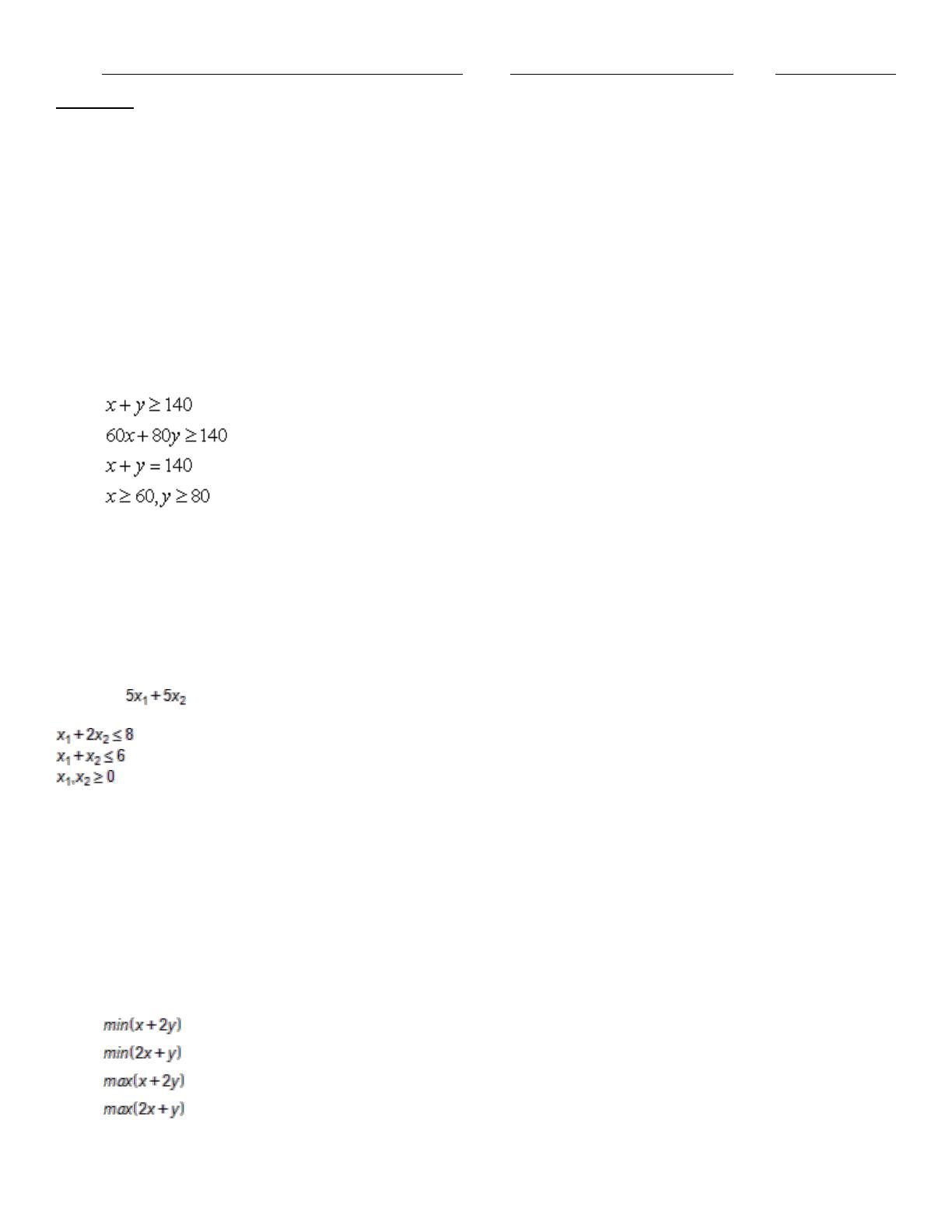
40. Suppose a firm must at least meet minimum expected demands of 60 for product x and 80 of product y. An algebraic
formulation of these constraints is:
a.
b.
c.
d.
41. The most important solution method for linear programming problems is known as the:
a.
spreadsheet method
b.
solution mix method
c.
complex method
d.
simplex method
42. Consider the following linear programming problem:
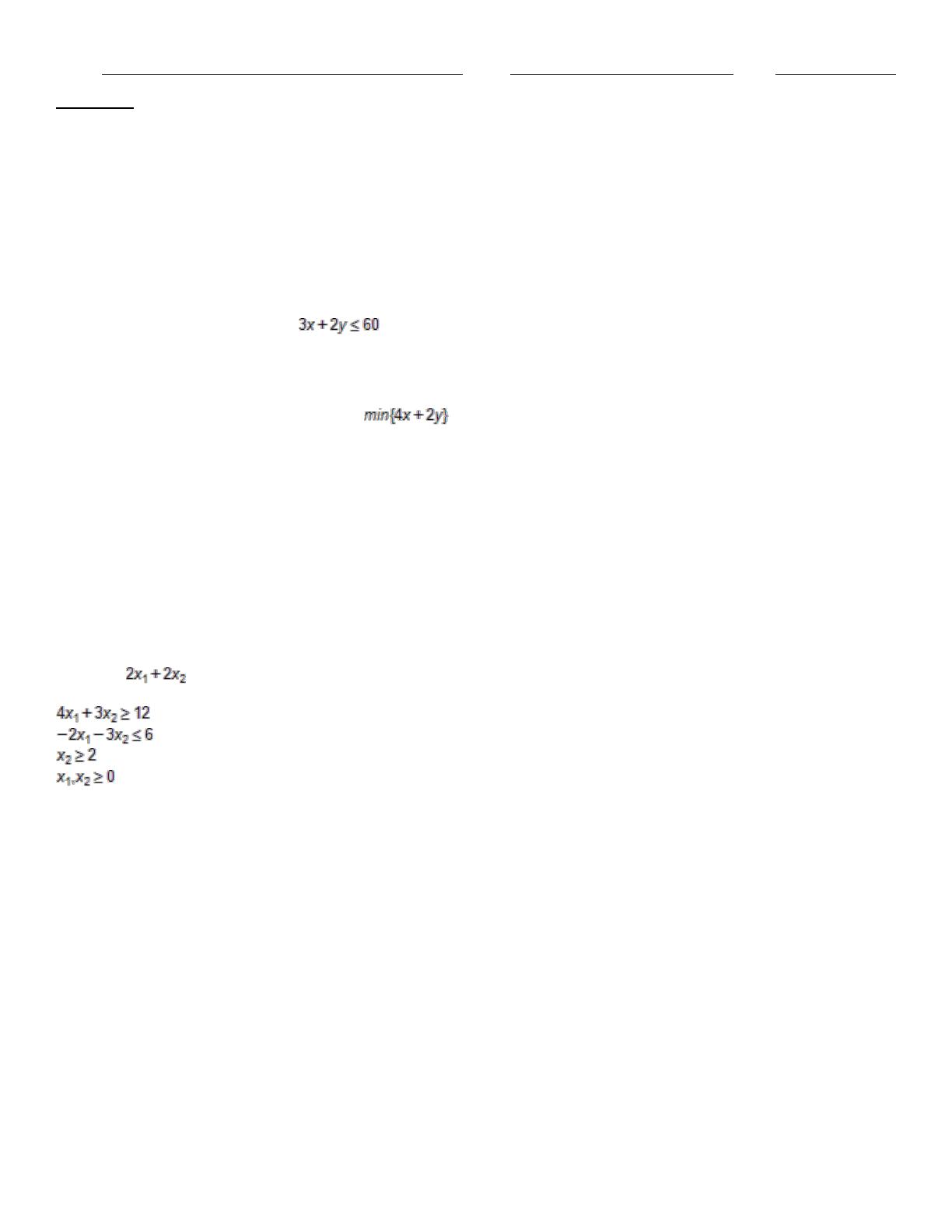
Maximize
Subject to
The above linear programming problem:
a.
has only one optimal solution
b.
has more than one optimal solution
c.
exhibits infeasibility
d.
exhibits unboundedness
43. Suppose a liquor store sells beer for a net profit of $1 per unit and wine for a net profit of $2 per unit. Let x equal the
amount of beer sold and y equal the amount of wine sold. An algebraic formulation of the profit function is:
a.
b.
c.
d.
Name:
Class:
Date:
chapter 13
44. A linear programming problem with _____decision variable(s) can be solved by a graphical solution method.
a.
1
b.
2
c.
3
d.
4
45. The additivity property of linear programming implies that the contribution of any decision variable to the objective is
of/on the levels of the other decision variables.
a.
dependent
b.
independent
c.
conditional
d.
the sum
46. The divisibility property of linear programming means that a solution can have both:
a.
integer and noninteger levels of an activity
b.
linear and nonlinear relationships
c.
positive and negative values
d.
revenue and cost information in the model
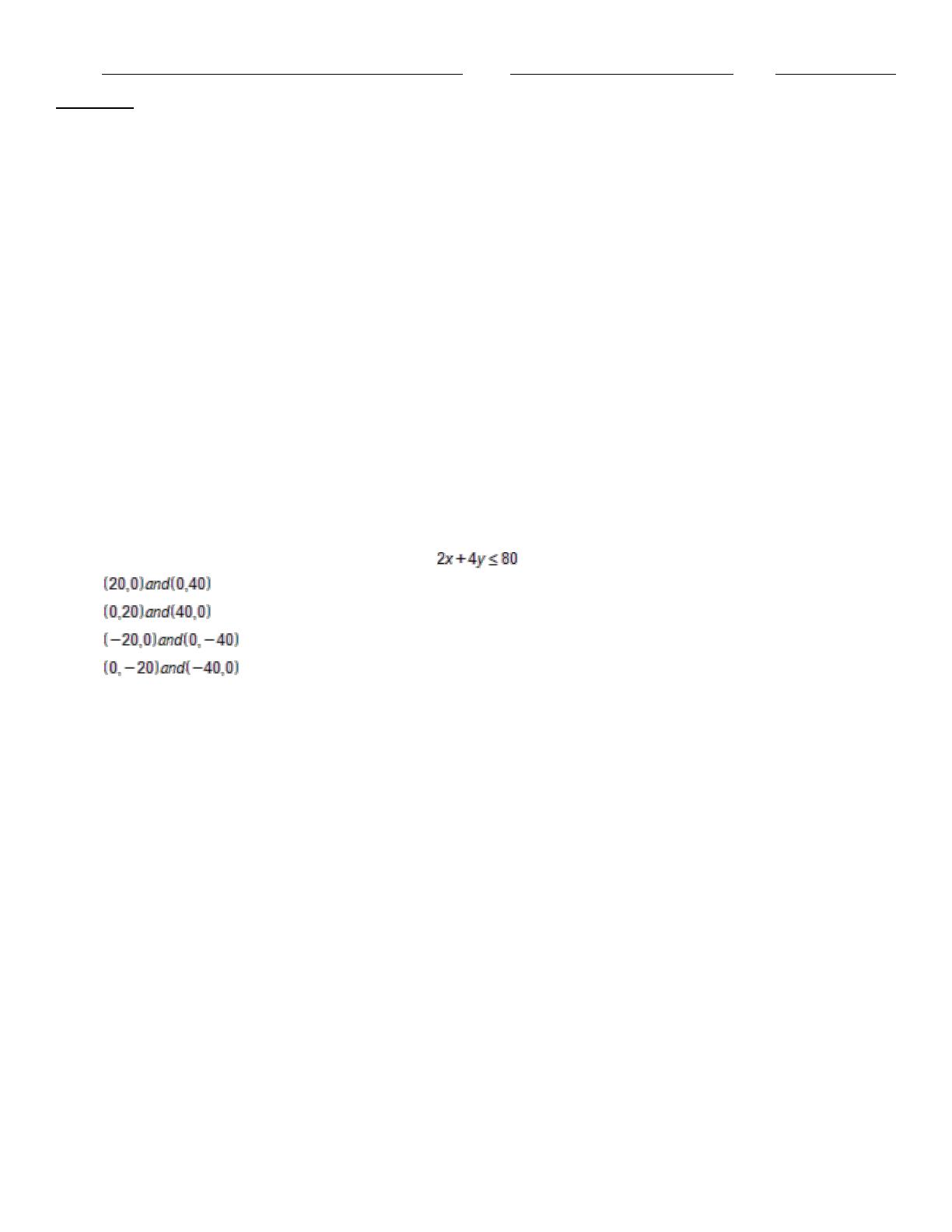
47. The equation of the line representing the constraint passes through the points:
a.
b.
c.
d.
48. Every linear programming problem involves optimizing a:
a.
linear regression model subject to several linear constraints
b.
linear function subject to several linear constraints
c.
linear function subject to several non-linear constraints
d.
non-linear function subject to several linear constraints
49. In most cases in solving linear programming problems, we want the decision variables to be:
a.
equal to zero
b.
nonnegative
c.
nonpositive
d.
All of these options
50. Linear programming is a subset of a larger class of models called:
a.
mathematical programming models
b.
mathematical optimality models
c.
linear regression models
d.
linear simplex model
51. In linear programming, sensitivity analysis involves examining how sensitive the optimal solution is to changes in:
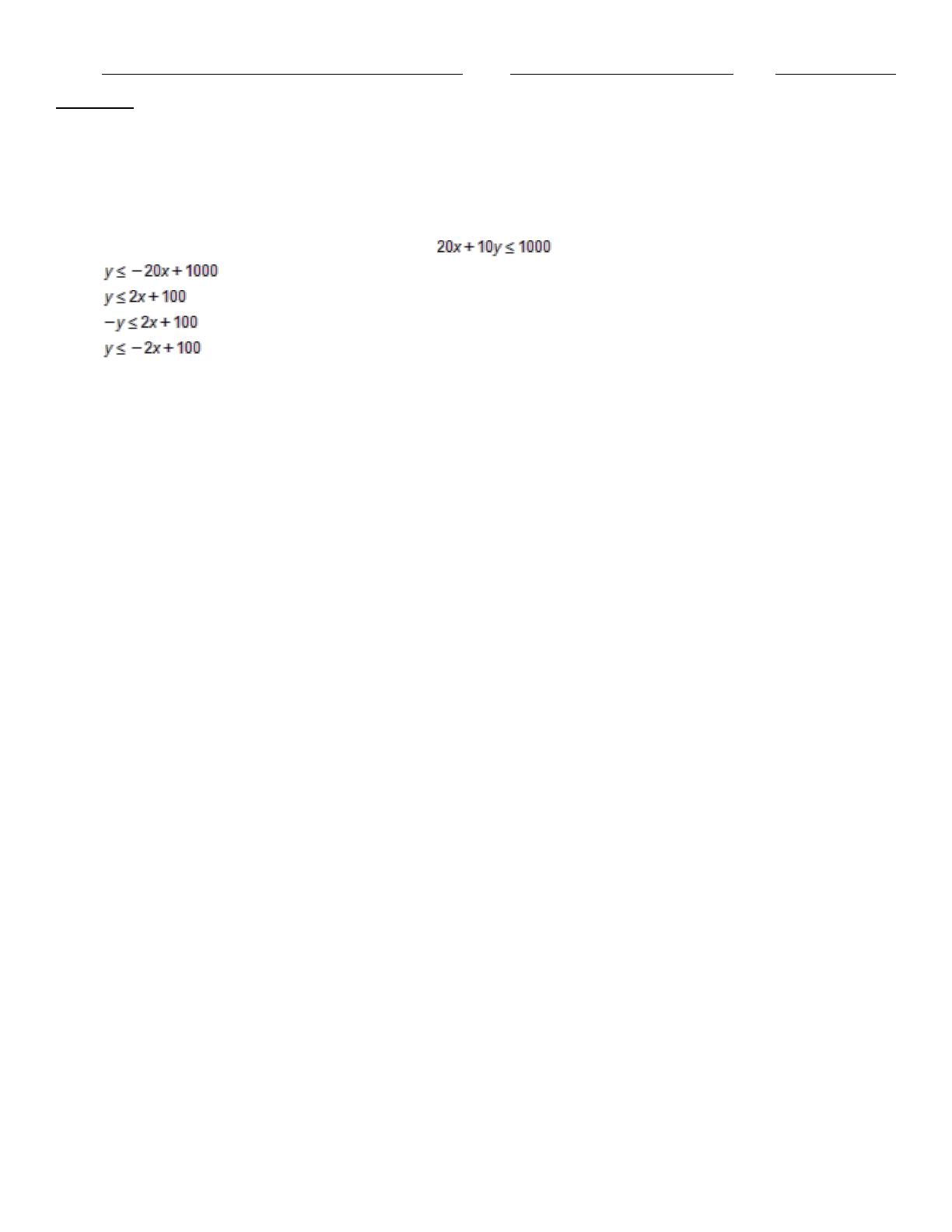
Name:
Class:
Date:
chapter 13
a.
profit of variables in model
b.
cost of variables in model
c.
resources available
d.
All of these options
52. The equation of the line representing the constraint is:
a.
b.
c.
d.
53. When there is a problem with Solver being able to find a solution, many times it is an indication of a (n):
a.
older version of Excel
b.
nonlinear programming problem
c.
problem that cannot be solved using linear programming
d.
mistake in the formulation of the problem
54. Suppose a company sells two different products, x and y, for net profits of $5 per unit and $10 per unit, respectively.
The slope of the line representing the objective function is:
a.
0.5
b.
–0.5
c.
2
d.
-2
55. In using Excel to solve linear programming problems, the changing cells represent the:
a.
value of the objective function
b.
constraints
c.
decision variables
d.
total cost of the model
56. In some cases, a linear programming problem can be formulated such that the objective can become infinitely large
(for a maximization problem) or infinitely small (for a minimization problem). This type of problem is said to be:
a.
infeasible
b.
inconsistent
c.
unbounded
d.
redundant
57. The solution of a linear programming problem using Microsoft Excel typically involves the following three stages:
a.
formulating the problem, invoking Solver, and sensitivity analysis
b.
formulating the problem, graphing the problem, and sensitivity analysis
c.
the changing cells, the target cells, and the constraints
d.
the inputs, the changing cells, and the outputs
58. In linear programming we can use the shadow price to calculate increases or decreases in:
a.
binding constraints
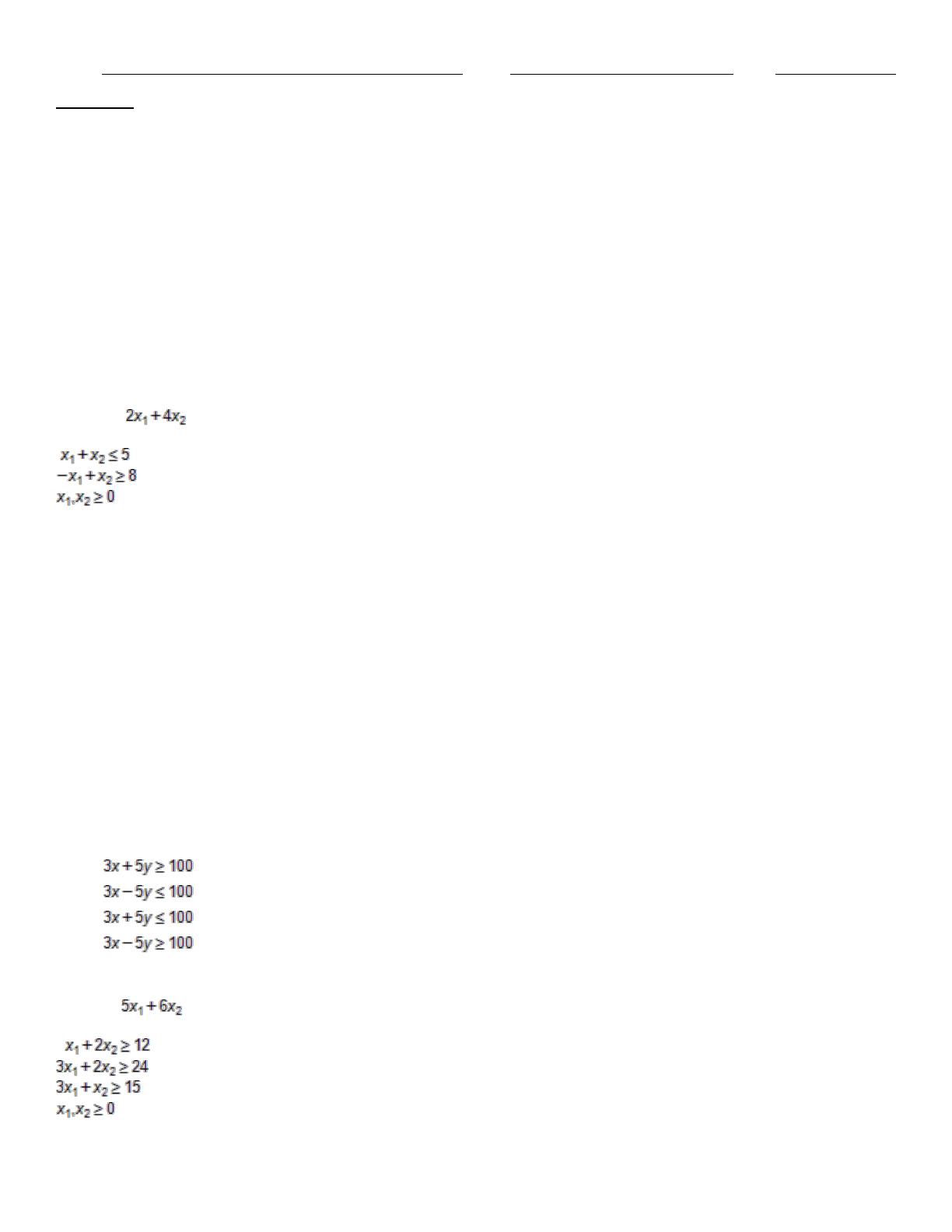
Name:
Class:
Date:
chapter 13
b.
nonbinding constraints
c.
values of the decision variables
d.
the value of the objective function
59. Related to sensitivity analysis in linear programming, when the profit increases with a unit increase in a resource, this
change in profit is referred to as the:
a.
add–in price
b.
sensitivity price
c.
shadow price
d.
additional profit
60.
Consider the following linear programming problem:
Maximize
Subject to
The above linear programming problem:
a.
has only one optimal solution
b.
has more than one optimal solution
c.
exhibits infeasibility
d.
exhibits unboundedness
61. The optimal solution to any linear programming model is:
a.
the maximum objective function line
b.
the minimum objective function line
c.
the corner point of a polygon
d.
the maximum or minimum of a parabola
62. If a manufacturing process takes 3 hours per unit of x and 5 hours per unit of y and a maximum of 100 hours of
manufacturing process time are available, then an algebraic formulation of this constraint is:
a.
b.
c.
d.
63. Consider the following linear programming problem:
Minimize
Subject to

Name:
Class:
Date:
chapter 13
The above linear programming problem:
a.
has only one optimal solution
b.
has more than one optimal solution
c.
exhibits infeasibility
d.
exhibits unboundedness
64. Linear programming models have three important properties. They are:
a.
optimality, additivity and sensitivity
b.
optimality, linearity and divisibility
c.
divisibility, linearity and nonnegativity
d.
proportionality, additivity and divisibility
65. One of the things that you can do with linear programming and a spreadsheet model is to develop a user interface to
make it easier for someone who is not an expert in using linear programming. The output can be a report that explains the
optimal policy in non-technical terms. The type of system being described is called a (n):
a.
expert system
b.
decision support system
c.
linear programming support system
d.
production planning system
66. The term nonnegativity refers to the condition where:
a.
the objective function cannot be less than zero
b.
the decision variables cannot be less than zero
c.
the right hand side of the constraints cannot be greater than zero
d.
the reduced cost cannot be less than zero
67. The prototype linear programming problem is to select an optimal mix of products to produce to maximize profit. This
type of problem is referred to as the:
a.
product mix problem
b.
production problem
c.
product/process problem
d.
product scheduling problem
68. When using the graphical solution method to solve linear programming problems, the set of points that satisfy all
constraints is called the:
a.
optimal region
b.
feasible region
c.
constrained region
d.
logical region
69. All optimization problems have:
a.
an objective function and decision variables
b.
an objective function and constraints
c.
decision variables and constraints
d.
an objective function, decision variables and constraints
Name:
Class:
Date:
chapter 13
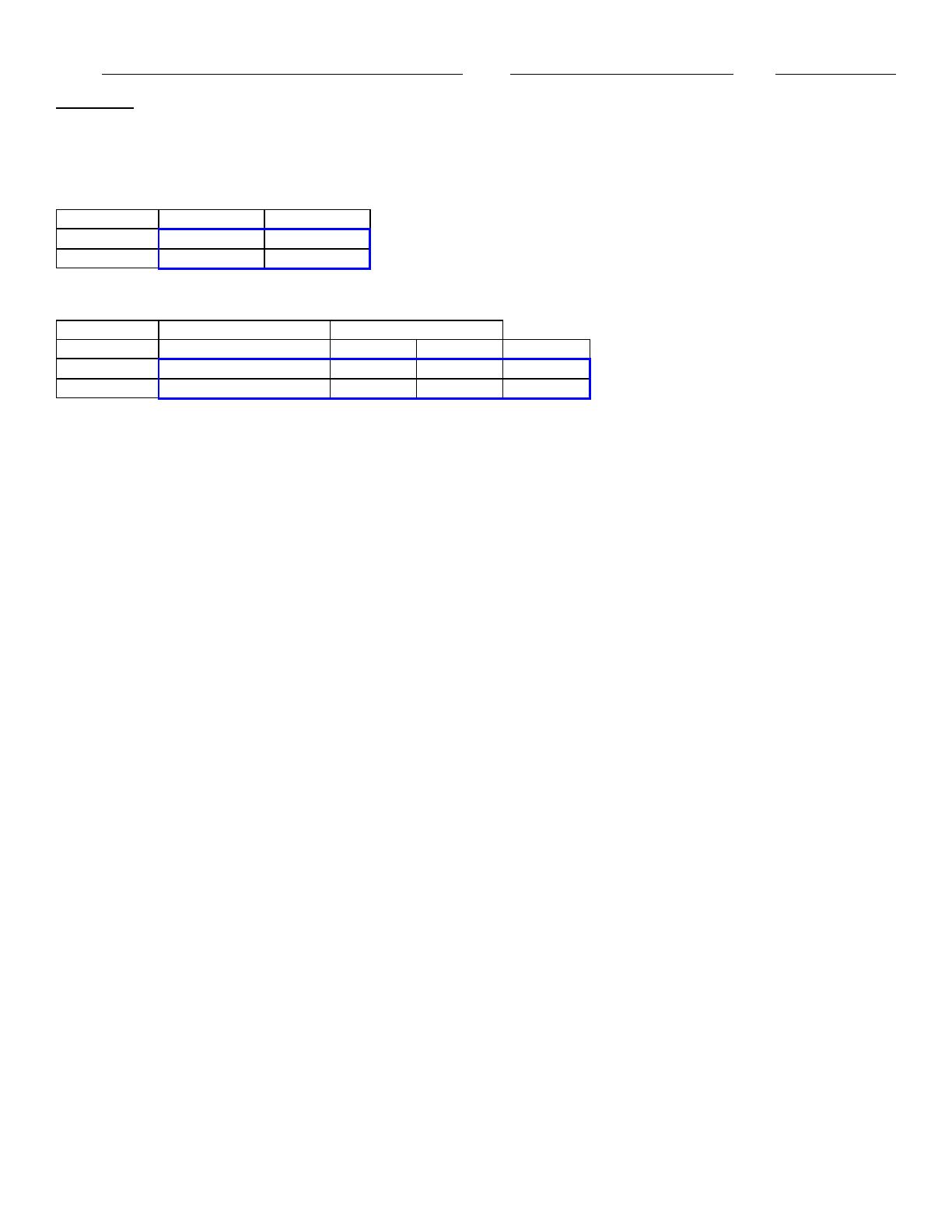
A company produces two products. Each product can be produced on either of two machines. The time (in hours)
required to produce each product on each machine is shown below:
Machine 1
Machine 2
Product 1
5
4
Product 2
8
5
Each month, 600 hours of time are available on each machine, and that customers are willing to buy up to the quantities
of each product at the prices that are shown below:
Demands
Prices
Month 1
Month 2
Month 1
Month 2
Product 1
120
200
$60
$15
Product 2
150
130
$70
$35
The company’s goal is to maximize the revenue obtained from selling units during the next two months.
70. What are the decision variables in this problem?
Western Chassis produces high-quality polished steel and aluminum sheeting and two lines of industrial chassis for the
rack mounting of Internet routers, modems, and other telecommunications equipment. The contribution margin
(contribution toward profit) for steel sheeting is $0.40 per pound and for aluminum sheeting is $0.60 per pound. Western
earns $12 contribution on the sale of a Standard chassis rack and $15 contribution on a Deluxe chassis rack. During the
next production cycle, Western can buy and use up to 25,800 pounds of raw unfinished steel either in sheeting or in
chassis. Similarly, 20,400 pounds of aluminum are available. One standard chassis rack requires 16 pounds of steel and
8 pounds of aluminum. A Deluxe chassis rack requires 12 pounds of each metal. The output of metal sheeting is restricted
only by the capacity of the polisher. For the next production cycle, the polisher can handle any mix of the two metals up to
4,000 pounds of metal sheeting. Chassis manufacture can be restricted by either metal stamping or assembly operations;
no polishing is required. During the cycle no more than 2,500 total chassis can be stamped, and there will be 920 hours of
assembly time available. The assembly time required is 24 minutes for the Standard chassis rack and 36 minutes for the
Deluxe chassis rack. Finally, market conditions limit the number of Standard chassis racks sold to no more than 1,200
Standard and no more than 1,000 Deluxe. Any quantities of metal sheeting can be sold.
71. What is the objective function in this problem?
A customer requires 50, 65, 100, and 70 units of a commodity during the next 4 months, respectively, and no backlogging
is allowed; that is, the customer’s requirements must be met on time. Production costs $5, $8, $4, and $7 per unit during
these months. The storage cost from one month to the next is $2 per unit (assessed on ending inventory). It is estimated
that each unit on hand at the end of month 4 could be sold for $6.
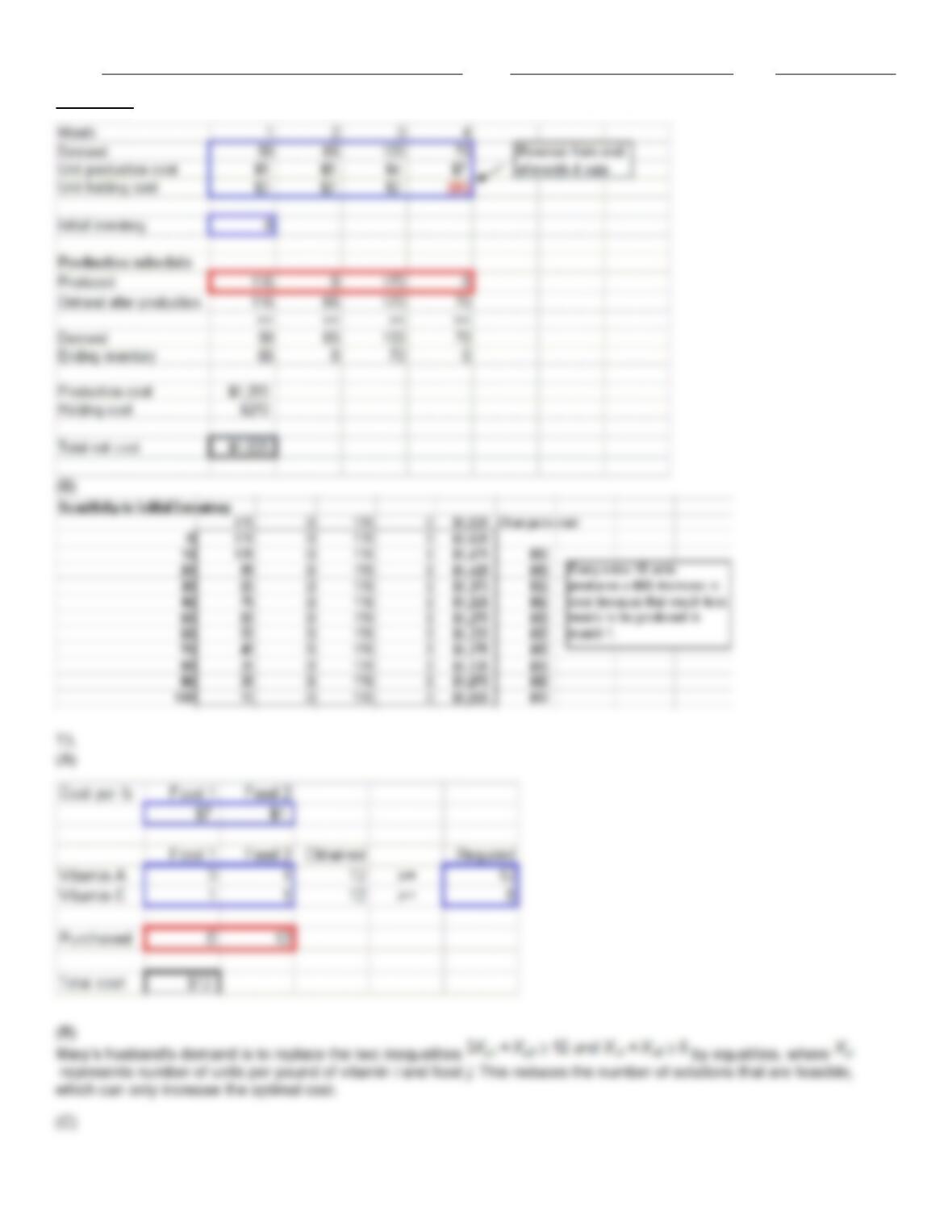
72. (A) Determine how to minimize the net cost incurred in meeting the demands for the next four months.
(B) Starting with the optimal solution to (A), use SolverTable add-in to see what happens to the decision variables and the
total cost when the initial inventory varies from 0 (the implied value in (A)) to 100 in 10-units increments. How much lower
would the total cost be if the company started with 10 units in inventory, rather than none? Would the same cost decrease
occur for every 10-init increase in initial inventory?
Mary has a limited food budget, but still wants to make sure her family members meet their daily nutritional requirements.
Mary can buy two foods. Food 1 sells for $7 per pound, and each pound contains 3 units of vitamin A and 1 unit of vitamin
C. Food 2 sells for $1 per pound, and each pound contains 1 unit of each vitamin. Each day, the family needs at least 12
units of vitamin A and 6 units of vitamin C.
73. (A) Verify that Mary should purchase 12 units of food 2 each day and thus oversatisfy the vitamin C requirement by 6
units.
(B) Mary’s husband has put his foot down and demanded that Mary fulfill the family’s daily nutritional requirement exactly
by obtaining precisely 12 units of vitamin A and 6 units of vitamin C. The optimal solution to the new problem will involve

Name:
Class:
Date:
chapter 13
ingesting less vitamin C, but it will be more expensive, why?
(C) Starting with the optimal solution to (B), use the SloverTable add–in to see what happens to the total cost when the
vitamin A and vitamin C requirements both vary (independently) from 3 to 18 in 3-unit increments. That is, from a two-way
table. Describe the behavior you observe. In particular, are the changes in total cost the same as you look across each
row of the table? Are they the same as you look across each column of the table?
Western Chassis produces high-quality polished steel and aluminum sheeting and two lines of industrial chassis for the
rack mounting of Internet routers, modems, and other telecommunications equipment. The contribution margin
(contribution toward profit) for steel sheeting is $0.40 per pound and for aluminum sheeting is $0.60 per pound. Western
earns $12 contribution on the sale of a Standard chassis rack and $15 contribution on a Deluxe chassis rack. During the
next production cycle, Western can buy and use up to 25,800 pounds of raw unfinished steel either in sheeting or in
chassis. Similarly, 20,400 pounds of aluminum are available. One standard chassis rack requires 16 pounds of steel and
8 pounds of aluminum. A Deluxe chassis rack requires 12 pounds of each metal. The output of metal sheeting is restricted
only by the capacity of the polisher. For the next production cycle, the polisher can handle any mix of the two metals up to
4,000 pounds of metal sheeting. Chassis manufacture can be restricted by either metal stamping or assembly operations;
no polishing is required. During the cycle no more than 2,500 total chassis can be stamped, and there will be 920 hours of
assembly time available. The assembly time required is 24 minutes for the Standard chassis rack and 36 minutes for the
Deluxe chassis rack. Finally, market conditions limit the number of Standard chassis racks sold to no more than 1,200
Standard and no more than 1,000 Deluxe. Any quantities of metal sheeting can be sold.
74. What are the constraints in this problem?
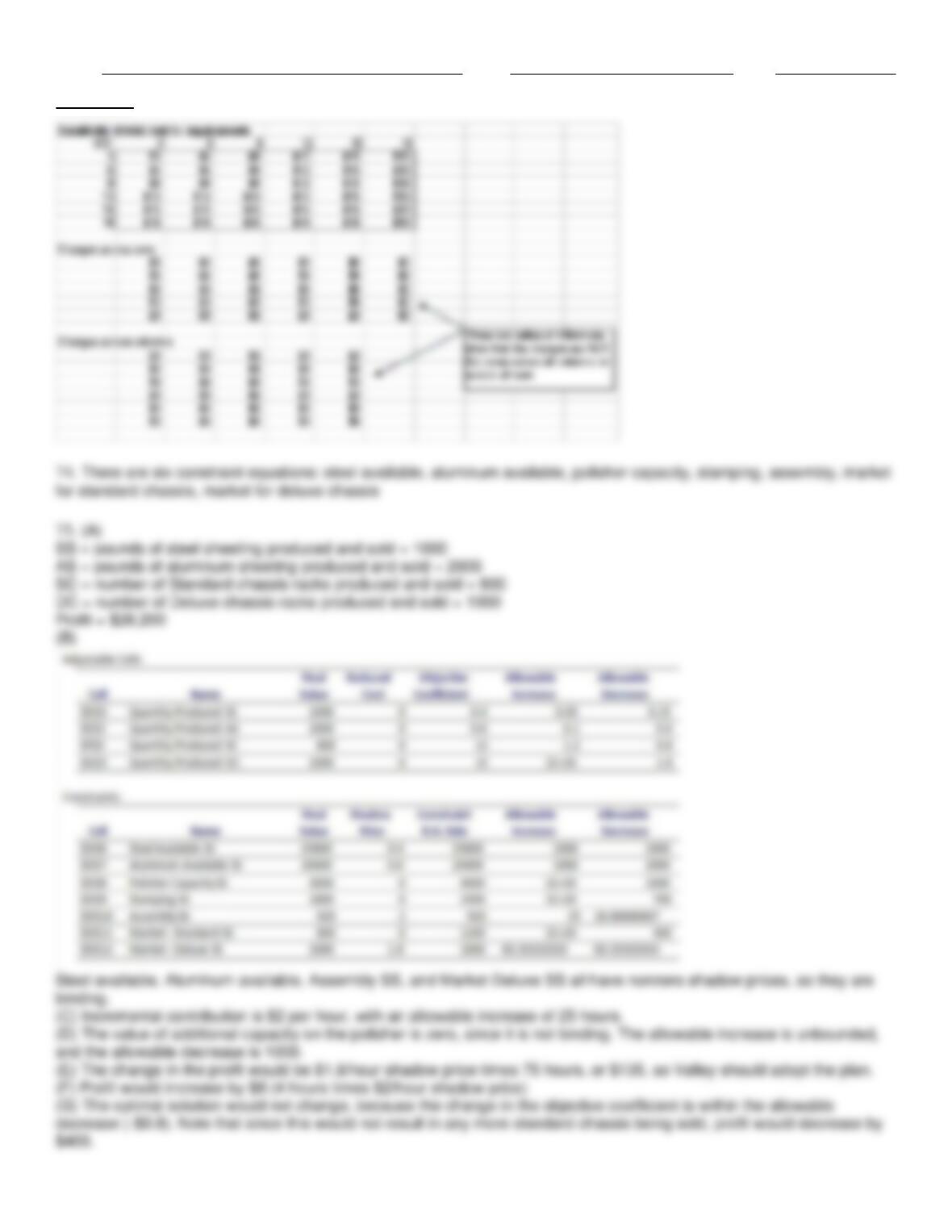
75. (A) Find an optimal solution to the problem. What is the production plan, and what is the total revenue?
(B) Obtain a sensitivity report for the solution reported in (A). Which constraints are binding?
(C) What is the incremental contribution associated with adding an hour of assembly time? Over what range of increase is
the marginal value valid?
(D) What is the value of additional capacity on the polisher? How much increase and decrease in this capacity is possible
before a change occurs in the optimal production schedule?
(E) An advertising agency has devised a marketing plan for the Valley Chassis Company that will increase the market for
Deluxe chassis. The plan will increase demand by 75 Deluxe chassis per month at a cost of $100 per month. Should
Valley adopt the plan? Briefly explain why.
(F) Suppose that four more hours of chassis assembly time could be made available. How much would profit change?
(G) Suppose next that Valley’s marketing department proposes lowering the price for a standard chassis from $12 to
$11.50 so that more can be sold (since there is slack under the demand constraint). Would the optimal solution change?
Explain why, or why not.
(H) If Valley could obtain 1,000 pounds more of raw material (steel or aluminum), which should it procure? How much
should they be willing to pay per pound for the steel or aluminum? Explain your answer.
(I) In doing some contingency planning, Valley thinks that the aging stamping machine will soon need to be taken down
for repairs that could last 2 months and will cost $10,000. During that time, they can continue to operate by outsourcing
the stamping at $2.50 per chassis (deluxe or standard), although the capacity will be reduced from 2,500 to 1,500. What
will be the total cost to repair the stamping machine?
A chemical manufacturer produces two products, chemical X and chemical Y. Each product is manufactured by a two-
step process that involves blending and mixing in machine A and packaging on machine B. Chemical X provides a
$60/unit contribution to profit, while Chemical Y provides a $50 contribution to profit. The processing times for the two
products on the mixing machine (A) and the packaging machine (B) are as follows:
Product
Machine A
Machine B
(hours)
(hours)
Name:
Class:
Date:
chapter 13
Chemical X
2
3
Chemical Y
4
2
For the upcoming two-week period, machine A has available 80 hours and machine B has available 60 hours of
processing time. Forecasts of the markets indicate that the manufacturer can expect to sell a maximum of 16 units of
chemical X and 18 units of chemical Y.
76. Write out an algebraic expression for the objective function in this problem.
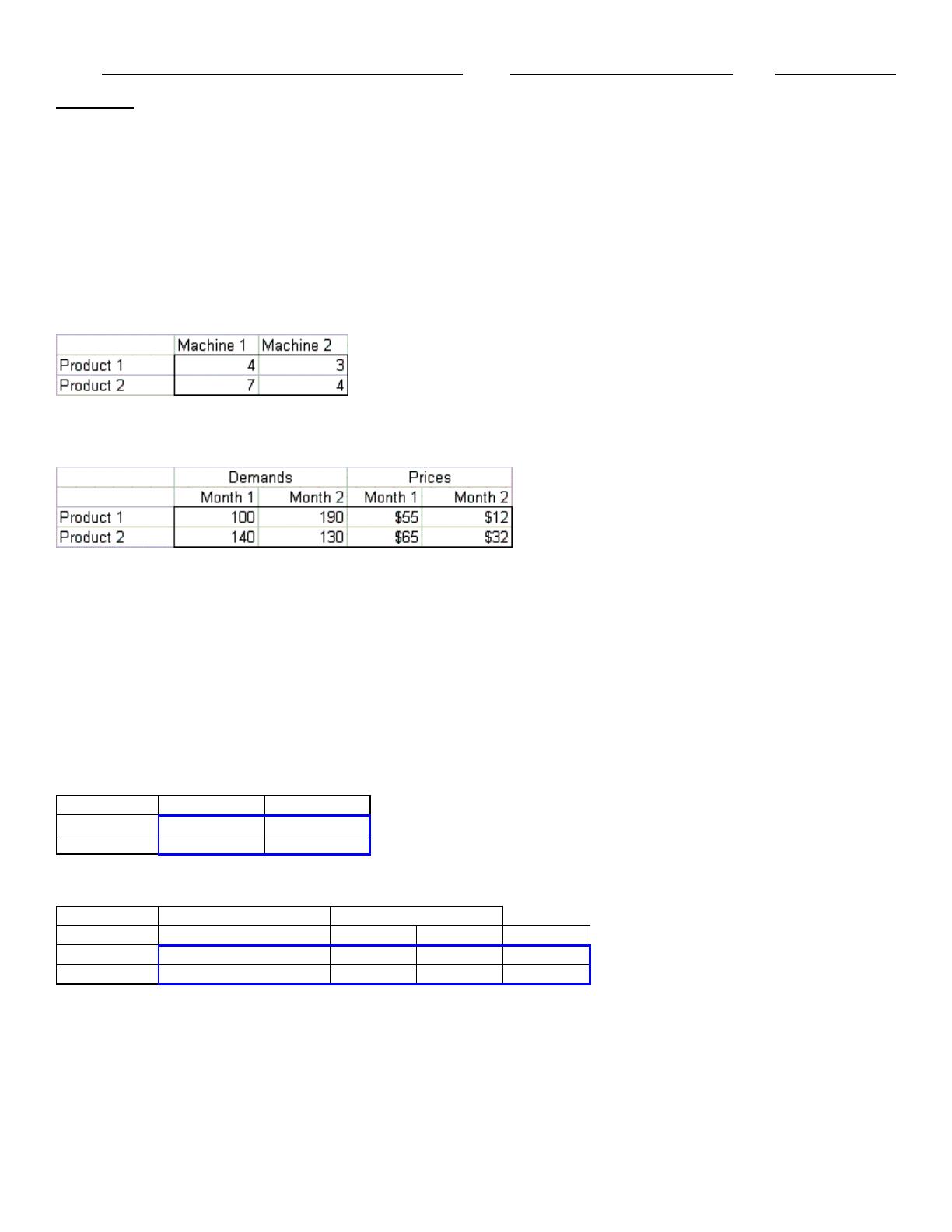
Adam Enterprises manufactures two products. Each product can be produced on either of two machines. The time (in
hours) required to make each product on each machine is shown below:
Each month, 500 hours of time are available on each machine, and also customers are willing to buy up to the quantities
of each product at the prices shown below:
The company’s goal is to maximize the revenue obtained from selling units during the next two months.
77. (A) Determine how the company can meet its goal. Assume that Adam will not produce any units in either month that it
cannot sell in that month.
(B) Referring to (A), suppose Adam wants to see what will happen if customer demands for each product in each month
simultaneously change by a factor 1 + k. Revise the model so that you can use the SolverTable add–in to investigate the
effect of this change on total revenue as k varies from –0.3 to 0.3 in increments of 0.1. Does revenue change in a linear
manner over this range? Can you explain intuitively why it changes in the way it does?
A company produces two products. Each product can be produced on either of two machines. The time (in hours)
required to produce each product on each machine is shown below:
Machine 1
Machine 2
Product 1
5
4
Product 2
8
5
Each month, 600 hours of time are available on each machine, and that customers are willing to buy up to the quantities
of each product at the prices that are shown below:
Demands
Prices
Month 1
Month 2
Month 1
Month 2
Product 1
120
200
$60
$15
Product 2
150
130
$70
$35
The company’s goal is to maximize the revenue obtained from selling units during the next two months.
78. What is the objective function in this problem?
79. Find an optimal solution to the problem, assuming that the company will not produce any units in either month that it
cannot sell in that month. What is the production plan, and what is the total revenue?
A chemical manufacturer produces two products, chemical X and chemical Y. Each product is manufactured by a two-
Name:
Class:
Date:
chapter 13
step process that involves blending and mixing in machine A and packaging on machine B. Chemical X provides a
$60/unit contribution to profit, while Chemical Y provides a $50 contribution to profit. The processing times for the two
products on the mixing machine (A) and the packaging machine (B) are as follows:
Product
Machine A
Machine B
(hours)
(hours)
Chemical X
2
3
Chemical Y
4
2
For the upcoming two-week period, machine A has available 80 hours and machine B has available 60 hours of
processing time. Forecasts of the markets indicate that the manufacturer can expect to sell a maximum of 16 units of
chemical X and 18 units of chemical Y.
80. What are the decision variables in this problem?
Sinclair Plastics operates two chemical plants which produce polyethylene; the Ohio Valley plant which produces 5000
tons per month and the Lakeview plant which can produce 7000 tons per month. Sinclair sells its polyethylene to three
different GM auto plants, Grand Rapids (demand = 3000 tons per month), Blue Ridge (demand = 5000 tons per month),
and Sunset (demand = 4000 tons per month). The costs of shipping between the respective plants is shown in the table
below:
Grand Rapids
Blue Ridge
Sunset
Ohio Valley
50
40
100
Lakeview
75
50
75
81. What is the objective function in this problem?
A company faces the following demands during the next 3 weeks: week 1, 20 units; week 2, 10 units; week 3, 15 units.
The unit production cost during each week is as follows: week 1, $13; week 2, $14; week 3, $15. A holding cost of $2 per
unit is assessed against each week’s ending inventory. At the beginning of week 1, the company has 5 units on hand.
Since not all goods produced during a month can be used to meet the current month’s demand, assume that half of the
goods produced during a week can be used to meet the current week’s demands.
82. (A) Determine how to minimize the cost of meeting the demand for the next three weeks.
(B) Revise the model in (A) so that the demands are of the form , where is the original demand in month t, k is a
factor, and is an amount of change in month t. Formulate the model in such a way that you can use the SolverTable
add–in to analyze changes in the amounts produced and the total cost when k varies from 0 to 10 in 1-unit increments, for
any fixed values of the ’s. For example, try this when = 2, = 5, and = 3. Describe the behavior you observe in
the table. Can you find any “reasonable” ’s that induce positive production levels in week 3?
A company produces two products. Each product can be produced on either of two machines. The time (in hours)
required to produce each product on each machine is shown below:
Machine 1
Machine 2
Product 1
5
4
Product 2
8
5
Each month, 600 hours of time are available on each machine, and that customers are willing to buy up to the quantities
of each product at the prices that are shown below:
Demands
Prices
Month 1
Month 2
Month 1
Month 2
Product 1
120
200
$60
$15
Product 2
150
130
$70
$35
The company’s goal is to maximize the revenue obtained from selling units during the next two months.
Name:
Class:
Date:
chapter 13
83. What are the constraints in this problem?
A marketing research professor is conducting a telephone survey and needs to contact at least 160 wives, 140 husbands,
110 single adult males, and 120 single adult females. It costs $2 to make a daytime call and $4 (because of higher labor
costs) to make an evening call. The table shown below lists the expected results. For example, 10% of all daytime calls
are answered by a single male, and 15% of all evening calls are answered by a single female. Because of a limited staff,
at most half of all phone calls can be evening calls. Determine how to minimize the cost of completing the survey.
Percentages
Daytime
Evening
Wife
25%
25%
Husband
15%
30%
Single male
10%
25%
Single female
15%
15%
None
35%
5%
84. What are the decision variables in this problem?
Sinclair Plastics operates two chemical plants which produce polyethylene; the Ohio Valley plant which produces 5000
tons per month and the Lakeview plant which can produce 7000 tons per month. Sinclair sells its polyethylene to three
different GM auto plants, Grand Rapids (demand = 3000 tons per month), Blue Ridge (demand = 5000 tons per month),
and Sunset (demand = 4000 tons per month). The costs of shipping between the respective plants is shown in the table
below:
Grand Rapids
Blue Ridge
Sunset
Ohio Valley
50
40
100
Lakeview
75
50
75
85. What is the optimal shipping plan? What are the total costs in that case?
A farmer in Egypt owns 50 acres of land. He is going to plant each acre with cotton or corn. Each acre planted with cotton
yields $400 profit; each with corn yields $200 profit. The labor and fertilizer used for each acre are given in the table
below. Resources available include 150 workers and 200 tons of fertilizer.
Cotton
Corn
Labor (Workers)
5
3
Fertilizer (Tons)
6
2
86. (A) Formulate a linear programming model that will enable the farmer to determine the number of acres that should be
planted cotton and/or corn in order to maximize his profit.
(B) Find an optimal solution to the model in (A) and determine the maximum profit.
(C) Implement the model in (A) in Excel Solver and obtain an answer report. Which constraints are binding on the optimal
solution?
(D) Obtain a sensitivity report for the model in (A). How much should the farmer be willing to pay for an additional worker?
(E) Suppose the farmer hires 10 additional workers. Can you use the sensitivity analysis obtained for (D) to determine his
expected profit? Would his planting plan change? Explain your answer.
(F) Suppose the farmer now wants to hire 20 additional workers, instead of just 10. Can you use the sensitivity analysis
obtained for (D) to determine his expected profit? Explain your answer.
Sinclair Plastics operates two chemical plants which produce polyethylene; the Ohio Valley plant which produces 5000
tons per month and the Lakeview plant which can produce 7000 tons per month. Sinclair sells its polyethylene to three
different GM auto plants, Grand Rapids (demand = 3000 tons per month), Blue Ridge (demand = 5000 tons per month),
and Sunset (demand = 4000 tons per month). The costs of shipping between the respective plants is shown in the table
below:
Name:
Class:
Date:
chapter 13
Grand Rapids
Blue Ridge
Sunset
Ohio Valley
50
40
100
Lakeview
75
50
75
87. What are the decision variables in this problem?
Western Chassis produces high-quality polished steel and aluminum sheeting and two lines of industrial chassis for the
rack mounting of Internet routers, modems, and other telecommunications equipment. The contribution margin
(contribution toward profit) for steel sheeting is $0.40 per pound and for aluminum sheeting is $0.60 per pound. Western
earns $12 contribution on the sale of a Standard chassis rack and $15 contribution on a Deluxe chassis rack. During the
next production cycle, Western can buy and use up to 25,800 pounds of raw unfinished steel either in sheeting or in
chassis. Similarly, 20,400 pounds of aluminum are available. One standard chassis rack requires 16 pounds of steel and
8 pounds of aluminum. A Deluxe chassis rack requires 12 pounds of each metal. The output of metal sheeting is restricted
only by the capacity of the polisher. For the next production cycle, the polisher can handle any mix of the two metals up to
4,000 pounds of metal sheeting. Chassis manufacture can be restricted by either metal stamping or assembly operations;
no polishing is required. During the cycle no more than 2,500 total chassis can be stamped, and there will be 920 hours of
assembly time available. The assembly time required is 24 minutes for the Standard chassis rack and 36 minutes for the
Deluxe chassis rack. Finally, market conditions limit the number of Standard chassis racks sold to no more than 1,200
Standard and no more than 1,000 Deluxe. Any quantities of metal sheeting can be sold.
88. What are the decision variables in this problem?
A marketing research professor is conducting a telephone survey and needs to contact at least 160 wives, 140 husbands,
110 single adult males, and 120 single adult females. It costs $2 to make a daytime call and $4 (because of higher labor
costs) to make an evening call. The table shown below lists the expected results. For example, 10% of all daytime calls
are answered by a single male, and 15% of all evening calls are answered by a single female. Because of a limited staff,
at most half of all phone calls can be evening calls. Determine how to minimize the cost of completing the survey.
Percentages
Daytime
Evening
Wife
25%
25%
Husband
15%
30%
Single male
10%
25%
Single female
15%
15%
None
35%
5%
89. (A) What is the objective function in this problem?
(B) What are the constraints in this problem? Write an algebraic expression for each.
(C) Find an optimal solution to the problem using the formulation given in (A) and (B). What is the call plan, and
what is the total cost?
(D) Implement the model in (C) in Excel Solver and obtain an answer report. Which constraints are binding on the
optimal solution?
(E) Obtain a sensitivity report for the model in (D). If the professor could cut the cost of evening calls from $4 to
$3, what would the new calling plan be?
(F) Again using the sensitivity report obtained for (E), suppose the professor could get by with just 100 calls for
single females. What would the call costs be in that case? Explain your answer.
Sinclair Plastics operates two chemical plants which produce polyethylene; the Ohio Valley plant which produces 5000
tons per month and the Lakeview plant which can produce 7000 tons per month. Sinclair sells its polyethylene to three
different GM auto plants, Grand Rapids (demand = 3000 tons per month), Blue Ridge (demand = 5000 tons per month),
and Sunset (demand = 4000 tons per month). The costs of shipping between the respective plants is shown in the table
below:
Grand Rapids
Blue Ridge
Sunset
Ohio Valley
50
40
100

Name:
Class:
Date:
chapter 13
Lakeview
75
50
75
90. What are the constraints in this problem?
A company must meet (on time) the following demands: quarter 1, 3000 units; quarter 2, 2000 units; quarter 3, 4000 units.
Each quarter, up to 2700 units can be produced with regular-time labor, at a cost of $40 per unit. During each quarter, an
unlimited number of units can be produced with overtime labor, at a cost of $60 per unit. Of all units produced, 20% are
unsuitable and cannot be used to meet demand. Also, at the end of each quarter, 10% of all units on hand spoil and
cannot be use used to meet any future demands. After each quarter’s demand is satisfied and spoilage is accounted for, a
cost of $15 per unit is assessed against the quarter’s ending inventory.
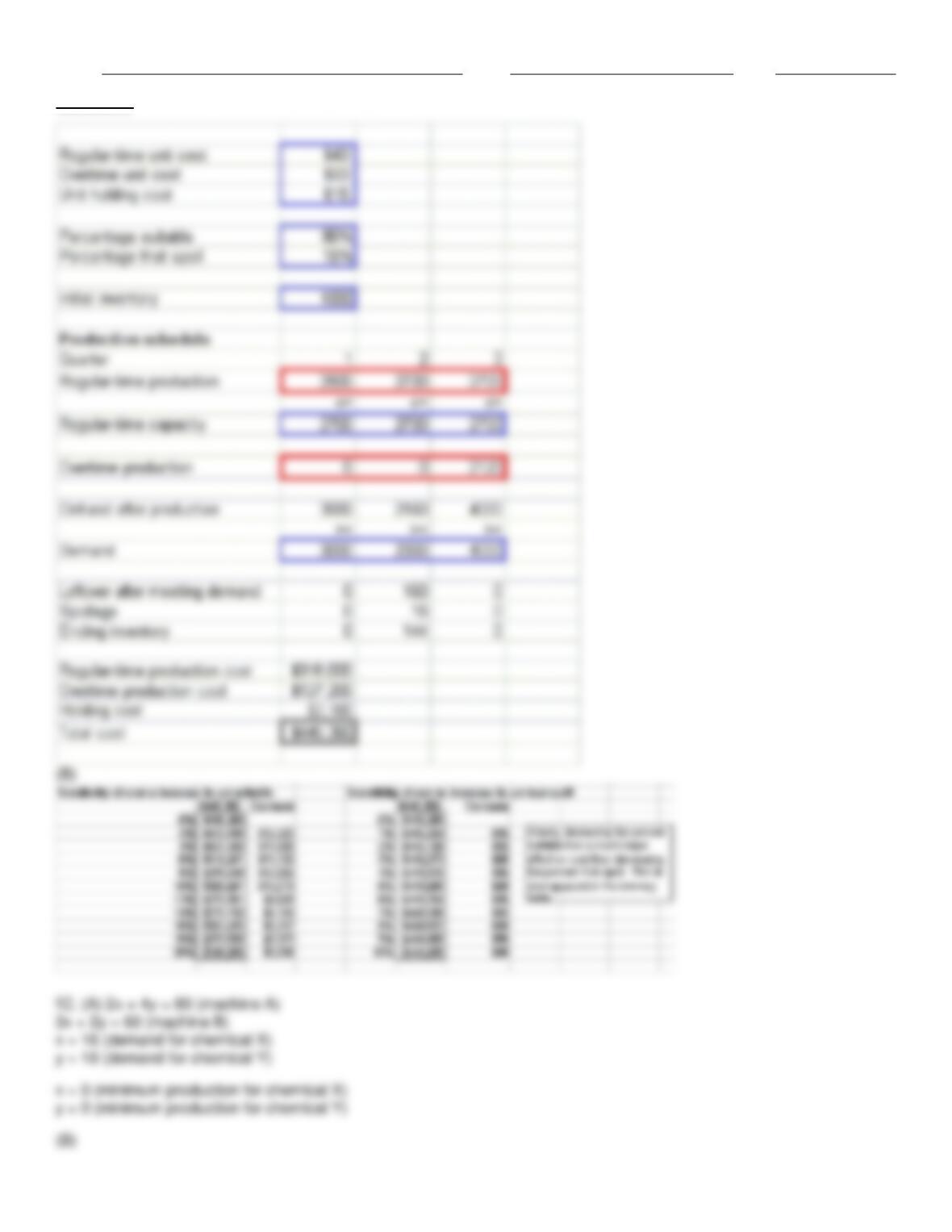
91. (A) Determine how to minimize the total cost of meeting the next 3 quarters’ demand. Assume that 1000 usable units
are available at the beginning of quarter 1.
(B) Referring to (A), the company wants to know how much money it would be worth to decrease the percentage of
unsuitable items and/or the percentage of items that spoil. Write a short report that provides relevant information. Base
your report on two uses of the SolverTable add-in: one where the percentage of unsuitable items decreases and the
percentage of items that spoil stays at 10%; and one where the percentage of unsuitable items stays at 20% and the
percentage of items that spoil decreases.
A chemical manufacturer produces two products, chemical X and chemical Y. Each product is manufactured by a two-
step process that involves blending and mixing in machine A and packaging on machine B. Chemical X provides a
$60/unit contribution to profit, while Chemical Y provides a $50 contribution to profit. The processing times for the two
products on the mixing machine (A) and the packaging machine (B) are as follows:
Product
Machine A
Machine B
(hours)
(hours)
Chemical X
2
3
Chemical Y
4
2
For the upcoming two-week period, machine A has available 80 hours and machine B has available 60 hours of
processing time. Forecasts of the markets indicate that the manufacturer can expect to sell a maximum of 16 units of
chemical X and 18 units of chemical Y.
92. (A) Write out algebraic expressions for all of the constraints in this problem.
(B) Construct a graph of the feasible region for this problem, given the constraints you identified in (A).
(C) Describe how you would find the location of the optimal solution in the feasible region you graphed in (B).
(D) Use the procedure you described in (C) to identify the optimal production plan. Confirm your solution using Solver.
What is the maximized profit?
(E) What constraints are binding on the optimal solution? Use your graphical solution to explain your answer.
Name:
Class:
Date:
chapter 13
Answer Key
Name:
Class:
Date:
chapter 13
Name:
Class:
Date:
chapter 13
variables).
Name:
Class:
Date:
chapter 13
(C)
Name:
Class:
Date:
chapter 13
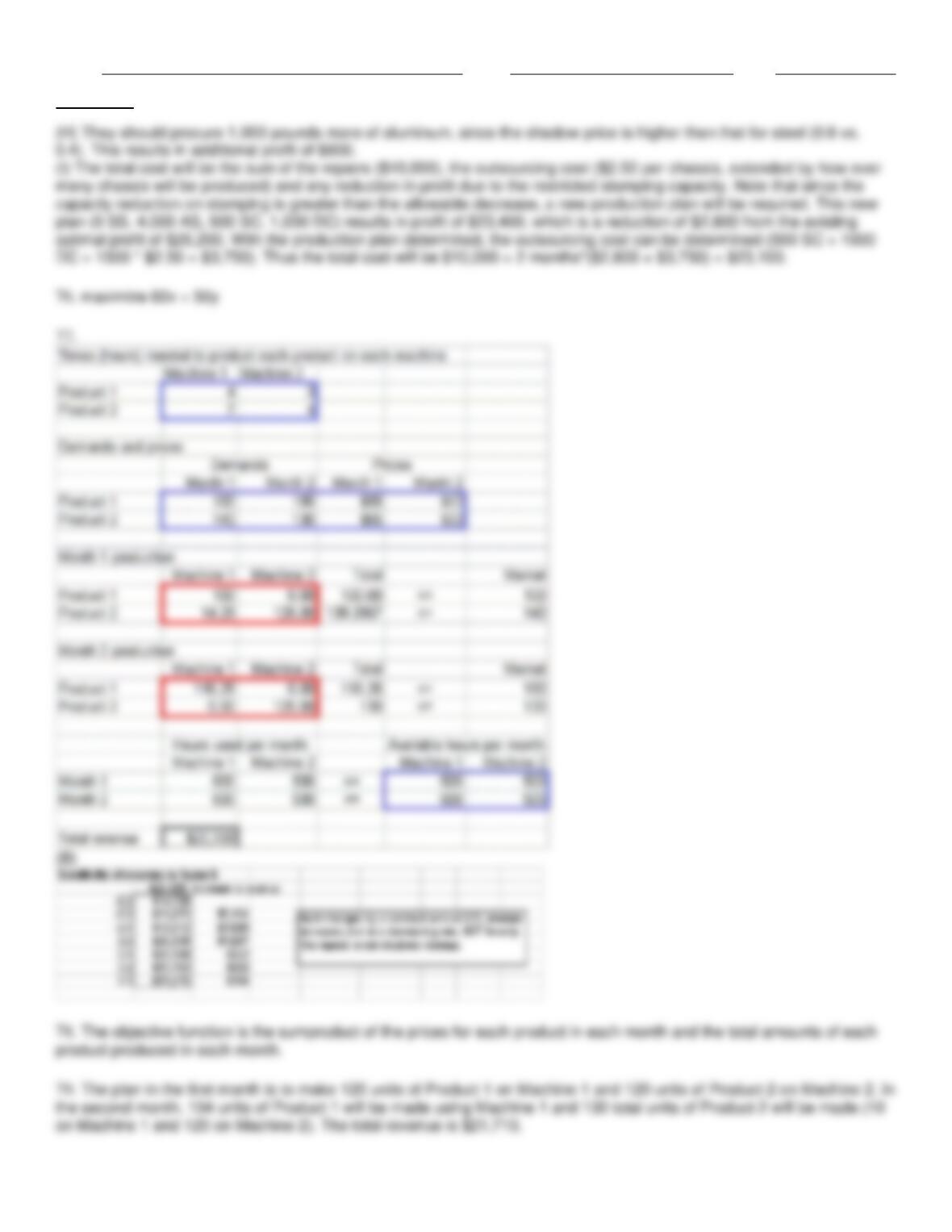
$400.
Name:
Class:
Date:
chapter 13
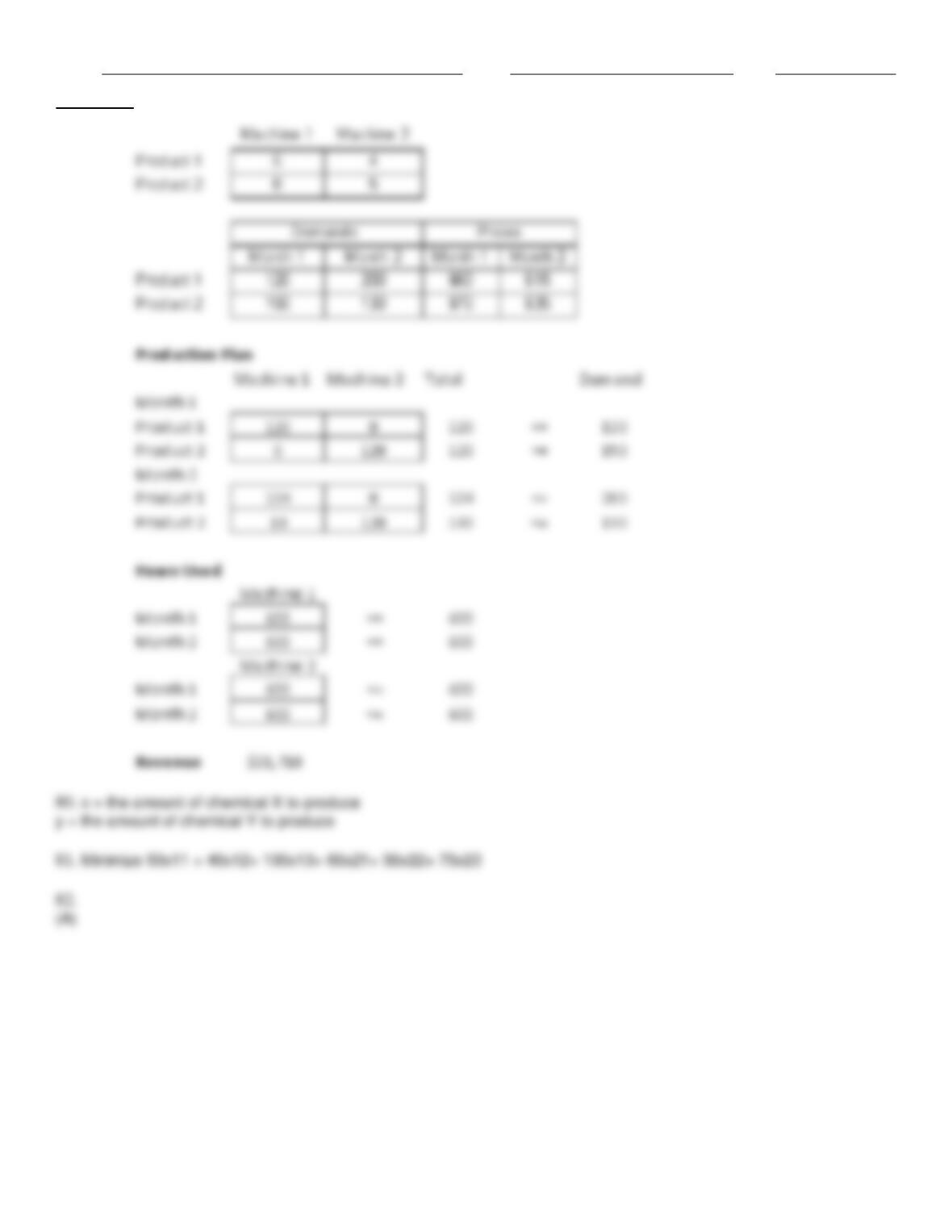
product produced in each month.
Name:
Class:
Date:
chapter 13
y = the amount of chemical Y to produce
(A)
Name:
Class:
Date:
chapter 13
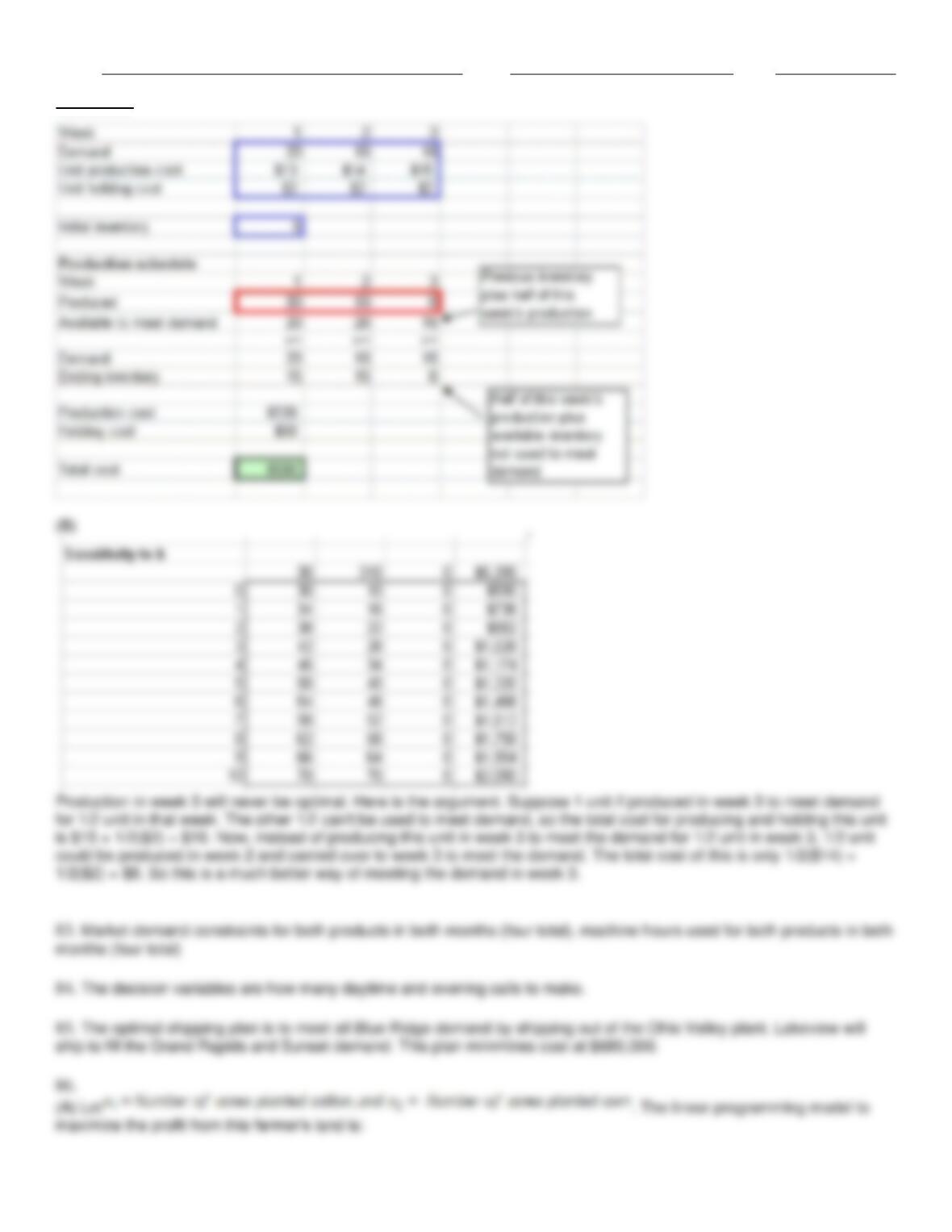
months (four total)
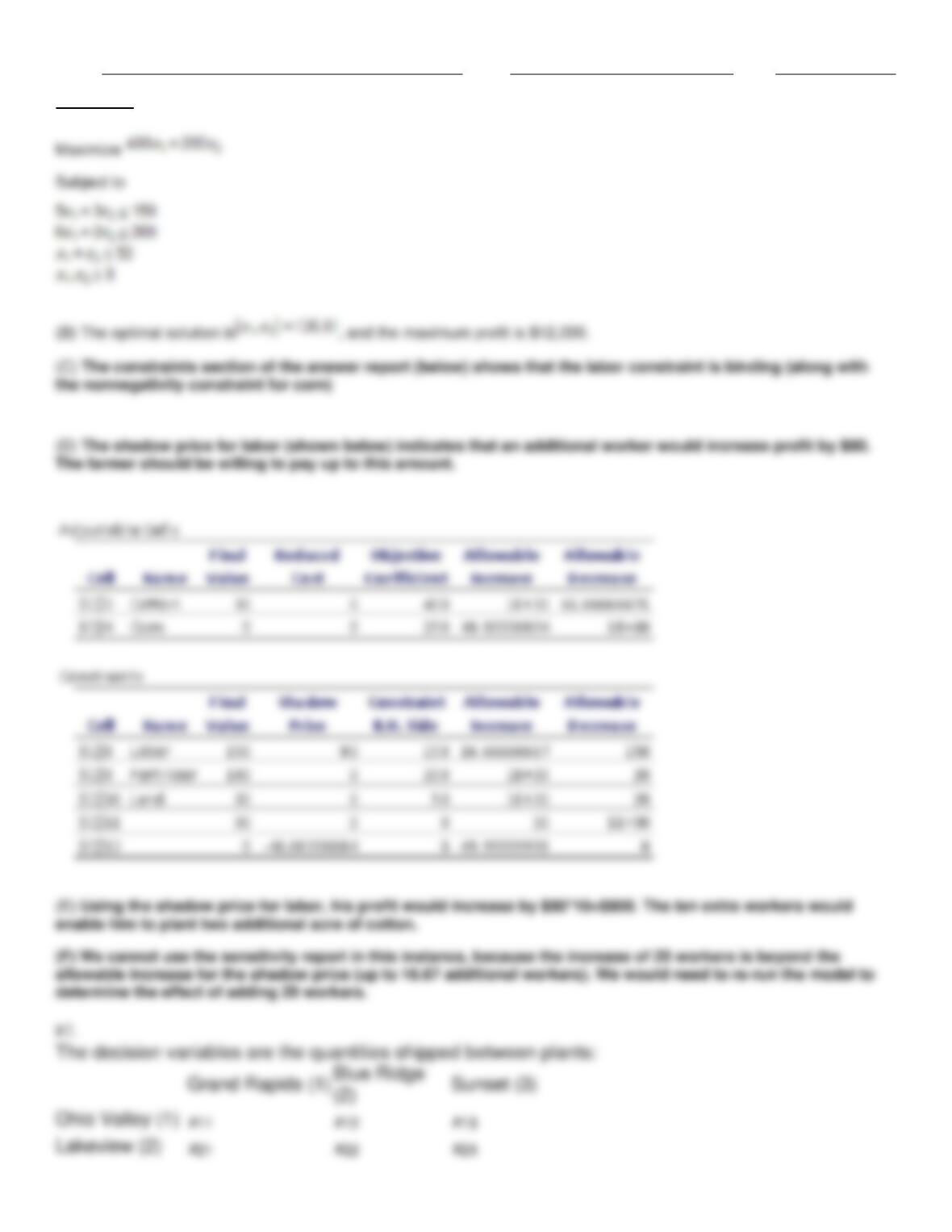
ship to fill the Grand Rapids and Sunset demand. This plan minimizes cost at $680,000.
Name:
Class:
Date:
chapter 13
Name:
Class:
Date:
chapter 13
Name:
Class:
Date:
chapter 13
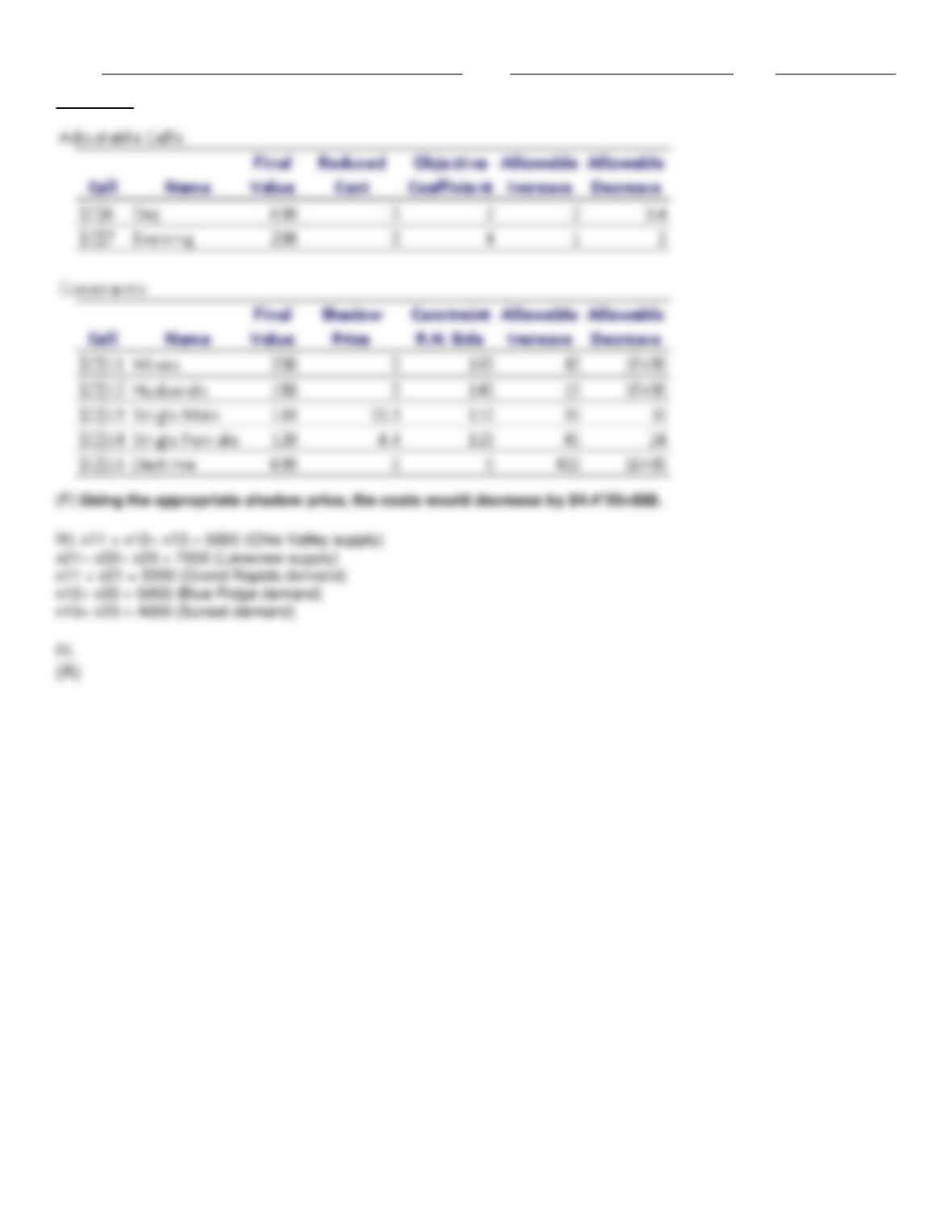
x13+ x23 = 4000 (Sunset demand)
Name:
Class:
Date:
chapter 13
(B)
Name:
Class:
Date:
chapter 13
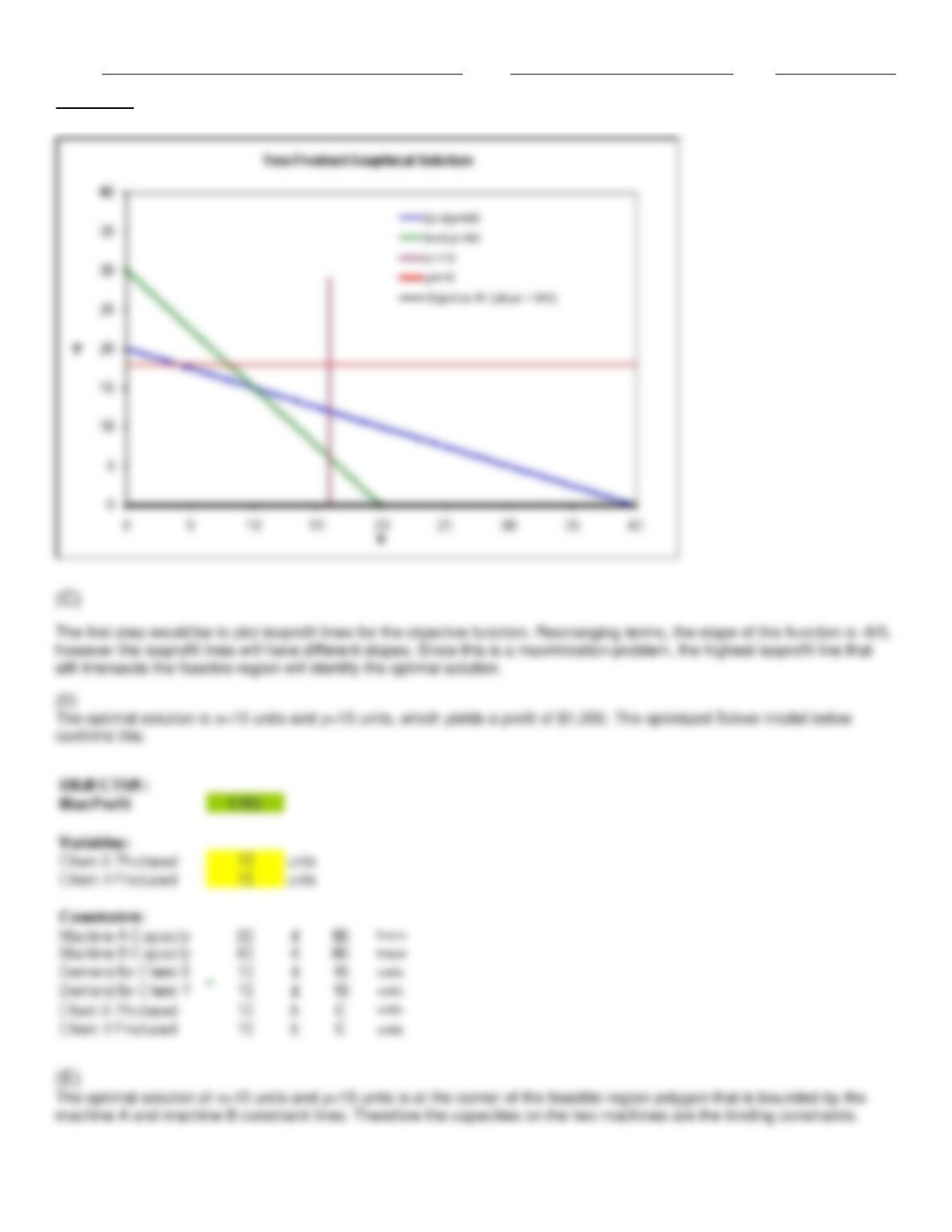
machine A and machine B constraint lines. Therefore the capacities on the two machines are the binding constraints.