
The Cultural Landscape, 11e (Rubenstein)
Chapter 13 Urban Patterns
1) In a simplified model of a city, the zone where retail and office activities are clustered is the
A) central business district.
B) central commerce zone.
C) urbanized downtown area.
D) metropolitan statistical area.
E) hub.
2) Retail activities which tend to concentrate in the CBD include those which have
A) no threshold.
B) no range.
C) services for office workers.
D) a need for rapid transportation.
E) a need for large amounts of horizontal space.
3) Cities tend to situate convention centers and sports complexes in their CBDs because
A) they hope to lower real estate prices and tax revenues in their downtown areas.
B) of their low ranges and thresholds.
C) they hope to stimulate more business for downtown restaurants, bars, and hotels.
D) they have a need for the kind of rapid transportation that is only available in the CBD.
E) the CBD offers large amounts of horizontal space.

4) Even with the diffusion of modern telecommunications, many lawyers, financial analysts, and
public officials in CBDs still exchange information with colleagues primarily through
A) face-to-face contact.
B) high-cost influence peddling.
C) interstate highway systems.
D) the Internet.
E) television and radio broadcasts.
5) Land values are high in the CBD primarily because of
A) competition for limited space.
B) high threshold and range.
C) less intensive land use.
D) the lack of skyscrapers.
E) the lack of residential space.
6) As a result of high land costs, the American CBD is characterized by
A) less intensive land use.
B) the construction of skyscrapers.
C) suburban sprawl.
D) a high threshold and range.
E) the reuse of existing buildings.

7) What activity tends to locate on the street-level floor of a skyscraper in a typical North
American CBD?
A) government
B) industrial
C) office
D) retail
E) education
8) A land use typically excluded from a North American CBD is
A) public administration.
B) industrial.
C) office.
D) retail.
E) legal.
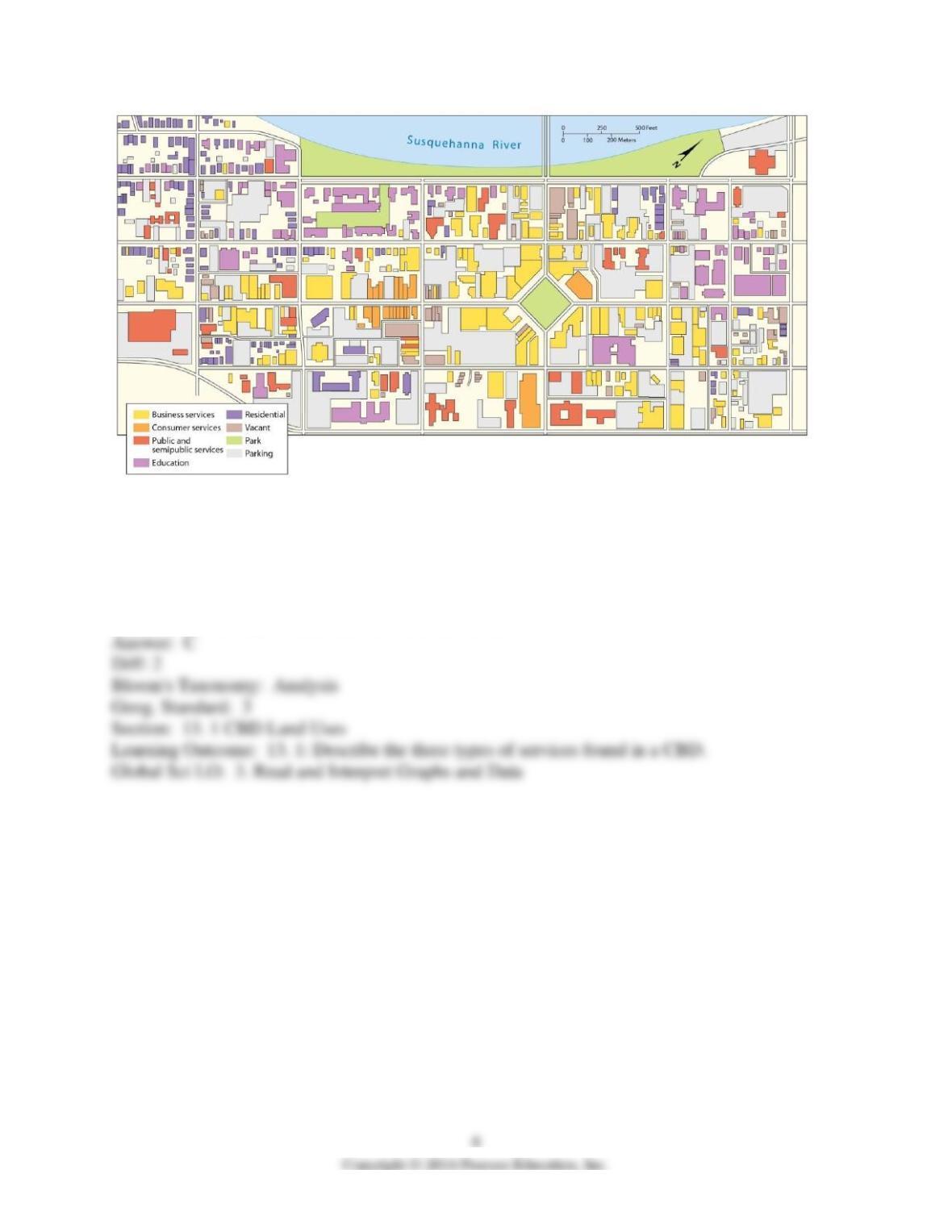
9) According to this plan of the CBD of Wilkes-Barre,
A) most business services are concentrated along the riverfront.
B) several business services are concentrated around a railway station.
C) several business services are concentrated around a park.
D) there is a lack of parking lots in the downtown area.
E) there are virtually no residential areas in the CBD.
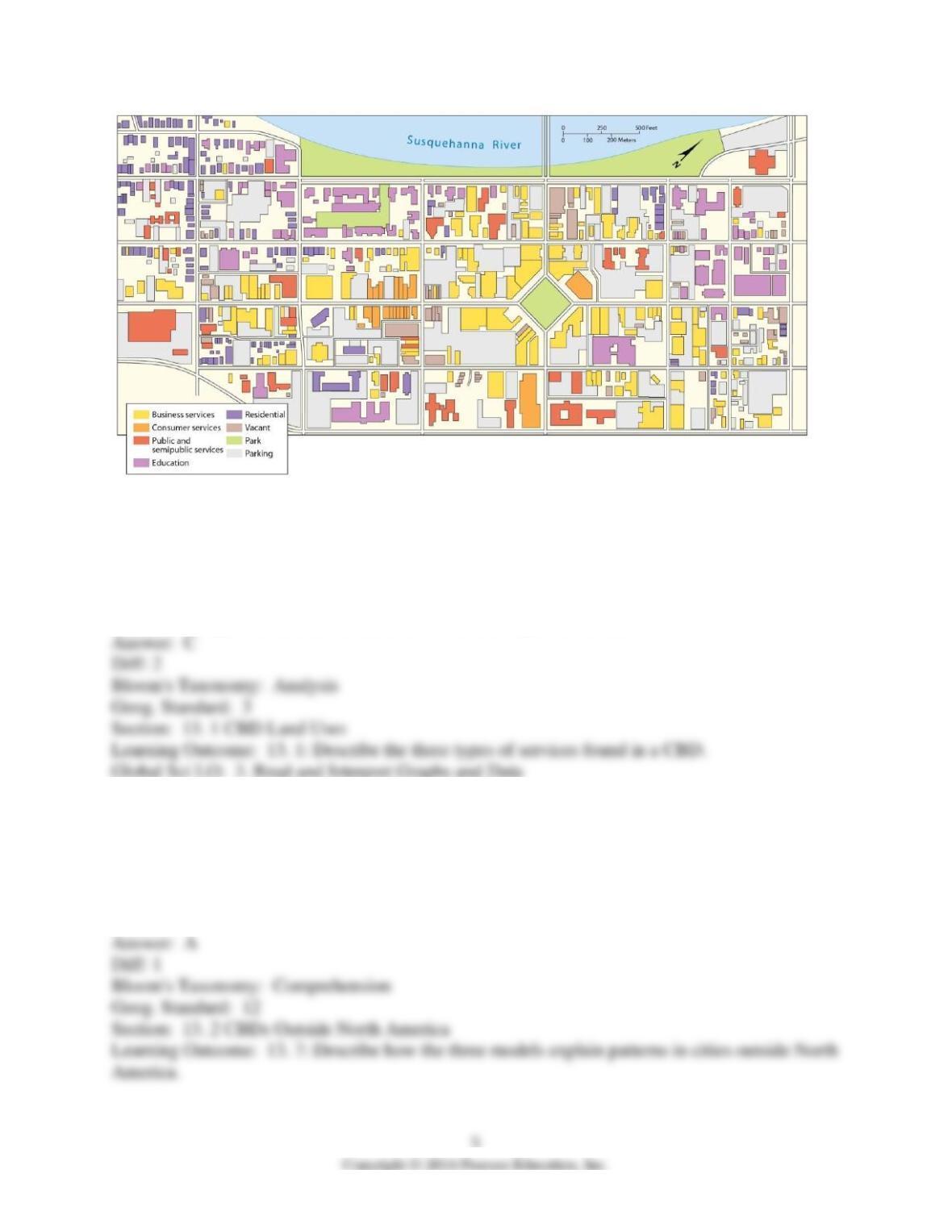
10) According to this plan of the CBD of Wilkes-Barre,
A) public and business services are concentrated mainly along the riverfront.
B) there is a mixture of public, semipublic, and business services in the suburbs.
C) there is a mixture of public, semipublic, and business services in the downtown area.
D) business services and consumer services hardly ever adjoin.
E) there are separate districts for business services and public services.
11) European CBDs are similar to those in North America because they both contain
A) retail and office activities.
B) extensive residential areas.
C) large numbers of skyscrapers.
D) structures inherited from medieval times.
E) ancient Roman structures.
12) The zone in transition in U.S. cities typically contains which of the following?
A) legal offices and parking lots
B) skyscrapers, suburbs, agricultural land, parking lots, and restaurants
C) agricultural land
D) suburbs, agricultural land, parking lots, and transportation hubs
E) warehouses, industry, and poorer-quality housing
13) According to the concentric zone model, a city develops in a series of
A) corridors.
B) nodes.
C) rings.
D) sectors.
E) quadrants.
14) According to the sector model, the best housing is located in
A) a corridor from downtown to the edge of the city.
B) an outer ring surrounding the city.
C) nodes near universities and parks.
D) renovated inner-city neighborhoods.
E) gated communities.
15) According to Homer Hoyt’s sector model, once a district with high-class housing is
established, the most expensive new housing is built
A) on the outer edge of that district, farther out from the center.
B) on the inner edge of that district, closer to the center.
C) in the skyscrapers of the CBD.
D) in old industrial buildings and retail shops.
E) on the outer edge of the suburban area, farther out from the center.
16) According to the multiple nuclei model, an airport is likely to attract nearby
A) hotels and warehouses.
B) residences and highways.
C) retail and wholesale shops.
D) universities and colleges.
E) hospitals and clinics.
17) Chicago is a good location in which to develop urban models because it is located
A) at the end of the nation’s transportation system.
B) in the center of the country.
C) on a relatively flat prairie.
D) on the shore of Lake Michigan.
E) near other primate cities.
18) Social area analysis attempts to explain
A) the changing location of retail and office activities in North American cities.
B) the development of squatter settlements in developing countries.
C) the distribution of different types of people in an urban area.
D) which of the three models of urban structure is the most accurate in the United States.
E) regions ideal for social services.
19) The multiple nuclei theory
A) involves four linked CBDs.
B) includes nodes such as a port, a university, airport, and a park.
C) includes a nucleus in the CBD which is connected to a nucleus in the suburbs.
D) links a seaport, an airport, and a railway station.
E) disregards the use of nodes.
20) A recent change in the typical U.S. density gradient has been
A) the elimination of the gap traditionally found in the center.
B) an increase in the extremes between the inner and outer areas.
C) an increase in the number of people living in the center.
D) a reduction in the differences in densities found within an urban area.
E) an increase in the differences in densities found within an urban area.
21) The city plus its surrounding built-up suburbs is the
A) central city.
B) urbanized area.
C) metropolitan statistical area.
D) consolidated metropolitan statistical area.
E) regional government federation.
22) In the United States, which of the following definitions of a city covers the largest land area?
A) central business district
B) central city
C) urbanized area
D) metropolitan statistical area
E) regional government federation
23) According to the sector model, if family X has an income of $100,000 and family Y has an
income of $40,000 but family Z has an income of $115,000
A) families Y and Z are likely to live in the same sector of the city.
B) families X and Z are likely to live in the same sector of the city.
C) families X and Y are likely to live in the same sector of the city.
D) families X, Y, and Z are likely to live in the same sector of the city.
E) none of these families are likely to live in the same sector of the city.
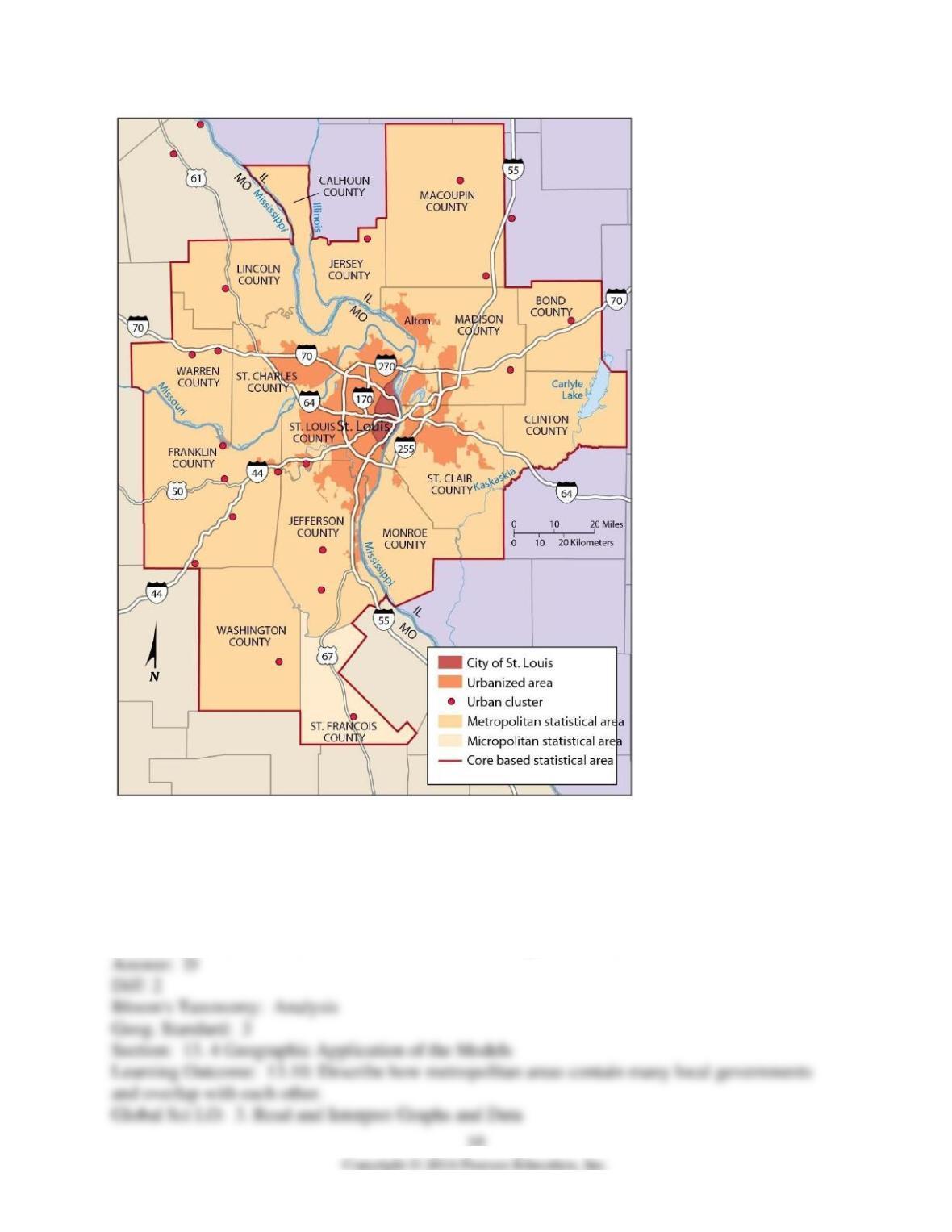
24) According to this map of the St. Louis area, the
A) city itself extends to the east bank of the Mississippi River but the urbanized area does not.
B) urbanized area extends through Washington and Clinton counties.
C) urbanized area extends through Madison, Jefferson, and Lincoln counties.
D) urbanized area extends through Madison and Jefferson counties.
E) increase in the differences in densities is found throughout the entire urban area.
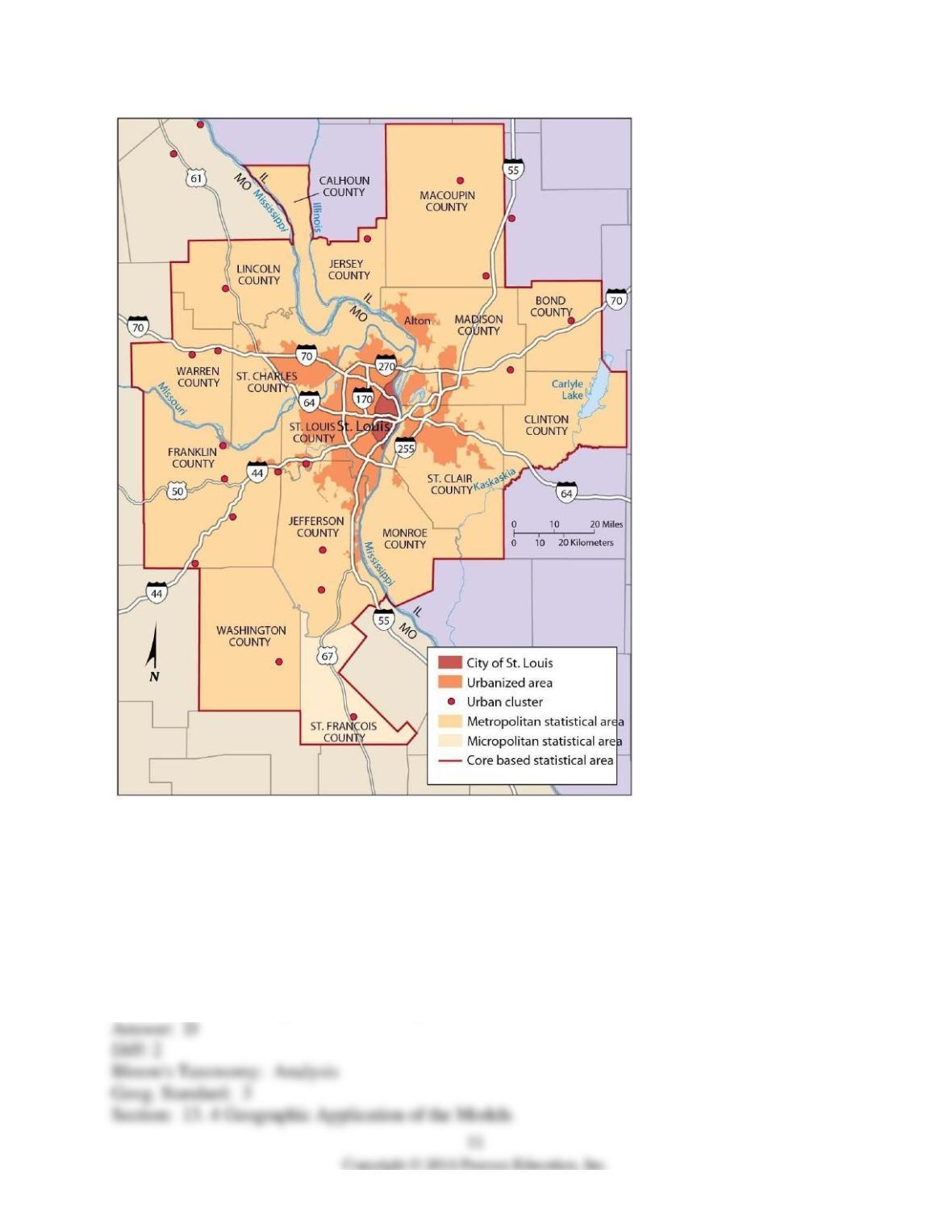
25) According to this map of the St. Louis area, the
A) Metropolitan Statistical Area extends to every county on the map.
B) city is primarily on the east bank of the Mississippi River.
C) there are several urban clusters within the urbanized area that are not within the Metropolitan
Statistical Area.
D) there are several urban clusters within the Metropolitan Statistical Area that are not within the
urbanized area.
E) there are several CBDs within the Metropolitan Statistical Area that are also parts of the
urbanized area but not parts of the Micropolitan Statistical Area.
26) Many of the poor on the periphery of cities in less developed countries live in areas known as
A) squatter settlements.
B) council estates.
C) public housing.
D) the zone in transition.
E) suburbs.
27) The areas on the periphery of cities in less developed countries are sometimes known as
A) barriadas, favelas bidonvilles, bastees, or kampongs.
B) young city and old city zones.
C) public housing, barmiadelas, fonelongas, or kuhpinongs.
D) the zone in transition, suburbs, or public zone.
E) suburbs, barmiadelas, fonelongas, or kuhpinongs.
28) The laws enacted in 1573 that specifically outlined how colonial Spanish cities were to be
constructed were called the
A) Bills of the Americas.
B) Laws of the Indies.
C) American Indian Laws.
D) Colonial Center Laws.
E) Laws of the Real Corona.
29) After 1573, most Spanish colonial cities were designed to have
A) neighborhoods built around central, smaller plazas with parish churches and older quarters
with narrow, winding streets and cramped residences.
B) gridiron street plans centered on a church and plaza, walls around houses, and wider streets
than are in the centers of most European cities.
C) winding street plans centered on a church and plaza, garden lawns around houses, and wider
streets than the centers of most European cities.
D) gridiron street plans centered on a church and plaza, walls around houses, and narrower, more
winding streets than are in the centers of most European cities.
E) a gridiron street plan, a cathedral, and at least 20 parish churches for each city.
30) When the models of urban structure developed in Chicago are applied to Sao Paulo, one
conclusion is that
A) both cities are located near large lakes.
B) Sao Paulo doesn’t have high income neighborhoods.
C) the models don’t work in Sao Paulo.
D) the poorest people are located in different areas.
E) physical geography has not influenced the distribution of social classes Sao Paulo.
31) Compared to the United Kingdom, the amount of sprawl in the United States is
A) greater.
B) less.
C) about the same.
D) better controlled.
E) declining.
32) Sprawl is the
A) change in density within an urban area from the periphery to the center.
B) development of new housing sites not contiguous to the existing built-up area.
C) land maintained as open space surrounding an urban area.
D) period in the morning and evening with the heaviest volumes of traffic.
E) increasing population density in rings two and three of the concentric zone model.
33) British cities are surrounded by open space known as
A) greenbelts.
B) public housing.
C) sprawl.
D) squatter settlements.
E) suburbs.
34) The “Boswash” corridor that stretches from Boston to Washington, D.C., was named
“Megalopolis”
A) by geographer Jean Gottmann.
B) because it covered more than one-fourth of total U.S. land area.
C) because it was planned to house more than half of the U.S. population.
D) as a counterbalance to the plans of geographer Hugh Separalle.
E) by economist, philanthropist, and geographer Harvey Keitel.
35) The strongest criticism of suburbs argued that historically,
A) low-income people and minorities are unable to live in some areas because of the high cost of
the housing, the unfriendliness (or discrimination) of established residents, and fears that
property values would decline if minorities were allowed to buy property there.
B) low-income people and minorities are able to live in some areas because of the low cost of the
housing, the friendliness of established residents, and the myth that property values would
decline if minorities were allowed to buy property there.
C) legal devices, such as requiring several small houses to sit on a large lot of land amid several
different apartments, prevented low-income families from living in many suburbs.
D) low-income people and minorities are unable to live in some areas because of the high cost of
the private schools there, the unfriendliness of African American and Hispanic minorities there,
and the fear that property values would not change if other minorities were allowed to buy
property there.
E) they encouraged the buying and selling of too many automobiles.
36) People in the United States are attracted to suburbs in part because suburbs are characterized
by
A) heavy traffic.
B) lower opportunity for home ownership.
C) private land surrounding the house.
D) row houses and apartments.
E) closer proximity to cultural institutions.
37) The largest component of the U.S. population lives in
A) central cities.
B) suburbs.
C) nonmetropolitan areas.
D) rural settlements.
E) the second and third rings of the concentric zone model.
38) Factories have moved to suburban locations in part because of
A) access to main highways.
B) adequate space to build vertical structures.
C) availability of large tracts of high-priced land.
D) good rail connections.
E) access to cheap labor.
39) Compared to the United States, poor families in European cities are more likely to be
A) clustered in inner–city neighborhoods.
B) dispersed throughout the city.
C) clustered in suburbs.
D) distributed uniformly in the city.
E) living along major boulevards.
40) A legal form of segregation in U.S. cities is achieved through
A) blockbusting.
B) redlining.
C) zoning.
D) greenbelts.
E) busing.
41) The largest number of daily trips are made primarily for
A) legal reasons.
B) shopping.
C) social meetings.
D) work.
E) recreational endeavors.
42) The U.S. government has encouraged the use of cars in part by
A) building interstate highways.
B) charging high gasoline taxes.
C) constructing new subways.
D) protecting prime agricultural land.
E) tax credits for automobile owners.
43) Compared to the private automobile, public transportation offers more
A) energy efficiency.
B) flexibility.
C) pollution.
D) privacy.
E) range.
44) Hybrid automobile sales in the United States increased during the early 2000s primarily
because of the success of Toyota’s
A) line of fuel-efficient SUVs.
B) Tundra.
C) Prius.
D) Prion.
E) Honda Civic.
45) The energy efficiency of a hybrid car is tied to
A) the use of hybrid gasolines.
B) the generation of electricity from rooftop solar panels and wind turbines affixed to the sides
and undercarriage of the car.
C) the use of a gasoline engine at high speeds, whereas at low speeds an electric motor takes
over; moreover, energy that would have otherwise escaped as heat is captured and stored while
the car is coasting and braking.
D) the use of a gasoline engine at low speeds, whereas at high speeds an electric motor takes
over; moreover, energy that would have otherwise escaped as heat is captured and stored while
the car is coasting and braking.
E) the use of a gasoline engine at high speeds, and at low speeds, when the gas engine is at its
most efficient, an electric motor takes over. Energy that would otherwise be gained while
coasting and braking is lost as electricity and heat when it would otherwise be needed.
46) Public transit is more extensive in Western European cities than in the United States
primarily because
A) Europeans can’t afford cars.
B) European governments subsidize public transit.
C) density is lower in the United States than in Europe.
D) the typical European central city contains fewer high-rises.
E) suburbs are built at subway terminals.
47) Large numbers of employees of suburban businesses may suffer hardships because they do
not
A) commute to the CBD on privately funded transportation systems.
B) experience sprawl.
C) own automobiles, although in this new urban landscape public transportation is widely
available.
D) own automobiles, in an urban landscape where public transportation is limited.
E) have new school districts, in an urban landscape where public schools are almost nonexistent.
48) The process that includes subdividing a house from single-family owner occupancy to
multiple occupancy, is
A) blockbusting.
B) filtering.
C) gentrification.
D) redlining.
E) urban blight.
49) During the process of ________, the owner may abandon the property because the rents that
can be collected are less than the costs involved in upkeep.
A) blockbusting
B) filtering
C) gentrification
D) redlining
E) urban blight
50) A process by which banks designate an area within which they refuse to lend money for
improvements is
A) blockbusting.
B) filtering.
C) gentrification.
D) redlining.
E) zoning.
51) The city of ________ declined from 1.8 million inhabitants in 1950 to 700,000 in 2010.
A) San Diego
B) St. Louis
C) Miami
D) Detroit
E) Chicago
52) Detroit is trying to figure out how to shut down and close off ________ because the city
cannot afford to pay for street lights, garbage pickup, and police protection for the entire 360
square kilometers (139 square miles).
A) advertising revenue
B) the rap video industry
C) corporate investment
D) entire neighborhoods
E) the entire CBD