Chapter 13 – Investments and Long–Term Receivables
118. Fish Galore Corp. bought 25% of Fin Chaser Corporation’s stock for $70,000 on January 1, 2017. During 2017, Fin
Chaser earned $25,000 of net income , and Fin Chaser distributed $15,000 of dividends on December 31, 2017.
Required:
Present all related 2017 entries on Fish Galore Corp.’s books, including the January 1 investment.
119. On January 1, 2017, the Z Corporation acquired a 20% interest in D Company by purchasing 4,800 shares of its
24,000 outstanding shares of common stock. The acquisition price was $30 per share. On the date of purchase, D
Company’s net assets were as follows:
Book Value
Fair Value
Difference
Nondepreciable assets
$ 60,000
$ 74,000
$14,000
Depreciable assets
160,000
196,000
36,000
Total assets
$220,000
$270,000
$50,000
Total liabilities
$ 80,000
$ 80,000
During 2017, D Company earned income of $70,000 and paid dividends of $18,000. The depreciable assets have a
ten-year remaining life and no residual value.
Required:
Prepare all of the journal entries on Z Corporation’s books to record the acquisition and subsequent events in 2017
related to the investment in D Company.
Investment in Stock: D Company ($30 ×4,800)
Cash
Investment in Stock: D Company (0.20 ×$70,000)
Investment Income
Cash (0.20 ×18,000)
3,600
Investment in Stock: D Company
Investment Income [($36,000 ×0.20)/10]
720
Investment in Stock: D Company
720
Purchase price
Book value ($140,000 ×0.20)
Excess
Adjustments:
Depreciable assets ($36,000 ×0.20)
Goodwill
120. Ringer Company acquired 40% of the outstanding stock of the Leopard Company for $370,000 on January 1, 2017.
The purchase price equaled 40% of the book value of Leopard Company. During 2017, Leopard engaged in the
following activities:
April 7
Declared and paid a cash dividend, $175,000.
Dec. 31
Reported annual earnings for 2017, $250,000.
Required:
Prepare the journal entries that Ringer would need to make in 2017 with respect to its investment in Leopard
Company.
1
ACCT.WHAL.16.13.6 – LO: 13.6
United States – OH – Default City – AICPA: FN-Measurement
Bloom’s: Analyzing
121. On January 1, 2017, Casey Company acquires a 30% interest in Hill Company by purchasing 6,000 shares of its
20,000 common stock for $16 per share. On January 1, 2017, the net assets of Hill Company were as follows:
Book Value
Fair Value
Nondepreciable assets
$ 60,000
$ 60,000
Depreciable assets (5-year remaining life)
200,000
240,000
$260,000
$300,000
Liabilities
$ 20,000
$ 20,000
During 2017, Hill reported net income of $200,000 and paid cash dividends of $80,000.
Required:
Prepare all journal entries on Casey’s books to record the acquisition, dividends, and income from the investment in
Hill Company.
1
Challenging
ACCT.WHAL.16.13.6 – LO: 13.6
United States – BUSPORG: Analytic
United States – OH – Default City – AICPA: FN-Measurement
Bloom’s: Analyzing
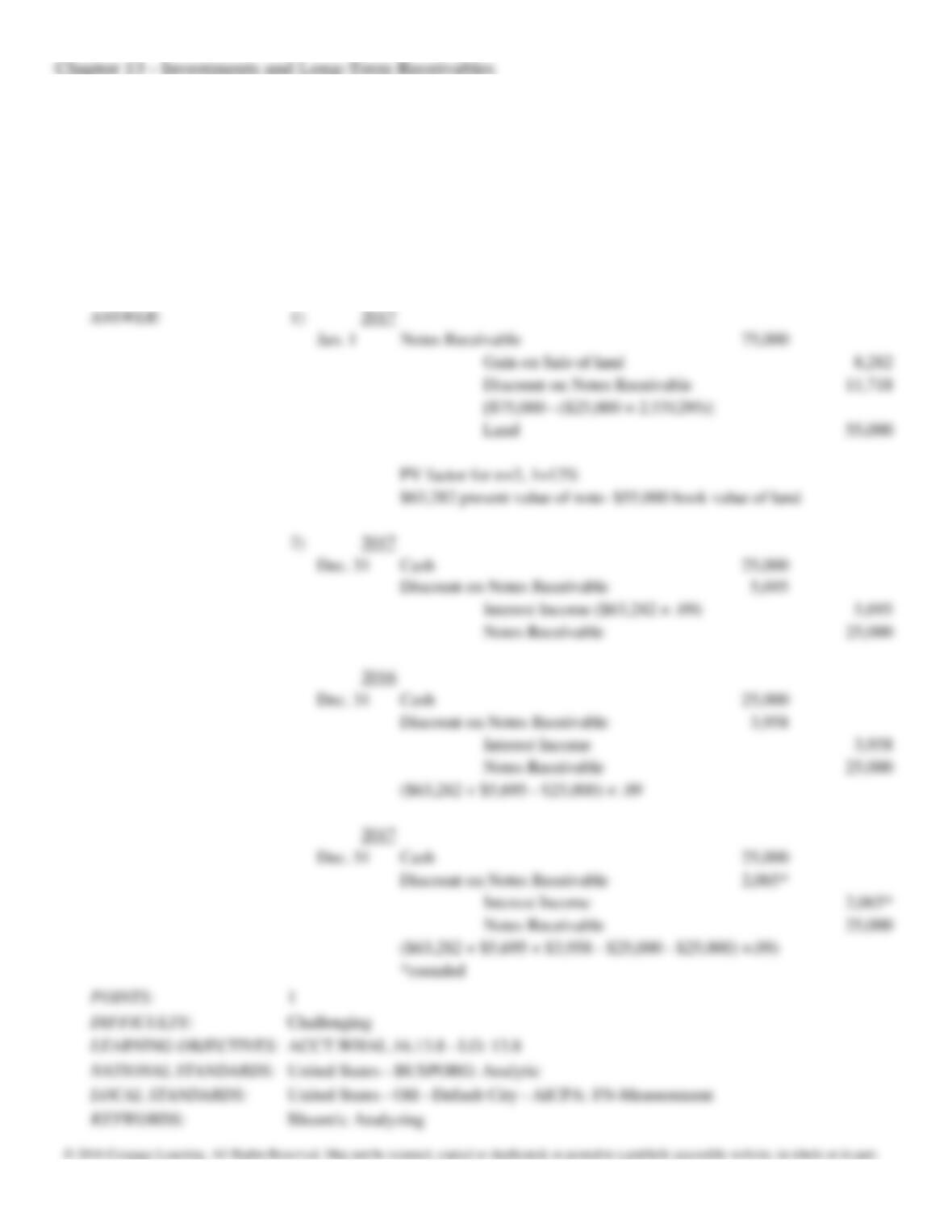
122. On January 1, 2017 Chester sold land to Melissa’s Company, accepting a 3-year $75,000 non-interest-bearing note
due in three equal installments of $25,000 beginning December 31, 2017. The land had a book value of $55,000, the
fair value for the land was not determinable. An appropriate interest rate for a note of this caliber is 9%.
Required:
Prepare the journal entries on Chester’s books to record:
1) the sale
2) the annual interest income and receipt of each $25,000 installment
1
Challenging
ACCT.WHAL.16.13.8 – LO: 13.8
United States – BUSPORG: Analytic
Bloom’s: Analyzing
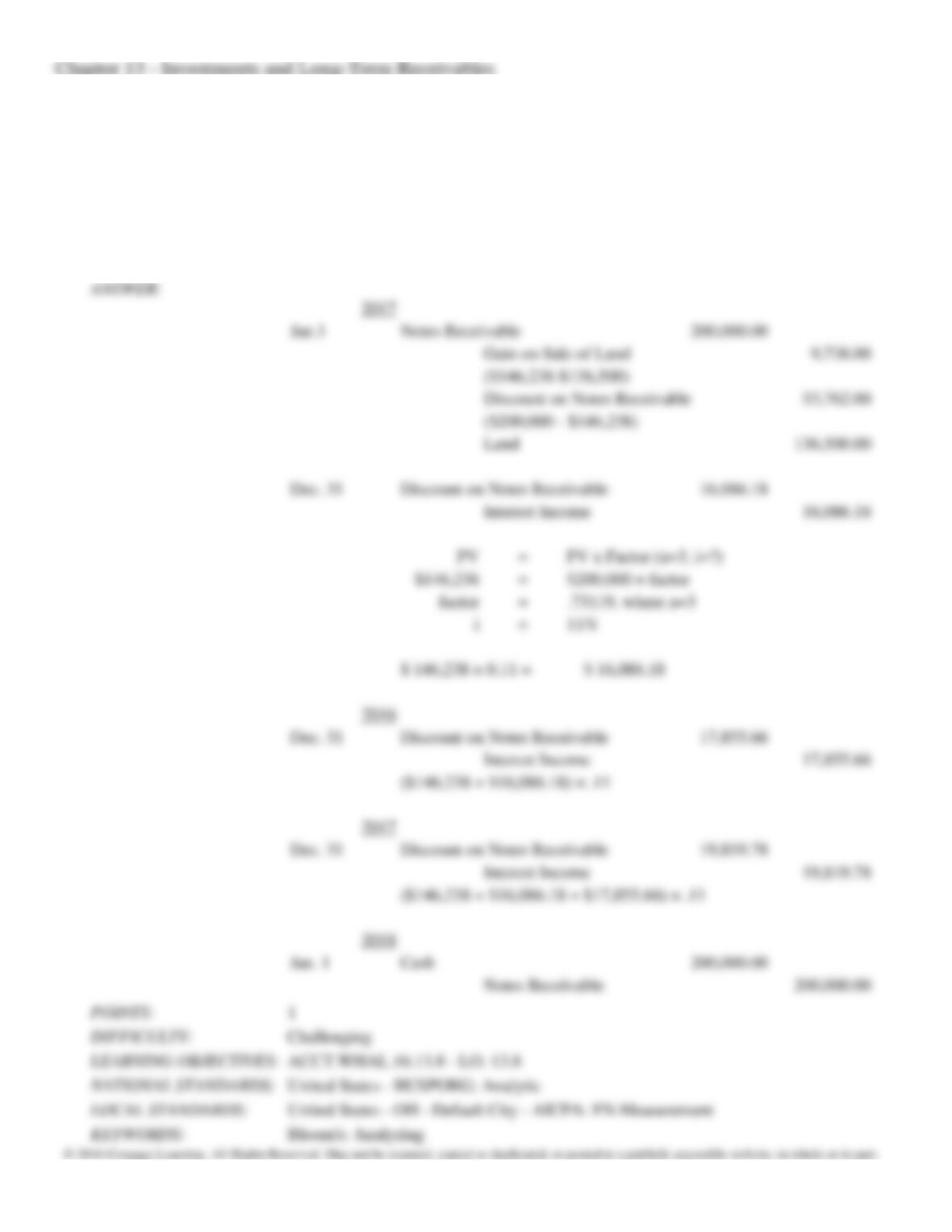
123. On January 1, 2017 Chase sold land to Run Company, accepting a 3-year $200,000 non-interest-bearing note due
January 1, 2018. The fair value of the land is $146,238. The land was originally purchased for $136,500 on January
1, 2010. An appropriate rate of interest for a note of this caliber is 11%.
Required:
Prepare all the journal entries in Chase’s books for the January 1,2017 through January 1,
2018, in regards to the Run note.
1
ACCT.WHAL.16.13.8 – LO: 13.8
United States – OH – Default City – AICPA: FN-Measurement
Bloom’s: Analyzing
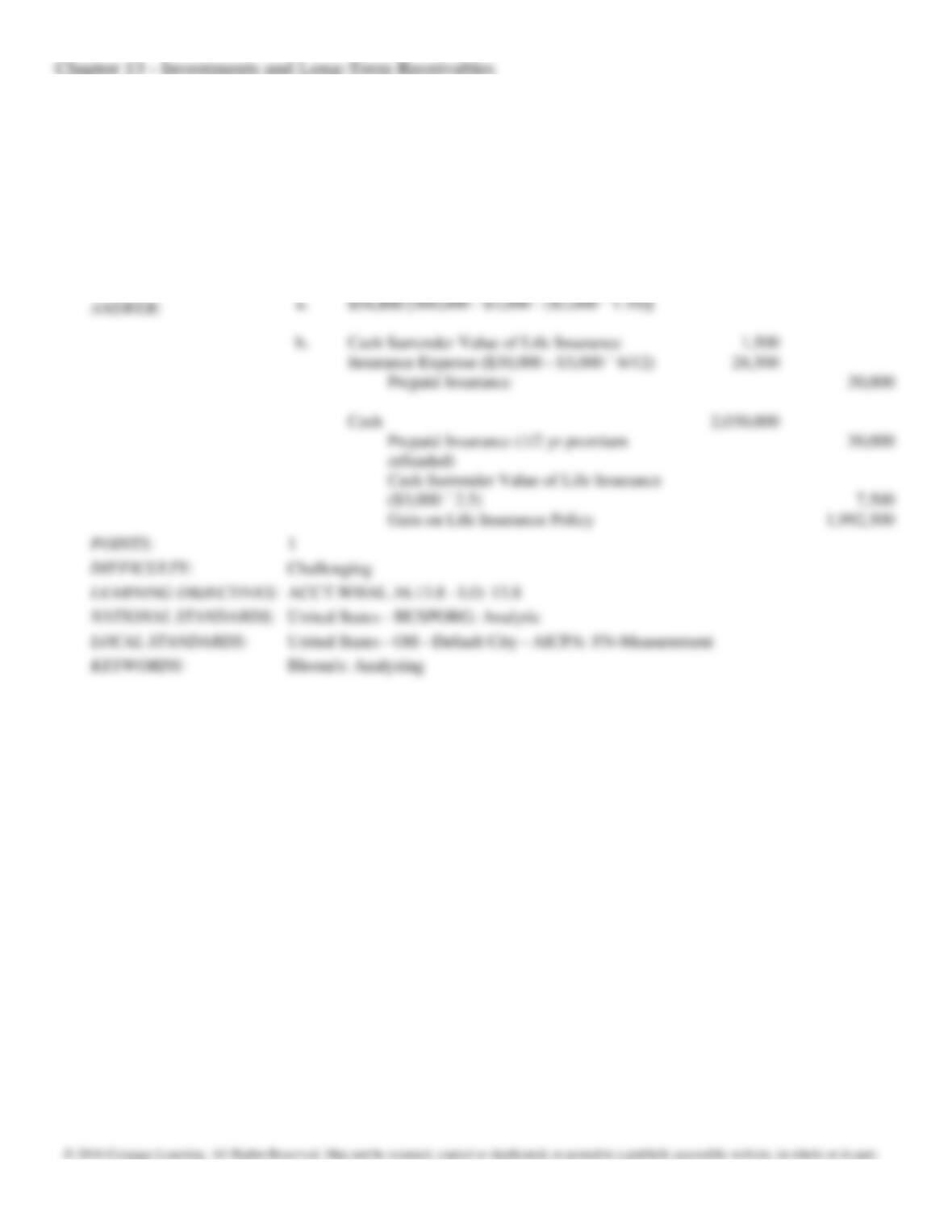
124. Quadra Corp. insured its president on January 1, 2017, with a $2,000,000 life insurance policy. The annual premium
was $60,000 payable on January 1 of each year. Cash surrender values increased each year by 5% of the premium
paid. Dividends received in the first year (2017) amounted to $2,000 and increased by 10% each year, accruable at
year-end only.
Required:
a.
Compute insurance expense for 2018.
b.
Prepare journal entries for July 1, 2019, when the president died.
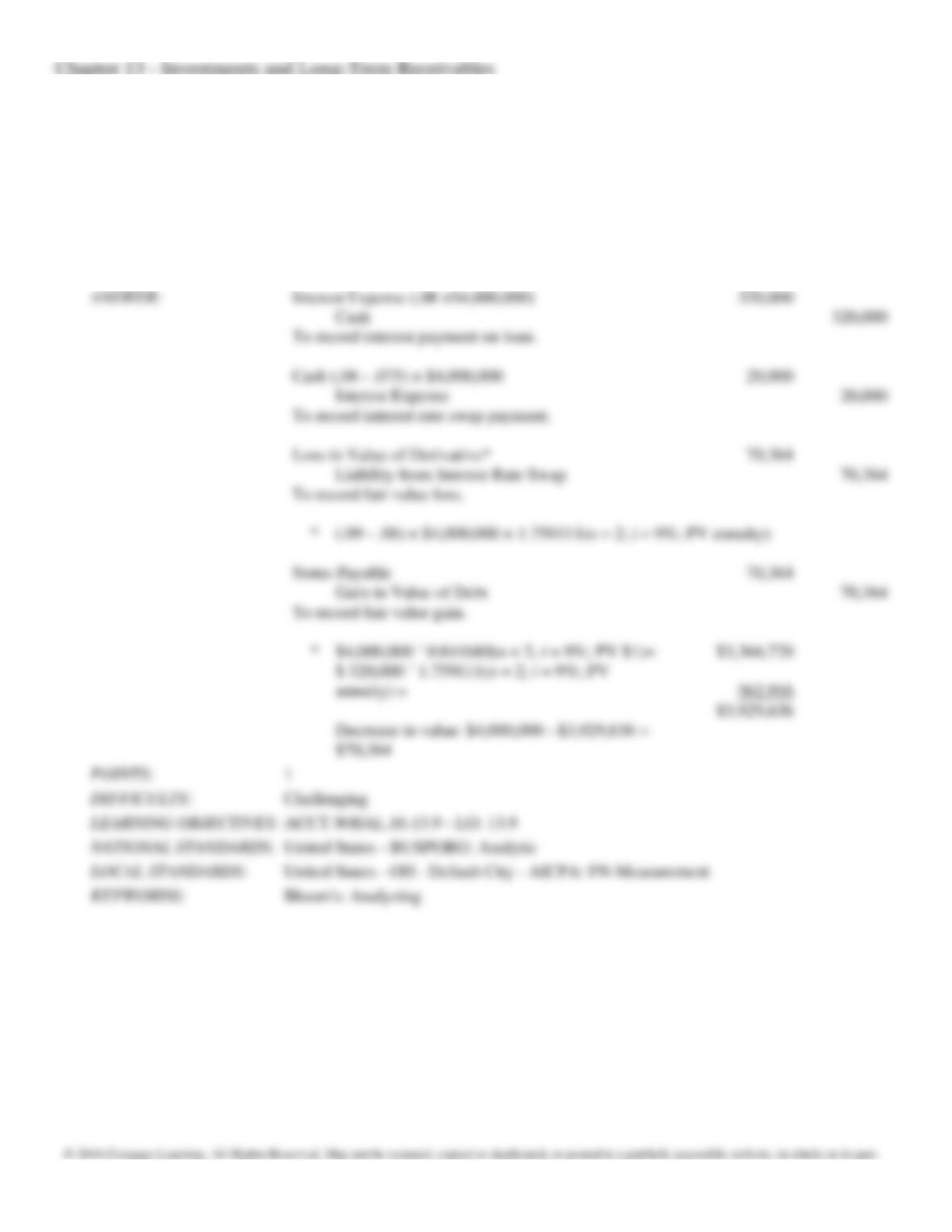
125. Texas Company has a $4,000,000, 8% bank loan from James Bank. On January 1, 2017, the bank loan has three
years to maturity. Texas enters into a three-year interest rate swap with Black and White Investments with a $4
million notional amount. The agreement calls for Texas to receive a fixed interest rate of 8% and pay a variable rate
based on LIBOR at the beginning of the year. Payments to Black and White are to be made for the net amount at
each year-end. At the beginning of 2017, the LIBOR rate is 7.5%. The three-year fixed rate at the end of 2017 is 9%.
Required:
Prepare the journal entries that Texas would make in 2017 relating to the bank loan and the derivative.
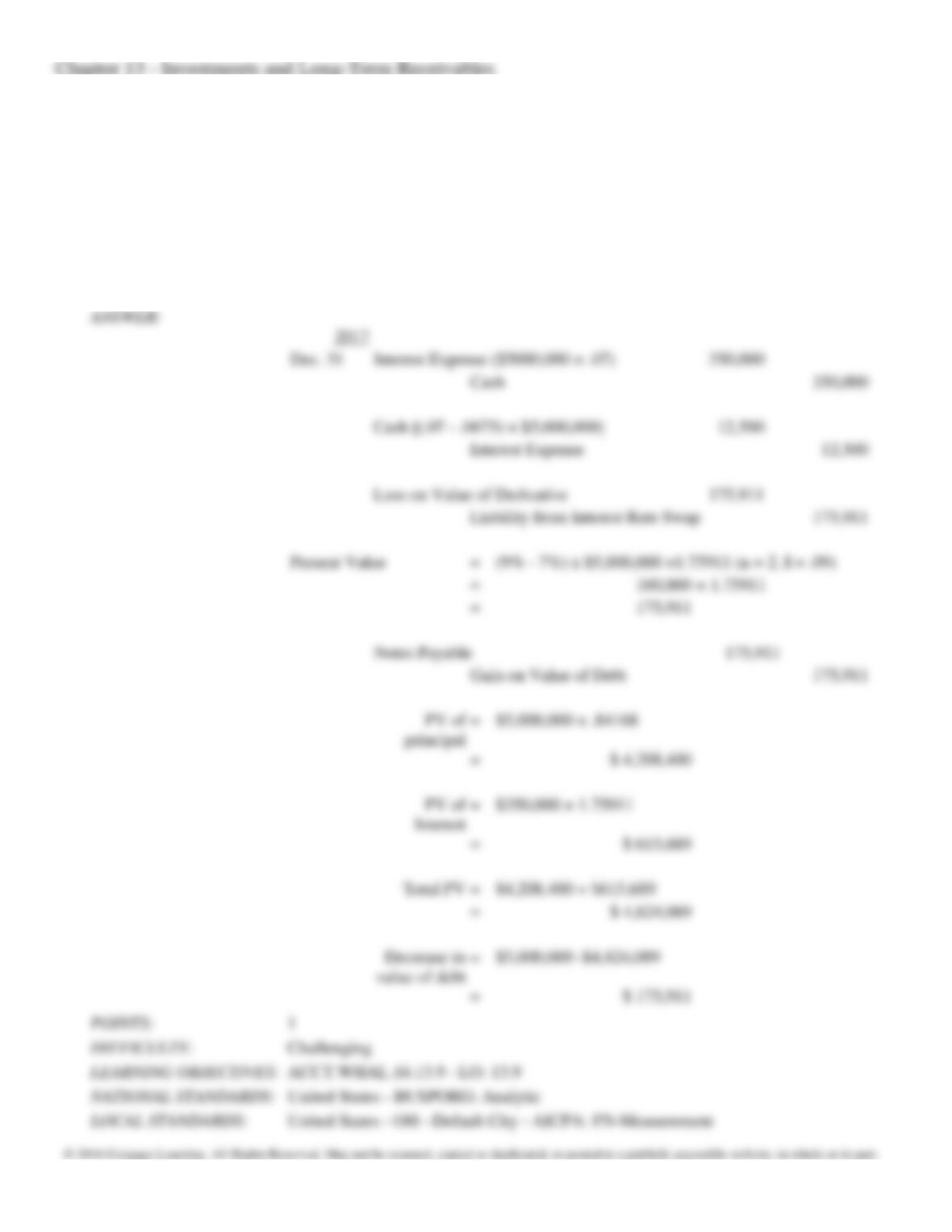
126. Vermont Cheese Company has a $5,000,000, 7% bank loan from National Bank. On January 1, 2017, the bank loan
has three years to maturity. Vermont enters into a three-year interest rate swap with Cheese Investments with a $5
million notional. The agreement calls for Vermont to receive a fixed interest rate of 7% and pay a variable rate based
on LIBOR at the beginning of the year. Payments are to be made to Cheese Investments for the net amount at each
year-end. At the beginning of 2017, the LIBOR rate is 6.75%. The three-year fixed rate at the end of 2017 is 9%.
Required:
Prepare the journal entries that Vermont Cheese Company would make in 2017 relating to the bank loan and the
derivative. (Round answers to the nearest dollar)
127. List 3 investments that are debt securities and 3 investments that are equity securities.
128. Define the following:
*Held-to-Maturity Securities
*Trading Securities
*Available-for-Sale Securities
129. What are the four components necessary to account for investments in held-to-maturity debt securities?
130. What are the four components necessary to account for investments in trading securities?
131. What are the five components necessary to account for investments in available-for-sale securities?
132. What three steps are necessary to evaluate whether or not an investment is impaired?
133. What factors determine significant influence over the financial and operating policies of the investee company?
134. When a company values an investment at fair value, what must the company disclose in addition to the fair value
measurement?
135. Define a long-term fund and list the three most common long-term funds that a company would report as investments
on its balance sheet.
136. Define a derivative financial instrument, provide two examples of derivative financial instruments, and list one
concept involving derivatives.
137. Discuss the three categories of investments described in the FASB‘s current standard for investments in marketable
securities.
138. Under current GAAP for marketable securities, trading securities and available-for-sale securities are reported at
their fair value, but held-to-maturity securities are reported at their amortized cost.
Required:
Explain why there is a difference in the reporting requirements for these three classifications of marketable
securities.
139. A marketable security is initially classified as a trading security, an available-for-sale security, or a held-to-maturity
debt security. Subsequently, a security can be transferred among categories.
Required:
Explain the accounting for a related unrealized holding gain or loss when a transfer to another category occurs.
140. ABC Company has been purchasing stock of XYZ Company for a few years. ABC has classified the XYZ Company
stock as available-for-sale. ABC has just purchased an additional 10% of XYZ’s stock so it now owns 25% and is the
largest shareholder. How does this last purchase affect ABC’s accounting for this stock?