13
Multiple Choice
Identify the choice that best completes the statement or answers the question.
____ 1. Because fantastic creatures do not exist, they can serve as ____.
a.
monsters
b.
spirits
c.
symbols
d.
protectors
____ 2. The ancient Greeks created woman-headed birds called ____.
a.
hags
b.
griffins
c.
harpies
d.
magpies
____ 3. Satyrs were men with ____ attributes and were prone to drunkenness and sexual excess.
a.
horse or monkey
b.
eagle or serpent
c.
goat or eagle
d.
goat or horse
____ 4. The unicorn was supposed to be a horse with some ____ features.
a.
bird
b.
narwhal
c.
eagle
d.
goat
____ 5. The unicorn became a symbol for ____.
a.
Christ
b.
Mary
c.
an angel
d.
eternal life
____ 6. A shaman was believed to be ____ between humans, animals, and spirits.
a.
an arbiter
b.
a bridge
c.
an amulet
d.
a conductor
____ 7. ____ are metaphors for humans in Thai, Hindu, and Buddhist art.
a.
demons
b.
monkeys
c.
unicorns
d.
serpents
____ 8. Chris Ofili, a British artist of Nigerian descent, often uses elephant ____ in his art.
a.
tusks
b.
hide
c.
dung
d.
tails
____ 9. Ashurbanipal II Killing Lions is an example of ____ relief carving.
a.
Assyrian
b.
Olmec
c.
Mesoamerican
d.
Thai
____ 10. Pear Blossoms is a lyric painting by Qian Xuan that is accompanied by ____.
a.
lines of propaganda
b.
lines of scripture
c.
lines of poetry
d.
lines of musical lyrics
____ 11. Landscapes were popular in China and Japan because ____.
a.
Asians had a sympathetic understanding of nature
b.
cities were noisy, polluted, and crowded
c.
they were a symbol of affluence
d.
nature was revered as holy
____ 12. John Constable’s works, while Romantic in essence, were the foundation for the ____.
a.
Neoclassicists
b.
Nationalists
c.
Post Impressionists
d.
Impressionists
____ 13. In the later years of his life, Claude Monet’s paintings approached abstraction, as ____ became
more important than imagery.
a.
concepts
b.
ideals
c.
brushstrokes
d.
lines
____ 14. Ansel Adams’ photographs emphasized the beauty of nature as ____.
a.
a metaphor for goodness
b.
untouched by humans
c.
a remedy for civilization
d.
a protest against urbanization
____ 15. Gardens were very popular among the ruling class of ____.
a.
Persia
b.
Central Asia
c.
Mughal India
d.
All of the above
____ 16. Flowers were often symbols for the Christian religion in earlier times; for example, the iris
represented ____.
a.
Mary
b.
Joseph
c.
Jesus
d.
John the Baptist
____ 17. Many Islamic gardens stood for ____.
a.
purity
b.
paradise
c.
earthly delights
d.
Allah
____ 18. Visitors to the Zen Garden of Contemplation in Japan are expected to ____.
a.
walk through and smell the flowers
b.
be reminded of the tenets of Confucius
c.
be awed by its great size
d.
sit still and meditate
____ 19. Lightning Field is regarded as a(n) ____ piece, since most people have seen it through
photographs rather than in person.
a.
foundation
b.
magical
c.
conceptual
d.
ecological
____ 20. In areas of Peru and Bolivia, the ____ is highly regarded because it can signify weather
changes and can predict rainfall.
a.
monkey
b.
parrot
c.
spider
d.
butterfly
____ 21. Robert Smithson created earthworks because ____.
a.
he was interested in moving his art outside the gallery system
b.
he was fascinated by the beauty of nature
c.
earlier in his career he had been a contractor
d.
he wanted to control nature
____ 22 Popular in late medieval literature, the ____ is a horse with some goat features
and a long, single horn projecting from its forehead.
a.
harpie
b.
satyr
c.
centaur
d.
unicorn
____ 23. Invented by the Greeks, ____ are man-headed horses known for their lustfulness.
a.
centaurs
b.
satyrs
c.
harpies
d.
lamassus
____ 24. A ____ is a person with supernatural powers, believed to be a bridge among
the human, animal, and spirit worlds.
a.
healer
b.
witch doctor
c.
shaman
d.
midwife
____ 25. Inspiration for Chinese and Japanese ____ paintings often came from
poetry or the beliefs of Daoism, which held nature in high esteem.
a.
kabuki
b.
landscape
c.
shunga
d.
portrait
____ 26. The Impressionist artist ____ was well known for
his paintings of natural scenes such as water lilies and haystacks.
a.
Claude Monet
b.
Edgar Degas
c.
Gustave Moreau
d.
Gustave Courbet
____ 27. In Japan, flowers are viewed as a vehicle for greater understanding, and ____
is considered an important art form, on the level of painting, calligraphy, and pottery.
a.
gardening
b.
still-life
c.
flower arranging
d.
horticulture
____ 28. Contemporary ____ are large-scale environmental pieces in which
the earth is an important component.
a.
happenings
b.
earthworks
c.
performances
d.
landscapes
____ 29. Popular in the United States and Europe in the 1960s, the ____ movement experimented
with patterns to affect visual perception.
a.
Abstract Expressionist
b.
Post-Impressionist
c.
Pop Art
d.
Op Art
Essay
30. Describe Ai Weiwei’s Forever Bicycles and explain its significance.
31. Explain the importance of Vesalius’ De Humani Corporis Fabrica.
32. Discuss the ideas and images of Surrealism.
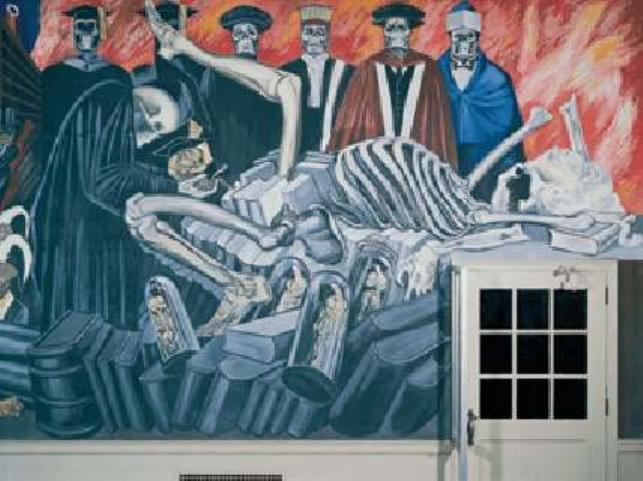
33.
Describe how this painting illustrates the concept of knowledge.
34. How do animals in art reflect despicable or desirable qualities in humans? Give specific examples.
True/False
Indicate whether the statement is true or false.
____ 35. Animals appear in art in every culture.
____ 36. Unicorns were first described in ancient Greece and Rome.
____ 37. The narwhal was a Medieval beast with twisted features that represented degraded human nature.
____ 38. In Assyrian culture, the king would kill lions in a public spectacle, called the royal lion hunt, to show his
courage and illustrate his power.
____ 39. The Incan civilization in Peru produced huge animal drawings by scraping the desert floor to reveal the
lighter-colored sand beneath it.

____ 40. The European painter John Constable painted his large landscapes outdoors from direct observation.
____ 41. Ansel Adams’ photographs helped raise public support for national parks and for the environmental
movement in general.
____ 42. The bouquets Dutch artist Jan Bruegel painted never existed in real life.
____ 43. Due to technological advances in photography, medical books no longer contain drawn illustrations.
13
Answer Section
MULTIPLE CHOICE
ESSAY
TRUE/FALSE