Chapter 13
Chapter Focus
When a student does not respond to interventions by teachers and other professionals, she or he
may be referred for a more comprehensive assessment as part of the problem-solving process.
Following assessment, the team meets to determine if the student requires special education
support. If the student is determined to be eligible for services, the team uses test data to design
educational goals and objectives.
This chapter provides suggestions for interpreting test results and designing educational goals for
appropriate interventions. You will be presented with a complete case that includes test scores,
interpretations, goals, and objectives. Test results help educators make decisions about
educational interventions, planning, and possible eligibility for special education services. After
the professional interprets a student’s test results from norm-referenced tests, classroom
observations, informal assessment, and parental input, team members use the results as part of
the data to make a decision concerning eligibility, interventions, and if age appropriate, long-
term transition plans. The teacher then uses curriculum-based assessment, teacher-made tests,
and direct measurement techniques to monitor progress and adapt instruction.
Check Your Understanding
Activity 13.1
1. What general criteria are used to determine if a student is functioning within the range of
mental retardation?
2. Which term listed in Table 13.1 is used when the student has communication problems
affecting developmental progress?
3. Which term listed in Table 13.1 indicates that a student has discrepancies between ability
and academic performance?
4. Behavioral observations, clinical interviews, information from multiple informants, and
projective tests are used in determining what disability?
5. Which tests are typically administered to assess for the possibility of learning disabilities?
6. For what categories of disabilities are classroom observations recommended as part the
assessment process?
7. What are the key components of assessment for autism spectrum disorders?
Apply Your Knowledge
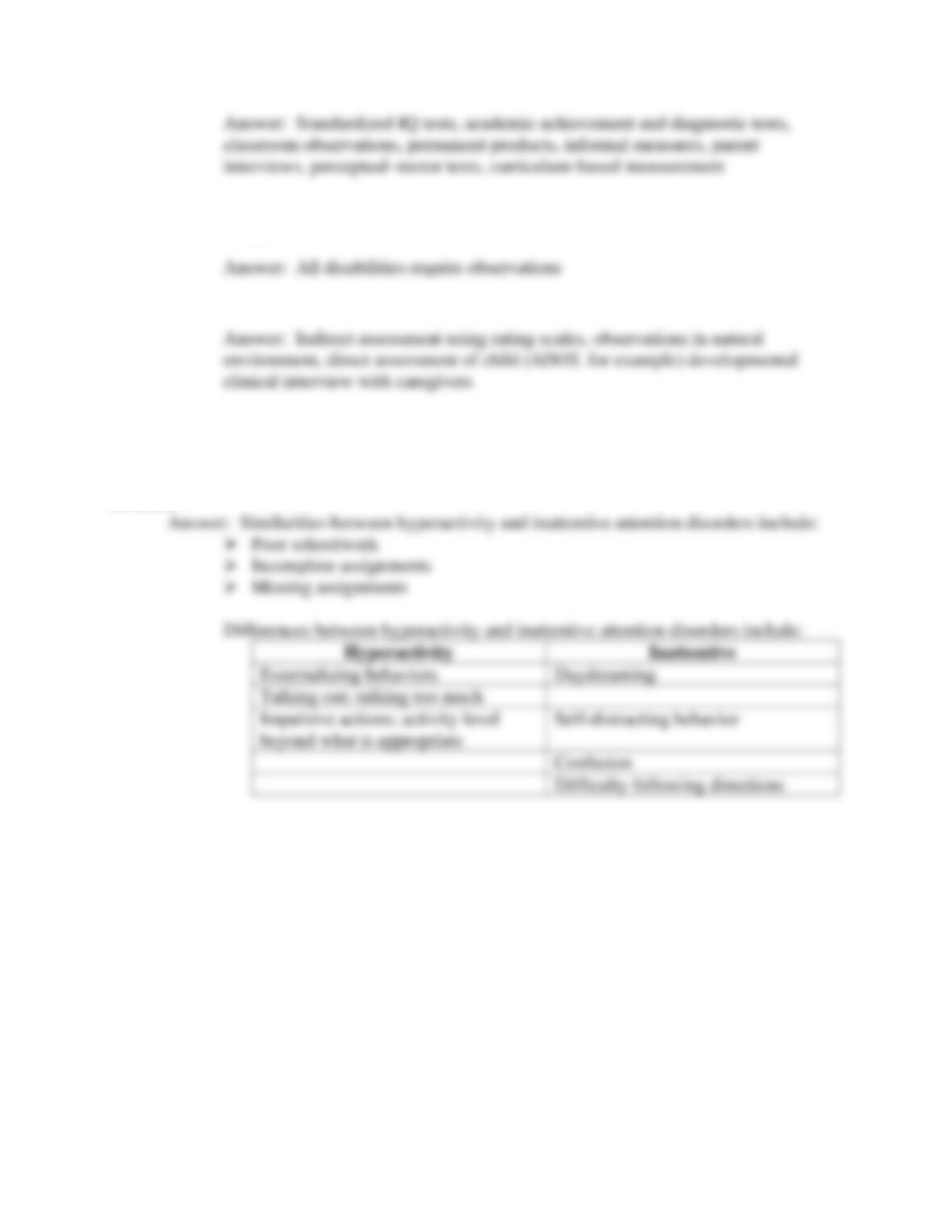
How are the characteristics of students with attention disorders with hyperactivity and the
characteristics of students with attention disorders, inattentive type, similar? How are they
different?
Activity 13.2
1. Before a decision is made that involves educational or intellectual ability, screening for
___ should be completed.
2. If there appears to be a conflict in the home or emotional or behavioral problems are
suspected, the student should be referred for ___.
3. If a student has average or above intellectual functioning, average emotional/behavioral
functioning, and average adaptive behavior skills, but has significant difficulty in
academic areas and specific fine-motor ability, she or he may be determined to have ___.
4. A student who is below expectancy in all academic areas, is subaverage in intellectual
functioning, and has below-average adaptive behavior may be found to be functioning
within the range of ___.
5. A student who has a communication problem that is affecting her or his relationships
with peers and her or his ability to progress in school may have a ___.
6. A student who has impulsive behavior, acts out, has difficulty completing schoolwork,
exhibits too much activity when observed, and whose parents and teachers rate as having
these types of behavioral problems may be found to have ___.
Apply Your Knowledge
The initial stage of the assessment process should be concerned with
Activity 13.3
1. Why was Rosalinda provided with Tier II interventions?
2. When the RTI committee met to review Rosalinda’s progress during the month of
November, what did they decide to do? Why?
3. Examine the graph in Figure 13.1. What can you determine about the effectiveness of the
interventions in December?
overlooked when evaluating if a student is making meaningful progress.
4. If you were on the RTI committee for Rosalinda, what would you recommend after
examining the December data?
Activity 13.4
1. Why was Susie referred for testing?
2. How is Susie functioning intellectually?
3. What are the discrepancies in Susie’s functioning according to test results?
4. What are Susie’s strengths as indicated by assessment?
5. What are Susie’s weaknesses? How do these weaknesses appear to influence her
academic functioning?
6. What additional assessment is recommended for Susie?
7. According to assessment results, what are Susie’s academic skill deficits?
8. What types of educational interventions and strategies are recommended?
Apply Your Knowledge
Indicate any additional concerns you have about Susie after reading this report.

Activity 13.5
1. When presented with ___, Susie will be able to ___ with ___% accuracy by ___.
Apply Your Knowledge
Using the information provided for this case, write a long-term annual goal for Susie’s written
expression.

Think Ahead Exercises
1. This level of test interpretation compares the student with the age or grade expectations
according to the norm-group statistics.
2. These are based on specific criteria included in state and federal regulations.
3. Interventions and strategies used to promote educational success.
4. This is a method of analyzing a student’s strengths in relation to her or his weaknesses to
determine a pattern of functioning that may be influencing the student’s educational
performance.
5. The 1997 and 2004 IDEA amendments changed this process so that less testing may be
necessary for some students.
Progress Monitoring Assessment
Matching
1. The core features of an autism spectrum disorder are abnormalities in communication,
repetitive patterns of behavior, and ___.
2. The use of a cognitive processing cross-battery analysis may be part of an evaluation for
___.
3. The ___ may conduct cross-battery assessments.
4. The ___ is the initial administration of an instrument to a sample population.
5. ___ may provide additional information used for specific academic or other weaknesses.
6. ___ are designed to accompany a set of skills.
7. ___ is assessing the learning environment.
8. ___ provide performance comparisons with students the same age as the examinee across
the United States.
9. ___ is usually used to calculate confidence intervals.
10. The measure of time between the presentation of a stimulus and a response is referred to
as the ___.
Fill in the Blanks
11. Analysis of comprehensive testing results is included in the _____________ section of
the test report.
12. The purpose of assessment is to ___.
13. ___ indicates that an assessment instrument has items that are representative across the
possible items in the domain.
14. ___ validity and ___ validity are differentiated by time.
15. A ___ is a behavioral measure that indicates how students in a class view each other.
16. ___ is a computerized assessment of a student’s ability to sustain attention across time.
17. Regulatory disturbances might be assessed when the assessment involves ___.
18. Story starters might be useful in the informal assessment of ___.
19. Any device that is necessary for a student to function within the educational environment
is known as___.
20. The final result of a comprehensive evaluation is to provide ___.
Chapter 13 Test Bank
True and False
1. Eligibility for special education services is determined by using a set of criteria stated in
IDEA; however, specific criteria vary from state to state for the different types of
disabilities.
2. If a student does not meet eligibility criteria for special education services, they may be
considered to receive accommodations under Section 504.
3. Educational setting or placement is determined previous to eligibility in the IEP process.
4. Eligibility is determined by a group of people rather than one person.
5. Students who would be found eligible to receive special education services according to
the federal law may be excluded by state criteria.
6. Administration of assessments is the most critical aspect of the evaluation process.
7. It is important to rule out any sensory acuity problems and refer to or consult with
medical personnel if physical problems are suspected prior to embarking on a full
psychoeducational evaluation.
8. A student’s prior academic career has no impact on their current level of performance in
school.
9. An IEP is not required to be developed as long as the psychoeducational report is
comprehensive in nature.
10. IDEA requires that an eligibility reevaluation occur every three years, although it is not
required to be comprehensive.
Multiple Choice
1. Test results help educators make decisions about which of the following?
A. educational planning and interventions
B. possible eligibility for special education services
C. needed transition services
D. all of the above
2. The regulations of the 1997 amendments to IDEA require that assessment data be
interpreted and used to develop educational and behavioral interventions that will be
which of the following?
A. utilized as part of the school code of conduct
B. of benefit to the student
C. published for public record
D. none of the above
3. Which of the following terms refers to interventions and strategies used to promote
educational success?
A. measurement criteria
B. high school exit evaluation
C. educational planning
D. IEP team meetings
4. Which of the following terms refers to the determination of whether a student will receive
special education services?
A. pre-referral meeting
B. eligibility decisions
C. placement decisions
D. needs assessment
5. Which of the following refers to measurable objectives that provide evidence of a
student’s progress toward annual goals in the IEP?
A. behaviorally stated short-term objectives
B. estimated short-term objectives
C. behaviorally stated long-term objectives
D. estimated long-term objectives
6. Which of the following refers to markers that provide evidence of a student’s progress
toward annual goals set forth in the IEP?
A. promotion to the next grade
B. 9 week’s grades
C. semester grades
D. benchmarks
7. Which of the following refers to statements of anticipated progress that a student will
make in one year, upon which the short-term objectives are based?
A. yearly grades
B. annual grades
C. promotion criteria
D. long-term goals
8. Students with the sole disabling condition of ADHD may qualify to receive special
education services under which of the following IDEA categories?
A. specific learning disability
B. other health impairment
C. emotionally disturbed
D. Section 504
9. Interpreting assessment results by comparing a student’s levels of performance on a
particular instrument to those of his/her peer norm group is known as
A. interindividual interpretations
B. intra-individual interpretations
C. comparison interpretations
D. performance interpretations
10. Which of the following terms refers to interpreting assessment results by comparing a
student’s levels of performance with his or her own performance?
A. intra-individual interpretations
B. comparison interpretations
C. performance interpretations
D. interindividual interpretations
11. Before referring a student for special education testing which of the following must
professionals secure?
A. a complete medical history
B. procedural safeguards
C. parental consent
D. none of the above
12. Cognitive or intellectual measures are generally administered by which of the following?
A. school psychologist
B. clinical psychologist
C. educational diagnosticians
D. all of the above
13. Which of the following sections is typically presented first in psychoeducational reports?
A. background and referral information
B. identifying data
C. test results
D. test interpretations
14. Previous to the 1997 amendments of IDEA regarding reevaluation, which of the
following is true?
A. the same areas initially assessed were required to be reassessed
B. each area was required to be reassessed regardless of whether it was initially
assessed
C. assessment only in the areas necessary to make a decision regarding continued
eligibility were required to be assessed
D. reevaluations were mandated to take place every 2 years
15. Which of the following statements is not true regarding the interpretation of assessment
results?
A. Tests results are most useful when interpreted and presented in a clear format.
B. The regulations of the 1997 amendments to IDEA require that assessment data
be interpreted and used to develop educational and behavioral interventions
that will be of benefit to the student.
C. When interpreting assessment results the holistic view of the student should
be considered.
D. Tests results that are used to determine if eligibility criteria have been met
may not be considered when determining educational or behavioral
interventions.
16. Interpreting a student’s skills and abilities across several assessment instruments is called
A. cross-battery assessment
B. patterns of functioning
C. psychoeducational report
D. summary statement
17. Interpretations of cognitive measures that reveal similarities and differences between
specific areas of functioning are known as
A. cross-battery assessment
B. psychoeducational report
C. patterns of functioning
D. summary statement
Short Answer
1. Describe the major purposes of assessment.
2. Compare and contrast interindividual interpretations and intra-individual interpretations.
3. Compare and contrast short-term objectives and long-term goals and provide examples of
each.
4. Describe the general procedures for writing a report of educational test results.
5. Provide an outline of the recommended format for the psychoeducational report.
6. Discuss the difference between the IDEA regulations of 1997 and those of 2004 with
regard to the re-evaluation process.
7. Identify the five suggestions Bagnato (1980) provides for organizing testing write-ups.
8. Identify at least three considerations when assessing a student holistically.
9. Discuss how cross-battery assessment may provide sights into a student’s pattern of
functioning.
10. Discuss the guidelines that IDEA provides for how assessment data are to be presented
and used in the psychoeducational process.
Chapter 13 Test Bank Answer Key
True and False
Multiple Choice
Short Answer