70. Exhibit 13-4
Selected balance sheet and income statement data for Fowler Inc. are presented below. The company uses the
direct method in preparing its statement of cash flows.
Partial Balance Sheet
Beginning
End
of Year
of Year
Accounts Receivable
$10,000
$ 12,000
Inventories
20,000
24,000
Prepaid Insurance
1,500
2,000
Prepaid Rent
1,500
1,000
Accounts Payable
12,000
14,000
Wages Payable
13,000
15,000
Unearned Rent
10,000
6,000
Partial Income Statement
Rent Revenue
$ 20,000
Sales Revenue
100,000
Cost of Goods Sold
60,000
Insurance Expense
10,000
Rent Expense
6,000
Wages Expense
30,000
Refer to Exhibit 13-4. Given the information above, cash paid for inventory is
71. Exhibit 13-4
Selected balance sheet and income statement data for Fowler Inc. are presented below. The company uses the
direct method in preparing its statement of cash flows.
Partial Balance Sheet
Beginning
End
of Year
of Year
Accounts Receivable
$10,000
$ 12,000
Inventories
20,000
24,000
Prepaid Insurance
1,500
2,000
Prepaid Rent
1,500
1,000
Accounts Payable
12,000
14,000
Wages Payable
13,000
15,000
Unearned Rent
10,000
6,000
Partial Income Statement
Rent Revenue
$ 20,000
Sales Revenue
100,000
Cost of Goods Sold
60,000
Insurance Expense
10,000
Rent Expense
6,000
Wages Expense
30,000
Refer to Exhibit 13-4. Given the information above, cash paid for wages is
72. Exhibit 13-4
Selected balance sheet and income statement data for Fowler Inc. are presented below. The company uses the
direct method in preparing its statement of cash flows.
Partial Balance Sheet
Beginning
End
of Year
of Year
Accounts Receivable
$10,000
$ 12,000
Inventories
20,000
24,000
Prepaid Insurance
1,500
2,000
Prepaid Rent
1,500
1,000
Accounts Payable
12,000
14,000
Wages Payable
13,000
15,000
Unearned Rent
10,000
6,000
Partial Income Statement
Rent Revenue
$ 20,000
Sales Revenue
100,000
Cost of Goods Sold
60,000
Insurance Expense
10,000
Rent Expense
6,000
Wages Expense
30,000
Refer to Exhibit 13-4. Given the information above, cash paid for rent is
73. In 2012, Kahoka Company paid $10,000 to satisfy its 2011 tax liability, $64,000 for its 2012 tax liability,
and still owed taxes payable of $16,000 at year-end. How much should Kahoka report as a cash outflow for tax
payments on the 2012 statement of cash flows?
74. The following data were taken from the 2012 financial statements of Magelby Corporation:
Cost of Goods Sold
$315,000
Beginning Inventory
36,000
Ending Inventory
54,000
Beginning Accounts Payable
22,500
Ending Accounts Payable
18,000
How much cash did Sigma pay for inventory in 2012?
75. The following information appeared on the 2012 income statement of Kane Company:
Depreciation expense
$ 25,000
Patent amortization expense
10,000
Loss on sale of machinery
6,000
Gain on sale of securities
3,000
Net income
120,000
Based on this information, what is Kane’s net cash provided by operations?
76. In 2011, Franco Manufacturing had sales of $975,000, beginning Accounts Receivable of $84,500, and
ending Accounts Receivable of $110,500. Cash collected from customers for the year totaled
77. Exhibit 13-5
Chen Corporation had the following cash flows during 2012. The company uses the direct method of preparing
a statement of cash flows.
Cash receipt from the issuance of stock
$ 80,000
Cash received from customers
40,000
Dividends received on long-term investments
20,000
Cash paid for wages
24,000
Cash paid for insurance
2,000
Cash paid for dividends
12,000
Cash paid to purchase building
120,000
Loan made to another company
40,000
Refer to Exhibit 13-5. Given the information above, net cash inflow (outflow) from investing activities is
78. Exhibit 13-5
Chen Corporation had the following cash flows during 2012. The company uses the direct method of preparing
a statement of cash flows.
Cash receipt from the issuance of stock
$ 80,000
Cash received from customers
40,000
Dividends received on long-term investments
20,000
Cash paid for wages
24,000
Cash paid for insurance
2,000
Cash paid for dividends
12,000
Cash paid to purchase building
120,000
Loan made to another company
40,000
Refer to Exhibit 13-5. Given the information above, net cash inflow (outflow) from financing activities is
79. Exhibit 13-5
Chen Corporation had the following cash flows during 2012. The company uses the direct method of preparing
a statement of cash flows.
Cash receipt from the issuance of stock
$ 80,000
Cash received from customers
40,000
Dividends received on long-term investments
20,000
Cash paid for wages
24,000
Cash paid for insurance
2,000
Cash paid for dividends
12,000
Cash paid to purchase building
120,000
Loan made to another company
40,000
Refer to Exhibit 13-5. Given the information above, net cash inflow (outflow) from ALL activities is
80. Ozark Corporation’s Retained Earnings balance increased by $100,000 during the year. Ozark also paid
$30,000 in cash dividends that had been declared last year and declared dividends of $40,000 for the current
year (but has not paid them at year-end). Ozark’s net income for the current year must be
81. Didericksen Company’s income statement for the year ended December 31, 2012, reported net income of
$360,000. The financial statements also disclosed the following information:
Amortization
$20,000
Increase in salaries payable
$ 28,000
Depreciation
60,000
Dividends paid
120,000
Increase in accounts receivable
20,000
Purchase of equipment
150,000
Increase in inventory
48,000
Increase in long-term note
payable
300,000
Decrease in accounts payable
76,000
Increase in common stock
outstanding
35,000
Net cash provided by operating activities for 2012 should be reported as
82. The following information is available from the financial statements of Sparta Corporation for the year
ended December 31, 2012:
Net income
$792,000
Increase in accounts payable
$ 48,000
Depreciation expense
204,000
Payment of dividends
108,000
Decrease in accounts
Purchase of available-for-sale
receivable
208,000
securities
44,000
Increase in inventories
180,000
Decrease in income taxes
payable
32,000
What is Sparta Corporation’s net cash flows from operating activities?
83. Exhibit 13-6
The following financial information is available for Ligutti Company:
2012
2011
Cash and cash equivalents
$ 12,000
$15,000
Accounts receivable
25,000
22,000
Buildings
108,000
45,000
Accumulated depreciation
(20,000)
(16,000)
Land
30,000
20,000
$155,000
$86,000
Accounts payable
$ 26,000
$22,000
Long-term notes payable
50,000
20,000
Common stock
50,000
30,000
Retained earnings
29,000
14,000
$155,000
$86,000
Refer to Exhibit 13-6. Additional information for Ligutti Company:
·
Dividends paid totaled $10,000.
·
Net income was $30,000.
·
No buildings were sold during the year.
What was the net cash provided by (used in) operating activities?
84. Exhibit 13-6
The following financial information is available for Ligutti Company:
2012
2011
Cash and cash equivalents
$ 12,000
$15,000
Accounts receivable
25,000
22,000
Buildings
108,000
45,000
Accumulated depreciation
(20,000)
(16,000)
Land
30,000
20,000
$155,000
$86,000
Accounts payable
$ 26,000
$22,000
Long-term notes payable
50,000
20,000
Common stock
50,000
30,000
Retained earnings
29,000
14,000
$155,000
$86,000
Refer to Exhibit 13-6. Additional information for Ligutti Company:
·
Dividends paid totaled $15,000.
·
Net income was $30,000.
·
No buildings were sold during the year.
What was the net cash provided by (used in) financing activities?
85. Exhibit 13-6
The following financial information is available for Ligutti Company:
2012
2011
Cash and cash equivalents
$ 12,000
$15,000
Accounts receivable
25,000
22,000
Buildings
108,000
45,000
Accumulated depreciation
(20,000)
(16,000)
Land
30,000
20,000
$155,000
$86,000
Accounts payable
$ 26,000
$22,000
Long-term notes payable
50,000
20,000
Common stock
50,000
30,000
Retained earnings
29,000
14,000
$155,000
$86,000
Refer to Exhibit 13-6. Additional information for Ligutti Company:
·
Dividends paid totaled $10,000.
·
Net income was $30,000.
·
No buildings were sold during the year.
What was the net cash provided by (used in) investing activities?
86. Analysis using cash flow information is restricted to
87. Which of the following cash flow patterns do rapidly growing start-up companies follow?
88. If a company is to succeed over the long-term, positive cash flows are necessary from
89. In 2012, Paula Company’s statement of cash flows displayed the following pattern:
Cash from operating activities:
Negative
Cash from investing activities:
Negative
Cash from financing activities:
Negative
Which one of the following statements BEST describes this cash flow pattern?
90. Tabiona Company had the following transactions during the year.
a.
Received $15,000 cash payment on accounts receivable.
b.
Sold land for $60,000.
c.
Paid $25,000 of its accounts payable
d.
Sold (issued) 1,000 shares of common stock, $10 par, for $40 per share.
e.
Recorded depreciation expense of $25,000.
f.
Borrowed $85,000 from Green Bank and signed a note to repay in 12 months, with 10% interest.
g.
Purchased equipment costing $40,000 by paying cash.
h.
Paid interest expense of $10,000.
i.
Received dividend revenue of $8,000.
For each of the above transactions, indicate:
1.
Whether it is a cash inflow, cash outflow, or noncash item,
2.
Which category it would be reported under on a statement of cash flows: operating, investing, or financing (assume Tabiona uses the direct
method or preparing its statement of cash flows).
91. The Santini Company had the following selected transactions during the past year:
a.
Sold (issued) 5,000 shares of common stock, $1 par, for $10 per share.
b.
Sold equipment for $5,000. The original cost was $20,000; the book value was $5,500.
c.
Paid $30,000 of its accounts payable.
d.
Borrowed $60,000 from First National Bank and signed a note to repay in 6 months, with 12% interest.
e.
Purchased equipment costing $80,000 by paying cash of $20,000 and signing a 12% note for the remainder.
f.
Purchased treasury stock for $20,000.
g.
Recorded depreciation expense of $8,000.
1.
Prepare journal entries for each of the transactions above.
2.
For each transaction, indicate the amount of cash inflow or cash outflow and how each of these cash flows would be classified on a
statement of cash flows.
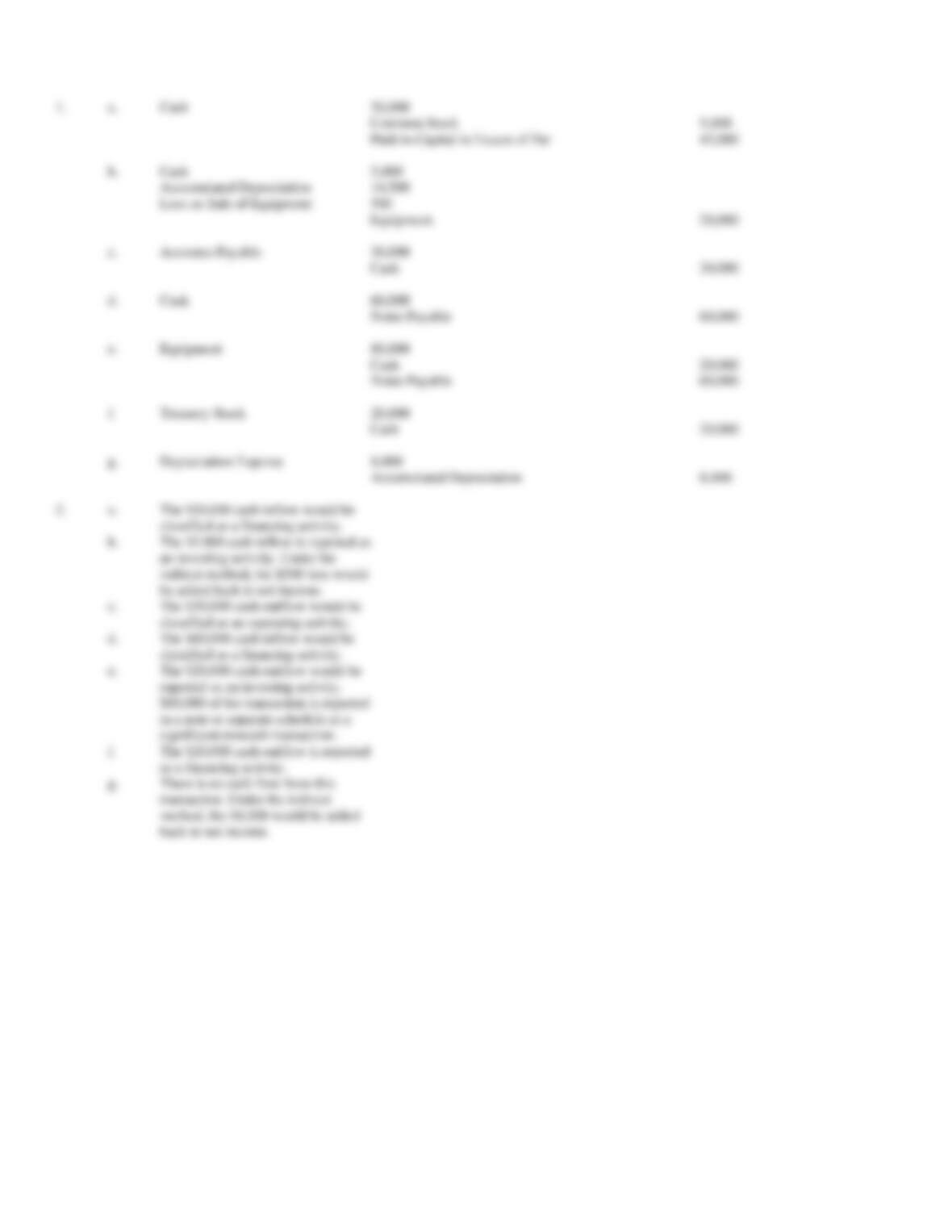
1 and 2.
Inflow/Outflow/Noncash
Operating, Investing, or Financing
a.
Inflow
Operating
b.
Inflow
Investing
c.
Outflow
Operating
d.
Inflow
Financing
e.
Noncash
n/a
f.
Inflow
Financing
g.
Outflow
Investing
h.
Outflow
Operating
i.
Inflow
Operating
92. On December 31, 2012, Catron Company’s ledger had the following information in its cash account:
Cash
Beg. Bal.
35,000
(a)
140,000
(b)
270,000
(c)
106,000
(d)
14,500
(e)
6,000
(f)
20,000
End. Bal.
47,500
The transactions that are represented in Catron’s cash account are as follows:
·
Payments for inventory
·
Collections on accounts receivables
·
Payments for wages and salaries
·
Proceeds from sale of equipment
·
Payment of dividends to stockholders
·
Payments for taxes
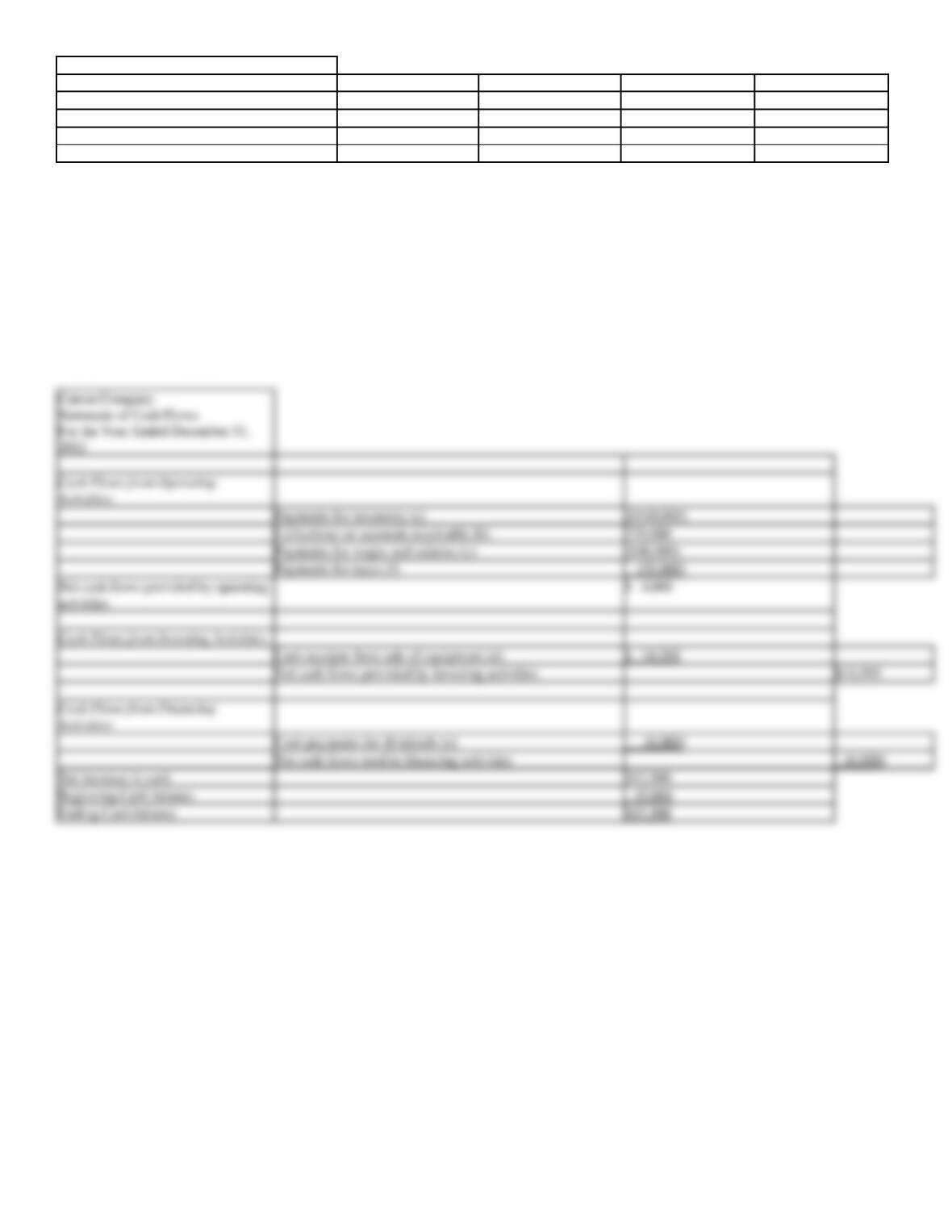
Using this information, prepare Catron’s cash flow statement using the direct method.
93. At the end of the year, Wyatt Company had the following information related to transactions in its cash
account:
Payments for inventory
$380,000
Collections on accounts receivables
500,000
Payments for interest
3,000
Payments for wages and salaries
174,000
Payments for purchase of land
45,000
Proceeds from sale of equipment
26,000
Payments for retirement of long-term debt
20,000
Proceeds from sale of common stock
100,000
Payments for taxes
55,000
Payments for inventory (a)
($140,000)
Collections on accounts receivable (b)
270,000
Payments for wages and salaries (c)
(106,000)
Payments for taxes (f)
(20,000)
Cash receipts from sale of equipment (d)
$ 14,500
Net cash flows provided by investing activities
$14,500
Cash payments for dividends (e)
(6,000)
Net cash flows used in financing activities
(6,000)
Net increase in cash
$12,500
Beginning Cash balance
35,000
Ending Cash balance
$47,500
Additionally, Wyatt had a cash balance at the beginning and ending of the year of $75,000 and $24,000, respectively.
94. From the following data for Vargas Company, determine the net cash flow provided (used) by operating
activities.
Net income
$50,000
Depreciation for the year
35,000
Dividends declared during the year
30,000
Beginning
End
of Year
of Year
Cash and cash equivalents
$35,000
$42,000
Inventory
83,000
80,000
Prepaid expenses
7,000
8,000
Accounts payable
28,000
22,000
Dividends payable
23,000
25,000
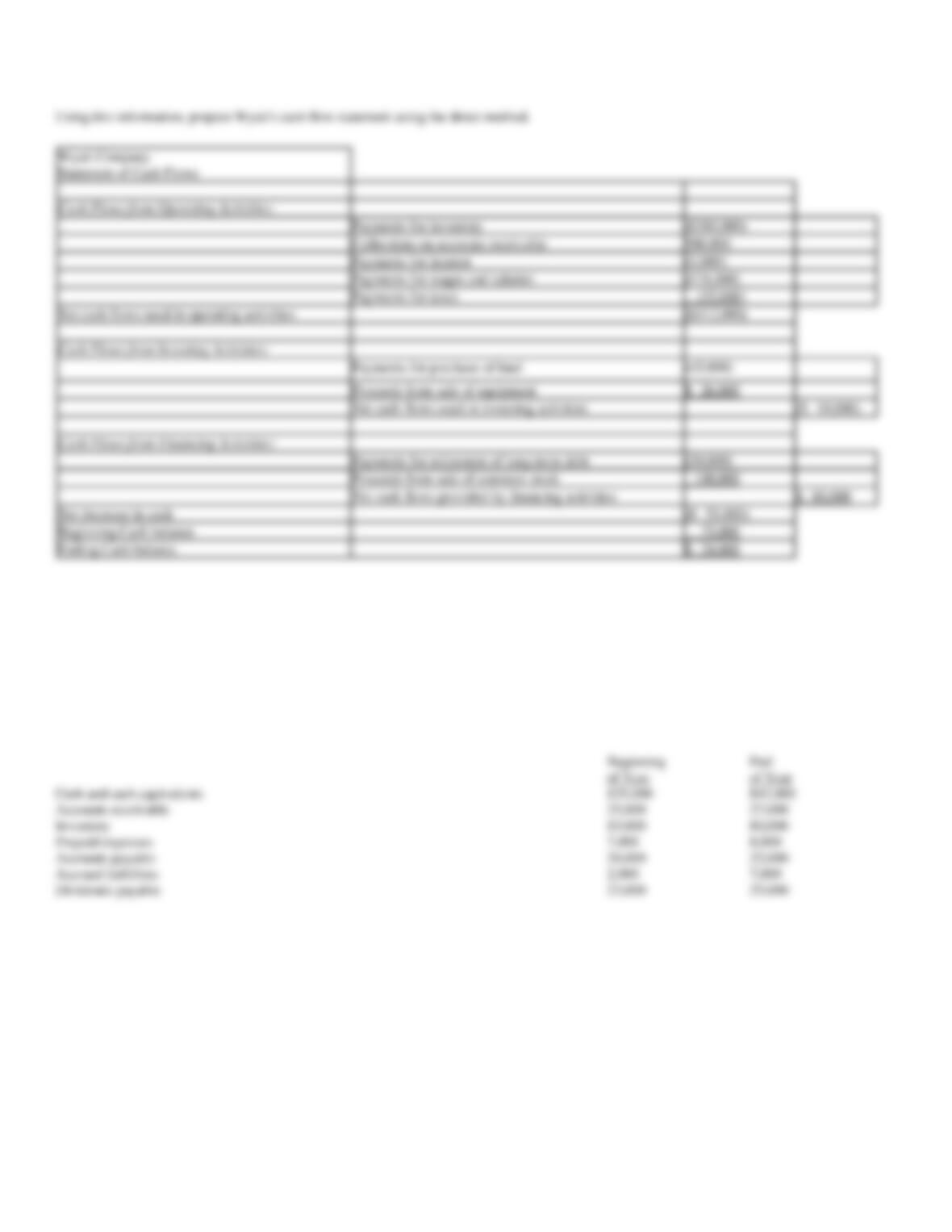
Payments for inventory
($380,000)
Collections on accounts receivable
500,000
Payments for interest
(3,000)
Payments for wages and salaries
(174,000)
Net cash flows used in operating activities
($112,000)
Proceeds from sale of equipment
$ 26,000
Net cash flows used in investing activities
Payments for retirement of long-term debt
(20,000)
Proceeds from sale of common stock
100,000
Net decrease in cash
Beginning Cash balance
75,000
Ending Cash balance
$ 24,000
95. Vandalia Company reports the following selected information at year-end:
Sales revenue
$1,500,000
Interest revenue
12,000
Cost of goods sold
720,000
Wages expense
560,000
Depreciation expense
86,000
Other (cash) operating expenses
190,000
Proceeds from sale of equipment
74,000
Beginning
End
of Year
of Year
Accounts receivable
$110,000
$ 98,000
Interest receivable
8,400
6,800
Inventory
442,000
450,000
Accounts payable
66,000
76,000
Wages payable
52,000
36,000
Net income
$50,000
Depreciation
35,000
Increase in accounts receivable
Decrease in inventory
Increase in prepaid expenses
Decrease in accounts payable
(6,000)
Increase in accrued liabilities
Net cash flow provided by operating activities
$84,000
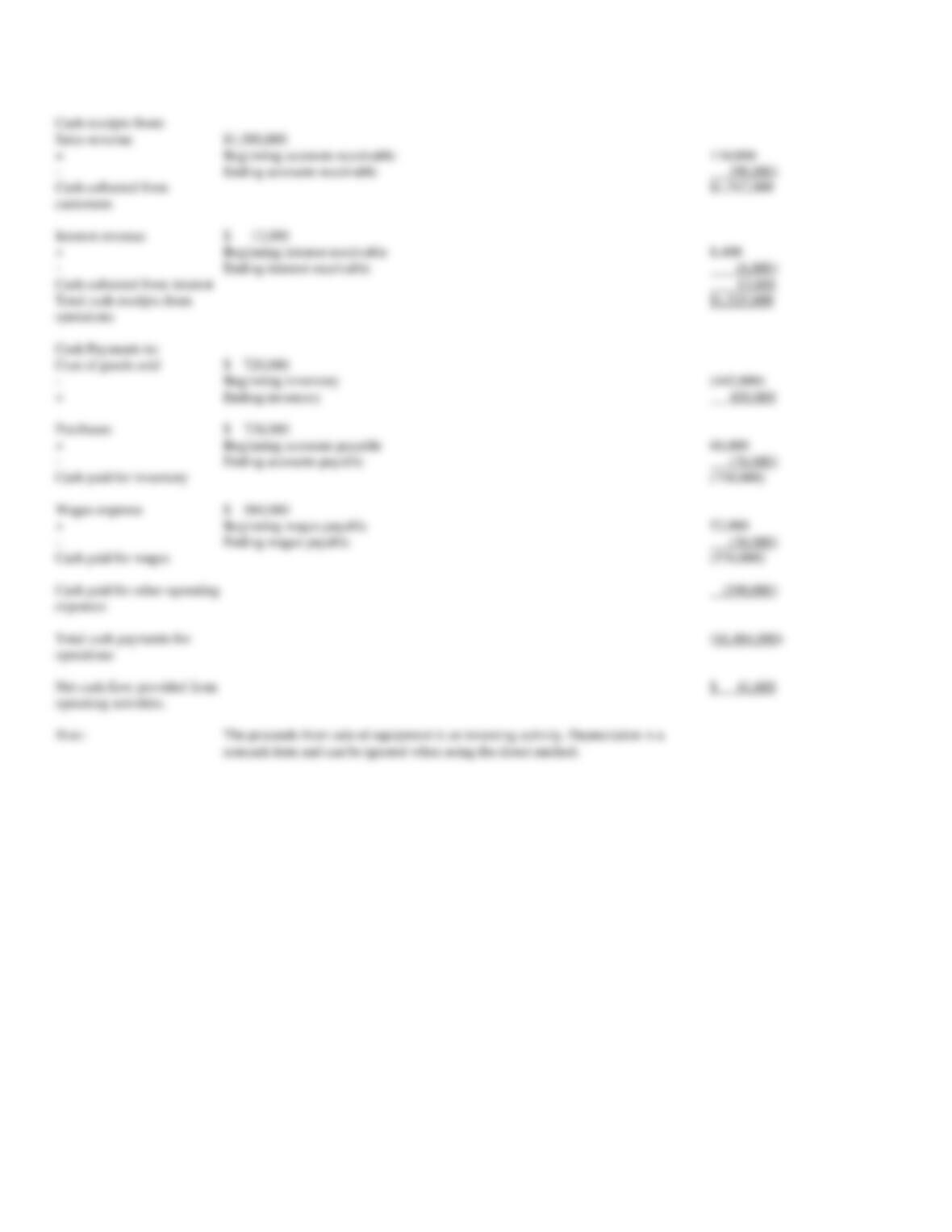
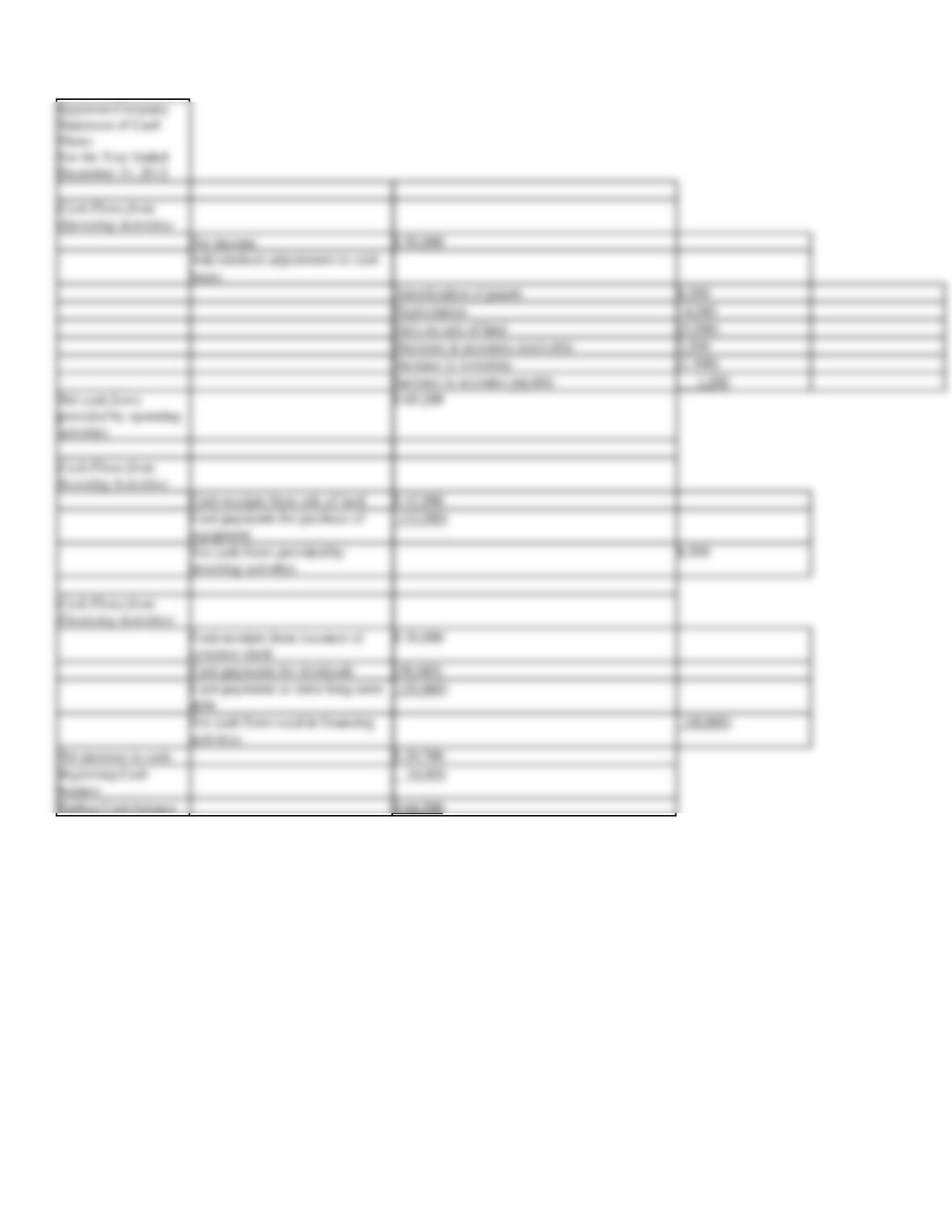
Using the direct method, compute the amount of net cash flow provided (used) by operating activities for Vandalia Company.
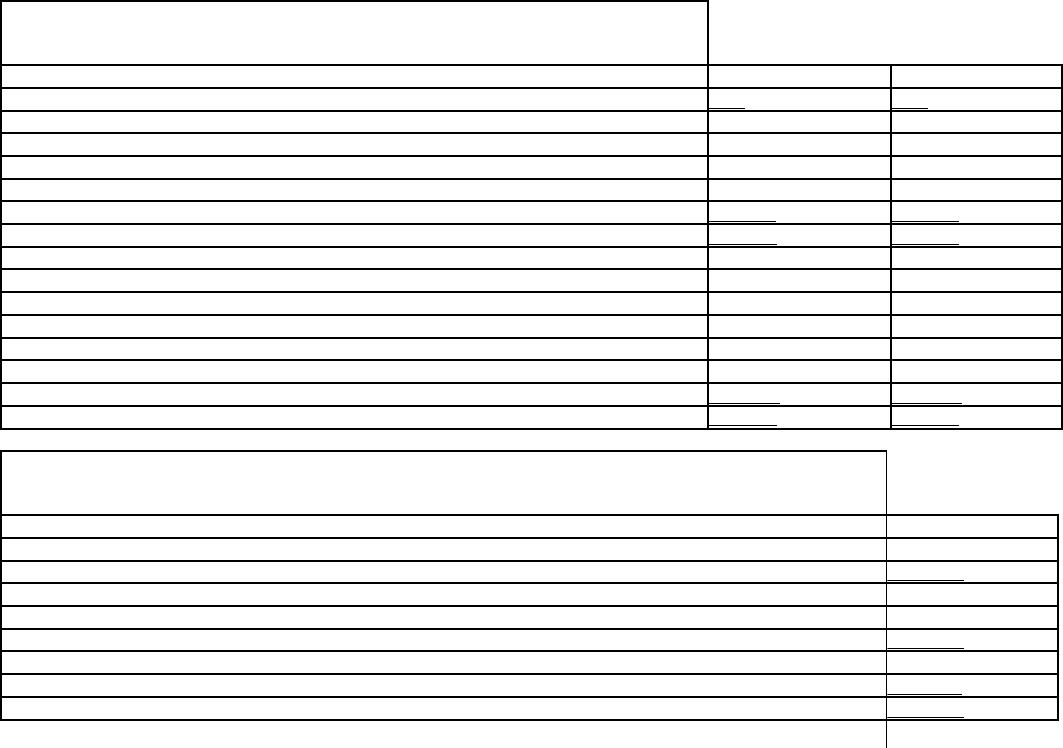
96. From the following information for Epperson Company, prepare a statement of cash flows for the year
ended December 31, 2012, using the indirect method.
Amortization of patent
$ 8,000
Depreciation expense
14,000
Net income
50,000
Payment of dividends
58,000
Purchase of equipment
33,500
Retirement of long-term debt
20,000
Issuance of common stock
30,000
Cash received in the sale of land (includes $5,000 gain)
42,000
Decrease in accounts receivable
2,500
Increase in inventory
1,500
Increase in accounts payable
1,200
Cash balance, January 1, 2012
34,800
Cash balance, December 31, 2012
?
Sales revenue
$1,500,000
+
Beginning accounts receivable
110,000
–
Ending accounts receivable
(98,000)
Interest revenue
$ 12,000
+
Beginning interest receivable
8,400
–
Ending interest receivable
(6,800)
Cash collected from interest
13,600
Cash Payments to:
Cost of goods sold
$ 720,000
–
Beginning inventory
(442,000)
+
Ending inventory
450,000
Purchases
$ 728,000
+
Beginning accounts payable
66,000
–
Ending accounts payable
(76,000)
Cash paid for inventory
(718,000)
Wages expense
$ 560,000
+
Beginning wages payable
52,000
–
Ending wages payable
(36,000)
Cash paid for wages
(576,000)
97. Using the following information, prepare a statement of cash flows for the year ended December 31, 2012,
using the indirect method.
Ciomara Corporation
Balance Sheet
December 31, 2012
Assets
2012
2011
Cash
$ 11,000
$ 46,500
Accounts receivable
120,000
115,500
Land
75,000
60,000
Equipment
70,000
90,000
Accumulated depreciation
(13,500)
(19,500)
Total assets
$262,500
$292,500
Liabilities and Stockholders’ Equity
Accounts payable
$ 6,000
$ 9,000
Long-term debt
20,000
28,500
Common stock
197,000
174,500
Treasury Stock
(7,000)
(2,000)
Retained earnings
46,500
82,500
Total liabilities & stockholders’ equity
$262,500
$292,500
Ciomara Corporation
Income Statement
For the year ended December 31, 2012
Sales
$ 320,000
Cost of goods sold
(279,000)
Gross margin
$ 41,000
Depreciation expense
(9,000)
Selling and administration expense
(65,000)
Operating income
$ (33,000)
Gain on sale of equipment
3,000
Net Loss
$ (30,000)
Other data:
·
Equipment with a cost of $20,000 was sold in 2012
·
Dividends were declared and paid in 2012
·
Stock was repurchased during 2012, but no treasury stock was sold.