ch13.doc Page 1
Chapter 13
Colleges and Universities
TRUE/FALSE (CHAPTER 13)
1. Government (public) colleges and universities must adhere to the FASB
pronouncements.
2. Private not-for-profit colleges and universities are subject to the same FASB
standards as other not-for-profit entities.
3. Most colleges and universities classify revenues by source and expenses by
function.
4. GASB requires that revenues be classified into three categories of restrictiveness
based on donor specification.
5. In a public university setting, general administration and sponsored research are
examples of revenues classified by source.
6. Long-lived assets held by public universities are carried at cost, or fair value if
donated.
7. Investments of a public college must be reported at amortized cost.
8. Tuition revenue should be reported net of tuition discounts and scholarships.
9. In accounting for colleges and universities, related entities should either be disclosed
in the Notes to the Financial Statements or reported as component entities,
depending on the degree of control and economic interest.
10. Under GASB Statement No. 39, colleges and universities are required to bring their
affiliated medical organizations into their financial reports.
11. Private colleges and universities should account for all grants on the accrual basis
as exchange transactions.
12. Dormitories and bookstores are examples of auxiliary enterprises (business-type
activities) engaged in by both private and public universities.
13. When a semester starts and ends in different fiscal years, FASB standards require
not-for-profit colleges to apportion tuition and fees between the two years.
14. Private colleges that receive federal grants are required to apply government
accounting standards set by the GASB.
15. The single largest source of revenues for not-for-profit universities is tuition and fees.
ch13.doc Page 2
MULTIPLE CHOICE (CHAPTER 13)
1. Financial statements for Smith College, a church-supported college, should be
prepared according to standards set by
a) AICPA.
b) FASB.
c) GASB.
d) Smith may choose any of the above.
2. For a not-for-profit college or university, which of the following categories of net
assets is NOT appropriate in its external financial statements?
a) Unrestricted net assets.
b) Temporarily restricted net assets.
c) Permanently restricted net assets.
d) None. All of the above are appropriate.
3. Landon College, a private college, received a $1 million donation. The donor
specified that the principal of her gift could never be used for program activities, but
the earnings on the principal must be used to provide scholarships to academically
qualified students in the business school. The $1 million gift would increase which of
the following categories of net assets?
a) Unrestricted net assets.
b) Temporarily restricted net assets.
c) Permanently restricted net assets.
d) Either (b) and (c).
4. During the current year, Luis University received a $50,000 gift from an alumna who
specified that it must be used to pay travel costs for faculty to attend health care
conferences in foreign countries. During the year the university spent $8,000 to
support travel to a health care conference in Italy. The $8,000 disbursement will
cause a NET decrease in which class of net assets?
a) Unrestricted net assets.
b) Temporarily restricted net assets.
c) Permanently restricted net assets.
d) Cannot be determined.
ch13.doc Page 3
Use the following information for Questions 5 and 6.
Lane College Foundation is governed by a board, some members of which are
appointed by the president of Lane College and some of which are elected by the
alumni. The foundation was created to solicit and accept donations on behalf of Lane
College, a private not-for-profit college. Lane College and its foundation are deemed
to be financially interrelated. All funds collected by the foundation must be used to
support activities of Lane College. The foundation board can select which activities of
Lane College it supports. Lane Foundation received a $1 million bequest from the
estate of a 1940 graduate.
5. At the time the foundation receives the donation, the foundation should debit Cash
for $1 million and credit what account for $1 million?
a) Unrestricted revenue.
b) Temporarily restricted revenue.
c) Liability.
d) No entry should be made by the foundation.
6. At the time the foundation receives the donation, Lane College should debit Asset
$1 million and credit what account for $1 million?
a) Unrestricted revenue.
b) Temporarily restricted revenue.
c) Liability.
d) No entry should be made by Lane College.
7. Bristol Public School Foundation had available temporarily restricted gifts in excess
of $200,000. The foundation decided to invest this money temporarily until it needs
the funds for the restricted purpose. The donors had made no specific stipulations
regarding investment earnings but the foundation board had voted to use the
earnings on the projects for which the gift had originally been restricted. At year–
end, the securities had a fair value of $200,500. The appropriate way to recognize
the change in fair value is
a) Debit Investment $500; Credit Unrestricted revenue $500.
b) Debit Investment $500; Credit Temporarily restricted revenue $500.
c) Debit Investment $500; Credit Permanently restricted revenue $500.
d) No entry should be made until the securities are sold.
8. An accountant has encountered a perplexing financial reporting issue related to the
private college for which he is preparing financial statements. The issue is not
specifically addressed by FASB Statements. To what standards would the
accountant first look for guidance?
a) GASB Statements.
b) AICPA accounting and auditing guide, Not-for-Profit Organizations.
c) AICPA accounting and auditing guide, Audits of Colleges and Universities and/or
AICPA SOP 74-8, Financial Accounting and Financial Reporting by Colleges and
Universities.
d) College textbooks.
ch13.doc Page 4
9. Current operating expenses of a public college may be classified by which of the
following?
a) Object classes
b) Organizational Units
c) Program functions
d) All of the above
10. Which of the following criteria must be met for a public university to report affiliated
organizations as component units?
I. The university is entitled to access the resources
II. The economic resources are significant to the component
III. The economic resources received or held are almost entirely for the
direct benefit of the university
a) I only
b) III only
c) I and III
d) All three criteria
11. Although it no longer is required for external financial reporting, the AICPA’s 1973
Audits of Colleges and Universities provides for which of the following in its guidance
on fund structure?
a) Plant funds
b) Loan funds
c) Annuity funds
d) All of the above
12. In June 2015, a public university bills and collects $45 million in tuition for the summer
semester that runs from June 1 through July 15. In addition, in May and June it bills $300
million for the fall semester that runs from September 1 through December 15. Of this
amount it collects only $120 million (expecting to collect the balance prior to September 1).
In its statement of revenues, expenses, and changes in net position for the fiscal year ending
June 30, 2015 it should recognize as tuition revenue
a) $30 million
b) $45 million
c) $150 million
d) $165 million
13. A not-for-profit university operates its college book-store as an auxiliary enterprise. During
the year the store has revenues of $30 million and expenses of $27 million. In its statement of
activities the university should report
a) Operating revenues of $3 million
b) Operating revenues of $30 million
c) Nonoperating revenues of $3 million
d) Nonoperating revenues of $30 million
14. In 2014, a public university was awarded a federal reimbursement grant of $18 million to
carry out research. Of this, $12 million was intended to cover direct costs and $6 million to
cover overhead. In a particular year, the university incurred $4 million in allowable direct
costs and received $3.4 million from the federal government. It expected to incur the
ch13.doc Page 5
remaining costs and collect the remaining balance in 2015. For 2014 it should recognize
revenues from the grant of
a) $3.4 million
b) $4.0 million
c) $6.0 million
d) $18.0 million
15. A not-for-profit university maintained as endowment of $800,000, the income of which was
restricted for an annual conference on international relations. In a particular year, the market
value of the endowment increased by $80,000. The university held a conference on
international relations at a cost of $86,000. The university should report
a) No revenue and unrestricted expenses of $86,000
b) Unrestricted revenues of $80,000 and unrestricted expenses of $86,000
c) Temporarily restricted revenues of $80,000, temporarily restricted expenses of $80,000
and unrestricted expenses of $6,000
d) Permanently restricted revenues of $80,000 and unrestricted expenses of $86,000
16. A public university had tuition and fees for the year ended June 30, 2012, in the amount of
$27,000,000. Scholarships, for which no services were required, amounted to $2,100,000.
Graduate assistantships, for which services were required, amounted to $1,950,000. The
amount to be reported by the university as net tuition and fee revenue would be
a) $27,000,000
b) $25,050,000
c) $24,900,000
d) $22,950,000
17. During the year, Dakota University’s board of trustees established a $500,000 fund to be
retained and invested for scholarship grants. The fund earned $30,000, which had not been
distributed by December 31. What amount should Dakota report in a board-designated
(quasi) endowment fund’s net position at December 31?
a) $0
b) $30,000
c) $500,000
d) $530,000
ch13.doc Page 6
18. During the year, Goodman College received the following:
• An unrestricted $280,000 pledge to be paid the following year
• A $140,000 cash gift restricted for study-abroad scholarships
• A notice from a recent business school graduate that he has named the college as a
beneficiary of $60,000 in his will
What amount of contribution revenue should Goodman College report in its statement of
activities?
a) $140,000
b) $200,000
c) $420,000
d) $480,000
19. In the current year, Generous University awarded scholarships to graduate students in the
amount of $5,000,000. The recipients are not required to provide any services in return for
the scholarships. How should the university record the award?
a) Scholarship expense $5,000,000
Accounts payable $5,000,000
b) Tuition deductions—unrestricted
student aid $5,000,000
Accounts receivable $5,000,000
c) Scholarship expense $5,000,000
Accounts receivable $5,000,000
d) Tuition deductions—unrestricted
student aid $5,000,000
Accounts payable $5,000,000
20. Declines in the stock market can affect the fiscal health of colleges and universities. Which
of the following is the least likely reason for that?
a) Reduction in endowment income.
b) Decrease in demand for university scholarship funds.
c) Reduced ability of parents and students to pay tuition.
d) Decrease in donors’ willingness and ability to make contributions.
ch13.doc Page 7
PROBLEMS (CHAPTER 13)
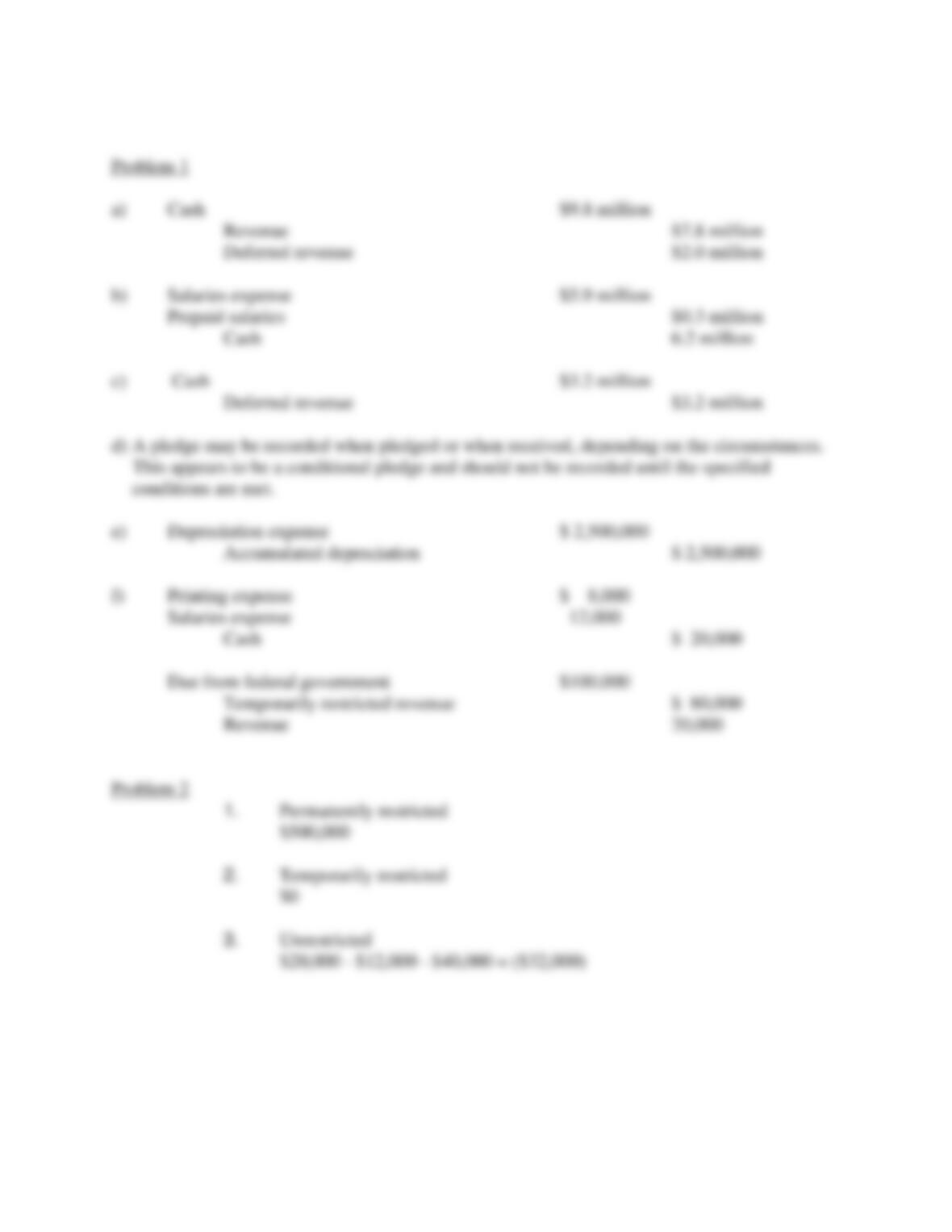
1. Roberta College is a not-for-profit entity. Record the following transactions for the fiscal
year ended June 30, 2014. that year..
a. Tuition revenue for the fall semester 2013 (August – December) was $4 million; tuition
for the Spring semester 2014 (January – May) was $3.8 million; tuition for the summer
semester 2014 (June 1-August 15) was $2 million. All tuition was received in cash.
b. Faculty salaries for the fall semester were $3 million; for the spring semester, $2.9
million; and for the summer semester, $0.6 million. All salaries are paid at the end of the
month earned. Salaries earned in summer are June $0.3 million, July $0.2 million, and
August $0.1 million.
c. During June, $3.2 million of tuition applicable to the fall 2014 semester was received in
cash.
d. During the year a wealthy benefactor pledged $1 million to the university for the fund-
raising campaign to renovate the oldest building on the campus. The benefactor will
deliver the cash when renovation is substantially complete.
e. Fixed assets of the university have a historical cost of $120 million, an estimated salvage
value of $20 million, and an estimated useful life of 40 years.
f. During the year the university’s college of business received notice of a $100,000 grant
from the federal government to conduct a research project on the effect of different
budgeting techniques on the performance of government employees. During the year the
university spent $8,000 on printing questionnaires and $12,000 on faculty salaries for
activities directly related to the grant. By year-end the university had not received any
cash from the federal government.
ch13.doc Page 8
2. In January 2013, the Free Cancer Foundation accepted an endowment of $500,000, the
income from which is restricted to promoting research related to recovery from cancer. All
gains, whether realized or unrealized are available for distribution. During 2013 the market
value of endowment’s investment portfolio increased to $520,000. Accordingly, at year-end
$20,000 was credited to a temporarily restricted expendable fund. During 2014 the market
value of the portfolio decreased to $480,000 and the foundation spent $12,000 on qualifying
projects.
Owing to these events and transactions, what should be the reported net asset balance of the
following categories during 2014 (assuming a zero beginning balance in unrestricted
net assets):
1. Permanently restricted
2. Temporarily restricted
3. Unrestricted
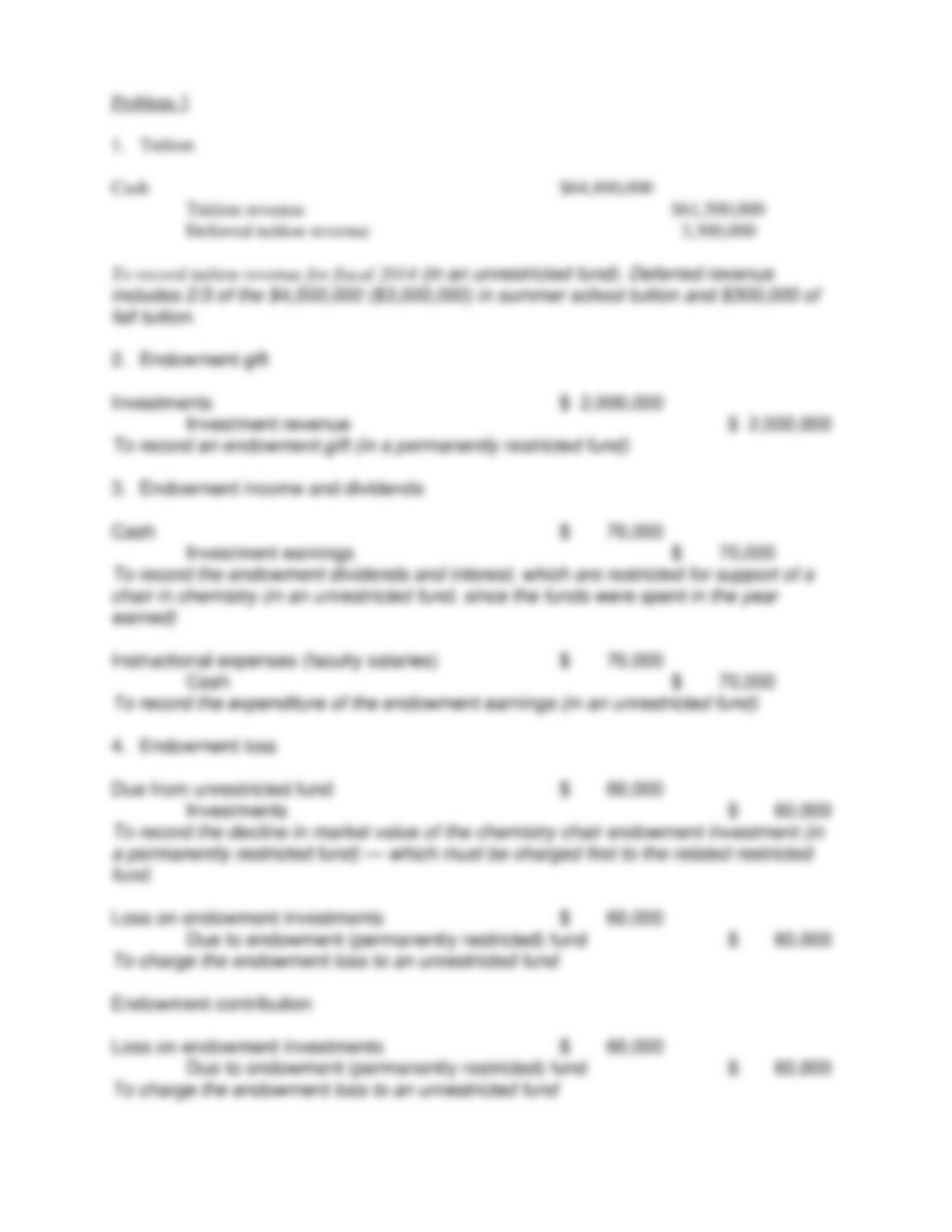
3. Betterman College, a not-for-profit institution, engaged in the following transactions
during its fiscal year ending June 30, 2014. Prepare appropriate journal entries,
indicating the types of funds (by restrictiveness) in which they would be recorded.
1. The college collected $64,800,000 in student tuition. Of this amount $4,500,000
was applicable to the summer semester, which ran from June 1 to August 30,
and $300,000 was applicable to the fall semester that began the following
September.
2. The college received a contribution of $2,000,000 in stocks and bonds to
establish an endowed chair in chemistry. Income from the chair must be used to
supplement the salary of a professor of chemistry.
3. During the year, the chemistry chair endowment earned interest and dividends of
$70,000, all of which was used to supplement the salary of the chair holder.
4. The market value of the investments of the chemistry chair endowment declined
by $60,000.
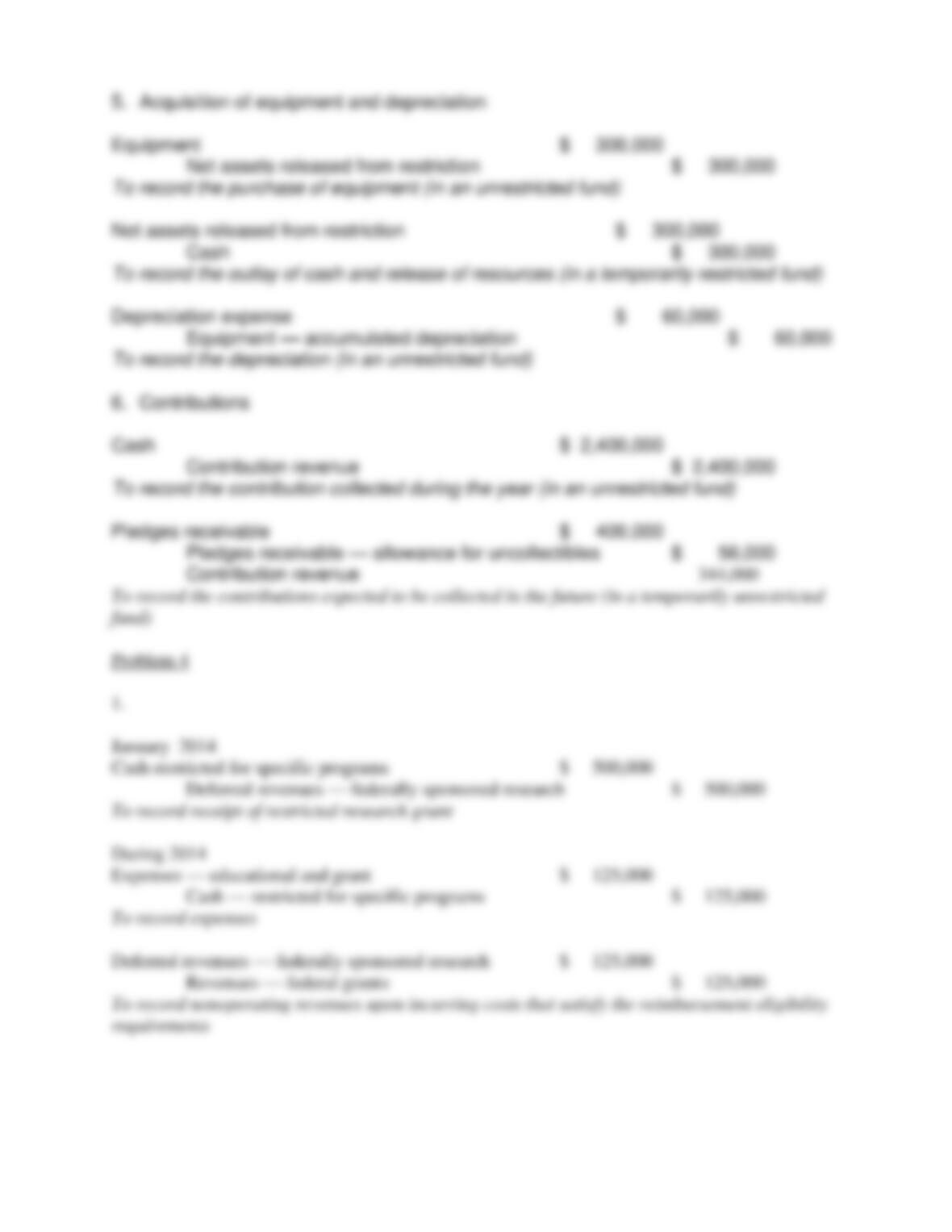
5. Using funds restricted for this purpose, the college purchased $300,000 of
equipment for intercollegiate athletics. Intercollegiate athletics is accounted for as
an auxiliary enterprise. The college charged depreciation of $60,000.
6. The annual alumni campaign yielded $2,800,000 in pledges. The college
estimated that 2 percent would be uncollectible. During the year the college
collected $2,400,000 on the pledges.
4. In January 2014, Granite Hills State University received a $500,000 government grant to be
used to finance a study to determine the effects of the federal stimulus bill on the regional
economy. During 2014, expenditures of $125,000 were incurred and paid on the research
project.
1. Record these transactions in the accounts of Granite Hills State University, and explain
how the effects of the transactions should be reported in the college’s financial
statements.
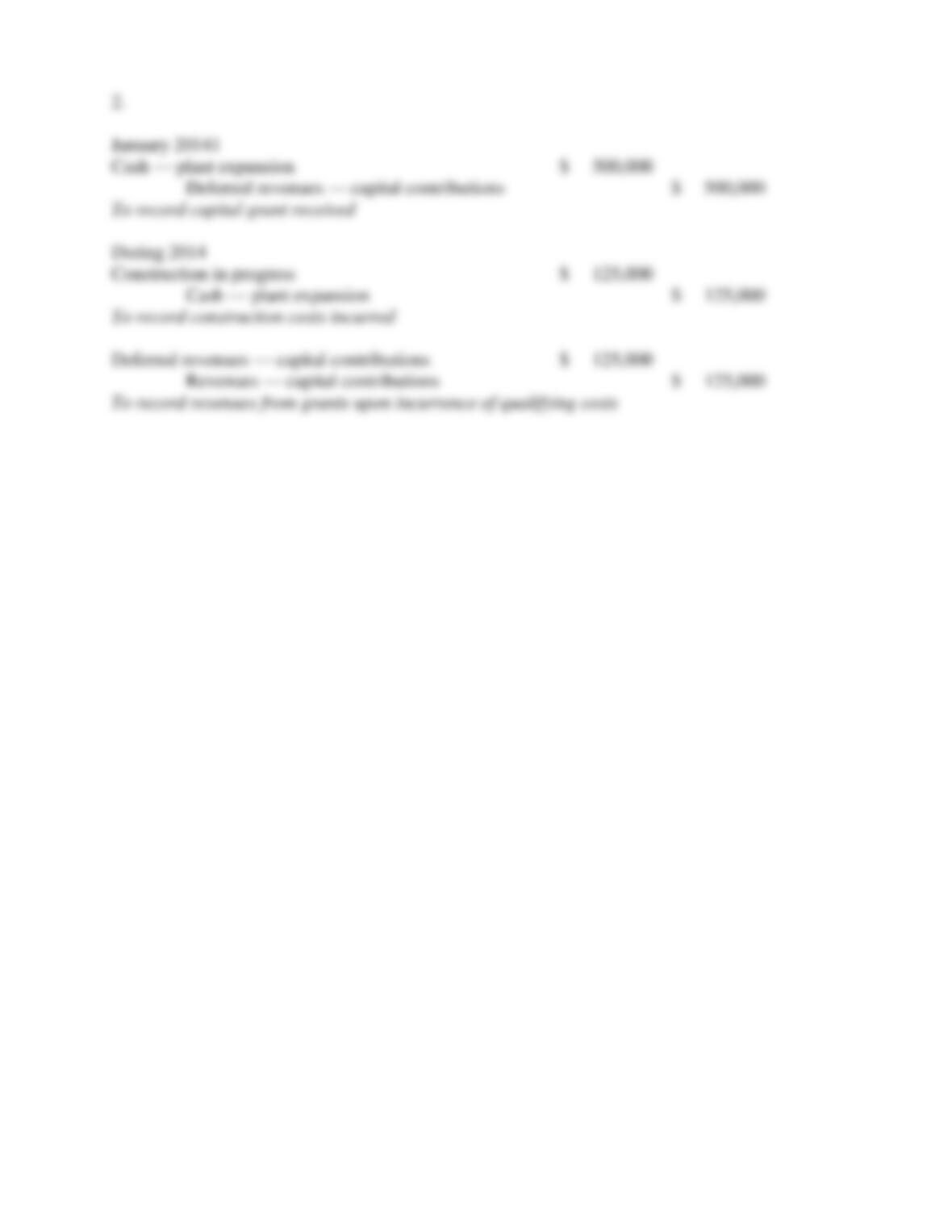
2. Repeat requirement (1) under the assumption that the grant was to finance plant
expansion.

ch13.doc Page 9
ESSAYS (CHAPTER 13)
1. Austin Community College, a public institution, issues stand-alone financial statements.
Although the college maintains its accounts on a fund basis, it does not include a combined
fund statement of net position or statement of revenues, expenses, and changes in net position
in its financial statements. Can such a practice be consistent with generally accepted
accounting principles? Explain, citing specific GASB provisions or pronouncements.
2. What are the key reporting options available to public colleges and universities?
3. How do the three major financial statements of a public college or university differ from
those of a private not-for-profit college or university?
4. In what ways can declines in the stock market affect the fiscal health of colleges and
universities?
ANSWERS TO TRUE/FALSE (CHAPTER 13)

ch13.doc Page 10
ANSWERS TO MULTIPLE CHOICE (CHAPTER 13)
ch13.doc Page 11
ANSWERS TO PROBLEMS (CHAPTER 13)
ch13.doc Page 12
ch13.doc Page 13
ch13.doc Page 14
ch13.doc Page 15
ESSAY ANSWERS (CHAPTER 13)