Introduction to General, Organic & Biological Chemistry, 12e (Timberlake)
Chapter 13 Carbohydrates
13.1 Multiple-Choice Questions
1) A carbohydrate that gives two molecules when it is completely hydrolyzed is known as a
________.
A) monosaccharide
B) disaccharide
C) polysaccharide
D) starch
E) trisaccharide
2) Which group of carbohydrates cannot be hydrolyzed to give simpler carbohydrates?
A) monosaccharides
B) disaccharides
C) trisaccharides
D) tetrasaccharides
E) polysaccharides
3) A monosaccharide that consists of 5 carbon atoms, one of which is in a ketone group, is
classified as a(n) ________.
A) aldotetrose
B) aldopentose
C) aldohexose
D) ketotetrose
E) ketopentose
4) A monosaccharide that contains 4 carbon atoms, one of which is in an aldehyde group, is
classified as a(n) ________.
A) aldopentose
B) aldohexose
C) ketopentose
D) aldotetrose
E) ketotetrose
5) A monosaccharide that contains 6 carbon atoms, one of which is in an aldehyde group, is
classified as a(n) ________.
A) aldopentose
B) aldohexose
C) ketopentose
D) aldotetrose
E) ketotetrose
6) Ribulose has the following structural formula. To what carbohydrate class does ribulose
belong?
–OH
∣
C =O
∣
H – C – OH
∣
H – C – OH
∣
–OH
A) aldotetrose
B) aldopentose
C) ketotetrose
D) ketopentose
E) ketohexose
7) In the carbon cycle, carbon dioxide and water are converted to glucose and oxygen by
________.
A) large animals
B) insects
C) mushrooms
D) green plants
E) earthworms
8) The breakdown of glucose to chemical energy for the cells to do work is an example of
________.
A) oxidation
B) respiration
C) reduction
D) anabolism
E) mutarotation
9) Photosynthesis uses ________ as an energy source.
A) glucose
B) carbon dioxide
C) chlorophyll
D) oxygen
E) sunlight
10) Fructose does not undergo hydrolysis because it is a ________.
A) aldose
B) hexose
C) reducing sugar
D) monosaccharide
E) disaccharide
11) Achiral compounds are those which ________.
A) have no “handedness”
B) have different mirror images
C) are nonsuperimposable
D) have the same formula but different structures
E) have a carbon attached to four different atoms
12) Stereoisomers that are nonsuperimposable mirror images of each other are known as
________.
A) enantiomers
B) achiral isomers
C) superimposable isomers
D) anomers
E) Fischer projections
13) Which of the following objects is chiral? Assume that each object has no markings or
printing.
A) an pencil
B) a baseball bat
C) a glove
D) a hockey puck
E) a drinking glass
14) Which of the following compounds is chiral?
A) H
∣
H – C – H
∣
H
B) H
∣
HO – C – OH
∣
H
C)
∣
HO – C – H
∣
Cl
D) Br
∣
H – C – OH
∣
H
E) Cl
∣
Br – C – Cl
∣
Br
15) An enantiomer is ________.
A) a stereoisomer that is not a mirror image of another molecule
B) a stereoisomer whose mirror image cannot be superimposed
C) a diastereoisomer
D) a constitutional isomer
E) a geometric isomer
16) Chirality occurs when stereoisomers have mirror images that are ________.
A) superimposable
B) the same
C) not superimposable
D) not visible to one another
E) identical
17) How many different substituents are required on a carbon atom for it to be chiral?
A) one
B) two
C) three
D) four
E) Any number from 1 to 4; chiralty does not depend on substitution.
18) Chiral drugs consist of only one enantiomer. The benefits of using a pure enantiomer, rather
than a mixture, include ________.
A) higher potency (lower total dose of drug)
B) elimination of side effects
C) reduced chances of drug interactions
D) all of the above
E) none of the above
19) In the L- isomer of a Fischer projection of a monosaccharide, the -OH group furthest from
the carbonyl is written ________.
A) on the left of the top chiral carbon
B) on the right of the top chiral carbon
C) on the left of the middle chiral carbon
D) on the left of the bottom chiral carbon
E) on the right of the bottom chiral carbon
20) One difference between D-glucose and L-glucose is ________.
A) the open-chain form of L-glucose does not exist
B) it is not possible to make L-glucose
C) L-glucose has a 5-membered ring, and D-glucose has a 6-membered ring
D) only D-glucose can act as a substrate in metabolic reactions
E) L-glucose cannot form a closed structure
21) The sugar also known as dextrose, and blood sugar is ________.
A) glucose
B) galactose
C) fructose
D) lactose
E) sucrose
22) Galactose is a ________.
A) monosaccharide
B) disaccharide
C) trisaccharide
D) polysaccharide
E) phosphosaccharide
23) Galactosemia is the name of a metabolic disorder. In this disorder, an enzyme is missing that
is needed to ________.
A) make galactose from lactose
B) make lactose from galactose
C) convert galactose to glycogen
D) convert galactose to glucose
E) convert α-galactose to β-galactose
24) Hypoglycemia is a condition in which ________.
A) the glucose level in the blood is about 100 mg/dL
B) the amount of glucose in the urine is higher than normal
C) the glucose level in the blood is higher than normal
D) the glucose level in the pancreas is higher than normal
E) the glucose level in the blood is lower than normal
25) Hyperglycemia is a condition in which ________.
A) the glucose level in the blood is about 100 mg/dL
B) the amount of glucose in the urine is lower than normal
C) the glucose level in the blood is higher than normal
D) the glucose level in the pancreas is lower than normal
E) the glucose level in the liver is lower than normal
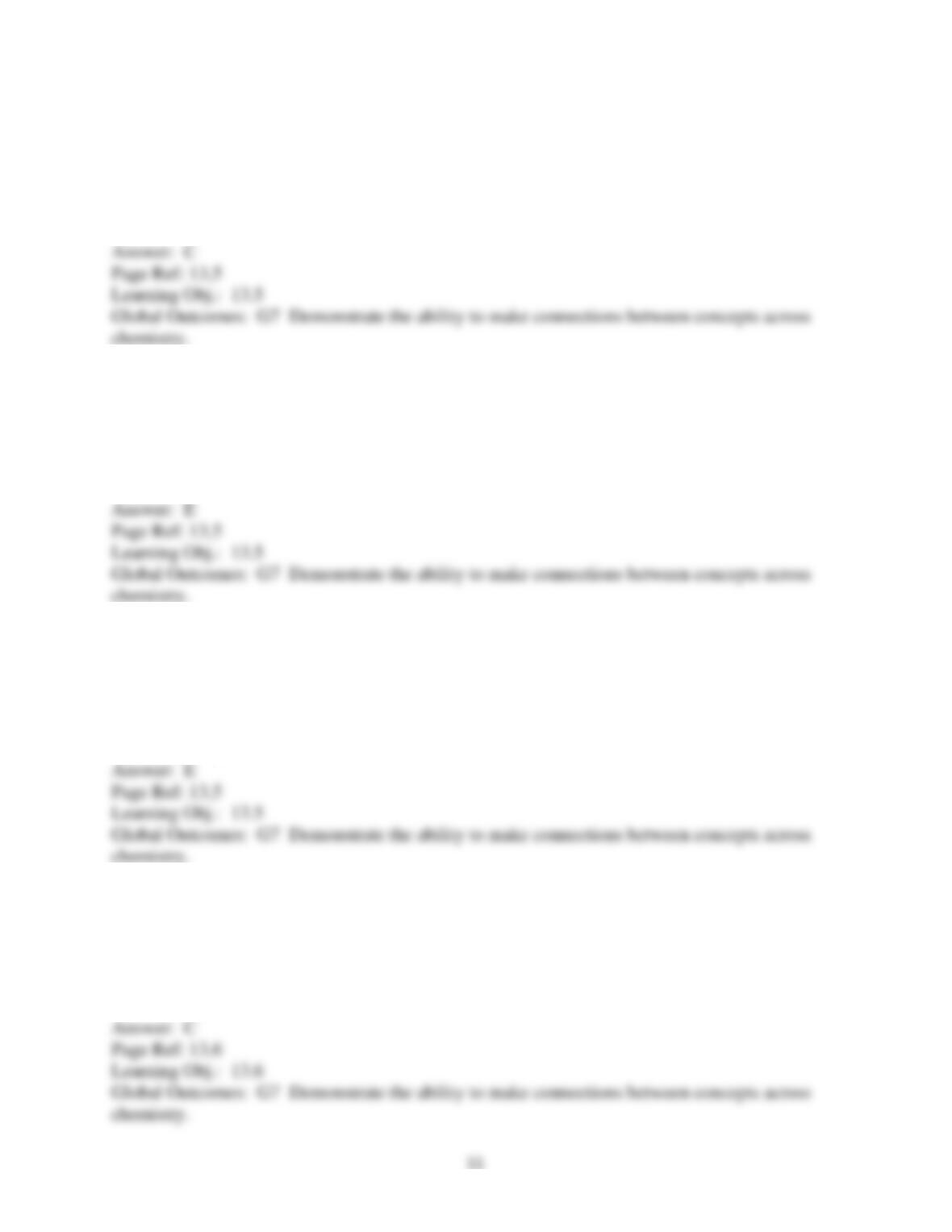
26) Glucose can have the structure shown below. It can be classified as a(n) ________.
A) ribose
B) ketose
C) disaccharide
D) monosaccharide
E) ketone
27) Benedict’s test requires an aldehyde and an adjacent ________.
A) saturated carbon
B) ketone
C) hydroxyl
D) phenyl ring
E) acid
28) Which sugar is not a reducing sugar?
A) glucose
B) fructose
C) galactose
D) maltose
E) sucrose
29) Aspartame® and Saccharin® are two examples of ________.
A) disaccharides
B) polysaccharides
C) chlorosaccharides
D) alcohol sweeteners
E) noncarbohydrate sweeteners
30) A glycosidic bond between two monosaccharides can also be classified as a(n) ________.
A) double bond
B) ester bond
C) ether bond
D) achiral bond
E) alcohol bond
31) In a disaccharide, two monosaccharides are joined by what kind of bond?
A) double
B) anomeric
C) alcohol
D) glycosidic
E) rotational
32) Which of the following contains a β–1,4-glycosidic bond?
A) galactose
B) lactose
C) maltose
D) sucrose
E) amylose
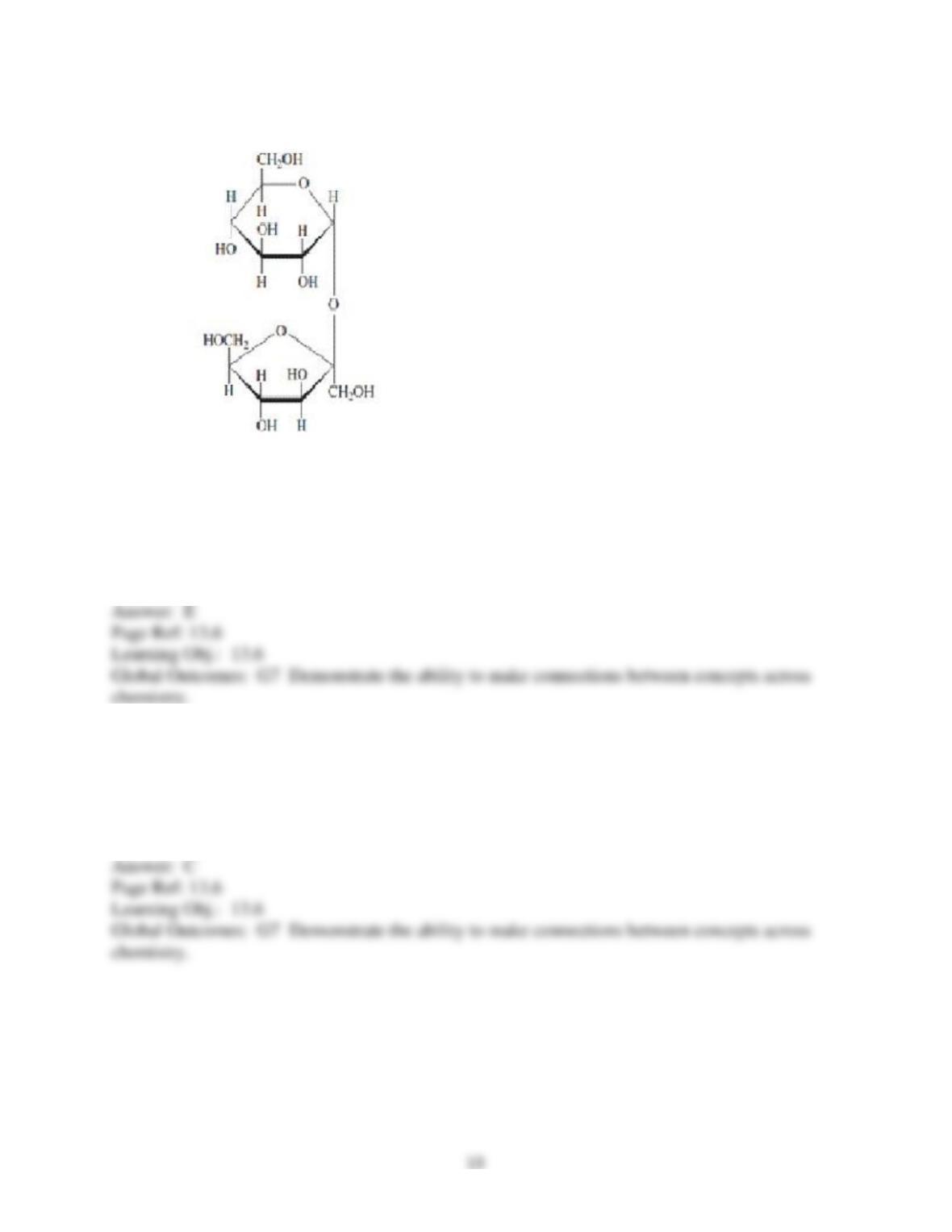
Refer to the disaccharide below to answer the following question(s).
33) In the figure above, the monosaccharide on the bottom is a(n) ________.
A) aldopentose
B) ketopentose
C) aldohexose
D) aldoheptose
E) ketohexose
34) In the figure above, the monosaccharide on the top is a(n) ________.
A) aldopentose
B) ketopentose
C) aldohexose
D) aldoheptose
E) ketohexose
35) Hydrolysis of the disaccharide above gives the monosaccharides ________.
A) fructose and ribose
B) fructose and galactose
C) ribose and glucose
D) ribose and galactose
E) fructose and lactose
36) The disaccharide above contains a(n) ________-glycosidic linkage.
A) α-1,4
B) β-1,4
C) α-2,4
D) β-2,4
E) α-2,6
37) Maltose is a ________.
A) monosaccharide
B) disaccharide
C) trisaccharide
D) polysaccharide
E) phosphosaccharide
38) Maltose can be classified as a(n) ________.
A) disaccharide
B) polysaccharide
C) ketose
D) pentose
E) tetrasaccharide
39) Galactose is a product of enzymatic hydrolysis of ________.
A) lactose
B) glucose
C) maltose
D) erythrose
E) sucrose
40) Amylose is a ________.
A) monosaccharide
B) disaccharide
C) trisaccharide
D) polysaccharide
E) phosphosaccharide
41) Which of the following contains α-1,6-branches?
A) amylose
B) glycogen
C) cellulose
D) sucrose
E) maltose
42) Cellulose is not digestible by humans because it contains glucose units linked by ________-
glycosidic bonds.
A) α-1,2
B) α-1,4
C) α-1,6
D) β-1,2
E) β-1,4
43) Amylose is a form of starch which has ________.
A) only β-1,4-bonds between glucose units
B) only α-1,4-links bonds glucose units
C) both α-1,4-and β-1,4-bonds between glucose units
D) hemiacetal links joining glucose units
E) carbon-carbon bonds joining glucose units
44) Amylopectin is a form of starch which has ________.
A) only β-1,4-bonds between glucose units
B) only α-1,4-links bonds glucose units
C) both α-1,4-and α-1,6-bonds between glucose units
D) hemiacetal links joining glucose units
E) carbon-carbon bonds joining glucose units
45) Cellulose is a polysaccharide which has ________.
A) only β-1,4-bonds between glucose units
B) only α-1,4-links bonds glucose units
C) both α-1,4-and α-1,6-bonds between glucose units
D) hemiacetal links joining glucose units
E) carbon-carbon bonds joining glucose units
46) Humans cannot digest cellulose because they ________.
A) lack the necessary enzymes to digest β-glycosides
B) are allergic to β-glycosides
C) are poisoned by β-glycosides
D) have intestinal flora which use up β-glycosides
E) cannot digest chlorophyll
47) Under acid hydrolysis conditions, starch is converted to ________.
A) glucose
B) xylose
C) maltose
D) galactose
E) fructose
13.2 Short Answer Questions
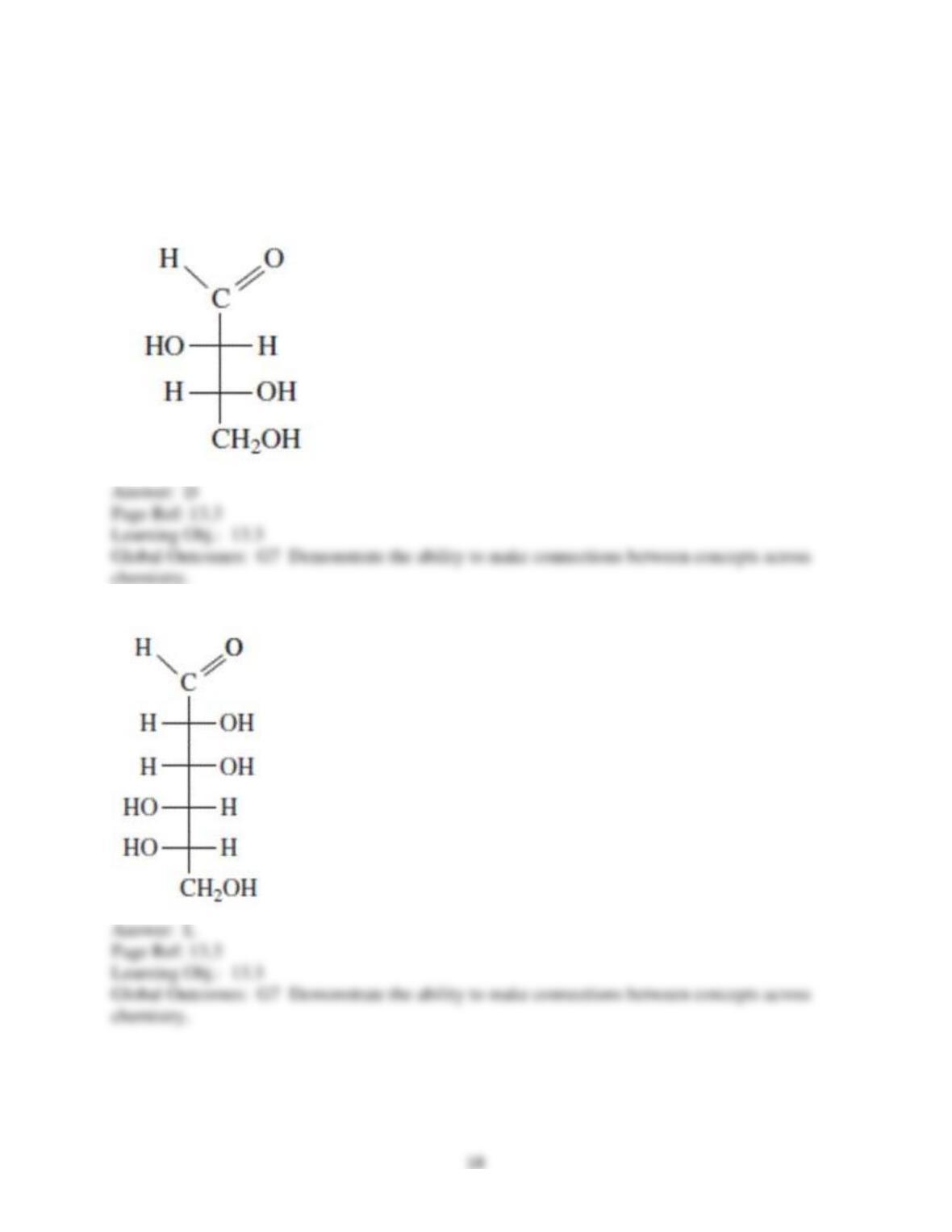
Identify each Fischer projection as the D- or L-isomer.
1)
2)
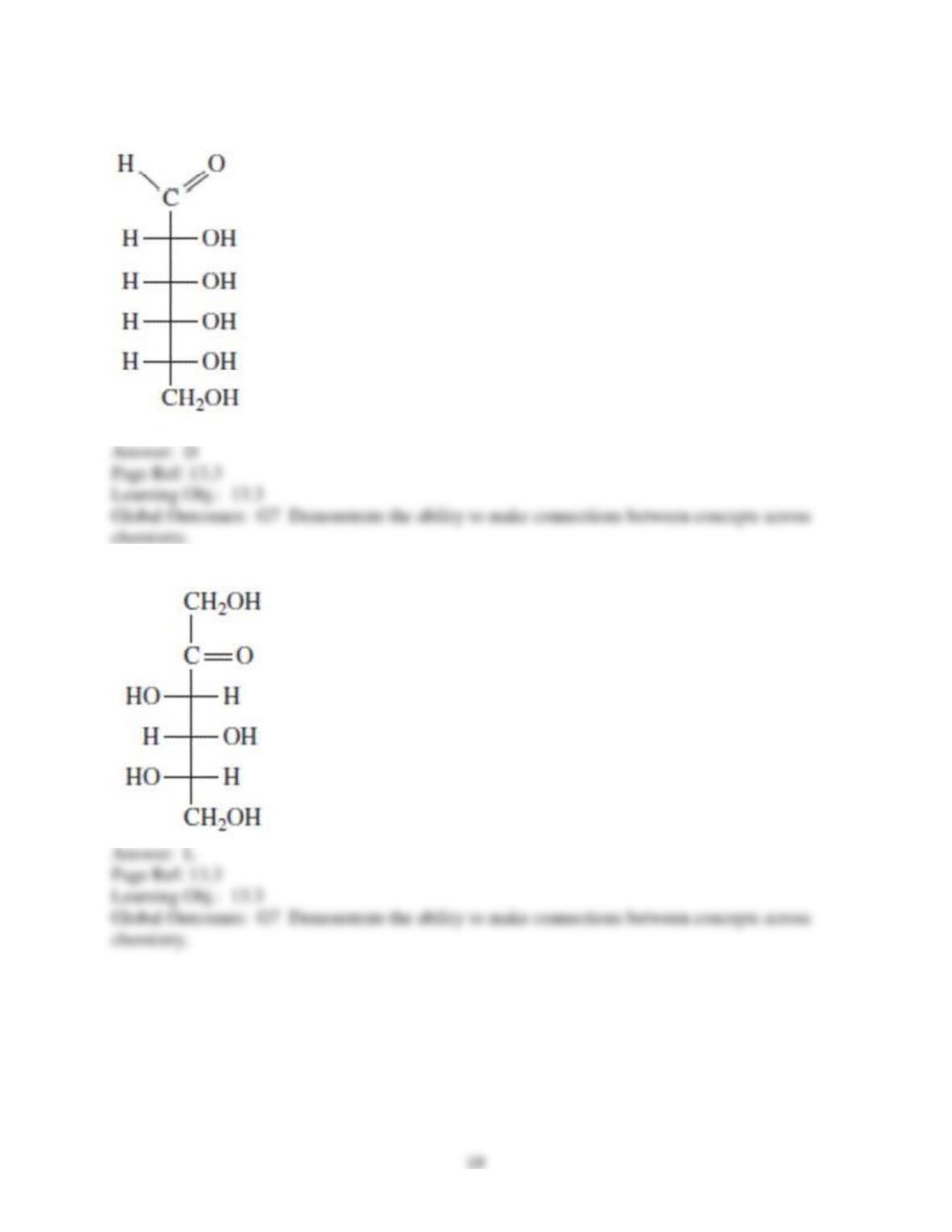
3)
4)
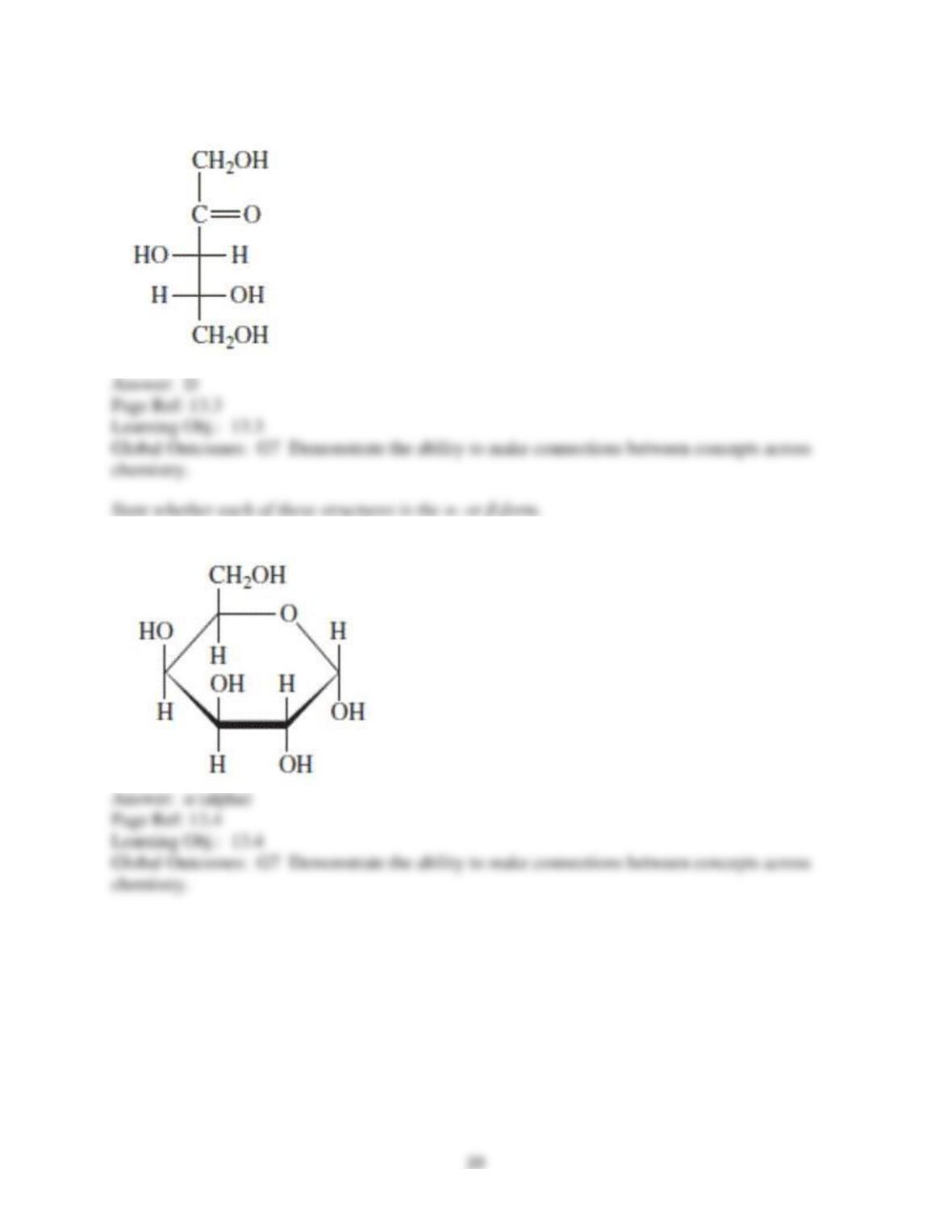
5)
6)
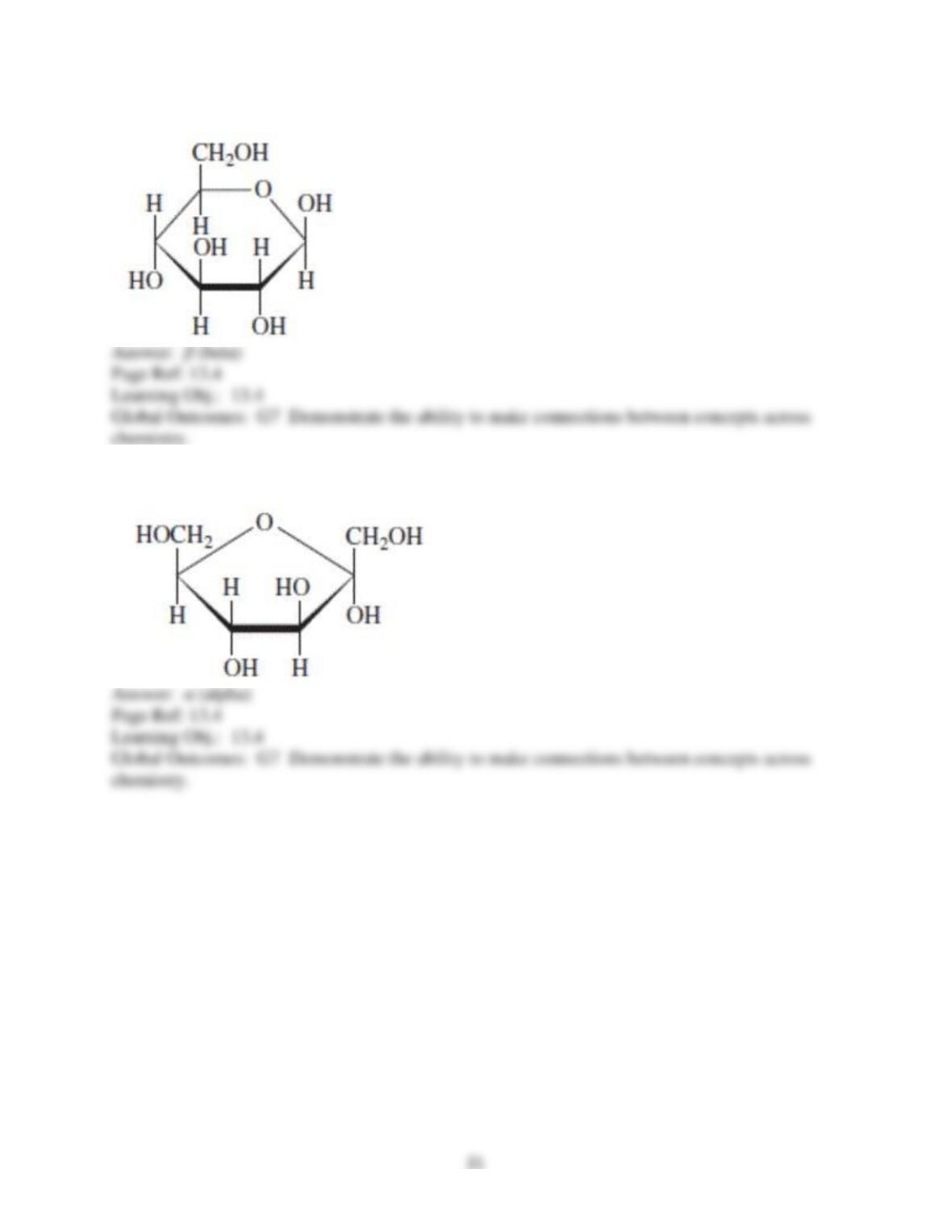
7)
8)
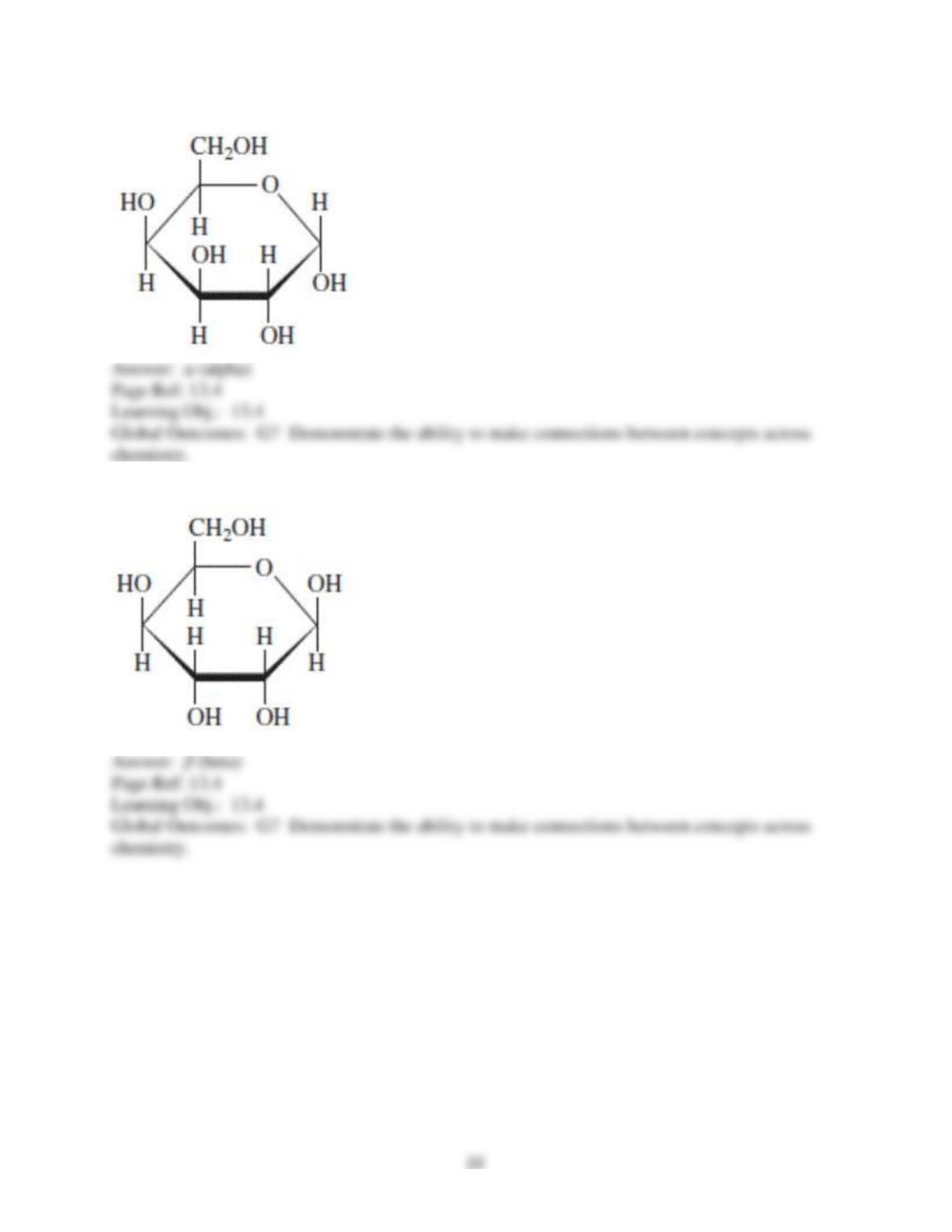
9)
10)
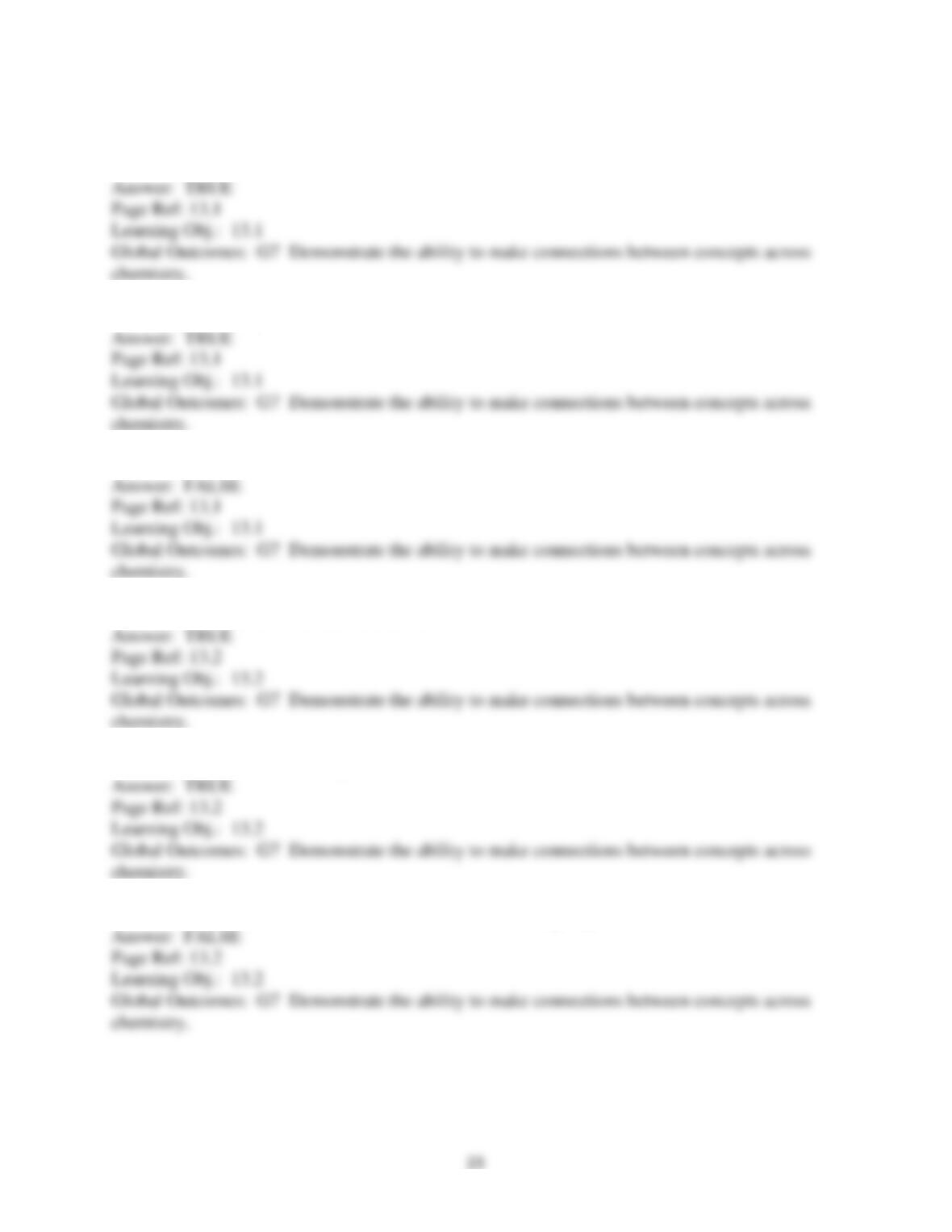
13.3 True/False Questions
1) Sucrose is a disaccharide.
2) Amylose is a polysaccharide.
3) Cellulose is a monosaccharide.
4) Stereoisomers are not structural isomers.
5) Enantiomers are mirror images of each other.
6) A chiral carbon atom can have fewer than four different groups bonded to it.
7) Enantiomers may have very different tastes or smells.
8) The biological activity of one enantiomers may be very different from the biological activity
of the other enantiomer.
9) In the Fischer projection of D-glucose, the -OH group on the chiral carbon farthest from the
aldehyde is to the left.
10) In the Fischer projection of D-fructose, the -OH group on the chiral carbon farthest from the
ketone is to the right.
11) In beta-glucose, the new -OH group is above the plane of the ring.
12) In glucose, the -OH group on carbon 4 is above the plane of the ring.
13) Aldehydes with an adjacent alcohol give a positive Benedict’s test.
14) A deep blue color in Benedict’s test indicates the presence of an aldehyde with an adjacent
alcohol.
15) A reducing sugar gives a precipitate of silver metal with Benedict’s reagent.
16) The product of oxidation of an aldose is a carboxylic acid.
17) The product of reduction of mannose is mannoic acid.
18) Sucrose is a reducing sugar.
19) The product of reduction of xylose is xylitol.
20) Sucrose is made up of glucose units only.
21) Amylopectin is a straight-chain polysaccharide.
22) The glucose units in cellulose are connected by β–1,4-glycosidic bonds.
23) Humans do not have the enzyme necessary to hydrolyze cellulose.
27
13.4 Matching Questions
Select the correct carbohydrate for each description.
A) cellulose
B) sucrose
C) lactose
D) galactose
E) fructose
F) maltose
G) glucose
H) glycogen
I) amylose
1) a monosaccharide found in fruit juices and honey, the sweetest carbohydrate
Page Ref: 13.3
Learning Obj.: 13.3
Global Outcomes: G7 Demonstrate the ability to make connections between concepts across
chemistry.
2) a disaccharide that occurs as a breakdown product of starch
Page Ref: 13.6
Learning Obj.: 13.6
Global Outcomes: G7 Demonstrate the ability to make connections between concepts across
chemistry.
3) a monosaccharide that combines with glucose to form lactose
Page Ref: 13.6
Learning Obj.: 13.6
Global Outcomes: G7 Demonstrate the ability to make connections between concepts across
chemistry.
4) a disaccharide found in milk and milk products
Page Ref: 13.6
Learning Obj.: 13.6
Global Outcomes: G7 Demonstrate the ability to make connections between concepts across
chemistry.
5) a disaccharide consisting of glucose and fructose
Page Ref: 13.6
Learning Obj.: 13.6
Global Outcomes: G7 Demonstrate the ability to make connections between concepts across
chemistry.
28
6) the product when maltose is hydrolyzed
Page Ref: 13.6
Learning Obj.: 13.6
Global Outcomes: G7 Demonstrate the ability to make connections between concepts across
chemistry.
7) a carbohydrate that cannot be digested by humans
Page Ref: 13.7
Learning Obj.: 13.7
Global Outcomes: G7 Demonstrate the ability to make connections between concepts across
chemistry.
8) a carbohydrate that stores energy in the human body
Page Ref: 13.7
Learning Obj.: 13.7
Global Outcomes: G7 Demonstrate the ability to make connections between concepts across
chemistry.
9) a carbohydrate that is used to build cell walls in plants
Page Ref: 13.7
Learning Obj.: 13.7
Global Outcomes: G7 Demonstrate the ability to make connections between concepts across
chemistry.
10) an unbranched carbohydrate that stores glucose in plants
Page Ref: 13.7
Learning Obj.: 13.7
Global Outcomes: G7 Demonstrate the ability to make connections between concepts across
chemistry.

29
Indicate the monosaccharide(s) produced upon hydrolysis of each carbohydrate.
A) glucose
B) glucose + galactose
C) glucose + fructose
11) maltose
Page Ref: 13.5
Learning Obj.: 13.5
Global Outcomes: G7 Demonstrate the ability to make connections between concepts across
chemistry.
12) lactose
Page Ref: 13.6
Learning Obj.: 13.6
Global Outcomes: G7 Demonstrate the ability to make connections between concepts across
chemistry.
13) sucrose
Page Ref: 13.6
Learning Obj.: 13.6
Global Outcomes: G7 Demonstrate the ability to make connections between concepts across
chemistry.
14) amylopectin
Page Ref: 13.7
Learning Obj.: 13.7
Global Outcomes: G7 Demonstrate the ability to make connections between concepts across
chemistry.
15) glycogen
Page Ref: 13.7
Learning Obj.: 13.7
Global Outcomes: G7 Demonstrate the ability to make connections between concepts across
chemistry.