CHAPTER 13—DIVIDEND POLICY
TRUE/FALSE
1. The dividend irrelevance theory, proposed by Miller and Modigliani, says that as long as a firm
pays a dividend, how much it pays does not affect either its cost of capital or its stock price.
2. The farther to the right the IOS is, other things held constant, the lower a firm’s dividend payout
ratio.
3. A reverse split reduces the number of shares outstanding.
4. The dividend irrelevance theory says that the firm’s dividend policy has no effect on either its
value or its cost of capital.
5. Managers, on average, do not raise dividends unless they believe future earnings will be able to
sustain the higher level dividends.
6. According to the free cash flow hypothesis, cash flows that cannot be reinvested in positive net
present value projects should be kept as retained earnings.
7. Firms following a constant dividend ration payout policy will cause investors to have greater
uncertainty concerning expected dividends each year when the earnings for the firm are stable
over time.
8. The “new stock” type of dividend reinvestment plan allows the stockholder to automatically
reinvest dividends to buy existing in the open market.
9. The ex-dividend date is the date on which a firm actually mails dividend checks.
10. Firms with a large number of acceptable capital budgeting projects generally have a high
dividend payout ratio.
11. A stock split is always associated with an increase in the value of the equity outstanding.
Chapter 13 Dividend Policy 301
12. On a 2-for-1 stock split, the shares outstanding are doubled, and the stock’s par value is halved.
13. The dividend payout ratio, on average, for companies in the United States is higher than for
companies in Japan.
14. A firm that follows a residual dividend policy must believe that the dividend irrelevance theory is
correct.
15. If the shape of the curve depicting a firm’s WACC versus its debt ratio is more like a sharp “V”,
as opposed to a shallow “U“, the easier it will be for the firm to maintain a steady dividend in the
face of varying investment opportunities from year to year.
16. If the information content, or signaling, hypothesis is correct, then changes in dividend policy can
be important with respect to firm value and capital costs.
MULTIPLE CHOICE
1. In the real world, we find that dividends
a.
Usually exhibit greater stability than earnings.
b.
Fluctuate more widely than earnings.
c.
Tend to be a lower percentage of earnings for mature firms.
d.
Are usually changed every year to reflect earnings changes.
e.
Are usually set as a fixed percentage of earnings.
2. Which of the following would not have an influence on the optimal dividend policy?
a.
The possibility of accelerating or delaying investment projects.
b.
A strong shareholders’ preference for current income versus capital gains.
c.
Bond indenture constraints.
d.
The costs associated with selling new common stock.
e.
All of the above can have an effect on dividend policy.
3. We can be sure that, in and of itself, a stock dividend will not affect which of the following
financial aspects of the firm? (Assume the stock has a par value.)
a.
Market value per share.
b.
Book value per share.
c.
Common stock account .
d.
Paid-in capital account.
e.
Total assets.
302 Chapter 13 Dividend Policy
4. Those who believe investors choose a particular stock due to the firm’s dividend policy would
contend that firm should consider the __________ effect when changing dividend policies.
a.
clientele
b.
tax
c.
free cash flow
d.
IRS
e.
relevance
5. The residual dividend policy implies that investors prefer to have the firm retain and reinvest
earnings rather than pay them out in dividends if the rate of return the firm can earn on reinvested
earnings
a.
exceeds the cost retained earnings.
b.
is less than the WACC.
c.
exceeds the cost of debt.
d.
exceeds the rate average investors can earn themselves for other investments of similar
risk.
e.
is less than the rate average investors can earn themselves for other investments of similar
risk.
6. The ex dividend date is __________ prior to the holder-of-record date.
a.
one business day
b.
two business days
c.
five business days
d.
one week
e.
one month
7. The date on which a firm’s board of directors issues a statement declaring a dividend is the
__________.
a.
declaration date
b.
holder-of-record date
c.
ex-dividend date
d.
payment date
e.
conversion date
Chapter 13 Dividend Policy 303
8. Why is the ex-dividend date important to someone who is considering purchasing a firm’s stock?
a.
If the stock is purchased on this date or later the buyer will not receive the next dividend
paid by the firm.
b.
This is the date the firm “opens its books” to determine the names of the persons who will
receive the next dividend that will be paid.
c.
This is the date the board of directors announces the value of the next dividend payment,
so the market price of the stock will increase at this point.
d.
This is the date the dividend is paid—that is, dividend checks are mailed to investors.
e.
The ex-dividend date really isn’t very important to potential investors; this date is more
important to accountants who construct financial statements because it is the date the
dividend becomes a legal liability of the firm.
9. If you are considering purchasing a stock because you want to receive the next dividend that will
be paid by the firm, which of the following dates would be most important to the timing of your
purchase?
a.
declaration date
b.
ex-dividend date
c.
payment date
d.
the date the firm’s fiscal year ends
e.
holder-of-record date
10. According to your text, the ex-dividend date associated with a stock is two days before the
a.
declaration date.
b.
holder-of-record date.
c.
payment date.
d.
firm pays interest on its debt every year.
e.
None of the above answers is correct.
11. Which of the following influences dividend policy?
a.
constraints on dividend payments such as debt contract restrictions
b.
investment opportunities
c.
alternative sources of capital
d.
cash availability
e.
all of these exert an influence on dividend policy.
12. All else equal, a “normal” stock split
a.
generally results in a significant increase in the per share price of the stock from what it
was before the split.
b.
reduces the number of shares of stock outstanding.
c.
increases the number of shares of stock outstanding.
d.
does not need to be recognized in any way on the balance sheet of a corporation.
e.
increase the dividend per share.
304 Chapter 13 Dividend Policy
13. A 2-for-1 stock split
a.
increases the number of shares of stock held by the firm’s stockholders.
b.
increases the per share price of the firm’s stock.
c.
requires stockholders to invest more money in the firm’s stock.
d.
requires the firm to adjust the value of its total assets on the balance sheet.
e.
generally decreases the total value of the firm that splits its stock.
14. The portion of the firm’s earnings that has been reinvested in the firm rather than paid out in
dividends is called
a.
net income.
b.
gross margin.
c.
reinvestment return.
d.
retained earnings.
e.
DRIP.
15. If the Modigliani and Miller hypothesis about dividends is correct, and if one found a group of
companies which differed only with respect to dividend policy, which of the following statements
would be most correct?
a.
The residual dividend model should not be used, because it is inconsistent with the MM
dividend hypothesis.
b.
The total expected return, which in equilibrium is also equal to the required return, would
be higher for those companies with lower payout ratios because of the greater risk
associated with capital gains versus dividends.
c.
If the expected total return of each of the sample companies were divided into a dividend
yield and a growth rate, and then a scatter diagram (or regression) analysis were
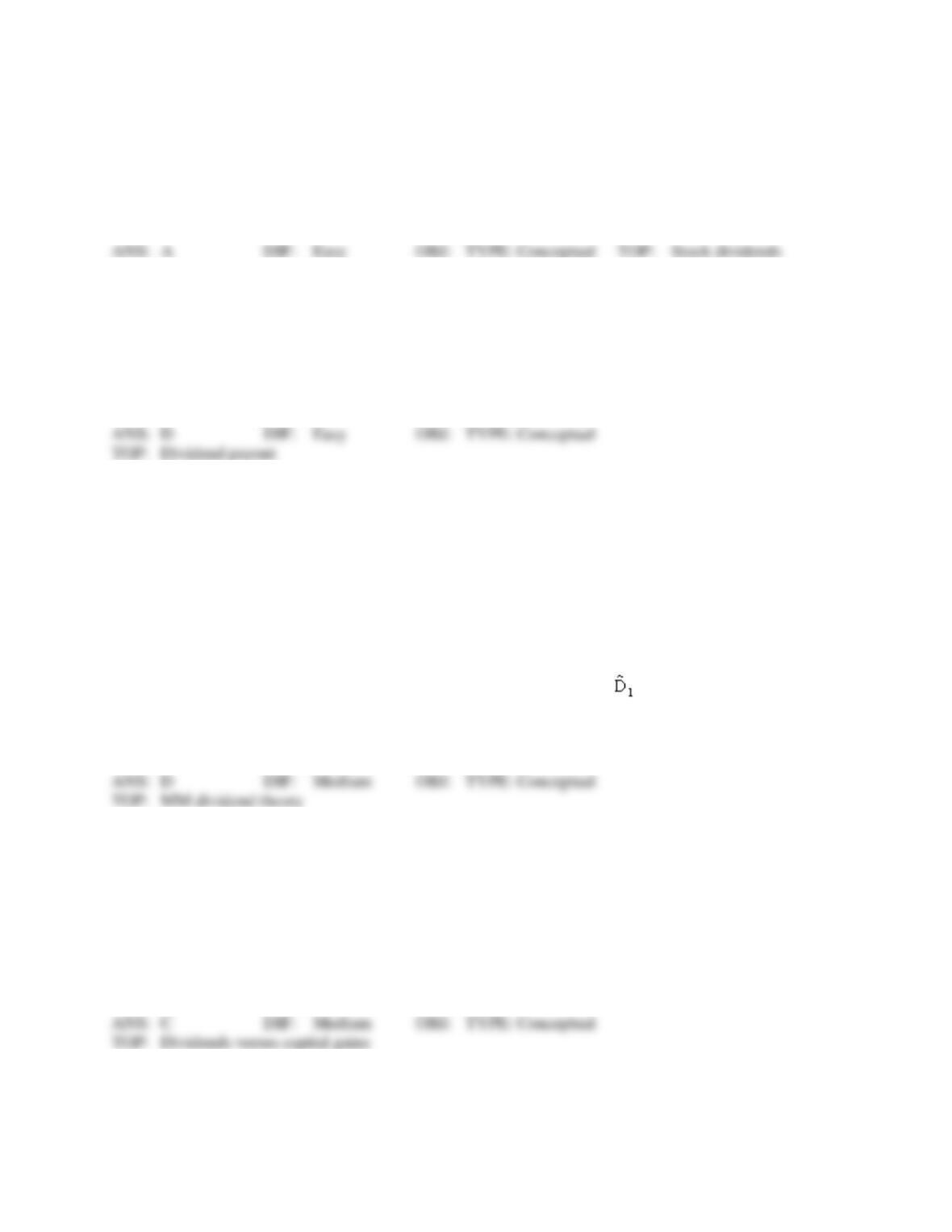
undertaken, then the slope of the regression line (or b in the equation /P0 = a + b(g))
would be equal to +1.0.
d.
None of the above statements is true.
e.
All of the above statements are true.
16. Which of the following statement completions is correct? If investors prefer dividends to capital
gains, then
a.
The equilibrium return, ks, will not be affected by a change in dividend policy because tax
effects will offset these preferences.
b.
ks will decrease as dividends are reduced.
c.
ks will increase as dividends are reduced.
d.
ks will decrease as the retention rate increases.
e.
Dividend policy as determined by the residual dividend model is the only dividend policy
which will maximize the price per share of common stock.
Chapter 13 Dividend Policy 305
17. Firms following a constant payout ratio dividend policy
a.
will have a stable dividend payment when earnings fluctuate.
b.
will have a fluctuating dividend policy when earnings are stable.
c.
will have a higher cost of equity when earnings are stable compared to other similar firms.
d.
will have a lower cost of equity when earnings are stable compared to other similar firms.
e.
will have a fluctuating dividend payment when earnings fluctuate.
18. For the past 10 years, Green Thumb Shrubbery has paid a very handsome dividend such that the
dividend yield normally has been approximately 10 percent. The holder-of-record date for the
next dividend payment is tomorrow. Sally Anderson just bought Green Thumb’s stock a few
minutes ago. As a result and assuming the stock’s price has been stable for the past couple of
days, the price Sally paid for her stock should have been
a.
greater than it was a couple of days ago because she will get the next dividend paid by
Green Thumb, which is expected to be fairly substantial.
b.
less than it was couple of days ago because she will not receive the next dividend paid by
the company.
c.
approximately the same as it was a couple of days ago because the stock’s price has been
stable and the next dividend should not affect the current price of the stock.
d.
differ from what it was a couple of days ago because the prices of all stocks constantly
fluctuate; but there is not enough information to determine whether the price will be
higher or lower than it was previously.
e.
None of the above is a correct answer.
19. Assume that stockholders have exactly the same information as the managers who make the
financial decisions of the firm. If the managers always make rational investment decisions—that
is, they purchase only positive net present value capital budgeting projects—which of the
following dividend policies should investors prefer the managers follow? Consider everything
else is equal.
a.
residual dividend
b.
constant payout ratio
c.
stable, predictable dividend
d.
low regular dividend plus extras
e.
It shouldn’t matter which dividend policy the managers follow because each policy should
maximize the value of the firm.
20. The study by Rafeal La Porta, Florencio Lopez-de-Silanes, Andrei Shleifer, and Robert W.
Vishney identify all the following factors as explanations for dividend policy difference around
the world.
a.
measures that help protect the minority right of shareholders.
b.
growth opportunities.
c.
risk associated with expected future dividends.
d.
number of shares outstanding.
e.
all of the above influence dividend policy differences around the world.
306 Chapter 13 Dividend Policy
21. Ducheyne Electric recently declared a 15 percent stock dividend. On the date of the stock
dividend Ducheyne had 16 million shares outstanding priced at $46 per share in the market. An
accounting entry was required on the balance sheet transferring some retained earnings to the
common stock account. If retained earnings was $280 million prior to the transaction, what was
the dollar amount of retained earnings after the transfer?
a.
$280.0 million
b.
$110.4 million
c.
$234.0 million
d.
$277.6 million
e.
$169.6 million
22. The following facts apply to your company:
Target capital structure: 50% debt; 50% equity.
EBIT: $200 million.
Assets: $500 million.
Tax rate: 40%.
Cost of new and old debt: 8%.
Based on the residual dividend policy, the payout ratio is 60 percent. How large (in millions of
dollars) will the capital budget be?
a.
$43.2
b.
$50.0
c.
$64.8
d.
$86.4
e.
$108.0
Chapter 13 Dividend Policy 307
23. Flavortech Inc. expects EBIT of $2,000,000 for the coming year. The firm’s capital structure
consists of 40 percent debt and 60 percent equity, and its marginal tax rate is 40 percent. The cost
of equity is 14 percent, and the company pays a 10 percent rate on its $5,000,000 of long-term
debt. One million shares of common stock are outstanding. In its next capital budgeting cycle, the
firm expects to fund one large positive NPV project costing $1,200,000, and it will fund this
project in accordance with its target capital structure. If the firm follows a residual dividend
policy and has no other projects, what is its expected dividend payout ratio?
a.
100%
b.
60%
c.
40%
d.
20%
e.
0%
308 Chapter 13 Dividend Policy
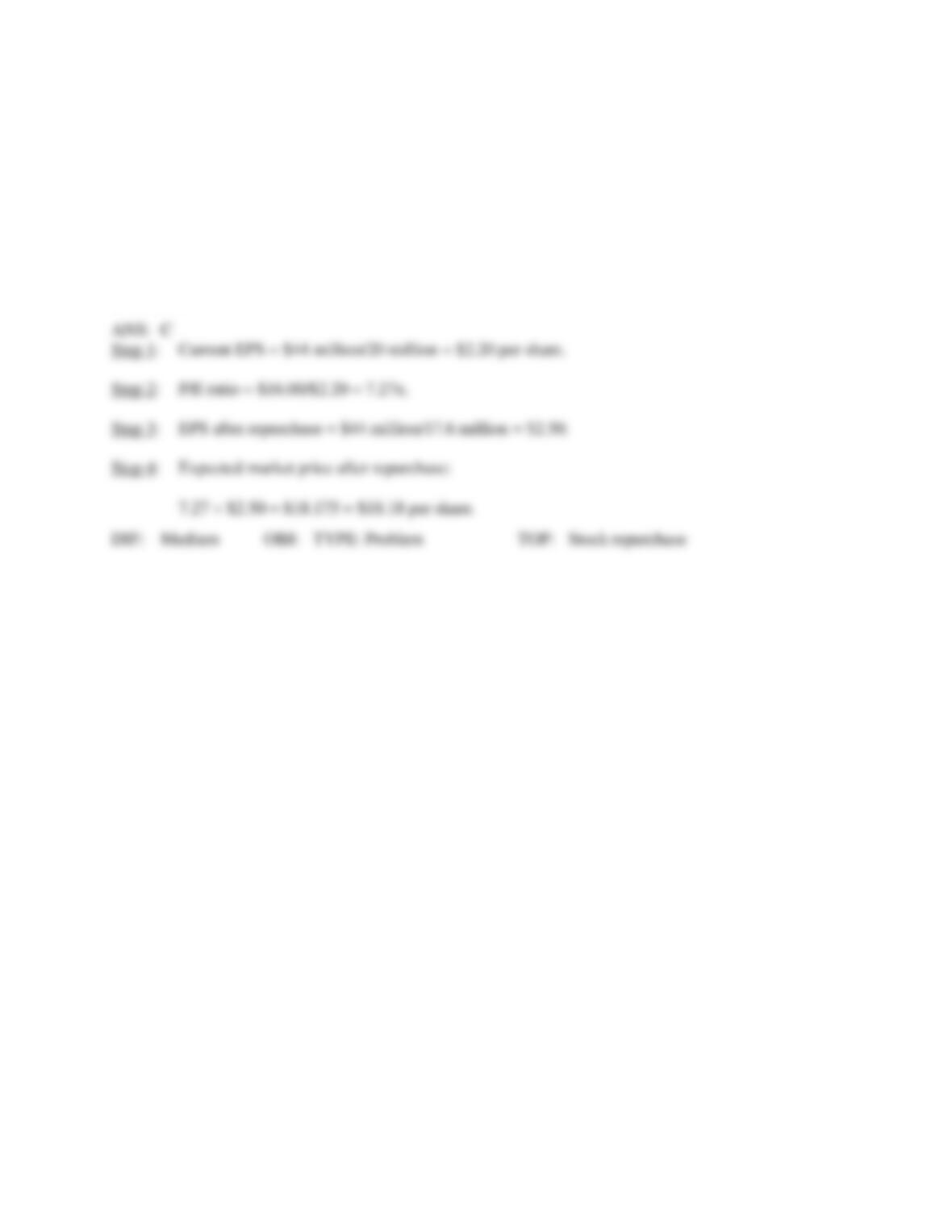
24. Makeover Inc. believes that at its current stock price of $16.00 the firm is undervalued in the
market. Makeover plans to repurchase 2.4 million of its 20 million shares outstanding. The firm’s
managers expect that they can repurchase the entire 2.4 million shares at the expected equilibrium
price after repurchase. The firm’s current earnings are $44 million. If management’s assumptions
hold, what is the expected market price after repurchase?
a.
$16.00
b.
$17.26
c.
$18.18
d.
$20.00
e.
$24.40