Chapter 13 Capital Budgeting Decisions
13–86
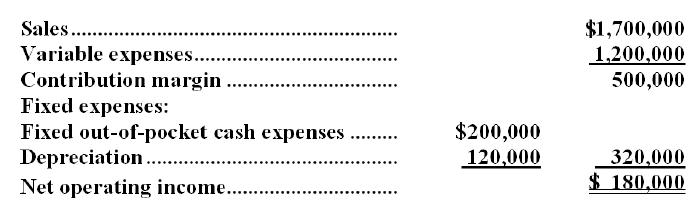
119. (Ignore income taxes in this problem.) Tranter, Inc., is considering a project that would
have a ten-year life and would require a $1,200,000 investment in equipment. At the end of
ten years, the project would terminate and the equipment would have no salvage value. The
project would provide net operating income each year as follows:
All of the above items, except for depreciation, represent cash flows. The company’s required
rate of return is 12%.
Required:
a. Compute the project’s net present value.
b. Compute the project’s internal rate of return to the nearest whole percent.
c. Compute the project’s payback period.
d. Compute the project’s simple rate of return.
Chapter 13 Capital Budgeting Decisions
Chapter 13 Capital Budgeting Decisions
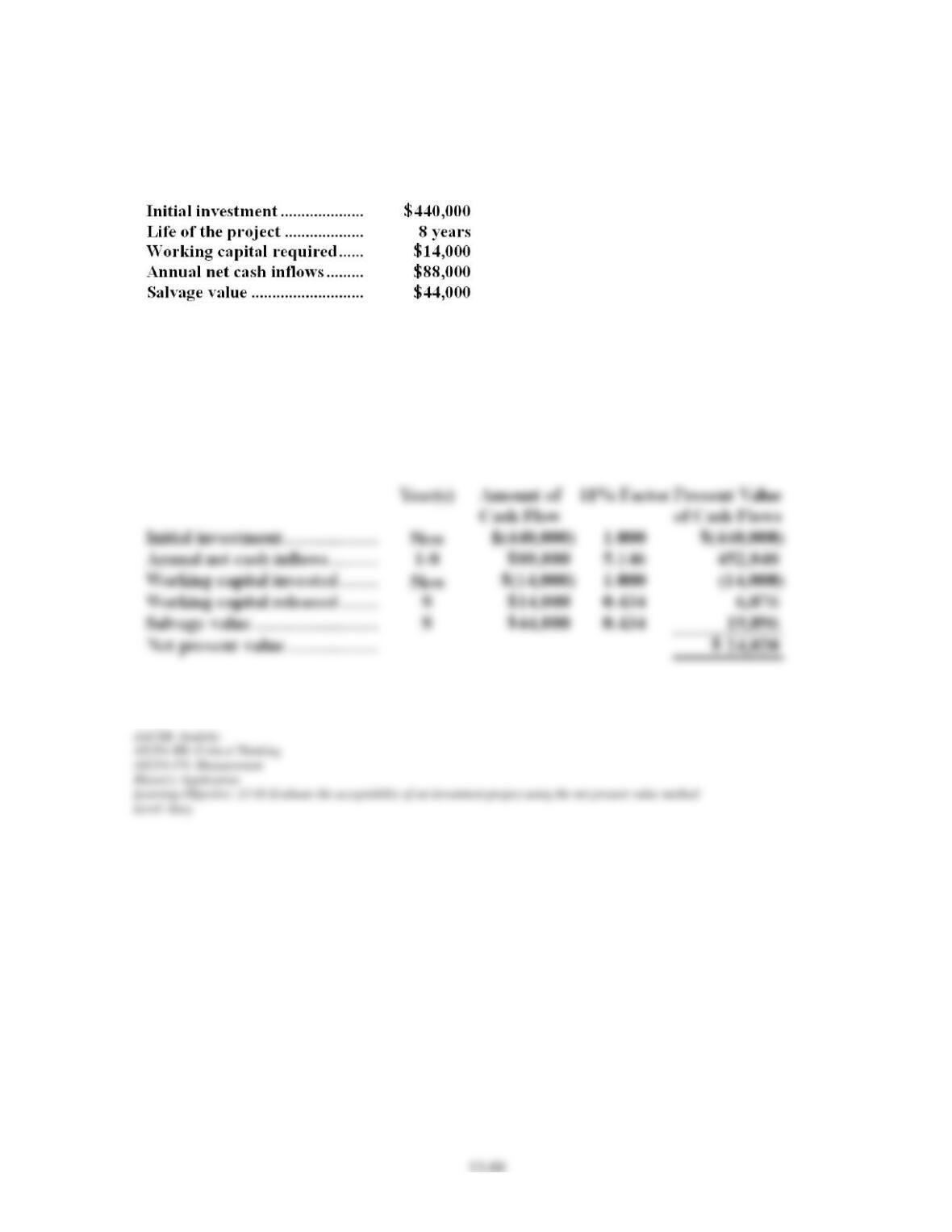
120. (Ignore income taxes in this problem.) Farah Corporation has provided the following
data concerning a proposed investment project:
The company uses a discount rate of 11%. The working capital would be released at the end
of the project.
Required:
Compute the net present value of the project.
Chapter 13 Capital Budgeting Decisions
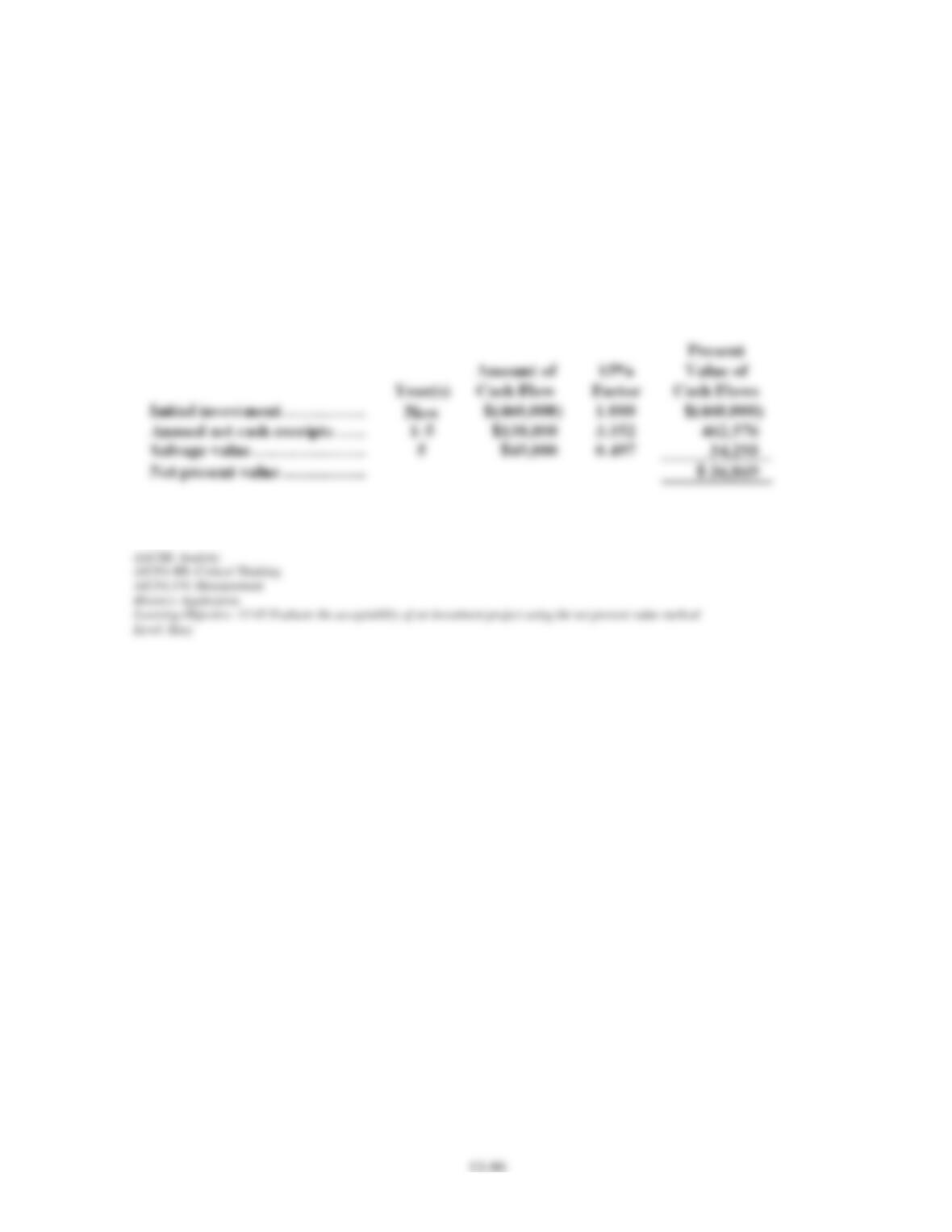
121. (Ignore income taxes in this problem.) Dunay Corporation is considering investing
$810,000 in a project. The life of the project would be 9 years. The project would require
additional working capital of $24,000, which would be released for use elsewhere at the end
of the project. The annual net cash inflows would be $162,000. The salvage value of the
assets used in the project would be $41,000. The company uses a discount rate of 17%.
Required:
Compute the net present value of the project.
Chapter 13 Capital Budgeting Decisions
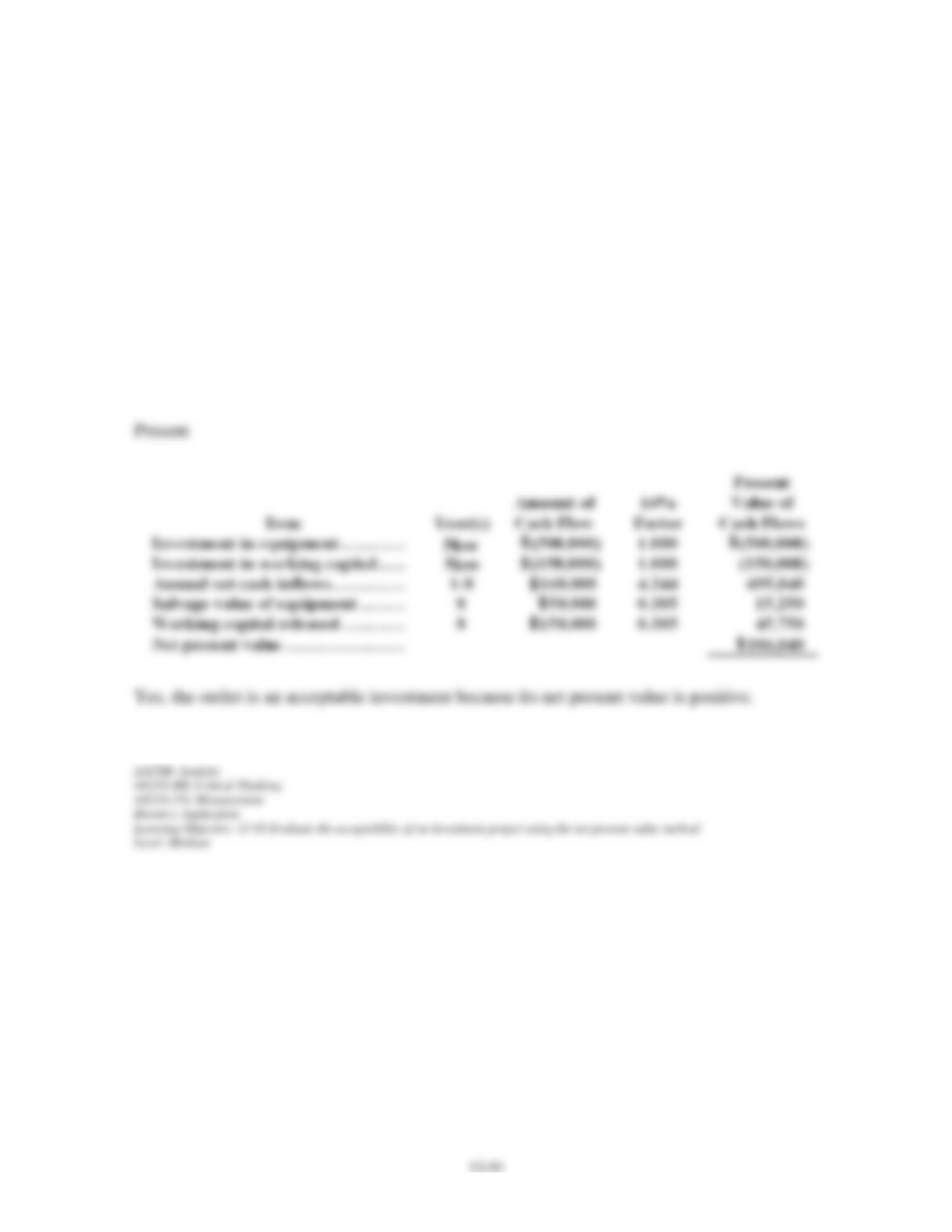
122. (Ignore income taxes in this problem.) Whatley Inc. is considering investing in a project
that would require an initial investment of $460,000. The life of the project would be 5 years.
The annual net cash inflows from the project would be $138,000. The salvage value of the
assets at the end of the project would be $69,000. The company uses a discount rate of 15%.
Required:
Compute the net present value of the project.
Chapter 13 Capital Budgeting Decisions
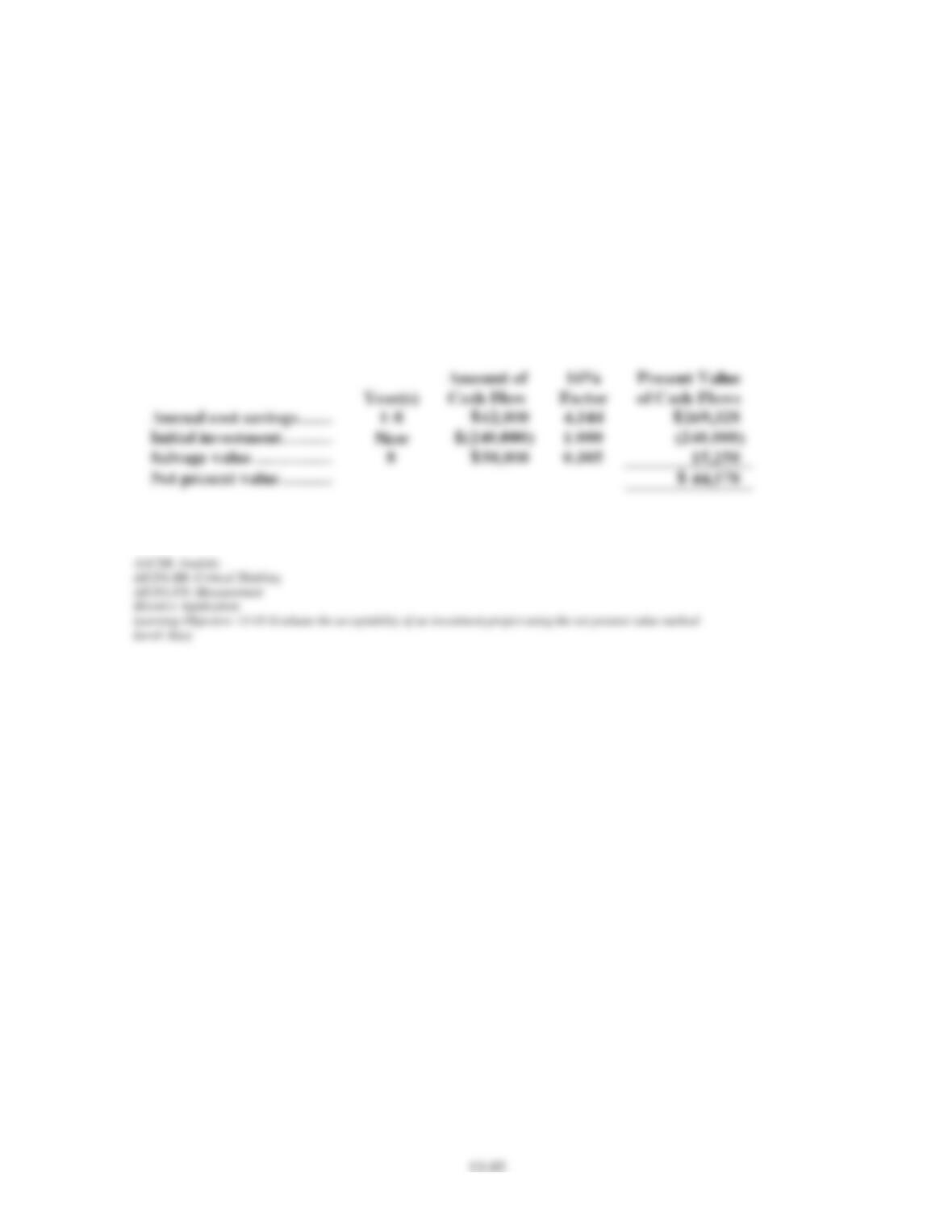
123. (Ignore income taxes in this problem.) Bill Anders retires in 8 years. He has $650,000 to
invest and is considering a franchise for a fast-food outlet. He would have to purchase
equipment costing $500,000 to equip the outlet and invest an additional $150,000 for
inventories and other working capital needs. Other outlets in the fast-food chain have an
annual net cash inflow of about $160,000. Mr. Anders would close the outlet in 8 years. He
estimates that the equipment could be sold at that time for about 10% of its original cost. Mr.
Anders’ required rate of return is 16%.
Required:
What is the investment’s net present value when the discount rate is 16 percent? Is this an
acceptable investment?
Chapter 13 Capital Budgeting Decisions
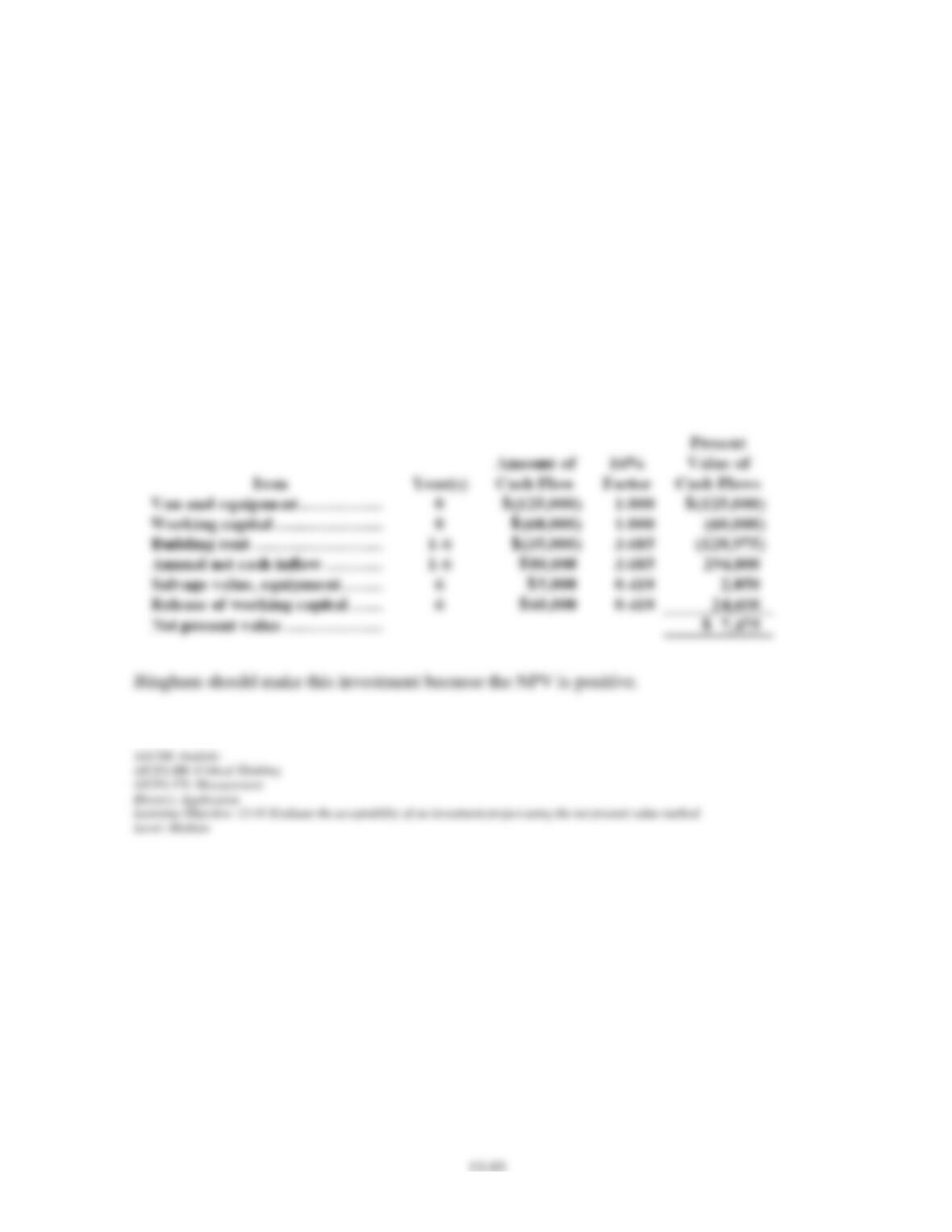
124. (Ignore income taxes in this problem.) Weilbacher Corporation is considering the
purchase of a machine that would cost $240,000 and would last for 8 years. At the end of 8
years, the machine would have a salvage value of $50,000. The machine would reduce labor
and other costs by $62,000 per year. The company requires a minimum pretax return of 16%
on all investment projects.
Required:
Determine the net present value of the project. Show your work!
Chapter 13 Capital Budgeting Decisions
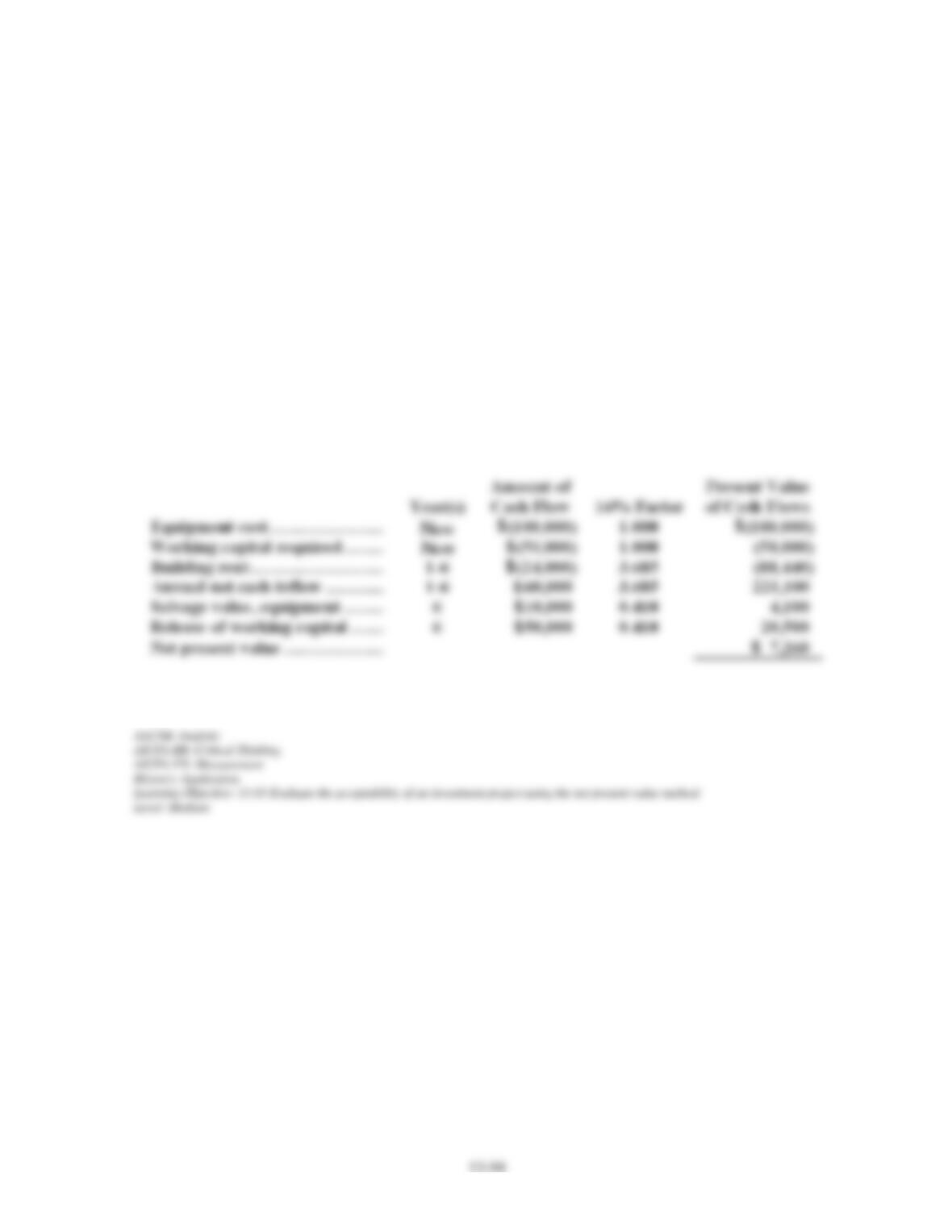
125. (Ignore income taxes in this problem.) Jim Bingham is considering starting a small
catering business. He would need to purchase a delivery van and various equipment costing
$125,000 to equip the business and another $60,000 for inventories and other working capital
needs. Rent for the building used by the business will be $35,000 per year. Jim’s marketing
studies indicate that the annual cash inflow from the business will amount to $120,000. In
addition to the building rent, annual cash outflow for operating costs will amount to $40,000.
Jim wants to operate the catering business for only six years. He estimates that the equipment
could be sold at that time for 4% of its original cost. Jim uses a 16% discount rate.
Required:
Would you advise Jim to make this investment?
Chapter 13 Capital Budgeting Decisions
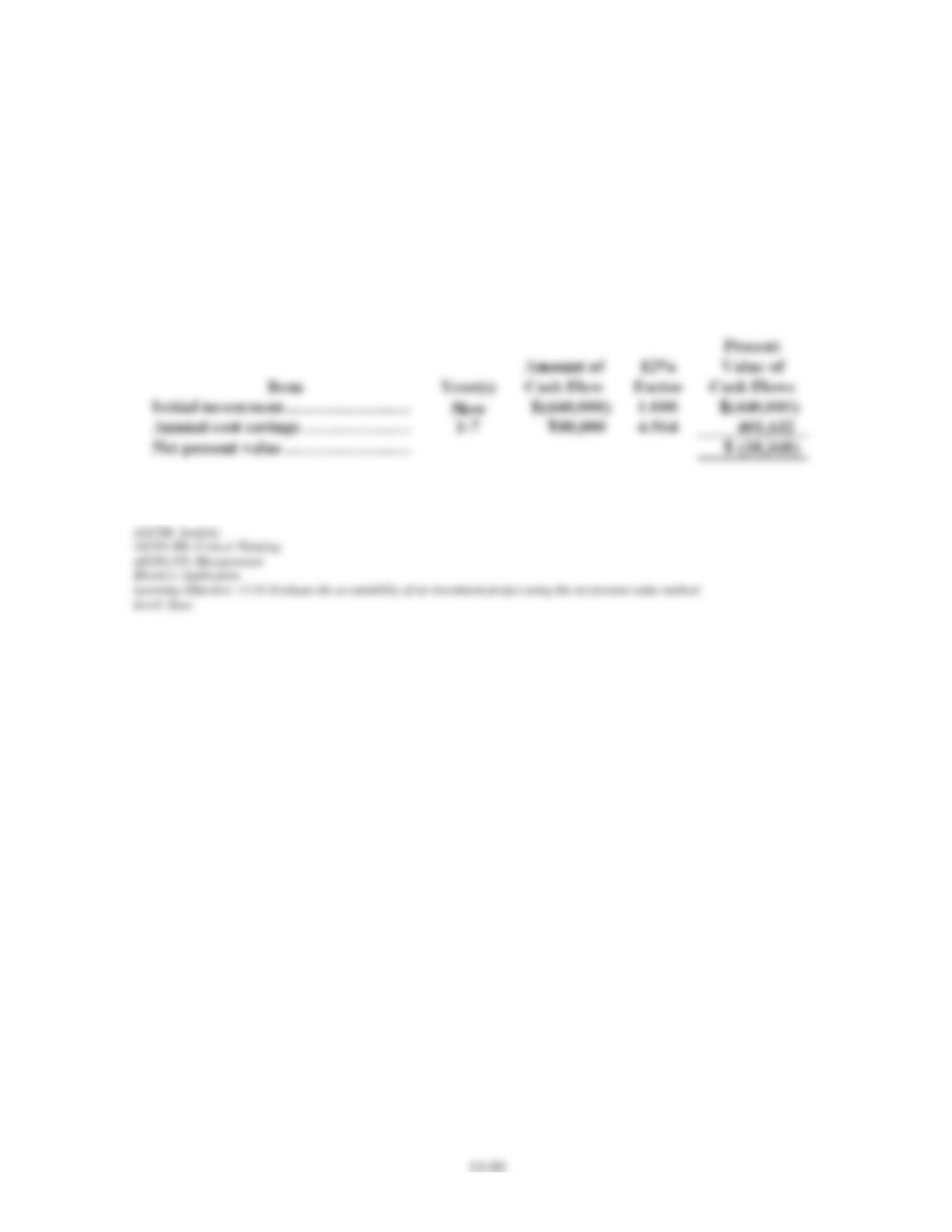
126. (Ignore income taxes in this problem.) Jane Summers has just inherited $600,000 from
her mother’s estate. She is considering investing part of these funds in a small catering
business. She would need to purchase a delivery van and various equipment costing $100,000
to equip the business and another $50,000 for inventories and other working capital needs.
Rent on the building used by the business will be $24,000 per year. Jane’s marketing studies
indicate that the annual cash inflow from the business will amount to $90,000. In addition to
the building rent, other annual cash outflows for operating costs will amount to $30,000. Jane
wants to operate the catering business for only six years. She estimates that the equipment
could be sold at that time for about 10% of its original cost. Jane’s required rate of return is
16%.
Required:
Compute the net present value of this investment.
Chapter 13 Capital Budgeting Decisions
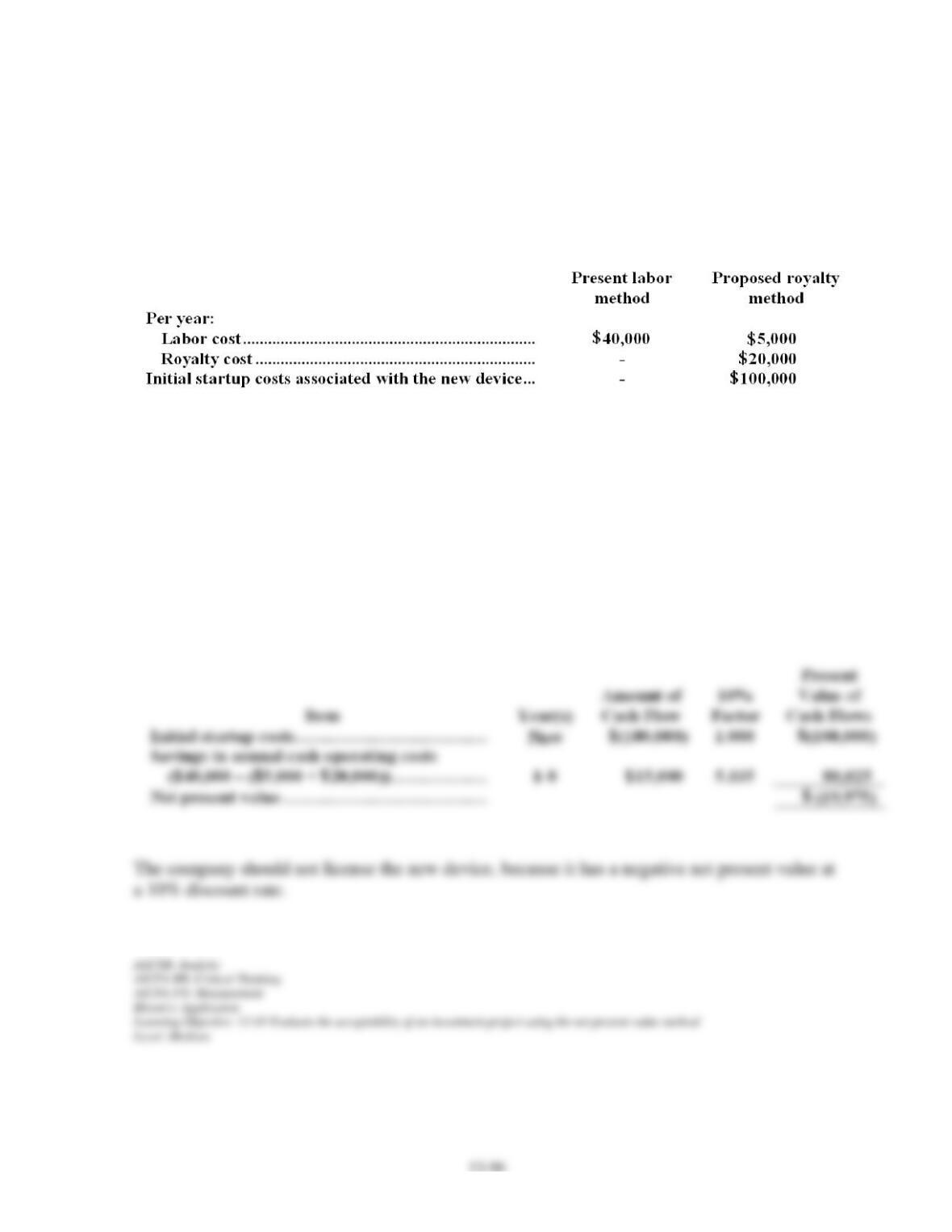
127. (Ignore income taxes in this problem.) The management of Basler Corporation is
considering the purchase of a machine that would cost $440,000, would last for 7 years, and
would have no salvage value. The machine would reduce labor and other costs by $88,000 per
year. The company requires a minimum pretax return of 12% on all investment projects.
Required:
Determine the net present value of the project. Show your work!
Chapter 13 Capital Budgeting Decisions
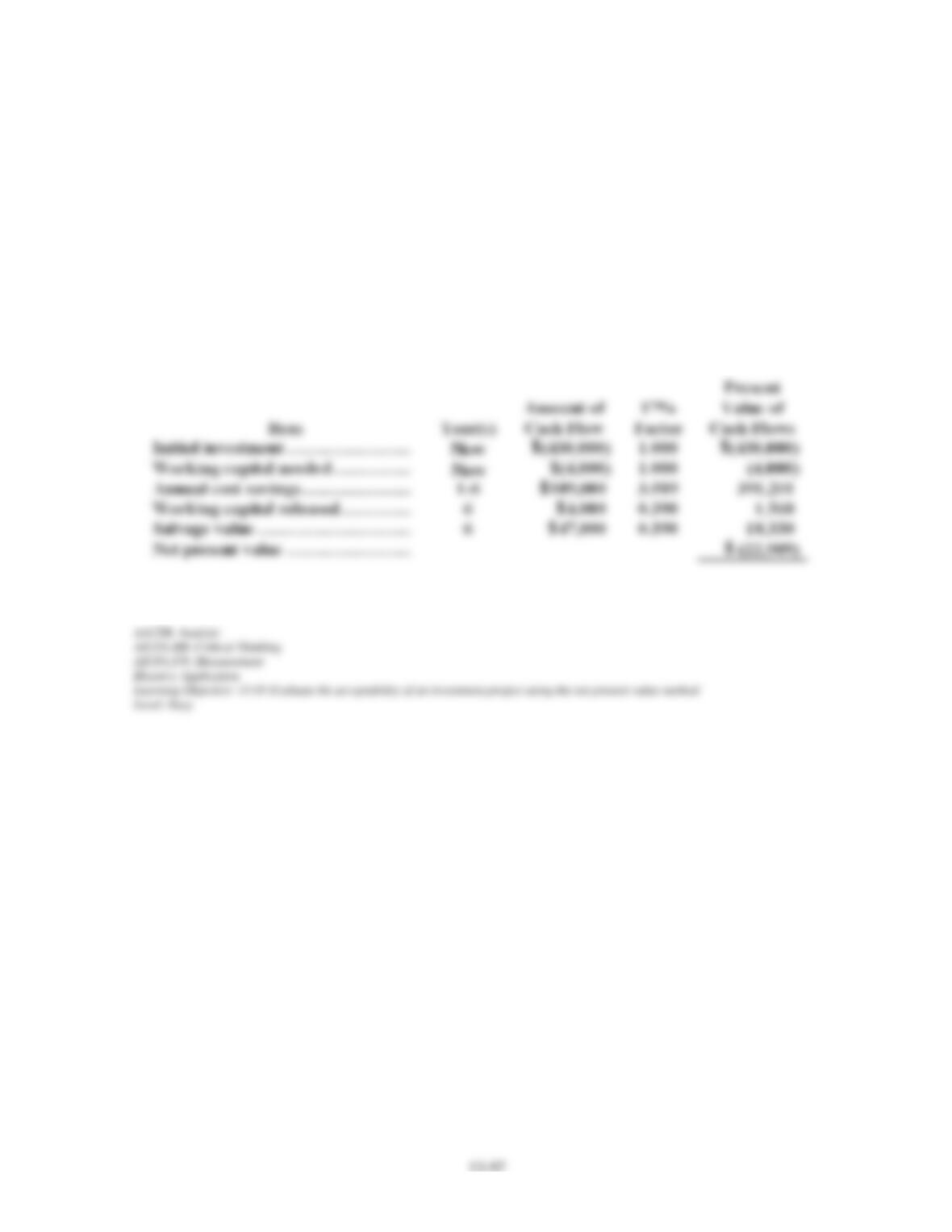
128. (Ignore income taxes in this problem.) A newly developed device is being considered by
Fairway Foods for use in processing and canning peaches. The device, which is available only
on a royalty basis, is reported to be a great labor saver. Fairway’s production manager has
gathered the following data:
The new device must be obtained through a licensing arrangement with the developer. The
license period lasts for only 8 years. Fairway Foods’ required rate of return is 10%.
Required:
By use of the incremental cost approach, compute the net present value of the proposed
licensing of the new device. Show all computations in good form. Should the company enter
into a licensing arrangement to use the new device?
Chapter 13 Capital Budgeting Decisions
129. (Ignore income taxes in this problem.) Janes, Inc., is considering the purchase of a
machine that would cost $430,000 and would last for 6 years, at the end of which, the
machine would have a salvage value of $47,000. The machine would reduce labor and other
costs by $109,000 per year. Additional working capital of $4,000 would be needed
immediately, all of which would be recovered at the end of 6 years. The company requires a
minimum pretax return of 17% on all investment projects.
Required:
Determine the net present value of the project. Show your work!
Chapter 13 Capital Budgeting Decisions
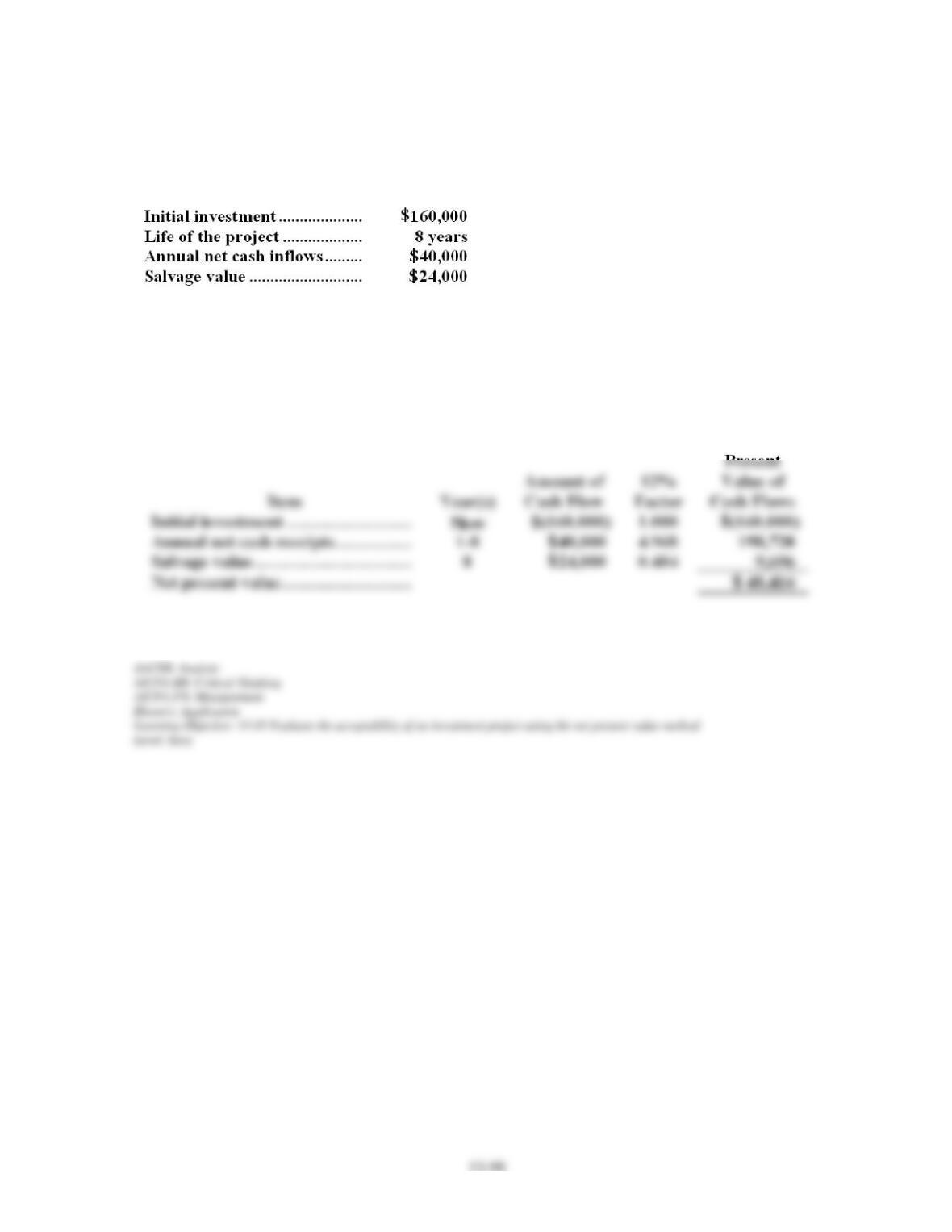
130. (Ignore income taxes in this problem.) Juliar Inc. has provided the following data
concerning a proposed investment project:
The company uses a discount rate of 12%.
Required:
Compute the net present value of the project.
Chapter 13 Capital Budgeting Decisions
13–99
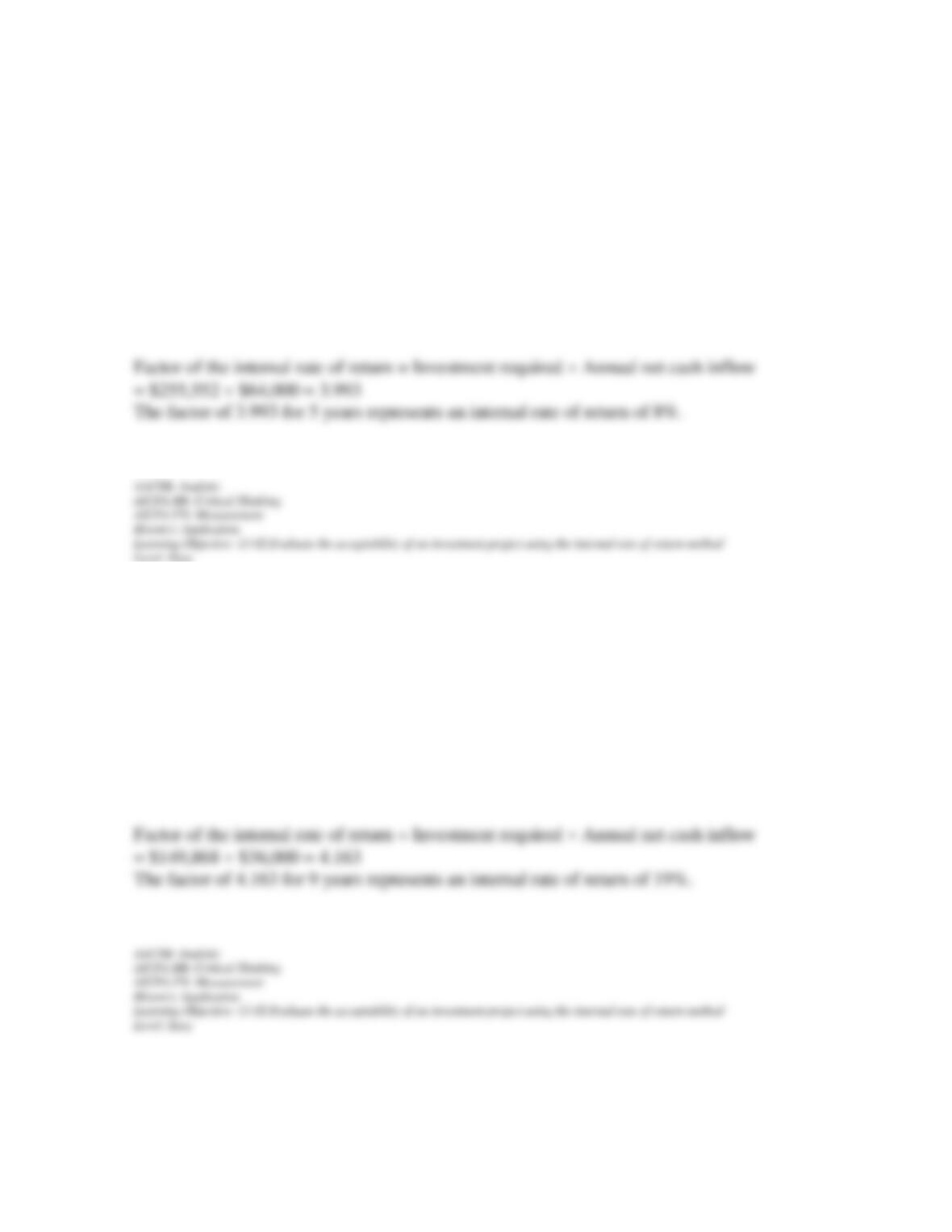
131. (Ignore income taxes in this problem.) The management of Peregoy Corporation is
considering the purchase of an automated molding machine that would cost $255,552, would
have a useful life of 5 years, and would have no salvage value. The automated molding
machine would result in cash savings of $64,000 per year due to lower labor and other costs.
Required:
Determine the internal rate of return on the investment in the new automated molding
machine. Show your work!
132. (Ignore income taxes in this problem.) Hayner Limos, Inc., is considering the purchase of
a limousine that would cost $149,868, would have a useful life of 9 years, and would have no
salvage value. The limousine would bring in cash inflows of $36,000 per year in excess of its
cash operating costs.
Required:
Determine the internal rate of return on the investment in the new limousine. Show your
work!
Chapter 13 Capital Budgeting Decisions
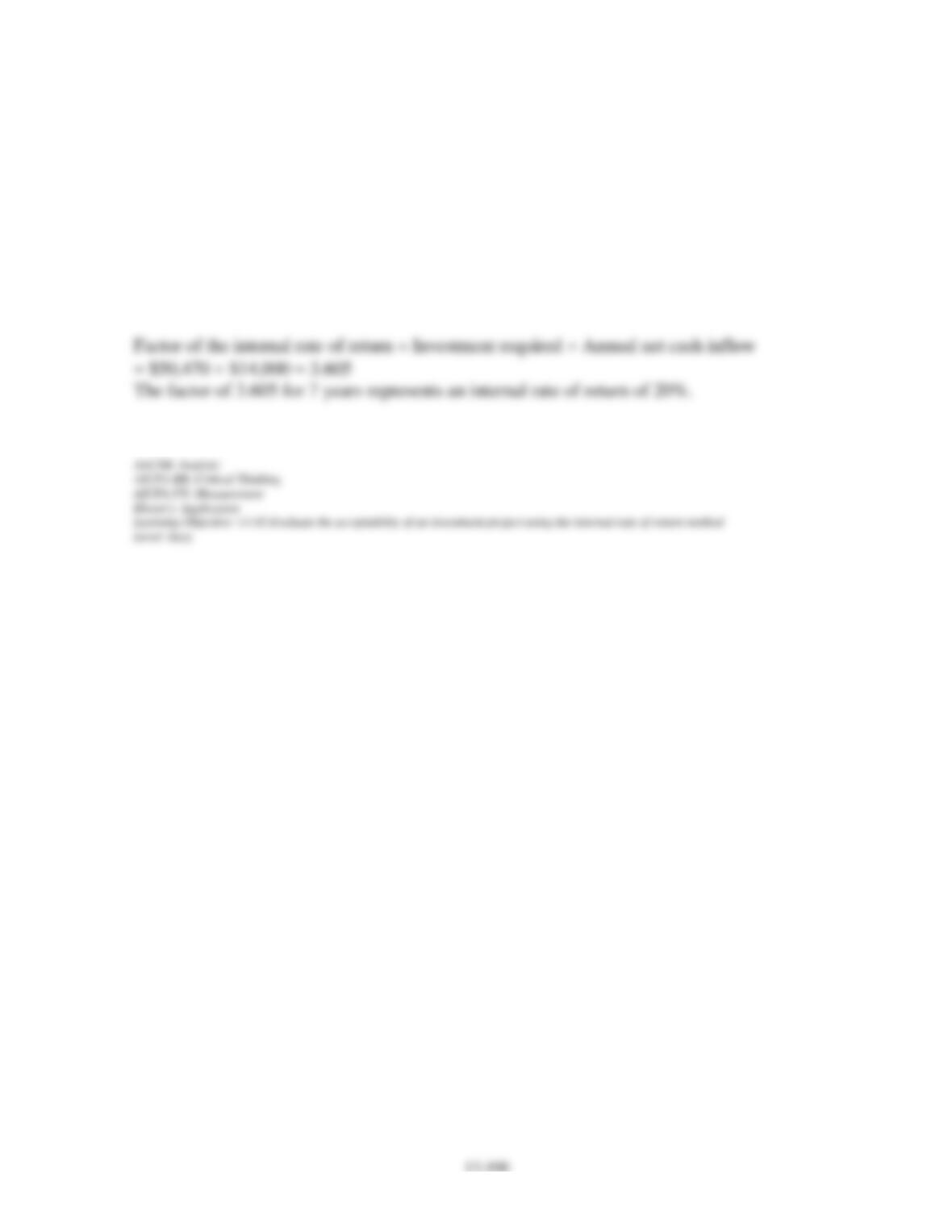
133. (Ignore income taxes in this problem.) The management of Eastridge Corporation is
considering the purchase of a machine that would cost $50,470 and would have a useful life
of 7 years. The machine would have no salvage value. The machine would reduce labor and
other operating costs by $14,000 per year.
Required:
Determine the internal rate of return on the investment in the new machine. Show your work!