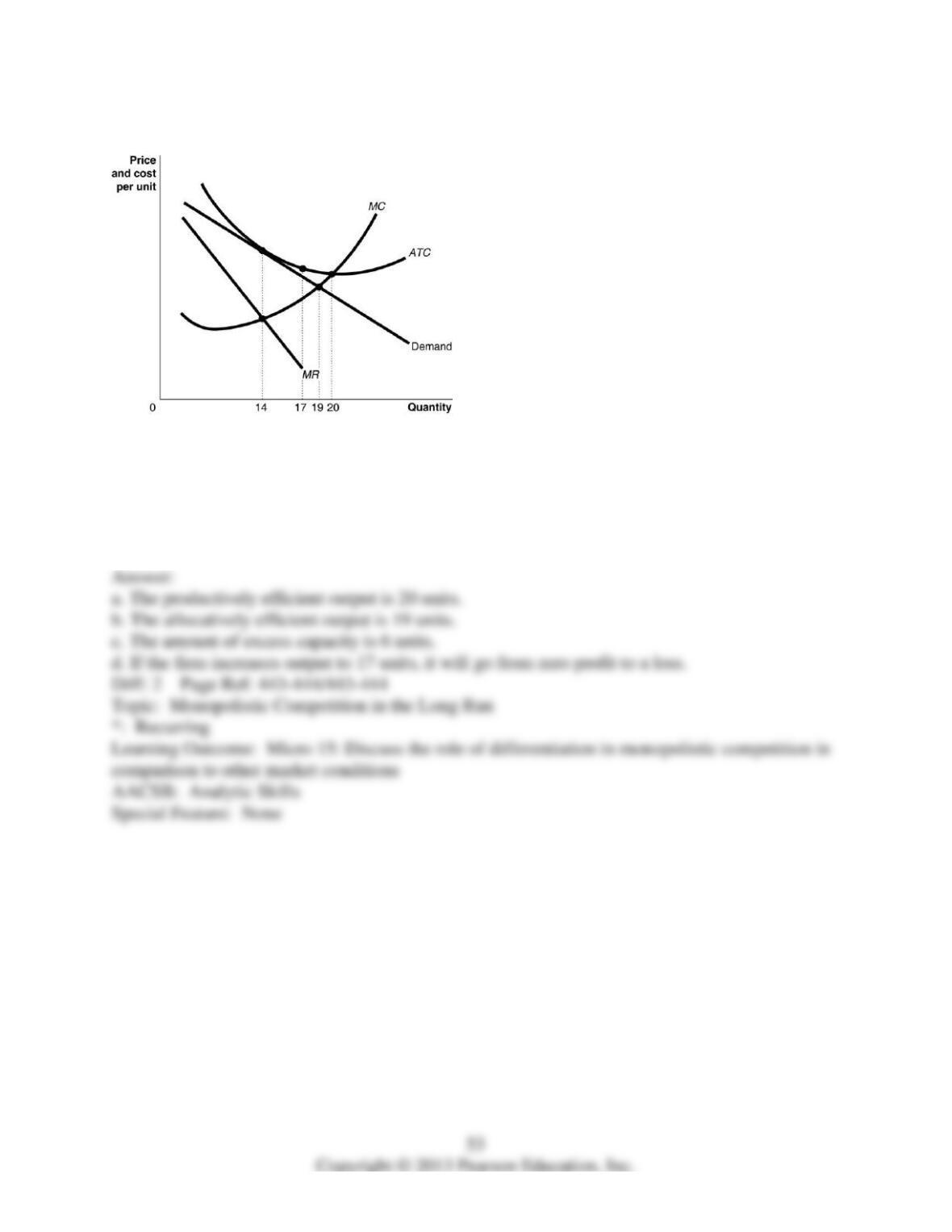
Figure 13-12
25) Refer to Figure 13-12 to answer the following questions.
a. What is the productively efficient output?
b. What is the allocatively efficient output?
c. What is the amount of excess capacity?
d. Suppose the firm is currently producing 14 units. What happens if it increases output to 17
units?
13.5 How Marketing Differentiates Products
1) A trademark is
A) a legal instrument which grants a firm the right to differentiate its product.
B) a legal right to position a firm’s product in high-traffic public areas such as airports and post
offices.
C) a patent on a firm’s product.
D) a distinguishing attribute such as a sign or logo that allows a firm to uniquely identify its
product.
2) Which of the following is a disadvantage of trademarking a firm’s product?
A) A trademark differentiates a firm’s product.
B) A trademark conveys information about the product to the public.
C) A trademark may become so widely used to denote a particular type of product that the
trademark may no longer be a legally protected brand name.
D) A trademark does not affect demand for the firm’s product.
3) Nike has used Michael Jordan to create the impression that Air Jordan basketball shoes are
superior to any other basketball shoes. Nike is attempting to
A) differentiate Air Jordan basketball shoes from other types of basketball shoes.
B) lower the marginal cost of producing Air Jordan basketball shoes.
C) increase its profit by raising the price of Air Jordan basketball shoes.
D) convince consumers that Air Jordan basketball shoes are no different from other basketball
shoes favored by celebrities.
4) When a credit card company offers different services with its card, like travel insurance for air
travel tickets purchased with the credit card or product insurance for items purchased with the
card, the credit card company is trying to
A) create a barrier to entry for competing firms.
B) create a perfectly competitive market in which to sell its credit card.
C) convince customers that its card has greater value than those offered by rival firms.
D) shift the demand curve for competing firms to the right.
5) Juicy Couture has been successful in selling women’s clothing using an unusual strategy.
According to an article in the Wall Street Journal, the key to the firm’s strategy is to “limit
distribution to maintain the brand’s exclusive cachet, even if that means sacrificing sales, a
brand-management technique once used only for high-end luxury brands.” In 2006, Juicy clothes
were sold in only four department stores: Neiman Marcus, Saks, Bloomingdale’s, and
Nordstrom. In 2006, its sales have more than quadrupled since 2002.
Source: Rachel Dodes, “From Track Suits to Fast Track,” Wall Street Journal, September 13,
2006.
How does limiting the number of stores in which Juicy’s products are sold contribute to its
success?
A) By sacrificing sales, the company was able to focus on producing high quality products.
B) It enables Juicy to price its products at a premium and differentiate them from lower priced
products.
C) It helps establish Juicy’s products as luxury items favored by the very wealthy.
D) Maintaining the exclusivity of a product increases the demand for the product.
6) Brand management refers to
A) picking a brand name for a new product that will attract attention.
B) the efforts to maintain the differentiation of a product over time.
C) efforts to reduce the cost of production.
D) selling the right to use a brand name in a particular market.
7) Which of the following statements is true about advertising by a monopolistically competitive
firm?
A) Since the monopolistic competitor, like the perfect competitor, makes zero profit in the long
run, it is a waste of resources to advertise its products.
B) Advertising could make the monopolistic competitor’s demand more inelastic, but advertising
has no effect on a perfect competitor’s demand.
C) Advertising will be more beneficial if a monopolistic competitor colludes with other firms to
advertise the products of the industry as a whole rather than an individual firm’s product.
D) Monopolistically competitive firms tend to shun advertising because advertising draws
attention to the variety of differentiated products available in the industry.
8) Although advertising raises the price of a monopolistic competitor’s product, it does confer a
benefit to consumers. Which of the following is a benefit to consumers?
A) Advertising acts as a barrier to entry.
B) Advertising engenders brand loyalty.
C) Advertising could provide consumers with useful information about new products and enable
them to comparison shop.
D) Advertised products tend to be of higher quality so consumers feel special when they
consume advertised products.
9) One of your classmates asserts that advertising, marketing research, and brand management
are redundant expenditures because a firm can obtain the same information by simply looking at
what customers are already buying. Which of the following is not a response you might offer
her?
A) Conducting market research is a good way for firms to keep abreast of changing consumer
tastes and preferences.
B) Advertising and brand management allow a firm to create an entry barrier which will insulate
the firm from competition and from undertaking further product innovations.
C) Marketing research could allow a firm to identify new market opportunities and at least, in the
short run, a firm can make a profit supplying products to this market segment.
D) If a firm successfully manages its brand, customers become less price sensitive as they
perceive fewer substitutes for the firm’s brand.
10) A successful trademark is one that becomes a generic name for a product, for example,
“Kleenex” has become a generic term for tissues.
11) In the highly competitive fast-food restaurant market, brand name restaurants have a strong
profit incentive to maintain high sanitary conditions and avoid any negative consequences.
12) What is the difference between the terms “marketing” and “advertising”?
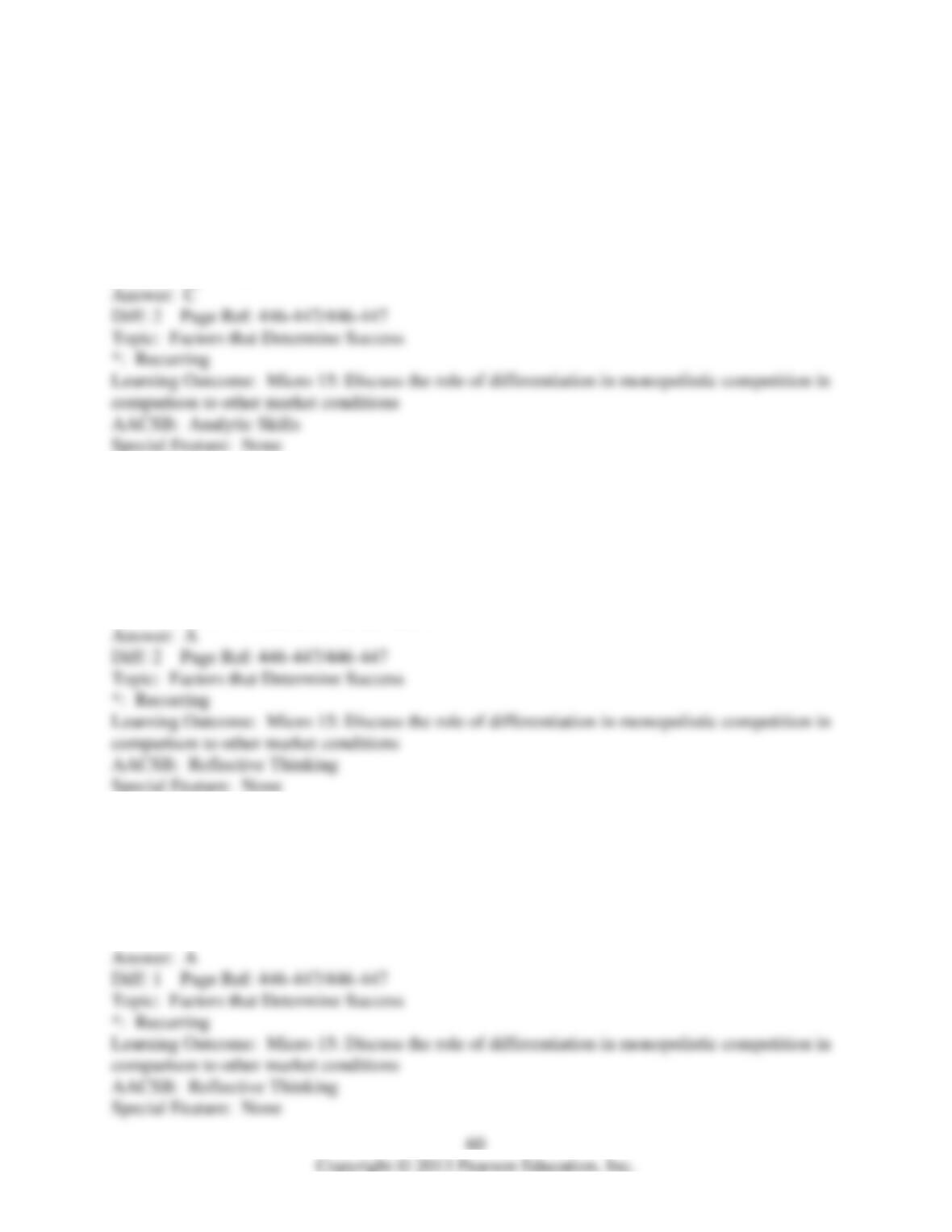
13) Draw a graph that shows the impact on a firm’s profit when it increases spending on
advertising and the increased advertising has no effect on the demand for a firm’s product.
13.6 What Makes a Firm Successful?
1) If buyers of a monopolistically competitive product feel the products of different sellers are
strongly differentiated, then the demand for each seller’s product is
A) perfectly inelastic.
B) perfectly elastic.
C) relatively inelastic.
D) relatively elastic.
2) Which of the following is an example of a factor that a firm’s owners and managers can
control in making the firm successful?
A) the ability to produce the product at a lower cost
B) changing consumer tastes
C) a rise in the price of a key input, for example, a rise in the price of oil leads to higher energy
costs
D) the number of competitors in the market
3) A firm that successfully differentiates its product or lowers its average cost of production
creates
A) value for its customers.
B) entry barriers into its market.
C) a perfectly inelastic demand curve for its product.
D) economies of scale.
4) A firm that is first to the market with a new product frequently discovers that there are design
flaws or problems with the product that were not anticipated. How do these problems affect the
innovating firm?
A) The firm is protected by a first-mover advantage: initial design flaws tend not to harm a firm
significantly because consumers resist changing products for fear of incurring high switching
costs.
B) They reduce profits for the new innovations and open the door to competitors who can enter
the new market with a better product.
C) Because these design flaws were not anticipated, consumers tend to be more forgiving and are
likely to remain loyal to the company and its products.
D) The firm’s cost increases as it improves the product but it will not be able to raise its price for
fear of alienating customers. Consequently, its profits will erode although its market share
remains secure.
5) Recent research has shown that the first firm to enter a market often does not have a long-term
advantage over later entrants into the market. An example that has been used to illustrate this is
A) McDonald’s entry into the high-end coffee market.
B) Xerox, which became a generic term for making photocopies.
C) Abercrombie and Fitch, which was the first clothing company to market to young men.
D) the introduction of the first ballpoint pen in 1945.
6) JoJo’s Cigar Bar is attempting to set itself apart from its competition by marketing to single
women. This is an example of
A) defending a brand name.
B) blocking entry into the market.
C) legally enforcing a trademark.
D) product differentiation.
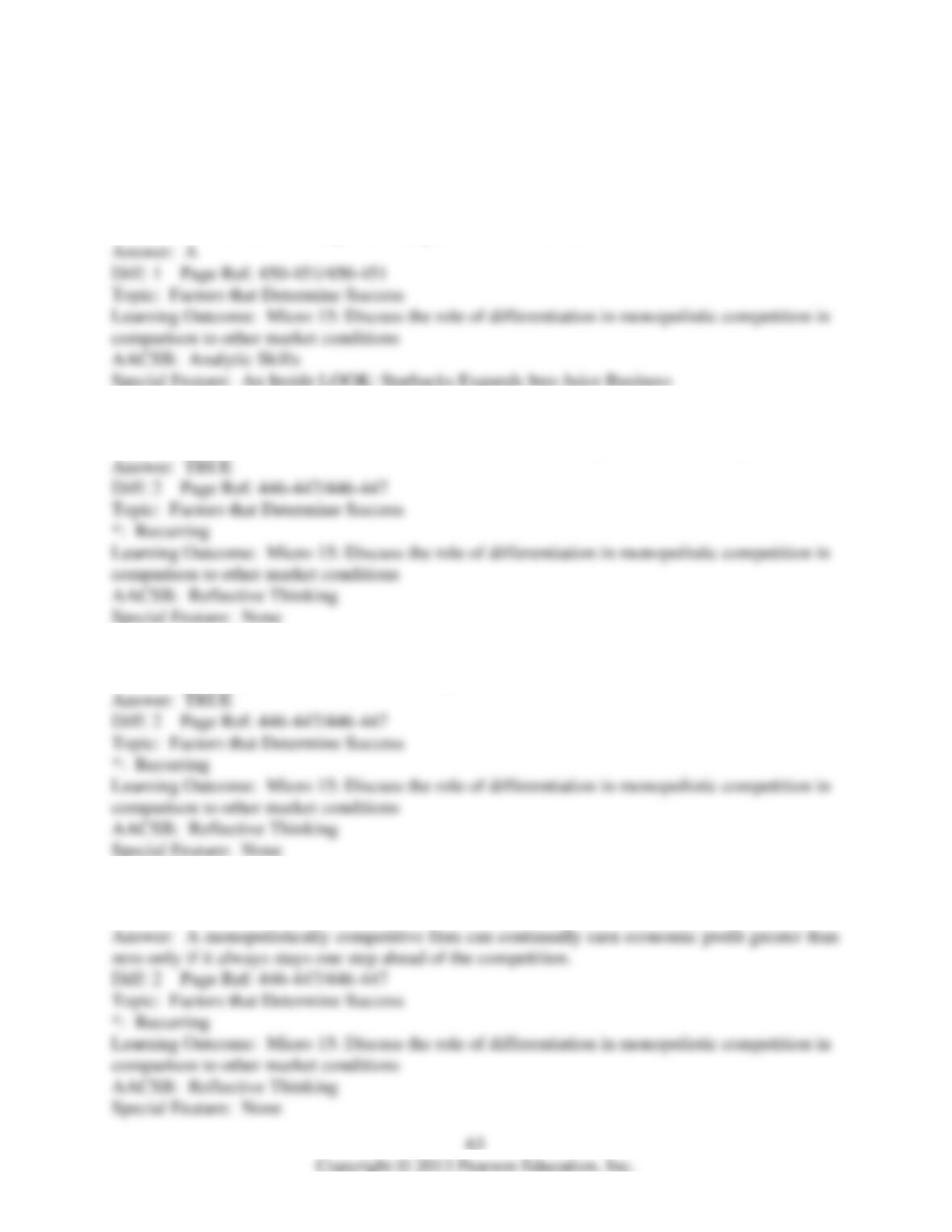
Figure 13-13
7) Refer to Figure 13-13. Assume Starbucks is successful with its new health and wellness
stores, and as a result it is able to earn economic profits. Which of the graphs in the figure above
reflects this?
A) Panel A
B) Panel B
C) Panel C
D) either Panel A or Panel B
8) If Starbucks is successful at luring away competitor’s customers with its new health and
wellness stores, what will be the effect on Starbucks’ demand and marginal revenue curves?
A) They will both shift to the right.
B) They will both shift to the left.
C) Demand will shift to the left and marginal revenue will shift to the right.
D) Demand will shift to the right and marginal revenue will shift to the left.
9) If buyers of a monopolistically competitive product feel the products of different sellers have
little differences between them, then the demand for each seller’s product is relatively elastic.
10) A monopolistically competitive firm can convince buyers that its product has value by
differentiating its product to suit consumers’ preferences.
11) How might a monopolistically competitive firm continually earn economic profit greater
than zero?
12) How would a marketing campaign directed at single women improve the chances of success
at a place like a cigar bar?