
67.
How many possible IRRs could you find for the following set of cash flows?
68.
How many possible IRRs could you find for the following set of cash flows?

69.
Suppose your firm is considering investing in a project with the cash flows shown as
follows, that the required rate of return on projects of this risk class is 8 percent, and that
the maximum allowable payback and discounted payback statistics for the project are
three and a half four and a half years, respectively. Use the payback decision to evaluate
this project; should it be accepted or rejected?

70.
Suppose your firm is considering investing in a project with the cash flows shown as
follows, that the required rate of return on projects of this risk class is 10 percent, and that
the maximum allowable payback and discounted payback statistics for the project are
three and a half and four and a half years, respectively. Use the discounted payback
decision to evaluate this project; should it be accepted or rejected?

71.
Suppose your firm is considering investing in a project with the cash flows shown as
follows, that the required rate of return on projects of this risk class is 8 percent, and that
the maximum allowable payback and discounted payback statistics for the project are 3.5
and 4.5 years, respectively. Use the IRR decision to evaluate this project; should it be
accepted or rejected?

72.
Suppose your firm is considering investing in a project with the cash flows shown as
follows, that the required rate of return on projects of this risk class is 8 percent, and that
the maximum allowable payback and discounted payback statistics for the project are
three and a half and four and a half years, respectively. Use the NPV decision to evaluate
this project; should it be accepted or rejected?

73.
Suppose your firm is considering investing in a project with the cash flows shown as
follows, that the required rate of return on projects of this risk class is 8 percent, and that
the maximum allowable payback and discounted payback statistics for the project are
three and a half and four and a half years, respectively. Use the MIRR decision to evaluate
this project; should it be accepted or rejected?

74.
Suppose your firm is considering investing in a project with the cash flows shown as
follows, that the required rate of return on projects of this risk class is 8 percent, and that
the maximum allowable payback and discounted payback statistics for the project are
three and a half and four and a half years, respectively. Use the PI decision to evaluate
this project; should it be accepted or rejected?

75.
Suppose your firm is considering investing in a project with the cash flows shown as
follows, that the required rate of return on projects of this risk class is 10 percent, and that
the maximum allowable payback and discounted payback statistics for the project are
three and three and a half years, respectively. Use the payback decision to evaluate this
project; should it be accepted or rejected?

76.
Suppose your firm is considering investing in a project with the cash flows shown as
follows, that the required rate of return on projects of this risk class is 10 percent, and that
the maximum allowable payback and discounted payback statistics for the project are
three and a half and four and a half years, respectively. Use the discounted payback
decision to evaluate this project; should it be accepted or rejected?

77.
Suppose your firm is considering investing in a project with the cash flows shown as
follows, that the required rate of return on projects of this risk class is 10 percent, and that
the maximum allowable payback and discounted payback statistics for the project are
three and a half and four and a half years, respectively. Use the IRR decision to evaluate
this project; should it be accepted or rejected?

78.
Suppose your firm is considering investing in a project with the cash flows shown as
follows, that the required rate of return on projects of this risk class is 10 percent, and that
the maximum allowable payback and discounted payback statistics for the project are
three and a half and four and a half years, respectively. Use the NPV decision to evaluate
this project; should it be accepted or rejected?

79.
Suppose your firm is considering investing in a project with the cash flows shown as
follows, that the required rate of return on projects of this risk class is 10 percent, and that
the maximum allowable payback and discounted payback statistics for the project are
three and a half and four and a half years, respectively. Use the MIRR decision to evaluate
this project; should it be accepted or rejected?
80.
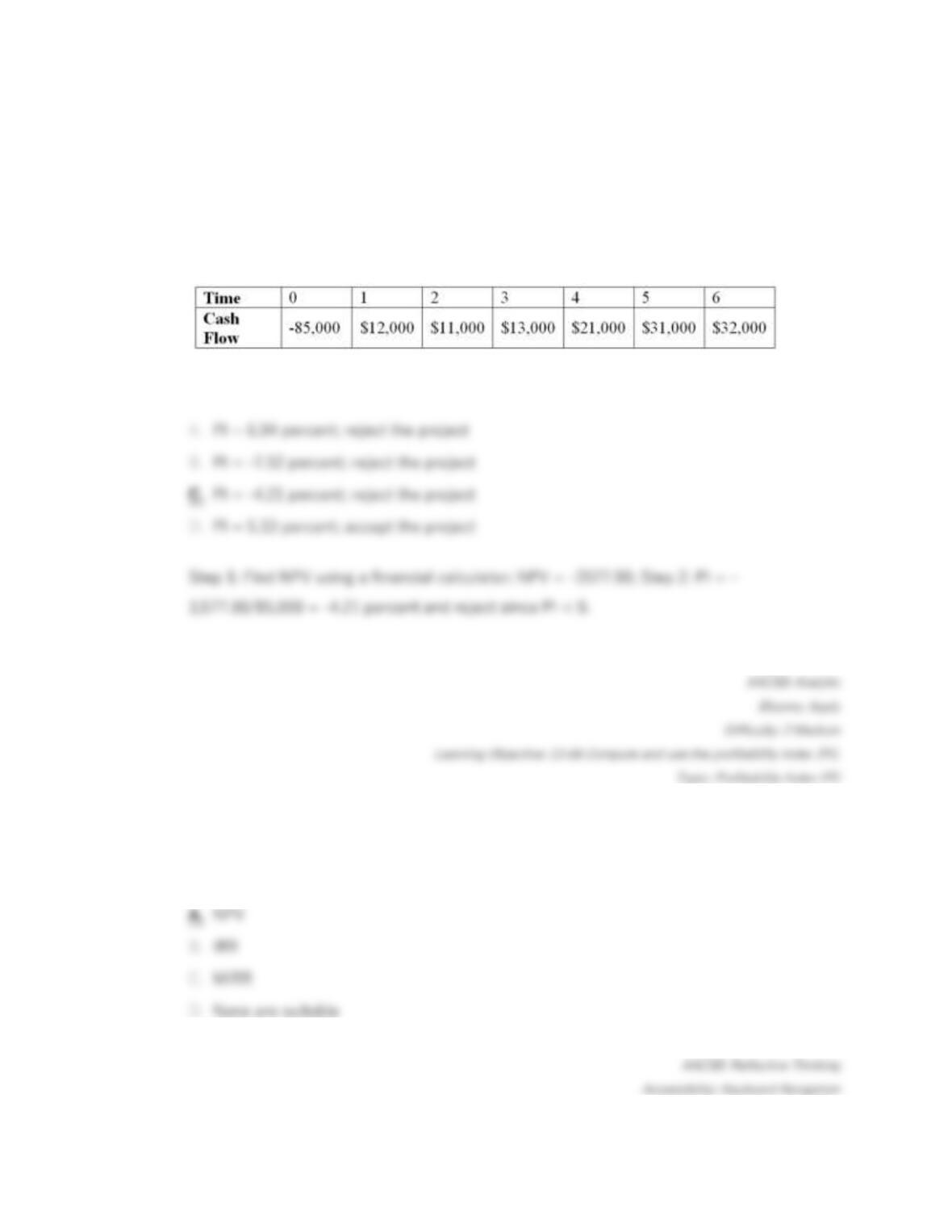
Suppose your firm is considering investing in a project with the cash flows shown as
follows, that the required rate of return on projects of this risk class is 10 percent, and that
the maximum allowable payback and discounted payback statistics for the project are
three and a half and four and a half years, respectively. Use the PI decision to evaluate
this project; should it be accepted or rejected?
81.
Which of the following tools is suitable for choosing between mutually exclusive projects?
82.
All of the following capital budgeting tools are suitable for firms facing time constraints
EXCEPT:
83.
All of the following capital budgeting tools are suitable for non-normal cash flows
EXCEPT:
84.
All of the following capital budgeting tools are suitable for non-normal cash flows
EXCEPT:
85.
All of the following capital budgeting tools are suitable for non-normal cash flows
EXCEPT:
86.
A decision rule and associated methodology for converting the NPV statistic into a rate–
based metric is referred to as:
87.
A capital budgeting method that converts a project’s cash flows using a more consistent
reinvestment rate prior to applying the IRR decision rule is referred to as:
88.
A capital budgeting technique that generates a decision rule and associated metric for
choosing projects based on the total discounted value of their cash flows is referred to as:
89.
Suppose you have a project whose discounted payback is equal to its termination date.
What can you say for sure about its PI?
90.
Under what conditions can a rate-based statistic yield a different accept/reject decision
than NPV?
91.
A project’s IRR:
92.
A project has normal cash flows. Its IRR is 15 percent and its cost of capital is 10 percent.
Which of the following statements is incorrect?
93.
All of the following are strengths of NPV EXCEPT:
94.
All of the following are strengths of payback EXCEPT:
95.
Which of the following statements is correct?