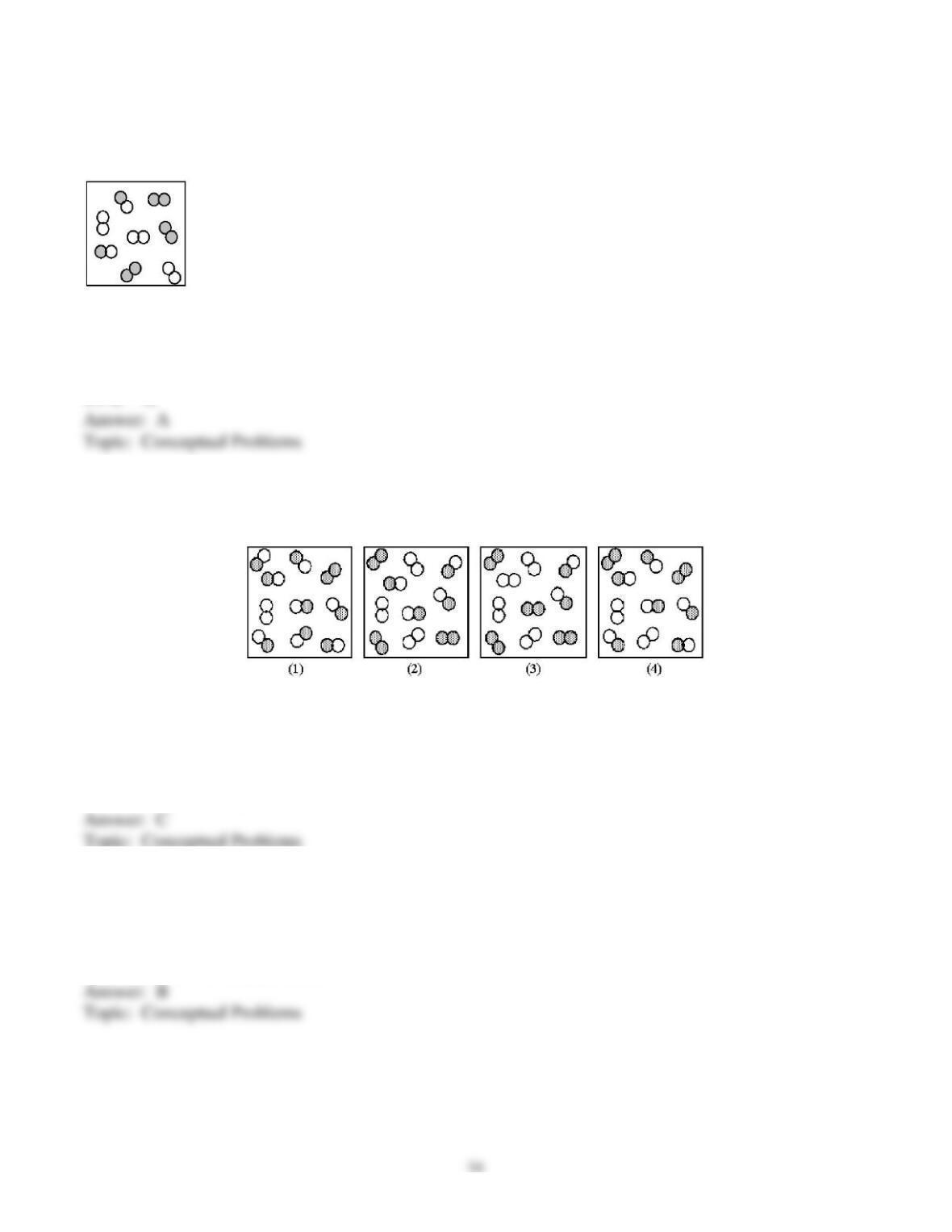
115) The following picture represents the equilibrium state for the reaction A2 + B2 ⇌ 2AB. What is the
relationship between the rate constant for the forward reaction, kf, and the rate constant for the reverse
reaction kr?
A) kf < kr
B) kf = kr = 0
C) kf = kr
D) kf > kr
The reaction A2 + B2 ⇌ 2AB has an equilibrium constant Kc = 1.8. The following pictures represent
reaction mixtures that contain A2 molecules (shaded) and B2 molecules (unshaded), and AB molecules.
116) Which nonequilibrium mixture will react in the forward direction to reach equilibrium?
A) reaction mixture (1)
B) reaction mixture (2)
C) reaction mixture (3)
D) reaction mixture (4)
117) Which nonequilibrium mixtures will react in the reverse direction to reach equilibrium?
A) reaction mixtures (1) and (2)
B) reaction mixtures (1) and (4)
C) reaction mixtures (2) and (3)
D) reaction mixtures (3) and (4)
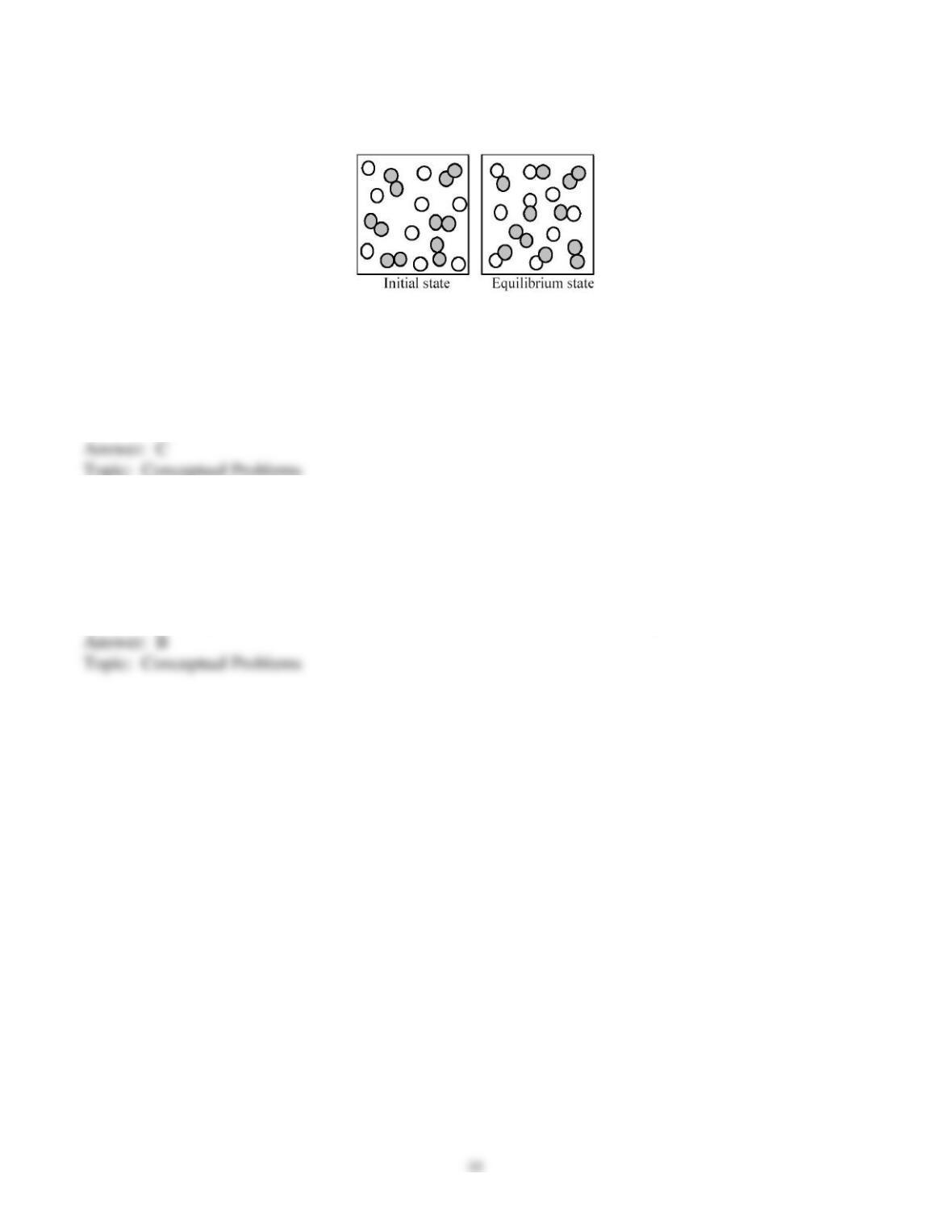
The following pictures represent the initial state and the equilibrium state for the gaseous state reaction
of A2 molecules (shaded spheres) with B atoms (unshaded spheres) to give AB molecules.
118) What is the best balanced chemical equation for the reaction?
A) A2 + B ⇌ A2B
B) A2 + 2 B ⇌ A2B2
C) A2 + 2 B ⇌ 2 AB
D) 6 A2 + 9 B ⇌ 3 A2 + 3B + 6 AB
119) If the volume of the equilibrium mixture is decreased, what will happen to the number of AB
molecules and the number of B atoms?
A) The number of AB molecules and the number of B atoms will both decrease.
B) The number of AB molecules will increase; the number of B atoms will decrease.
C) The number of AB molecules will decrease; the number of B atoms will increase.
D) The number of AB molecules and the number of B atoms will both increase.
36
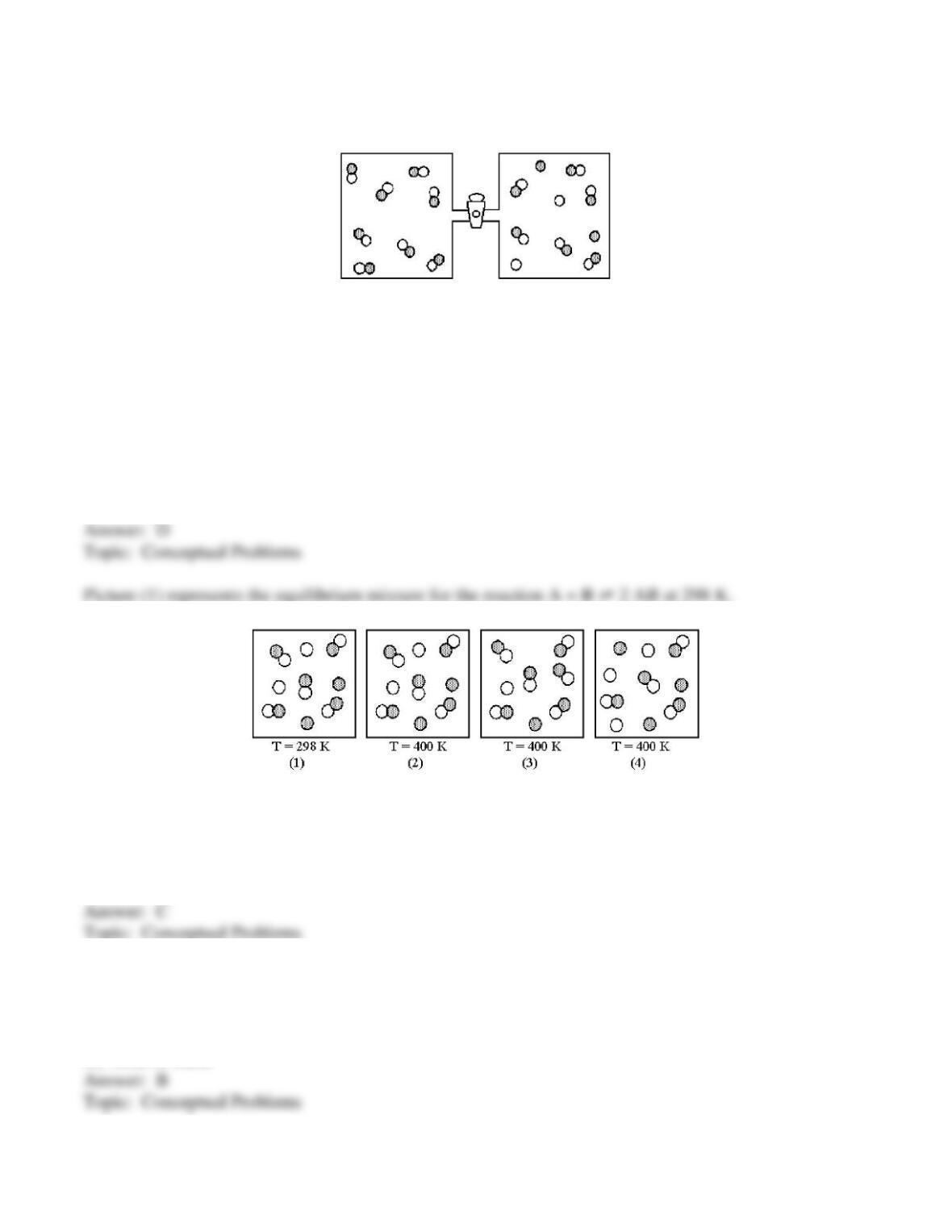
Consider the reaction A + B ⇌ 2 AB. The vessel on the right contains an equilibrium mixture of A
atoms (shaded spheres), B atoms (unshaded spheres), and AB molecules.
120) If the barrier between the two vessels is removed and the contents of the two vessels are allowed to
mix, what will be observed?
A) The reaction will go in the forward direction decreasing the number of A atoms and B atoms and
increasing the number of AB molecules.
B) The reaction will go in the forward direction increasing the number of A atoms and B atoms and
decreasing the number of AB molecules.
C) The reaction will go in the reverse direction decreasing the number of A atoms and B atoms and
increasing the number of AB molecules.
D) The reaction will go in the reverse direction increasing the number of A atoms and B atoms and
decreasing the number of AB molecules.
121) If this reaction is exothermic, which picture (2)-(4) represents the equilibrium mixture at 400 K?
A) picture (2)
B) picture (3)
C) picture (4)
D) None of these
122) If this reaction is endothermic, which picture (2)-(4) represents the equilibrium mixture at 400 K?
A) picture (2)
B) picture (3)
C) picture (4)
D) None of these
123) Picture (1) represents the equilibrium mixture for the gas-phase reaction A + B ⇌ 2 AB at 298 K. If
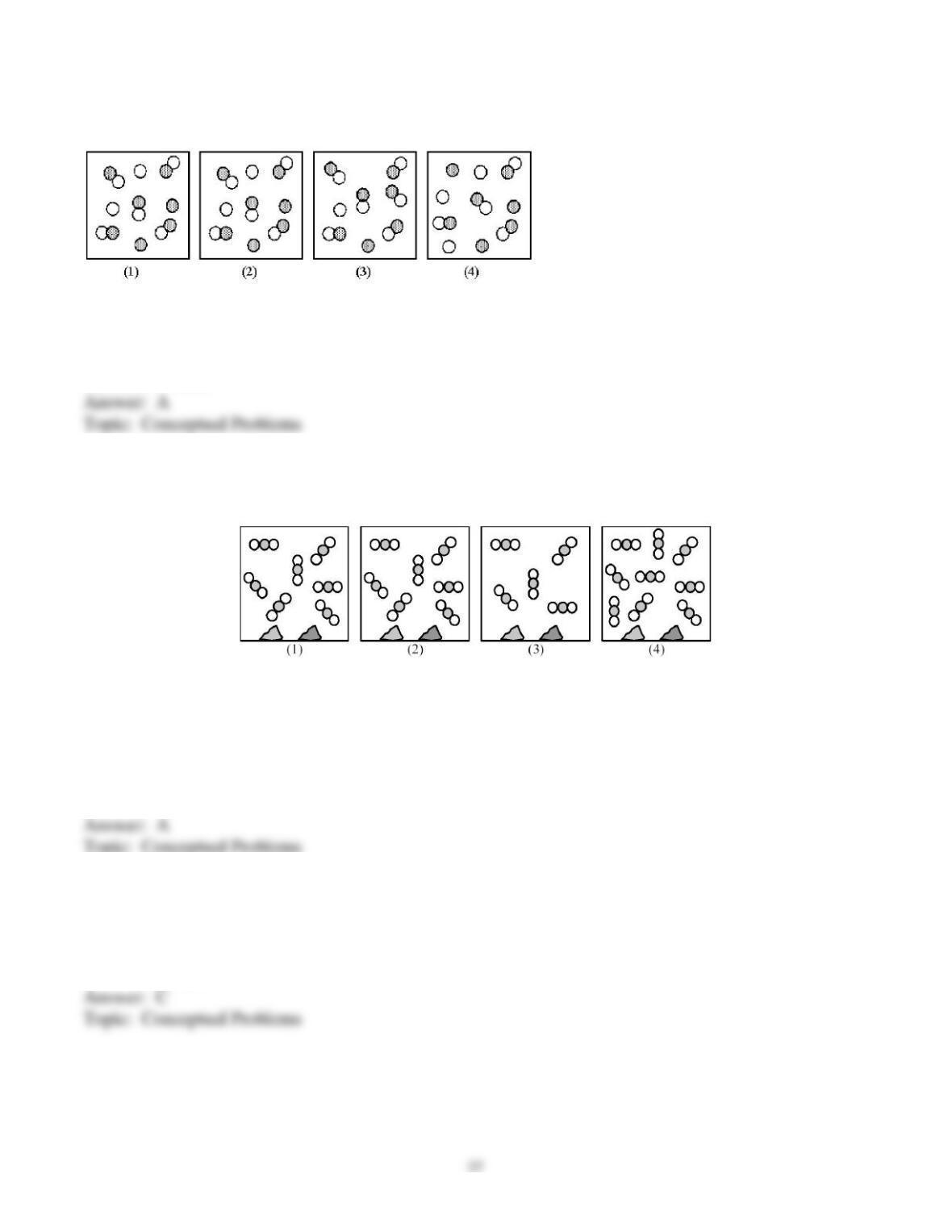
the volume of the equilibrium mixture is decreased, which picture (2)-(4) represents the equilibrium at
the reduced volume?
A) picture (2)
B) picture (3)
C) picture (4)
D) None of these
Picture (1) represents an equilibrium mixture of solid CaCO3, solid CaO, and gaseous CO2, obtained as
a result of the endothermic decomposition of CaCO3.
124) Which picture (2)-(4) represents the equilibrium mixture after addition of four more CO2
molecules?
A) picture (2)
B) picture (3)
C) picture (4)
D) None of these
125) Which picture (2)-(4) represents the equilibrium mixture at a higher temperature?
A) picture (2)
B) picture (3)
C) picture (4)
D) None of these
38
126) Which picture (2)-(4) represents the equilibrium mixture when a catalyst is added?
A) picture (2)
B) picture (3)
C) picture (4)
D) All of these
127) Which picture (2)-(4) represents the equilibrium mixture when more solid CaCO3 is added?
A) picture (2)
B) picture (3)
C) picture (4)
D) All of these
128) Which picture (2)-(4) represents the equilibrium mixture when more solid CaO is added?
A) picture (2)
B) picture (3)
C) picture (4)
D) All of these
13.2 Algorithmic Questions
1) For the reaction: N2(g) + 2 O2(g) ⇌ 2 NO2(g), Kc = 8.3 × 10⁻¹⁰ at 25°C. What is the concentration
of N2 gas at equilibrium when the concentration of NO2 is five times the concentration of O2 gas?
A) 3.3 × 10– 11 M
B) 1.7 × 10⁻¹⁰ M
C) 6.0 × 10⁹ M
D) 3.0 × 10¹⁰ M
2) The decomposition of ammonia is: 2 NH3(g) = N2(g) + 3 H2(g). If Kp is 1.5 × 10³ at 400°C, what is
the partial pressure of ammonia at equilibrium when N2 is 0. 10 atm and H2 is 0.15 atm?
A) 2.2 × 10– 7 atm
B) 4.7 × 10– 4 atm
C) 2.1 × 10³ atm
D) 4.4 × 10⁶ atm
3) The equilibrium constant is equal to 5.00 at 1300 K for the reaction:
2 SO2(g) + O2(g) ⇌ 2 SO3(g).
If initial concentrations are [SO2] = 6.00 M, [O2] = 0.45 M, and [SO3] = 9.00 M, the system is
A) at equilibrium.
B) not at equilibrium and will remain in an unequilibrated state.
C) not at equilibrium and will shift to the left to achieve an equilibrium state.
D) not at equilibrium and will shift to the right to achieve an equilibrium state.
4) The equilibrium constant, Kp, equals 3.40 at 25°C for the isomerization reaction:
cis-2-butene ⇌ trans-2-butene.
If a flask initially contains 5.00 atm of each gas, in what direction will the system shift to reach
equilibrium?
A) It will shift left.
B) It will shift right.
C) The system is already at equilibrium.
D) The system is not at equilibrium and will remain in an unequilibrated state.
5) Cyclohexane (C6H12) undergoes a molecular rearrangement in the presence of AlCl3 to form
methylcyclopentane (MCP) according to the equation:
C6H12 ⇌ MCP
If Kc = 0.143 at 25°C for this reaction, predict the direction in which the system will shift if the initial
concentrations of C6H12 and MCP are 0. 0400 M and 0. 0200 M, respectively. The system
A) will shift left.
B) will shift right.
C) is already at equilibrium.
D) is not at equilibrium and will remain in an unequilibrated state.
6) At a certain temperature, nitrogen and hydrogen react to form ammonia:
N2(g) + 3 H2(g) ⇌ 2 NH3(g).
When initial amounts of N2, H2, and NH3 are mixed, the concentration of NH3 increases. Which
statement below is true?
A) Kc < Q
B) Kc > Q
C) Kc = Q
D) More information is needed to make a statement about Kc.
40
7) An equilibrium mixture of CO, O2 and CO2 at a certain temperature contains 0.0010 M CO2 and 0.
0100 M O2. At this temperature, Kc equals 1.4 × 10² for the reaction:
2 CO(g) + O2(g) ⇌ 2 CO2(g).
What is the equilibrium concentration of CO?
A) 7.1 × 10– 7 M
B) 8.4 × 10– 4 M
C) 1.4 × 10⁻² M
D) 1.2 × 10⁻¹ M
8) At a certain temperature, Kc equals 1.4 × 10² for the reaction:
2 CO(g) + O2(g) ⇌ 2 CO2(g).
If a 3.00-L flask contains 0.400 mol of CO2 and 0.100 mol of O2 at equilibrium, how many moles of
CO are also present in the flask?
A) 0.555 mol
B) 0. 185 mol
C) 0.107 mol
D) 0.0114 mol
9) For the isomerization reaction:
butane ⇌ isobutane
Kp equals 25 at 500°C. If the initial pressures of butane and isobutane are 20. atm and 0.0 atm,
respectively, what are the pressures of the two gases at equilibrium?
A) P(butane) = 0.77 atm and P(isobutane) = 19.2 atm
B) P(butane) = 0.80 atm and P(isobutane) = 20. atm
C) P(butane) = 19.2 atm and P(isobutane) = 0.77 atm
D) P(butane) = 20 atm and P(isobutane) = 0.80 atm
10) Cyclohexane, C6H12, undergoes a molecular rearrangement in the presence of AlCl3 to form
methylcyclopentane, CH3C5H9, according to the equation:
C6H12 ⇌ CH3C5H9
If Kc = 0.143 at 25°C for this reaction, find the equilibrium concentrations of C6H12 and CH3C5H9 if
the initial concentrations are 0.200 M and 0. 075 M, respectively.
A) [C6H12] = 0. 041 M, [CH3C5H9] = 0. 041 M
B) [C6H12] = 0. 159 M, [CH3C5H9] = 0. 116 M
C) [C6H12] = 0. 241 M, [CH3C5H9] = 0. 034 M
D) [C6H12] = 0. 253 M, [CH3C5H9] = 0. 022 M
11) At a certain temperature the equilibrium constant, Kc, equals 0.11 for the reaction:
2 ICl(g) ⇌ I2(g) + Cl2(g).
What is the equilibrium concentration of ICl if 0. 75 mol of I2 and 0. 75 mol of Cl2 are initially mixed in
a 2.0-L flask?
A) 0. 22 M
B) 0. 28 M
C) 0. 45 M
D) 0. 56 M
12) The equilibrium constant, Kp, equals 3.40 for the isomerization reaction:
cis-2-butene ⇌ trans-2-butene.
If a flask initially contains 0.250 atm of cis-2-butene and 0. 145 atm of trans-2-butene, what is the
equilibrium pressure of each gas?
A) P(cis-2-butene) = 0.0 426 atm and P(trans-2-butene) = 0. 145 atm
B) P(cis-2-butene) = 0.0 471 atm and P(trans-2-butene) = 0. 160 atm
C) P(cis-2-butene) = 0.0 735 atm and P(trans-2-butene) = 0.250 atm
D) P(cis-2-butene) = 0. 0898 atm and P(trans-2-butene) = 0. 305 atm
13) Phosphorus pentachloride decomposes to phosphorus trichloride at high temperatures according to
the equation:
PCl5(g) ⇌ PCl3(g) + Cl2(g)
At 250° 0. 125 M PCl5 is added to the flask. If Kc = 1.80, what are the equilibrium concentrations of
each gas?
A) [PCl5] = 0.0 0765 M, [PCl3] = 0. 117 M, and [Cl2] = 0. 117 M
B) [PCl5] = 0. 0625 M, [PCl3] = 0. 335 M, and [Cl2] = 0. 335 M
C) [PCl5] = 1.80 M, [PCl3] = 1.80 M, and [Cl2] = 1.80 M
D) [PCl5] = 3.96 M, [PCl3] = 3.83 M, and [Cl2] = 3.83 M
14) Kc is 1.67 × 10²⁰ at 25°C for the formation of iron(III) oxalate complex ion:
Fe3+(aq) + 3 C2O42-(aq) ⇌ [Fe(C2O4)3]3-(aq).
If 0. 0200 M Fe3+ is initially mixed with 1.00 M oxalate ion, what is the concentration of Fe3+ ion at
equilibrium?
A) 1.44 × 10⁻²² M
B) 0.0100 M
C) 8.35 × 10¹⁹ M
D) 6.94 × 10²¹ M
13.3 Short Answer Questions
1) A reaction in which reactants form products in the forward reaction and products simultaneously form
reactants in the reverse reaction is said to be ________.
2) In a reversible reaction, when the rate of the forward reaction equals the rate of the reverse reaction,
the reaction is at ________.
3) For the reaction H2(g) + S(s) ⇌ H2S(g), if the rate constant for the forward reaction is greater than
the rate constant for the reverse reaction, the value of Kc must be ________ (equal to, greater than, less
than) 1.
4) For the reaction shown below, N2O4 and NO2 have equilibrium concentrations, [N2O4]eq = 2.160 ×
10-4 and [NO2]eq = 1.001 × 10⁻³, respectively. The equilibrium constant, Kc, for this reaction equals
________.
N2O4(g) ⇌ 2 NO2(g)
5) For the reaction CaCO3(s) ⇌ CaO(s) + O2(g) the equilibrium expression is Kp = ________.
6) For the reaction shown below the value of Kp is ________ than the value of Kc, because Δn =
________.
N2O4(g) ⇌ 2 NO2(g)
7) At 298 K, Kp = 2.1 × 10⁴ for the reaction CO(g) + 2 H2(g) ⇌ CH3OH(g). What is the value of Kc at
this temperature?
8) At 298 K, Kc = 1.7 × 10-56 for the reaction 3 O2(g) ⇌ 2 O3(g). What is the value of Kp at this
temperature?
43
9) At 1000 K, Kp = 19.9 for the reaction Fe2O3(s) + 3 CO(g) ⇌ 2 Fe(s) + 3 CO2(g). What is the value
of Kp for the reaction 2 Fe(s) + 3 CO2(g) ⇌ Fe2O3(s) + 3 CO(g)?
10) At 1000 K, Kp = 19.9 for the reaction Fe2O3(s) + 3 CO(g) ⇌ 2 Fe(s) + 3 CO2(g). What is the value
of Kp for the reaction 6 Fe(s) + 9 CO2(g) ⇌ 3 Fe2O3(s) + 9 CO(g)?
11) For the reaction shown below the equilibrium constant expression for Kc = ________.
HF(aq) + H2O(l) ⇌ H3O+(aq) + F–(aq)
12) Kc = 57.0 at 700 K for the reaction shown below.
H2(g) + I2(g) ⇌ 2 HI(g)
If [H2(g)] = [I2(g)] = 0.200 M at equilibrium, the molar concentration [HI((g)] = ________ at
equilibrium.
13) Kc = 1.2 × 10-42 at 500 K for the reaction shown below.
H2(g) ⇌ 2 H(g)
If [H2] = 1 × 10⁻² M and [H] = 1.2 × 10⁻²² M, in order to achieve equilibrium a net reaction must occur
from ________ to ________ until Qc = ________.
14) At an elevated temperature, Kp = 0.19 for the reaction 2 NOCl(g) ⇌ 2 NO(g) + Cl2(g). If the initial
partial pressures of NOCl, NO, and Cl2 are 0.50 atm, 0.25 atm, and 0.45 atm, respectively, a net
________ (forward, reverse) reaction must occur in order to achieve equilibrium.
15) At an elevated temperature, Kp = 4.2 × 10⁻⁹ for the reaction 2 HBr(g) ⇌ H2(g) + Br2(g). If the
initial partial pressures of HBr, H2, and Br2 are 1.0 × 10⁻² atm, 2.0 × 10⁻⁴ atm, and 2.0 × 10⁻⁴ atm,
respectively, what is the equilibrium partial pressure of H2?
44
16) For the reaction 2 A + B2 ⇌ 2 AB, the rate of the forward reaction is 0.75 M/s and the rate of the
reverse reaction is 0.25 M/s. The reaction is not at equilibrium. In order to attain equilibrium the reaction
must proceed in the ________ (forward, reverse) direction in order to achieve equilibrium.
17) For the reaction A2 + 2 B3 ⇌ 2 AB3, the rate of the forward reaction is 0.25 M/s and the rate of the
reverse reaction is 0.75 M/s. The reaction is not at equilibrium. In order to attain equilibrium the reaction
must proceed in the ________ (forward, reverse) direction in order to achieve equilibrium.
18) If additional SCN– is added to the equilibrium system shown below, Le Châtelier’s principle
predicts a net reaction from ________ to ________, causing the red color to become ________.
Fe3+(aq) + SCN–(aq) ⇌ FeSCN2+(aq)
yellow colorless red
19) The reaction CaCO3(s) ⇌ CaO(s) + O2(g) is endothermic 298 K. The effect of adding additional
CaO to the system at equilibrium will ________ (decrease, increase, have no effect on) the total quantity
of CaCO3 once equilibrium is reestablished.
20) According to Le Châtelier’s principle, if the volume of the vessel containing the equilibrium system
shown below is decreased, there will be an increase in the concentration of ________ and a decrease in
the concentration of ________.
H2(g) ⇌ 2 H(g)
21) The reaction CaCO3(s) ⇌ CaO(s) + O2(g) is endothermic 298 K. The effect of increasing the partial
pressure of O2 in the system at equilibrium will ________ (decrease, increase, have no effect on) the
total quantity of CaCO3 once equilibrium is reestablished.
22) The reaction CaCO3(s) ⇌ CaO(s) + O2(g) is endothermic 298 K. The effect of increasing the total
volume of the system at equilibrium will ________ (decrease, increase, have no effect on) the total
quantity of CaCO3 once equilibrium is reestablished.
45
23) The reaction below is heated from 20°C to 90°C, according to Le Châtelier’s principle, there will be
a net reaction from ________ to ________, and the brown color will become ________.
N2O4(g) ⇌ 2 NO2(g) ΔH°= + 57.2 kJ
colorless brown
24) The reaction CaCO3(s) ⇌ CaO(s) + O2(g) is endothermic 298 K. The effect of increasing the
temperature of the system at equilibrium will ________ (decrease, increase, have no effect on) the total
quantity of CaCO3 once equilibrium is reestablished.
25) The reaction CaCO3(s) ⇌ CaO(s) + O2(g) is endothermic 298 K. The effect of adding a catalyst to
the system at equilibrium will ________ (decrease, increase, have no effect on) the total quantity of
CaCO3 once equilibrium is reestablished.