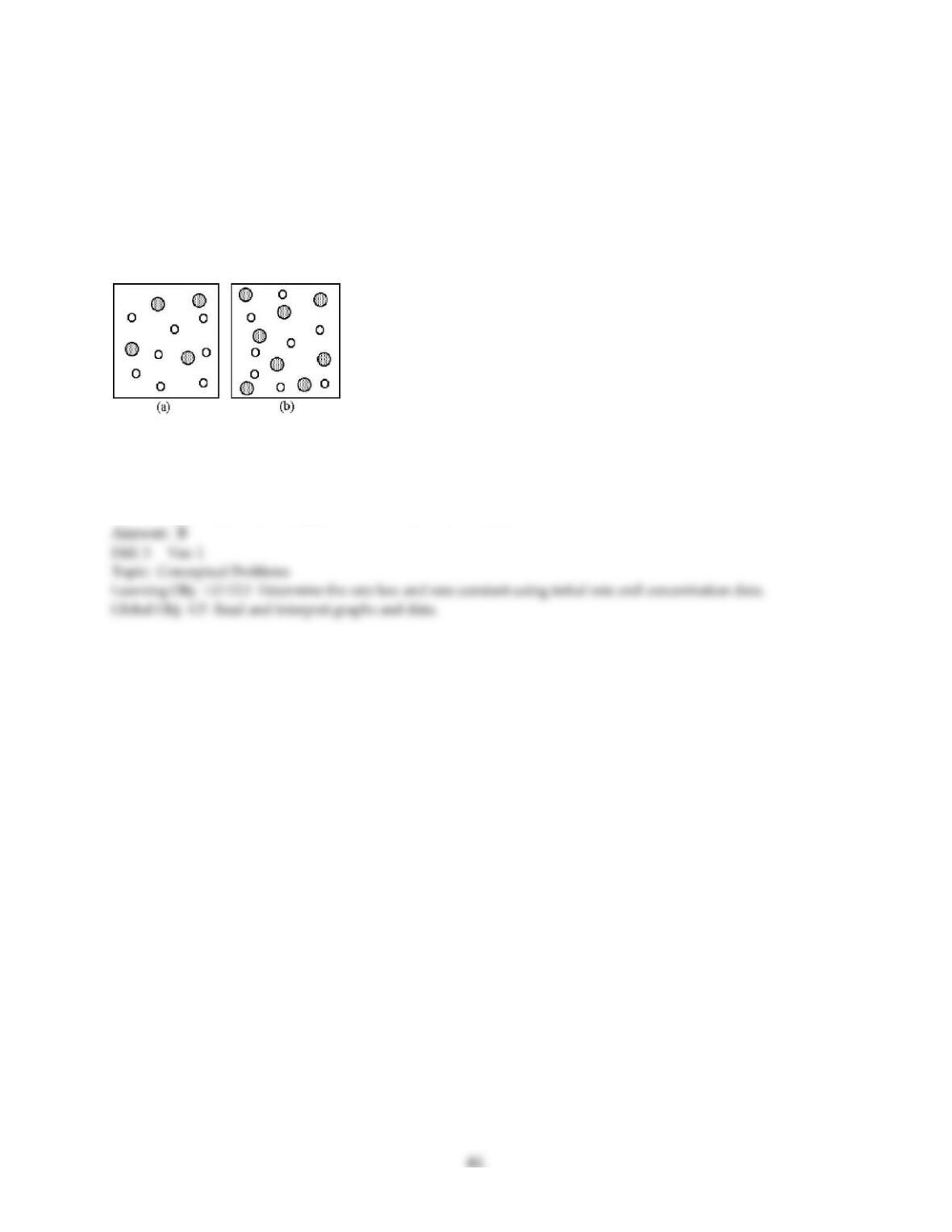
93) The following reaction is second order in A and first order in B:
A + B → Products Rate = k[A]2[B]
What is the rate constant k of this reaction in vessel (b) relative to the rate constant k of this reaction in
vessel (a)? Each vessel has the same volume. Shaded spheres represent A molecules, and unshaded
spheres represent B molecules.
A) rate constant k in vessel (b)/rate constant k in vessel (a) = 1:2
B) rate constant k in vessel (b)/rate constant k in vessel (a) = 1:1
C) rate constant k in vessel (b)/rate constant k in vessel (a) = 2:1
D) rate constant k in vessel (b)/rate constant k in vessel (a) = 4:1
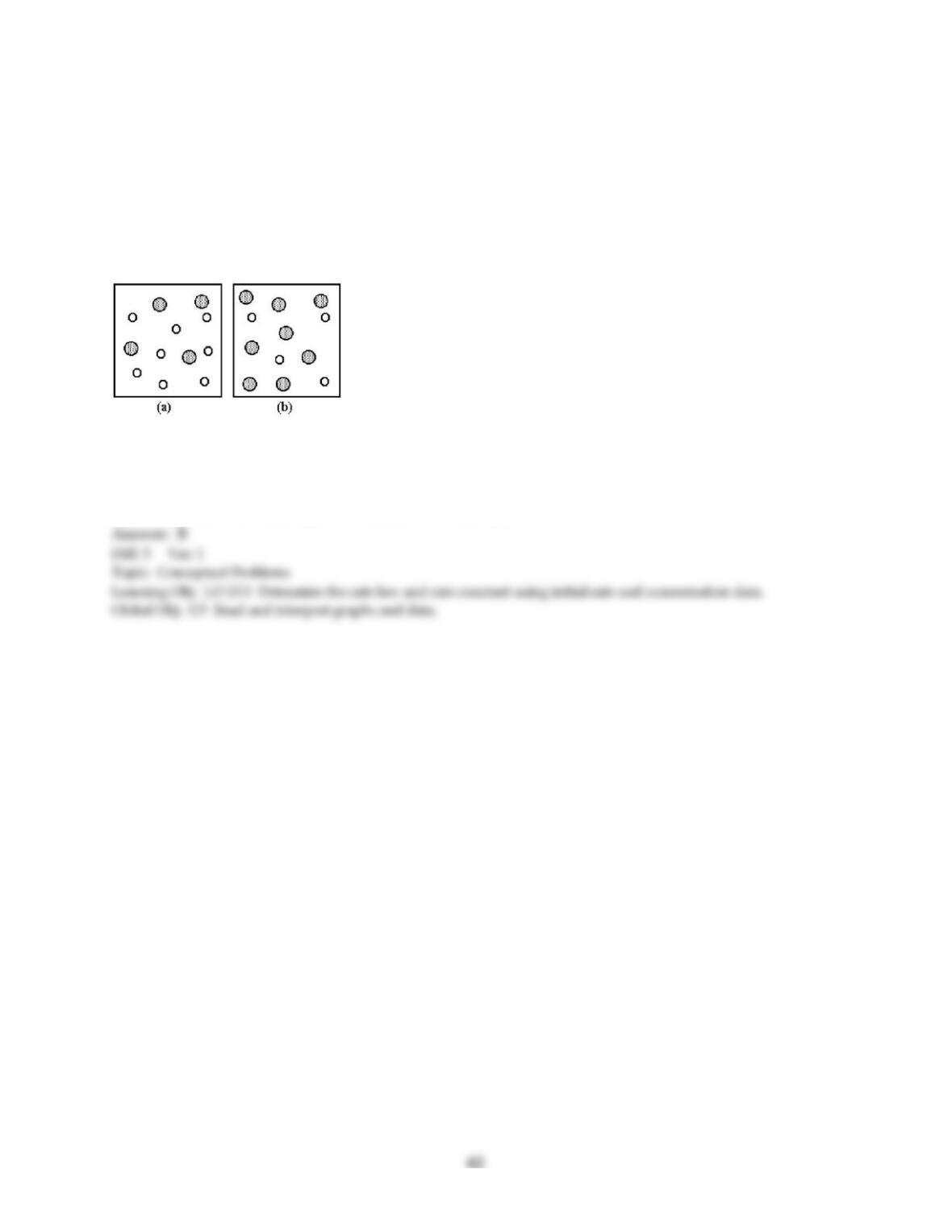
94) The following reaction is second order in A and first order in B:
A + B → Products Rate = k[A]2[B]
What is the rate constant k of this reaction in vessel (b) relative to the rate constant k of this reaction in
vessel (a)? Each vessel has the same volume. Shaded spheres represent A molecules, and unshaded
spheres represent B molecules.
A) rate constant k in vessel (b)/rate constant k in vessel (a) = 1:2
B) rate constant k in vessel (b)/rate constant k in vessel (a) = 1:1
C) rate constant k in vessel (b)/rate constant k in vessel (a) = 2:1
D) rate constant k in vessel (b)/rate constant k in vessel (a) = 4:1
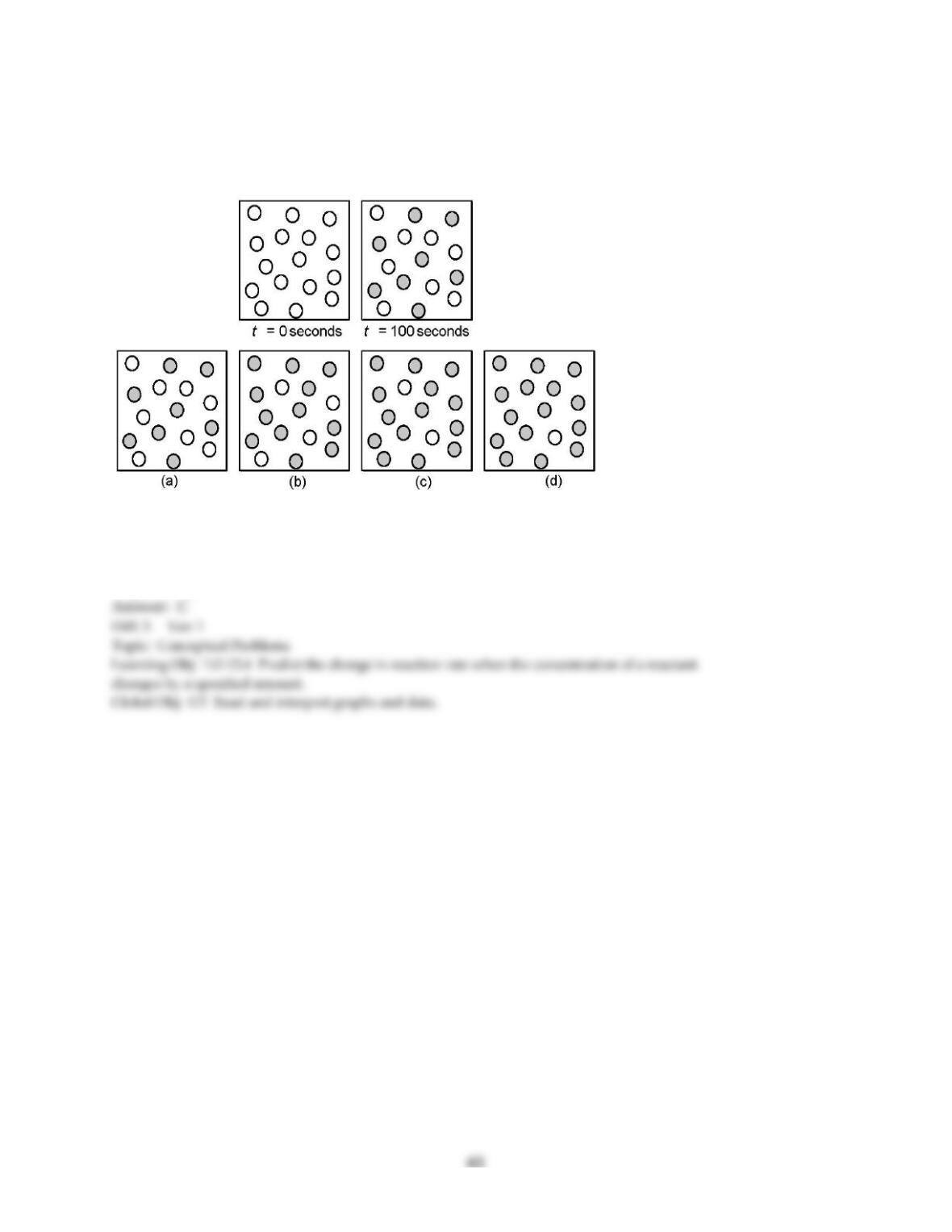
95) Consider the first-order reaction A → B in which A molecules (unshaded spheres) are converted to B
molecules (shaded spheres). Given the following pictures at t = 0 seconds and t = 100 seconds, which
picture represents the number of A and B molecules remaining at 300 seconds?
A) picture a)
B) picture b)
C) picture c)
D) picture d)
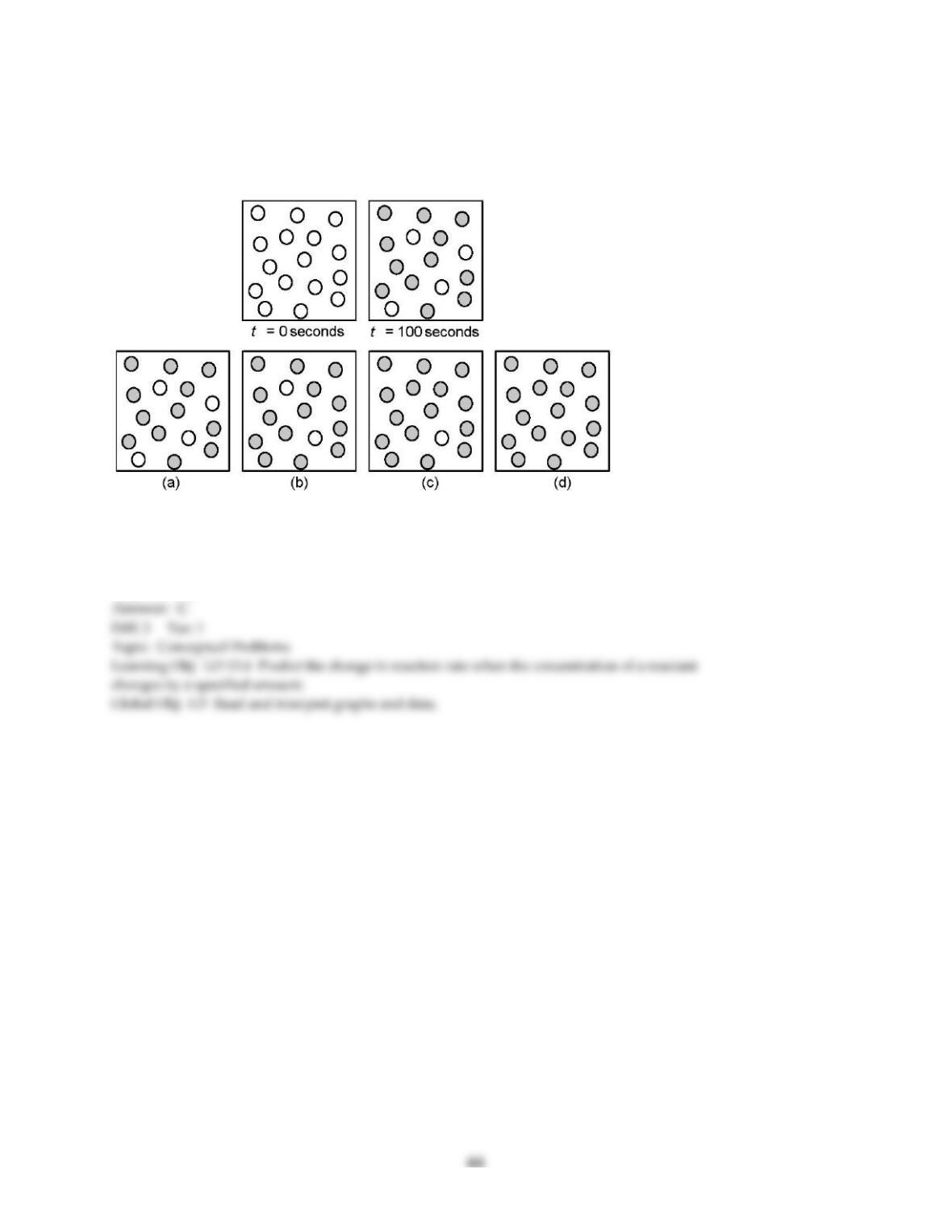
96) Consider the first-order reaction A → B in which A molecules (unshaded spheres) are converted to B
molecules (shaded spheres). Given the following pictures at t = 0 seconds and t = 100 seconds, which
picture represents the number of A and B molecules remaining at 200 seconds?
A) picture a)
B) picture b)
C) picture c)
D) picture d)
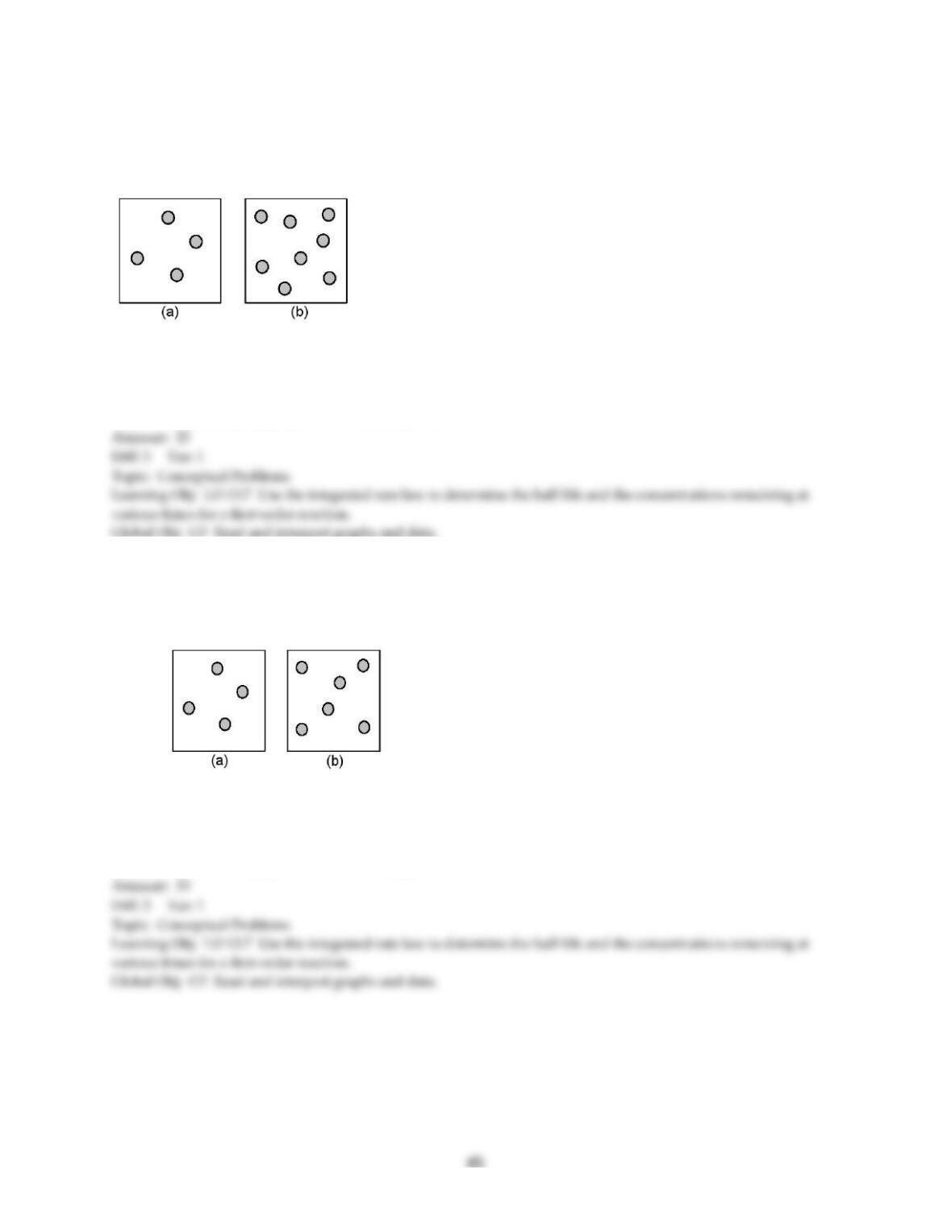
97) Consider the first-order decomposition of A molecules (shaded spheres) in two vessels of equal
volume. What is the half-life of decomposition in vessel (b) relative to the half-life of decomposition in
vessel (a)?
A) half-life in vessel (b)/half-life in vessel (a) = 4:1
B) half-life in vessel (b)/half-life in vessel (a) = 2:1
C) half-life in vessel (b)/half-life in vessel (a) = 3:2
D) half-life in vessel (b)/half-life in vessel (a) = 1:1
98) Consider the first-order decomposition of A molecules (shaded spheres) in two vessels of equal
volume. What is the half-life of decomposition in vessel (b) relative to the half-life of decomposition in
vessel (a)?
A) half-life in vessel (b)/half-life in vessel (a) = 4:1
B) half-life in vessel (b)/half-life in vessel (a) = 2:1
C) half-life in vessel (b)/half-life in vessel (a) = 3:2
D) half-life in vessel (b)/half-life in vessel (a) = 1:1
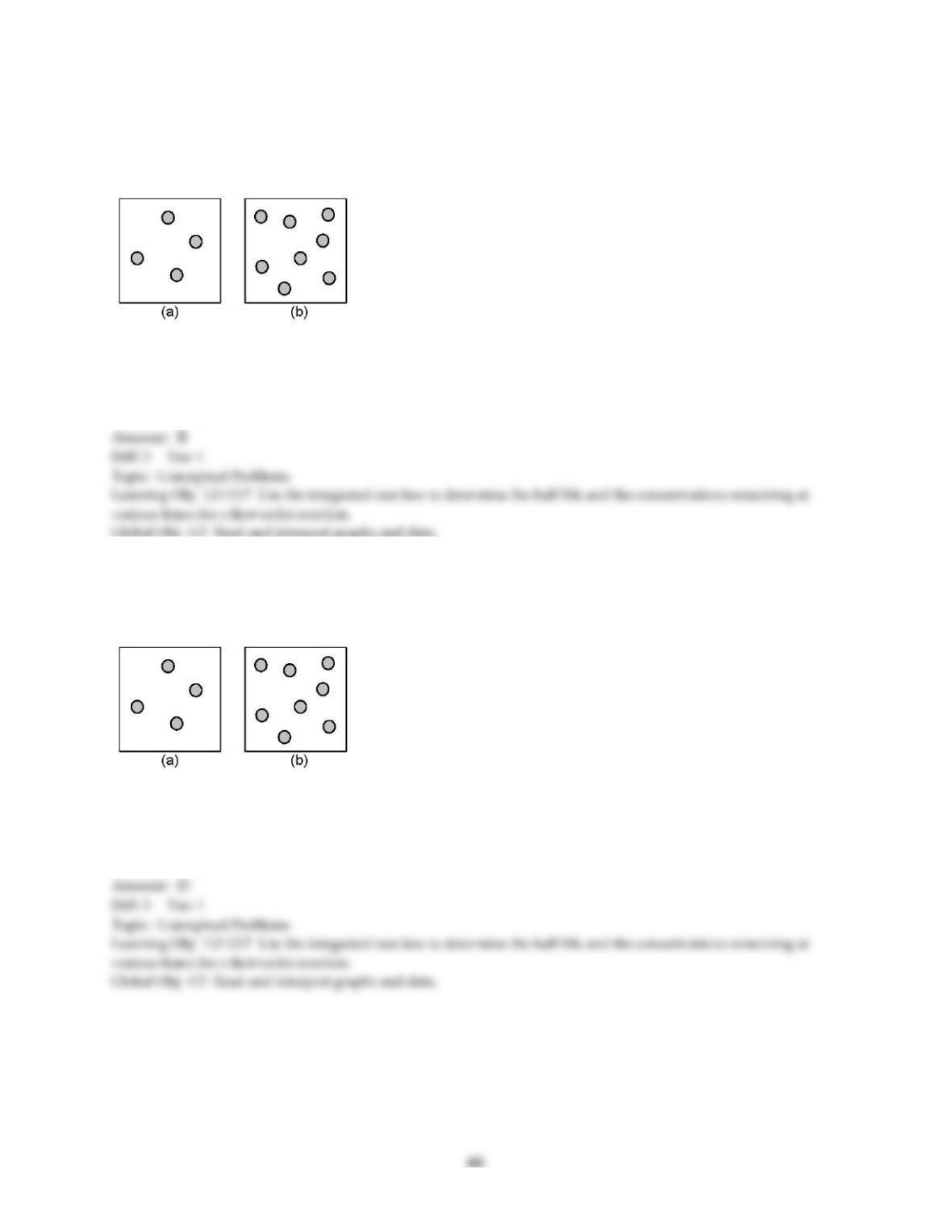
99) Consider the first-order decomposition of A molecules (shaded spheres) in two vessels of equal
volume. How will the rate of decomposition in vessel (a) be affected if the volume of the vessel is
decreased by a factor of 2?
A) decrease by 1/2
B) increase by 2
C) increase by 4
D) stay the same
100) Consider the first-order decomposition of A molecules (shaded spheres) in two vessels of equal
volume. How will the half-life of decomposition in vessel (a) be affected if the volume of the vessel is
decreased by a factor of 2?
A) decrease by 1/2
B) increase by 2
C) increase by 4
D) stay the same
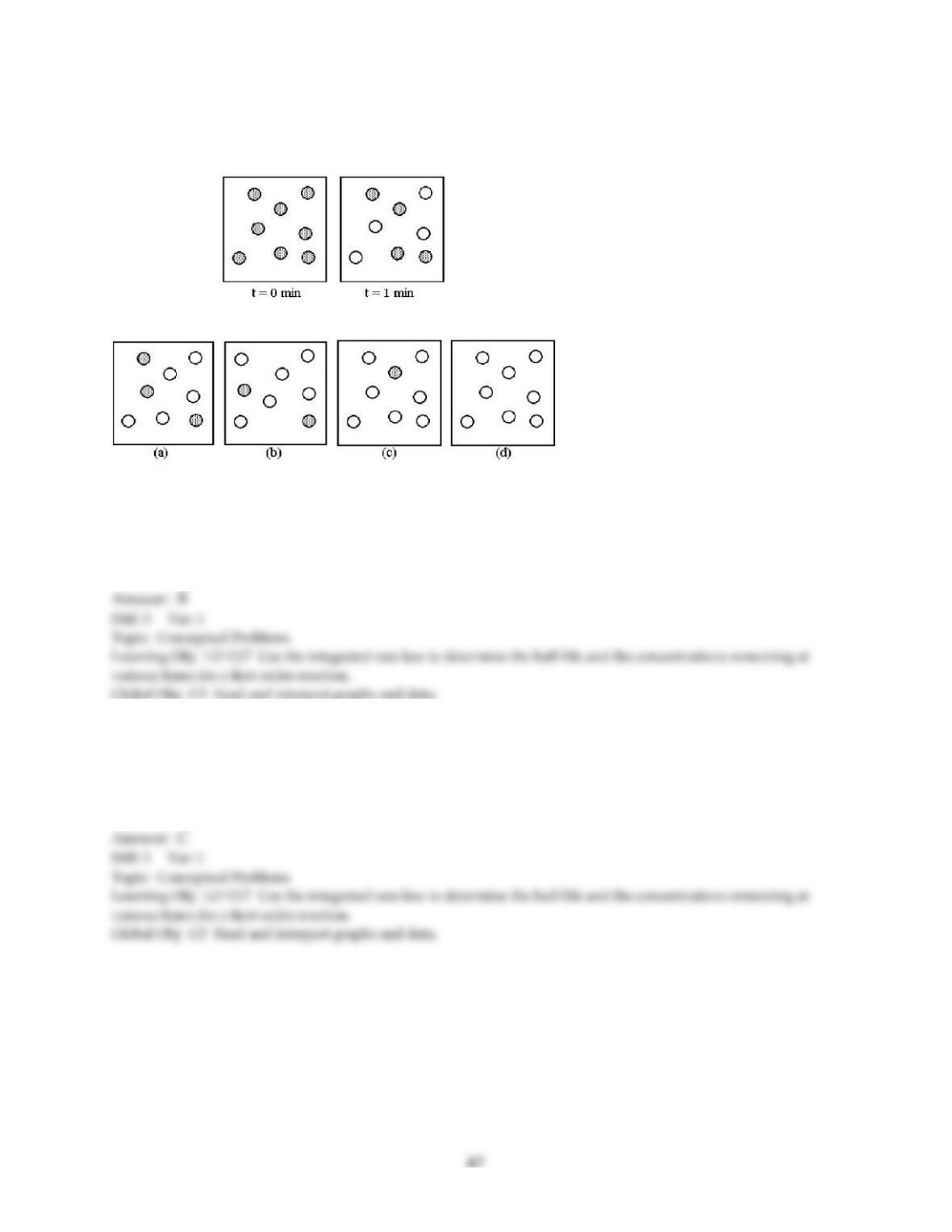
Consider the first-order reaction A → B in which A molecules (shaded spheres) are converted to B
molecules (unshaded spheres).
101) Which drawing (a)-(d) represents the reaction mixture at t = 2 minutes?
A) drawing (a)
B) drawing (b)
C) drawing (c)
D) drawing (d)
102) Which drawing (a)-(d) represents the reaction mixture at t = 3 minutes?
A) drawing (a)
B) drawing (b)
C) drawing (c)
D) drawing (d)
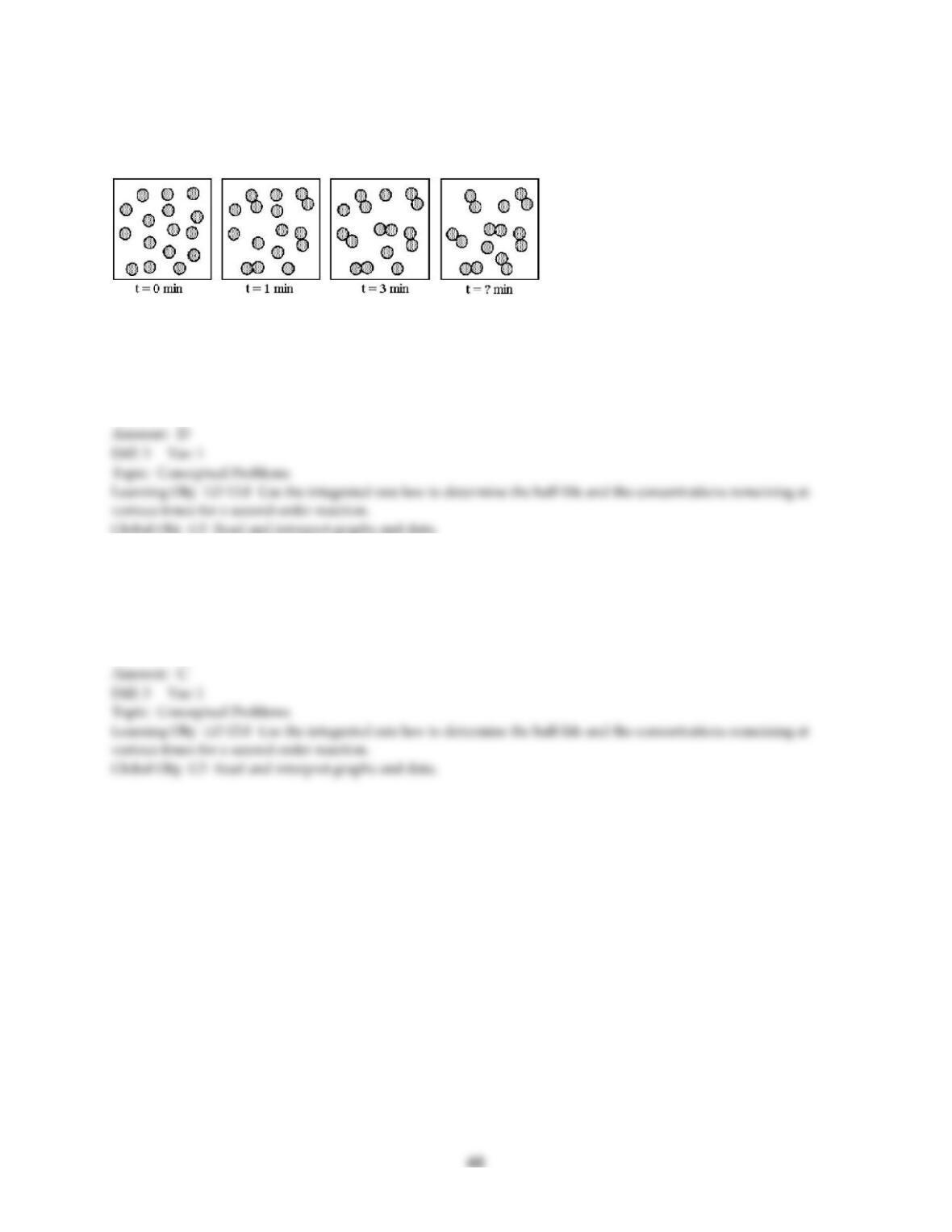
The following pictures represent the progress of a reaction in which two A molecules combine to give a
more complex molecule A2, 2A → A2.
103) What is the order of reaction with respect to A?
A) 0
B) 1/2
C) 1
D) 2
104) What is the time required to achieve the molecular mixture in drawing (d)?
A) 4 min
B) 5 min
C) 7 min
D) 8 min
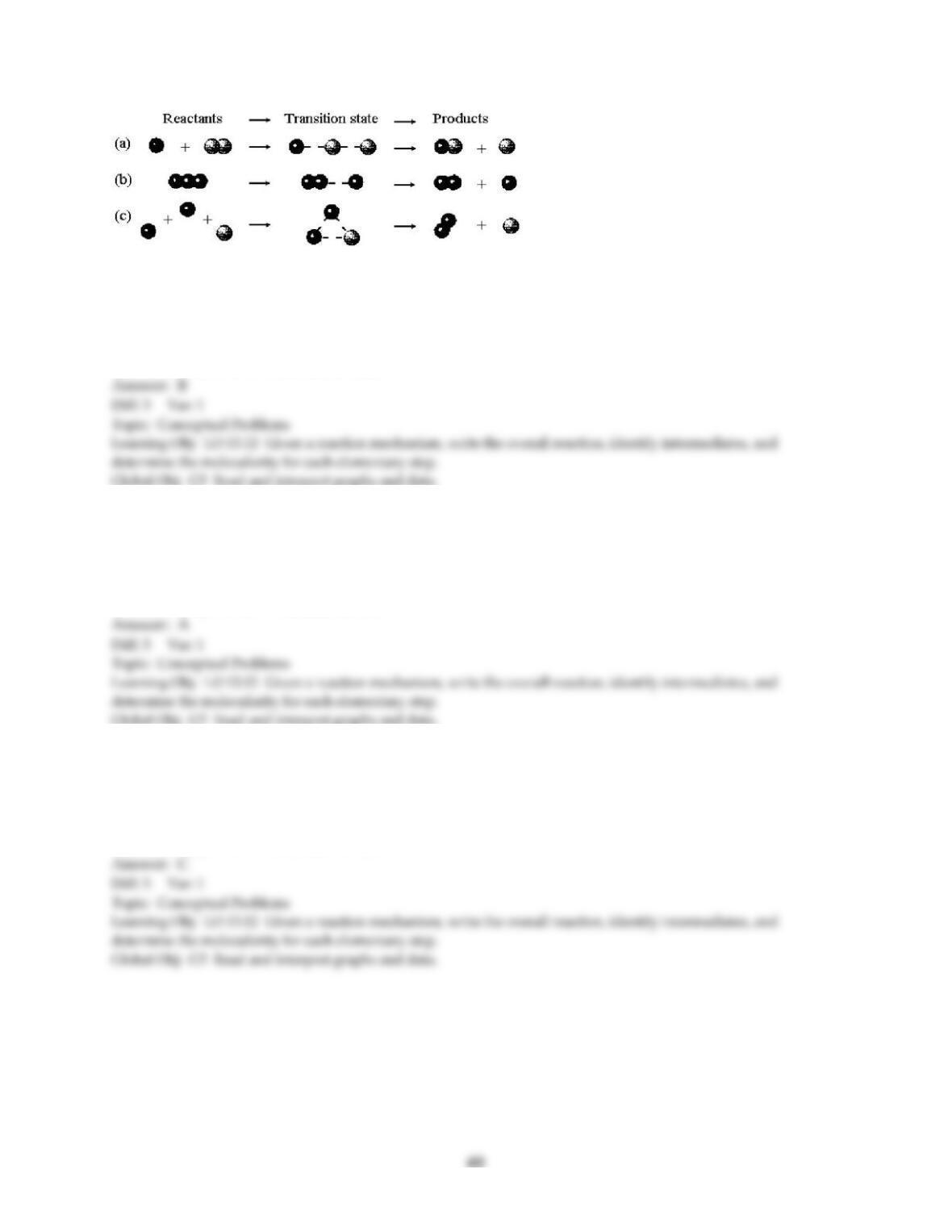
105) Which of the elementary reactions shown above has a molecularity of one?
A) elementary reaction (a)
B) elementary reaction (b)
C) elementary reaction (c)
D) elementary reactions (a), (b), and (c)
106) Which of the elementary reactions shown above has a molecularity of two?
A) elementary reaction (a)
B) elementary reaction (b)
C) elementary reaction (c)
D) elementary reactions (a), (b), and (c)
107) Which of the elementary reactions shown above has a molecularity of three?
A) elementary reaction (a)
B) elementary reaction (b)
C) elementary reaction (c)
D) elementary reactions (a), (b), and (c)
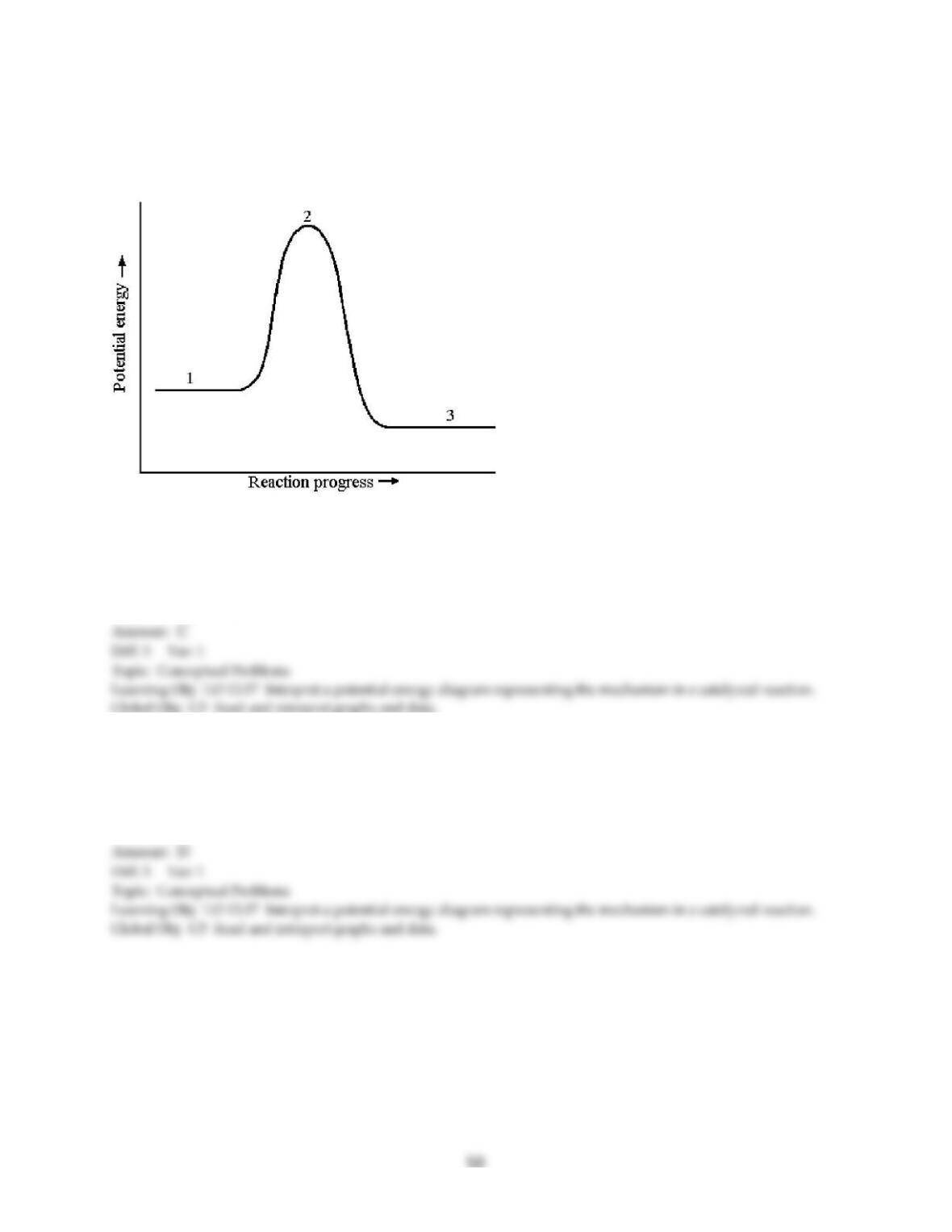
Consider a reaction that occurs by the following one-step mechanism:
A2 + B2 → 2 AB
The potential energy profile for this reaction is shown below.
108) What is the species present at reaction stage 1?
A) an intermediate
B) a product
C) a reactant
D) a transition state
109) What is the species present at reaction stage 2?
A) an intermediate
B) a product
C) a reactant
D) a transition state
110) What is the species present at reaction stage 3?
A) an intermediate
B) a product
C) a reactant
D) a transition state
111) The activation energy for the forward reaction is given by the difference in energy between which
two reaction stages?
A) reaction stage 2 — reaction stage 1
B) reaction stage 2 — reaction stage 3
C) reaction stage 1 — reaction stage 3
D) reaction stage 3 — reaction stage 1
112) The energy of reaction, ΔE, is given by the difference in energy between which two reaction stages?
A) reaction stage 2 — reaction stage 1
B) reaction stage 2 — reaction stage 3
C) reaction stage 1 — reaction stage 3
D) reaction stage 3 — reaction stage 1
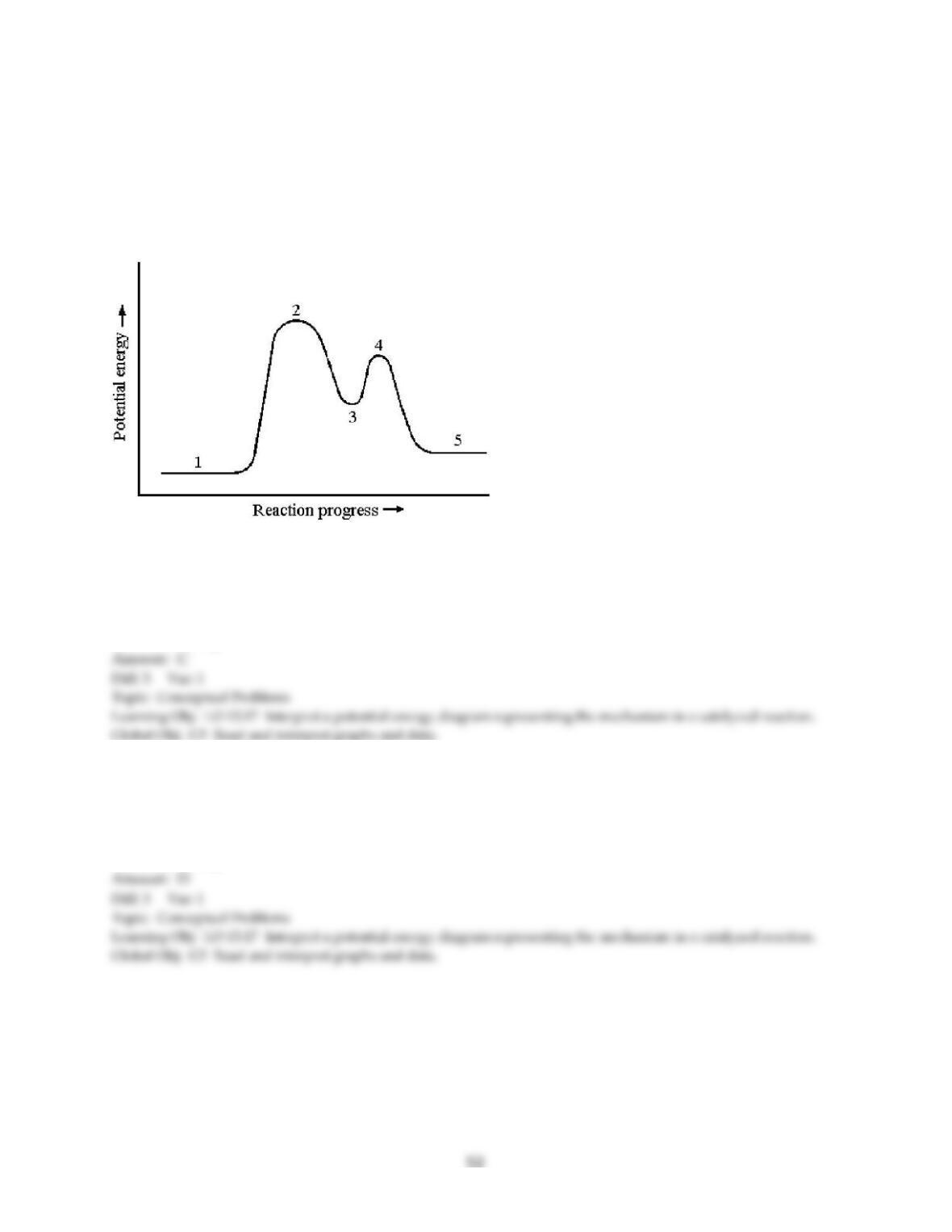
Consider a reaction that occurs by the following mechanism:
A + BC → AC + B
AC + D → A + CD
The potential energy profile for this reaction is shown below.
113) Transition states occur at which reaction stages?
A) reaction stages 1 and 5
B) reaction stages 2, 3, and 4
C) reaction stages 2 and 4
D) reaction stage 3
114) Intermediates occur at which reaction stages?
A) reaction stages 1 and 5
B) reaction stages 2, 3, and 4
C) reaction stages 2 and 4
D) reaction stage 3
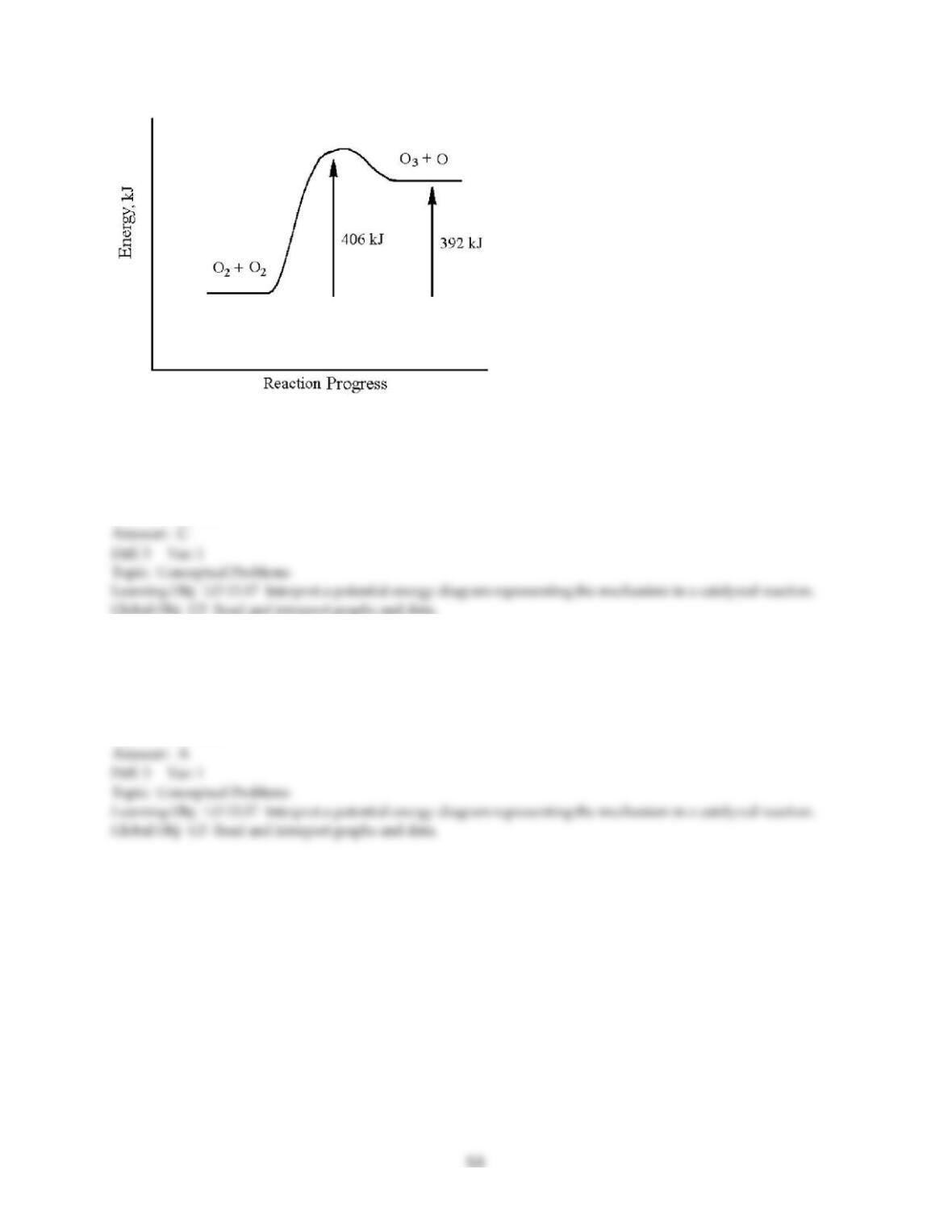
115) What is the activation energy for the formation of ozone?
A) 14 kJ
B) 392 kJ
C) 406 kJ
D) none of these
116) What is the activation energy for the destruction of ozone?
A) 14 kJ
B) 392 kJ
C) 406 kJ
D) none of these
13.2 Algorithmic Questions
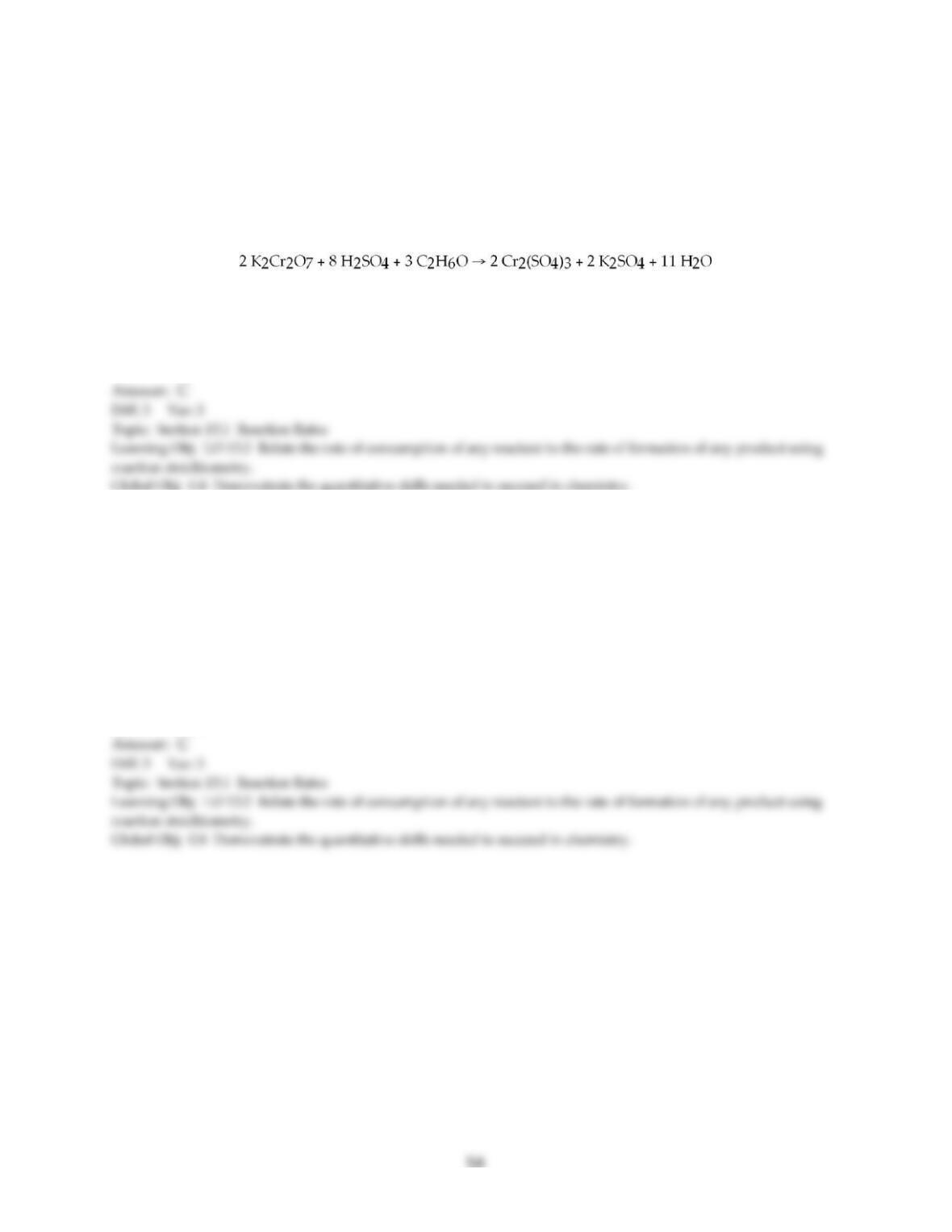
1) The reaction that occurs in a Breathalyzer, a device used to determine the alcohol level in a person’s
bloodstream, is given below. If the rate of appearance of Cr2(SO4)3 is 1.24 mol/min at a particular
moment, what is the rate of disappearance of C2H6O at that moment?
A) 0.413 mol/min
B) 0.826 mol/min
C) 1.86 mol/min
D) 3.72 mol/min
2) The decomposition of dinitrogen pentoxide is described by the chemical equation
2 N2O5(g) → 4 NO2(g) + O2(g)
If the rate of disappearance of N2O5 is equal to 1.40 mol/min at a particular moment, what is the rate of
appearance of NO2 at that moment?
A) 0.700 mol/min
B) 1.40 mol/min
C) 2.80 mol/min
D) 5.60 mol/min
3) The decomposition of dinitrogen pentoxide is described by the chemical equation
2 N2O5(g) → 4 NO2(g) + O2(g)
If the rate of appearance of NO2 is equal to 0.660 mol/min at a particular moment, what is the rate of
appearance of O2 at that moment?
A) 0.165 mol/min
B) 0.330 mol/min
C) 1.32 mol/min
D) 2.64 mol/min
4) The decomposition of dinitrogen pentoxide is described by the chemical equation
2 N2O5(g) → 4 NO2(g) + O2(g)
If the rate of appearance of O2 is equal to 2.80 mol/min at a particular moment, what is the rate of
disappearance of N2O5 at that moment?
A) 0.700 mol/min
B) 1.40 mol/min
C) 5.60 mol/min
D) 11.2 mol/min
5) Which term describes the measure of the decrease in the concentration of a product per unit time?
A) reactant energy
B) kinetics
C) reaction rate
D) reaction time
6) “Instantaneous rate” is defined as the
A) change in concentration per g.
B) equation showing how the rate depends on the concentration of each product.
C) rate of reaction at a particular time.
D) rate of reaction during at time zero.
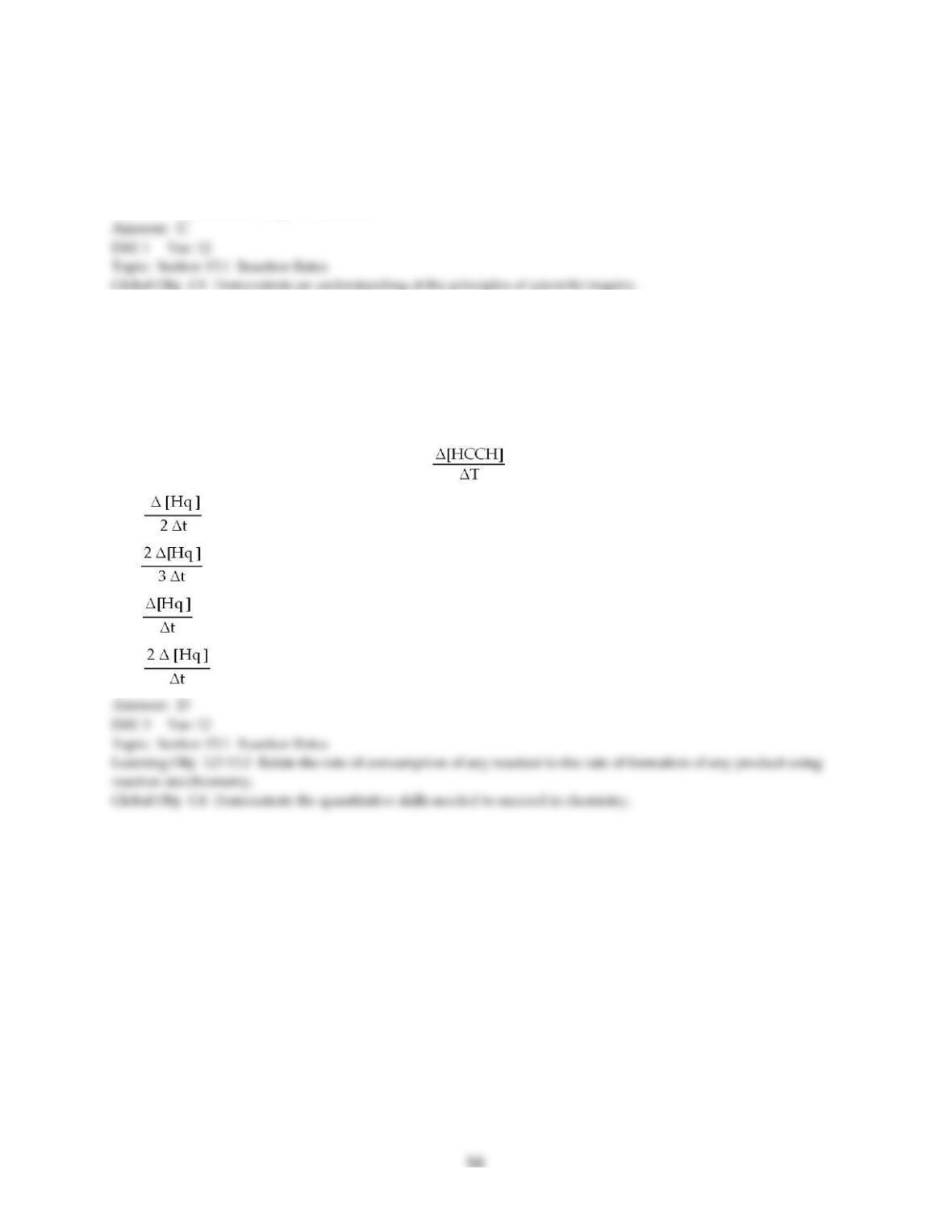
7) Hydroquinone, HOC6H6OH, can be formed by the reaction with acetylene below:
2 HCCH + 3 CO + H2O → HOC6H4OH + CO2
How is the rate of disappearance of acetylene, HCCH, related to the appearance of hydroquinone?
– = ?
A) +
B) +
C) +
D) +
8) For the reaction shown below, what is the relationship between the rate of formation of Br2 and the
rate of reaction of ClO2– over the same time period?
ClO2–(aq) + 4 Br–(aq) + 4 H+(aq)→ Cl–(aq) + 2 Br2(aq) +2 H2O(l)
A) rate of formation of Br2 = 2 × rate of reaction of ClO2–
B) rate of formation of Br2 = 1/2 × rate of reaction of ClO2–
C) rate of formation of Br2 = 4 x rate of reaction of ClO2–
D) rate of formation of Br2 = 8 x rate of reaction of ClO2–
9) For a reaction that follows the general rate law, Rate = k[A][B]2, what will happen to the rate of reaction
if the concentration of A is increased by a factor of 1.50? The rate will
A) decrease by a factor of 1/2.25.
B) decrease by a factor of 1/1.50.
C) increase by a factor of 1.50.
D) increase by a factor of 2.25.
10) For a reaction that follows the general rate law, Rate = k[A][B]2, what will happen to the rate of
reaction if the concentration of B is increased by a factor of 1.50? The rate will
A) decrease by a factor of 1/2.25.
B) decrease by a factor of 1/1.50.
C) increase by a factor of 1.50.
D) increase by a factor of 2.25.
11) What is the overall reaction order for the reaction that has the rate law: Rate = k[Cl ]2[N2]?
A) zero order
B) first order
C) second order
D) third order
12) Which statement is true for the general rate law: Rate = k[A]m[B]n?
A) It can be written from the stoichiometry of the first step.
B) The overall order of the reaction is equal to m times n.
C) The values for the exponents must be determined by experiment.
D) The exponents in the rate law must be positive integers.
13) For the reaction shown below, what is the order of reaction with respect to Br?
ClO2–(aq) + 4 Br–(aq) + 4 H+(aq)→ Cl–(aq) + 2 Br2(aq) +2 H2O(l)
A) 1st order
B) 2nd order
C) 4th order
D) can’t tell from the information provided