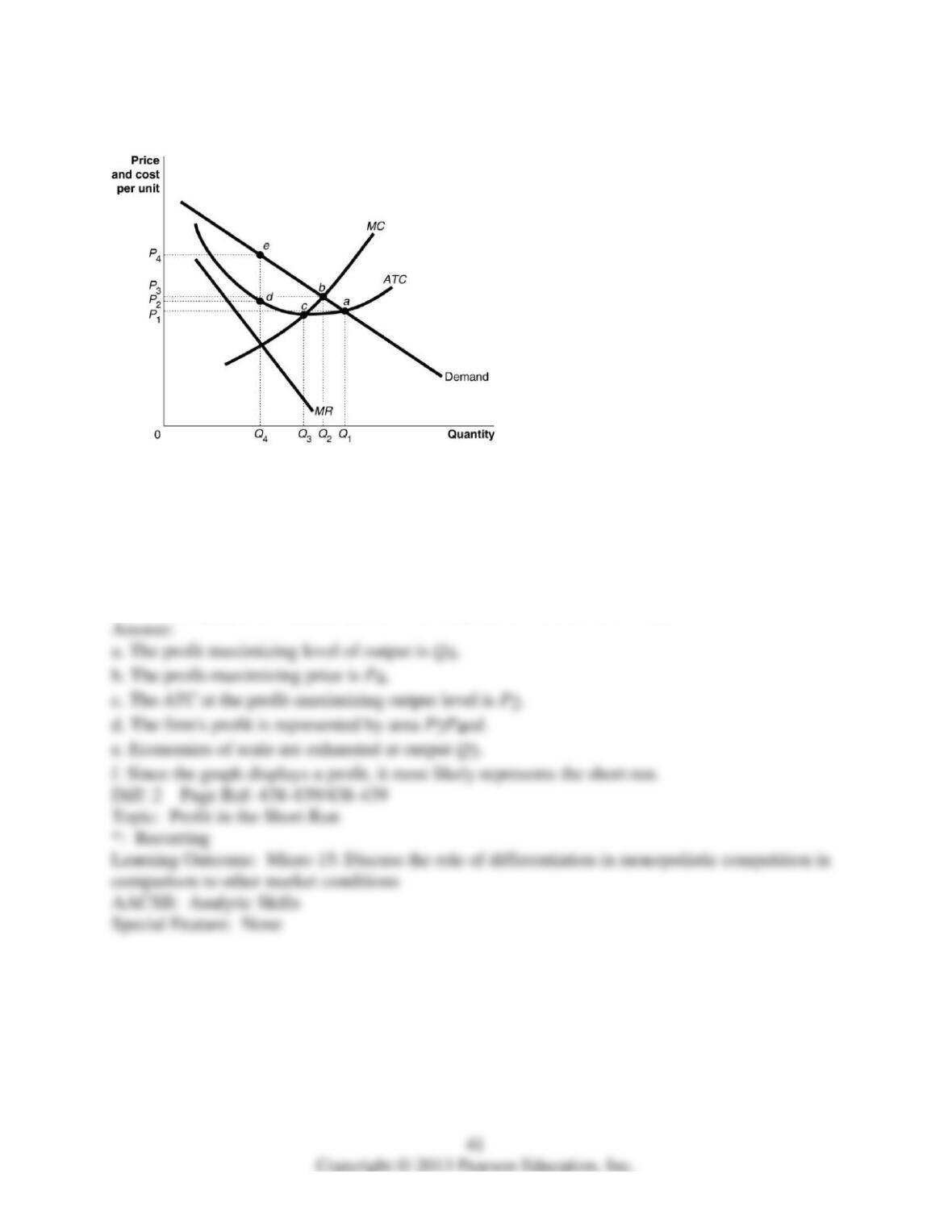
Figure 13-8
28) Refer to Figure 13-8 to answer the following questions.
a. What is the profit-maximizing output level?
b. What is the profit-maximizing price?
c. What is the average total cost at the profit-maximizing output level?
d. What area represents the firm’s profit?
e. At which output level are economies of scale exhausted?
f. Does this graph most likely represent the long run or the short run? Why?
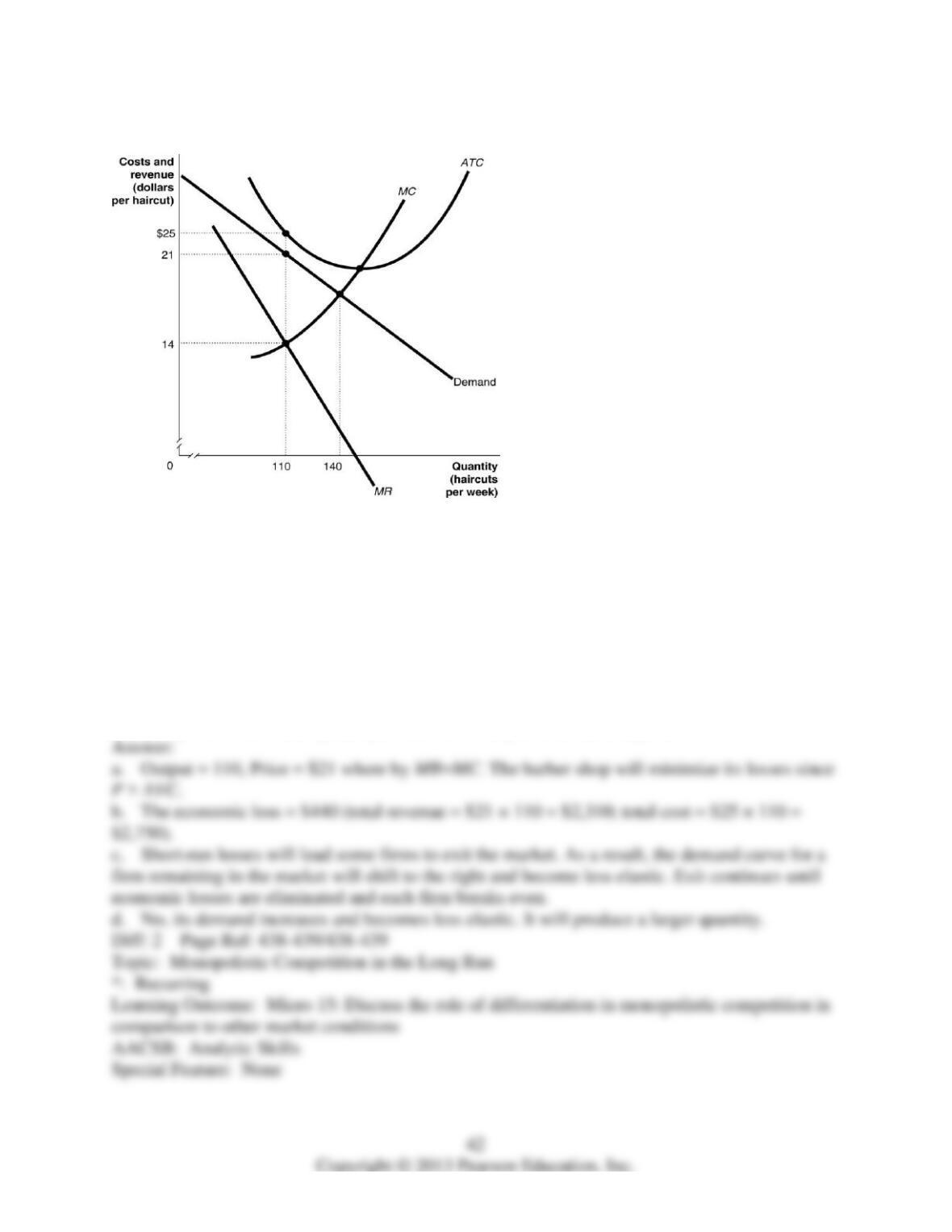
Figure 13-9
29) Refer to Figure 13-9. Figure 13-9 depicts a monopolistically competitive barber shop. Use
the diagram to answer the following questions.
a. Suppose the average variable cost of production is $15 when output equals 110 haircuts and
$15.25 when output equals 140 haircuts. If the firm wants to maximize its profit or minimize its
losses, how many haircuts will it produce and what price should it charge? Explain your answer.
b. Calculate the firm’s profit or loss.
c. What is likely to happen in this industry over time as it moves to its new long-run
equilibrium?
d. Suppose the barber shop depicted in the diagram remains in the industry. Is this barber shop
likely to produce this same quantity of haircuts as in part (a) in the long run?
13.4 Comparing Monopolistic Competition and Perfect Competition
1) How does the long run equilibrium of a monopolistically competitive industry differ from that
of a perfectly competitive industry?
A) A firm in monopolistic competition will earn economic profits but a firm in perfect
competition earns zero profit.
B) A firm in monopolistic competition will charge a price higher than the average cost of
production but a firm in perfect competition charges a price equal to the average cost of
production.
C) A firm in monopolistic competition does not take full advantage of its economies of scale but
a firm in perfect competition produces at the lowest average cost possible.
D) A firm in monopolistic competition produces an allocatively efficient output level while a
firm in perfect competition produces a productively efficient output level.
2) Long-run equilibrium under monopolistic competition is similar to that under perfect
competition in that
A) firms produce at the minimum point of their average cost curves.
B) price equals marginal cost.
C) firms earn normal profits.
D) price equals marginal revenue.
3) Which of the following is not a characteristic of long-run equilibrium in a monopolistically
competitive market?
A) Selling price equals average total cost.
B) Production is at minimum average total cost.
C) Marginal revenue equals marginal cost.
D) Selling price is greater than marginal cost.
4) For productive efficiency to hold,
A) price must equal the marginal cost of the last unit produced.
B) price must equal marginal revenue of the last unit sold.
C) average variable cost is minimized in production.
D) average total cost is minimized in production.
5) For allocative efficiency to hold,
A) price must equal marginal revenue of the last unit sold.
B) price must equal the marginal cost of the last unit produced.
C) average variable cost is minimized in production.
D) average total cost is minimized in production.
6) Is a monopolistically competitive firm productively efficient?
A) No, because it does not produce at minimum average total cost.
B) Yes, because it produces where marginal cost equals marginal revenue.
C) No, because price is greater than marginal cost.
D) Yes, because price equals average total cost.
7) Is a monopolistically competitive firm allocatively efficient?
A) No, because it does not produce at minimum average total cost.
B) Yes, because it produces where marginal cost equals marginal revenue.
C) No, because price is greater than marginal cost.
D) Yes, because price equals average total cost.
8) If a firm has excess capacity, it means
A) that the firm expends too much of its resources on advertising its product without seeing an
appreciable increase in sales.
B) that the firm is not producing its minimum efficient scale of output.
C) that the firm’s long-run average cost of producing a given quantity exceeds its short-run cost
of producing that same quantity.
D) that the firm’s quantity supplied exceeds its quantity demanded.
9) Economists agree that a monopolistically competitive market structure
A) lowers consumer utility because consumers pay a price higher than the marginal cost of
production.
B) is detrimental to society because it leads to a waste of scarce resources.
C) benefits consumers because firms produce products that appeal to a wide range of consumer
tastes.
D) can eliminate any excess capacity if all firms in the industry devote more funds to
differentiating their products.
10) Consumers benefit from monopolistic competition by
A) being able to choose from products more closely suited to their tastes.
B) paying the lowest possible price for the product.
C) paying the same price as everyone else.
D) being able to purchase high-quality products at low prices.
11) Some of the advantages Netflix had over companies like Blockbuster and Wal-Mart in
successfully competing in the mail order DVD rental business include all of the following except
A) a quick turnaround of mailing out the customer’s next DVD once the previous one was
returned.
B) an extensive system of storefront operations where customers could rent DVDs in person.
C) an efficient system of processing DVDs returned from customers.
D) a national system of warehouses allowing for quick customer delivery.
12) As customers switch from renting DVDs to downloading or streaming movies from the
Internet, Netflix will likely find it ________ to remain profitable as they face ________
competition with streaming movies than with mail order DVD rental.
A) harder; more
B) harder; less
C) easier; more
D) easier; less
Figure 13-10
13) Refer to Figure 13-10. What is the productively efficient output for the firm represented in
the diagram?
A) Qf units
B) Qg units
C) Qh units
D) Qj units
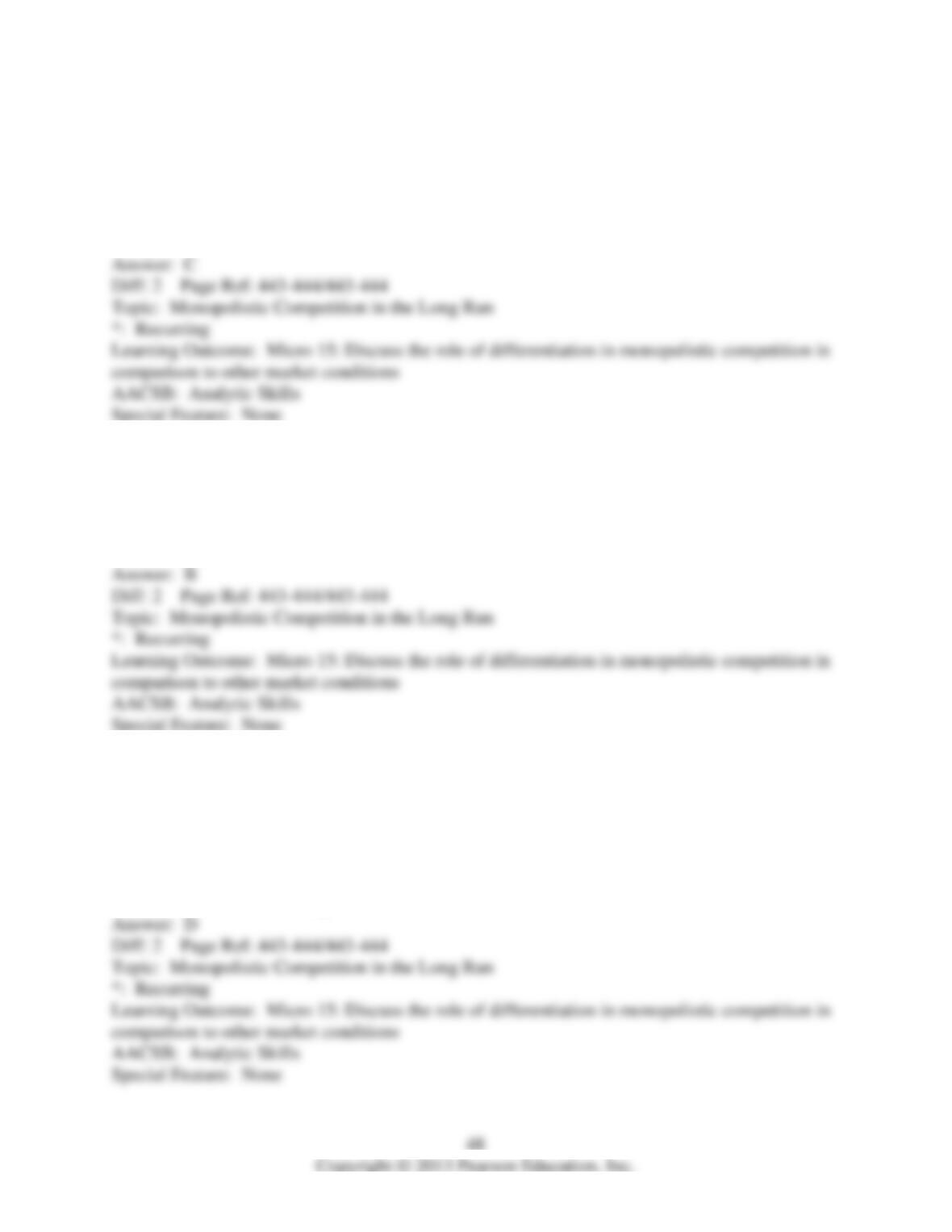
14) Refer to Figure 13-10. What is the allocatively efficient output for the firm represented in
the diagram?
A) Qf units
B) Qg units
C) Qh units
D) Qj units
15) Refer to Figure 13-10. What is the amount of excess capacity?
A) Qh – Qf units
B) Qj – Qf units
C) Qj – Qh units
D) Qh – Qg units
16) Refer to Figure 13-10. Suppose the firm is currently producing Qf units. What happens if it
increases its output to Qg units?
A) Its average cost of production will fall and its profit will rise.
B) It will be taking advantage of economies of scale and will be able to lower the price of its
product.
C) It will move from a zero profit situation to a profit situation
D) It will move from a zero profit situation to a loss situation
17) Refer to Figure 13-10. In the long run, why will the firm produce Qf units and not Qg units,
which has a lower its average cost of production?
A) Although its average cost of production is lower when the firm produces Qg units, to be able
to sell its output the firm will have to charge a price below average cost, resulting in a loss.
B) At Qg, average cost exceeds marginal cost so the firm will actually make a loss.
C) At Qg, marginal revenue is less than average revenue which will result in a loss for the firm.
D) The firm’s goal is to charge a high price and make a small profit rather than a low price and
no profit.
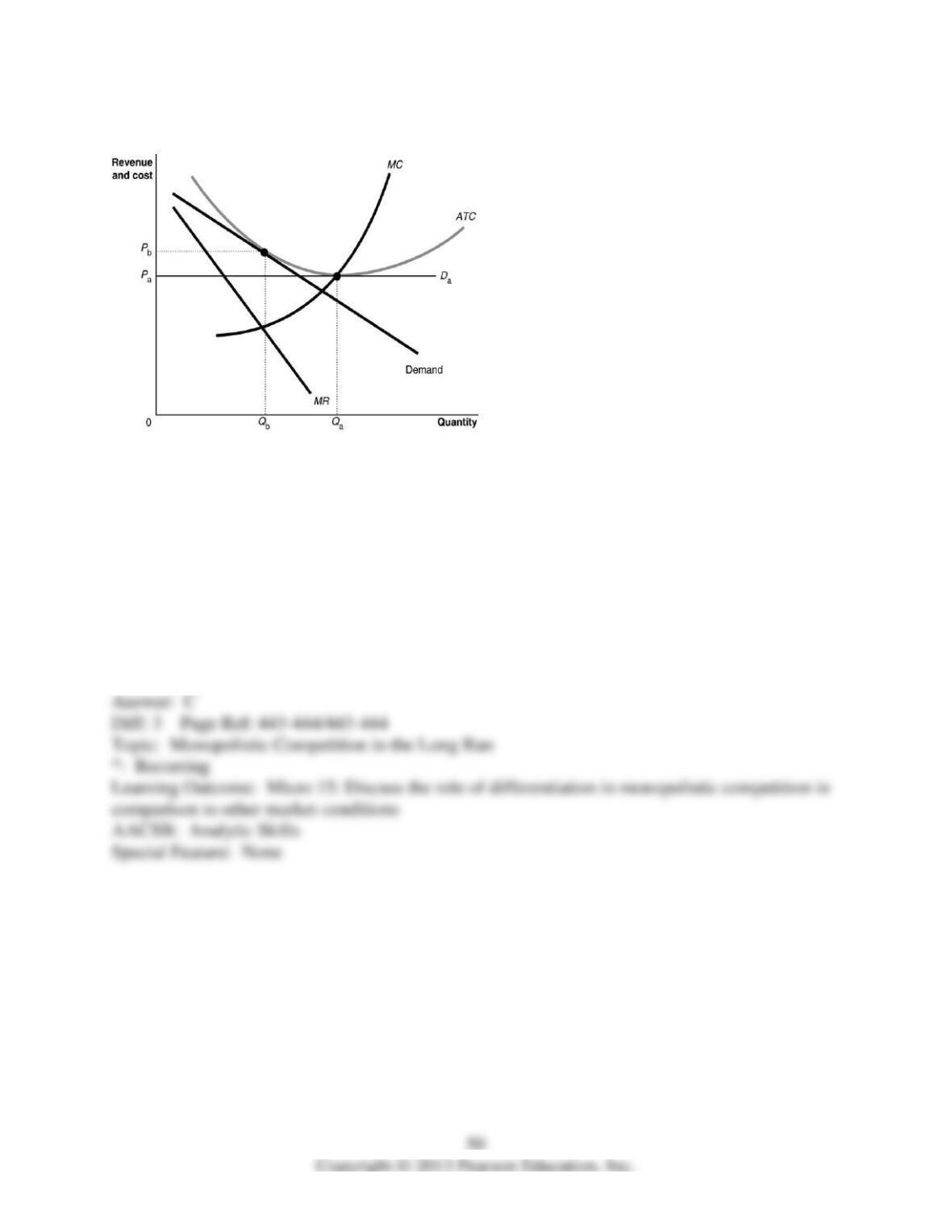
Figure 13-11
18) Refer to Figure 13-11. Which of the following statements is true?
A) Da represents the long-run demand curve facing a monopolistic competitor in a constant-cost
industry while Db depicts the demand curve in the short run.
B) Da represents the long-run demand curve facing a monopolistic competitor in a constant-cost
industry while Db depicts the long-run demand curve in an increasing-cost industry.
C) Da represents the long-run demand curve facing a perfect competitor while Db depicts the
long-run demand curve facing a monopolistic competitor.
D) Da represents the long-run supply curve in a perfectly competitive, constant-cost industry
while Db depicts the long-run demand curve facing a monopolistic competitor in a decreasing-
cost industry.
19) Refer to Figure 13-11. The diagram demonstrates that
A) in the short run, the monopolistic competitor produces an output Qb but in the long run after
it adjusts its capacity, it will produce the allocatively efficient output, Qa.
B) it is not possible for a monopolistic competitor to produce the productively efficient output
level, Qa, because of product differentiation.
C) it is possible for a monopolistic competitor to produce the productively efficient output level,
Qa, if it is willing to lower its price from Pb to Pa.
D) in the long run, the monopolistic competitor produces the minimum-cost output level, Qa, but
in the short run its output of Qb is not cost minimizing.
20) Consumers in monopolistically competitive markets face a tradeoff between paying prices
greater than marginal costs and purchasing products that are more closely suited to their tastes.
21) One way by which firms differentiate their products is to find a market niche.
22) In the long-run equilibrium, a monopolistically competitive firm earning normal profit
produces the allocatively efficient output level.
23) Productive efficiency does not hold for a profit-maximizing, monopolistically competitive
firm in the long-run equilibrium because the firm operates along the diseconomies-of-scale
region of its average total cost curve.
24) Does the fact that monopolistically competitive firms do not achieve productive efficiency or
allocative efficiency mean that there is a significant loss in consumer welfare?