Chapter 13 Capital Budgeting Decisions
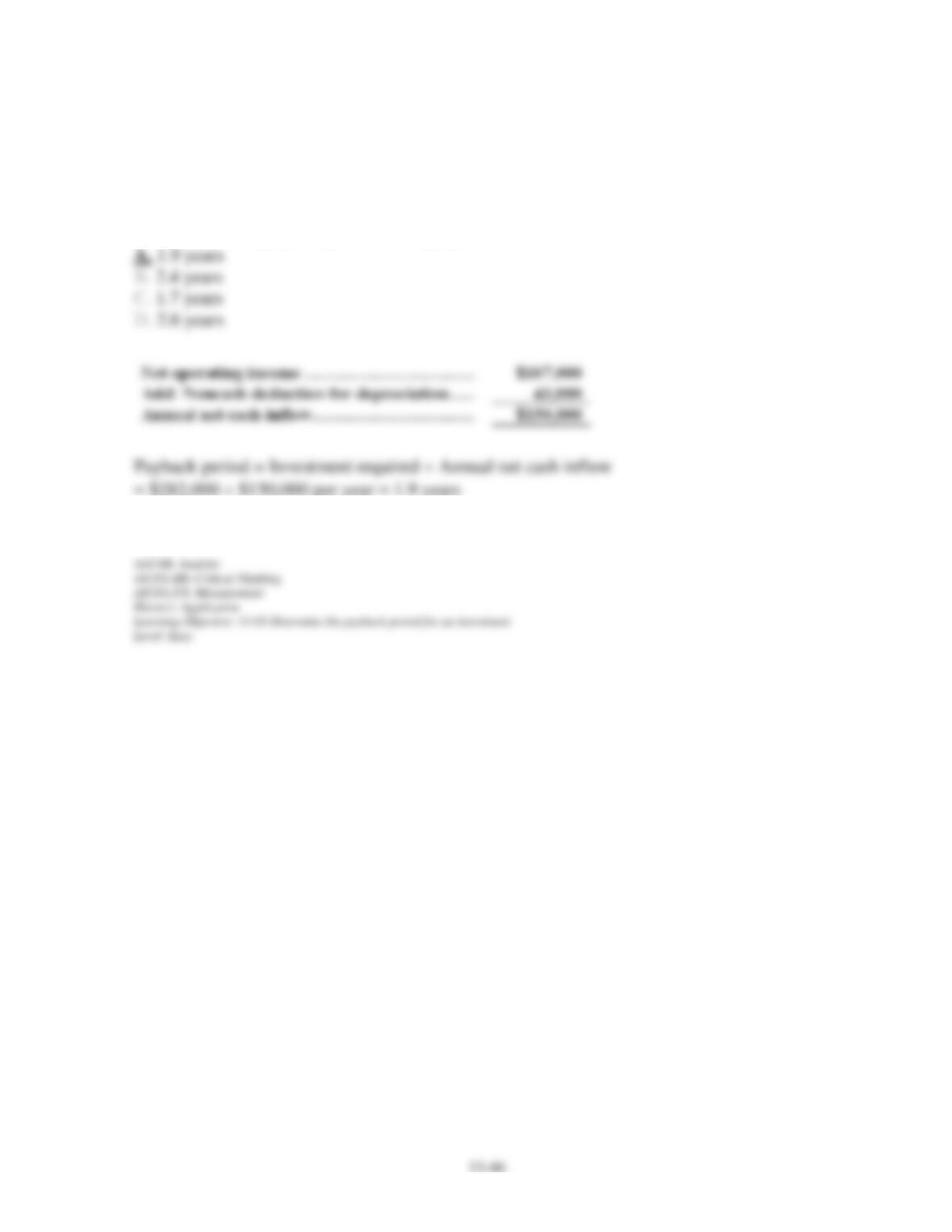
66. (Ignore income taxes in this problem.) The management of Rusell Corporation is
considering a project that would require an investment of $282,000 and would last for 6 years.
The annual net operating income from the project would be $107,000, which includes
depreciation of $43,000. The scrap value of the project’s assets at the end of the project would
be $24,000. The payback period of the project is closest to:
Chapter 13 Capital Budgeting Decisions
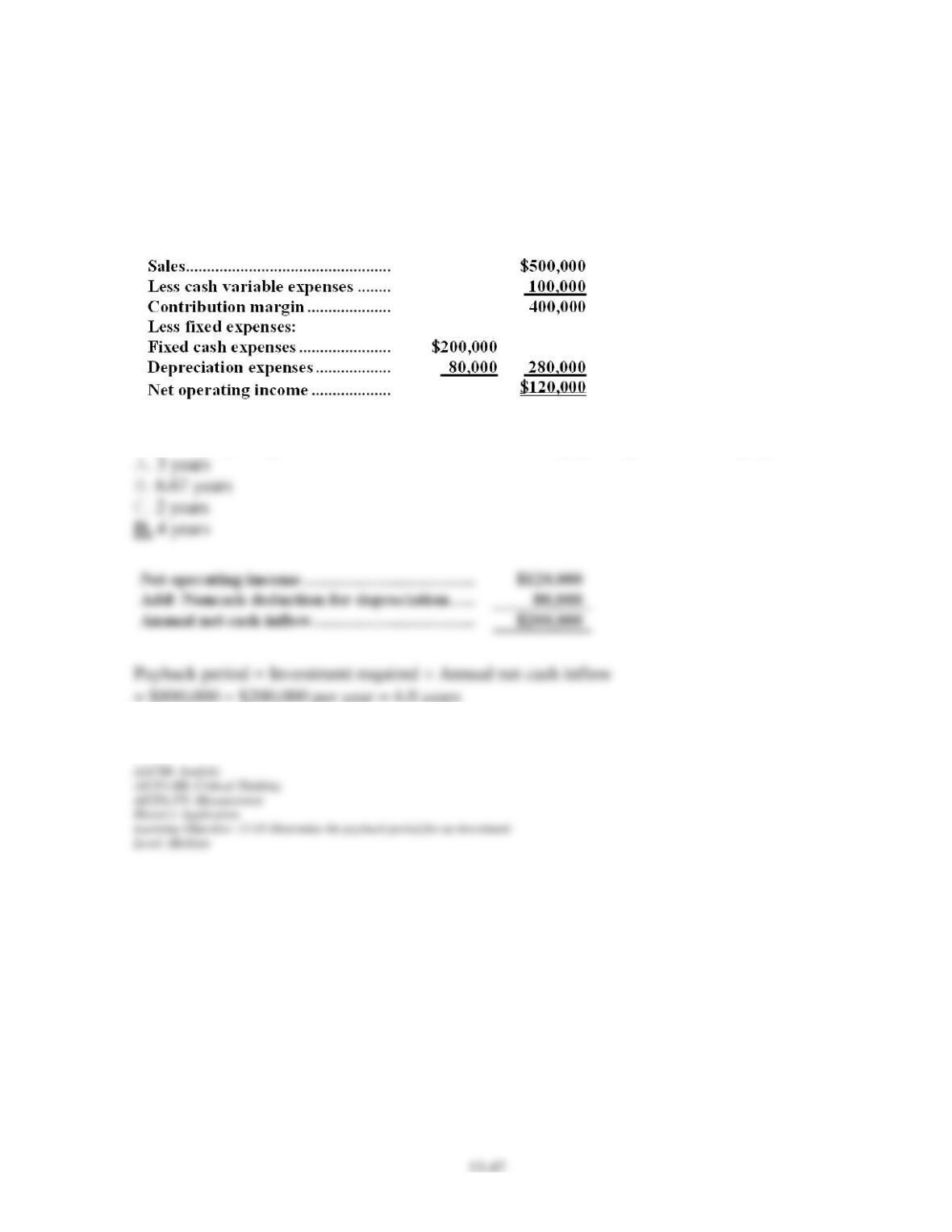
67. (Ignore income taxes in this problem.) Rogers Company is studying a project that would
have a ten-year life and would require an $800,000 investment in equipment which has no
salvage value. The project would provide net operating income each year as follows for the
life of the project:
The company’s required rate of return is 8%. What is the payback period for this project?
Chapter 13 Capital Budgeting Decisions
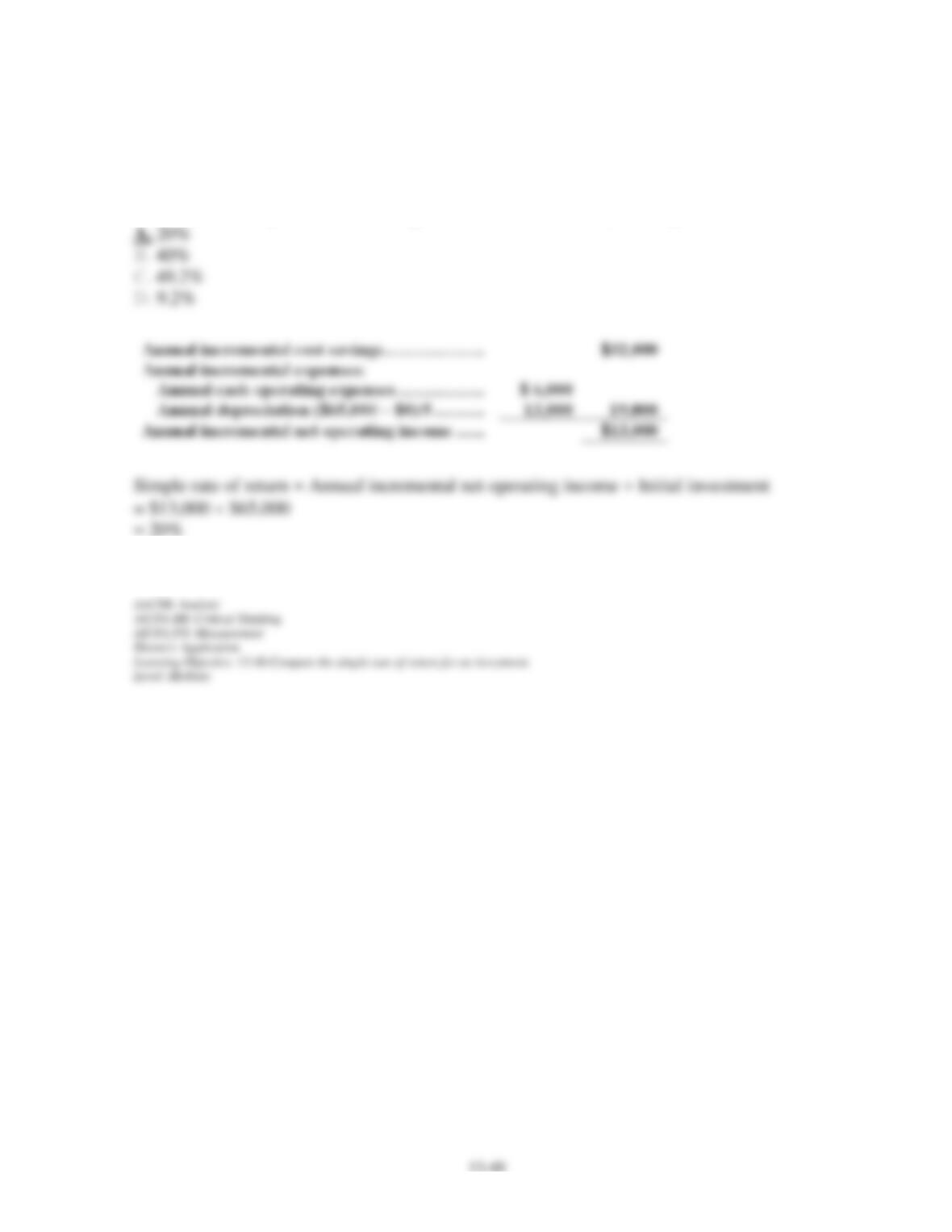
68. (Ignore income taxes in this problem.) The Jason Company is considering the purchase of
a machine that will increase revenues by $32,000 each year. Cash outflows for operating this
machine will be $6,000 each year. The cost of the machine is $65,000. It is expected to have a
useful life of five years with no salvage value. For this machine, the simple rate of return is:
Chapter 13 Capital Budgeting Decisions
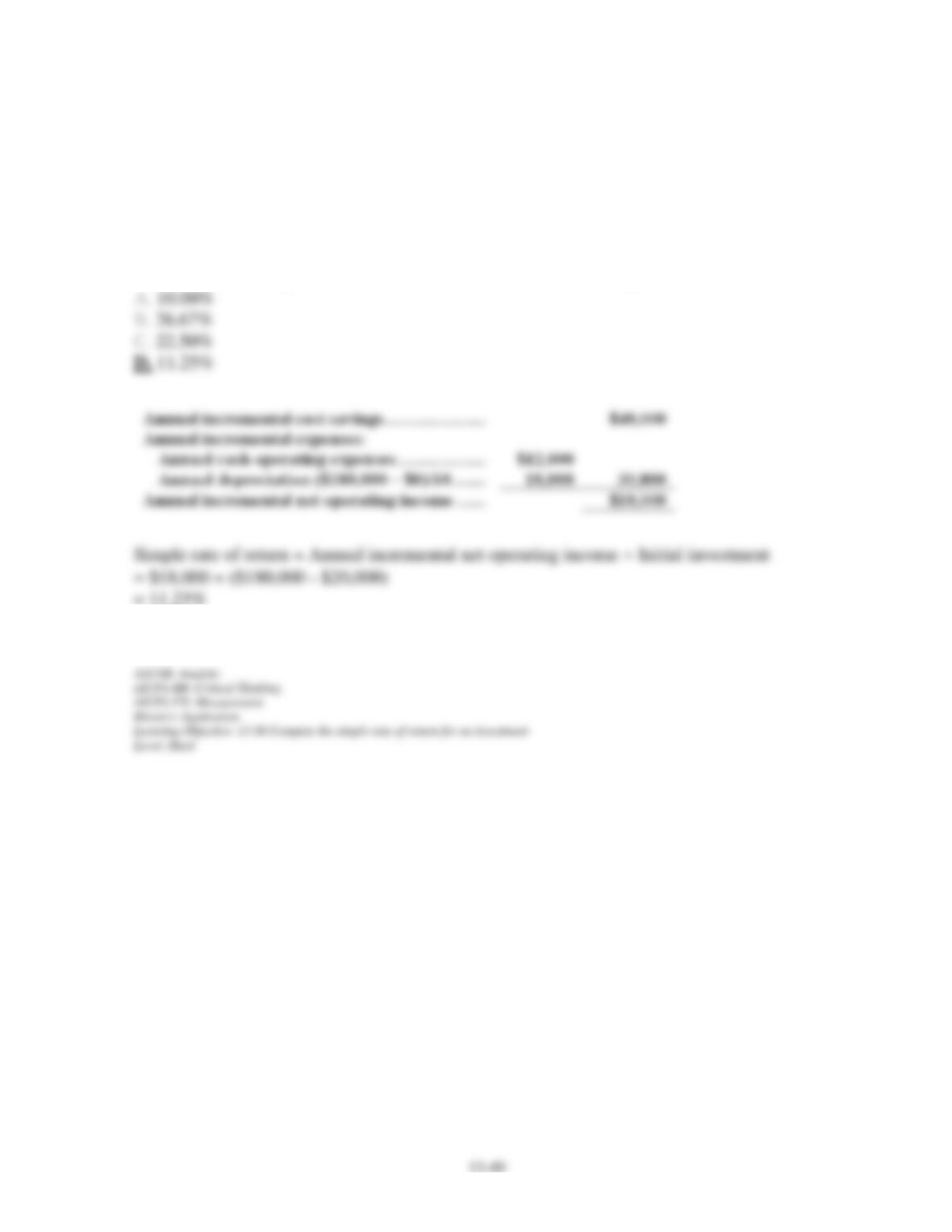
69. (Ignore income taxes in this problem.) Blaine Corporation is considering replacing a
technologically obsolete machine with a new state-of-the-art numerically controlled machine.
The new machine would cost $180,000 and would have a ten-year useful life. Unfortunately,
the new machine would have no salvage value. The new machine would cost $12,000 per year
to operate and maintain, but would save $48,000 per year in labor and other costs. The old
machine can be sold now for scrap for $20,000. What is the simple rate of return on the new
machine (round off your answer to the nearest one-hundredth of a percent)?
Chapter 13 Capital Budgeting Decisions
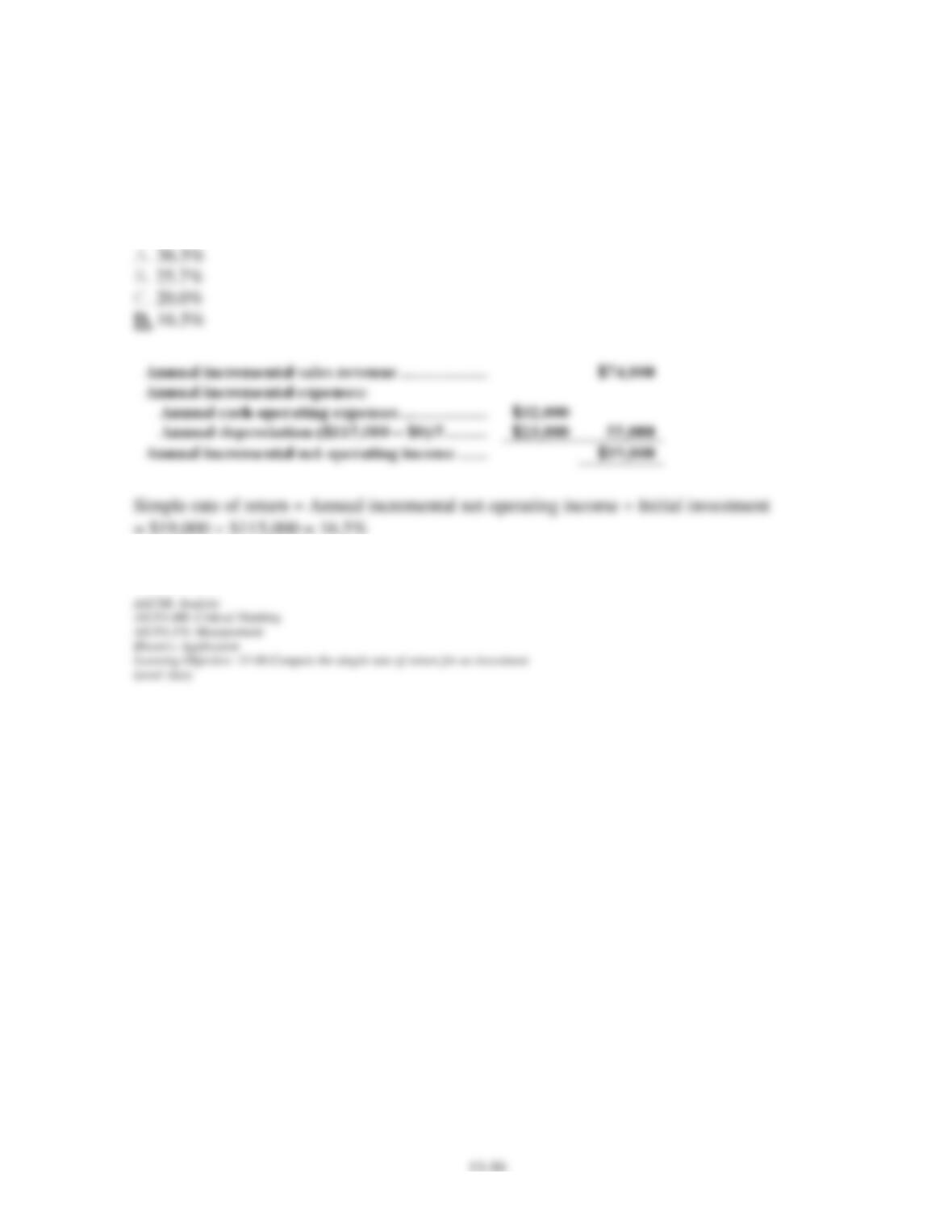
70. (Ignore income taxes in this problem.) The management of Burney Corporation is
investigating purchasing equipment that would increase sales revenues by $74,000 per year
and cash operating expenses by $32,000 per year. The equipment would cost $115,000 and
have a 5 year life with no salvage value. The simple rate of return on the investment is closest
to:
Chapter 13 Capital Budgeting Decisions
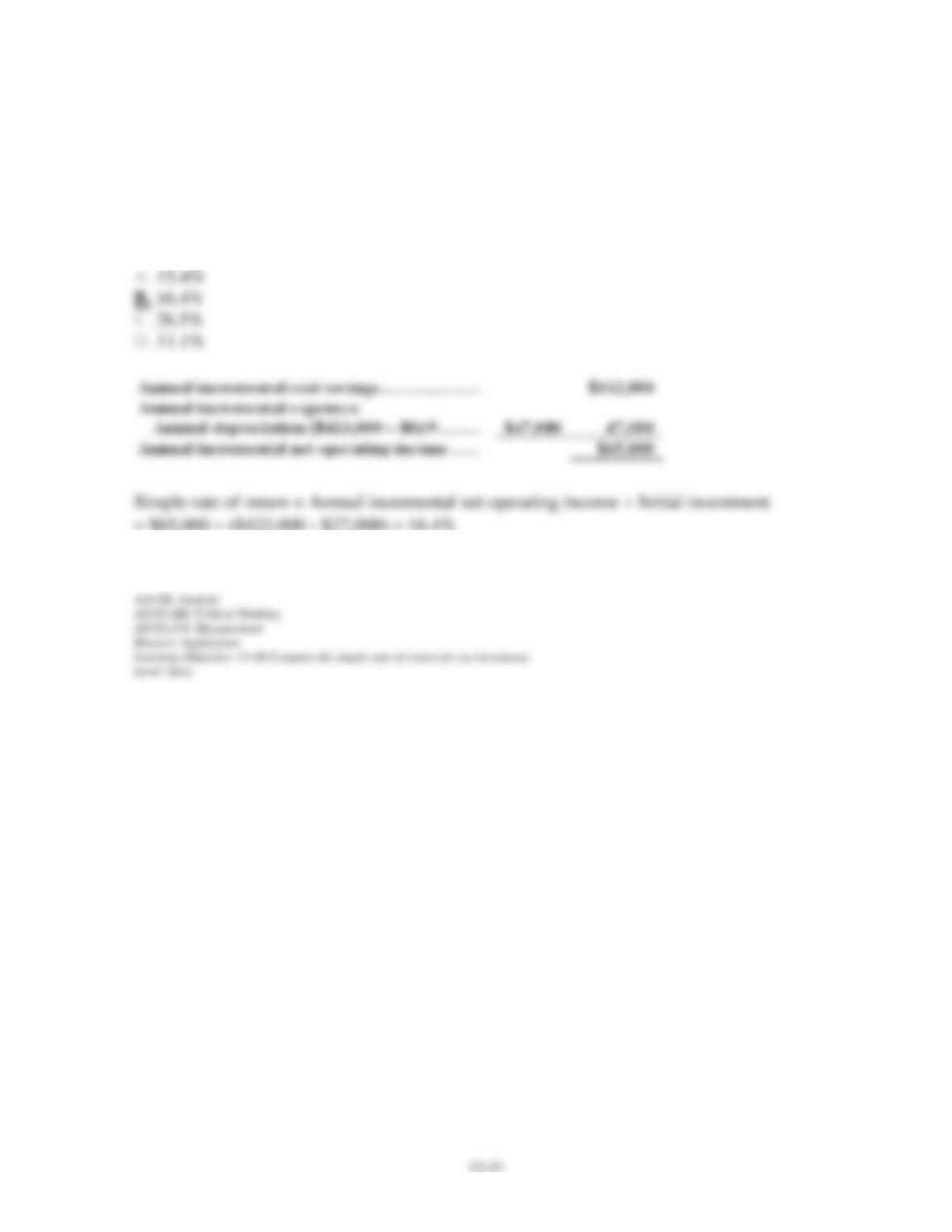
71. (Ignore income taxes in this problem.) Tu Corporation is investigating automating a
process by purchasing a machine for $423,000 that would have a 9 year useful life and no
salvage value. By automating the process, the company would save $112,000 per year in cash
operating costs. The new machine would replace some old equipment that would be sold for
scrap now, yielding $27,000. The annual depreciation on the new machine would be $47,000.
The simple rate of return on the investment is closest to:
Chapter 13 Capital Budgeting Decisions
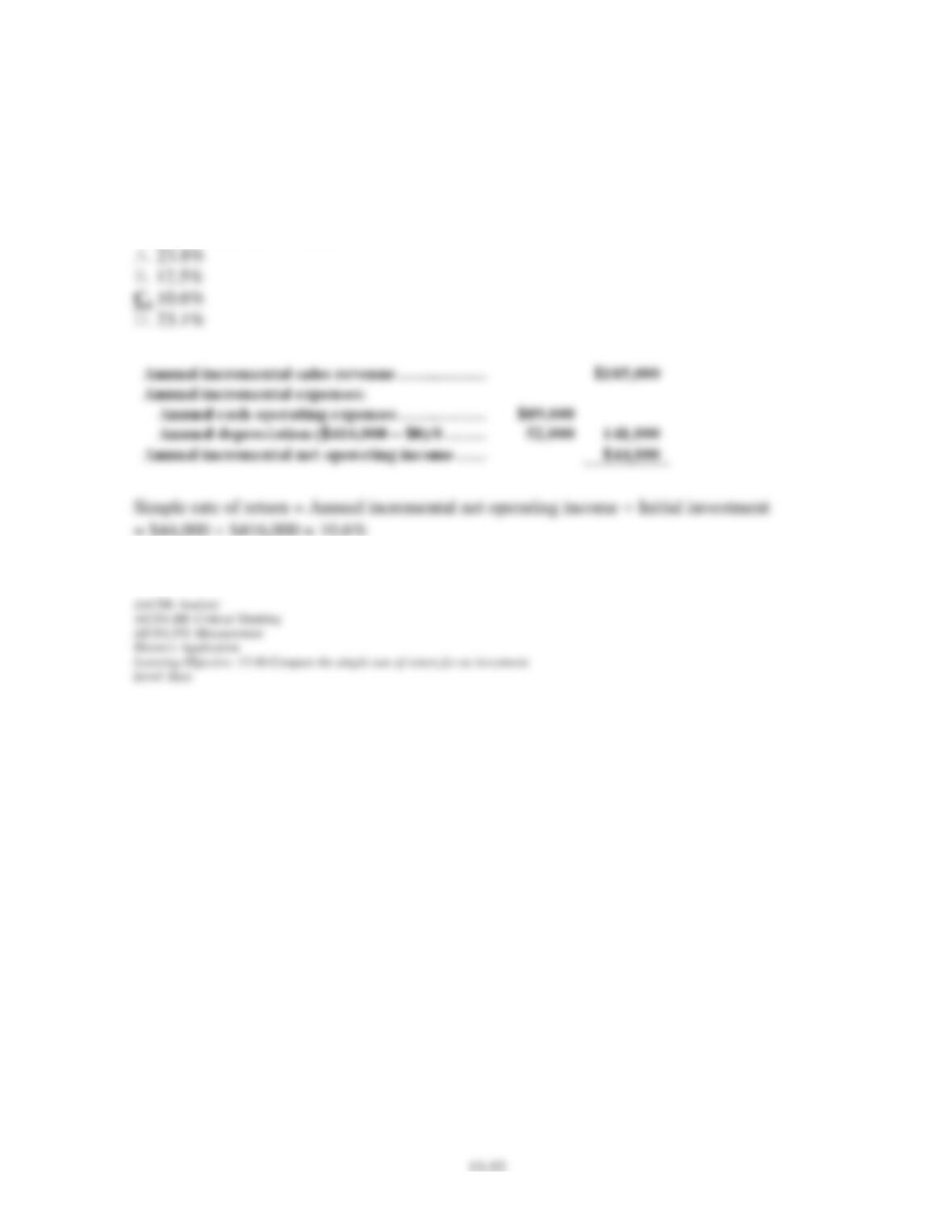
72. (Ignore income taxes in this problem.) Hartong Corporation is contemplating purchasing
equipment that would increase sales revenues by $185,000 per year and cash operating
expenses by $89,000 per year. The equipment would cost $416,000 and have a 8 year life
with no salvage value. The annual depreciation would be $52,000. The simple rate of return
on the investment is closest to:
Chapter 13 Capital Budgeting Decisions
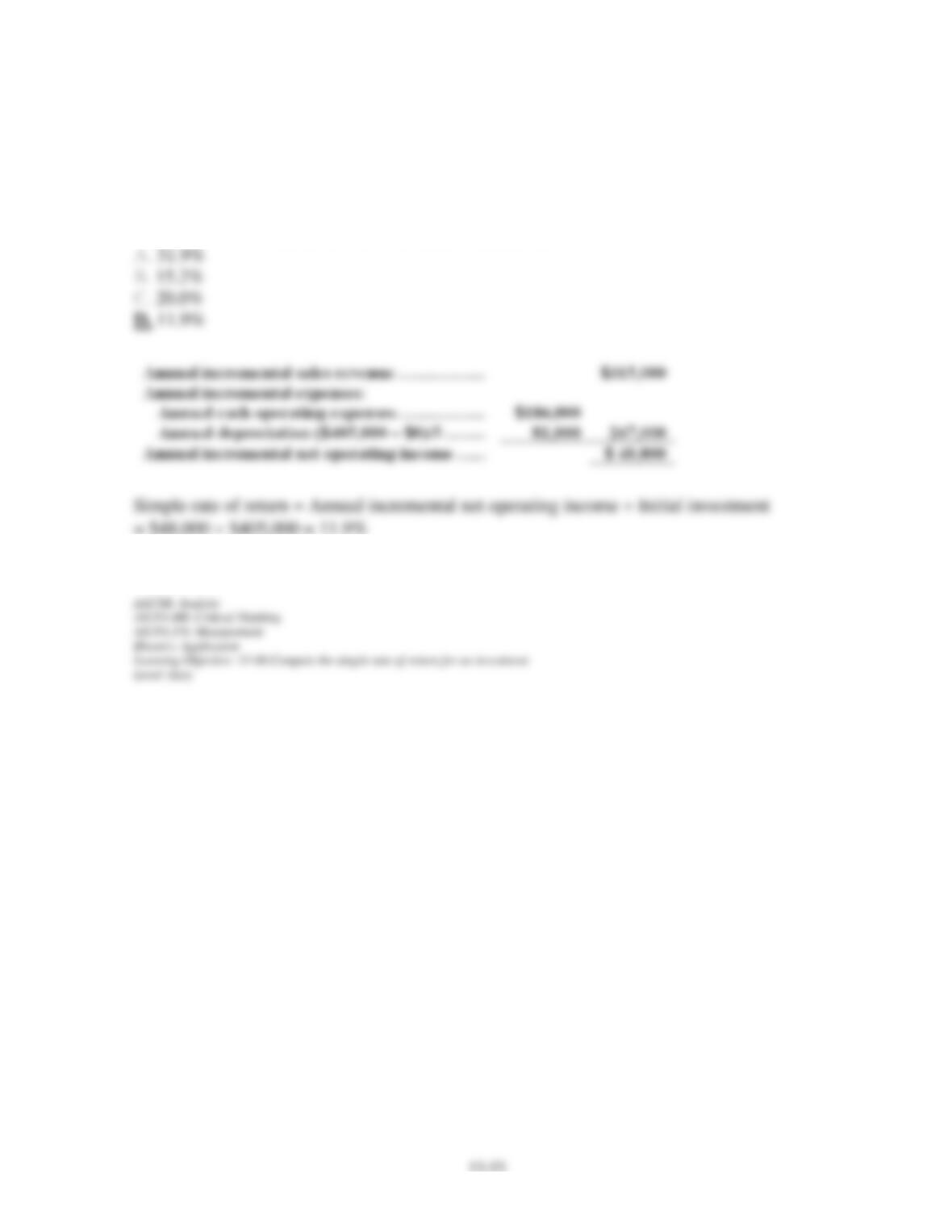
73. (Ignore income taxes in this problem.) An expansion at Fenstermacher, Inc., would
increase sales revenues by $315,000 per year and cash operating expenses by $186,000 per
year. The initial investment would be for equipment that would cost $405,000 and have a 5
year life with no salvage value. The annual depreciation on the equipment would be $81,000.
The simple rate of return on the investment is closest to:
Chapter 13 Capital Budgeting Decisions
74. (Ignore income taxes in this problem.) The management of Rouleau Corporation is
investigating automating a process. Old equipment, with a current salvage value of $10,000,
would be replaced by a new machine. The new machine would be purchased for $240,000 and
would have a 6 year useful life and no salvage value. By automating the process, the company
would save $64,000 per year in cash operating costs. The simple rate of return on the
investment is closest to:
Chapter 13 Capital Budgeting Decisions
75. The payback period for the investment is closest to:
76. The simple rate of return on the investment is closest to:
Chapter 13 Capital Budgeting Decisions
77. The net present value on this investment is closest to:
78. The internal rate of return on the investment is closest to:
Chapter 13 Capital Budgeting Decisions
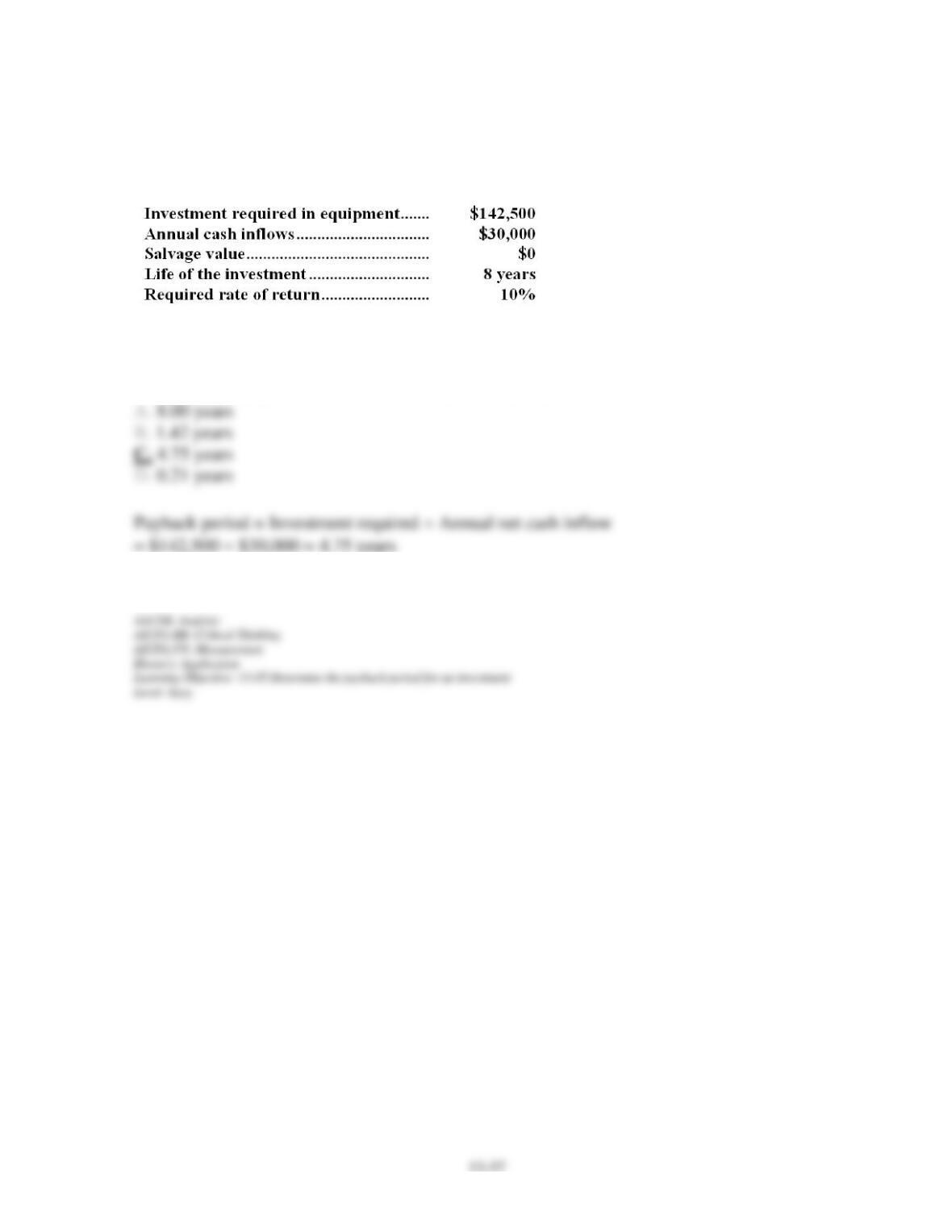
(Ignore income taxes in this problem.) Chow Company has gathered the following data on a
proposed investment project:
79. The payback period for the investment is closest to:
Chapter 13 Capital Budgeting Decisions
80. The simple rate of return on the investment is closest to:
81. The net present value on this investment is closest to:
Chapter 13 Capital Budgeting Decisions
82. The internal rate of return on the investment is closest to:
(Ignore income taxes in this problem.) Bugle’s Bagel Bakery is investigating the purchase of
a new bagel making machine. This machine would provide an annual operating cost savings
of $3,650 for each of the next 4 years. In addition, this new machine would allow the
production of one new type of bagel which would result in selling 1,500 dozen more bagels
each year. The company earns a contribution margin of $0.90 on each dozen bagels sold. The
purchase price of this machine is $13,450 and it will have a 4 year useful life. Bugle’s
discount rate is 14%.
83. The total annual cash inflow from this machine for capital budgeting purposes is:
Chapter 13 Capital Budgeting Decisions
84. The internal rate of return for this investment is closest to:
85. The net present value of this investment is closest to:
Chapter 13 Capital Budgeting Decisions
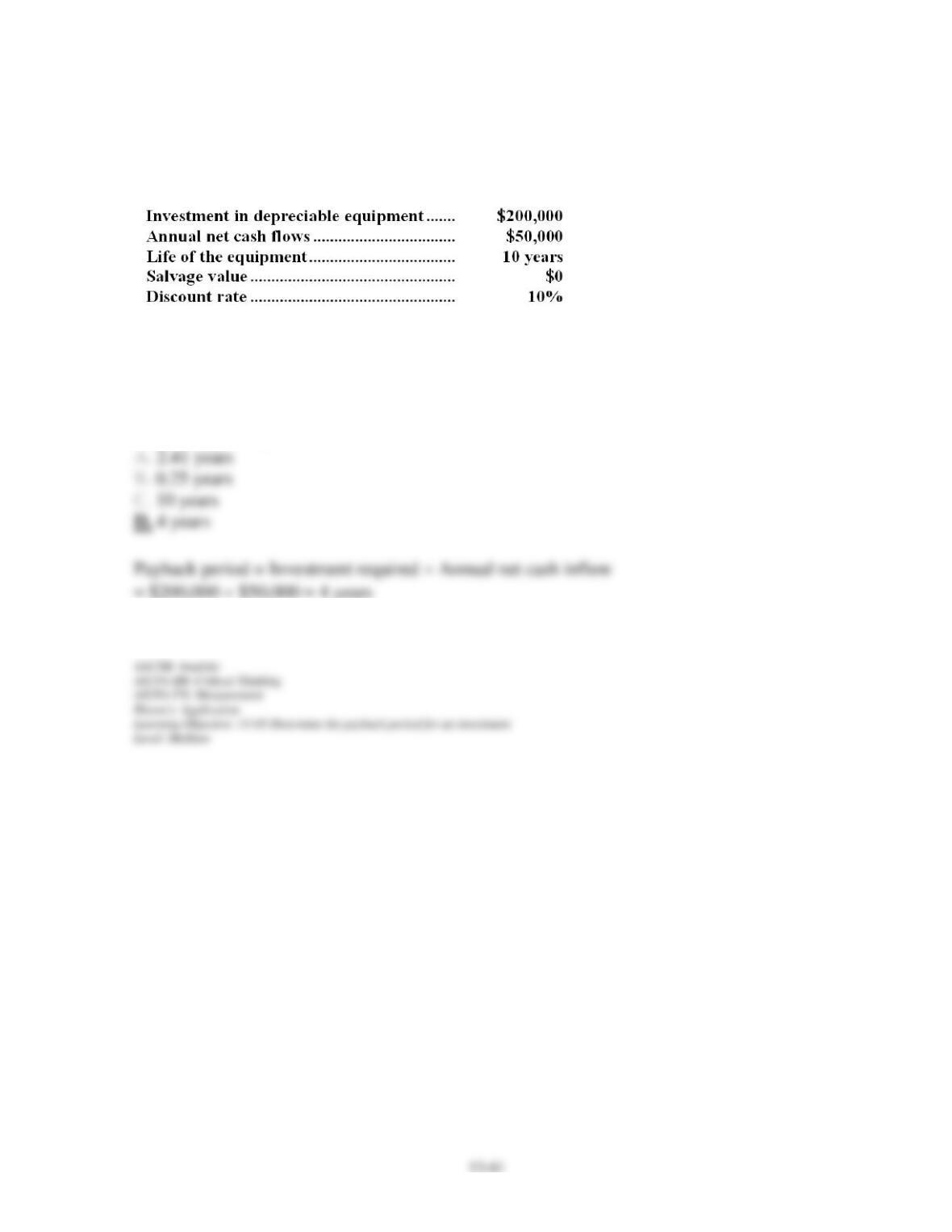
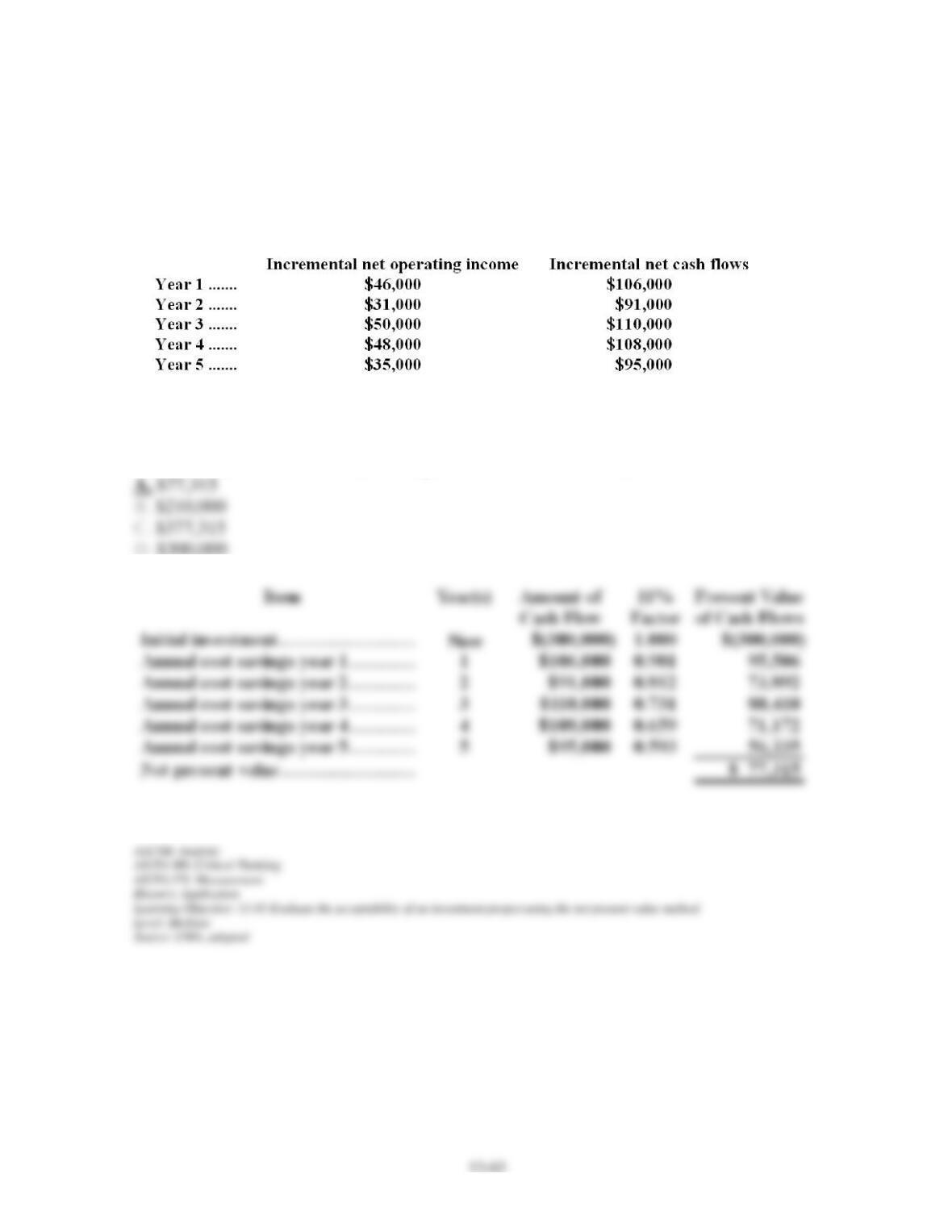
(Ignore income taxes in this problem.) Oriental Company has gathered the following data on
a proposed investment project:
The company uses straight-line depreciation on all equipment.
86. The payback period for the investment would be:
Chapter 13 Capital Budgeting Decisions
87. The simple rate of return on the investment would be:
88. The net present value of this investment would be:
Chapter 13 Capital Budgeting Decisions
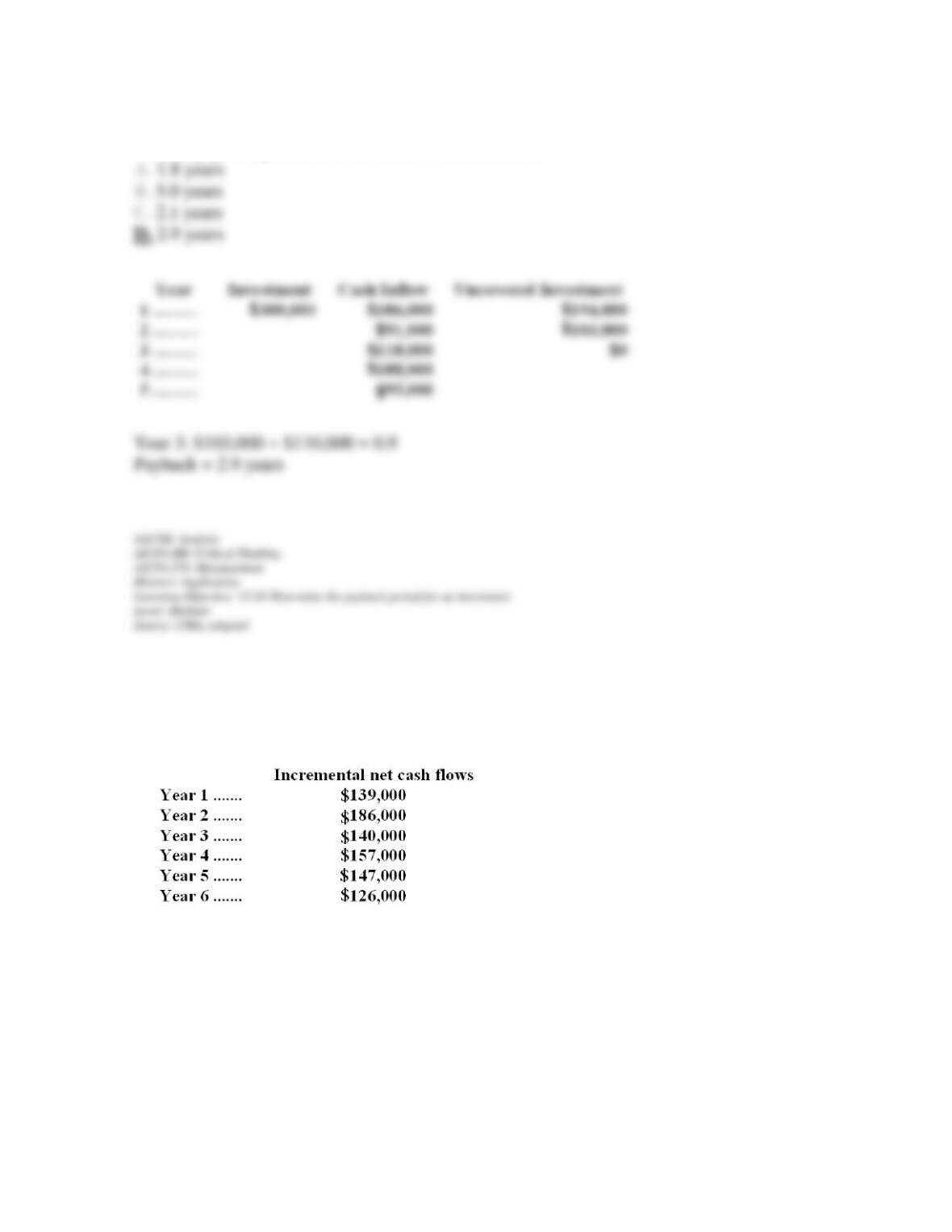
(Ignore income taxes in this problem.) Houis Inc. is considering the acquisition of a new
machine that costs $300,000 and has a useful life of 5 years with no salvage value. The
incremental net operating income and incremental net cash flows that would be produced by
the machine are:
89. If the discount rate is 11%, the net present value of the investment is closest to:
Chapter 13 Capital Budgeting Decisions
13–64
90. The payback period of this investment is closest to:
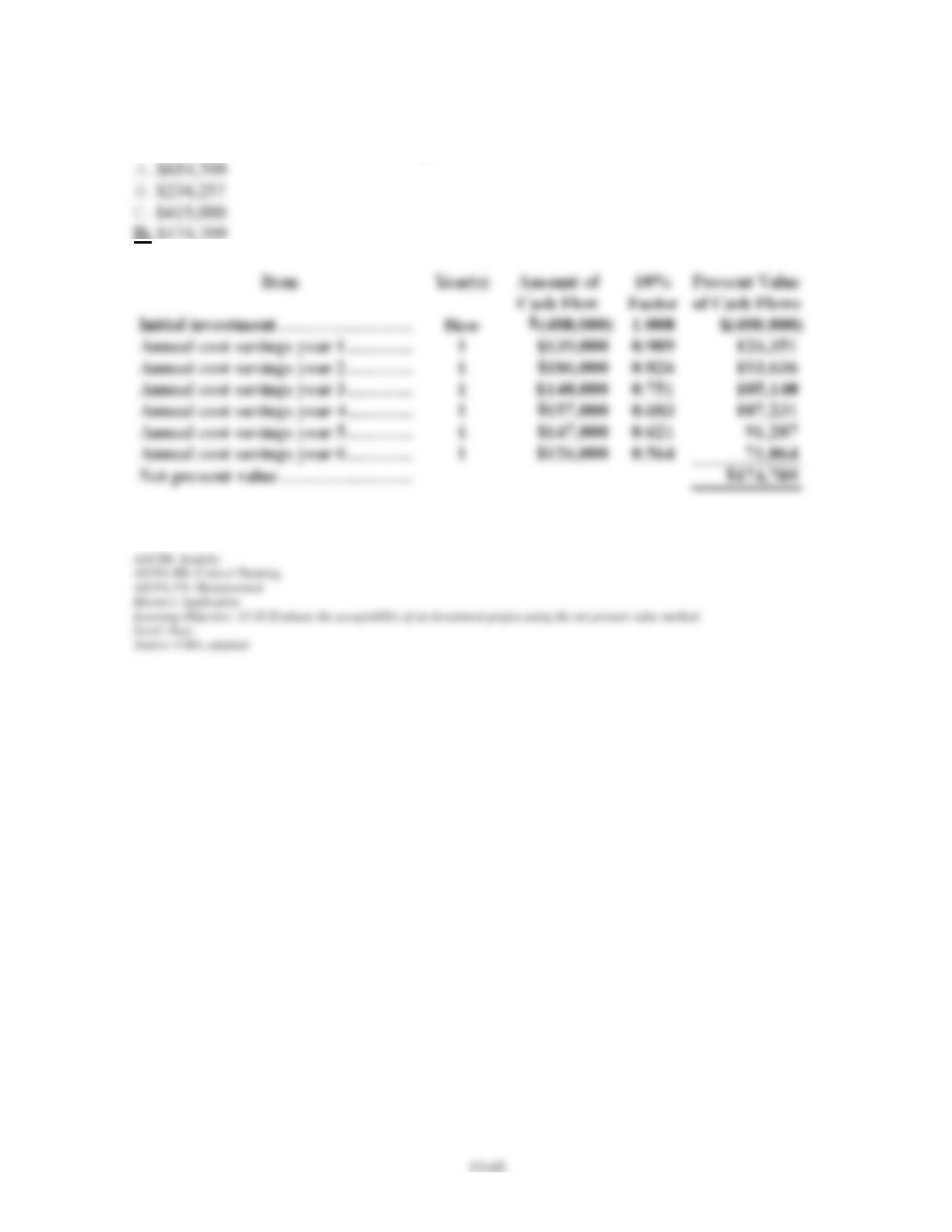
(Ignore income taxes in this problem.) Gull Inc. is considering the acquisition of equipment
that costs $480,000 and has a useful life of 6 years with no salvage value. The incremental net
cash flows that would be generated by the equipment are:
Chapter 13 Capital Budgeting Decisions
91. If the discount rate is 10%, the net present value of the investment is closest to: