Current Liabilities and Contingencies
13 – 35
DERIVATIONS — Computational (cont.)
No. Answer Derivation
Test Bank for Intermediate Accounting, Fifteenth Edition
13 – 36
DERIVATIONS — Computational (cont.)
DERIVATIONS — CPA Adapted
No. Answer Derivation
Current Liabilities and Contingencies
13 – 37
BRIEF EXERCISES
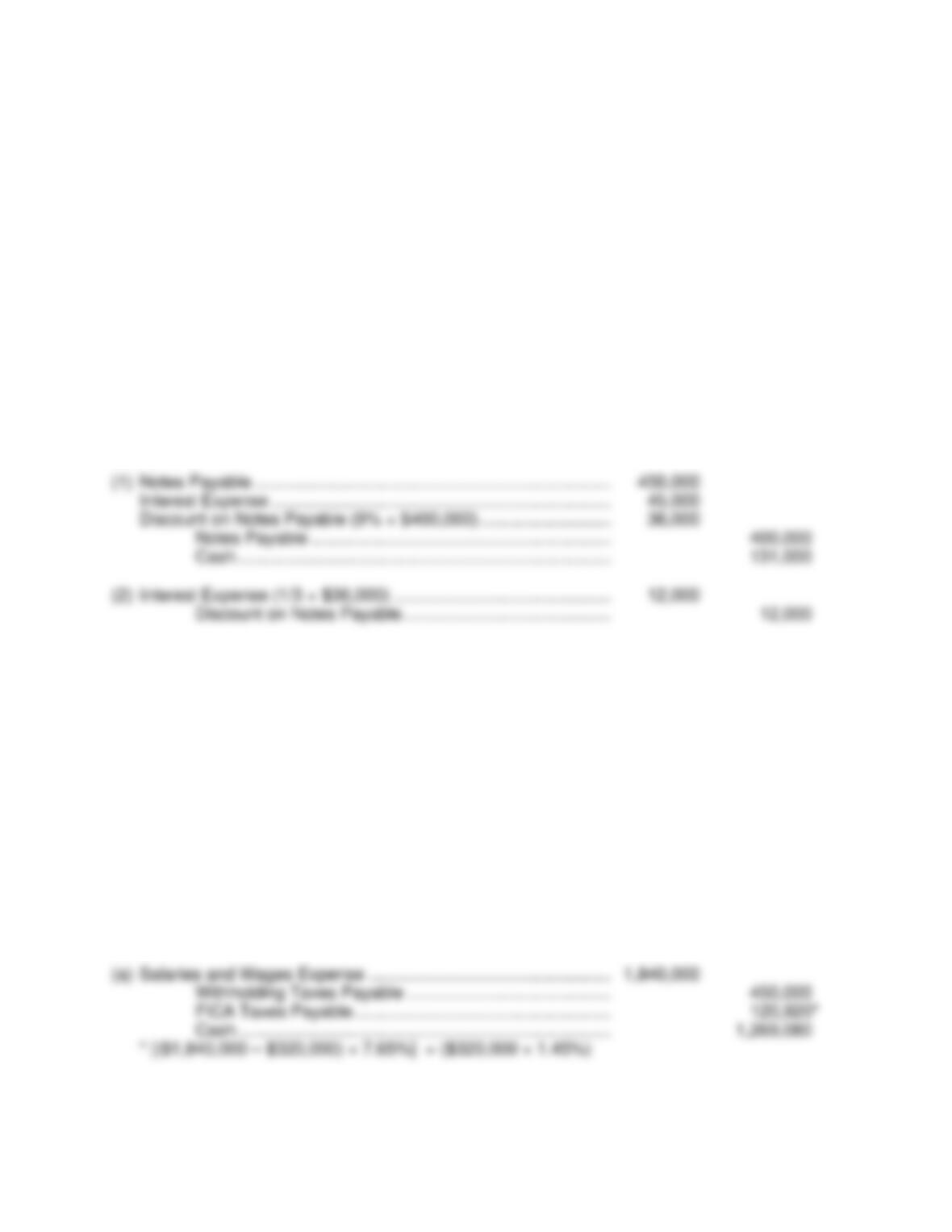
BE. 13-147—Notes payable.
On August 31, Latty Co. partially refunded $450,000 of its outstanding 10% note payable made
one year ago to Dugan State Bank by paying $450,000 plus $45,000 interest, having obtained the
$495,000 by using $131,000 cash and signing a new one-year $400,000 note discounted at 9%
by the bank.
Instructions
(1) Make the entry to record the partial refunding. Assume Latty Co. makes reversing entries
when appropriate.
(2) Prepare the adjusting entry at December 31, assuming straight-line amortization of the
discount.
Solution 13-147
BE. 13-148—Payroll entries.
Total payroll of Walnut Co. was $1,840,000, of which $320,000 represented amounts paid in
excess of $106,800 to certain employees. The amount paid to employees in excess of $7,000
was $1,440,000. Income taxes withheld were $450,000. The state unemployment tax is 1.2%, the
federal unemployment tax is .8%, and the F.I.C.A. tax is 7.65% on an employee’s salaries and
wages to $106,800 and 1.45% in excess of $106,800.
Instructions
(a) Prepare the journal entry for the salaries and wages paid.
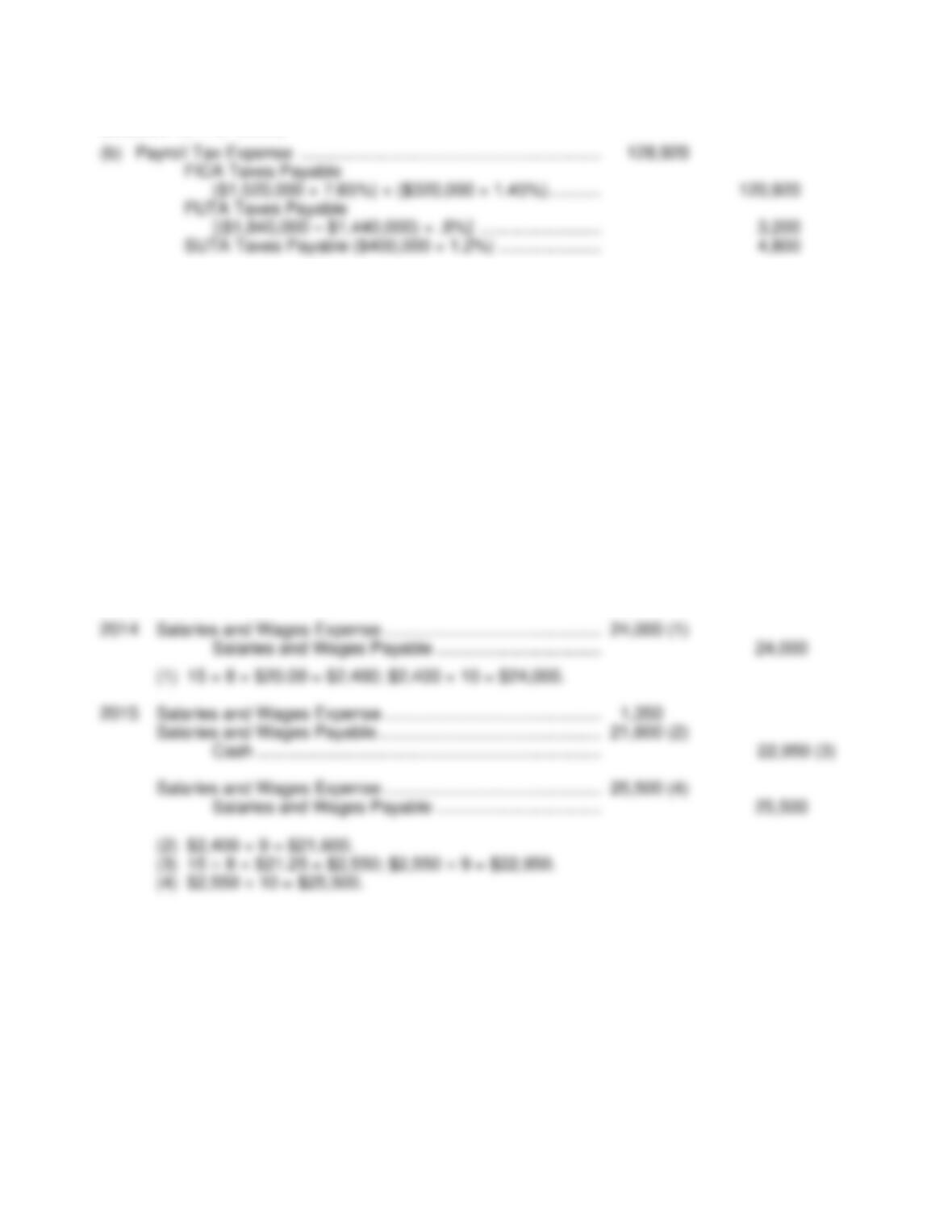
(b) Prepare the entry to record the employer payroll taxes.
Solution 13-148
Test Bank for Intermediate Accounting, Fifteenth Edition
13 – 38
Solution 13-148 (cont.)
EXERCISES
Ex. 13-149—Compensated absences.
Snow Co. began operations on January 2, 2014. It employs 15 people who work 8-hour days.
Each employee earns 10 paid vacation days annually. Vacation days may be taken after January
10 of the year following the year in which they are earned. The average hourly wage rate was
$20.00 in 2014 and $21.25 in 2015. The average vacation days used by each employee in 2015
was 9. Snow Co. accrues the cost of compensated absences at rates of pay in effect when earned.
Instructions
Prepare journal entries to record the transactions related to paid vacation days during 2014 and
2015.
Solution 13-149
Ex. 13-150—Contingent liabilities.
Below are three independent situations.
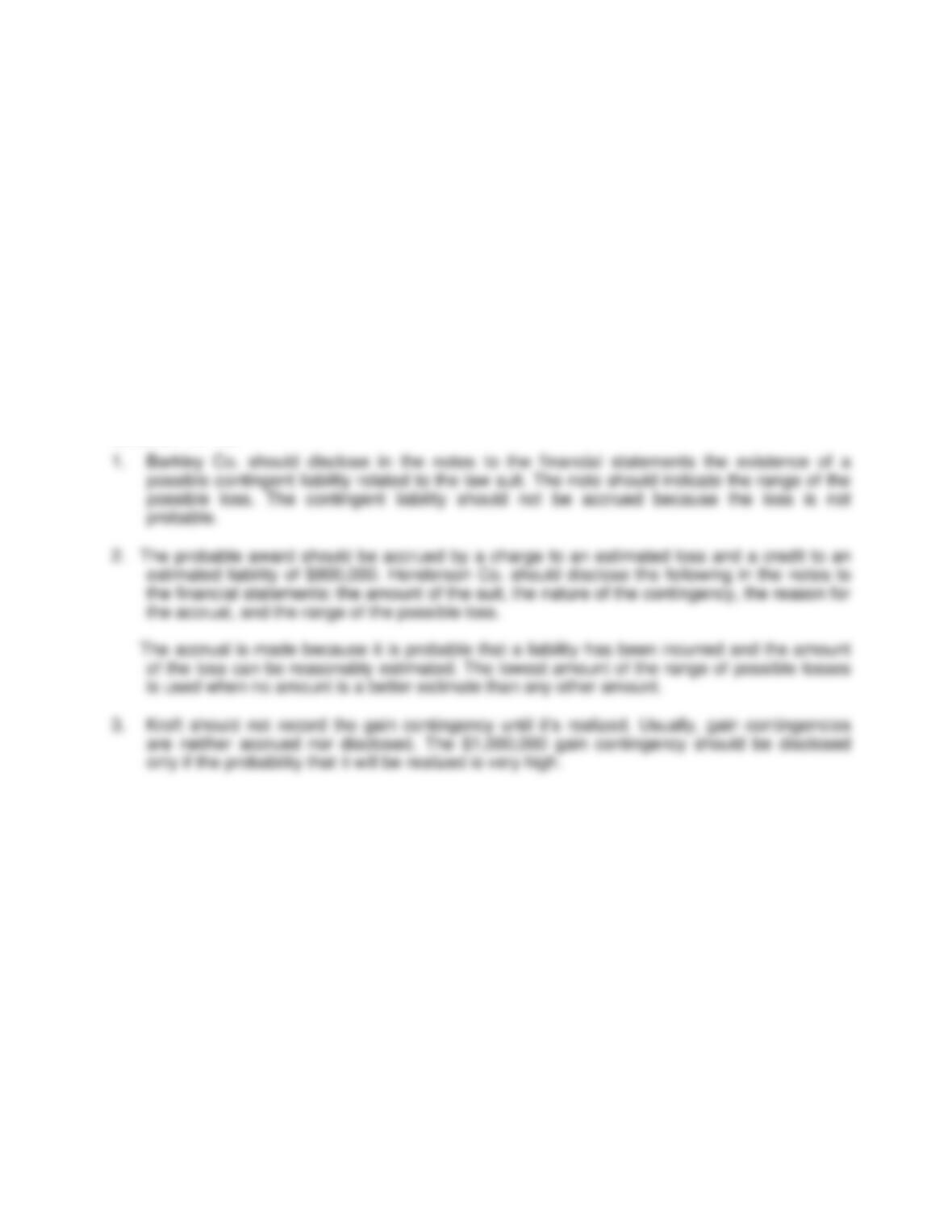
1. In August, 2014 a worker was injured in the factory in an accident partially the result of his
own negligence. The worker has sued Barkley Co. for $800,000. Counsel believes it is
reasonably possible that the outcome of the suit will be unfavorable and that the settlement
would cost the company from $250,000 to $500,000.
Current Liabilities and Contingencies
13 – 39
Ex. 13-150 (cont.)
2. A suit for breach of contract seeking damages of $2,400,000 was filed by an author against
Henderson Co. on October 4, 2014. Henderson’s legal counsel believes that an unfavorable
outcome is probable. A reasonable estimate of the award to the plaintiff is between $800,000
and $1,800,000. No amount within this range is a better estimate of potential damages than
any other amount.
3. Kroft is involved in a pending court case. Kroft’s lawyers believe it is probable that Kroft will be
awarded damages of $1,000,000.
Instructions
Discuss the proper accounting treatment, including any required disclosures, for each situation.
Give the rationale for your answers.
Solution 13-150
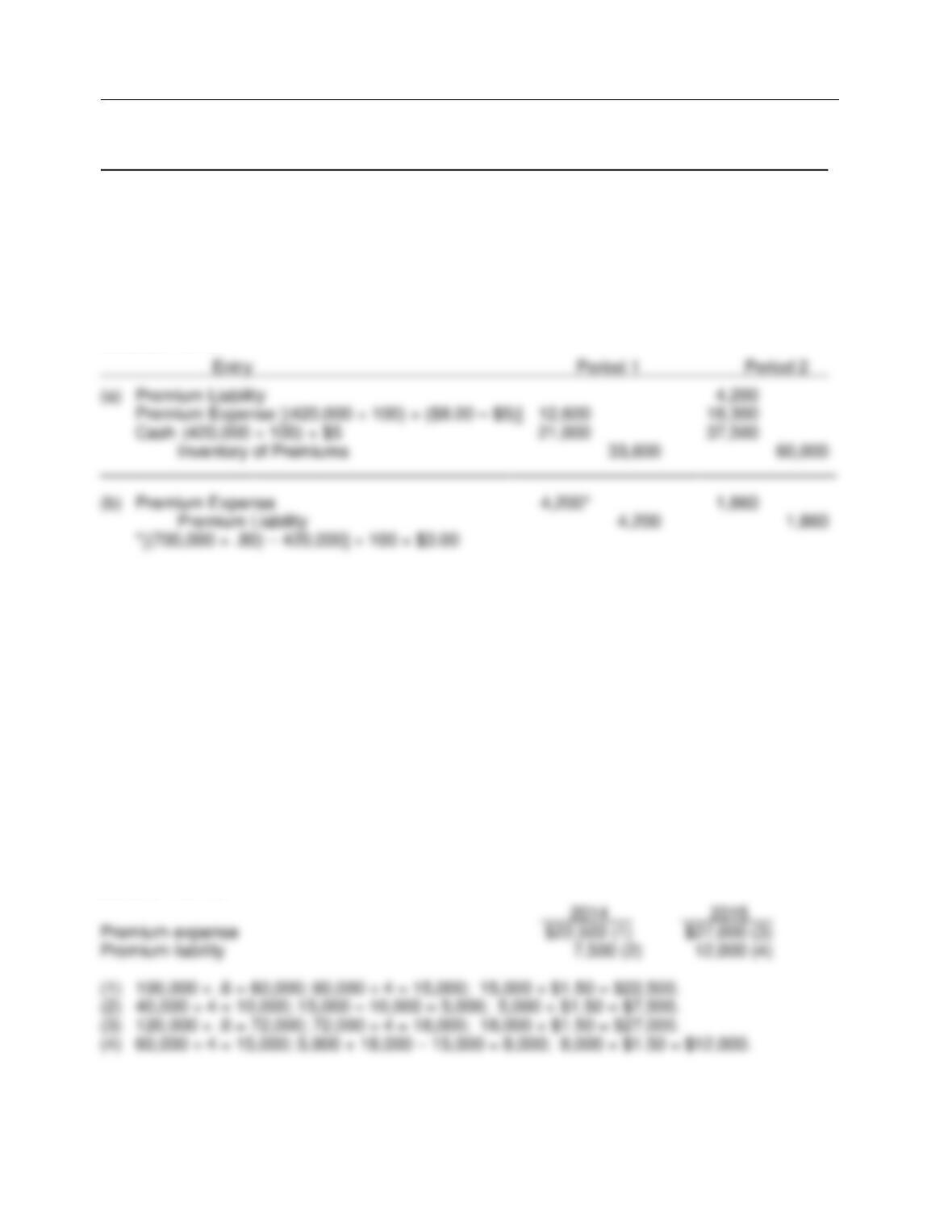
Ex. 13-151—Premiums.
Irwin Music Shop gives its customers coupons redeemable for a poster plus a Bo Diddley CD.
One coupon is issued for each dollar of sales. On the surrender of 100 coupons and $5.00 cash,
the poster and CD are given to the customer. It is estimated that 80% of the coupons will be
presented for redemption. Sales for the first period were $700,000, and the coupons redeemed
totaled 420,000. Sales for the second period were $840,000, and the coupons redeemed totaled
750,000. Irwin Music Shop bought 20,000 posters at $2.00/poster and 20,000 CDs at $6.00/CD.
Instructions
Prepare the following entries for the two periods, assuming all the coupons expected to be
redeemed from the first period were redeemed by the end of the second period.
Test Bank for Intermediate Accounting, Fifteenth Edition
13 – 40
Ex. 13-151 (cont.)
Entry Period 1 Period 2
(a) To record coupons redeemed
———————————————————————————————————————————
(b) To record estimated liability
———————————————————————————————————————————
Solution 13-151
Ex. 13-152—Premiums.
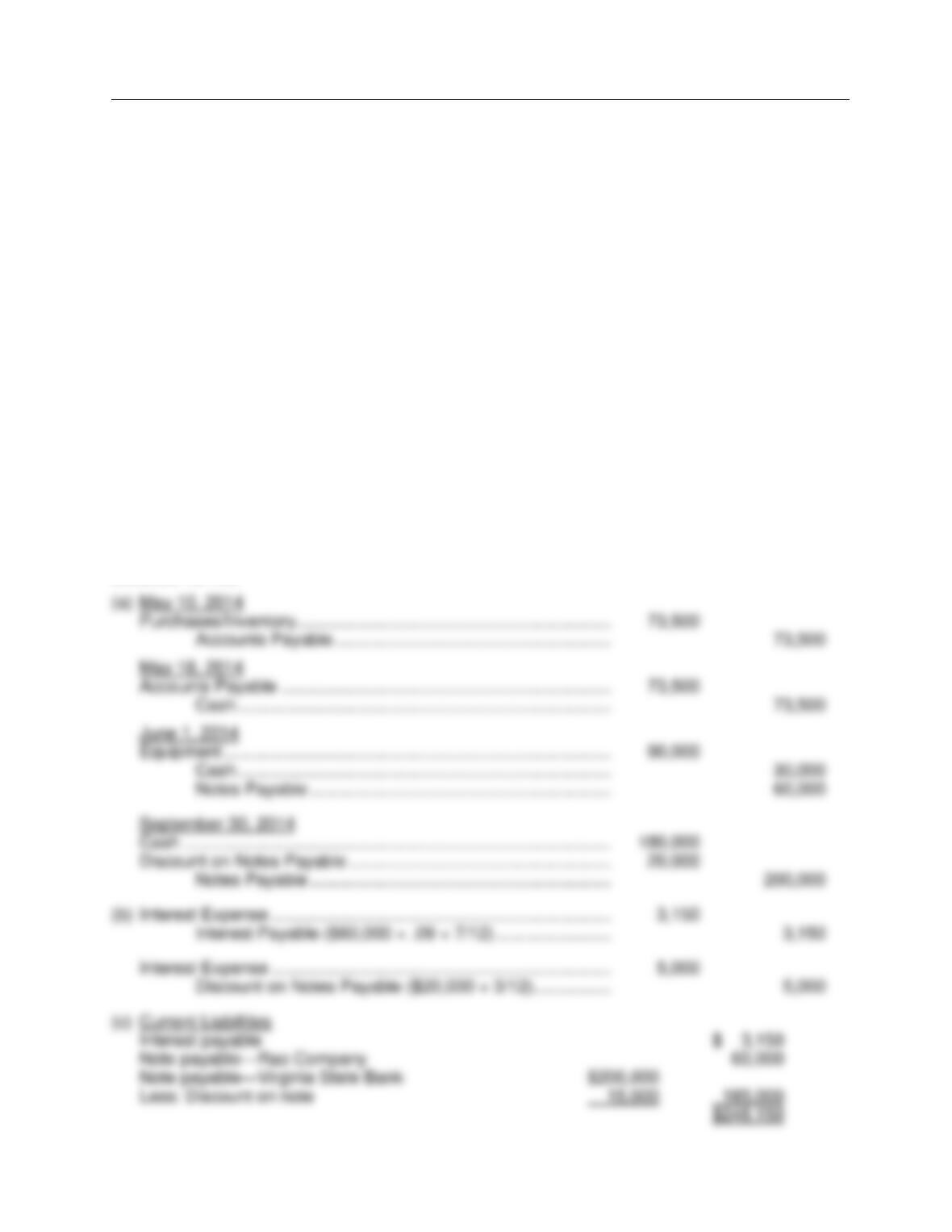
Sterling Co. includes one coupon in each bag of dog food it sells. In return for 4 coupons,
customers receive a dog toy that the company purchases for $1.50 each. Sterling’s experience
indicates that 60 percent of the coupons will be redeemed. During 2014, 100,000 bags of dog
food were sold, 12,000 toys were purchased, and 40,000 coupons were redeemed. During 2015,
120,000 bags of dog food were sold, 16,000 toys were purchased, and 60,000 coupons were
redeemed.
Instructions
Determine the premium expense to be reported in the income statement and the premium liability
on the balance sheet for 2014 and 2015.
Solution 13-152
Current Liabilities and Contingencies
13 – 41
PROBLEMS
Pr. 13-153—Accounts and Notes Payable.
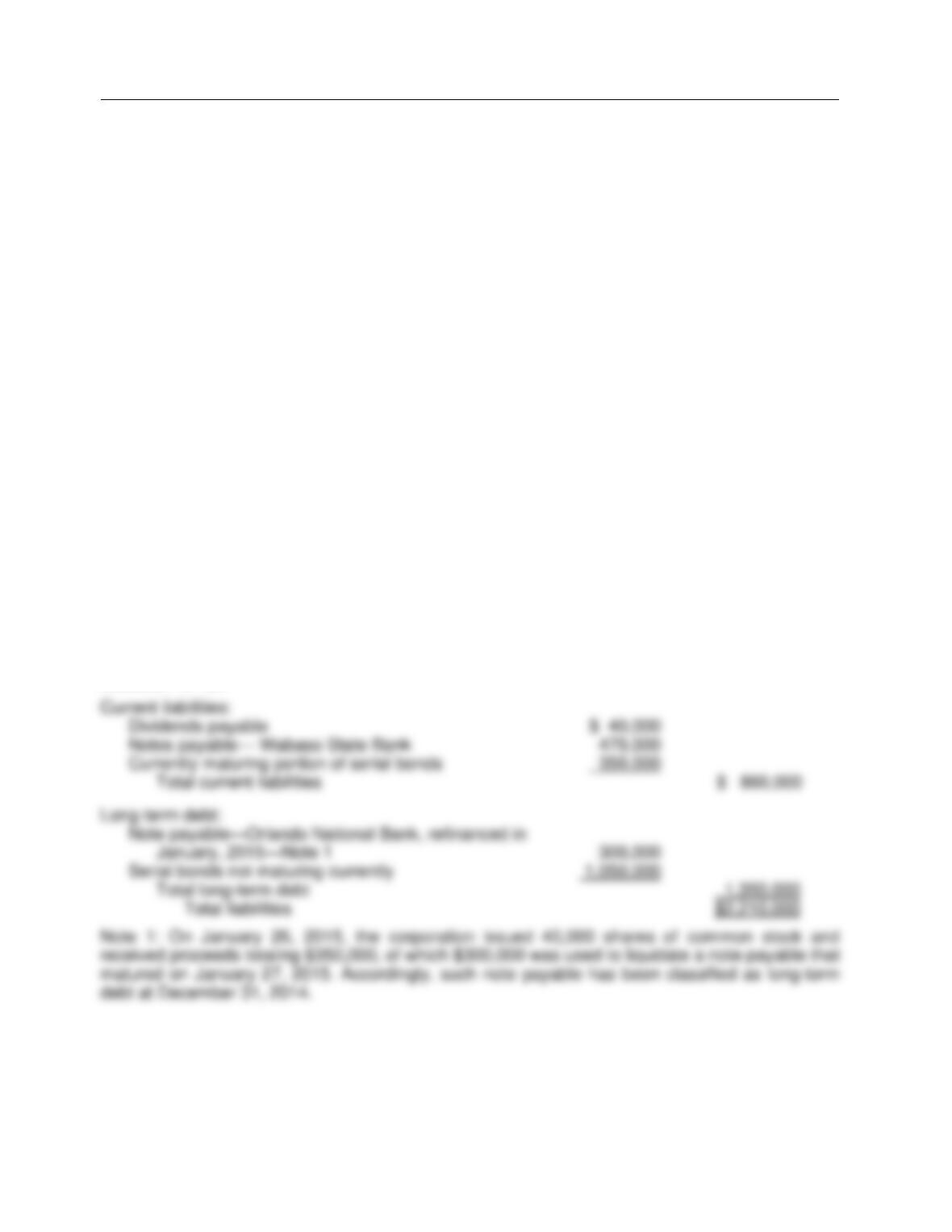
Described below are certain transactions of Lamar Company for 2014:
1. On May 10, the company purchased goods from Fox Company for $75,000, terms 2/10,
n/30. Purchases and accounts payable are recorded at net amounts. The invoice was paid
on May 18.
2. On June 1, the company purchased equipment for $90,000 from Rao Company, paying
$30,000 in cash and giving a one-year, 9% note for the balance.
3. On September 30, the company discounted at 10% its $200,000, one-year zero-interest-
bearing note at Virginia State Bank.
Instructions
(a) Prepare the journal entries necessary to record the transactions above using appropriate
dates.
(b) Prepare the adjusting entries necessary at December 31, 2014 in order to properly report
interest expense related to the above transactions. Assume straight-line amortization of
discounts.
(c) Indicate the manner in which the above transactions should be reflected in the Current
Liabilities section of Lamar Company’s December 31, 2014 balance sheet.
Solution 13-153
Test Bank for Intermediate Accounting, Fifteenth Edition
13 – 42
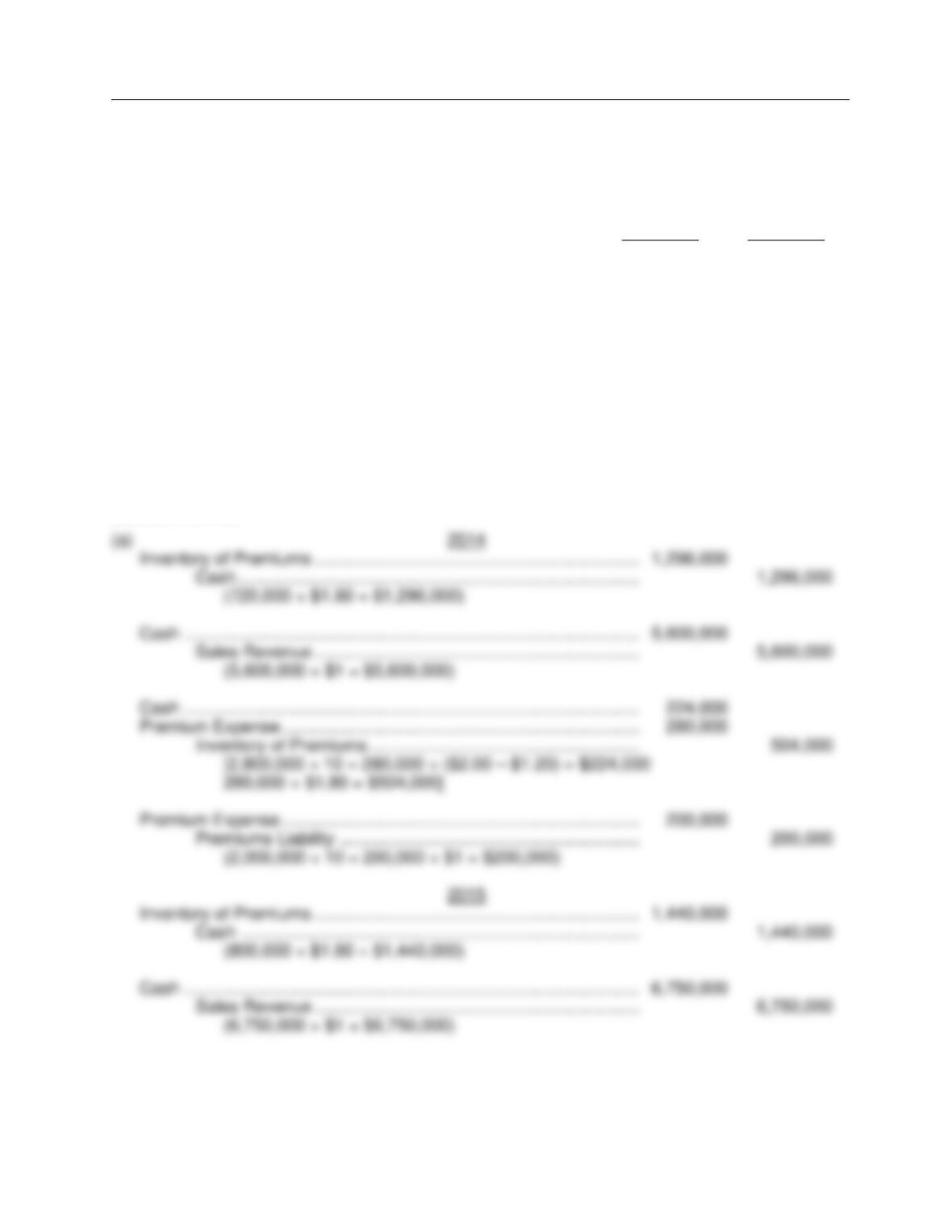
Pr. 13-154—Refinancing of short-term debt.
At the financial statement date of December 31, 2014, the liabilities outstanding of Pollard
Corporation included the following:
1. Cash dividends on common stock, $40,000, payable on January 15, 2015.
2. Note payable to Wabaso State Bank, $470,000, due January 20, 2015.
3. Serial bonds, $1,400,000, of which $350,000 mature during 2015.
4. Note payable to Orlando National Bank, $300,000, due January 27, 2015.
The following transactions occurred early in 2015:
January 15: The cash dividends on common stock were paid.
January 20: The note payable to Wabaso State Bank was paid.
January 25: The corporation entered into a financing agreement with Wabaso State Bank,
enabling it to borrow up to $500,000 at any time through the end of 2017.
Amounts borrowed under the agreement would bear interest at 1% above the
bank’s prime rate and would mature 3 years from the date of the loan. The
corporation immediately borrowed $400,000 to replace the cash used in paying its
January 20 note to the bank.
January 26: 40,000 shares of common stock were issued for $350,000. $300,000 of the
proceeds was used to liquidate the note payable to Orlando National Bank.
February 1: The financial statements for 2014 were issued.
Instructions
Prepare a partial balance sheet for Pollard Corporation, showing the manner in which the above
liabilities should be presented at December 31, 2014. The liabilities should be properly classified
between current and long-term, and appropriate note disclosure should be included.
Solution 13-154
Current Liabilities and Contingencies
13 – 43
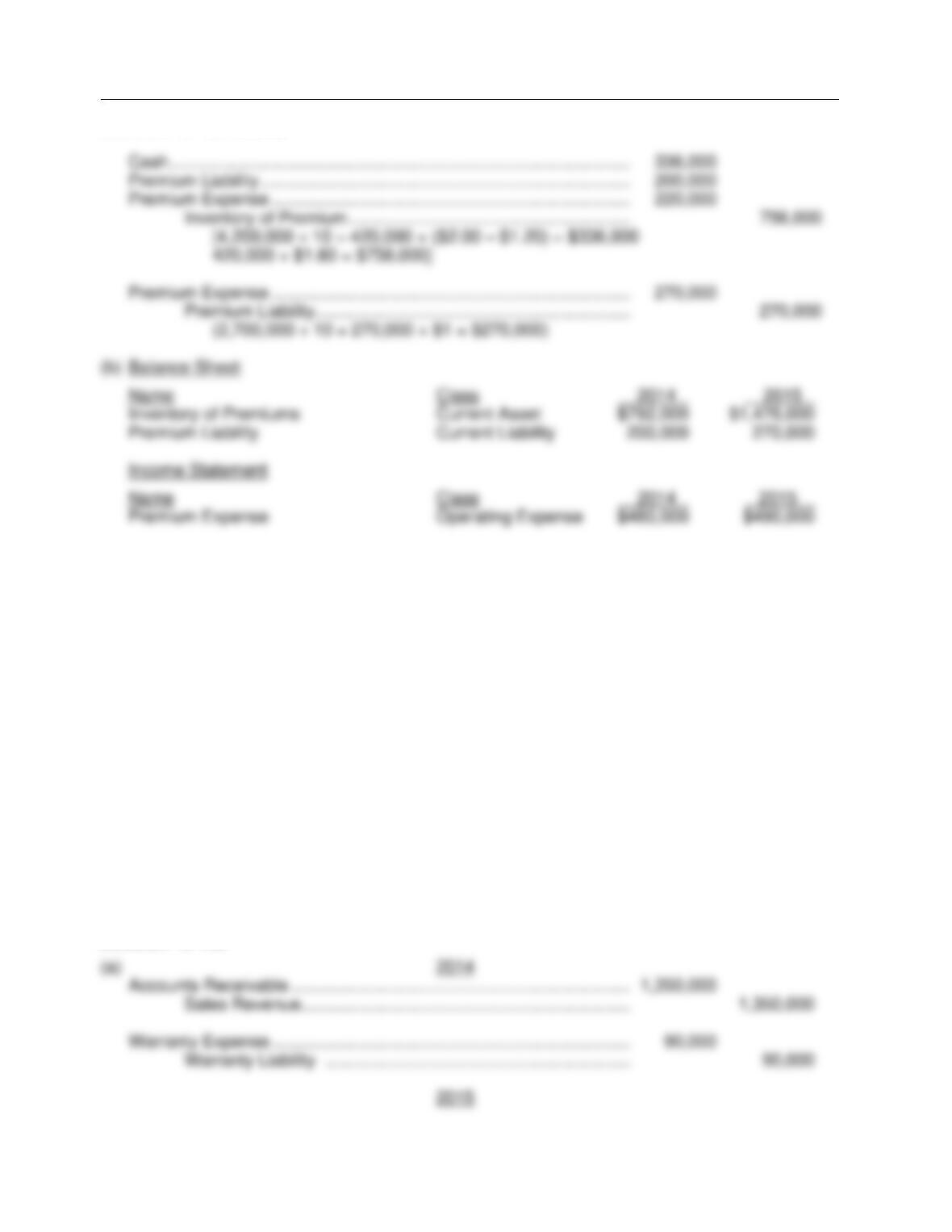
Pr. 13-155—Premiums.
Kane Candy Company offers a coffee mug as a premium for every ten $1 candy bar wrappers
presented by customers together with $2. The purchase price of each mug to the company is
$1.80; in addition it costs $1.20 to mail each mug. The results of the premium plan for the years
2014 and 2015 are as follows (assume all purchases and sales are for cash):
2014 2015
Coffee mugs purchased 720,000 800,000
Candy bars sold 5,600,000 6,750,000
Wrappers redeemed 2,800,000 4,200,000
2014 wrappers expected to be redeemed in 2015 2,000,000
2015 wrappers expected to be redeemed in 2016 2,700,000
Instructions
(a) Prepare the general journal entries that should be made in 2014 and 2015 related to the
above plan by Kane Candy.
(b) Indicate the account names, amounts, and classifications of the items related to the premium
plan that would appear on the Kane Candy Company balance sheet and income statement
at the end of 2014 and 2015.
Solution 13-155
Test Bank for Intermediate Accounting, Fifteenth Edition
13 – 44
Solution 13-155 (cont.)
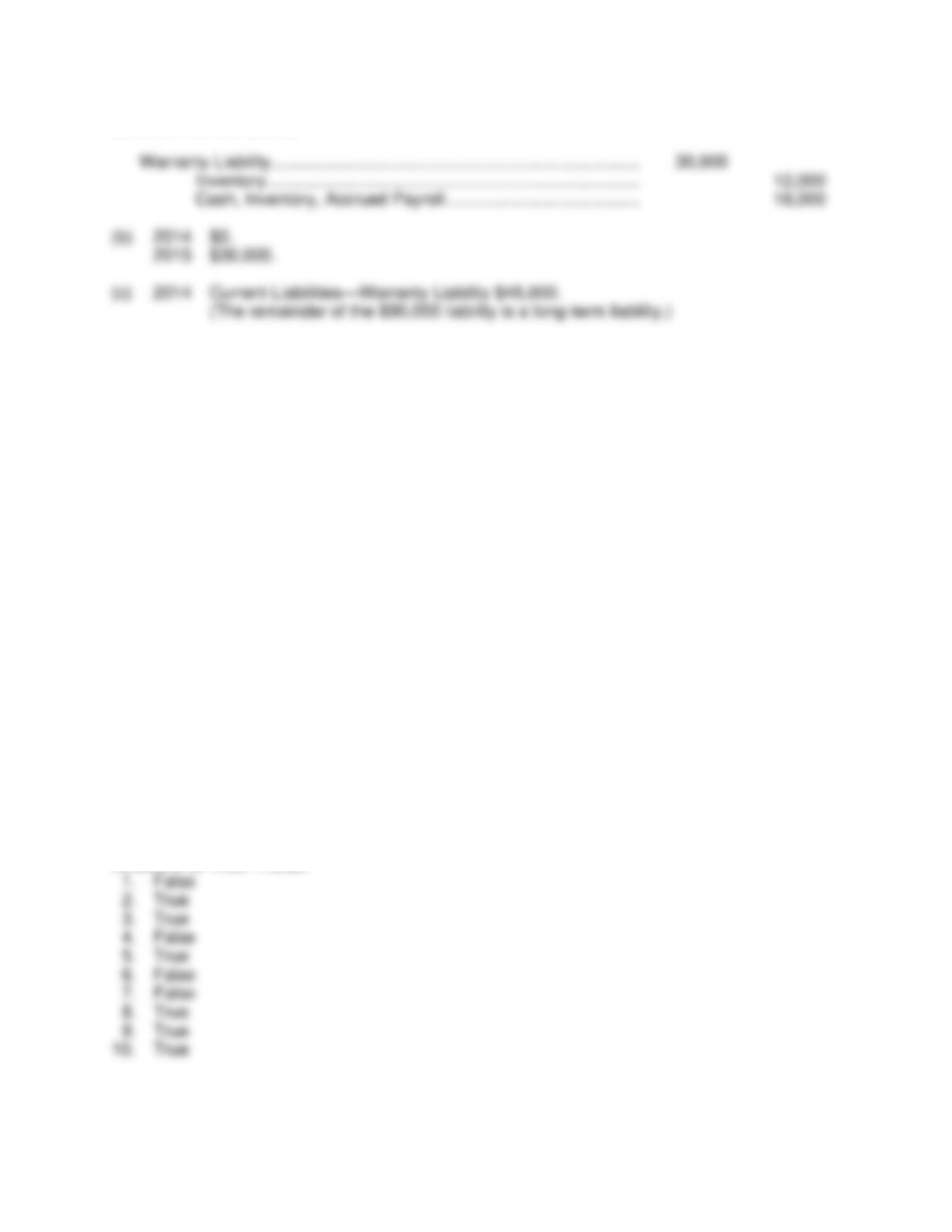
Pr. 13-156—Warranties.
Merritt Equipment Company sells computers for $1,500 each and also gives each customer a 2-
year warranty that requires the company to perform periodic services and to replace defective
parts. During 2014, the company sold 900 computers. Based on past experience, the company
has estimated the total 2-year warranty costs as $40 for parts and $60 for labor. (Assume sales
all occur at December 31, 2014.)
In 2015, Merritt incurred actual warranty costs relative to 2014 computer sales of $12,000 for
parts and $18,000 for labor.
Instructions
(a) Under the expense warranty approach, give the entries to reflect the above transactions
(accrual method) for 2014 and 2015.
(b) Under the cash-basis method, what are the Warranty Expense balances for 2014 and 2015?
(c) The transactions of part (a) create what balance under current liabilities in the 2014 balance
sheet?
Solution 13-156
Current Liabilities and Contingencies
13 – 45
Solution 13-156 (cont.)
IFRS QUESTIONS
True / False Questions
1. Short-term debt obligations are classified as current liabilities unless an agreement to
refinance is completed before the financial statements are issued.
2. For purposes of recognizing a provision “probable” is defined as more likely than not
3. A provision differs from other liabilities in that there is greater uncertainty about the timing
and amount of settlement.
4. IFRS allows for reduced disclosure of contingent liabilities if the disclosure could increase
the company`s chance of losing a lawsuit.
5. Contingent liabilities are not reported in the financial statements but may be disclosed in the
notes to the financial statements if the likelihood of an unfavorable outcome is possible.
6. A company can exclude a short-term obligation from current liabilities if it intends to
refinance the obligation and has an unconditional right to defer settlement of the obligation
for at least 12 months following the due date.
7. Provisions are only recorded if it is likely that the company will have to settle an obligation at
some point in the future.
8. An onerous contract is one in which the unavoidable costs of satisfying the obligations
outweigh the economic benefits to be received.
9. Contingent assets are not reported in the statement of financial position.
10. IFRS uses the term “contingent” for assets and liabilities not recognized in the financial
statement.
Answers to True / False:

Test Bank for Intermediate Accounting, Fifteenth Edition
13 – 46
Multiple Choice:
11. Under IFRS, which of the following is used to measure a liability, if a range of estimates is
predicted and no amount in the range is more likely than any other amount in the range?
a. Minimum of the range
b. Maximum of the range
c. Mid-point of the range
d. Average of the range
Correct Answer: C
Explanation: Under IFRS, if a range of estimates is predicted and no amount in the range is
more likely than any other amount in the range, the “mid–point” of the range is used to
measure the liability.
12. Under IFRS, short-term obligations expected to be refinanced can be classified as noncurrent
if the refinancing is completed:
a. by the financial reporting date.
b. by issue date of the financial statement.
c. either by the financial statement date or before the date the financial statement is issued.
d. after the maturity date of the obligation.
Correct Answer: A
Explanation: Under IFRS, a company must classify its short-term obligation as a current
liability if the refinancing was not completed by the financial reporting date. Only if the
refinancing was completed before the financial reporting date, can the company classify the
obligation as non-current.
13. Examples of contingent assets include all of the following except:
a. unrealized gain on the sale of investments.
b. pending lawsuit with a probable favorable outcome.
c. possible refunds from the government in tax disputes.
d. promise of land to be donated by city as an enticement to move manufacturing facilities.
Correct Answer: A
Explanation: Typical contingent assets include: possible receipts of monies from gifts,
donations, bonuses, possible refunds from the government in tax disputes, and pending court
cases with a probable favorable outcome.
14. Contingent assets need not be disclosed in the financial statements or in the notes if they are:
a. virtually certain to occur.
b. probable to occur.
c. likely to occur.
d. possible but not probable to occur.
Current Liabilities and Contingencies
13 – 47
Correct Answer: D
Explanation: If realization of the contingent asset is possible but not probable to occur, no
disclosure is required.
15. For which of the following areas a provision may be recognized in the financial statement?
a. Possibility of war
b. Business recession
c. Warranties
d. Strike
Correct Answer: C
Explanation: Common areas for which provisions may be recognized in the financial
statements includes: lawsuits, warranties, premiums, environmental, onerous contracts, and
restructuring. Companies do not record or report in the notes to the financial statements
general risk contingencies inherent in business operations (e.g., the possibility of war, strike,
uninsurable catastrophes, or a business recession).
IFRS Short Answer:
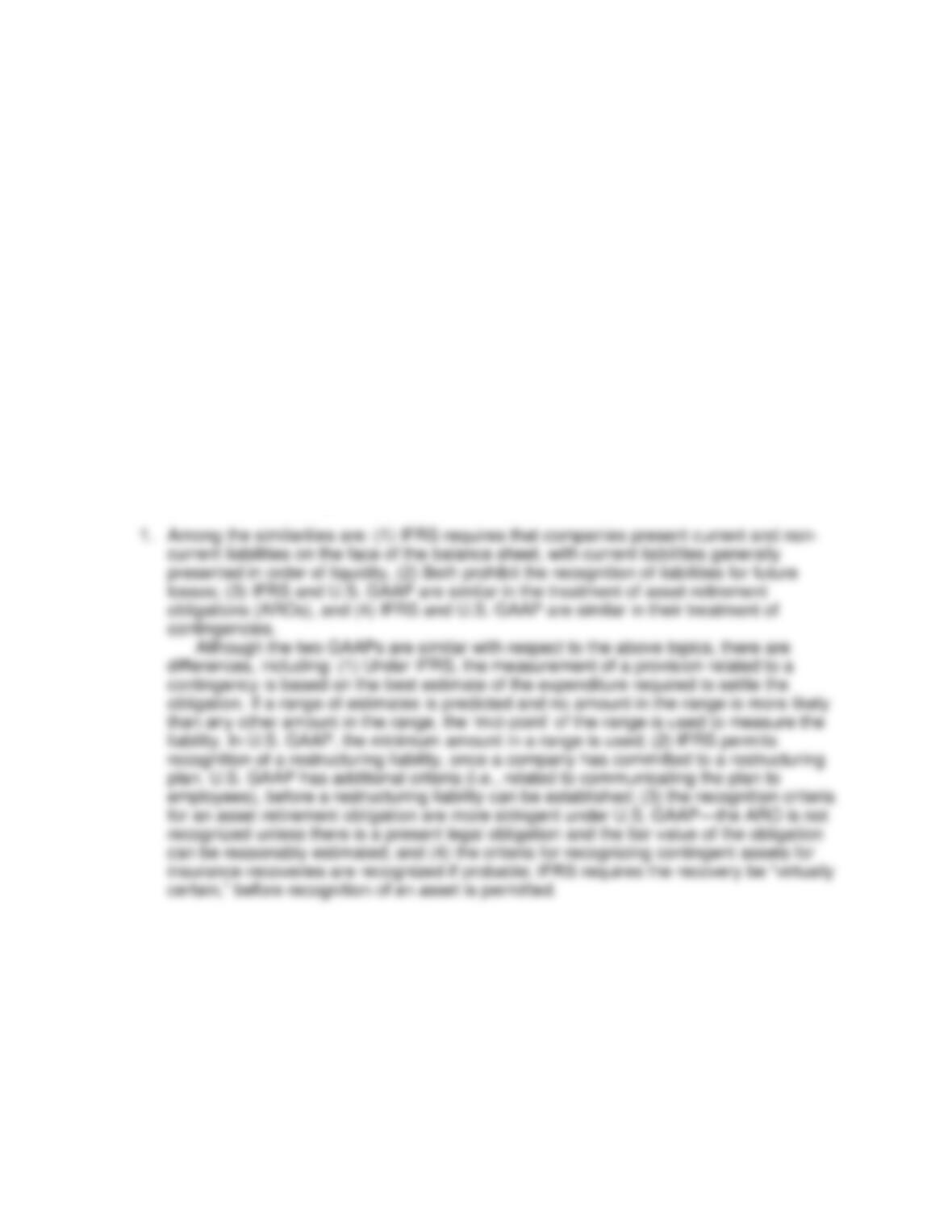
16. Briefly describe some of the similarities and differences between U.S. GAAP and IFRS with
respect to the accounting for liabilities.

Test Bank for Intermediate Accounting, Fifteenth Edition
13 – 48