129. Cummings Industries places a firm order for the equipment on June 30, 2013. It simultaneously signs a
forward currency contract for £20,000. The forward rate on June 30, 2013, for settlement on June 30, 2014, is
$1.64 per £1. Cummings designates the forward contract as a fair value hedge of the firm commitment.
REQUIRED:
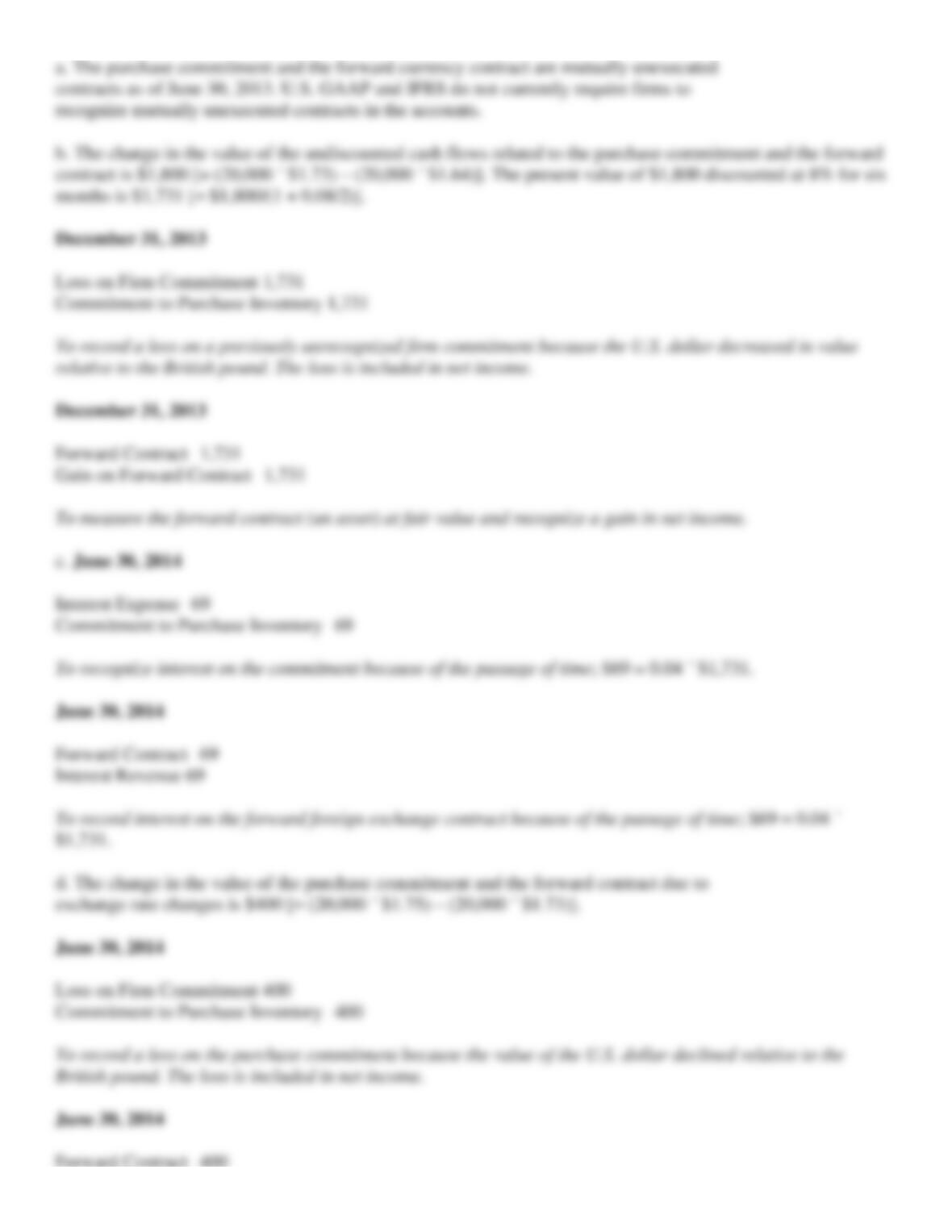
a. U.S. GAAP and IFRS guidance does not require Cummings to record either the purchase
commitment or the forward contract on the balance sheet as a liability or an asset on June 30, 2013. What is the
logic for this accounting?
b. On December 31, 2013, the forward exchange rate for settlement on June 30, 2014,
is $1.73 per £1. Give the journal entries to record the change in the fair value of the
purchase commitment and the change in the fair value of the forward contract for
2013. Assume an 8% interest rate for discounting cash flows to their present values on
December 31, 2013.
c. Give the journal entries on June 30, 2014, to record the change in the present value of
the purchase commitment and the forward contract for the passage of time.
d. On June 30, 2014, the spot exchange rate is $1.75 per £1. Give the journal entries to
record the change in the fair value of the purchase commitment and the change in the
fair value of the forward contract due to changes in the exchange rate during the first
six months of 2014.
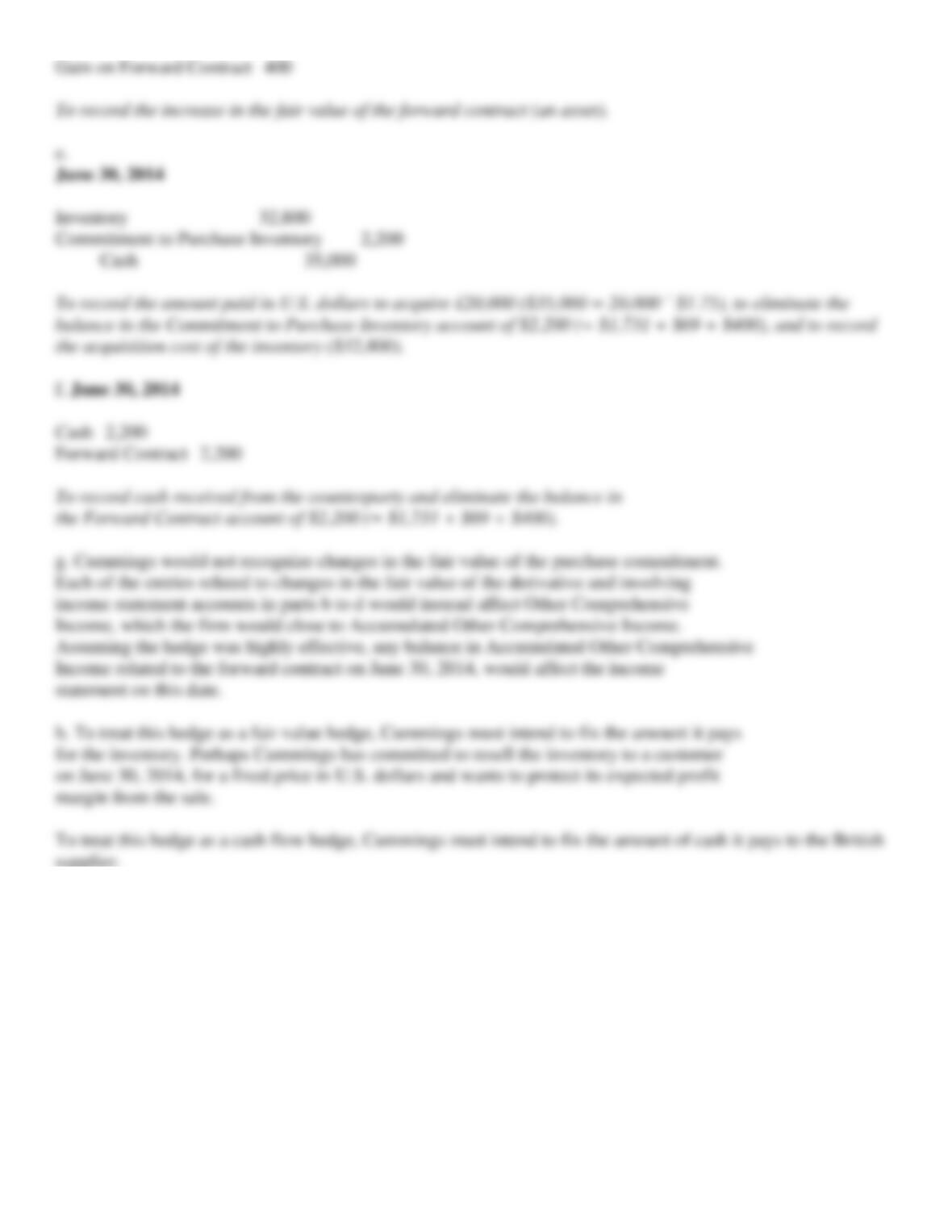
e. Give the journal entry on June 30, 2014, to purchase £20,000 with U.S. dollars and
acquire the equipment.
f. Give the journal entry on June 30, 2014, to settle the forward contract.
g. How would the entries in parts (b) through (f) differ if Cummings had chosen to designate
the forward currency contract as a cash flow hedge of a forecasted transaction
instead of a fair value hedge of a firm commitment?
h. What type of scenario would justify Cummings treating the forward currency contract
as a fair value hedge? What type of scenario that would justify the firm treating the contract
as a cash flow hedge?.
130. (CMA adapted, Jun 97 #2) Morgan Aircraft Products is a publicly-held corporation that manufactures
airframe and engine parts for the light aircraft producers and for the home-built aircraft market. During Year 6,
the Board of Directors decided to expand into aircraft kit production. The company plans to complete new
facilities for the partial assembly of the kit airplanes by the fourth quarter of Year 7. In order to finance the new
facilities, Morgan authorized and issued 50,000 shares of 7.15 percent, $100 par value, non-participating,
cumulative preferred stock for $110 per share on November 26, Year 6. As of the current year end, the company
has paid all preferred stock dividends.
William McElroy, controller for Morgan, is responsible for the preparation of the company’s financial
statements. He has assigned Alice York, assistant controller, to complete the shareholders’ equity statement and
any related notes. In addition to the preferred stock described above, York has assembled the following
information that she believes may affect shareholders’ equity at May 31, Year 7.
·
7 percent, $50 par value, cumulative preferred stock with 100,000 shares authorized and 30,000 shares issued and outstanding. The shares
were sold for $57 per share. The dividends are current as of the end of the year.
·
$1 par value common stock with 1,000,000 shares authorized and 307,160 shares issued. The shares were sold for an average of $6.20 per
share.
·
9,500 shares of common treasury stock is held by the company at an average cost of $5.86 per share.
·
Retained earnings at May 31, Year 7, after closing, was $25,330,000.
·
The cumulative unrealized translation adjustment at May 31, Year 7, had a $1,400,000 credit balance.
·
Unrealized holding gain on available-for-sale securities was $442,000.
·
Unrealized holding loss on trading securities was $289,000.
·
Retained earnings have been appropriated for treasury stock and an amount of $2,000,000 for contingencies.
McElroy has agreed to meet with York to discuss the first draft of the shareholders’ equity statement.
Required:
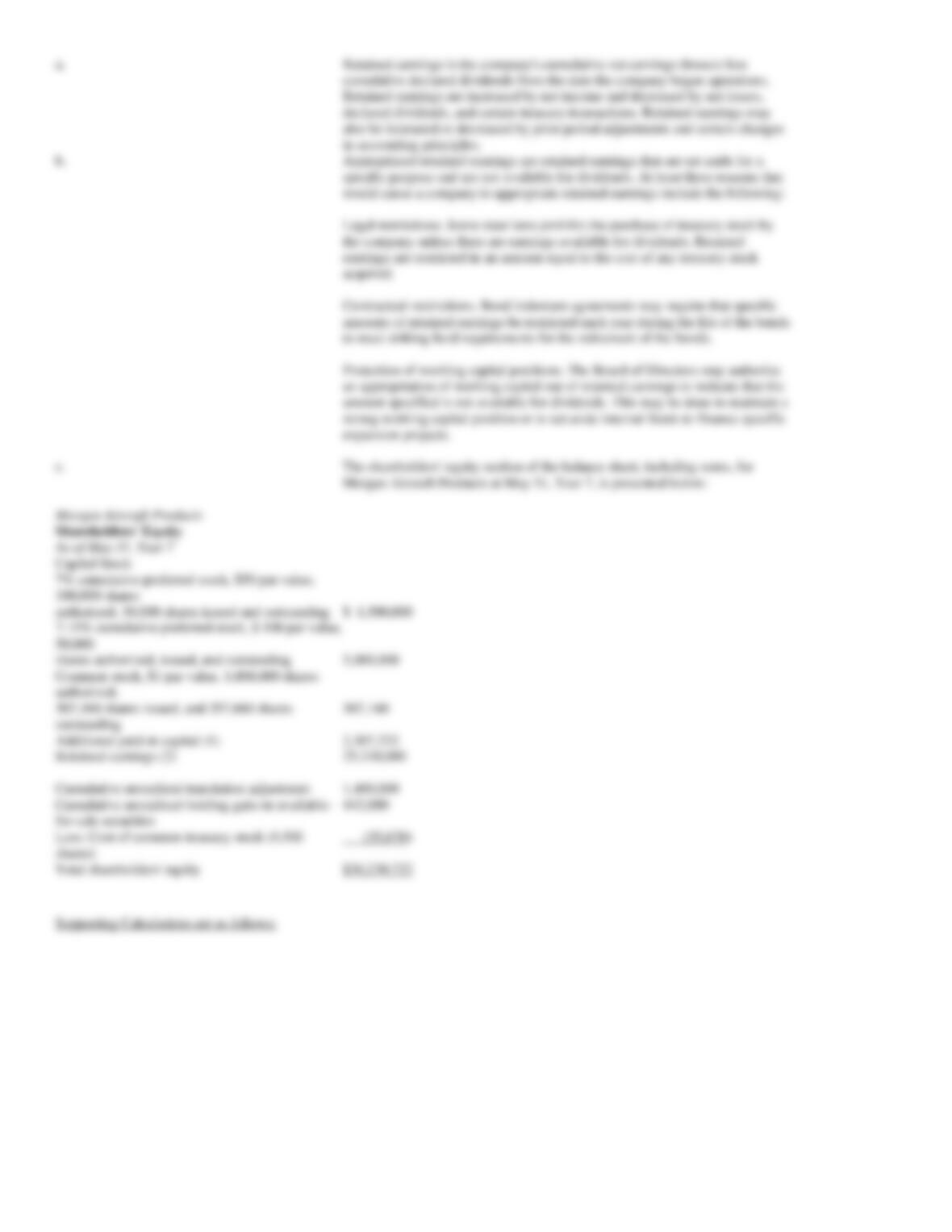
a.
Define retained earnings.
b.
List and explain three reasons that would cause a company to appropriate retained earnings.
c.
Prepare the portion of the shareholders’ equity section of the balance sheet, in good form and including notes, for Morgan Aircraft Products
at May 31, Year 7. Be sure to support your answer with appropriate schedules and calculations. Indicate the reason for omitting any
accounts listed by Alice York above from the shareholders’ equity statement.
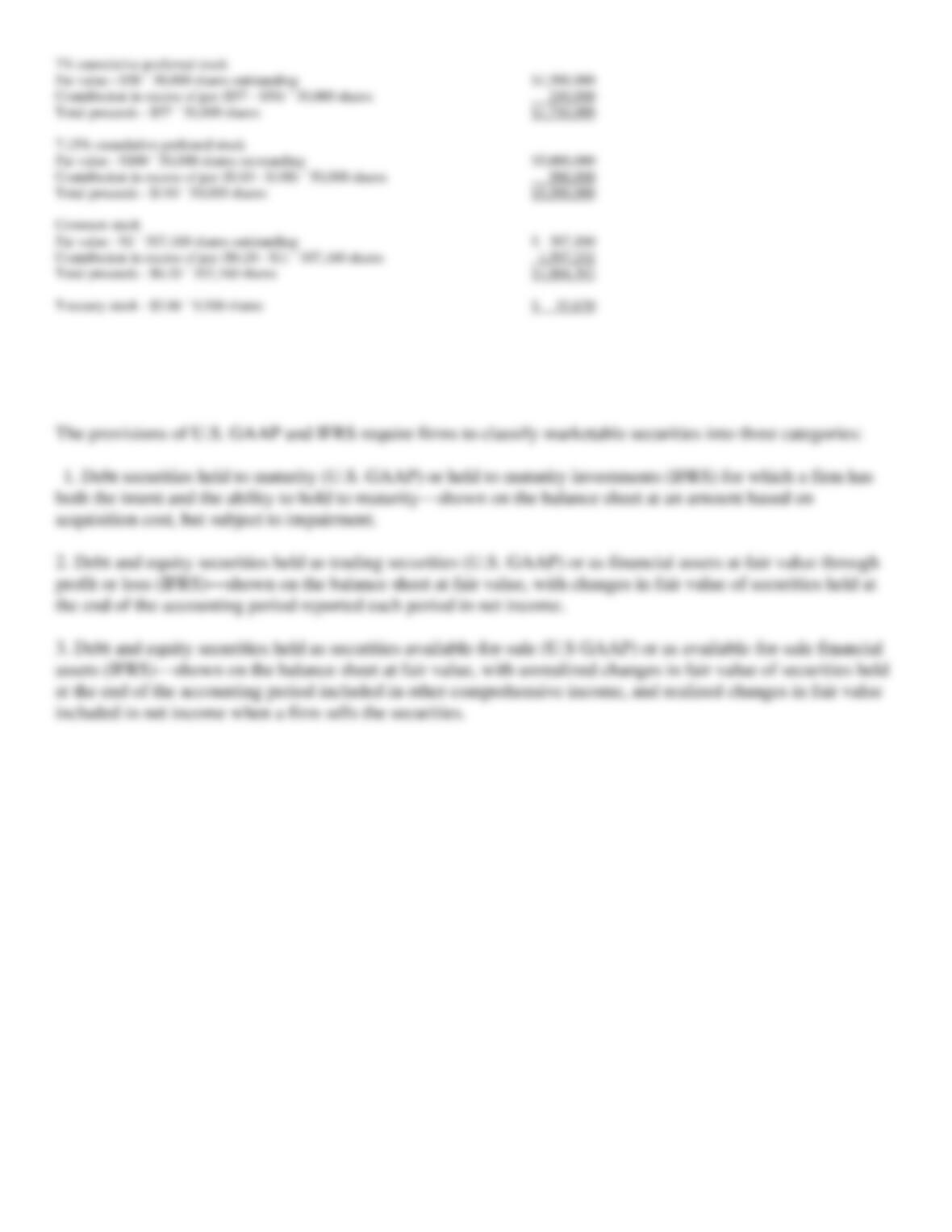
131. How does U.S. GAAP and IFRS require firms to classify marketable securities?
132. How are securities measured at acquisition?
MEASUREMENT OF SECURITIES AT ACQUISITION
133. How are securities measured after acquisition?
MEASUREMENT OF SECURITIES AFTER ACQUISITION
134. Discuss the accounting for debt securities held to maturity and arguments against this approach.
135. What is the accounting treatment for trading securities?
136. What is the accounting treatment for securities available for sale?
137. What disclosures about marketable securities are required by U.S. GAAP?
138. What are derivative instruments and how are they used?
DERIVATIVE INSTRUMENTS
139. What are elements of a derivative?
140. Describe the accounting for derivatives.
ACCOUNTING FOR DERIVATIVES
141. How are hedging gains and losses treated?
142. Describe the accounting for a fair value hedge of a recognized asset or liability.
143. U.S. GAAP and IFRS require firms to disclose the fair value of financial instruments in a note to the
financial statements. What should such a note include?
DISCLOSURES RELATED TO DERIVATIVE INSTRUMENTS
144. Describe the fair value option applied to marketable securities and derivatives.
THE FAIR VALUE OPTION APPLIED TO MARKETABLE SECURITIES AND DERIVATIVES
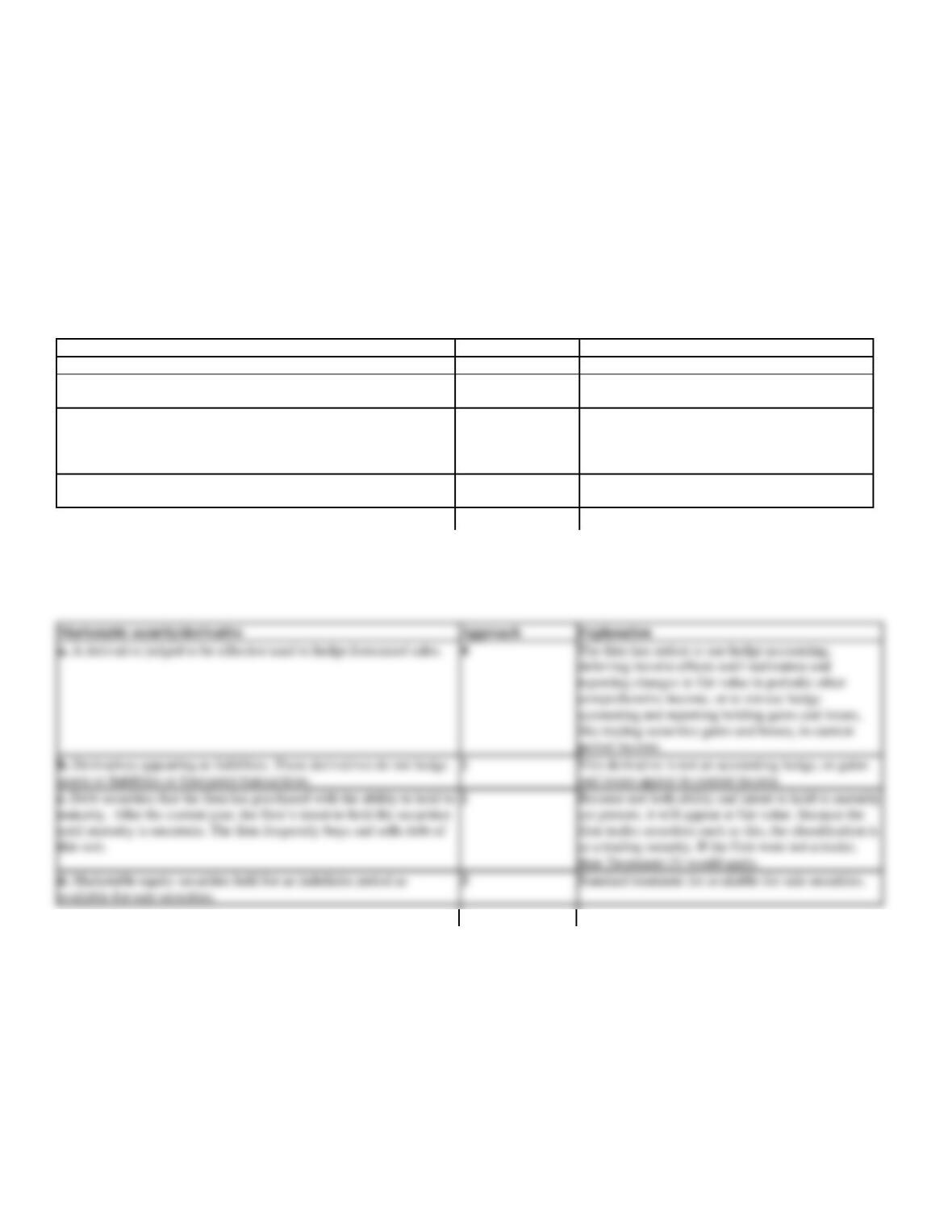
145. Complete the following chart for items a through d, describing the accounting treatment
using the number by one of the following four approaches listed as follows.
(Assume that the firm does not elect the fair value option):
APPROACHES
(1) Measured at fair value with changes recognized in net income.
(2) Measured at amortized cost.
(3) Measured at fair value with changes recognized initially in other comprehensive income.
(4) Measurement depends on whether firm uses hedge accounting.
In the third column of the chart, present your explanation regarding this approach.
Marketable security/derivative
Approach
Explanation
a. A derivative judged to be effective used to hedge forecasted sales.
b. Derivatives appearing as liabilities. These derivatives do not hedge
assets or liabilities or forecasted transactions.
c. Debt securities that the firm has purchased with the ability to hold to
maturity. After the current year, the firm’s intent to hold the securities
until maturity is uncertain. The firm frequently buys and sells debt of
this sort.
d. Marketable equity securities held for an indefinite period as
available-for-sale securities.
comprehensive income, or to not use hedge
then Treatment (3) would apply.
d. Marketable equity securities held for an indefinite period as
Standard treatment for available-for-sale securities.