18) An advantage of a ________ is that it avoids giving shareholders false hopes.
A) constant-payout-ratio policy
B) regular dividend policy
C) low-regular-and-extra dividend policy
D) target dividend policy
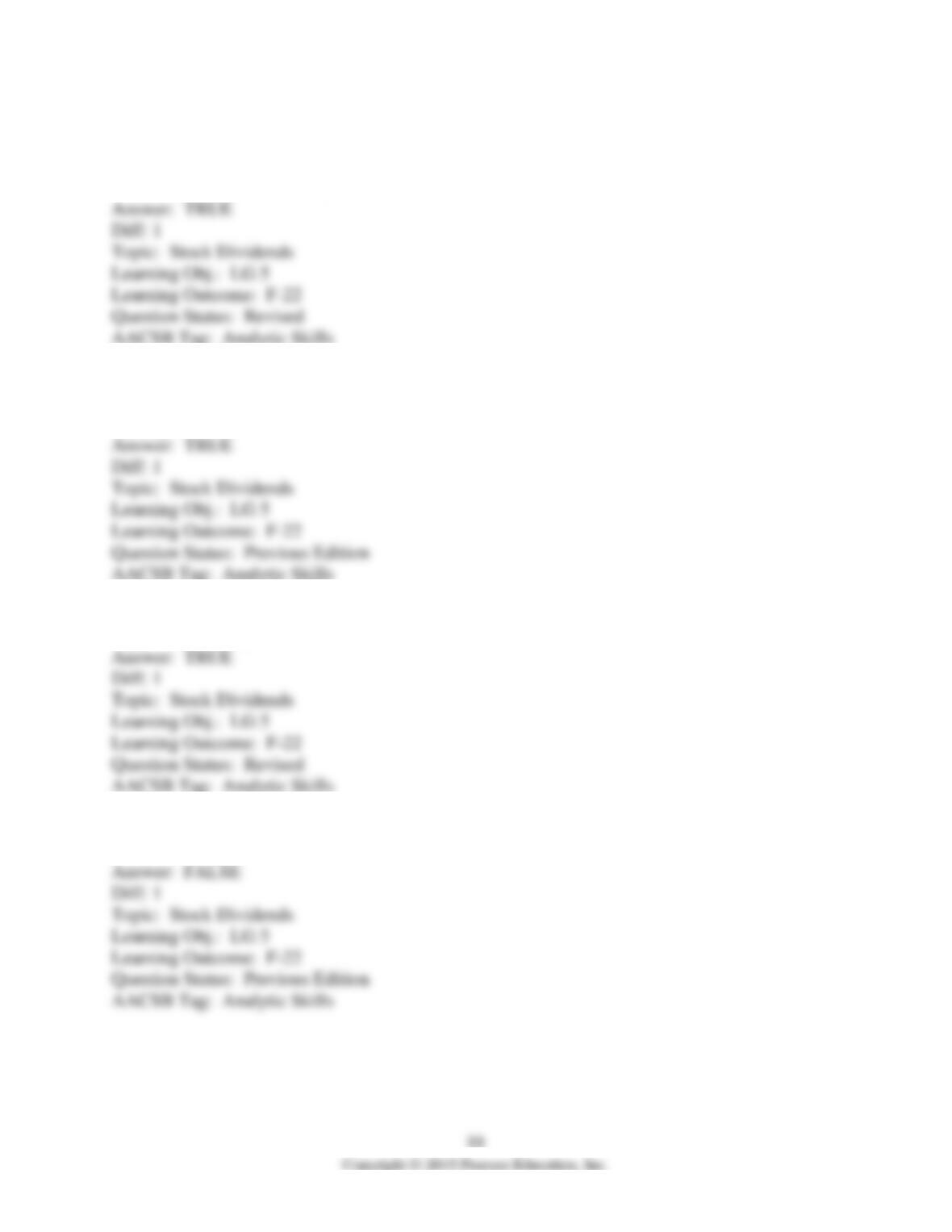
19) A firm has had the indicated earnings per share over the last three years:
(a) If the firm’s dividend policy was based on a constant payout ratio of 50 percent, determine
the annual dividend for each year.
(b) If the firm’s dividend policy was based on a fixed dollar payout policy of 50 cents per share
plus an extra dividend equal to 75 percent of earnings per share above $1.00, determine the
annual dividend for each year.
13.5 Evaluate stock dividends from accounting, shareholder, and company points of view.
1) The payment of a stock dividend is a shifting of funds between stockholders’ equity accounts
rather than an outflow of funds.
2) In case of stock dividend, the shareholder’s proportion of ownership in a firm remains the
same, and as long as the firm’s earnings remain unchanged, so does his or her share of total
earnings.
3) If a firm’s earnings remain constant and total cash dividends do not increase, a stock dividend
results in a lower per-share market value for the firm’s stock.
4) The shareholder receiving a stock dividend receives a share of common stock of equal value
to their existing shares of common stock.
5) After the stock dividend is paid, the per share value of a stockholder’s stock will remain the
same as the value before the stock dividend and, thus, the market value of his or her total
holdings in the firm will remain unchanged.
6) The motive to pay stock dividend to retain cash to satisfy past-due bills, may result in a
decline in market value.
7) A shareholder receiving a stock dividend typically receives nothing of value.
8) The shareholder receiving a stock dividend receives ________.
A) a share of common stock of equal value to their existing shares of common stock
B) cash
C) additional shares of common stock and cash
D) nothing of value
9) Stock dividends are ________.
A) taxable at a higher level than dividend taxes
B) taxable at a lower level than dividend taxes
C) non taxable
D) are taxable only to the shareholders
10) Mr. R. owns 20,000 shares of ABC Corporation stock. The company is planning to issue a
stock dividend. Before the dividend Mr. R. owned 10 percent of the outstanding stock, which
had a market value of $200,000, or $10 per share. Upon receiving the 10 percent stock dividend
the value of his shares is ________.
A) $220,000
B) $210,000
C) $200,000
D) $180,000
11) Paying a stock dividend ________.
A) decreases the retained earnings account
B) has no effect on the retained earnings account
C) increases the retained earnings account
D) reorganizes the income
12) Tangshan Mining has 100,000 shares outstanding and just declared a 20% stock dividend.
Before the announcement, the firm’s shares were trading at $50.00 per share. After the stock
dividend, the firm’s shares should trade at ________ per share.
A) $42.00
B) $41.67
C) $46.33
D) $50.00
13.6 Explain stock splits and the firm’s motivation for undertaking each of them.
1) The stock repurchase can be viewed as a cash dividend.
2) A stock split commonly increases the stock’s per share par value.
3) In a 2-for-1 stock split, the number of shares outstanding decreases by fifty percent and the
stock’s per share par value will double.
4) Reverse stock splits are initiated when a stock is selling at a very low price to appear
respectable.
5) A stock split is usually taxable to a firm as it restructures the capital.
6) A ________ has an effect on a firm’s share price similar to that of a ________.
A) stock repurchase; stock split
B) stock dividend; stock split
C) cash dividend; stock dividend
D) cash dividend; stock split
7) The purpose of a stock split is to ________.
A) change a firm’s capital structure
B) decrease the dividend
C) enhance the trading activity of the stock by lowering the market price
D) increase the market price of a stock
8) A stock split has ________.
A) little effect on a firm’s capital structure
B) no effect on a firm’s capital structure
C) a measurable effect on a firm’s capital structure
D) a detrimental effect on a firm’s capital structure
9) The purpose of a reverse stock split is to ________.
A) issue additional shares
B) increase the dividend
C) increase the price of a stock
D) decrease trading activity
10) The primary purpose of a stock split is to ________.
A) issue additional shares
B) increase the dividend
C) reduce the price of a stock
D) reduce trading activity
11) Tangshan Mining has 100,000 shares outstanding and just declared a 2-for-1 stock split.
Before the announcement, the firm’s shares were trading at $50.00 per share. After the stock
split, the firm’s shares should trade at ________ per share.
A) $100.00
B) $25.00
C) $50.00
D) $75.00
12) Tangshan Mining has 100,000 shares outstanding and just declared a 3-for-2 stock split.
Before the announcement, the firm’s shares were trading at $50.00 per share. After the stock
split, the firm’s shares should trade at ________ per share.
A) $33.33
B) $66.67
C) $75.00
D) $100.00
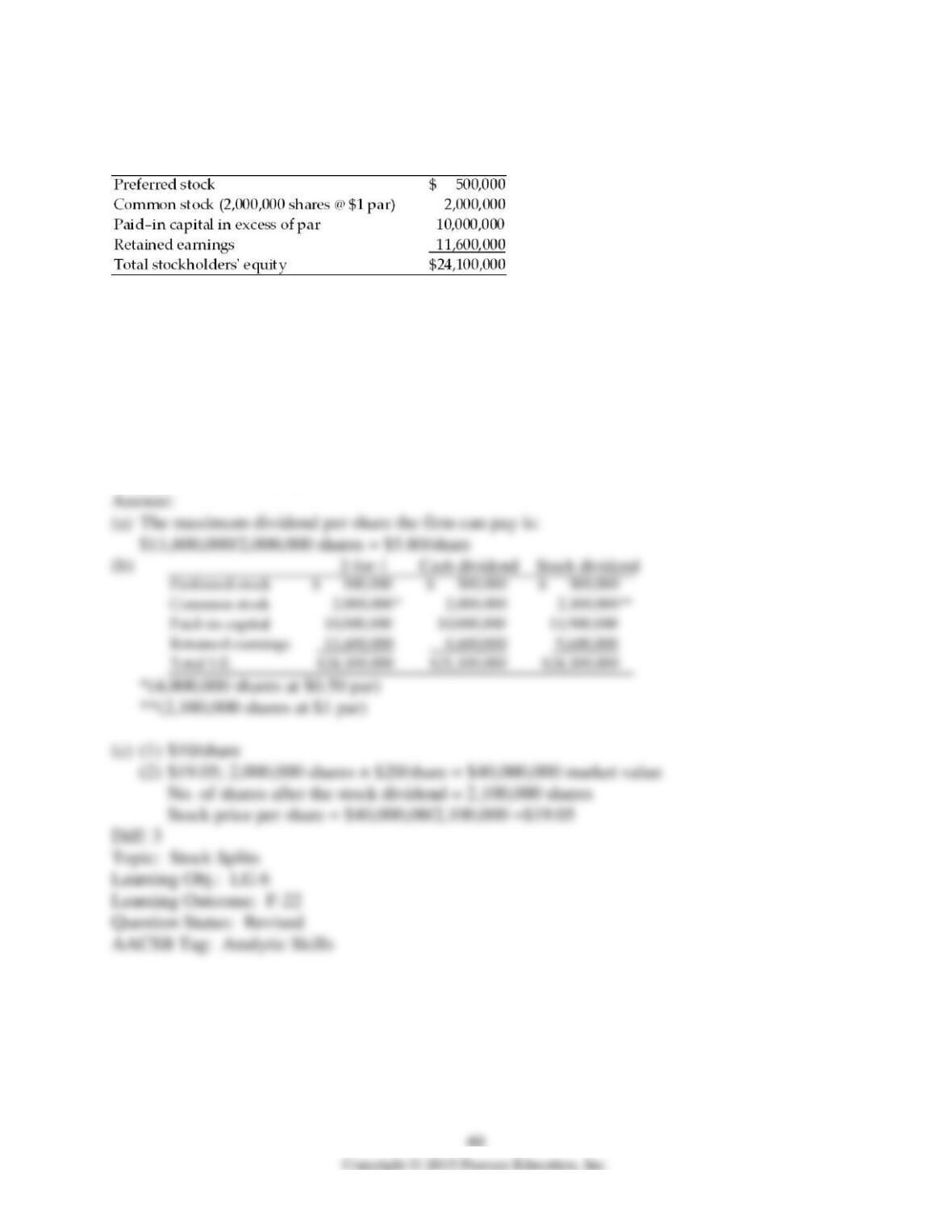
13) Hayley’s Optical has a stockholders’ equity account as shown below. The firm’s common
stock currently sells for $20 per share.
(a) What is the maximum dividend per share Hayley’s Optical can pay? (Assume capital includes
all paid-in capital.)
(b) Recast the partial balance sheet (the stockholders’ equity accounts) to show independently
(1) a 2-for-1 stock split of the common stock.
(2) a cash dividend of $1.50 per share.
(3) a stock dividend of 5% on the common stock.
(c) At what price would you expect Hayley’s Optical stock to sell after
(1) the stock split?
(2) the stock dividend?
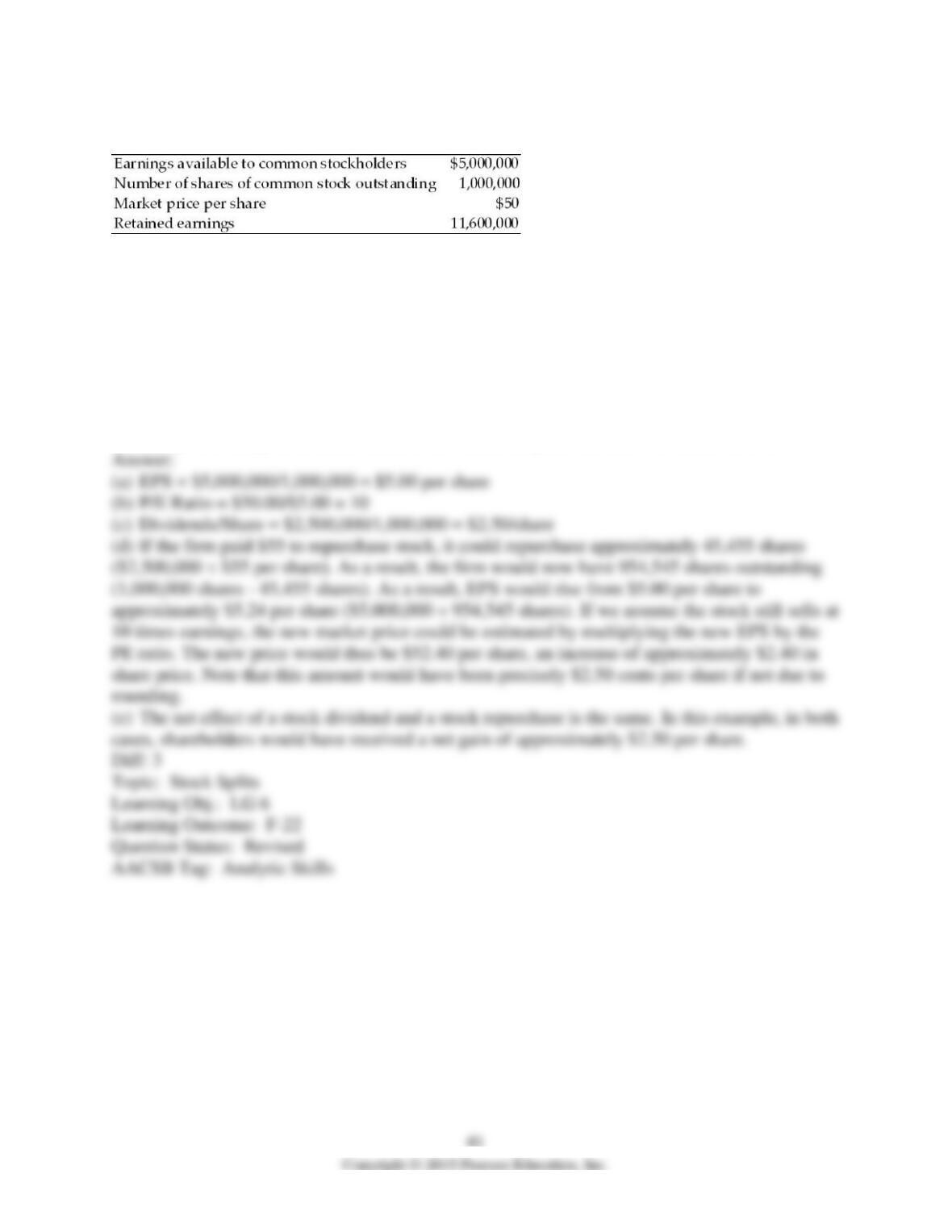
14) Tangshan Mining Company has released the following information.
(a) What are Tangshan Mining’s current earnings per share?
(b) What is Tangshan Mining’s current P/E ratio?
(c) Tangshan Mining wants to use half of its earnings either to pay shareholders dividends or to
repurchase shares for inclusion in the firm’s employee stock ownership plan. If the firm pays a
cash dividend, what will be the dividend per share received by existing shareholders?
(d) Instead of paying the cash dividend, what if the firm uses half of its earnings to pay $55 per
share to repurchase the shares, what will be the firm’s new EPS? What should be the firm’s new
share price?
(e) Compare the impact of a stock dividend and stock repurchase on shareholder wealth.