
Chapter 13: Capital Structure M/C Problems Page 493
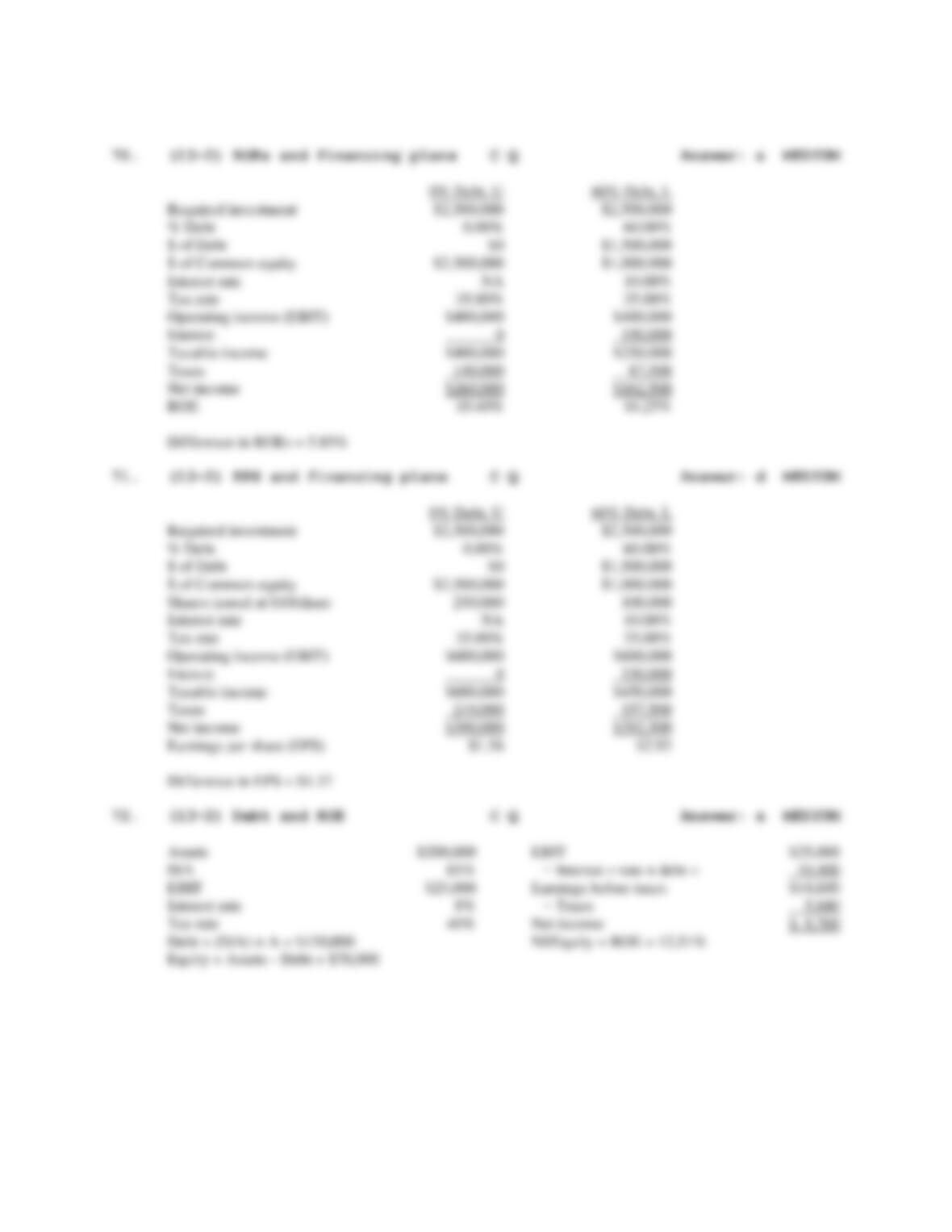
71. You work for the CEO of a new company that plans to manufacture and
sell a new type of laptop computer. The issue now is how to finance
the company, with only equity or with a mix of debt and equity.
Expected operating income is $600,000. Other data for the firm are
shown below. How much higher or lower will the firm’s expected EPS be
if it uses some debt rather than only equity, i.e., what is EPSL – EPSU?
0% Debt, U 60% Debt, L
Oper. income (EBIT) $600,000 $600,000
Required investment $2,500,000 $2,500,000
% Debt 0.0% 60.0%
$ of Debt $0.00 $1,500,000
$ of Common equity $2,500,000 $1,000,000
Shares issued, $10/share 250,000 100,000
Interest rate NA 10.00%
Tax rate 35% 35%
a. $1.00
b. $1.11
c. $1.23
d. $1.37
e. $1.50
72. Confu Inc. expects to have the following data during the coming year.
What is the firm’s expected ROE?
Assets $200,000 Interest rate 8%
Debt/Assets, book value 65% Tax rate 40%
EBIT $25,000
a. 12.51%
b. 13.14%
c. 13.80%
d. 14.49%
e. 15.21%
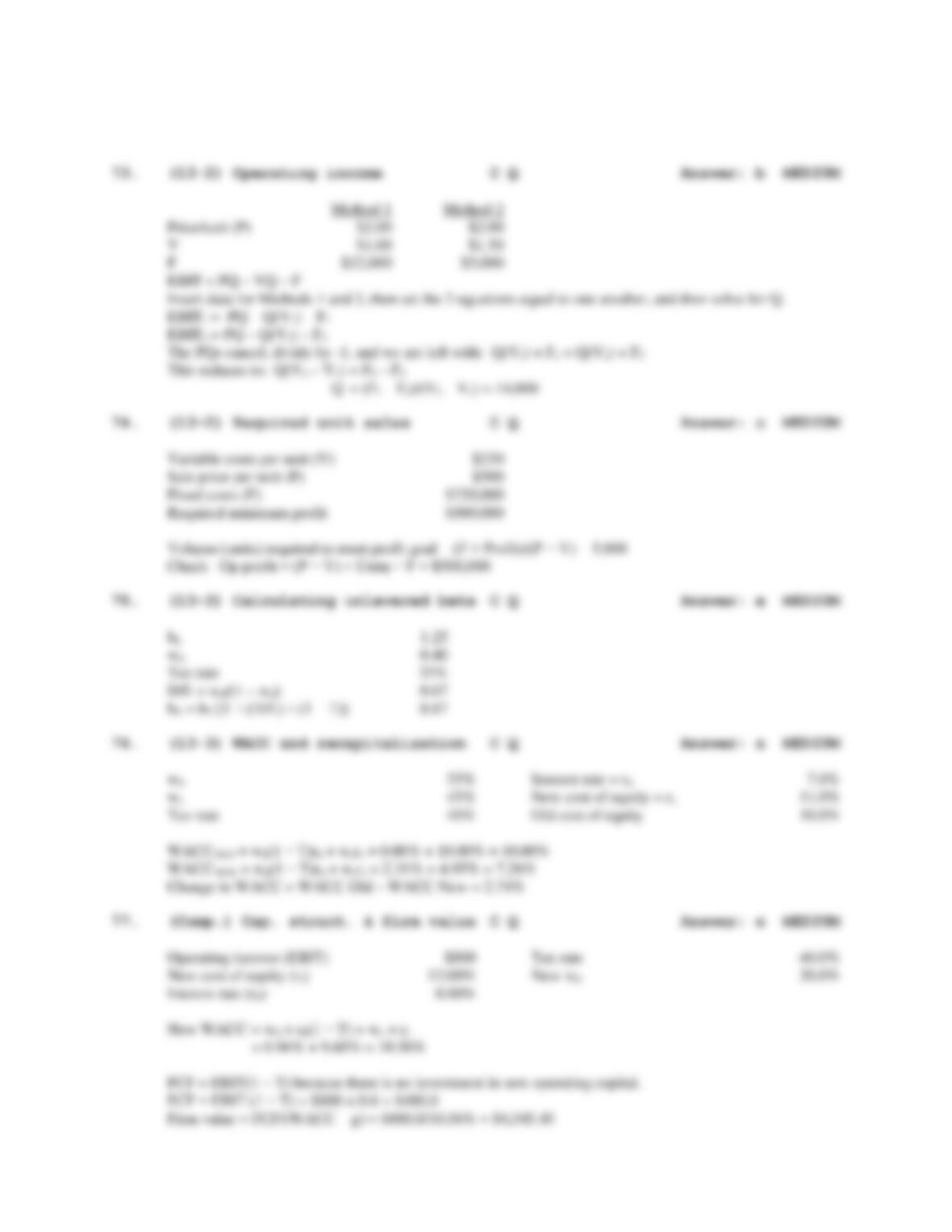
73. Senate Inc. is considering two alternative methods for producing
playing cards. Method 1 involves using a machine with a fixed cost
(mainly depreciation) of $12,000 and variable costs of $1.00 per deck
of cards. Method 2 would use a less expensive machine with a fixed
cost of only $5,000, but it would require a variable cost of $1.50 per
deck. The sales price per deck would be the same under each method.
At what unit output level would the two methods provide the same
operating income (EBIT)?
a. 12,600
b. 14,000
c. 15,400
d. 16,940
e. 18,634
Page 494 M/C Problems Chapter 13: Capital Structure
74. A group of venture investors is considering putting money into Lemma
Books, which wants to produce a new reader for electronic books. The
variable cost per unit is estimated at $250, the sales price would be
set at twice the VC/unit, or $500, and fixed costs are estimated at
$750,000. The investors will put up the funds if the project is likely
to have an operating income of $500,000 or more. What sales volume
would be required in order to meet the minimum profit goal? (Hint: Use
the break-even formula, but include the required profit in the
numerator.)
a. 4,513
b. 4,750
c. 5,000
d. 5,250
e. 5,513
75. El Capitan Foods has a capital structure of 40% debt and 60% equity,
its tax rate is 35%, and its beta (leveraged) is 1.25. Based on the
Hamada equation, what would the firm’s beta be if it used no debt,
i.e., what is its unlevered beta, bU?
a. 0.71
b. 0.75
c. 0.79
d. 0.83
e. 0.87
76. Gator Fabrics Inc. currently has zero debt (i.e., wd = 0). It is a zero
growth company, and additional firm data are shown below. Now the
company is considering using some debt, moving to the new capital
structure indicated below. The money raised would be used to
repurchase stock at the current price. It is estimated that the
increase in risk resulting from the additional leverage would cause the
required rate of return on equity to rise somewhat, as indicated below.
If this plan were carried out, by how much would the WACC change, i.e.,
what is WACCOld – WACCNew?
wd 55% Orig. cost of equity, rs 10.0%
wc 45% New cost of equity = rs 11.0%
Interest rate new = rd 7.0% Tax rate 40%
a. 2.74%
b. 3.01%
c. 3.32%
d. 3.65%
e. 4.01%

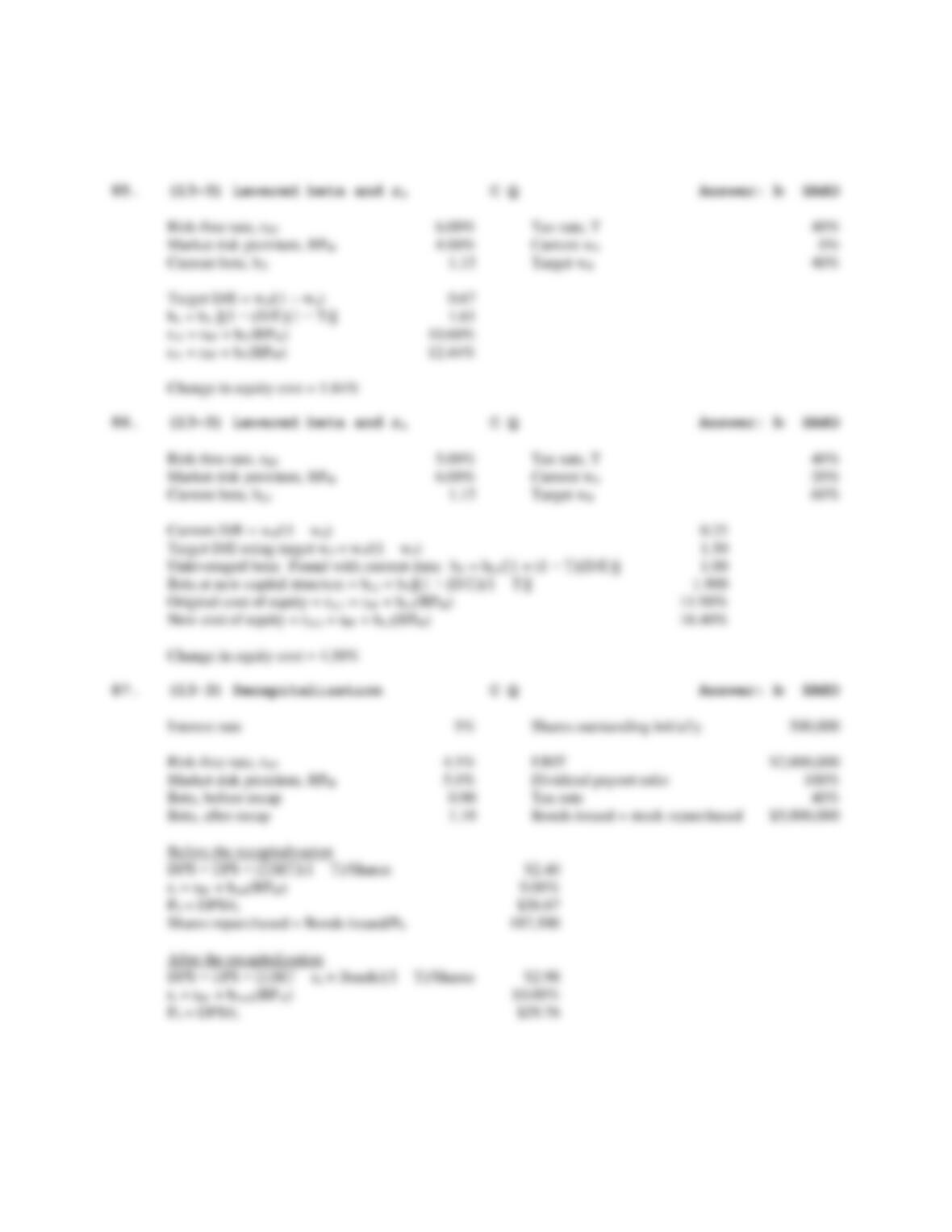
Chapter 13: Capital Structure M/C Problems Page 495
77. As a consultant to First Responder Inc., you have obtained the following
data (dollars in millions). The company plans to pay out all of its
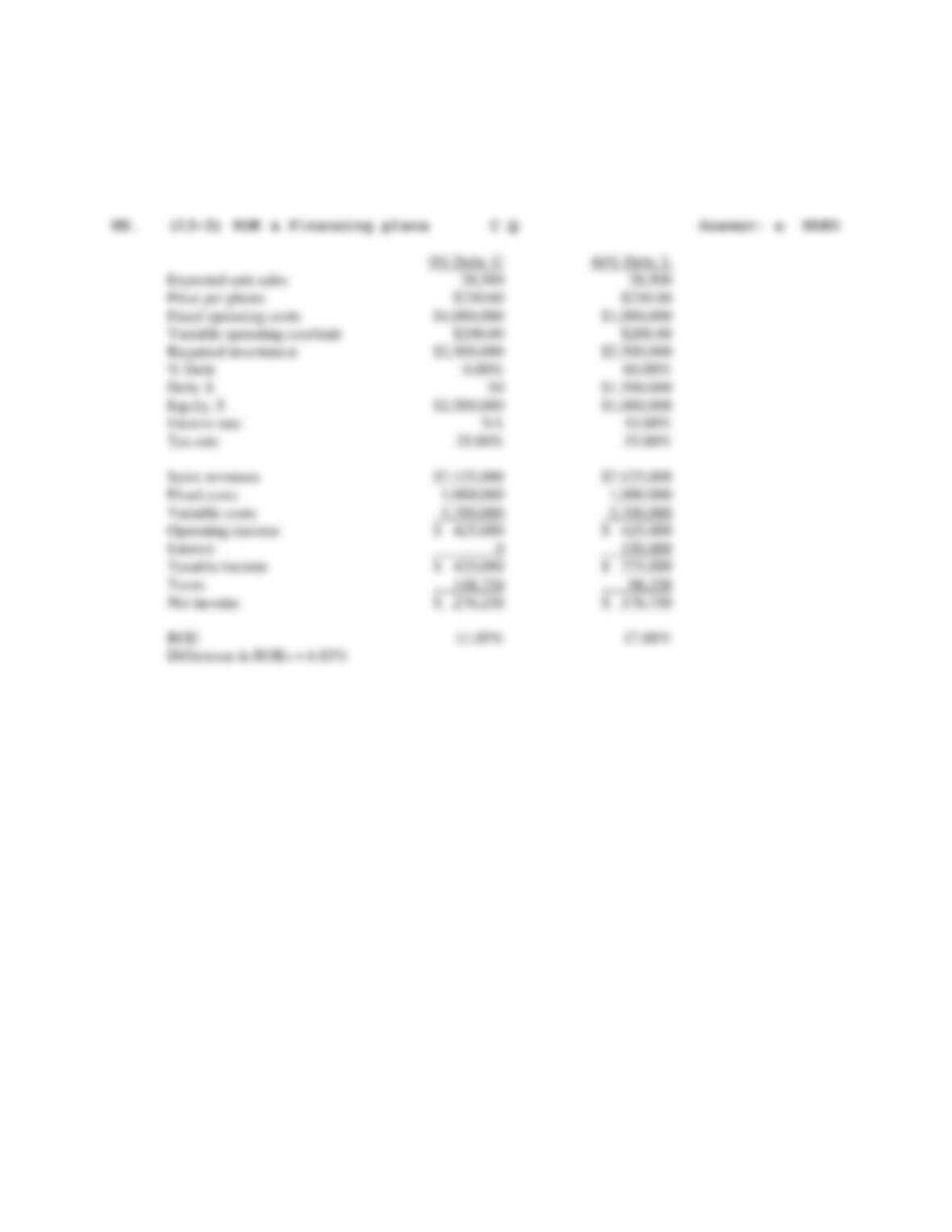
earnings as dividends, hence g = 0. Also, no net new investment in
operating capital is needed because growth is zero. The CFO believes that
a move from zero debt to 20.0% debt would cause the cost of equity to
increase from 10.0% to 12.0%, and the interest rate on the new debt would
be 8.0%. What would the firm’s total market value be if it makes this
change? Hints: Find the FCF, which is equal to NOPAT = EBIT(1 – T)
because no new operating capital is needed, and then divide by (WACC – g).
Oper. income (EBIT) $800 Tax rate 40.0%
New cost of equity (rs) 12.00% New wd 20.0%
Interest rate (rd) 8.00%
a. $2,982
b. $3,314
c. $3,682
d. $4,091
e. $4,545
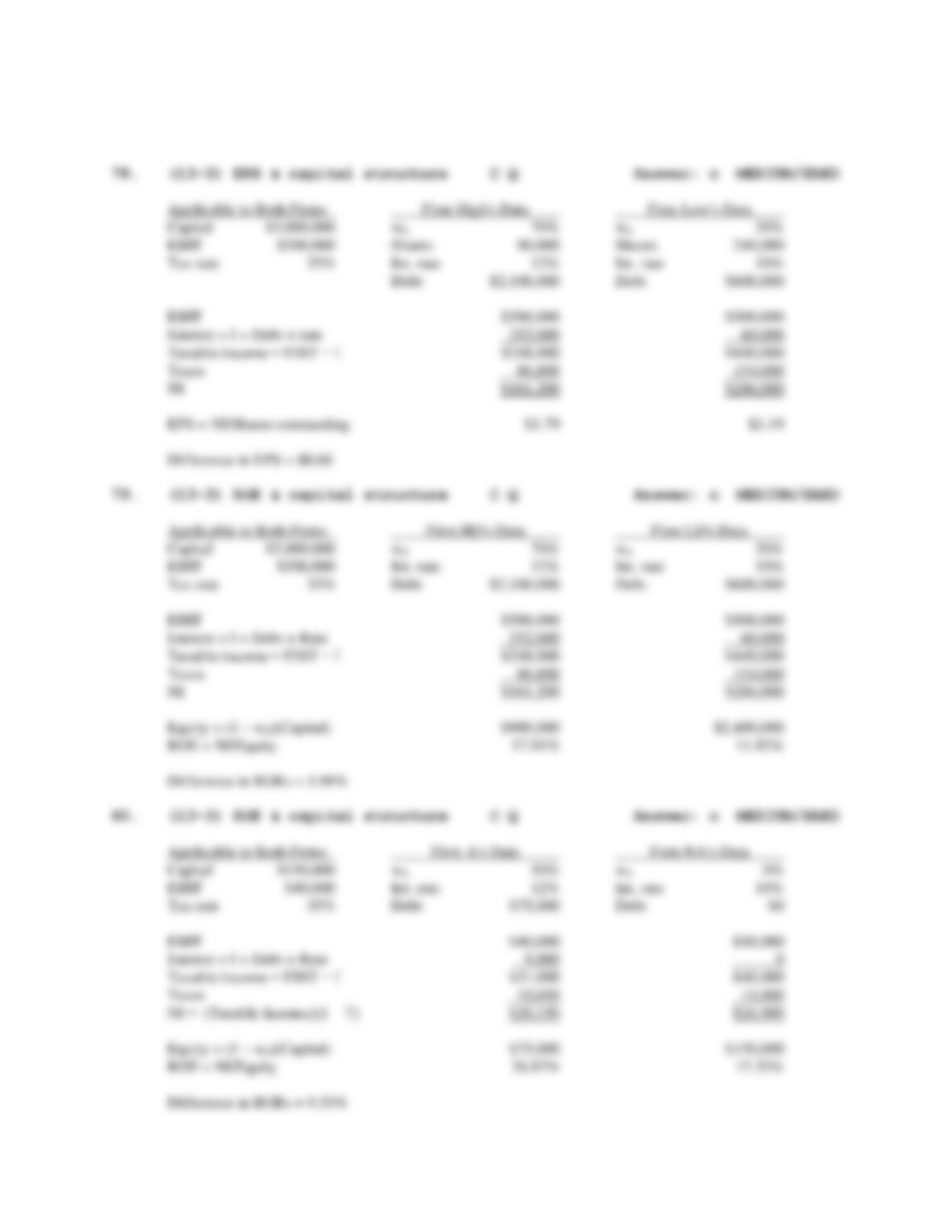
78. You plan to invest in one of two home delivery pizza companies, High
and Low, that were recently founded and are about to commence
operations. They are identical except for their use of debt (wd) and
the interest rates on their debt–High uses more debt and thus must pay
a higher interest rate. Based on the data given below, how much higher
or lower will High’s expected EPS be versus that of Low, i.e., what is
EPSHigh – EPSLow?
Applicable to Both Firms Firm High’s Data Firm Low’s Data
Capital $3,000,000 wd 70% wd 20%
EBIT $500,000 Shares 90,000 Shares 240,000
Tax rate 35% Int. rate 12% Int. rate 10%
a. $0.49
b. $0.54
c. $0.60
d. $0.66
e. $0.73
79. Firms HD and LD are identical except for their use of debt and the
interest rates they pay–HD has more debt and thus must pay a higher
interest rate. Based on the data given below, how much higher or lower
will HD’s ROE be versus that of LD, i.e., what is ROEHD – ROELD?
Applicable to Both Firms Firm HD’s Data Firm LD’s Data
Capital $3,000,000 wd 70% wd 20%
EBIT $500,000 Int. rate 12% Int. rate 10%
Tax rate 35%
a. 5.41%
b. 5.69%
c. 5.99%
Page 496 M/C Problems Chapter 13: Capital Structure
d. 6.29%
e. 6.61%
80. Firm A is very aggressive in its use of debt to leverage up its
earnings for common stockholders, whereas Firm NA is not aggressive and
uses no debt. The two firms’ operations are identical–they have the
same total investor-supplied capital, sales, operating costs, and EBIT.
Thus, they differ only in their use of financial leverage (wd). Based
on the following data, how much higher or lower is A’s ROE than that of
NA, i.e., what is ROEA – ROENA?
Applicable to Both Firms Firm A’s Data Firm NA’s Data
Capital $150,000 wd 50% wd 0%
EBIT $40,000 Int. rate 12% Int. rate 10%
Tax rate 35%
a. 8.60%
b. 9.06%
c. 9.53%
d. 10.01%
e. 10.51%
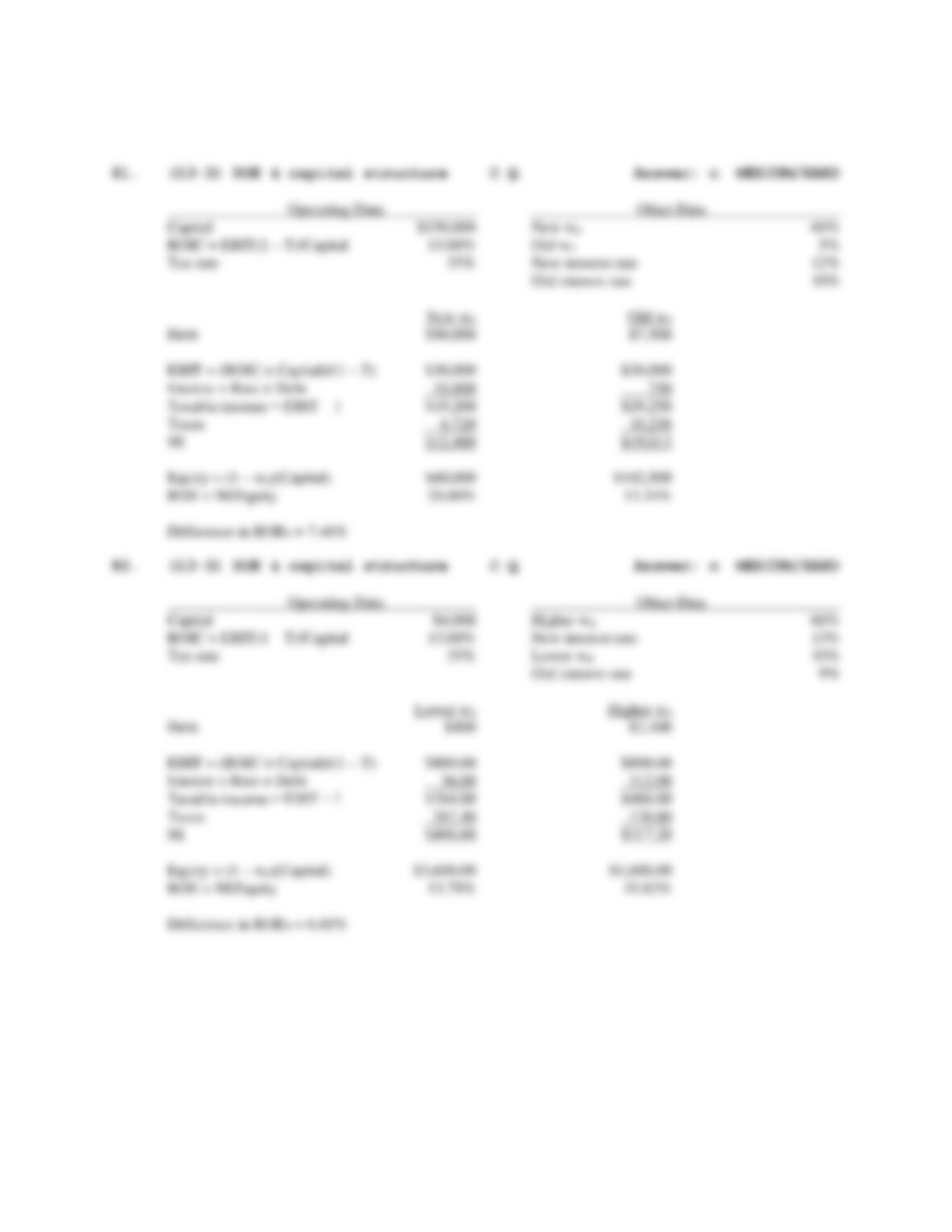
81. Your firm’s debt ratio is only 5.00%, but the new CFO thinks that more
debt should be employed. She wants to sell bonds and use the proceeds
to buy back and retire common shares so the percentage of common equity
in the capital structure (wc) = 1 – wd. Other things held constant, and
based on the data below, if the firm increases the percentage of debt
in its capital structure (wd) to 60.0%, by how much would the ROE
change, i.e., what is ROENew – ROEOld?
Operating Data Other Data
Capital $150,000 Old wd 5%
ROIC = EBIT(1 – T)/Capital 13.00% Old interest rate 10%
Tax rate 35% New wd 60%
New interest rate 12%
a. 6.73%
b. 7.09%
c. 7.46%
d. 7.83%
e. 8.22%
Chapter 13: Capital Structure M/C Problems Page 497
82. You have been hired by a new firm that is just being started. The CFO
wants to finance with 60% debt, but the president thinks it would be
better to hold the percentage of debt in the capital structure (wd) to
only 10%. Other things held constant, and based on the data below, if
the firm uses more debt, by how much would the ROE change, i.e., what
is ROENew – ROEOld?
Operating Data Other Data
Capital $4,000 Higher wd 60%
ROIC = EBIT(1 – T)/Capital 13.00% Higher interest rate 13%
Tax rate 35% Lower wd 10%
Lower interest rate 9%
a. 5.44%
b. 5.73%
c. 6.03%
d. 6.33%
e. 6.65%
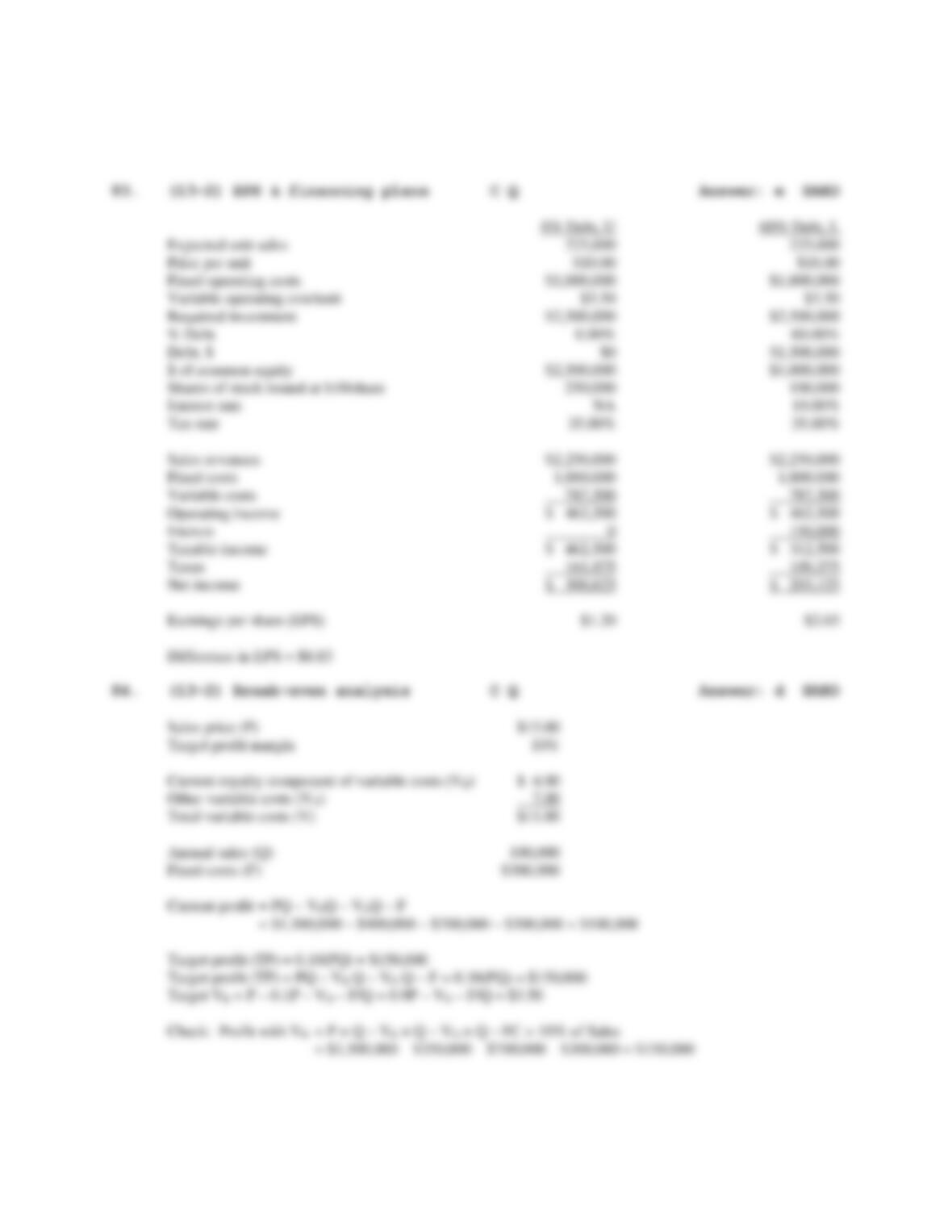
83. Your girlfriend plans to start a new company to make a new type of cat
litter. Her father will finance the operation, but she will have to
pay him back. You are helping her, and the issue now is how to finance
the company, with equity only or with a mix of debt and equity. The
price per unit will be $10.00 regardless of how the firm is financed.
The expected fixed and variable operating costs, along with other
information, are shown below. How much higher or lower will the firm’s
expected EPS be if it uses some debt rather than only equity, i.e.,
what is EPSL – EPSU?
0% Debt, U 60% Debt, L
Expected unit sales 225,000 225,000
Price per unit $10.00 $10.00
Fixed costs $1,000,000 $1,000,000
Variable cost/unit $3.50 $3.50
Required investment $2,500,000 $2,500,000
Shares issued at $10/share 250,000 100,000
% Debt 0.00% 60.00%
Debt, $ $0 $1,500,000
Equity, $ $2,500,000 $1,000,000
Interest rate NA 10.00%
Tax rate 35.00% 35.00%
a. $0.54
b. $0.60
c. $0.67
d. $0.75
e. $0.83

Page 498 M/C Problems Chapter 13: Capital Structure
84. Southeast U’s campus book store sells course packs for $15.00 each, the
variable cost per pack is $11.00, fixed costs for this operation are
$300,000, and annual sales are 100,000 packs. The unit variable cost
consists of a $4.00 royalty payment, VR, per pack to professors plus
other variable costs of VO = $7.00. The royalty payment is negotiable.
The book store’s directors believe that the store should earn a profit
margin of 10% on sales, and they want the store’s managers to pay a
royalty rate that will produce that profit margin. What royalty per
pack would permit the store to earn a 10% profit margin on course
packs, other things held constant?
a. $2.55
b. $2.84
c. $3.15
d. $3.50
e. $3.85
85. Dye Industries currently uses no debt, but its new CFO is considering
changing the capital structure to 40.0% debt (wd) by issuing bonds and
using the proceeds to repurchase and retire common shares so the
percentage of common equity in the capital structure (wc) = 1 – wd.
Given the data shown below, by how much would this recapitalization
change the firm’s cost of equity, i.e., what is rL – rU?
Risk-free rate, rRF 6.00% Tax rate, T 40%
Market risk premium, RPM 4.00% Current wd 0%
Current beta, bU 1.15 Target wd 40%
a. 1.66%
b. 1.84%
c. 2.02%
d. 2.23%
e. 2.45%
86. Dyson Inc. currently finances with 20.0% debt (i.e., wd = 20%), but its
new CFO is considering changing the capital structure so wd = 60.0% by
issuing additional bonds and using the proceeds to repurchase and
retire common shares so the percentage of common equity in the capital
structure (wc) = 1 – wd. Given the data shown below, by how much would
this recapitalization change the firm’s cost of equity? (Hint: You must
unlever the current beta and then use the unlevered beta to solve the
problem.)
Risk-free rate, rRF 5.00% Tax rate, T 40%
Market risk premium, RPM 6.00% Current wd 20%
Current beta, bL1 1.15 Target wd 60%
a. 4.05%
b. 4.50%
c. 4.95%
d. 5.45%
e. 5.99%

Chapter 13: Capital Structure M/C Problems Page 499
87. Monroe Inc. is an all-equity firm with 500,000 shares outstanding. It
has $2,000,000 of EBIT, and EBIT is expected to remain constant in the
future. The company pays out all of its earnings, so earnings per
share (EPS) equal dividends per shares (DPS), and its tax rate is 40%.
The company is considering issuing $5,000,000 of 9.00% bonds and using
the proceeds to repurchase stock. The risk-free rate is 4.5%, the
market risk premium is 5.0%, and the firm’s beta is currently 0.90.
However, the CFO believes the beta would rise to 1.10 if the
recapitalization occurs. Assuming the shares could be repurchased at
the price that existed prior to the recapitalization, what would the
price per share be following the recapitalization? (Hint: P0 = EPS/rs
because EPS = DPS.)
a. $28.27
b. $29.76
c. $31.25
d. $32.81
e. $34.45
88. You were hired as the CFO of a new company that was founded by three
professors at your university. The company plans to manufacture and
sell a new product, a cell phone that can be worn like a wrist watch.
The issue now is how to finance the company, with equity only or with a
mix of debt and equity. The price per phone will be $250.00 regardless
of how the firm is financed. The expected fixed and variable operating
costs, along with other data, are shown below. How much higher or
lower will the firm’s expected ROE be if it uses 60% debt rather than
only equity, i.e., what is ROEL – ROEU?
0% Debt, U 60% Debt, L
Expected unit sales (Q) 28,500 28,500
Price per phone (P) $250.00 $250.00
Fixed costs (F) $1,000,000 $1,000,000
Variable cost/unit (V) $200.00 $200.00
Required investment $2,500,000 $2,500,000
% Debt 0.00% 60.00%
Debt, $ $0 $1,500,000
Equity, $ $2,500,000 $1,000,000
Interest rate NA 10.00%
Tax rate 35.00% 35.00%
a. 5.68%
b. 5.94%
c. 6.22%
d. 6.52%
e. 6.83%
Page 500 Answers Chapter 13: Capital Structure
CHAPTER 13
ANSWERS AND SOLUTIONS
Chapter 13: Capital Structure Answers Page 501
Page 502 Answers Chapter 13: Capital Structure
Chapter 13: Capital Structure Answers Page 503
Page 504 Answers Chapter 13: Capital Structure
Chapter 13: Capital Structure Answers Page 505
Page 506 Answers Chapter 13: Capital Structure
Chapter 13: Capital Structure Answers Page 507
Page 508 Answers Chapter 13: Capital Structure
Chapter 13: Capital Structure Answers Page 509
Page 510 Answers Chapter 13: Capital Structure