77. U.S. GAAP classifies securities that are neither debt securities held to maturity or trading securities as
78. A financial instrument that obtains its value from some other financial item is known as a(n)
79. Which of the following is/are not true?
80. Which of the following is/are elements of a derivative?
81. Firms engage in transactions that subject them to specific financial risks. Most firms face risks—that is,
variability of outcome—from changes in interest rates, foreign exchange rates, and commodity prices. Firms
can purchase financial instruments to reduce these business risks, that is, to reduce the volatility of certain
outcomes. Some of these instruments trade in relatively active markets, like marketable securities, while others
have specialized terms and do not trade at all. The general term used for the types of financial instruments that
firms might buy to mitigate the risks is a(n)
82. Derivatives include
83. Which of the following is not a derivative?
84. Which of the following can be a counterparty in a derivative transaction?
85. Which of the following is/are elements of a derivative?
86. Firms can purchase financial instruments to reduce certain business risks, that is, to reduce the volatility of
certain outcomes. The outcomes include changes in
87. Which of the following is/are true?
88. Which of the following is not true?
89. Which of the following is not a derivative?
90. Which of the following is a characteristic of a derivative?
91. Which of the following is a characteristic of a derivative?
92. The U.S. GAAP and IASB require that firms record derivatives on the balance sheet date at
93. Gains and losses on effective cash flow hedges are reported initially in
94. Gains and losses on speculative securities, fair value hedges, and the ineffective portion of cash flow hedges
are included in
95. Cash flow hedges are revalued to market value each period and gains and losses from changes in the market
values of such derivatives appears
96. A fair value hedge
97. U.S. GAAP and IFRS require firms to classify derivatives as
98. Which of the following is/aretrue?
99. Derivative instruments acquired to hedge exposure to changes in the
fair values of assets or liabilities are fair value hedges. Fair value hedges are
100. Cash flow hedges are
101. Which of the following is/aretrue?
102. The accounting for fair value hedges is similar under both U.S. GAAP and IFRS. Which of the following
is/aretrue?
103. For cash flow hedges, which of the following is/aretrue?
104. The matching convention provides both the basis for hedge accounting, as well as the logic for the treating
gains and losses from changes in fair value of fair value hedges differently from cash flow hedges. Which of the
following is/are not true?
105. When accounting for a fair value hedge of a recognized asset or liability, on the date a firm enters the
derivative contract and designates that contract as a fair value hedge,
106. When accounting for a cash flow hedge of an recognized asset or liability, which of the following is/are
true?
107. When accounting for a cash flow hedge of a recognized asset or liability, which of the following is/are
true?
108. U.S. GAAP requires firms to disclose which of the following information with respect to derivatives?
109. Which of the following is/aretrue?
110. Firms can elect the fair value option for the following items: (1) bonds held to maturity, (2) available-for-
sale securities, and (3) cash flow hedges. Which of the following is/aretrue?
111. U.S. GAAP and IFRS require firms to account for debt securities designated as held to maturity at _____
except that they are also subject to _____. That is, firms do not recognize increases in fair value (unrealized
gains) but might recognize decreases in fair value(unrealized losses).
112. U.S. GAAP and IFRS require firms to account for debt securities designated as held to maturity by not
recognizing _____ but might recognize _____.
113. U.S. GAAP and IFRS require firms to report trading securities at _____.
114. The counter-argument for (1) not measuring held-to-maturity debt securities at amortized cost and (2)
recognizing most changes in fair value during the contractual term of the debt include any change in the _____
could change the investor’s willingness or ability to hold the securities until maturity.
115. The argument for measuring held-to-maturity debt securities at amortized cost and ignoring most changes
in fair value during the contractual term of the debt is/are
116. Measurement of trading securities at _____ reflects income when it occurs in the form of a change in
_____, not when the investor realizes a gain or loss _____.
117. Which of the following is/are true regarding reporting trading securities at fair value on the balance sheet.
118. GAAP and IFRS require firms to report trading securities at fair value on the balance sheet. The income
statement reports the debit (loss) for decreases in the fair value and the credit (gain) for increases in the fair
value of trading securities in an account with a title such as _____.
119. The firm’s purpose for holding certain securities may change, requiring it to transfer securities from one
category to another. The firm transfers the securities at _____ at the time of the transfer.
120. Which of the following is/are true?
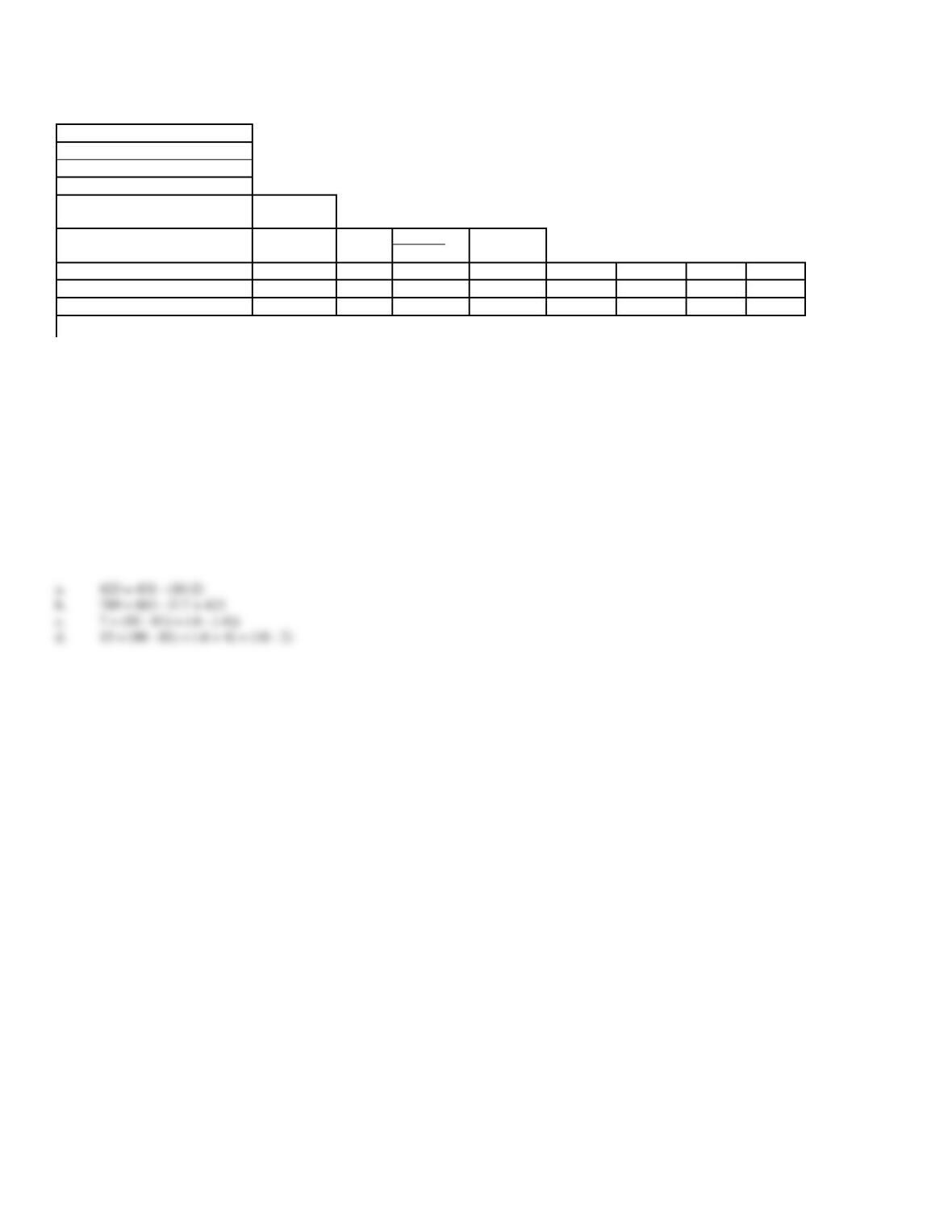
121. The 2013 annual report of Travel Industries reports the following data about its marketable securities held
available-for-sale.
Travel Industries
Securities Available-for-Sale
Data from 2013 Annual Report
(Dollar Amounts in Millions)
At Year End
During Year
Ended 12/31
Gross
Unrealized
Fair
Proceeds
Realized
Cost
Gains
(Losses)
Value
Year
of Sale
Gains
(Losses)
Dec. 31-12
$517
$81
$(4)
$594
2012
$410
$13
$2
Dec. 31-13
883
90
(6)
967
2013
431
10
2
Required:
a.
What was the cost of the securities available-for-sale that Travel Industries sold during the year 2013?
b.
What was the cost of the securities available-for-sale that Travel Industries purchased during the year 2013?
c.
What was Travel Industries’ Other Comprehensive Income related to securities available-for-sale for 2013?
d.
What were the total gains or losses, net, both realized and unrealized on Travel Industries’ securities available-for-sale during the year
2013?
a.
423 = 431 – (10-2)
b.
789 = 883 – 517 + 423
c.
7 = (90 – 81) + (-6 – (-4))
15 = (90 – 81) + (-6 + 4) + (10 – 2)
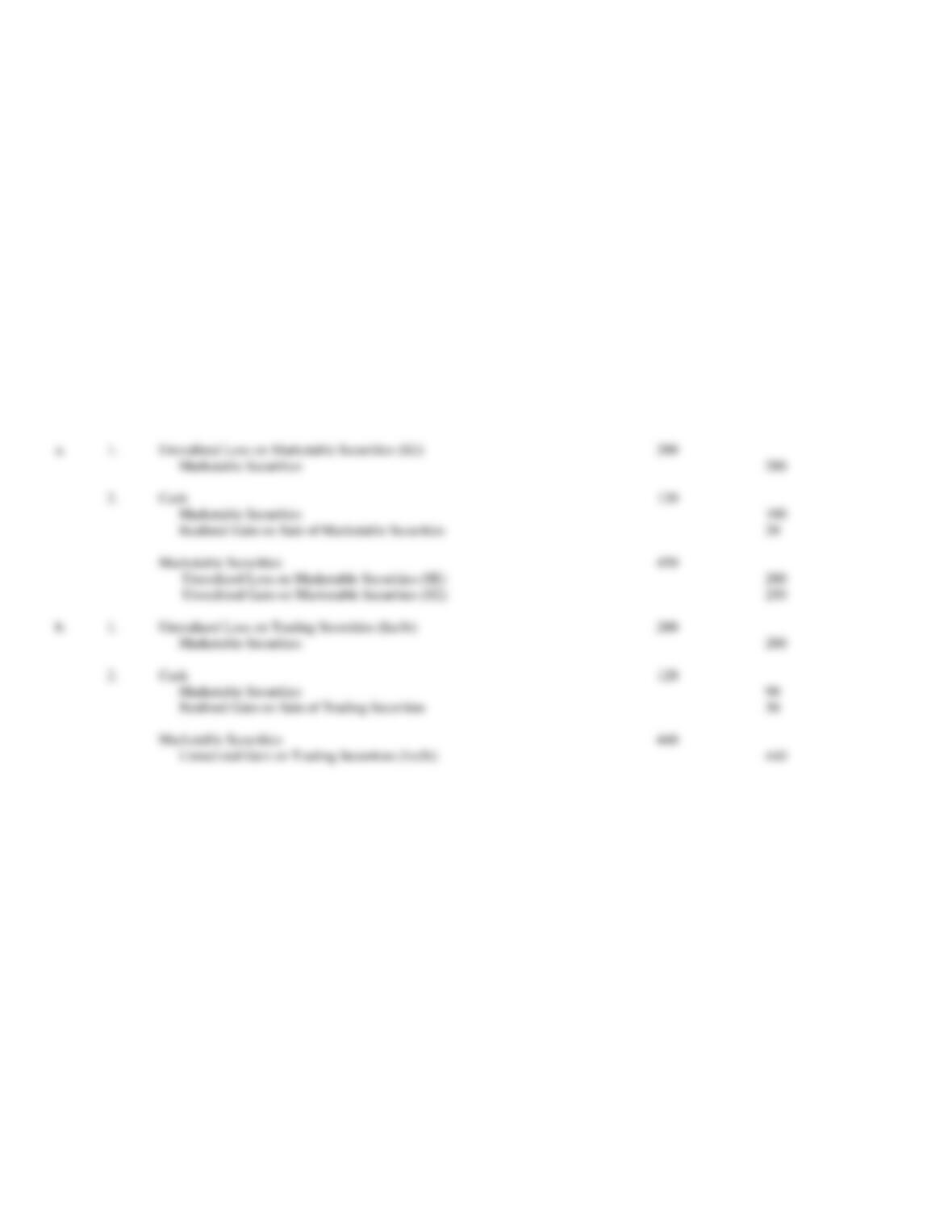
122. In Year 1, the firm purchased a portfolio of marketable securities for $1,000, which it holds as current
assets. At the end of Year 1, the portfolio had a market value of $800. During Year 2, the firm sold some of the
securities for $120 which had originally cost $100, but which had a market value of $90 at the end of Year 1. At
the end of Year 2, the remaining securities had a market value of $1,150.
Required:
a.
Assume the firm treats its holdings as available-for-sale.
1. Record the entry made at the end of Year 1.
2. Record the entries made during Year 2 and at the end of Year 2.
b.
Assume the firm treats its holdings as trading securities.
1. Record the entry made at the end of Year 1.
2. Record the entries made during Year 2 and at the end of Year 2.
a.
1.
Unrealized Loss on Marketable Securities (SE)
200
Marketable Securities
2.
Cash
120
Marketable Securities
100
Realized Gain on Sale of Marketable Securities
Marketable Securities
450
Unrealized Loss on Marketable Securities (SE)
200
Unrealized Gain on Marketable Securities (SE)
b.
1.
Unrealized Loss on Trading Securities (IncSt)
200
2.
Cash
120
Marketable Securities
90
Realized Gain on Sale of Trading Securities
30
Marketable Securities
Unrealized Gain on Trading Securities (IncSt)
440
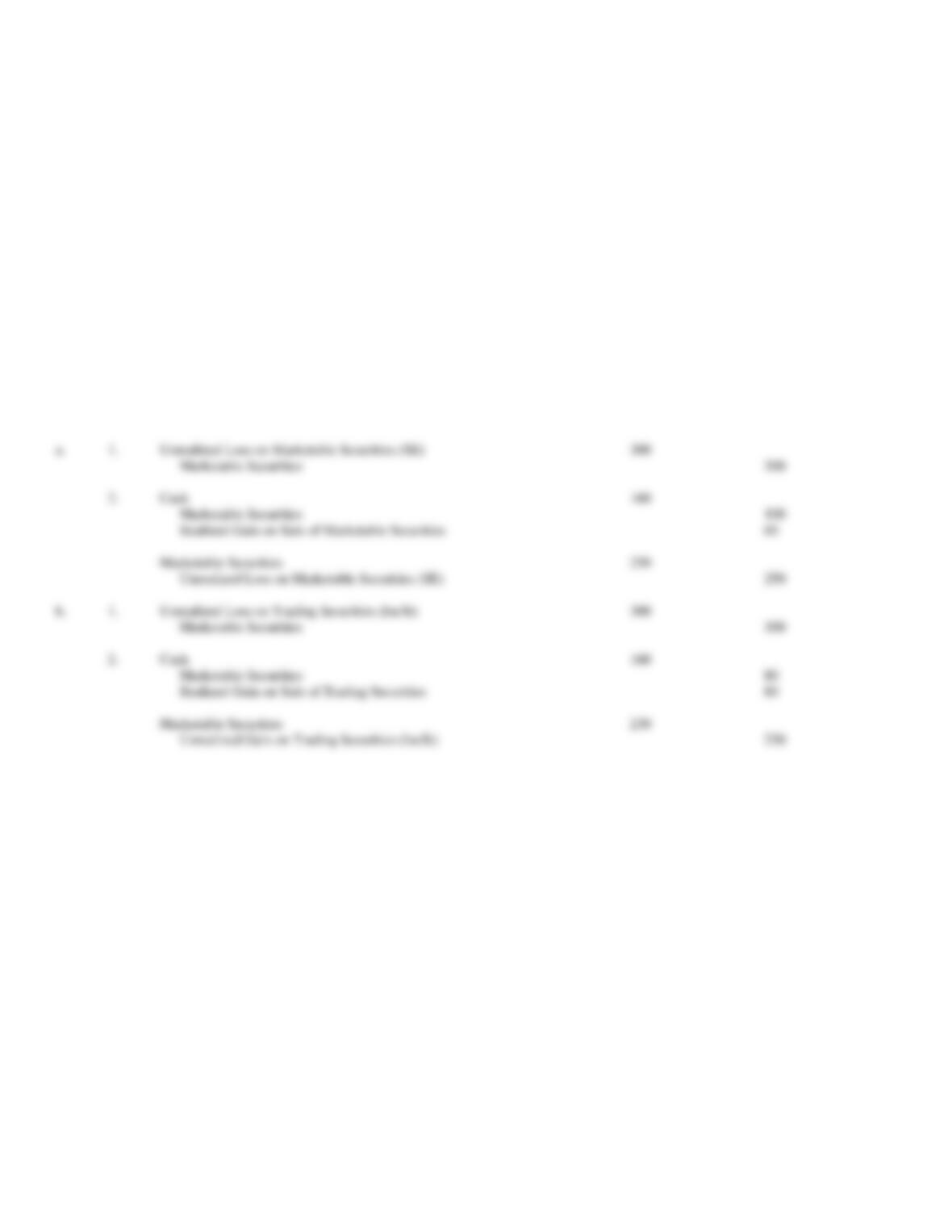
123. In Year 1, the firm purchased a portfolio of marketable securities for $1,000, which it holds as current
assets. At the end of Year 1, the portfolio had a market value of $700. During Year 2, the firm sold some of the
securities for $160 which had originally cost $100, but which had a market value of $80 at the end of Year 1. At
the end of Year 2, the remaining securities had a market value of $850.
Required:
a.
Assume the firm treats its holdings as available-for-sale.
1. Record the entry made at the end of Year 1.
2. Record the entries made during Year 2 and at the end of Year 2.
b.
Assume the firm treats its holdings as trading securities.
1. Record the entry made at the end of Year 1.
2. Record the entries made during Year 2 and at the end of Year 2.
a.
1.
Unrealized Loss on Marketable Securities (SE)
300
Marketable Securities
2.
Cash
160
Marketable Securities
100
Realized Gain on Sale of Marketable Securities
Marketable Securities
250
Unrealized Loss on Marketable Securities (SE)
250
b.
1.
Unrealized Loss on Trading Securities (IncSt)
300
Marketable Securities
300
Cash
Marketable Securities
80
Realized Gain on Sale of Trading Securities
80
Marketable Securities
230
Unrealized Gain on Trading Securities (IncSt)
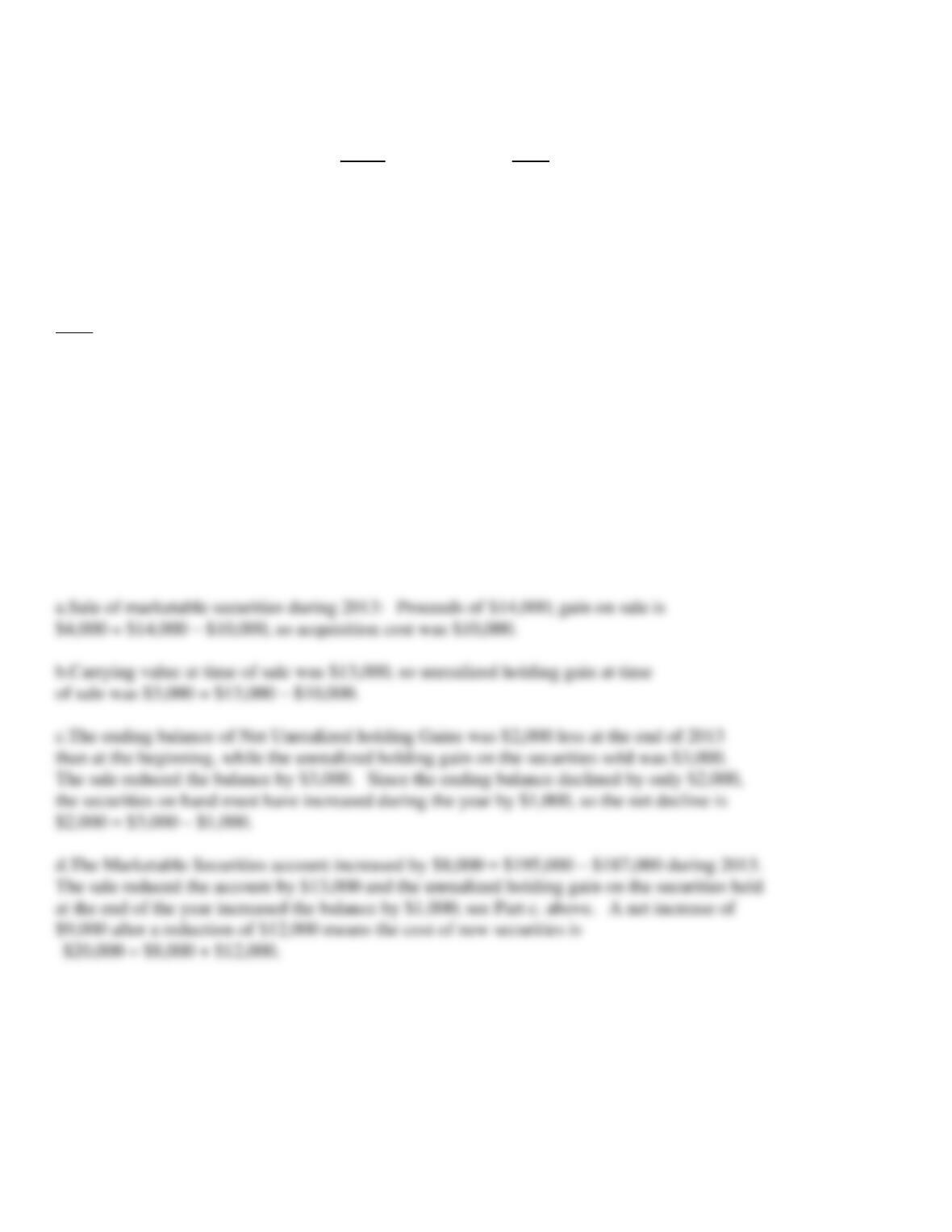
124. During 2013, Maria Corporation sold marketable securities for $14,000 that had a carrying value of
$13,000 at the time of sale. The financial statements of Maria Corporation reveal the following
information with respect to securities available-for-sale:
December 31 2013 2012
Balance Sheet
Marketable Securities at Fair Value . . . $195,000 $187,000
Net Unrealized Holding Gain on
Securities Available-for-Sale. . . . . . . . $ 10,000 $ 12,000
2013
Income Statement
Realized Gain on Sale of Securities Available-for-Sale . . . $4,000
a. What was the acquisition cost of the marketable securities sold?
b. What was the unrealized holding gain on the securities sold at the time of sale?
c. What was the unrealized holding gain during 2013 on securities still held by the end of 2013?
d. What was the cost of marketable securities purchased during 2013?
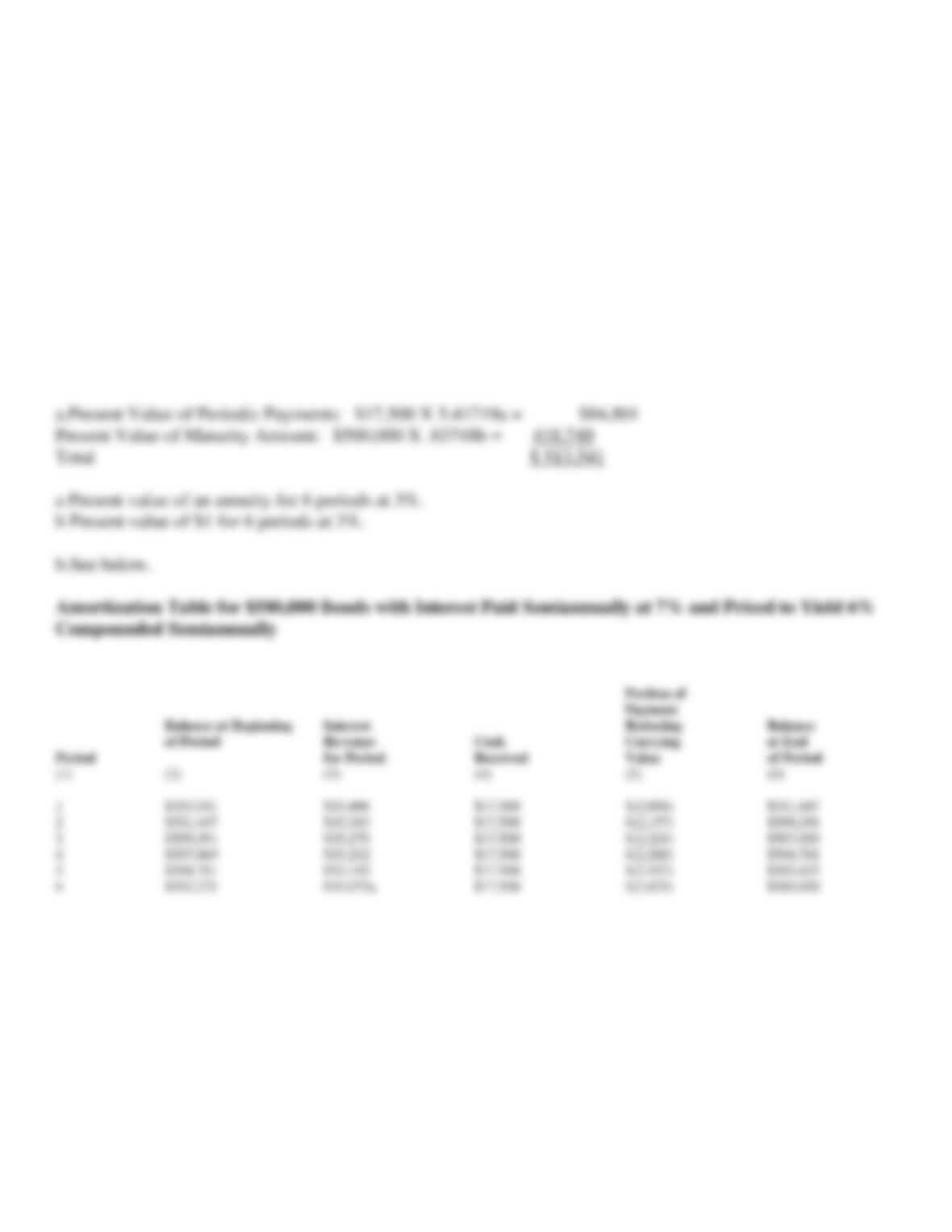
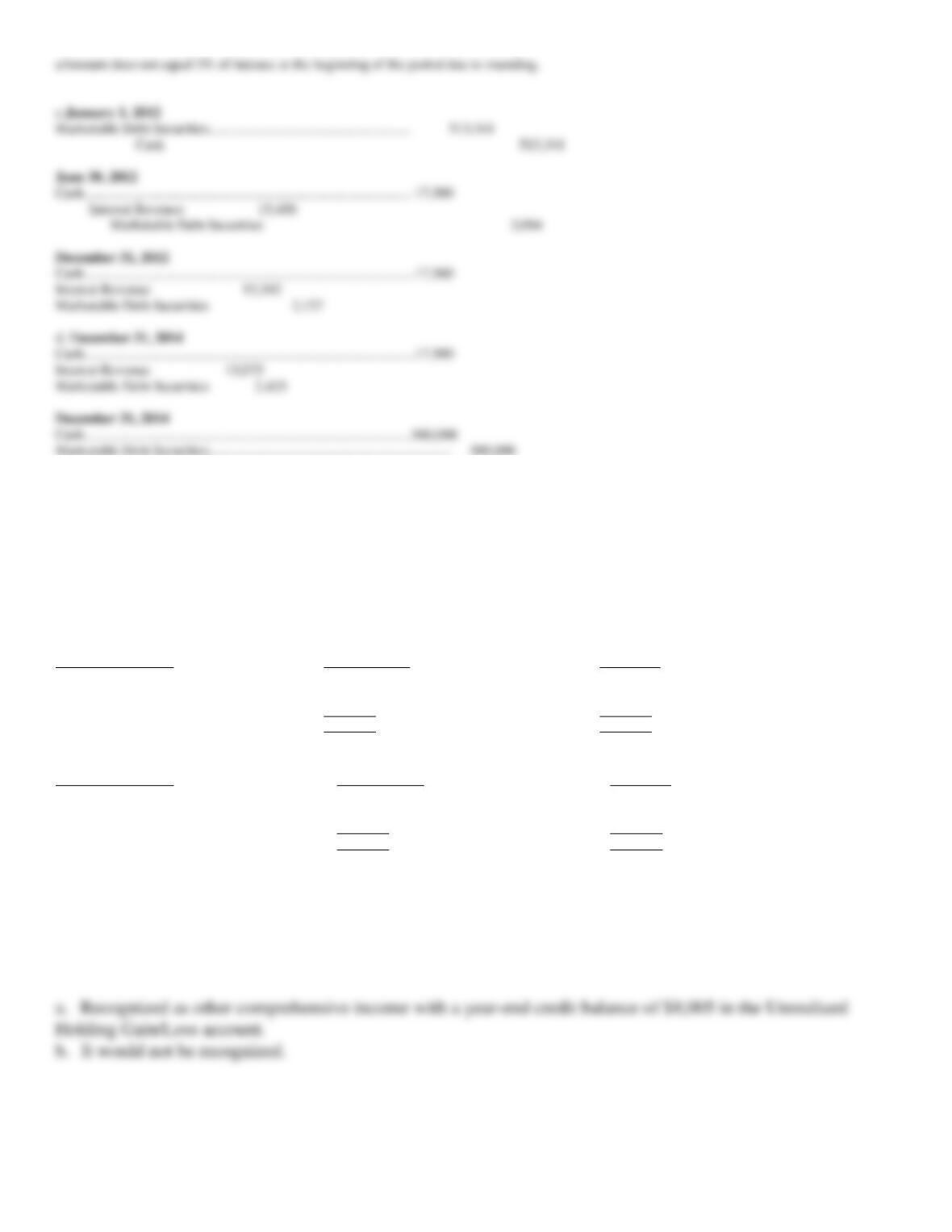
125. Martin Company acquired $500,000 face value of the outstanding bonds of Tory Company on January 1,
2012. The bonds pay interest semiannually on June 30 and December 31 at an annual rate of 7% and mature on
December 31, 2014. The bonds were priced on the market on January 1, 2012, to yield 6% compounded
semiannually. Martin Company classifies these bonds as held to maturity.
a. Compute the amount that Martin Company paid for these bonds, excluding commissions and taxes.
b. Prepare an amortization table for these bonds.
c. Give the journal entries that Martin Company would make to account for these bonds during 2012.
d. Give the journal entries that Martin Company would make to account for these bonds on December 31,
2014.
(Martin Company, accounting for bonds held to maturity.)
126. Credit Company
Information concerning Credit Company’s portfolio of debt securities at May 31, Year 6, and May 31, Year 7, is
presented below. All of the debt securities were purchased by Credit Co. during June, Year 5. Prior to June,
Year 5, Credit Co. had no investments in debt or equity securities.
As of May 31, Year 6
Amortized Cost
Fair Value
CZ Company bonds
$164,526
$168,300
Jerry Industry bonds
204,964
205,200
Barley Inc. bonds
305,785
285,200
$675,275
$658,700
As of May 31, Year 7
Amortized Cost
Fair Value
CZ Company bonds
$152,565
$147,600
Jerry Industry bonds
193,800
204,500
Barley Inc. bonds
289,130
291,400
$635,495
$643,500
a. Assuming that the above securities are properly classified as available-for-sale securities under U.S. GAAP, how would the unrealized holding
gain or loss as of May 31, Year 7, be recognized?
b. Assuming that the above securities are properly classified as held-to-maturity securities under U.S. GAAP, how, if at all, would the unrealized
holding gain or loss as of May 31, Year 7, be recognized?
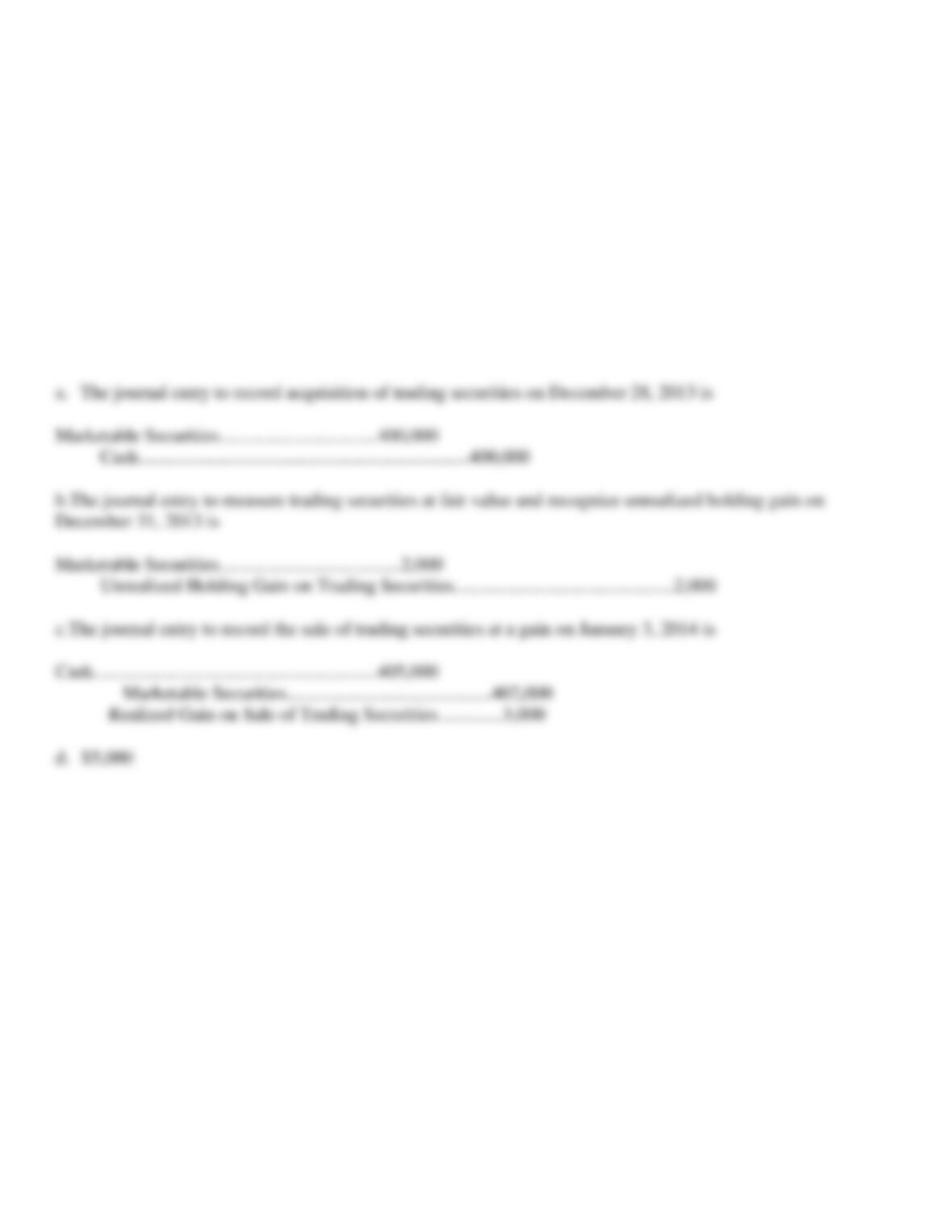
127. Armul Insurance
Armul Insurance acquired shares of Bannock’s common stock on December 28, 2013, for $400,000 and
classified them as trading securities. The fair value of these securities on December 31, 2013, was $402,000.
Armul Insurance sold these shares on January 3, 2014, for $405,000.
a. What is the journal entry to record acquisition of trading securities on December 28, 2013?
b. What is the journal entry to measure trading securities at fair value and recognize unrealized holding gain on
December 31, 2013?
c. What is the journal entry to record the sale of trading securities at a gain on January 3, 2014?
d. What is the total income from the purchase and sale of the securities?
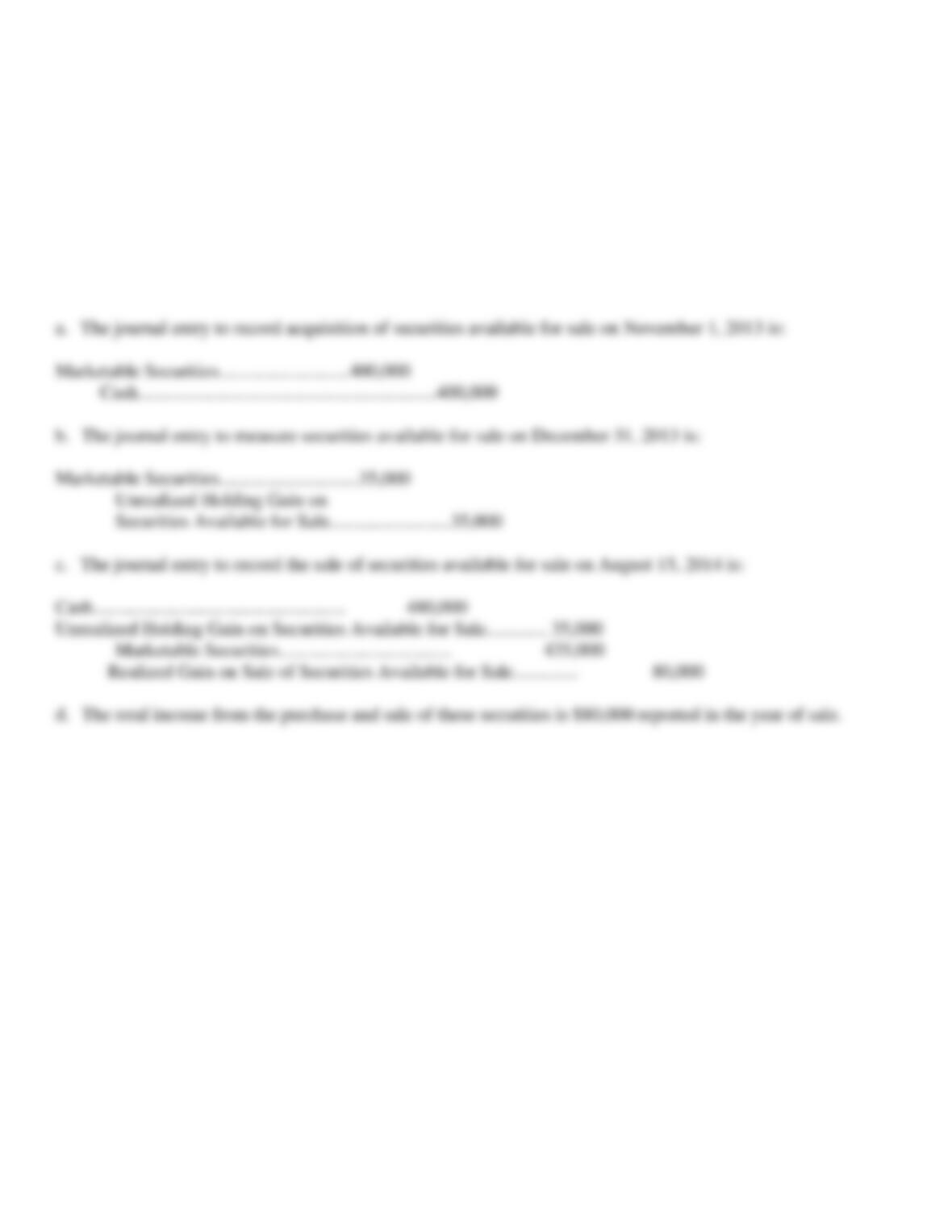
128. Bartow Company acquires common stock of Champion Enterprises for $400,000 on November 1, 2013,
and designates this investment as available-for-sale. The fair value of these shares is $435,000 on December 31,
2013. Bartow sells these shares on August 15, 2014, for $480,000.
a. What is the journal entry to record acquisition of securities available-for-sale on November 1, 2013?
b. What is the journal entry to measure securities available-for-sale on December 31, 2013?
c. What is the journal entry to record the sale of securities available-for-sale on August 15, 2014?.
d. What is the total income from the purchase and sale of these securities reported in the year of sale?