12) The market rewards firms that adopt a constant dividend payout policy rather than a fixed or
increasing level of dividends through higher share prices.
13) The market rewards firms that adopt a fixed or increasing level of dividends rather than a
fixed dividend payout policy through higher share prices.
14) Firms are usually prohibited by state law from distributing ________.
A) retained earnings as dividends
B) paid-in capital in excess of par as dividends
C) dividends in a year the firm has a net loss
D) preferred dividends
15) Tangshan Mining has common stock at par of $200,000, paid-in capital in excess of par of
$400,000, and retained earnings of $280,000. In states where the firm’s legal capital is defined as
the par value of common stock, the firm could pay out ________ in cash dividends without
impairing its capital.
A) $200,000
B) $680,000
C) $600,000
D) $880,000
16) Tangshan Mining has common stock at par of $200,000, paid-in capital in excess of par of
$400,000, and retained earnings of $280,000. In states where the firm’s legal capital is defined as
the total of par value and paid-in capital in excess of par, the firm could pay out ________ in
cash dividends without impairing its capital.
A) $280,000
B) $400,000
C) $480,000
D) $600,000
17) Legal capital refers to ________.
A) a legal constraint imposed by lenders of a firm to maintain a certain level of debt to equity
ratio and capital
B) capital impairment restrictions are generally established to provide a sufficient equity base to
protect creditors’ claims
C) the capital which is typically measured by the retained earnings
D) the capital which is typically measured by net income
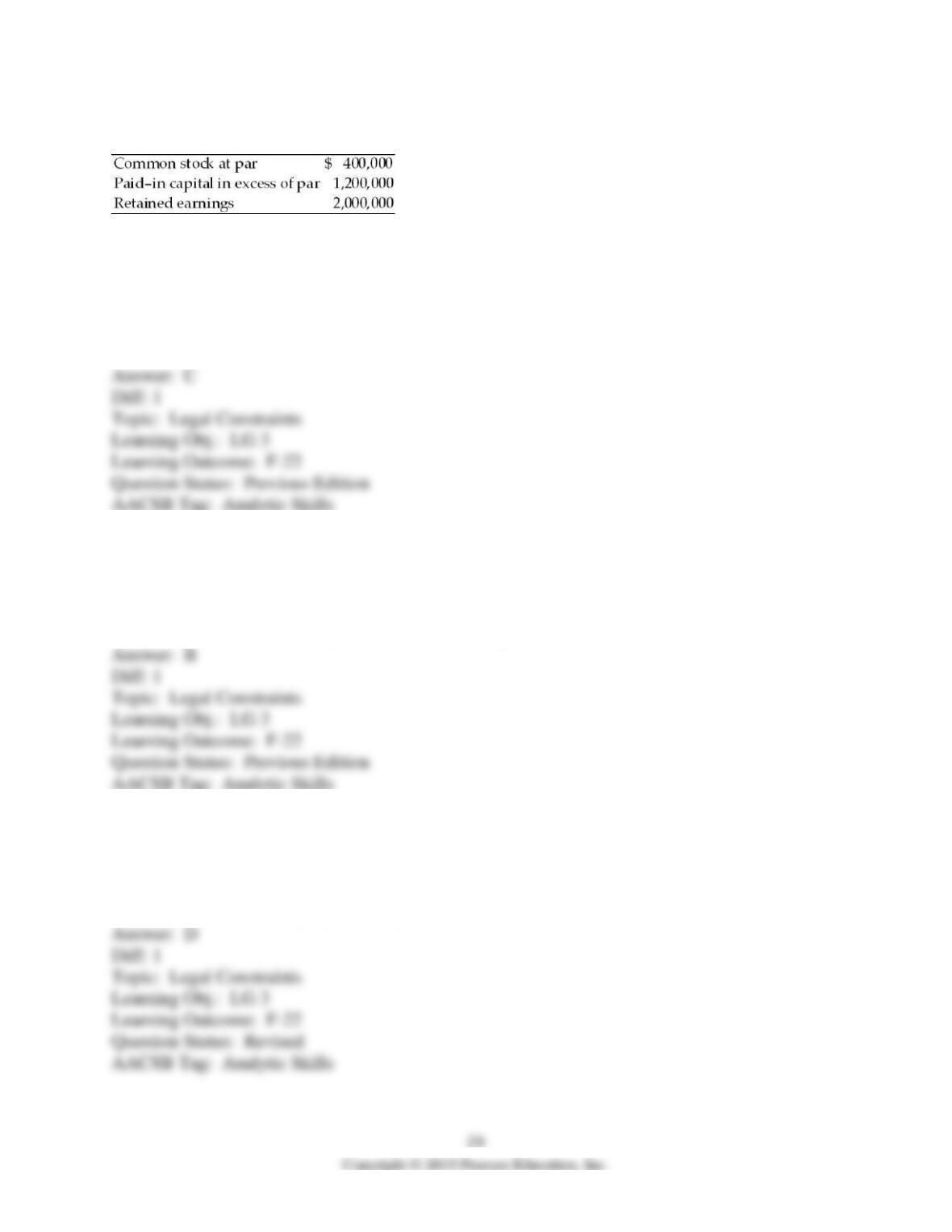
18) A firm has the following stockholders’ equity balances:
In states where the firm’s legal capital is defined as the par value of its common stock, the
maximum cash dividend the firm could pay is ________.
A) $3,600,000
B) $400,000
C) $3,200,000
D) $1,600,000
19) An excess earnings accumulation tax is levied when ________.
A) shareholders receive dividends which exceed a firm’s earnings
B) firms do not pay dividends in order to delay the owners’ tax liability
C) firms do not pay dividends to reinvest in the firm
D) earnings exceed accumulated dividends over the years
20) The capital impairment restrictions are established to ________.
A) reduce dividends equal to or below the current earnings level
B) constrain the firm to paying dividends which do not require additional borrowing
C) provide sufficient safety to equity holders
D) provide a sufficient equity base to protect creditors’ claims
21) With regard to dividend payments, which of the following is included in the contractual
constraints imposed by loan agreements?
A) limiting the payment to suppliers
B) limiting the percentage of earnings that can be paid out in dividends
C) sustaining a constant dividend payout ratio
D) making fixed payment to equityholders
22) Which of the following is considered in designing a dividend policy that is favorable to
wealthy owners?
A) the tax status of the firm’s owners
B) the political risk of the firm
C) the liability of the firm’s owners
D) the reinvestment risk of the firm
23) A firm that has a large percentage of ________ investors may pay out a lower percentage of
its earnings as dividends.
A) wealthy
B) domestic
C) middle-income
D) international
24) According to ________, investors’ demands for dividends fluctuate over time.
A) the catering theory
B) Modigliani and Miller theory
C) the residual theory of dividends
D) CAPM theory
25) According to the catering theory, firms cater to the preferences of ________.
A) investors
B) creditors
C) managers
D) government
13.4 Review and evaluate the three basic types of dividend policies.
1) A constant-payout-ratio dividend policy is based on the payment of a certain percentage of
earnings to owners in each dividend period.
2) Regular dividend policy is a dividend policy based on the payment of a certain fixed
percentage of earnings to owners in each dividend period.
3) Regularly paying a fixed or increasing dividend eliminates uncertainty about the frequency
and magnitude of dividends.
4) By calling the additional dividend an extra dividend, a firm avoids setting expectations that
the dividend increase will be permanent.
5) The dividend policy must be formulated considering two basic objectives, namely ________.
A) delaying the tax liability of the stockholder and information content
B) maximizing shareholder wealth and maintaining liquidity
C) maximizing shareholder wealth and providing for sufficient financing
D) maintaining liquidity and minimizing the weighted average cost of capital
6) A firm has current after-tax earnings of $1,000,000 and has declared a cash dividend of
$400,000. The firm’s dividend payout ratio is ________.
A) 2.5 percent
B) 2.0 percent
C) 4.0 percent
D) 40 percent
7) A firm’s dividend payout ratio is calculated by ________.
A) dividing cash dividend per share by its earnings per share
B) dividing earnings per share by its cash dividend per share
C) dividing cash dividend per share by its net income
D) dividing net income by its cash dividend per share
8) A firm has had the following earnings history over the last five years:
If the firm’s dividend policy was based on a constant payout ratio of 50 percent for all of the
years with earnings over $1.50 per share and a zero payout otherwise, the annual dividends for
2012 and 2015 were ________.
A) $0.50 and $1.25, respectively
B) $0 and $2.00, respectively
C) $0 and $1.25, respectively
D) $0 and $0.88, respectively
9) Which type of dividend payment policy has the disadvantage that if a firm’s earnings drop or
if a loss occurs in a given period, dividends may be low or nonexistent?
A) constant-payout-ratio policy
B) regular dividend policy
C) low-regular-and-extra dividend policy
D) stock dividend policy
10) The problem with a constant-payout-ratio dividend policy from the shareholders’ perspective
is that ________.
A) it pays constant dividend irrespective of the earnings of a firm
B) if the firm’s earnings drop, the dividends tend to be lower
C) even when earnings are low, the company must pay a fixed dividend
D) there is no uniformity in this type of dividend policy
11) The problem with the regular dividend policy from a firm’s perspective is that ________.
A) it regularly pays dividends which fluctuate with earnings
B) if the firm’s earnings drop, the dividends may be low
C) even when earnings are low, the company must pay a fixed dividend
D) it increases the shareholders’ uncertainty
12) When a firm pays a stated dollar dividend and adjusts the payment as earnings increase, its
dividend policy can be called ________.
A) a low-regular-and-extra dividend policy
B) a regular dividend policy
C) a target dividend-payout ratio policy
D) a constant-payout-ratio dividend policy
13) Which type of dividend payment policy has the advantage that if a firm’s earnings drop,
dividends will still be maintained at a relatively constant level?
A) constant-payout-ratio policy
B) regular dividend policy
C) low-regular-and-extra dividend policy
D) target dividend policy
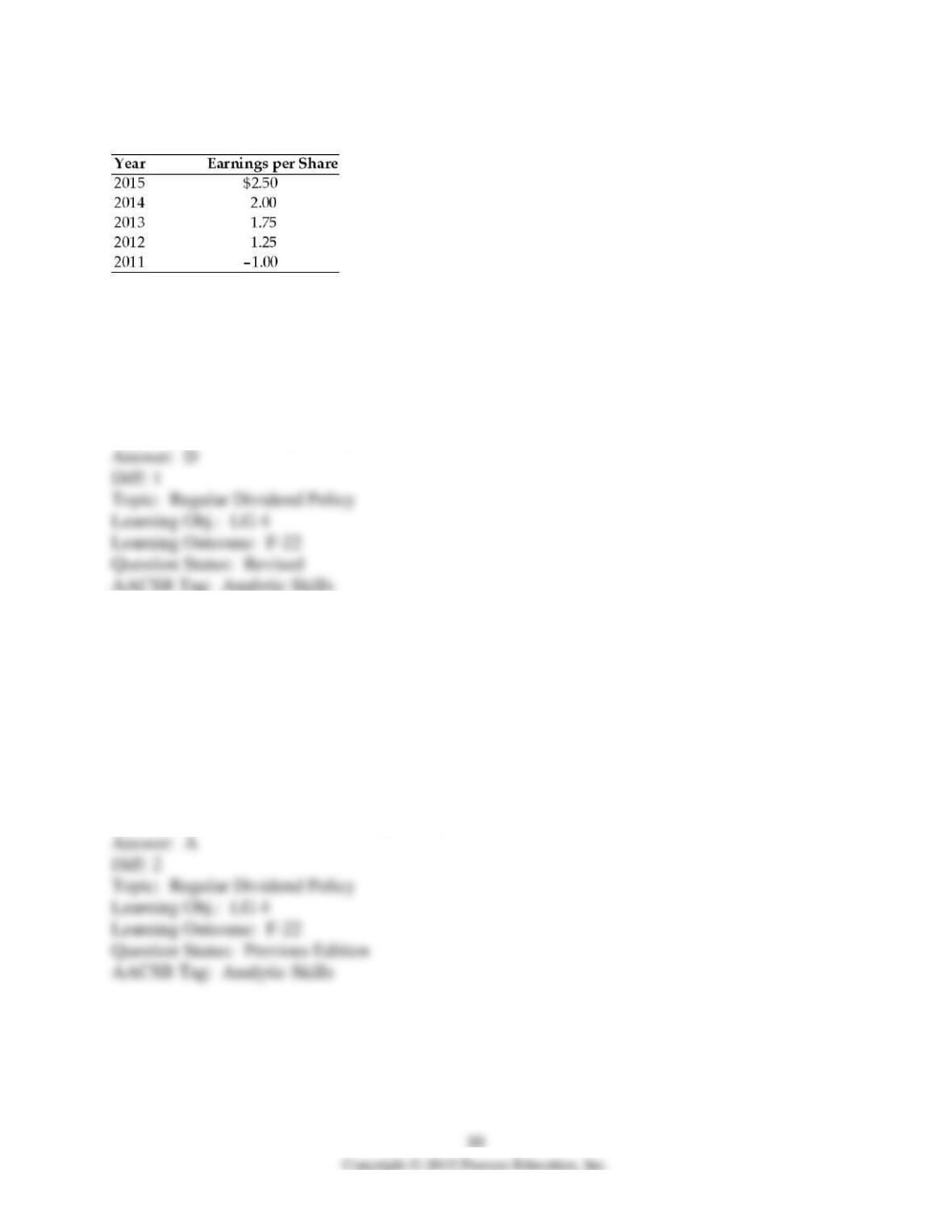
14) A firm has had the following earnings history over the last five years:
If the firm’s dividend policy is based on a $0.50 payout per share whenever it makes a positive
earnings, increasing by $0.05 to previous year dividends per share whenever earnings exceed
$1.50 per share, the annual dividends for 2014 and 2015 were ________.
A) $0.50 and $0.60, respectively
B) $0.50 and $0.55, respectively
C) $0.55 and $0.65, respectively
D) $0.60 and $0.65, respectively
15) At a firm’s quarterly dividend meeting held on December 5, the directors declared a $1.50
per share cash dividend to be paid to the holders of record on Monday, January 1. Before the
dividend was declared, the firm’s accumulated retained earnings balance and cash balance were
$1,280,000 and $30,000 respectively. The firm has 10,000 shares of common stock outstanding.
On January 2, the cash, dividends payable, and retained earnings accounts had balances of
________.
A) $15,000, $0, and $1,265,000, respectively
B) $30,000, $15,000, and $1,280,000, respectively
C) $30,000, $0, and $1,265,000, respectively
D) $15,000, $0, and $1,280,000, respectively
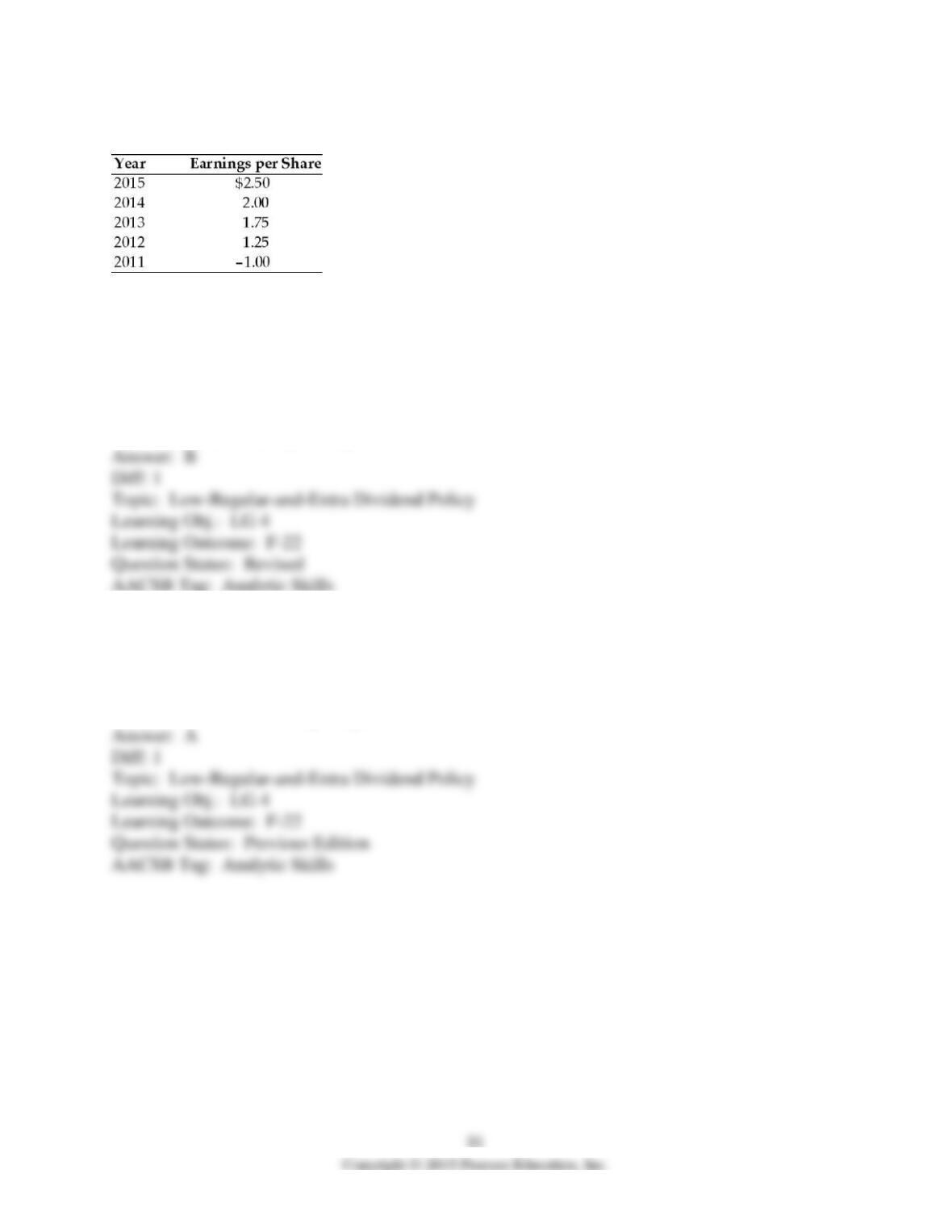
16) A firm has had the following earnings history over the last five years:
If the firm’s dividend policy was to pay $0.25 per share each period except when earnings exceed
$1.50, an extra dividend equal to 50 percent of the earnings above $1.50 would be paid, the
annual dividends for 2012 and 2015 were ________.
A) $0.25 and $1.25, respectively
B) $0.25 and $0.75, respectively
C) $0 and $0.25, respectively
D) $0.25 and $0.25, respectively
17) The advantage of using the extra dividend policy is that ________.
A) a firm can avoid giving false hopes to shareholders
B) if a firm’s earnings drop, so does the dividend payment
C) the extra dividend may become a regular event
D) cyclical shifts in earnings may be avoided