Test Bank – Chapter 13 – The Complete Income Statement 13-21
MATCHING QUESTIONS
1. Indicate whether each event listed below in 1 through 6 is reported as a discontinued
operation (D), a change in accounting principle (A), or a component of continuing
operations (C), by placing the letter of your choice in the space provided. If an item does
not fall into one of these categories, place an X in the blank.
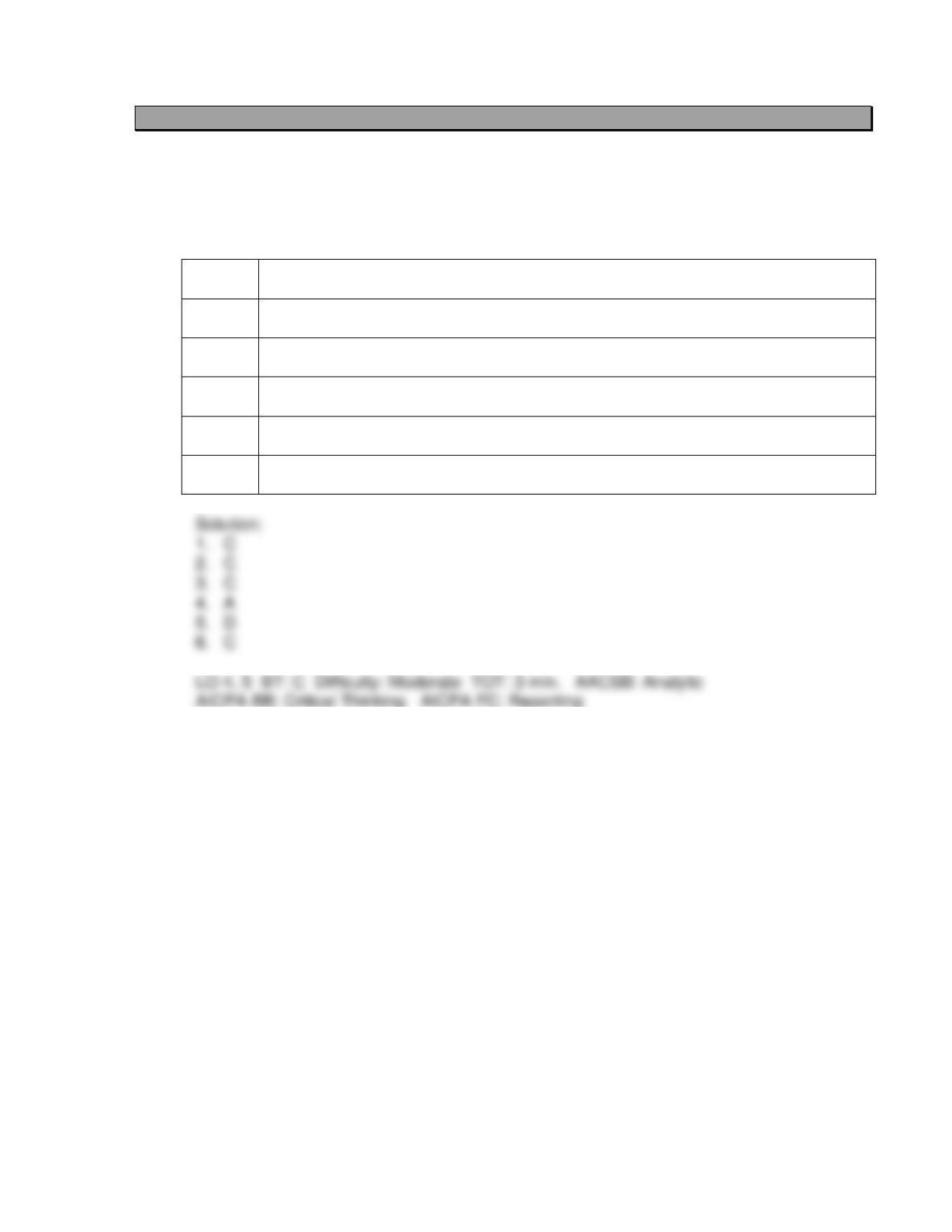
1. Gain on disposal of one of the company’s four corporate office buildings
2. Retired bonds early and incurred a loss
3. Received dividends on stock investments
4. Changed from FIFO to average cost flow assumption
5. Disposal of a business segment
6. Estimated uncollectible accounts at year-end
13–22 Test Bank – Chapter 13 – The Complete Income Statement
2. Given below are several items (1 through 4) that will be reported on a company’s financial
statements. Select the letter of the proper financial statement reporting section listed as a
through e. You may use each letter more than once or not at all.
Financial Statement Reporting Sections
a. Income from continuing operations section of the income statement
b. Discontinued operations section of the income statement
c. Cumulative effect of a change in accounting principle section of the income statement
d. A separate comprehensive income item
e. Not reported on the income statement or comprehensive income statement
_____1. A loss incurred by Maranda Corporation due to a strike by employees of the
company
_____2. A large loss of inventory incurred by a meat-packing factory due to a government
FDA inspection which found dangerously high levels of bacteria; no previous
situations in the company’s history
_____3. Manufacturing circuits were determined obsolete and had to be written down to a
nominal scrap value due to an improved manufacturing process
_____4. A loss due to a decline in market value on an available-for-sale investment
_____5. Increase in value of goodwill
_____6. Financial impacts of the adoption of a new FASB standard on goodwill.
_____7. The financial effects of outsourcing the company’s industrial product division

Test Bank – Chapter 13 – The Complete Income Statement 13-23
3. Given below are several items (1 through 4) that will be reported on a company’s financial
statements. Select the letter of the proper financial statement reporting section listed as a
through e. You may use each letter more than once or not at all.
Financial Statement Reporting Sections
a. Income from continuing operations section of the income statement
b. Discontinued operations section of the income statement
c. Cumulative effect of a change in accounting principle section of the income statement
d. A separate comprehensive income item
e. Not reported on the income statement or comprehensive income statement
_____1. A gain due to an early payoff of debt that had a high interest rate
_____2. A loss of plant assets incurred by a company whose distribution warehouse is
located on an island that has experienced severe flooding three times in the past
5 years
_____3. A $1 billion loss due to a permanent shutdown of the company’s only subsidiary,
Coastal, Inc, triggered by poor product development
_____4. A foreign currency translation gain at yearend

13–24 Test Bank – Chapter 13 – The Complete Income Statement
4. Select the financial statement section (a through e) in which each of the items listed in 1
through 6 would be reported by writing the letter of the best answer in the space
provided.
Financial Statement Sections
a. Income from continuing operations section of the income statement
b. Discontinued operations section of the income statement
c. Cumulative effect of a change in accounting principle section of the income statement
d. Balance sheet
e. Not necessary to report on a financial statement
1. ____ Loss due to government expropriation of plant location in Venezuela
2. ____ Financial effects of the adoption of a new FASB standard regarding post–
retirement benefits
3. ____ Financial effects of dropping a company’s domestic product division
4. ____ Unusual and infrequent gain from a plant explosion
5. ____ Unrealized gain/loss from trading securities
6. ____ Interest revenue
Test Bank – Chapter 13 – The Complete Income Statement 13-25
5. Select the financial statement section (a through f) in which each of the items listed in 1
through 5 below would properly be reported by writing the letter of the best answer in the
space provided.
Financial Statement Sections
a.
Income from continuing operations section of the income statement
b.
Discontinued operations section of the income statement
c.
Cumulative effect of a change in accounting principle section of the income statement
d.
Statement of shareholders’ equity
e.
Balance sheet
f.
Not necessary to report on a financial statement
1. _____ Declared cash dividends for the first time in the history of the corporation
2. _____ Realized a gain on the sale of four Preston franchise stores, but held onto
the Little Steps chain
3. _____ Incurred a casualty loss
4. _____ Recorded interest income for the year
5. _____ Incurred $14,000 to replace the company’s office products (letterhead,
envelopes, pens, etc.) with a new logo to promote a new product line
13–26 Test Bank – Chapter 13 – The Complete Income Statement
SHORT PROBLEMS
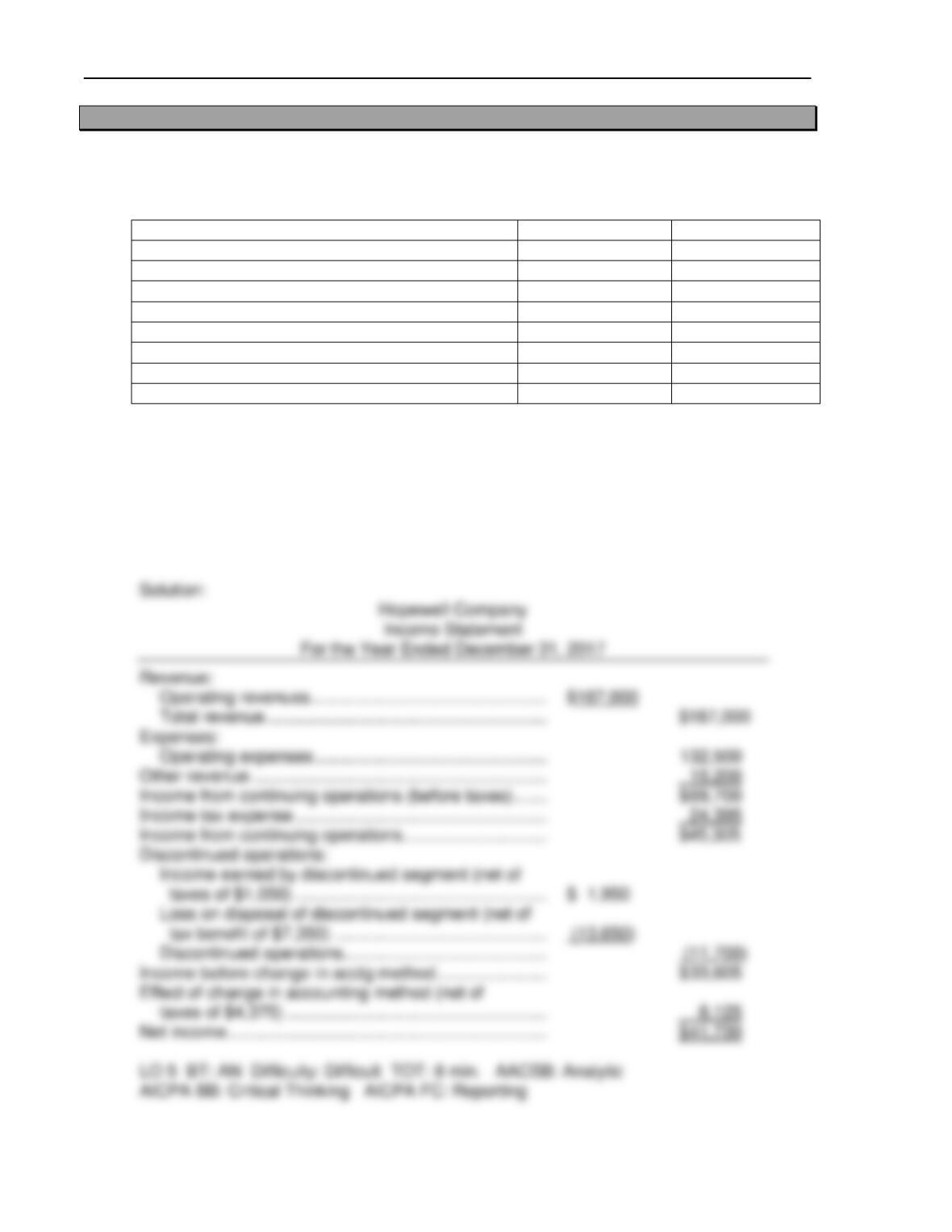
1. The following information was taken from the 2017 financial records of Hopewell
Company.
Debit
Credit
Operating revenues
187,000
Operating expenses
132,500
Gain on sale of short-term investments
15,200
Loss on sale of business segment
21,000
Income earned on disposed business segment
3,000
Income due to change in accounting principle
12,500
Retained earnings (beginning balance)
72,000
Dividends declared
18,000
The company’s income tax rate is 35 percent, and the items above are treated identically
for the financial reporting and tax purposes.
REQUIRED:
Prepare an income statement using this information.
Test Bank – Chapter 13 – The Complete Income Statement 13-27
2. Canter Company operates a boat rental service in North Carolina. The company was
involved in the following transactions and events during 2017:
1. The supplies, gasoline, and other maintenance item costs incurred associated with the
rentals are $420,000.
2. Provided rental boats to customers during 2017 for total revenue of $880,000.
3. Sued by a rental customer that got his head caught in the ladder of a rental boat. The
customer will probably win the suit that is estimated at $80,000. Lawsuits are common in
the rental industry.
4. Switched from FIFO to average cost for inventory sales. Effect was to increase the cost
of goods sold account by $58,000.
6. Declared and paid $25,000 in dividends.
For each transaction, state in which section of the income statement it should be
reported and give the dollar amount that should be reported. State whether each
reporting amount is added or subtracted on the income statement and if the specific line
item on the income statement is reported net of taxes. Canter’s income tax rate is 30%.
13–28 Test Bank – Chapter 13 – The Complete Income Statement
3. The following are the revenue and expense accounts for the year ending August 31,
2017, for Hammer Corporation:
Sales revenue
$70,000
Interest revenue
3,000
Interest expense
2,000
Gain from sale of land
8,000
Cost of goods sold
45,000
Administrative expense
9,000
Loss on disposal of segment
3,500
Income tax expense
4,200
A. Calculate the amount of gross profit for Hammer Corporation for the year ending
August 31, 2017.
B. How much should be reported as ‘Other Revenues’?
4. Badger, Inc. is planning a major stock issuance in early 2017. During 2016, the company
reported net income from operations of $530,000 before taxes. The items below
describe major events that occurred during 2016.
1. A $52,000 gain was recognized on the sale of a subsidiary
2. Inventory was written down by $21,000 due to obsolescence
3. Casualty loss of $320,000
4. A $31,000 gain was recognized due to the adoption of a new FASB statement
The company’s tax rate is 30 percent.
A. Which items should not be reported as a component of income from continuing
operations?
B. Suppose management decided to exclude all of the above items from income from
continuing operations. What effect might this have on investor and creditor
decisions?
Test Bank – Chapter 13 – The Complete Income Statement 13-29
5. Hamilton Corp. had the following infrequent income statement items during 2016:
• $45,000 of dividends received from a stock investment
• $20,000 gain on the sale of a plant asset which became outdated because of new technology
• $19,000 loss due to the sale of treasury stock at a price less than its original cost
• $34,000 fair value adjustment increase to market for available–for-sale investments
• $50,000 interest expense for the year of which only $42,000 was actually paid
How much should Hamilton report as part of ‘income from continuing operations’?
6. On January 1, total assets and liabilities had a fair market value of $30,000 and $12,000,
respectively. On December 31, total assets and liabilities were $28,000 and $20,000,
respectively. During the year, $7,000 of dividends were declared and paid and no stock
was purchased or issued. Calculate the amount of net income or loss for the year.
7. On January 1, total assets and liabilities had a fair market value of $21,000 and $8,000,
respectively. On December 31, total assets and liabilities were $30,000 and $7,000,
respectively. During the year, $9,000 of dividends were declared and paid and $3,000 of
stock was issued. Calculate net income for the year.
13–30 Test Bank – Chapter 13 – The Complete Income Statement
8. On January 1 and December 31, 2017, retained earnings were $23,000 and $42,000,
respectively. During the year, the only dividends were an ordinary stock dividend
recorded at $11,000. Calculate net income for 2017.
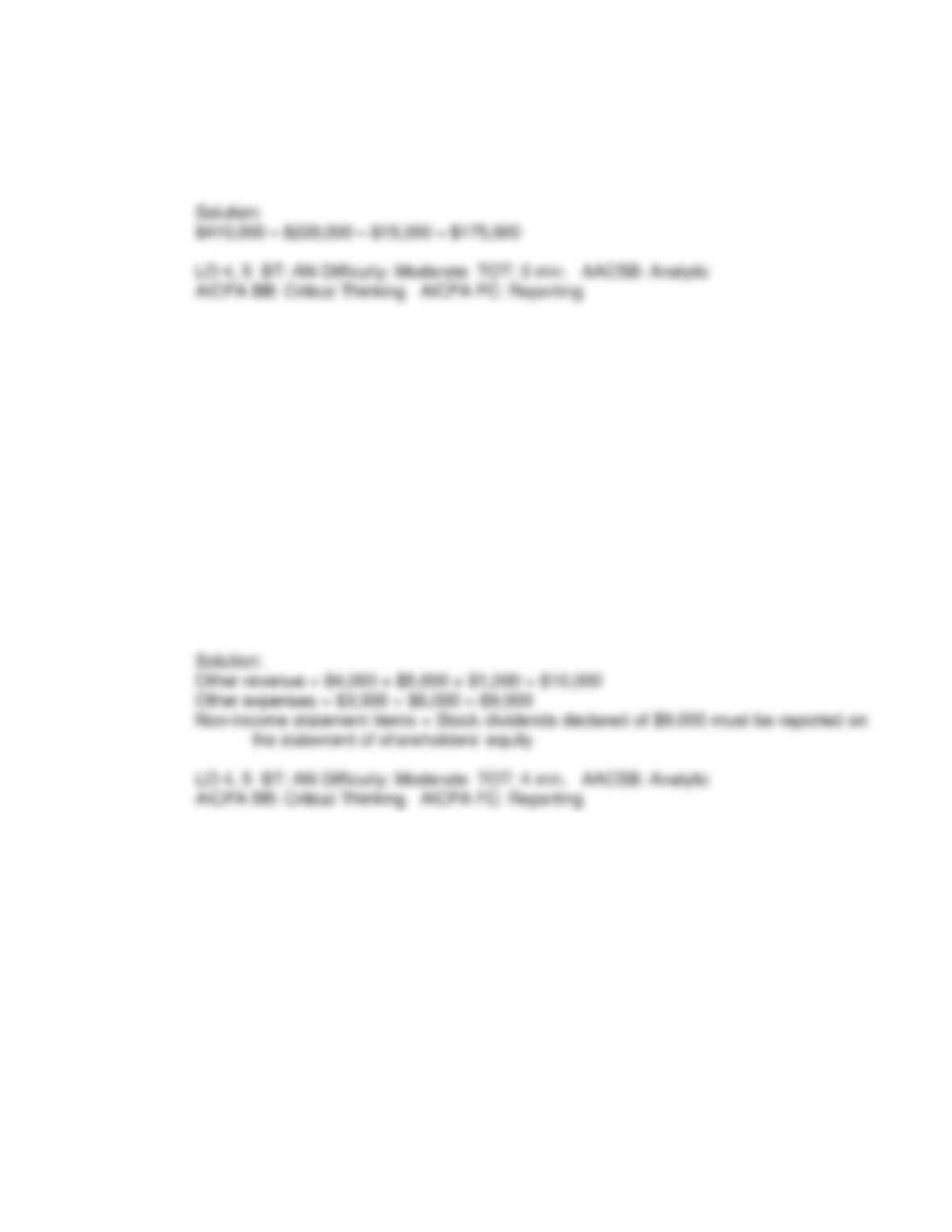
9. Cabell Inc. reported ‘income from operations before taxes’ in the amount of $402,000
before including the following items for the year ending December 31, 2017:
• On December 31, 2017, borrowed long-term debt of $50,000 that limits dividends to 10
percent of net income from continuing operations
• $21,000 unrealized gain from fair value adjustment related to available–for-sale investments
• $30,000 loss recognized on the sale of a trading security
• $58,000 loss recognized on a lawsuit relating to patent violations
• $11,000 government fine for environmental violation
• $63,000 write-down of obsolete inventory
• $25,000 loss on the disposal of a segment.
The company’s income tax rate is 30 percent. No taxes have been considered in any
information provided. Prepare a calculation of income from operations starting with
income from operations before taxes, as tentatively reported. Omit the heading. Be sure
to label correctly.
Test Bank – Chapter 13 – The Complete Income Statement 13-31
10. Hubbell Service showed the following information for 2017: Net sales revenue,
$410,000; interest revenue, $11,000; cost of goods sold, $220,000; operating expense,
$15,000, gain on disposal of segment, $30,000; and dividends declared, $14,000.
Calculate operating income for 2017.
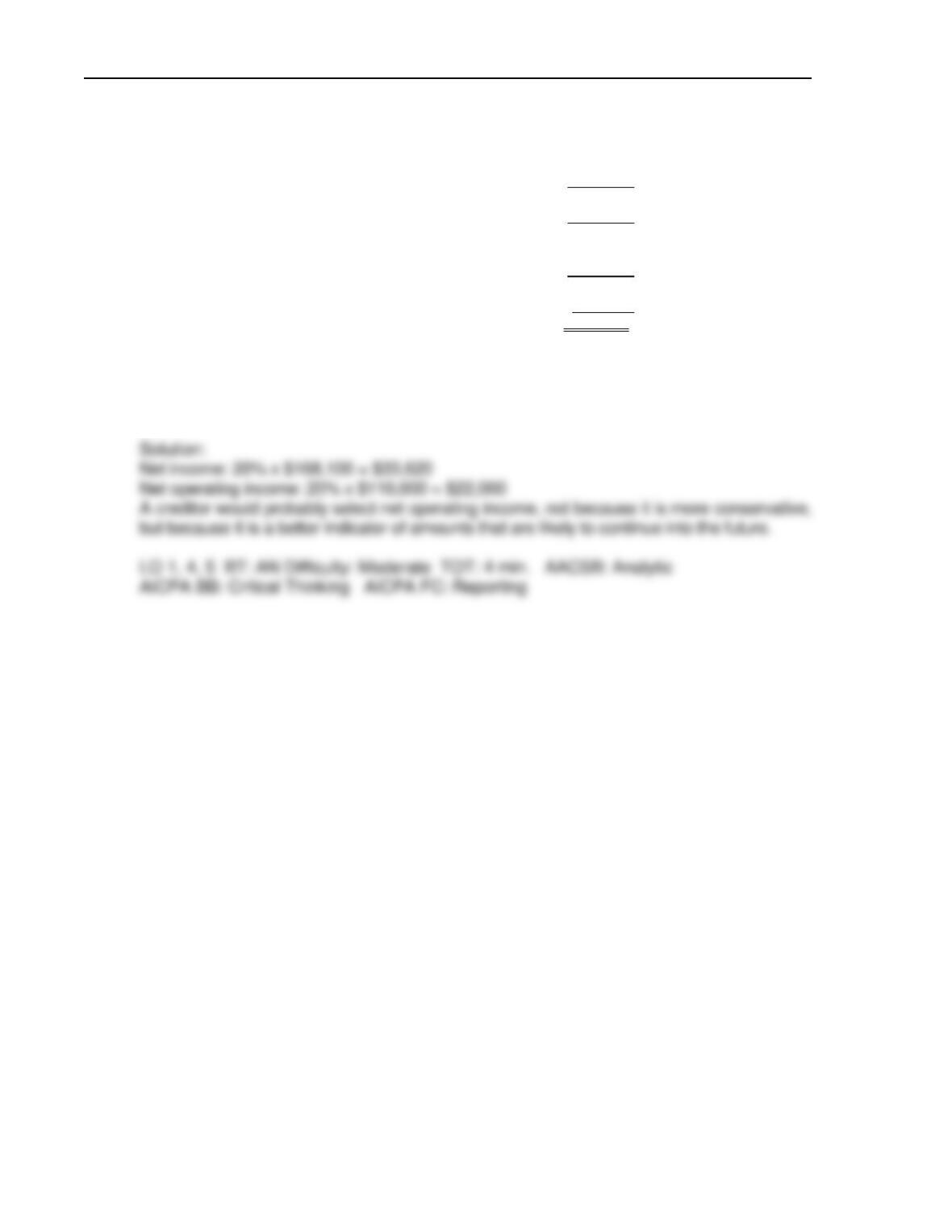
11. The following are some accounts for Marvell Corp. for 2017:
Sales revenue
$102,000
Cost of goods sold
85,000
Administrative expense
34,000
Interest expense
3,000
Loss from disposal of segment
21,000
Gain from sale of land
4,000
Stock dividends declared
9,000
Loss due to permanent value decline of plant asset
6,000
Unrealized gain from trading securities
5,000
Interest revenue
1,000
All amounts are before income taxes. Marvell has a 30% tax rate. Determine the amount
of Marvell’ ‘other revenue’ and ‘other expenses’ for 2017. List all non-income statement
items and indicate on which financial statement they are reported.
13–32 Test Bank – Chapter 13 – The Complete Income Statement
12. Hilton Corporation’s income statement for the year ending December 31, 2017, appears
below.
Net sales
$810,000
Cost of goods sold
(610,000)
Gross profit
200,000
Selling and administrative expenses
(90,000)
Net operating income
110,000
Gain on sale of land
112,000
Interest expense
(5,000)
Income from continuing operations before tax
217,000
Income tax expense
(48,900)
Net income
$168,100
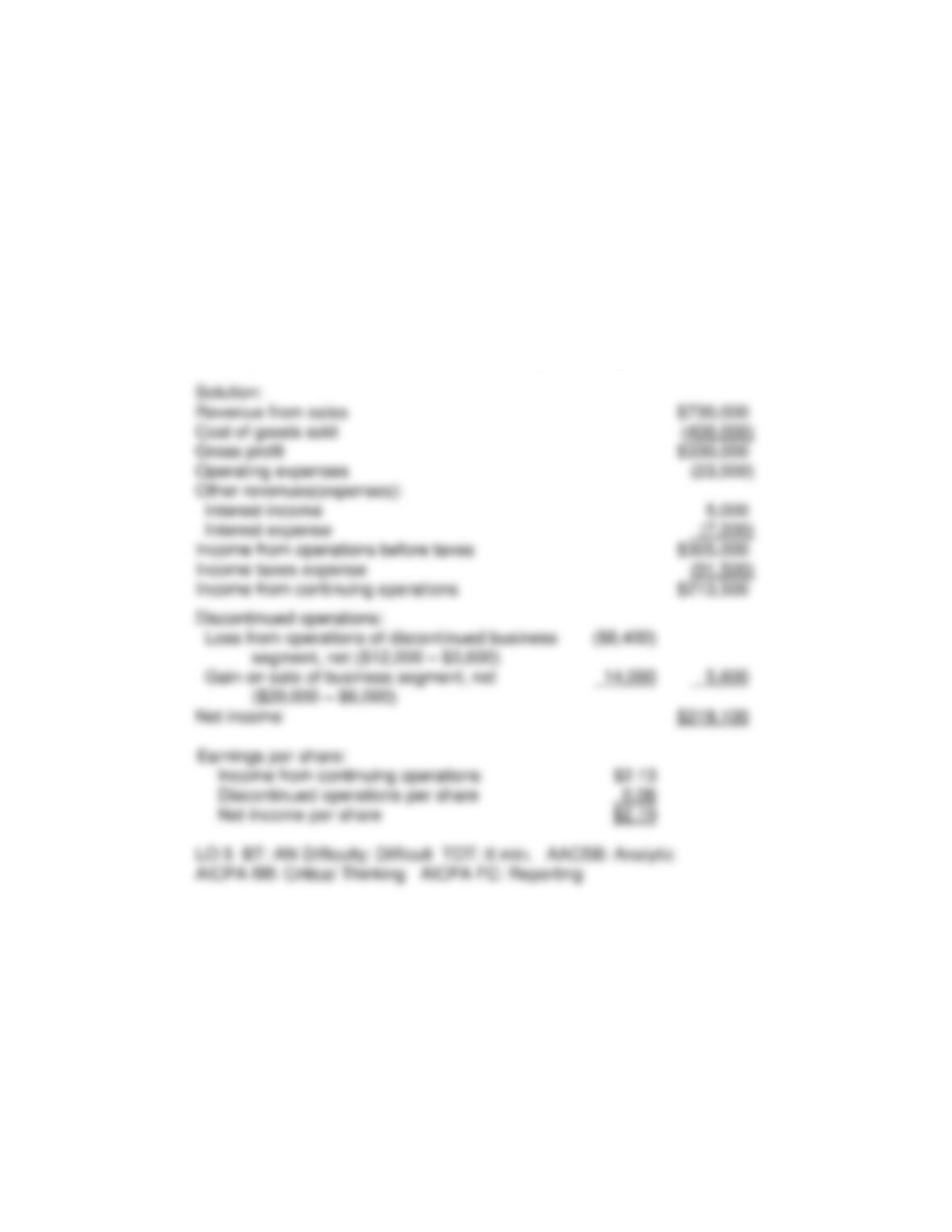
Compute the maximum amount of dividends Hilton can pay if it has a debt covenant
expressed as 20 percent of net income, and as 20 percent of net operating income.
Which amount would a creditor more likely use as the restriction on dividends? Explain.
Test Bank – Chapter 13 – The Complete Income Statement 13-33
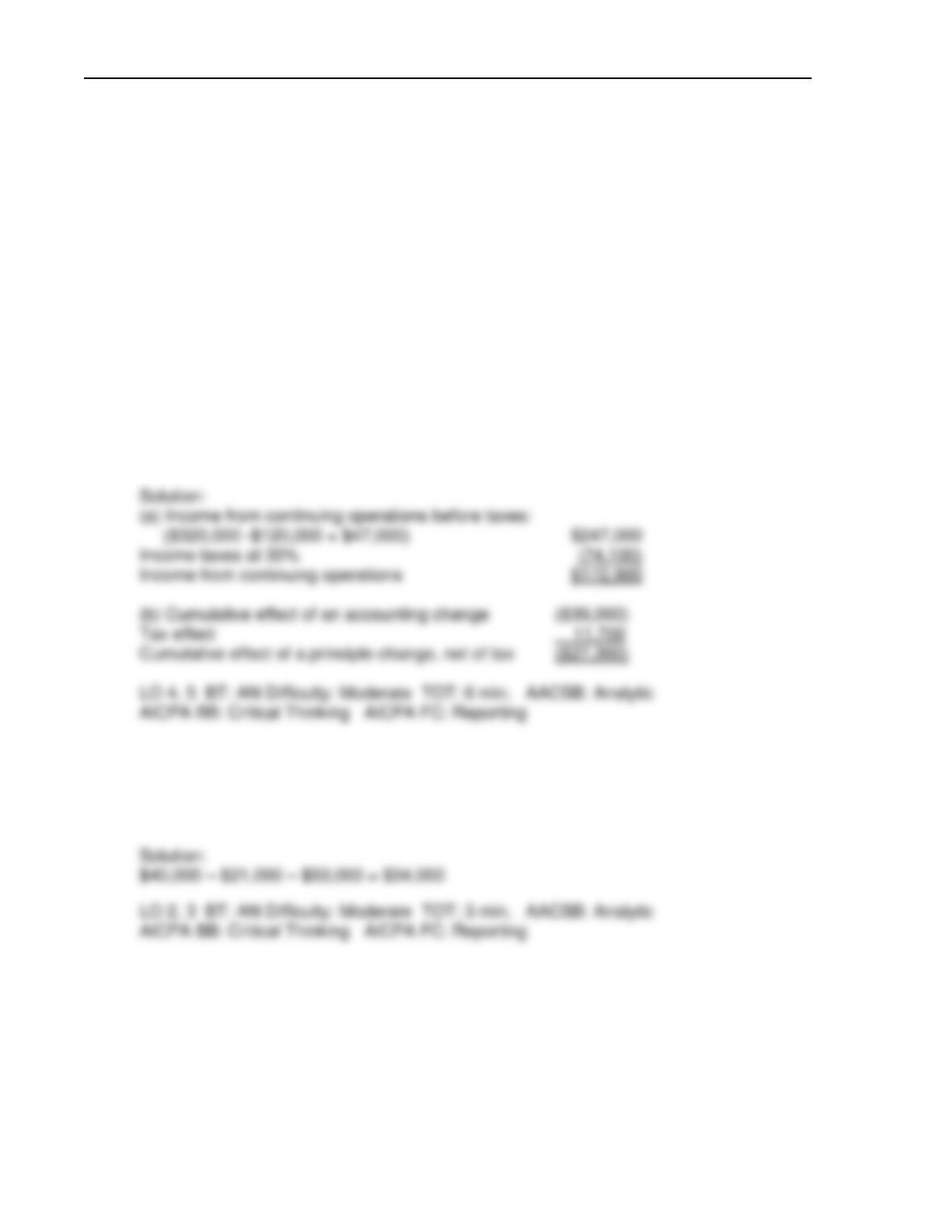
13. Jarvis Company provided the following information for the year ending December 31,
2017:
Cost of goods sold
$400,000
Gain on sale of business segment
20,000
Income tax rate
30%
Interest income
5,000
Interest expense
7,000
Loss from operation of discontinued business segment
12,000
Operating expenses
23,000
Revenue from sales
730,000
Number of shares of common stock outstanding
100,000
Prepare an income statement in good form. You may omit the heading. Include all
earnings per share amounts required for the year ending December 31, 2017.
13–34 Test Bank – Chapter 13 – The Complete Income Statement
14. Nichol Corp. has 20,000 shares of common stock outstanding. For the year ending
December 31, 2017, the company tentatively reported income from continuing operations
before taxes of $320,000. Nichol Corp. has a 30 percent tax rate. The additional information
given below has not been recorded in the accounts unless specifically stated.
• The company is located in Cheyenne, Wyoming. During the year, an earthquake destroyed
some of Nichol’s assets amounting to a loss of $120,000.
• The company’s employees went on strike for six weeks in March of 2017. Revenues would
have been about $23,000 more had the strike not occurred. No adjustment was recorded.
• During 2017, the company changed its method of accounting for inventories from FIFO to
weighted average. Cost of goods sold related to prior years would have been $39,000 greater.
• The company’s accounts include $47,000 as Unrealized Holding Gain from Trading
Investments at December 31, 2017.
(a) Calculate how much should be reported on Nichol’s income statement as ‘Income from
Continuing Operations’ for the period ended December 31, 2017.
(b) How much should be reported for the year ended December 31, 2017, as ‘Cumulative
Effect of a Change in Accounting Principle’?
15. On January 1 and December 31, retained earnings were $40,000 and $53,000,
respectively. During the year, $21,000 of dividends were declared. Calculate net income
during the year.
Test Bank – Chapter 13 – The Complete Income Statement 13-35
16. The following information was taken from the accounting records of ABCO Corporation
for the year ending December 31, 2017.
Cost of sales
$342,000
Loss on sale of business segment
23,000
Profit from operations of discontinued business segment
19,000
Operating expenses
176,000
Revenue from sales
690,000
Number of shares of common stock outstanding
100,000
Income tax rate
30%
Appropriated retained earnings for plant expansion
176,000
Dividends
130,000
Gain on sale of plant asset
24,000
A. In good form, prepare the section of the income statement that begins immediately
under ‘income from continuing operations’. Do not be concerned with calculating the
amount reported as ‘income from continuing operations.’
B. List all the items that would appear in the ‘Other Revenue/Other Expenses’ section of
the income statement.
C. How is the number of shares of common stock outstanding used on the income
statement?
17. The following are the revenue and expense accounts of the current year for ABCO
Corporation:
Sales revenue
$200,000
Interest revenue
3,000
Interest expense
6,000
Gain from sale of land
2,700
Cost of goods sold
120,000
Administrative expense
39,000
Loss on disposal of segment
45,000
All items are before income taxes. The income tax rate is 20%. Calculate the gross profit
that should be disclosed on the income statement.
13–36 Test Bank – Chapter 13 – The Complete Income Statement
18. Balance sheet information of Digital Solutions, Inc. at December 31, 2016, is provided
below.
Assets
$100,000
Liabilities
34,000
Shareholders’ equity
66,000
During 2017, the company entered into the following transactions:
1. Common stock was issued for $12,000 cash.
2. Services were performed for $45,000 cash.
3. Cash expenses of $31,000 were incurred.
4. Long-term liabilities of $18,000 were paid.
5. The market value of an available-for-sale investment owned at yearend exceeded its
cost by $6,000.
6. Dividends of $9,000 were declared and paid.
A. Which transactions are operating?
B. Compute net income for the year ending December 31, 2017.
C. Compute comprehensive income for the year ending December 31, 2017.
SHORT ESSAY QUESTIONS
1. Identify types of transactions that are considered exchanges of liabilities and
shareholders’ equity. Why are these transactions considered ‘financing’?
Test Bank – Chapter 13 – The Complete Income Statement 13-37
2. How do items at the top of the income statement differ from items at the bottom of the
income statement?
3. How are operating transactions that are not part of the normal operations of a company
reported on the financial statements?
4. One of the three objectives of financial reporting directly relates to the income statement
and measurement of income. Indicate the context of this objective, and explain how it
relates to the earnings process.
13–38 Test Bank – Chapter 13 – The Complete Income Statement
5. Identify the GAAP requirements of comprehensive income.
6. What is the definition of a business segment and what special reporting is required for
discontinued segments?
7. Is consistency violated when a company changes accounting principles?
8. Why are losses resulting from employee layoffs and write-downs such as inventory and
receivables reported as ‘other expenses and losses’?
Test Bank – Chapter 13 – The Complete Income Statement 13-39
9. Discuss the reasons for and the financial statement effects of intraperiod tax allocation.
10. What is ‘pro forma’ as it relates to the income statement?
11. How does diluted earnings per share differ from the traditional basic earnings per share?
13–40 Test Bank – Chapter 13 – The Complete Income Statement
12. What is earnings persistence?
13. How has the movement toward internationalization of many businesses increased
reporting of the number of special gains and losses on the income statement?
IFRS questions
1. Which of the following statements is true?
a. IFRS relies less heavily on fair market value accounting than does US GAAP.
b. IFRS relies more heavily on fair market value accounting than does US GAAP.
c. Neither IFRS nor US GAAP will use fair market value accounting in the near
future.
d. Only US GAAP uses fair value market accounting.