78)
The cost equation for a cookie store is given by C(x) =x3– 6x2+ 250, where x is the
number of cookies made (in dozens) and C(x) is the cost in dollars. Use the first–derivative
test to find when relative extrema occur.
78)
79)
If f(x) =x3–6x2– 15x– 7, determine the intervals on which f is increasing and the
intervals on which f is decreasing.
79)
80)
If y= 3x4– 6x2, use the second–derivative test to find all values of x for which (a) relative
maxima occur (b) relative minima occur.
80)
81)
A cable TV company has 200 customers paying $10 each month. For each $1 reduction in
price, the company attracts 50 more customers. Find the price that yields maximum
revenue.
81)
82)
Find two positive numbers whose product is 25 and whose sum is a minimum.
82)
83)
The revenue equation for a company is given by R(x) = 84.375x– 0.5x3. Determine when
relative extrema occur on the interval (0, ).
83)
84)
A manufacturer found that the total cost c of producing q units of a product is given by
c= 0.02q2+ 2q+ 800. At what level of production will average cost be a minimum?
84)
85)
Find two numbers whose sum is 30 and whose product is a maximum.
85)
86)
A new movie has its monthly revenue given by R(x) =70x
x2+ 100 where x is the number of
days after its release and R is in millions of dollars. Find the relative extrema and use this
information to determine which day will bring the greatest revenue.
86)
87)
A rectangular closed box with a square base is to have a volume of 1000 in3. Find its
dimensions if the box is to require the least possible material.
87)
88)
If f(x) = 2x3+ 3x2– 36x+ 1, determine the intervals on which f is increasing and the
intervals on which f is decreasing.
88)
89)
Use your graphing calculator to estimate the relative extrema of the function y=x7–x5–
x3 (estimate to 3 decimal places).
89)
90)
Find the vertical and non–vertical asymptotes of the following function. Do not sketch its
graph.
y=x2+ 5x– 4
x– 5
90)
91)
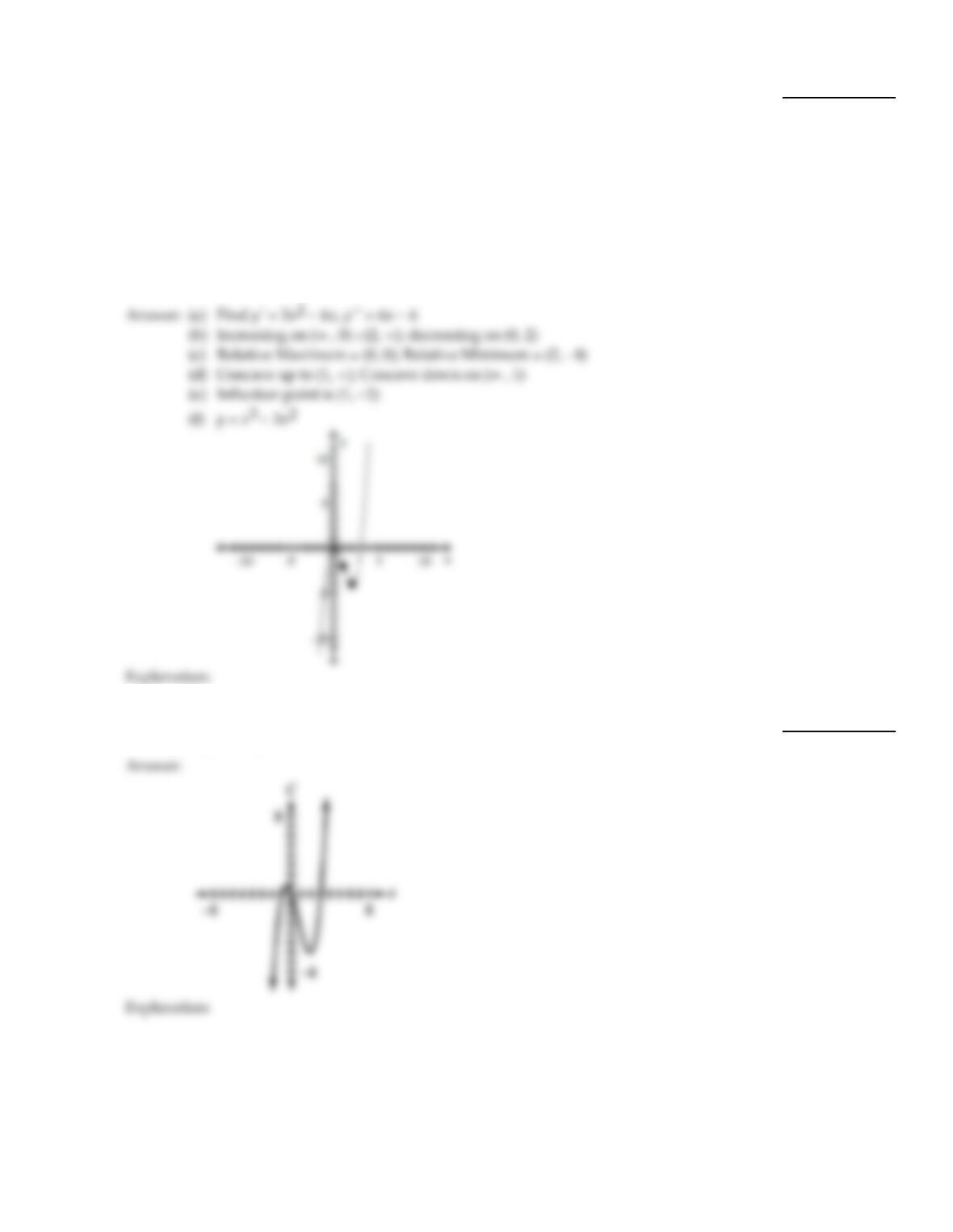
Let y=x3– 3x2
(a) Find y’ and y”.
(b) Determine intervals on which the function is increasing; determine intervals on which
the function is decreasing.
(c) Determine the coordinates of all relative maximum and relative minimum points.
(d) Determine intervals on which the function is concave up; determine intervals on
which the function is concave down.
(e) Determine the coordinates of all inflection points.
(f) With the aid of the information obtained in parts (a) – (e), give a reasonable sketch of
the curve.
91)
92)
If C= – 3x– 2x2+x3 is a cost function, sketch the graph of this function with the aid of
intercepts, symmetry, and the first–derivative test.
92)
23
93)
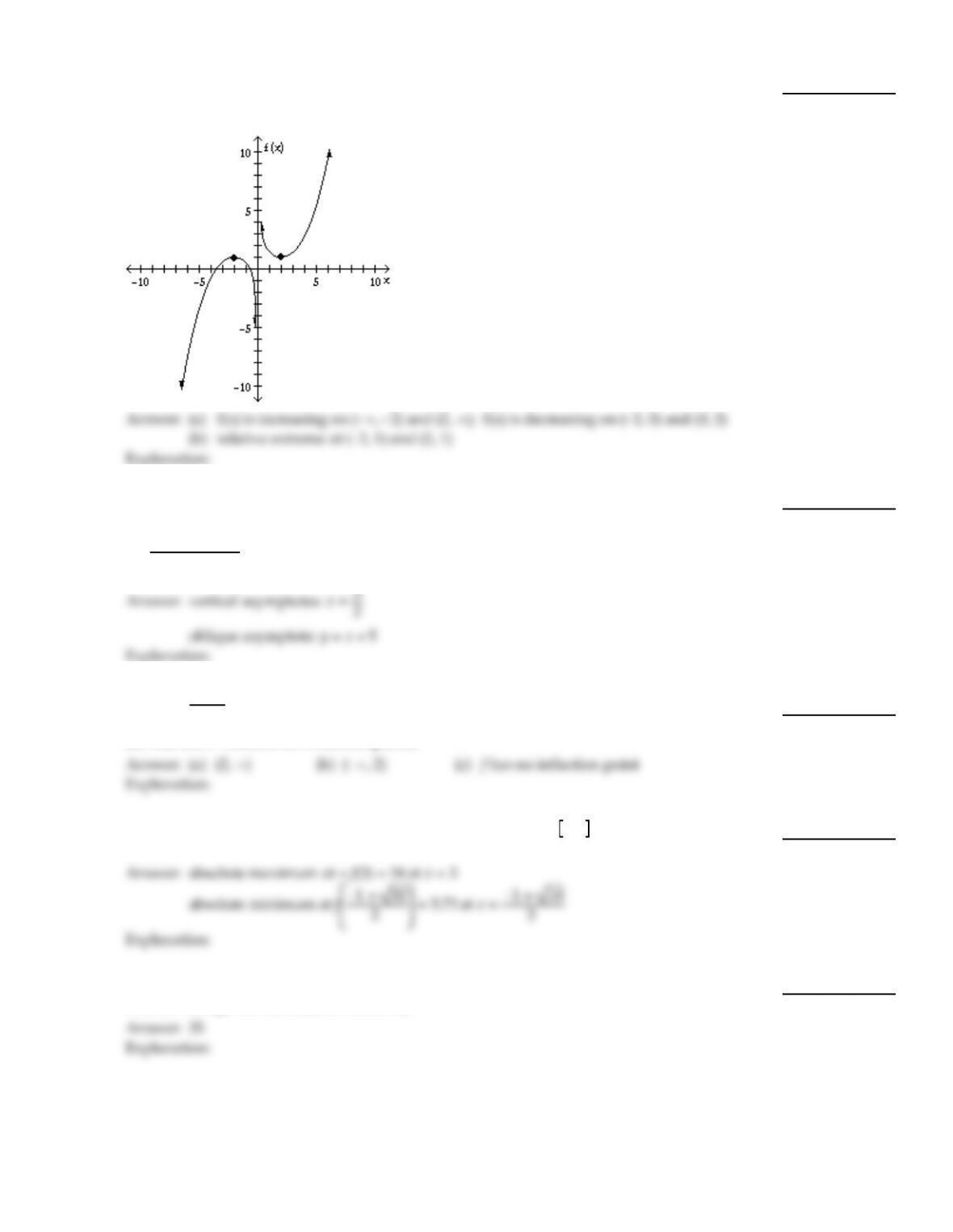
The graph of a function is given. Find
(a) the open intervals on which the function is increasing or decreasing;
(b) the coordinates of all relative extrema.
93)
94)
Find the vertical and non–vertical asymptotes of the following function. Do not sketch its
graph.
y=2x2+ 7x– 22
2x– 3
94)
95)
Let f(x) =5
x– 2 . Determine the intervals of which f is (a) concave up and (b) concave down.
(c) Find the x–values of all inflection points.
95)
96)
Find the absolute extrema for y=x3+x2– 3x+ 7 on the interval 0, 3 and where they
occur.
96)
97)
Sensitivity to a drug depends on the dosage size x according to the equation s= 50x–x2.
Find the dosage that maximizes sensitivity.
97)
24
98)
Use the second derivative test to find the relative extremas of f(x) = 4x3– 6x and where
they occur. If the relative extremas can not be determined by the second derivative test,
state so.
98)
99)
If f(x) =x2
x– 3 , determine the intervals on which f is increasing and the intervals on which f
is decreasing.
99)
100)
A rectangular plot of ground is to be fenced in so that it has an area of 15,000 square feet.
The plot is to be divided in half with a fence parallel to one pair of sides. Find the
dimensions of the plot if the least amount of fencing is to be used.
100)
101)
Given y=f(x) = 2x3+12x2– 7 on the interval 0, 4 , find the values of x at which absolute
maxima and absolute minima occur.
101)
102)
Determine the intervals on which the function is increasing and on which it is decreasing.
Also determine the points of relative maxima and relative minima.
y=x3+x2– 3x+ 7
102)
103)
The cost equation for a cookie store is given by C(x) =x3– 6x2+ 250, where x is the
number of cookies made (in dozens), and C(x) is the cost in dollars. Determine where the
graph of the equation is concave up and where it is concave down and find any inflection
points.
103)
25
104)
The cost equation for a company is C(x) = 3x3– 27x2+ 45x+ 100. Use the
second–derivative test, if applicable, to find the relative maxima and the relative minima.
104)
105)
Determine the equations of the vertical asymptotes and non–vertical asymptotes for the
graph of y=4x2– 2x+ 3
9 –x2.
105)
106)
A manufacturer has to produce annually 1000 units of a product that are sold at a uniform
rate during the year. The production cost for each unit is $400, and carrying costs
(insurance, interest, storage, and so on) are estimated to be 5% of the value of average
inventory. Set–up costs per production run are $64. Find the economic lot size.
106)
107)
Determine the intervals on which the function is increasing and on which it is decreasing.
Also determine the points of relative maxima and relative minima.
f(x) = 16x5– 5x
107)
108)
A released film has a revenue given by R(t) =50t
t3+ 8 , where R(t) is in millions of dollars
and t is the number of weeks after its release. Sketch the graph of this function.
108)
109)
The demand equation for a monopolist’s product is p= 2700 –q2, where p is the price per
unit (in dollars) when q units are demanded.
(a) Find the value of q for which revenue is maximum.
(b) What is the maximum revenue?
109)
110)
A released film has a revenue given by R(t) =20t
t+ 3 , where R(t) is in millions of dollars and
t is the number of weeks after its release. Sketch the graph of this function.
110)
111)
Determine the equations of the vertical asymptotes and non–vertical asymptotes for the
graph of y=x– 2
x2+ 5x.
111)
112)
Find the absolute extrema for y=x2
ex on the interval 0, 3 and where they occur.
112)
113)
A company owns an apartment building containing 100 units. If the company charges $400
per month rent, then all units can be rented out, and for every increase of $20 per month in
rent, the company will lose one customer. What rent should be charged to maximize
revenue?
113)
114)
Use the second derivative test to find the points of relative maxima and relative minima for
the function y=x4
2– 2x3+ 5.
114)
115)
Determine the intervals on which the function is increasing and on which it is decreasing.
Also determine the points of relative maxima and relative minima.
f(x) = (x2– 3x +2)2
115)
Answer:
Explanation:
116)
Determine the intervals on which the function is increasing and on which it is decreasing.
Also determine the points of relative maxima and relative minima.
f(x) =x2
ex
116)
Answer:
Decreasing on the intervals (–, 0) and (2, ); increasing on (0, 2); relative maximum
at x= 2; relative minimum at x= 0.
Explanation:
117)
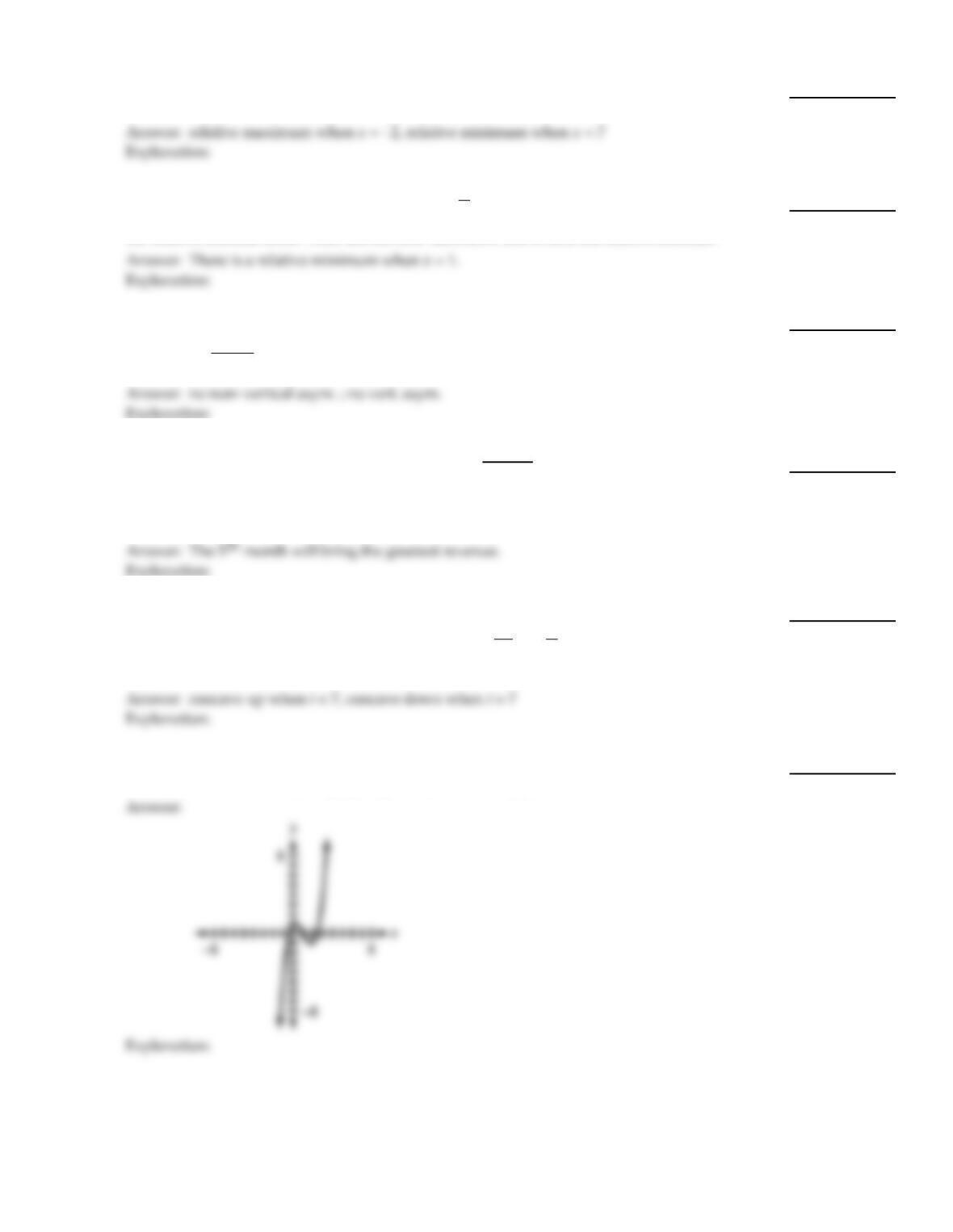
If C= – 4x+x3 is a cost function, sketch the graph of this function with the aid of intercepts,
symmetry, and the first–derivative test.
117)
Answer:
Explanation:
118)
Determine the equations of the vertical asymptotes and non–vertical asymptotes for the
graph of y=x2– 4
4x2– 25 .
118)
Answer:
Explanation:
Answer:
Explanation:
119)
The cost equation for a company is C(x) = 2x3– 15x2– 84x+ 3100. Use the
second–derivative test, if applicable, to find the relative maxima and the relative minima.
119)
120)
Use your graphing calculator to graph y= ln(x) +1
x. Inspect the graph to estimate where
the relative extrema occur. Then use the first–derivative test to find the relative extrema.
120)
121)
Determine the equations of the vertical asymptotes and non–vertical asymptotes for the
graph of y=x2– 4
2.
121)
122)
A new book has its monthly revenue given by R(x) =40x
x2+ 25 where x is the number of
months after its release and R is in thousands of dollars. Find the relative extrema and use
this information to determine which month will bring the greatest revenue.
122)
123)
Suppose that the total number of units produced by a worker in t hours of an 8–hour shift
can be modeled by the production function P(t) = 19t+21
2t2–1
2t3. Find where the
function is concave up and where the function is concave down.
123)
124)
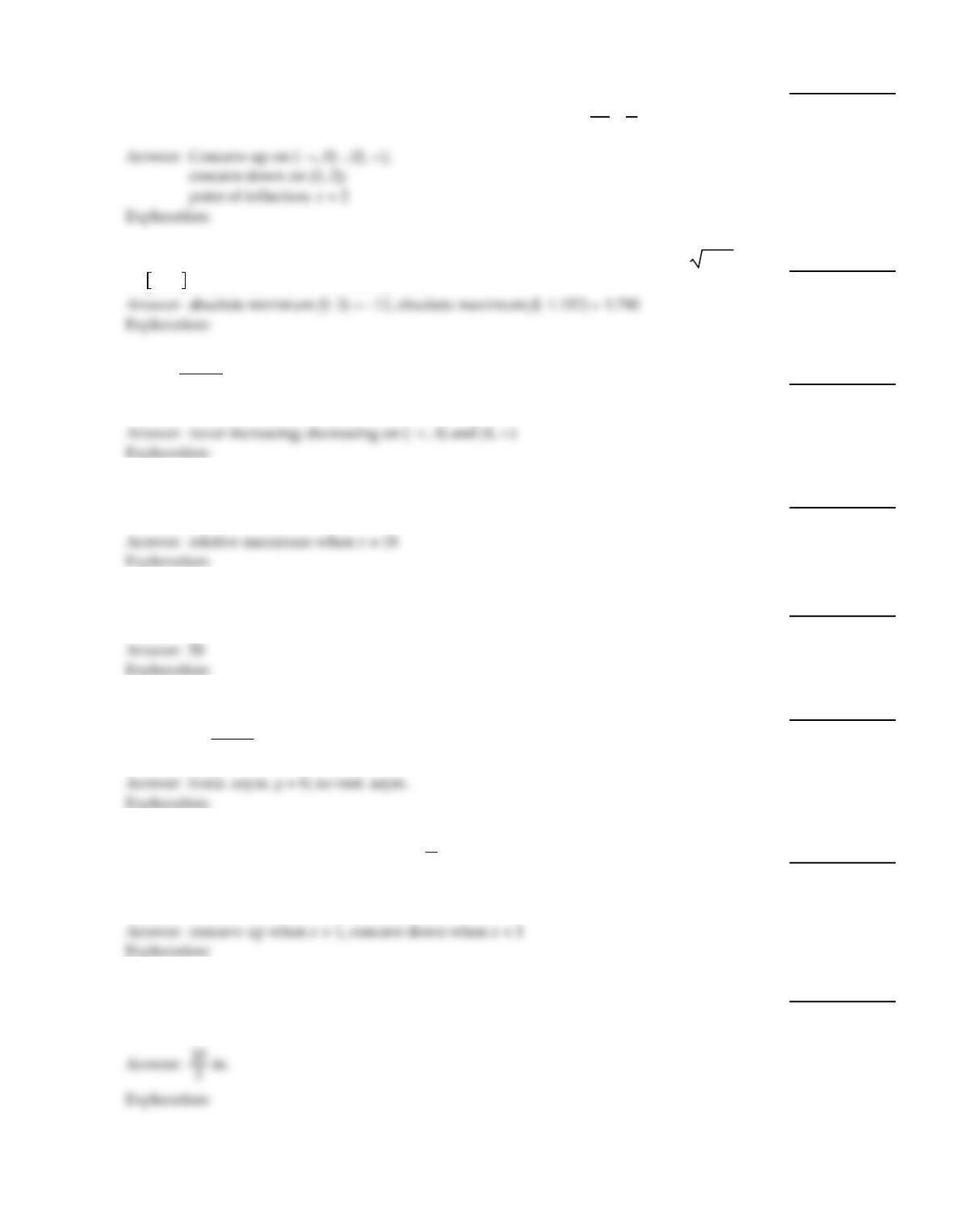
Sketch the graph of y=x3– 3x2+x+ 1 with the aid of intercepts, symmetry, and the
first–derivative test. Use your graphing calculator to verify your solution.
124)
29
125)
Find the intervals where the graph of y=f(x) is concave up and where it is concave down.
Do not sketch its graph. Also determine its points of inflection. f(x) =x2
8–1
x.
125)
126)
Use your graphing calculator to find the absolute extrema of f(x) =x3+x2– 2x– 2 +x+ 4
on –3, 1 (round answers to 3 decimal places).
126)
127)
If f(x) =2x – 3
x– 4 , determine the intervals on which f is increasing and the intervals on which
f is decreasing.
127)
128)
The revenue equation for a company is given by R(x) = 68.04x– 0.07x3. Determine when
relative extrema occur on the interval (0, ).
128)
129)
Sensitivity to a drug depends on the dosage size x according to the equation s= 100x–x2.
Find the dosage that maximizes sensitivity.
129)
130)
Determine the equations of the vertical asymptotes and non–vertical asymptotes for the
graph of y=6
x2+ 4 .
130)
131)
Use your graphing calculator to graph f(x) =1
3x3–x2+ 2. Looking at the graph, estimate
the intervals where the function is concave up and concave down. Now find these intervals
using the second derivative.
131)
132)
An open box is to be made by cutting equal squares from each corner of a 20–in. square
piece of cardboard and then folding up the sides. Find the length of the side of the square
that must be cut out if the volume of the box is to be maximized.
132)
30
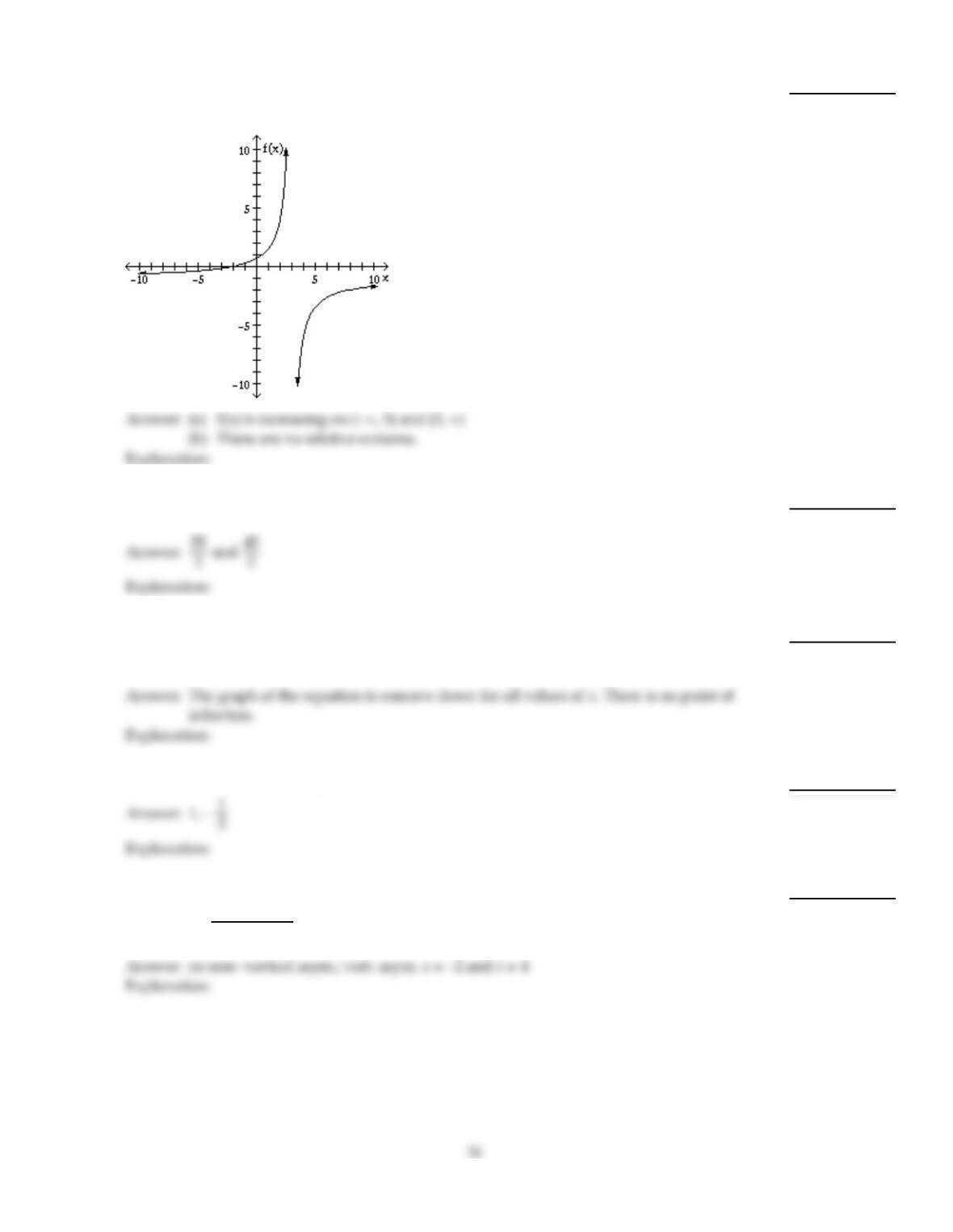
133)
The graph of a function is given. Find
(a) the open intervals on which the function is increasing or decreasing;
(b) the coordinates of all relative extrema.
133)
134)
Find two numbers whose sum is 50 and such that the product of one of them and five more
than the other is a maximum.
134)
135)
The profit equation for a taco stand is given by P(x) = – 0.4x2+ 100x–100, where x is the
number of tacos sold, and P(x) is the profit in dollars. Determine where the graph of the
equation is concave up and where it is concave down and find any inflection points.
135)
136)
Find all the critical values of y=x3–x2–x+ 2.
136)
137)
Determine the equations of the vertical asymptotes and non–vertical asymptotes for the
graph of y=4x5– 2x+ 3
x2– 2x – 8 .
137)
138)
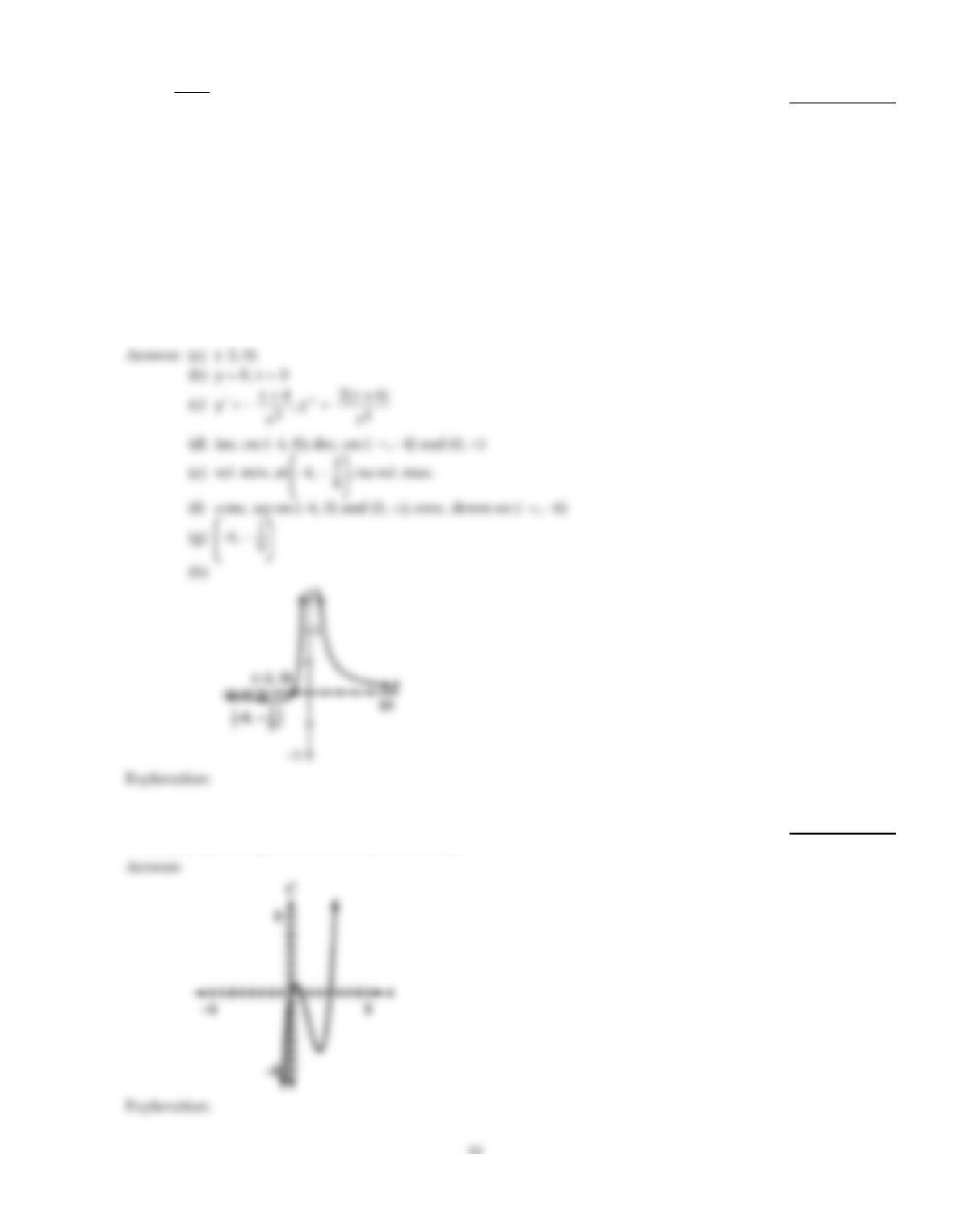
Let y=x+ 2
x2
(a) Determine all x– and y–intercepts.
(b) Determine equations of all vertical asymptotes and non–vertical asymptotes.
(c) Determine y’ and y”.
(d) Determine intervals on which the function is increasing; determine intervals on which
the function is decreasing.
(e) Determine the coordinates of all relative maximum and relative minimum points.
(f) Determine intervals on which the function is concave up; determine intervals on
which the function is concave down.
(g) Determine the coordinates of all inflection points.
(h) With the aid of the information obtained in parts (a) – (g), give a reasonable sketch of
the curve.
138)
139)
If C= 4x– 5x2+x3 is a cost function, sketch the graph of this function with the aid of
intercepts, symmetry, and the first–derivative test.
139)
32
140)
If y=x3+ 4x2– 3x+ 4, use the second–derivative test to find all values of x for which (a)
relative maxima occur (b) relative minima occur.
140)
141)
Sketch the graph of y =x3– 4x with the aid of intercepts, symmetry, and the
first–derivative test. Use your Graphing Calculator to verify your solution.
141)
142)
The cost equation for a company is C(x) = 2x3– 39x2+ 180x+ 21,200. Use the
second–derivative test, if applicable, to find the relative maxima and the relative minima.
142)
143)
Determine the intervals on which the function is increasing and on which it is decreasing.
Also determine the points of relative maxima and relative minima.
f(x) =8x
x2+ 6
143)
144)
Given y=f(x) = 4x2– 4x+ 5 on the interval 0, 4 , find the values of x at which absolute
maxima and absolute minima occur.
144)
33
145)
The cost equation for a hot dog stand is given by C(x) = 2x3– 21x2+ 60x+ 500, where x is
the number of hot dogs sold, and C(x) is the cost in dollars. Determine where the graph of
the equation is concave up and where it is concave down and find any inflection points.
145)
146)
Use the second derivative test to find the relative extremas of f(x) = – 4x5 and where they
occur. If the relative extremas can not be determined by the second derivative test, state so.
146)
147)
The revenue equation for a company is given by R(x) = 1296x– 0.12x3. Determine when
relative extrema occur on the interval (0, ).
147)
148)
If f(x) = (x+ 5)3, determine the intervals on which f is increasing and the intervals on which
f is decreasing.
148)
149)
It is estimated that under a short–term energy–assistance plan, n million households will
receive direct aid in meeting home–fuel costs after t years, where
n= 2t3– 15t2+ 36t, 0 t
4. For what value of t will n be a maximum?
149)
150)
Using fencing, a rectangular area is to be enclosed next to the wall of a building. The
building will form one of the sides and no fencing will be placed there. The cost of the
fencing for the side opposite the building is $5 per foot. The cost of the fencing for the other
two sides is $3 per foot. The area to be enclosed is 3000 ft2. In order to keep expenses of the
three sides to a minimum, how many feet of each type of fencing must be bought?
150)