Chapter 13 Capital Budgeting Decisions
40. (Ignore income taxes in this problem.) Mcclam, Inc., is considering the purchase of a
machine that would cost $100,000 and would last for 9 years. At the end of 9 years, the
machine would have a salvage value of $23,000. The machine would reduce labor and other
costs by $19,000 per year. Additional working capital of $2,000 would be needed
immediately. All of this working capital would be recovered at the end of the life of the
machine. The company requires a minimum pretax return of 13% on all investment projects.
The net present value of the proposed project is closest to:
Chapter 13 Capital Budgeting Decisions
13–27
41. (Ignore income taxes in this problem.) Charley has a typing service. He estimates that a
new computer will result in increased cash inflow $1,600 in Year 1, $2,000 in Year 2 and
$3,000 in Year 3. If Charley’s required rate of return is 12%, the most that Charley would be
willing to pay for the new computer would be:
Chapter 13 Capital Budgeting Decisions
42. (Ignore income taxes in this problem.) A piece of equipment has a cost of $20,000. The
equipment will provide cost savings of $3,500 each year for ten years, after which time it will
have a salvage value of $2,500. If the company’s discount rate is 12%, the equipment’s net
present value is:
Chapter 13 Capital Budgeting Decisions
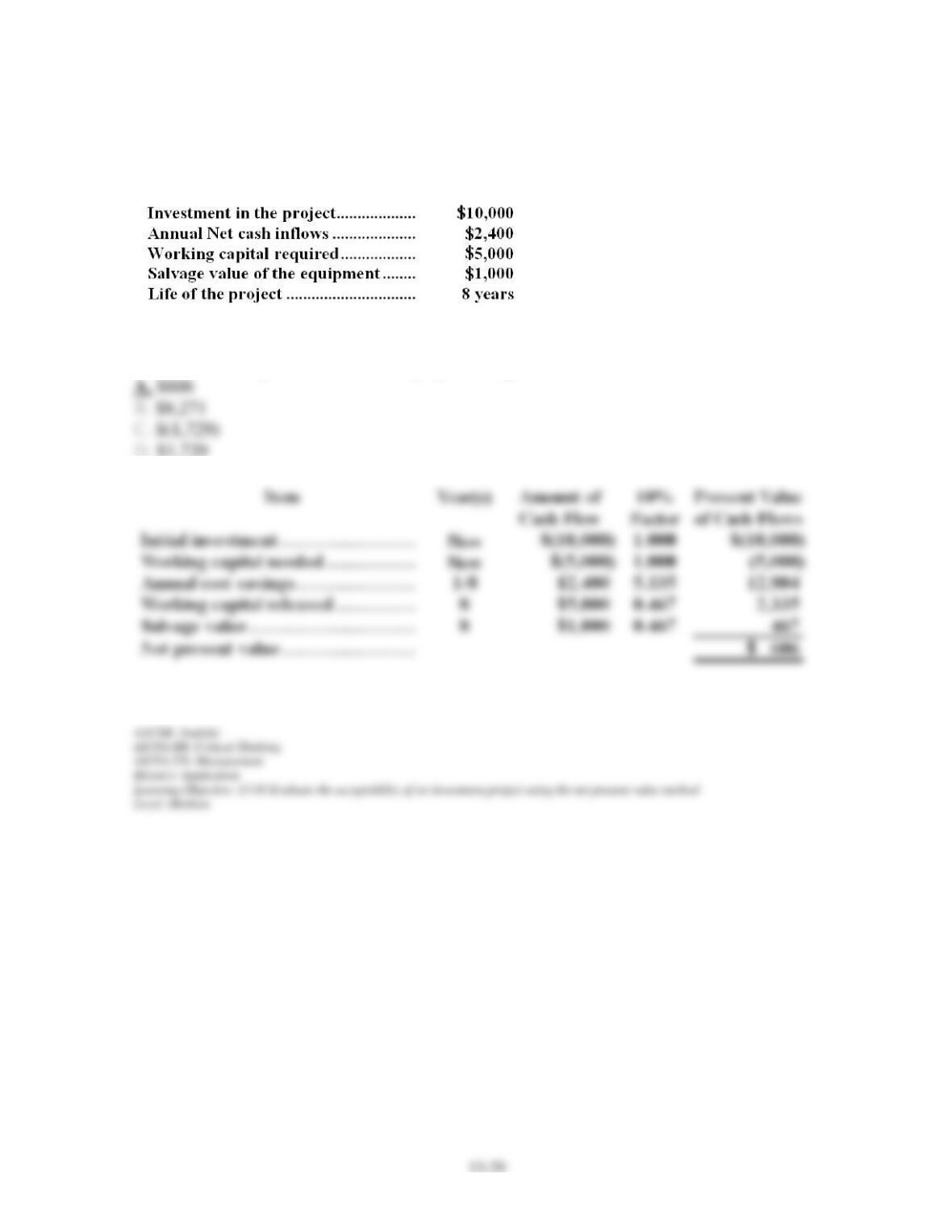
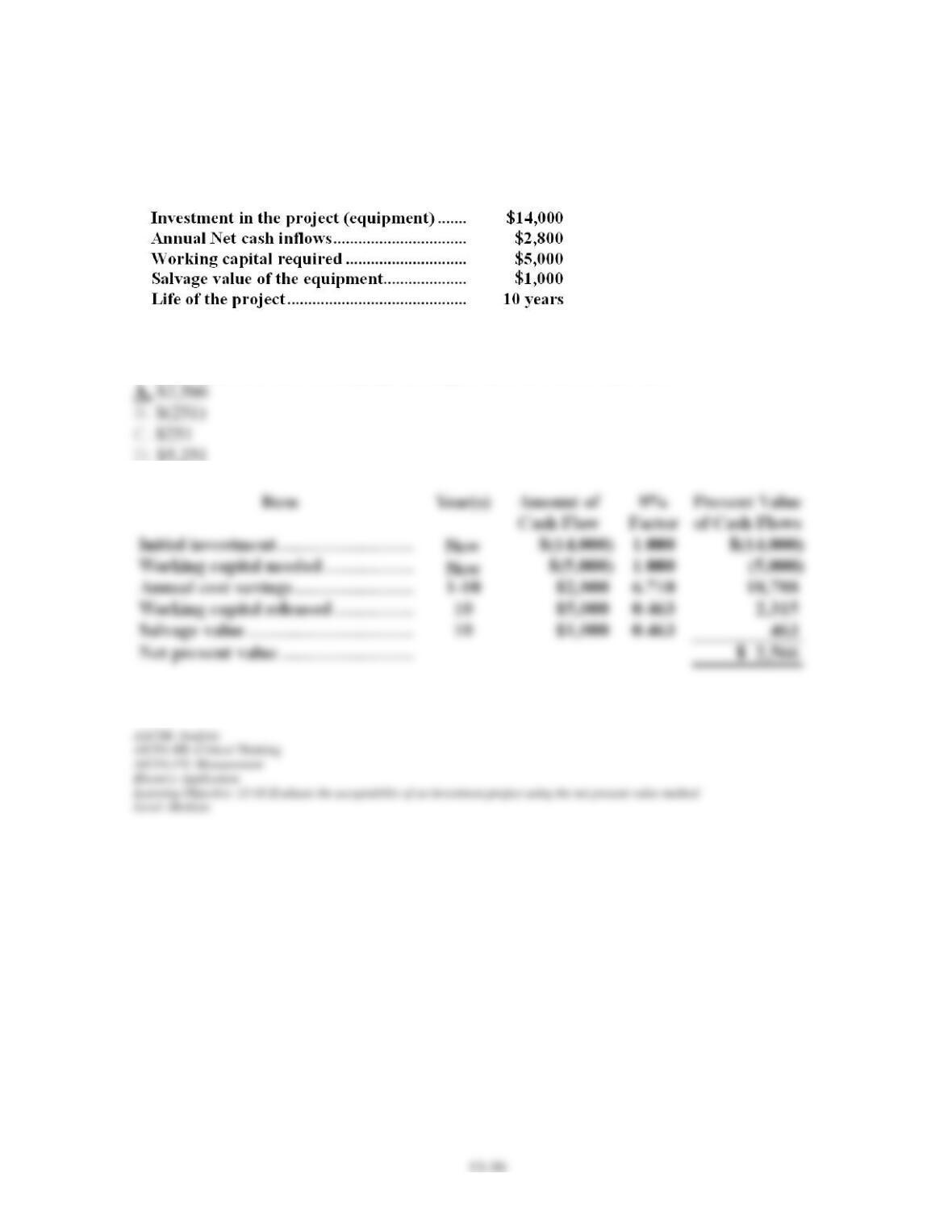
43. (Ignore income taxes in this problem.) The following data pertain to an investment in
equipment:
At the completion of the project, the working capital will be released for use elsewhere.
Compute the net present value of the project, using a discount rate of 10%:
Chapter 13 Capital Budgeting Decisions
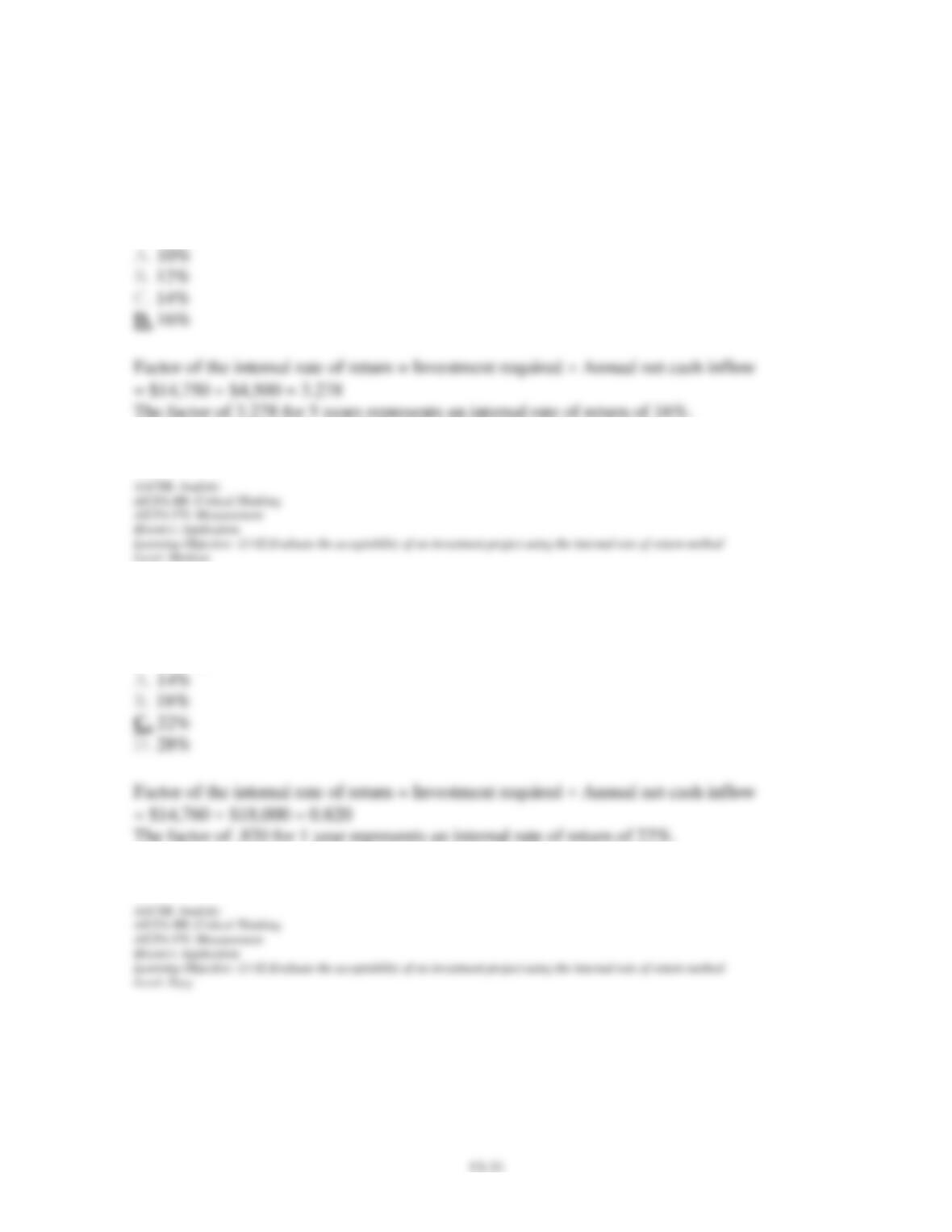
44. (Ignore income taxes in this problem.) The following data pertain to an investment
proposal:
The working capital would be released for use elsewhere when the project is completed. What
is the net present value of the project, using a discount rate of 8 percent?
Chapter 13 Capital Budgeting Decisions
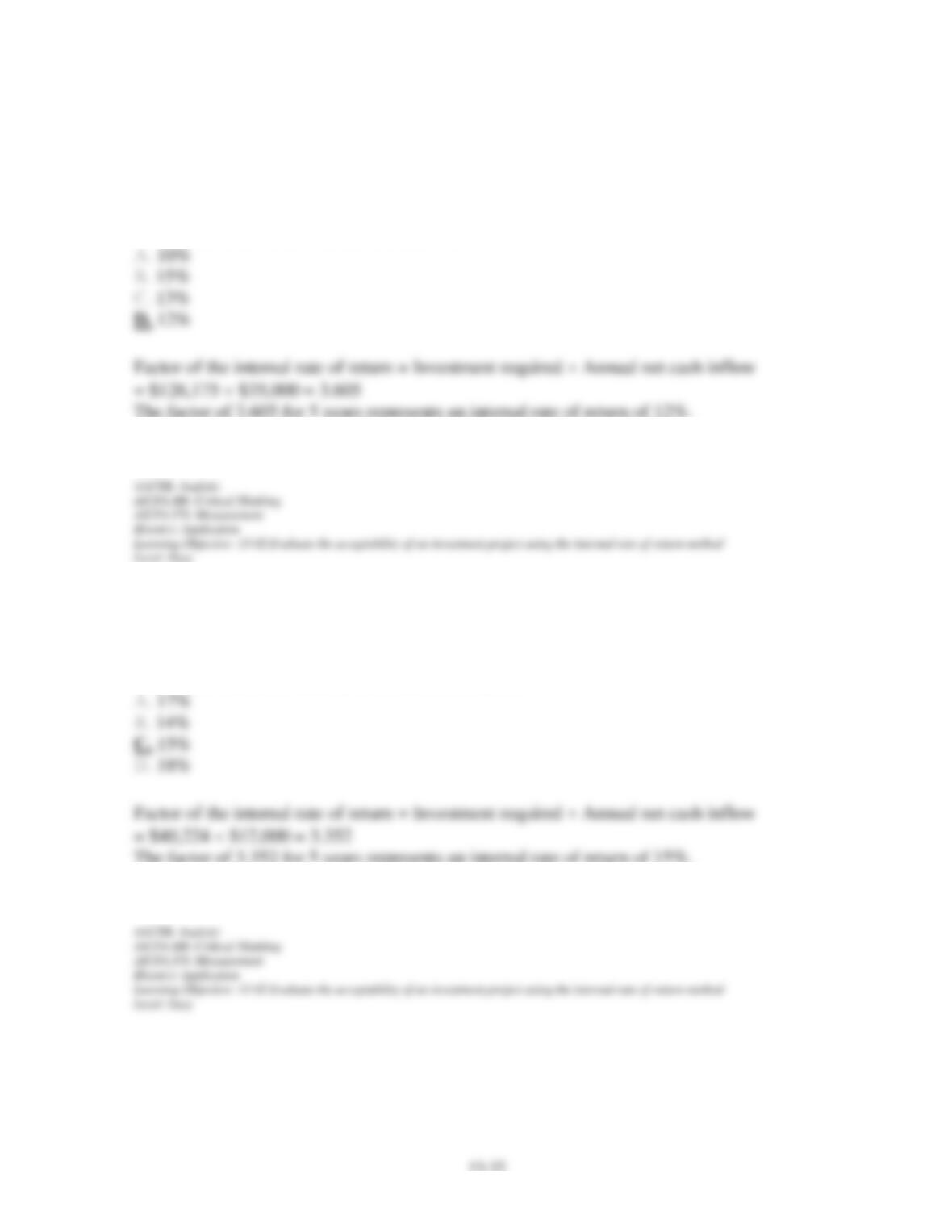
45. (Ignore income taxes in this problem.) The Valentine Company has decided to buy a
machine costing $14,750. Estimated cash savings from using the new machine amount to
$4,500 per year. The machine will have no salvage value at the end of its useful life of five
years. If Valentine’s required rate of return is 10%, the machine’s internal rate of return is
closest to:
46. (Ignore income taxes in this problem.) If an investment of $14,760 now will yield $18,000
at the end of one year, then the internal rate of return for this investment to the nearest whole
percentage is:
Chapter 13 Capital Budgeting Decisions
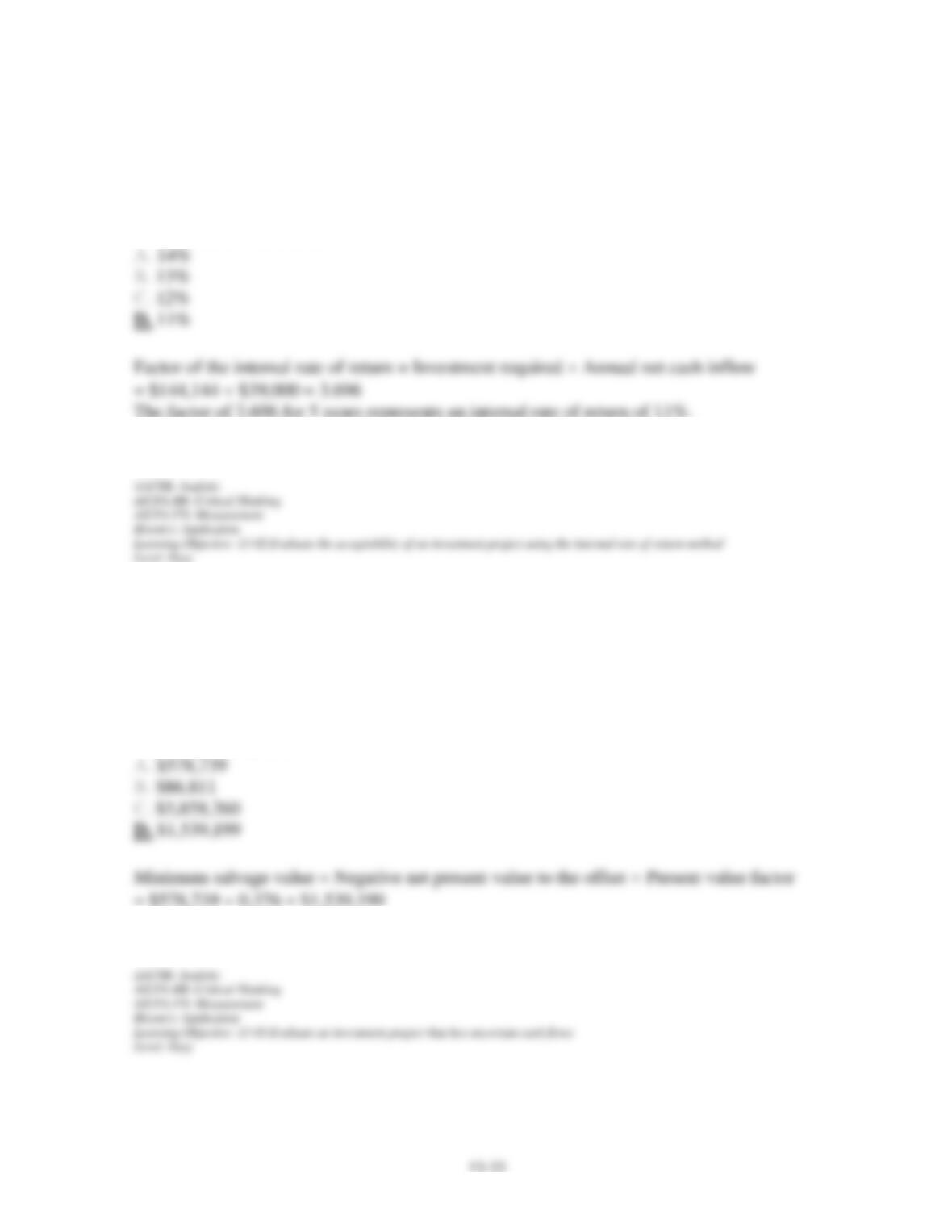
47. (Ignore income taxes in this problem.) Duhl Long-Haul, Inc., is considering the purchase
of a tractor-trailer that would cost $126,175, would have a useful life of 5 years, and would
have no salvage value. The tractor-trailer would be used in the company’s hauling business,
resulting in additional net cash inflows of $35,000 per year. The internal rate of return on the
investment in the tractor-trailer is closest to:
48. (Ignore income taxes in this problem.) Mongon Roofing is considering the purchase of a
crane that would cost $40,224, would have a useful life of 5 years, and would have no salvage
value. The use of the crane would result in labor savings of $12,000 per year. The internal rate
of return on the investment in the crane is closest to:
Chapter 13 Capital Budgeting Decisions
49. (Ignore income taxes in this problem) The management of Mazor Corporation is
considering the purchase of a machine that would cost $144,144 and would have a useful life
of 5 years. The machine would have no salvage value. The machine would reduce labor and
other operating costs by $39,000 per year. The internal rate of return on the investment in the
new machine is closest to:
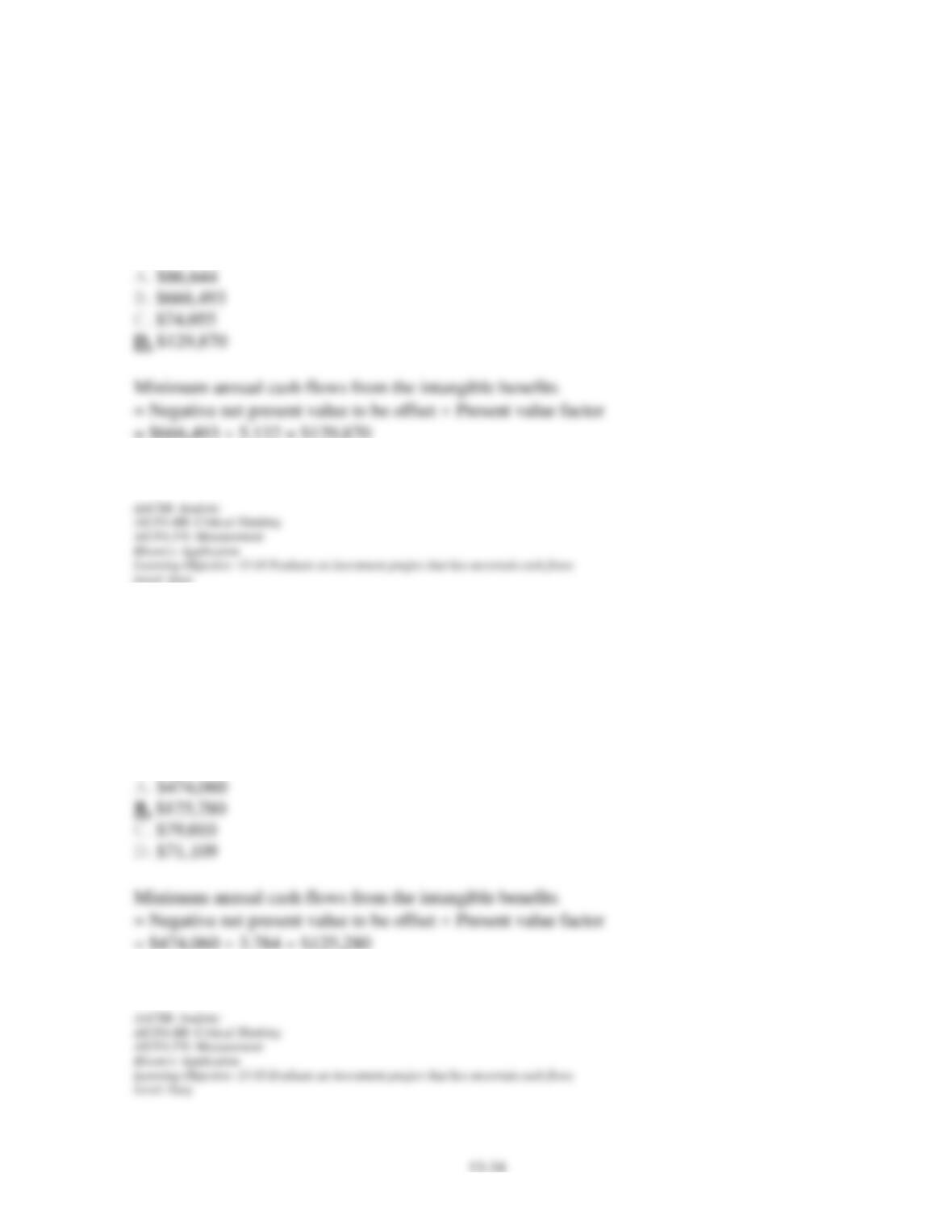
50. (Ignore income taxes in this problem) Lett Corporation is investigating buying a small
used aircraft for the use of its executives. The aircraft would have a useful life of 7 years. The
company uses a discount rate of 15% in its capital budgeting. The net present value of the
investment, excluding the salvage value of the aircraft, is -$578,739. Management is having
difficulty estimating the salvage value of the aircraft. To the nearest whole dollar how large
would the salvage value of the aircraft have to be to make the investment in the aircraft
financially attractive?
Chapter 13 Capital Budgeting Decisions
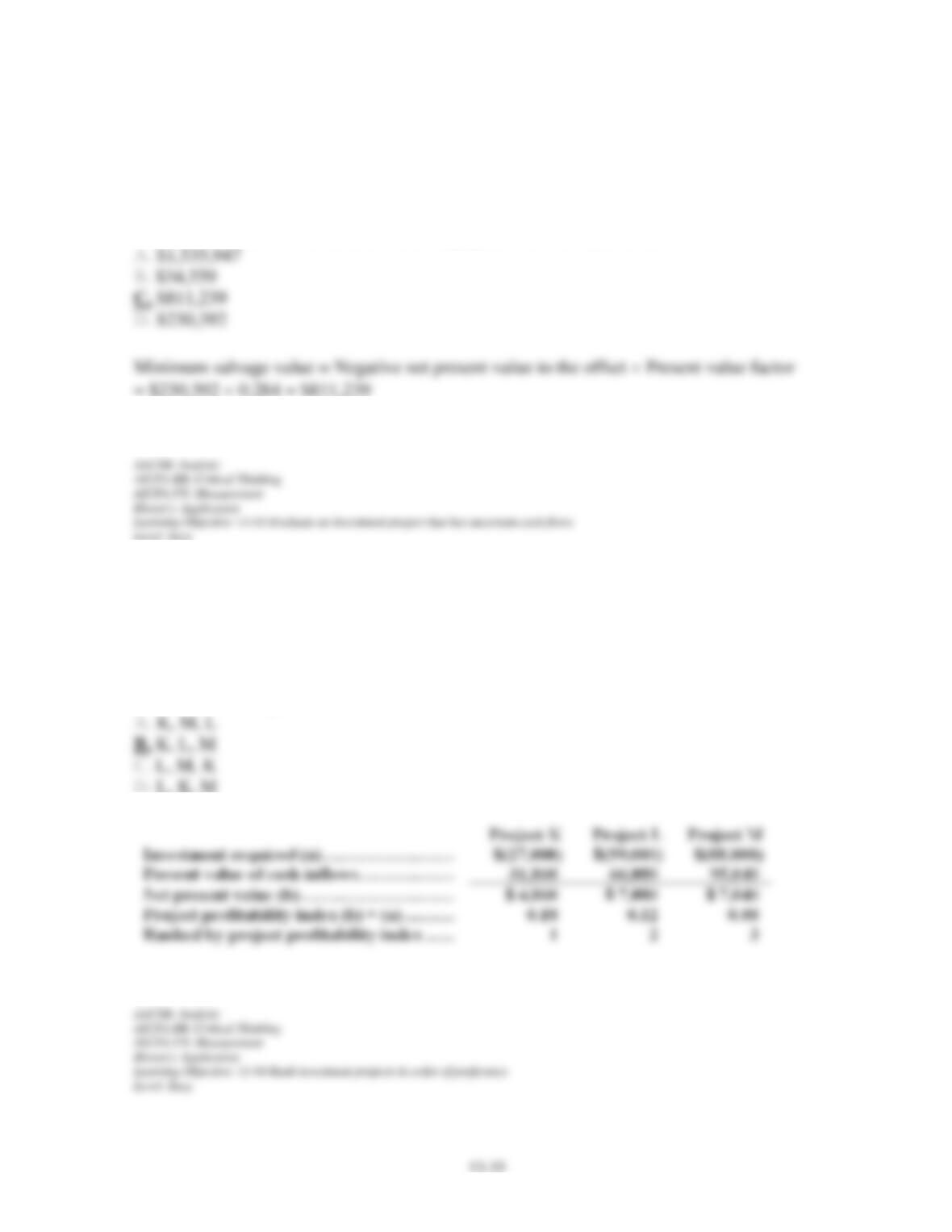
51. (Ignore income taxes in this problem) The management of Hirsh Corporation is
investigating an investment in equipment that would have a useful life of 9 years. The
company uses a discount rate of 13% in its capital budgeting. The net present value of the
investment, excluding the annual cash inflow, is -$666,493. To the nearest whole dollar how
large would the annual cash inflow have to be to make the investment in the equipment
financially attractive?
52. (Ignore income taxes in this problem) The management of Londo Corporation is
investigating buying a small used aircraft to use in making airborne inspections of its above-
ground pipelines. The aircraft would have a useful life of 6 years. The company uses a
discount rate of 15% in its capital budgeting. The net present value of the investment,
excluding the intangible benefits, is -$474,060. To the nearest whole dollar how large would
the annual intangible benefit have to be to make the investment in the aircraft financially
attractive?
Chapter 13 Capital Budgeting Decisions
53. (Ignore income taxes in this problem.) Cottrell, Inc., is investigating an investment in
equipment that would have a useful life of 9 years. The company uses a discount rate of 15%
in its capital budgeting. The net present value of the investment, excluding the salvage value,
is -$230,392. To the nearest whole dollar how large would the salvage value of the equipment
have to be to make the investment in the equipment financially attractive?
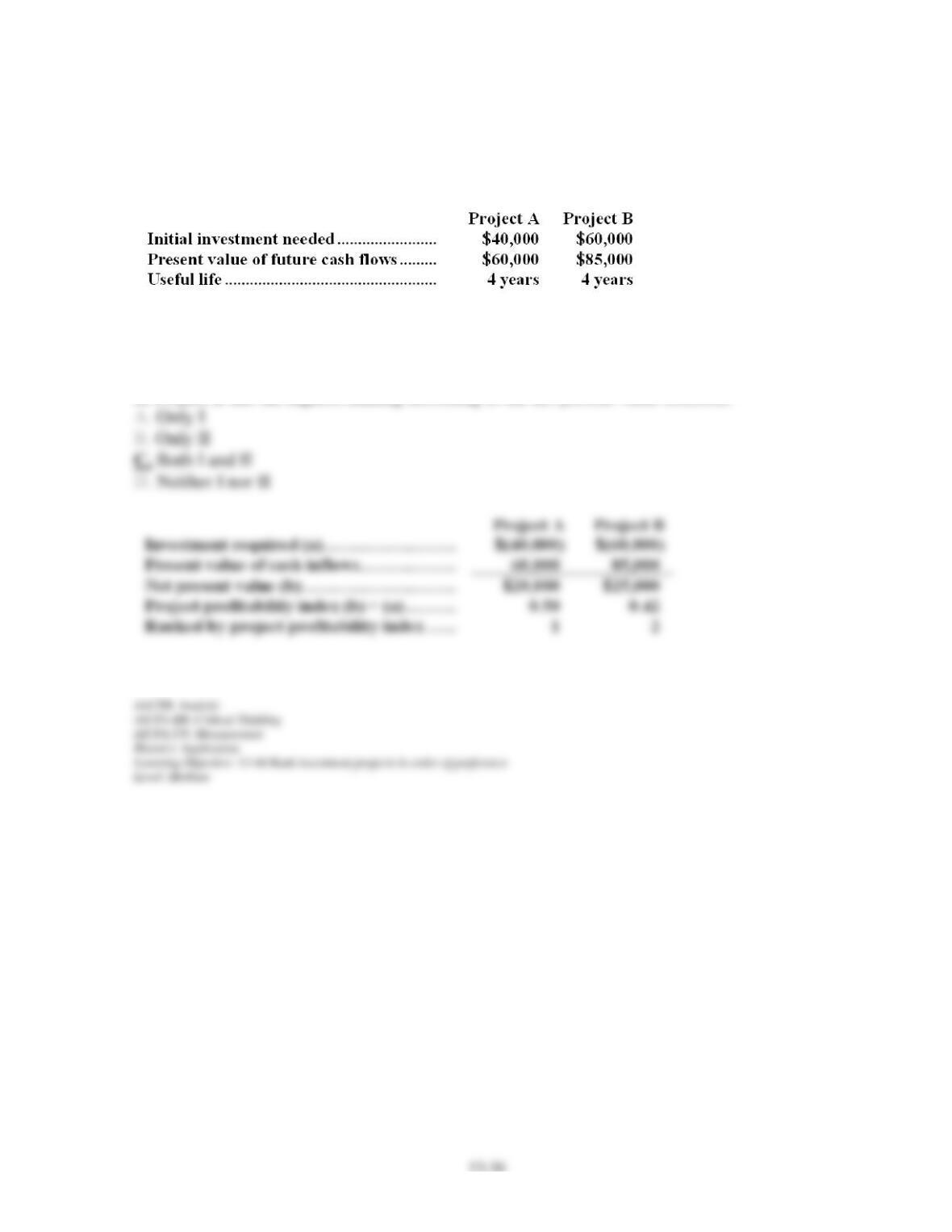
54. (Ignore income taxes in this problem.) Girman Corporation is considering three
investment projects: K, L, and M. Project K would require an investment of $27,000, Project
L of $59,000, and Project M of $88,000. No other cash outflows would be involved. The
present value of the cash inflows would be $31,860 for Project K, $66,080 for Project L, and
$95,040 for Project M. Rank the projects according to the profitability index, from most
profitable to least profitable.
Chapter 13 Capital Budgeting Decisions
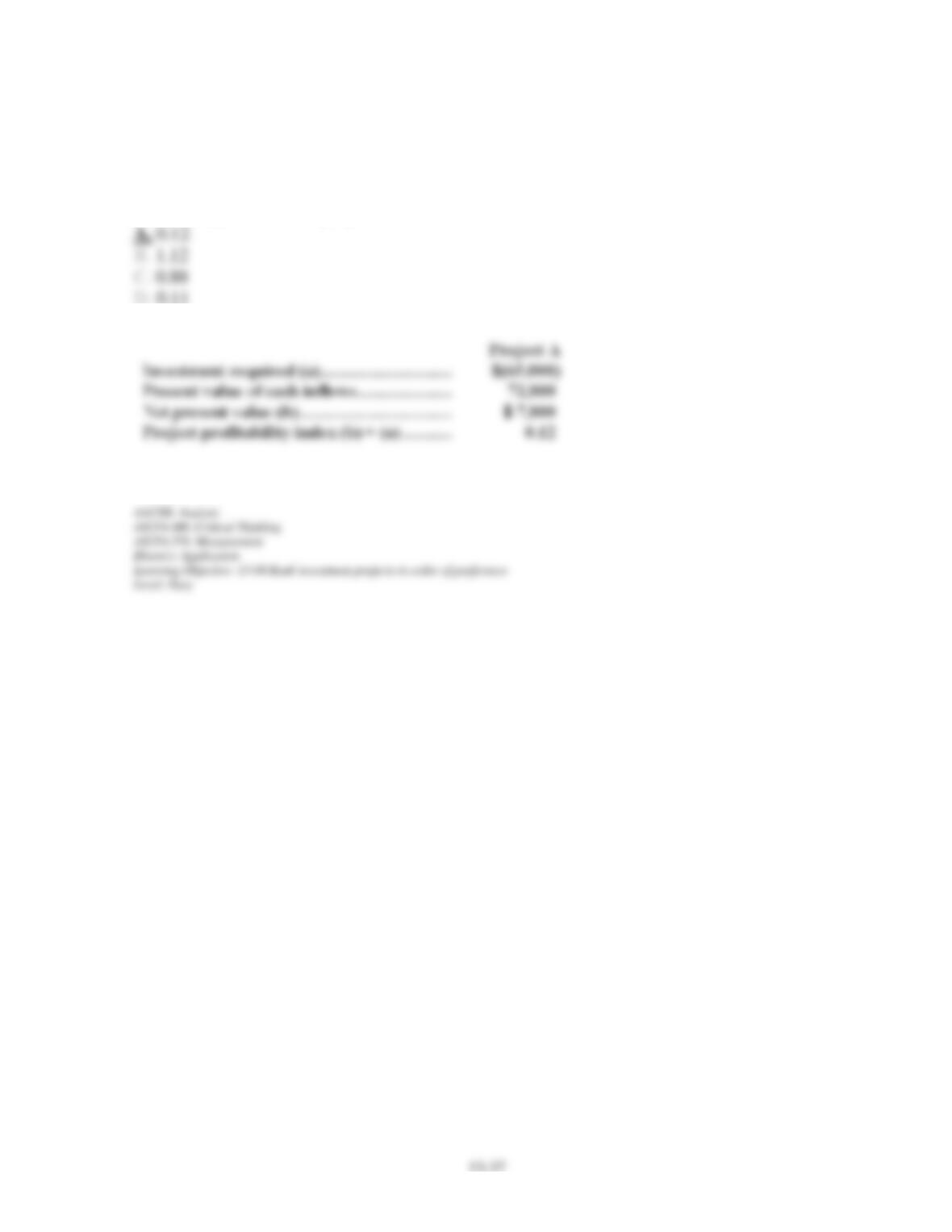
55. Logan Company is considering two projects, A and B. The following information has
been gathered on these projects:
Based on this information, which of the following statements is (are) true?
I. Project A has the highest ranking according to the project profitability index criterion.
II. Project B has the highest ranking according to the net present value criterion.
Chapter 13 Capital Budgeting Decisions
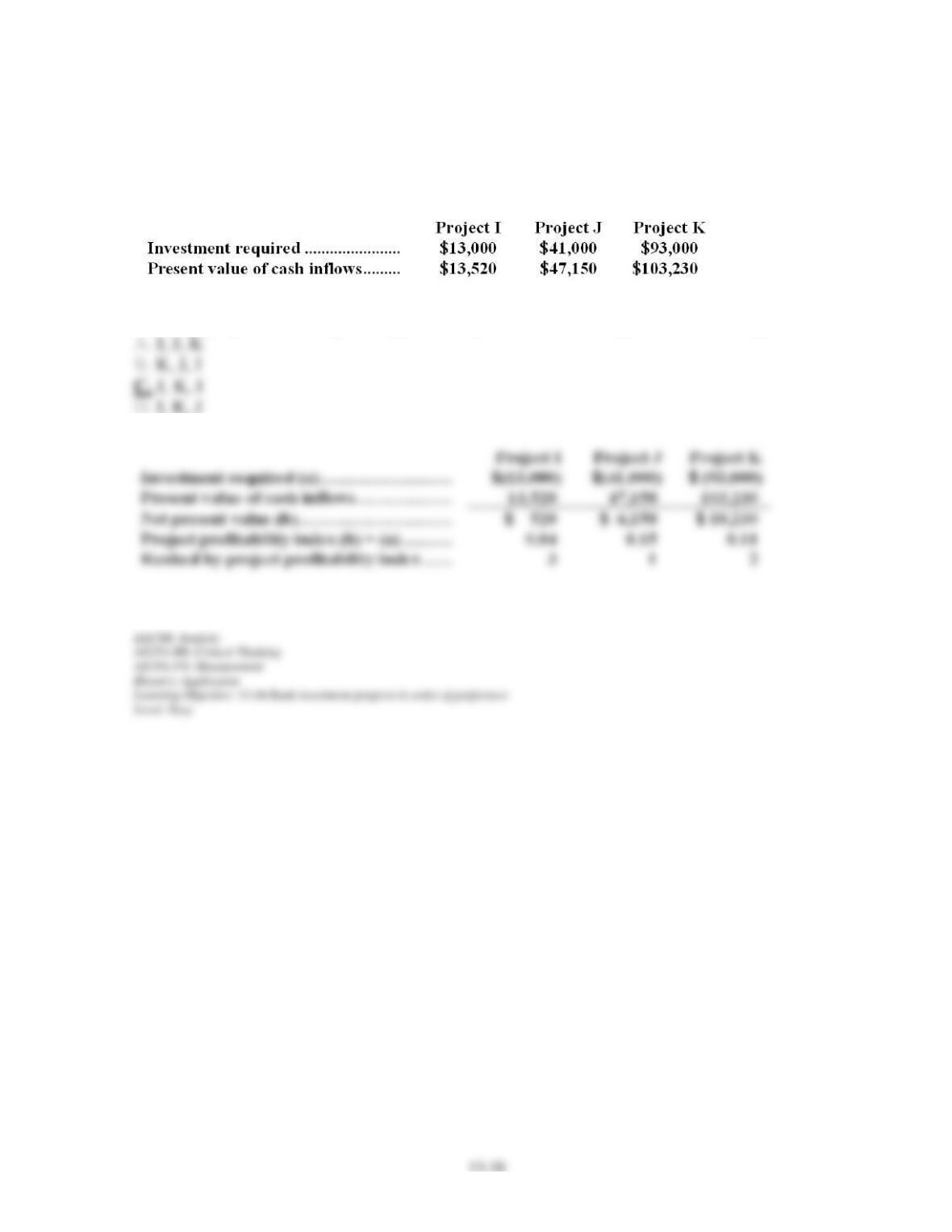
56. (Ignore income taxes in this problem.) The management of Dewitz Corporation is
considering a project that would require an initial investment of $65,000. No other cash
outflows would be required. The present value of the cash inflows would be $72,800. The
profitability index of the project is closest to:
Chapter 13 Capital Budgeting Decisions
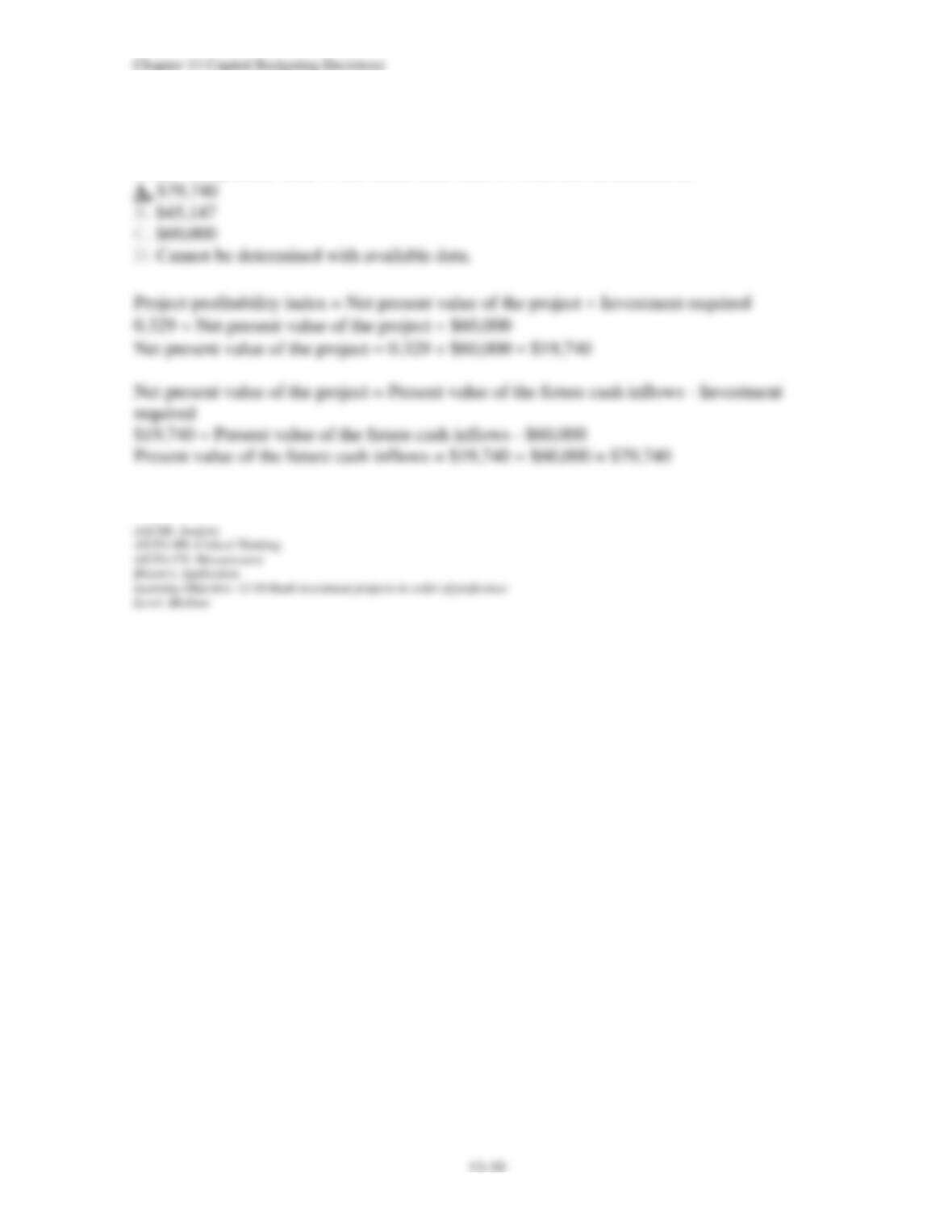
57. (Ignore income taxes in this problem.) The management of Dittrick Corporation is
considering the following three investment projects:
Rank the projects according to the profitability index, from most profitable to least profitable.
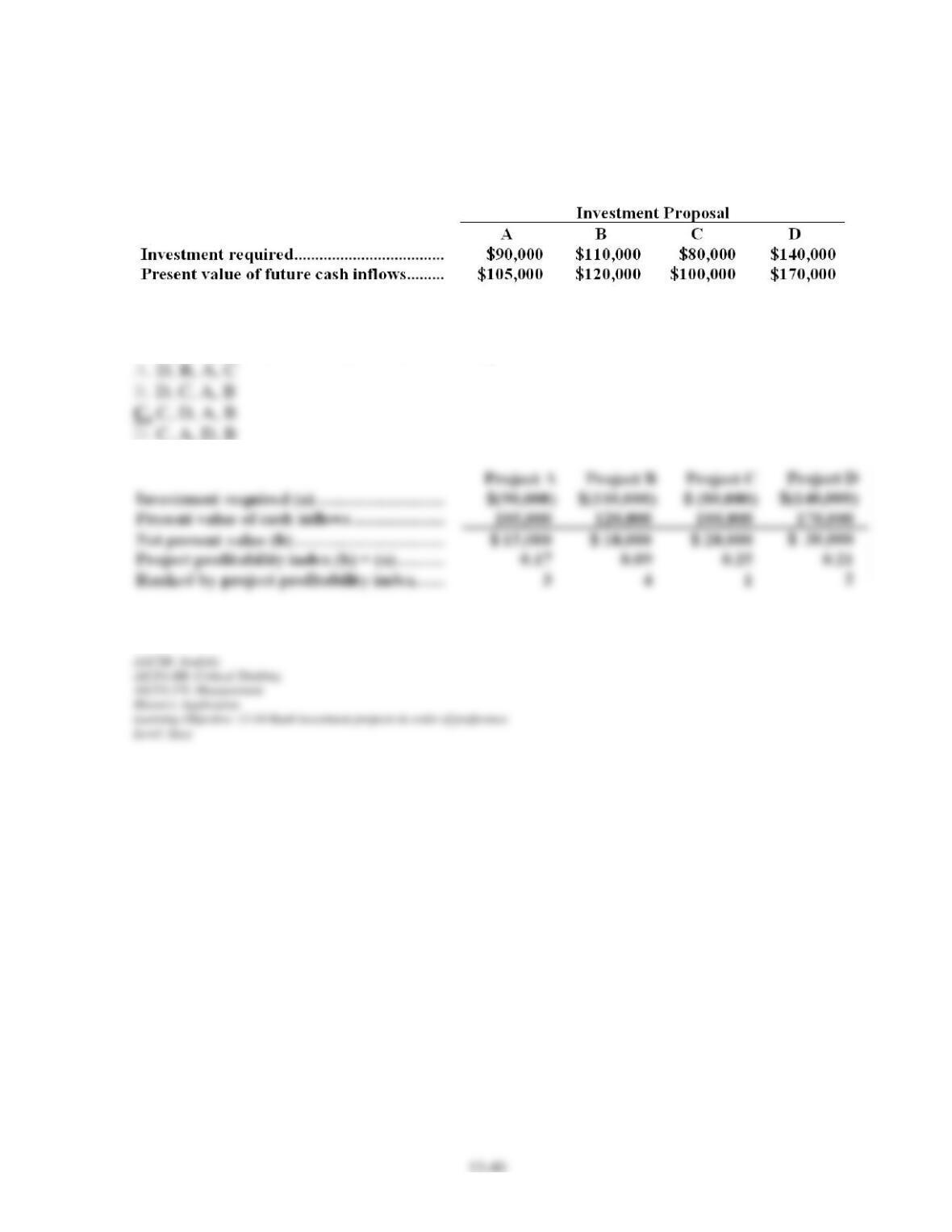
58. A project requires an initial investment of $60,000 and has a project profitability index of
0.329. The present value of the future cash inflows from this investment is:
Chapter 13 Capital Budgeting Decisions
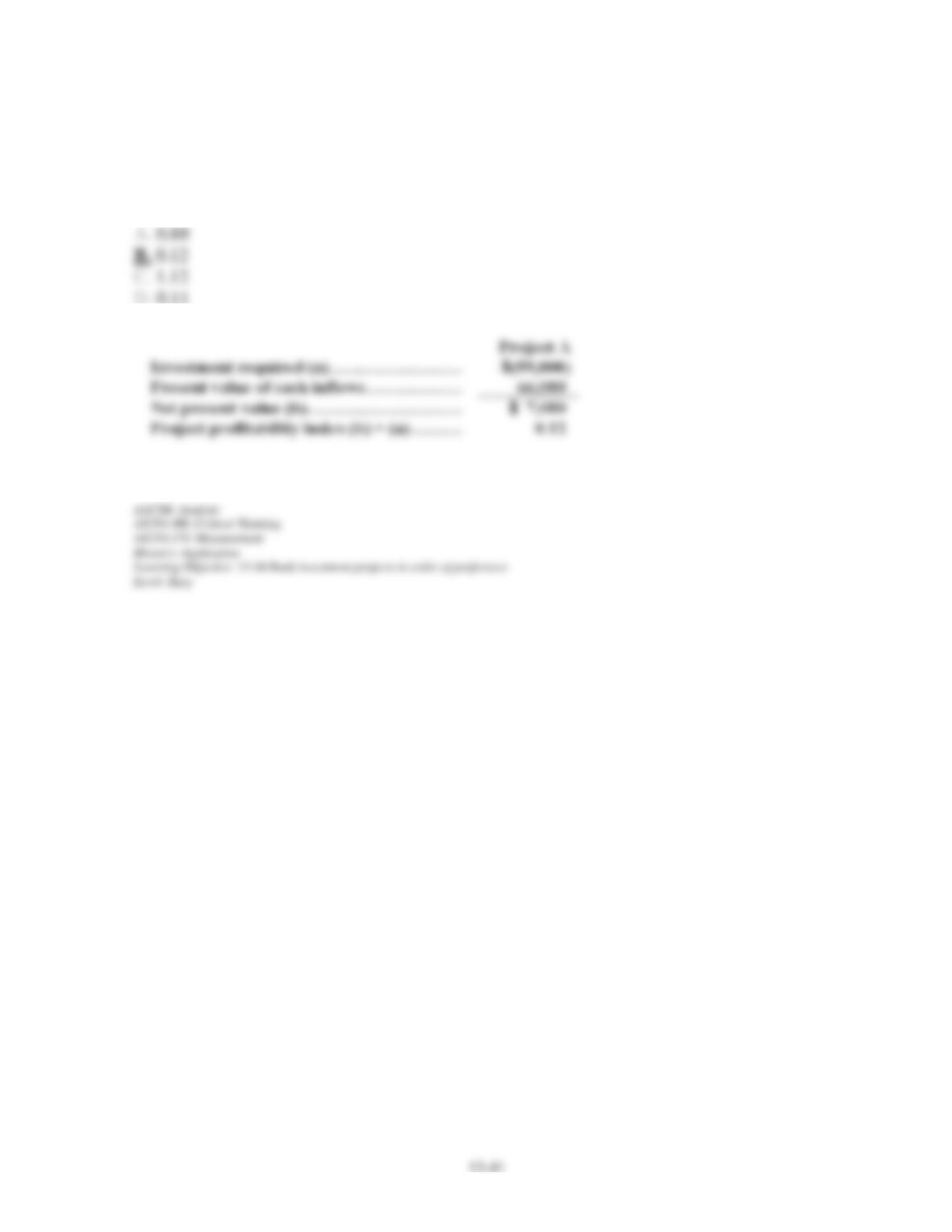
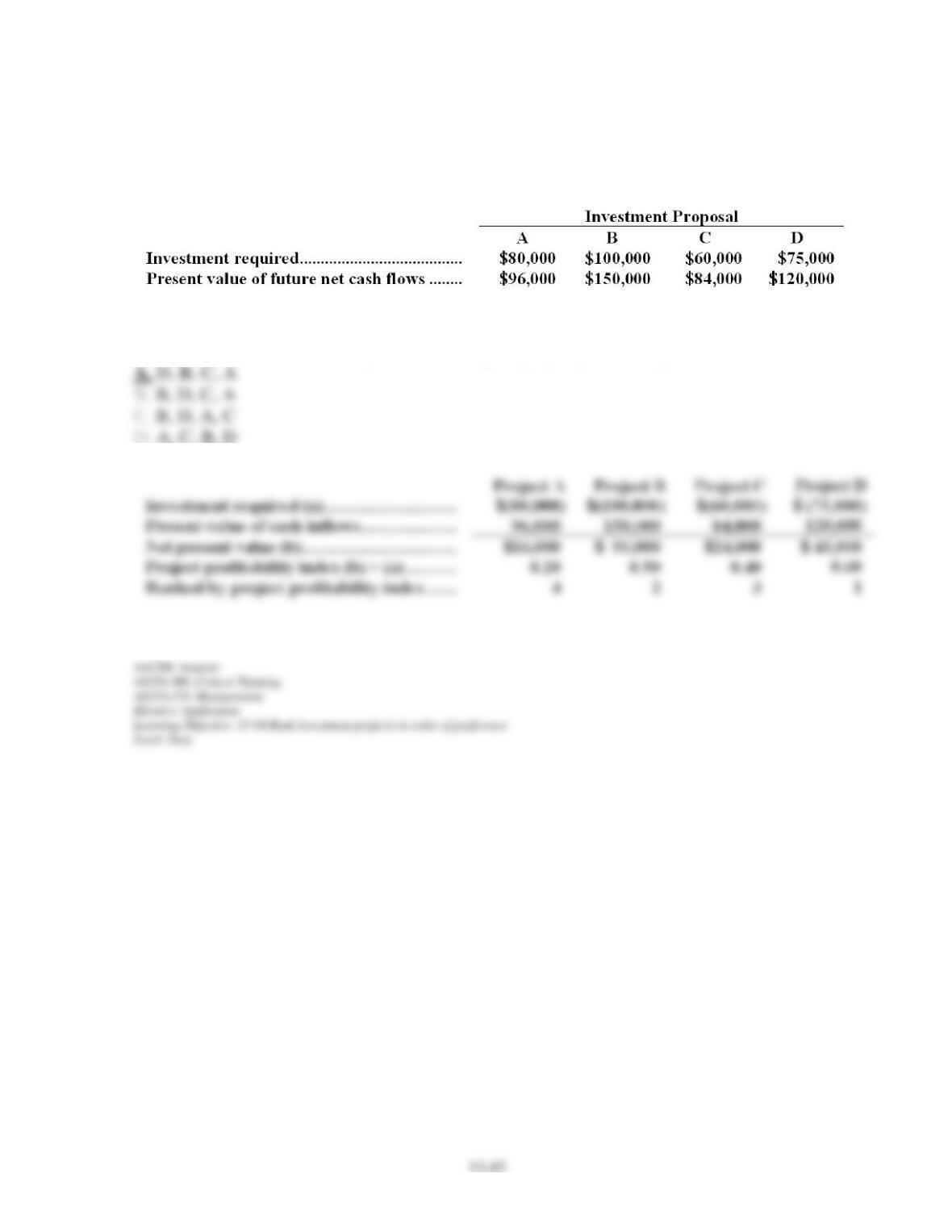
59. Blanding Company is considering several investment proposals, as shown below:
Using the project profitability index, the ranking would be:
Chapter 13 Capital Budgeting Decisions
60. (Ignore income taxes in this problem.) Deibel Corporation is considering a project that
would require an investment of $59,000. No other cash outflows would be involved. The
present value of the cash inflows would be $66,080. The profitability index of the project is
closest to:
Chapter 13 Capital Budgeting Decisions
61. Perkins Company is considering several investment proposals, as shown below:
Rank the proposals in terms of preference using the project profitability index:
Chapter 13 Capital Budgeting Decisions
62. (Ignore income taxes in this problem.) The Jackson Company has invested in a machine
that cost $70,000, that has a useful life of seven years, and that has no salvage value at the end
of its useful life. The machine is being depreciated by the straight-line method, based on its
useful life. It will have a payback period of four years. Given these data, the simple rate of
return on the machine is closest to:
Chapter 13 Capital Budgeting Decisions
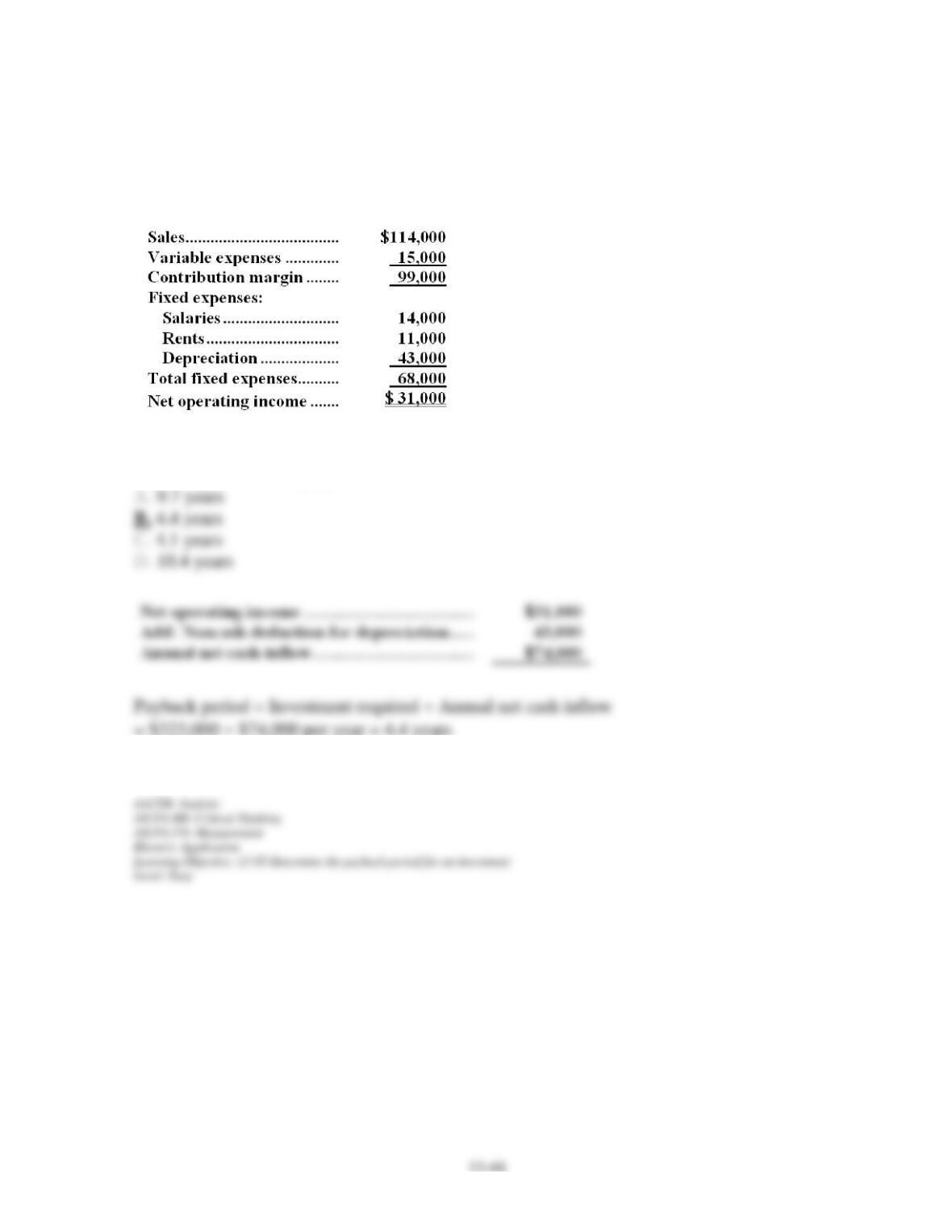
63. (Ignore income taxes in this problem.) Czaplinski Corporation is considering a project that
would require an investment of $323,000 and would last for 7 years. The incremental annual
revenues and expenses generated by the project during those 7 years would be as follows:
The scrap value of the project’s assets at the end of the project would be $22,000. The
payback period of the project is closest to:
Chapter 13 Capital Budgeting Decisions
64. (Ignore income taxes in this problem.) Buy-Rite Pharmacy has purchased a small auto for
delivering prescriptions. The auto was purchased for $9,000 and will have a 6-year useful life
and a $3,000 salvage value. Delivering prescriptions (which the pharmacy has never done
before) should increase gross revenues by at least $5,000 per year. The cost of these
prescriptions to the pharmacy will be about $2,000 per year. The pharmacy depreciates all
assets using the straight-line method. The payback period for the auto is:
65. (Ignore income taxes in this problem.) The Higgins Company has just purchased a piece
of equipment at a cost of $120,000. This equipment will reduce operating costs by $40,000
each year for the next eight years. This equipment replaces old equipment which was sold for
$8,000 cash. The new equipment has a payback period of: