Solve the problem.
82)
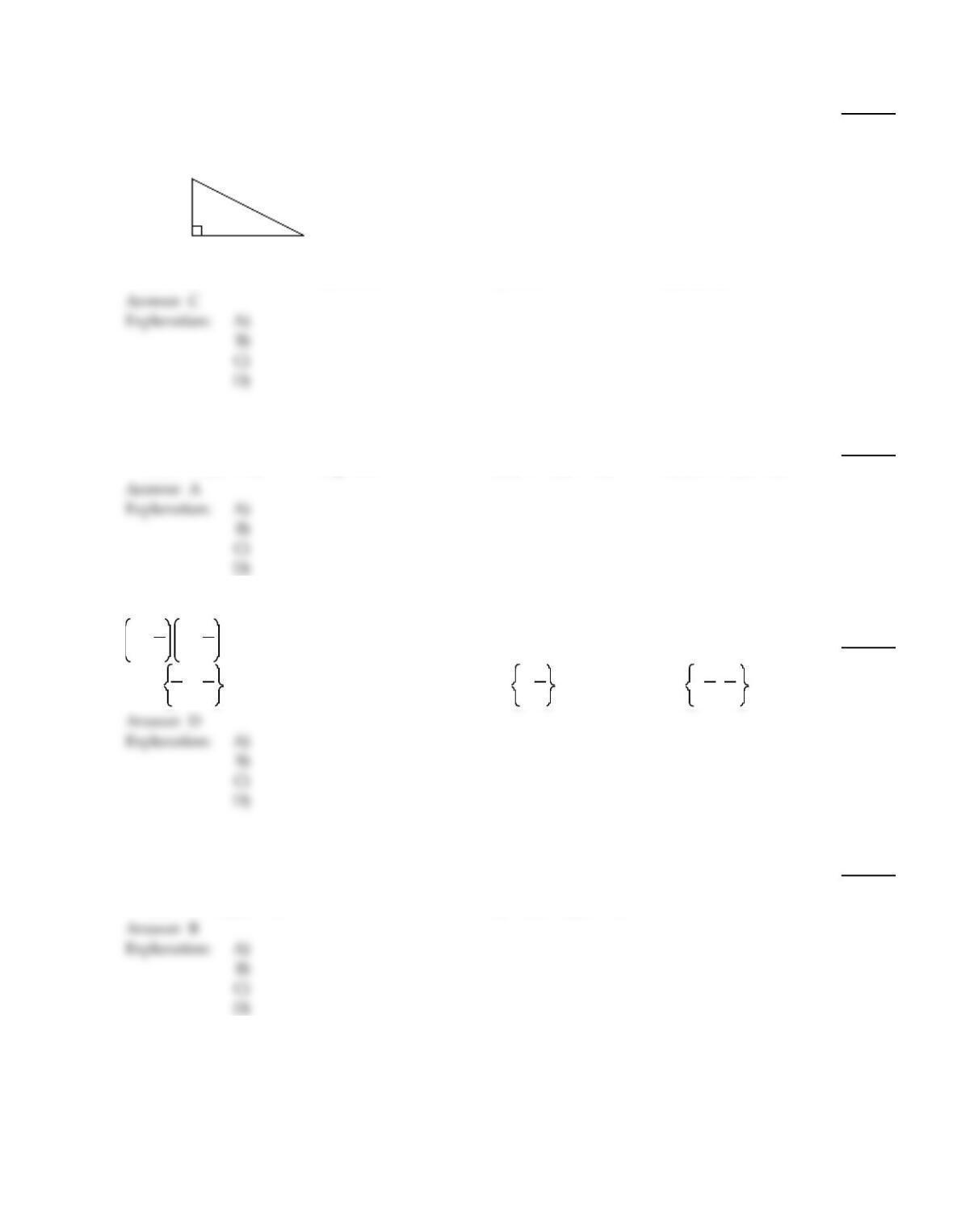
Below is a diagram of a water slide. The slide is 16 ft long. The ladder leading to the slide is 13 ft
long. How far is it from the end of the slide to the foot of the ladder? Round approximations to the
nearest tenth.
13 ft 16 ft
?
82)
A)
4.7 ft
B)
43.5 ft
C)
9.3 ft
D)
14.5 ft
Factor as completely as possible. If unfactorable, indicate that the polynomial is prime.
83)
15x2+ 16x + 4
83)
A)
(3x + 2)(5x + 2)
B)
prime
C)
(3x – 2)(5x – 2)
D)
(15x + 2)(x + 2)
A
Solve the equation.
84)
x +1
4x –2
5= 0
84)
A)
1
4, –2
5
B)
{3, 3}
C)
4, 5
2
D)
–1
4, 2
5
D
Factor as completely as possible. If unfactorable, indicate that the polynomial is prime.
85)
–48x2– 40x + 48
85)
A)
prime
B)
–8(3x – 2)(2x + 3)
C)
(–24x + 16)(2x + 3)
D)
–8(3x + 2)(2x – 3)
B
17
C
Find the greatest common factor of the numbers.
86)
12, 32, 36
86)
A)
12
B)
8
C)
1
D)
4
Factor by grouping.
87)
10x2– 6xy + 15xy – 9y2
87)
A)
(2x + 3)(5x – 3)
B)
(2x – 3y)(5x – 3y)
C)
(10x + 3y)(x – 3y)
D)
(2x + 3y)(5x – 3y)
D
Find the greatest common factor of the numbers.
88)
42, 24
88)
A)
7
B)
3
C)
66
D)
6
D
Complete the factoring.
89)
42x2– 11xy – 20y2= (6x – 5y)( )
89)
A)
4x – 7y
B)
7+ 4xy
C)
4y – 7x
D)
7x + 4y
D
D
Solve the problem.
90)
The table shows the population of a city over the past five years.
Year Population (in millions of people)
1995 65
1996 65.5
1997 67
1998 69
1999 71.5
We used this data to develop the quadratic equation y = 0.373x2+ 0.165x + 65, which models the
population of the city y in millions in the year x, where x = 0 represents 1995, x = 1 represents 1996,
and so on. Use the model to find the estimated population in the year 1997.
90)
A)
65,538,000
B)
1,490,000,000,000
C)
1,490,000
D)
66,822,000
Factor by grouping.
91)
12x2– 15x – 16x + 20
91)
A)
(3x – 4)(4x – 5)
B)
(12x – 4)(x – 5)
C)
(3x + 4)(4x + 5)
D)
(12x + 4)(x + 5)
Factor as completely as possible. If unfactorable, indicate that the polynomial is prime.
92)
45 – 14x +x2
92)
A)
(x – 9)(x + 5)
B)
(x + 9)(x + 5)
C)
(x – 9)(x – 5)
D)
(x + 9)(x – 5)
Factor.
93)
x2– 15x + 225
93)
A)
(x + 15)2
B)
(x – 15)2
C)
Prime
D)
(x + 15)(x – 15)
19
Provide an appropriate response.
94)
Is x8y6z7 a common factor of x9y7z8and –x8y6z7?
94)
A)
Yes
B)
No
Factor.
95)
16a3–2
95)
A)
2(2a + 1)(4a2–2a + 1)
B)
2(2a – 1)(4a2+2a + 1)
C)
(4a + 1)(4a2–2a +2)
D)
(4a – 1)(4a2+2a +2)
D)
Provide an appropriate response.
96)
49x2– 9 has a common factor of 441. Is this statement true?
96)
A)
No, it is not true.
B)
Yes, it is true.
Factor as completely as possible. If unfactorable, indicate that the polynomial is prime.
97)
8x2– 8x – 16
97)
A)
(4x + 4)(2x – 4)
B)
(4x – 4)(2x + 4)
C)
(2x + 4)(4x – 4)
D)
(x + 4)(8x – 4)
D)
Complete the factoring.
98)
6x2=6x( )
98)
A)
36
B)
2
C)
x
D)
x2
D)
20
Factor.
99)
w3+ 512z3
99)
A)
(w – 512z)(w2+z2)
B)
(w – 8z)(w2+ 8wz + 64z2)
C)
(w + 8z)(w2– 8wz + 64z2)
D)
(w + 8z)(w2+ 64z2)
Factor the polynomial.
100)
81p2– 64q2
100)
A)
(9p – 8q)2
B)
(9p + 8q)2
C)
(81p + q)(p – 64q)
D)
(9p + 8q)(9p – 8q)
D
Solve the problem.
101)
A parallelogram has a base of length 2x + 1 and a height of x + 3 and has an area of 42 square units.
Find the base and height of the parallelogram. (A = BH)
101)
A)
height = 7 units; base = 6 units
B)
height = 3 units; base = 14 units
C)
height = 6 units; base = 7 units
D)
height = 14 units; base = 3 units
C
Factor the polynomial.
102)
10x2– 7xy – 12y2
102)
A)
(5xy + 4)(2xy – 3)
B)
(5x – 4y)(2x – 3y)
C)
(5x + 4y)(2x + 3y)
D)
(5x + 4y)(2x – 3y)
D
C
Factor by grouping.
103)
8a3– 6a2b – 20ab2+ 15b3
103)
A)
(8a2– 5b2)(a – 3b)
B)
(2a2+ 5b2)(4a + 3b)
C)
(2a2– 5b2)(4a – 3b)
D)
(2a2– 5b)(4a – 3b)
Factor out the greatest common factor.
104)
72m8+ 24m5+ 108m3
104)
A)
12(6m8+ 2m5+ 9m3)
B)
no common factor (except 1)
C)
m3(72m5+ 24m2+ 108)
D)
12m3 (6m5+ 2m2+ 9)
Factor.
105)
5x3+320
105)
A)
(5x –4)(x2+4x +16)
B)
5(x –4)(x2+4x +16)
C)
5(x +4)(x2–4x +16)
D)
(5x +4)(x2–4x +16)
Solve the equation.
106)
10c3– 4c2– 6c = 0
106)
A)
1, –1
B)
2
5, –3
2
C)
1, –3
5, 0
D)
{0}
Factor completely.
107)
81x2– 49
107)
A)
(9x – 7)2
B)
(9x + 7)2
C)
(9x + 7)(9x – 7)
D)
Prime
22
Factor as completely as possible. If unfactorable, indicate that the polynomial is prime.
108)
–54x2– 45x + 54
108)
A)
(–27x + 18)(2x + 3)
B)
prime
C)
–9(3x + 2)(2x – 3)
D)
–9(3x – 2)(2x + 3)
Complete the factoring.
109)
9x2– 79x + 56 = (9x – 7)( )
109)
A)
9x + 49
B)
7– 9x
C)
x – 8
D)
x + 8
C
Solve the equation.
110)
x(5x + 10) = 0
110)
A)
{0, –2}
B)
0, 1
2
C)
0, –1
2
D)
{0, 2}
A
111)
(x – 8)(x2+ 2x – 3) = 0
111)
A)
{–8}
B)
{–8, 3, –1}
C)
{8}
D)
{8, –3, 1}
D
Factor as completely as possible. If unfactorable, indicate that the polynomial is prime.
112)
72x2+ 42xy + 6y2
112)
A)
6(3x – y)(4x – y)
B)
(18x + 6y)(4x + y)
C)
prime
D)
6(3x + y)(4x + y)
D
23
D
Factor completely.
113)
36m2–4
9
113)
A)
6m +2
36m –2
3
B)
Prime
C)
6m +2
3
2
D)
6m –2
3
2
Provide an appropriate response.
114)
Find a quadratic equation having the given solutions.
x = – 3
2 or x =2
3
114)
A)
2x2– 1x + 6 = 0
B)
2x2+ 1x – 6 = 0
C)
6x2+ 5x – 6 = 0
D)
6x2– 5x – 6 = 0
Factor the polynomial.
115)
21x2–9x +12x3
115)
A)
x(21x –9+12x2)
B)
3x(7x –9+12x2)
C)
3x(7x –3+4x2)
D)
3(7x2–3x +4x3)
Solve the problem.
116)
A triangle has a base of length 2x + 3 and a height of x + 3 and has an area of 27 square units. Find
the length of base and height. (A =1
2BH)
116)
A)
base = 3 units; height = 9 unit
B)
base = 9 units; height = 3 units
C)
base = 9 units; height = 6 units
D)
base = 18 units; height = 3 units
24
Factor the polynomial.
117)
6z2–48z
117)
A)
6z(z –48)
B)
6z(z –8)
C)
8z(z –6)
D)
6(z2–8z)
118)
b2– bz +19z2
118)
A)
(b –19z)(b – z)
B)
(b –19z)2
C)
prime
D)
(b +19z)(b – z)
Factor.
119)
m3–n3
119)
A)
(m –n)(m2–mn –n2)
B)
(m –n)(m2–mn +n2)
C)
(m +n)(m2–mn +n2)
D)
(m –n)(m2+mn +n2)
Complete the factoring.
120)
x2+ 3x – 10 = (x – 2)( )
120)
A)
x + 5
B)
x – 5
C)
x2+ 2
D)
2– x
Solve the problem.
121)
A triangle has a base of length x + 2 and a height of x + 8 and has an area of 36 square units. Find
the length of base and height. (A =1
2BH)
121)
A)
base = 8 units; height = 9 units
B)
base = 6 units; height = 6 units
C)
base = 4 units; height = 9 units
D)
base = 6 units; height = 12 units
25
Factor the polynomial.
122)
21prs2–9pst +15pr2st
122)
A)
3prs(7s –3t +5rt)
B)
3ps2(7r –3t +5r2t)
C)
3ps(7rs –3t +5r2t)
D)
3ps(7rs –9t +15r2t)
Factor completely.
123)
3x2– 18x + 27
123)
A)
(3x – 9)(x – 3)
B)
3(x – 9)(x + 1)
C)
3(x – 3)(x – 3)
D)
Prime
D)
Solve the equation.
124)
3
8zz –1
7= 0
124)
A)
–1
7, 0
B)
–3
8, 1
7
C)
3
8, 1
7
D)
1
7, 0
D)
Solve the problem.
125)
Find three consecutive integers such that the square of the sum of the smaller two is 72 more than
the square of the largest.
125)
A)
–5, –4, –3
B)
5, 6, 7, or –5, –4, –3
C)
5, 6, 7
D)
3, 5, 7
D)
Factor.
126)
5x2–30x +45
126)
A)
5(x –3)2
B)
Prime
C)
(5x –30)2
D)
5(x +3)2
D)
26
D)
Factor the polynomial.
127)
18a3b – 78a2b2– 60ab3
127)
A)
ab(3a + 2b)(6a – 30b)
B)
6a(3a + 2b)(a – 5b2)
C)
6ab(3a – 2b)(a + 5b)
D)
6ab(3a + 2b)(a – 5b)
Solve the equation.
128)
6k2– 47k – 8 = 0
128)
A)
1
47 , –1
6
B)
–1
6, 6
C)
{–6, 8}
D)
–1
6, 8
27
Answer Key
Testname: C13
28
Answer Key
Testname: C13
Answer Key
Testname: C13

Answer Key
Testname: C13