26) A 12,000-N car is raised using a hydraulic lift, which consists of a U-tube with arms of
unequal areas, filled with oil and capped at both ends with tight-fitting pistons. The wider arm of
the U-tube has a radius of 18.0 cm and the narrower arm has a radius of 5.00 cm. The car rests on
the piston on the wider arm of the U-tube. The pistons are initially at the same level. What is the
initial force that must be applied to the smaller piston in order to start lifting the car? For
purposes of this problem, neglect the weight of the pistons.
A) 727 N
B) 926 N
C) 2.90 kN
D) 3.33 kN
E) 1.20 kN
27) A 12,000-N car is raised using a hydraulic lift, which consists of a U-tube with arms of
unequal areas, filled with oil with a density of 800 kg/m3 and capped at both ends with tight-
fitting pistons. The wider arm of the U-tube has a radius of 18.0 cm and the narrower arm has a
radius of 5.00 cm. The car rests on the piston on the wider arm of the U-tube. The pistons are
initially at the same level. What is the force that must be applied to the smaller piston in order to
lift the car after it has been raised 1.20 m? For purposes of this problem, neglect the weight of
the pistons.
A) 0.954 kN
B) 1.88 kN
C) 1.96 kN
D) 3.67 kN
E) 1.20 kN
28) A 500-N weight sits on the small piston of a hydraulic machine. The small piston has an
area of 2.0 cm2. If the large piston has an area of 40 cm2, how much weight can the large piston
support? Assume the pistons each have negligible weight.
A) 25 N
B) 500 N
C) 10000 N
D) 40000 N
29) In a hydraulic garage lift, the small piston has a radius of 5.0 cm and the large piston has a
radius of 15 cm. What force must be applied on the small piston in order to lift a car weighing
20,000 N on the large piston? Assume the pistons each have negligible weight.
A) 6.7 × 10³ N
B) 5.0 × 10³ N
C) 2.9 × 10³ N
D) 2.2 × 10³ N
30) A 13,000-N vehicle is to be lifted by a 25-cm diameter hydraulic piston. What force needs to
be applied to a 5.0 cm diameter piston to accomplish this? Assume the pistons each have
negligible weight.
A) 260 N
B) 520 N
C) 2600 N
D) 5200 N
31) The small piston of a hydraulic lift has a diameter of 8.0 cm, and its large piston has a
diameter of 40 cm. The lift raises a load of 15,000 N. Assume the pistons each have negligible
weight.
(a) Determine the force that must be applied to the small piston.
(b) Determine the pressure applied to the fluid in the lift.
32) A block of metal weighs 40 N in air and 30 N in water. What is the buoyant force on the
block due to the water? The density of water is 1000 kg/m3.
A) 10 N
B) 30 N
C) 40 N
D) 70 N
33) If a ship has a mass of 10 million kilograms, what volume of fresh water must it displace in
order to float? The density of water is 1000 kg/m3.
A) 1010 m3
B) 1012 m3
C) 104 m3
D) 107 m3
E) 108 m3
34) An object has a volume of 4.0 m3 and weighs 40,000 N. What will its apparent weight be in
water of density 1000 kg/m3?
A) 40,000 N
B) 39,200 N
C) 9,800 N
D) 800 N
35) A 4.0-kg cylinder of solid iron is supported by a string while submerged in water. What is
the tension in the string? The density of iron is 7860 kg/m3 and that of water is 1000 kg/m3.
A) 2.5 N
B) 20 N
C) 24 N
D) 34 N
E) 40 N
36) What buoyant force does a 0.60-kg solid gold crown experience when it is immersed in
water? The density of gold is 19.3 × 10³ kg/m3 and that of water is 1000 kg/m3.
A) 3.0 × 10⁻⁵ N
B) 3.0 × 10⁻⁴ N
C) 3.0 × 10⁻² N
D) 0.30 N
37) A crane lifts a steel submarine of density 7800 kg/m3 and mass 20,000 kg. What is the
tension in the lifting cable (a) when the submarine is submerged in water of density 1000 kg/m3,
and (b) when it is entirely out of the water?
A) (a) 2.0 × 10⁵ N (b) 1.7 × 10⁵ N
B) (a) 1.7 × 10⁵ N (b) 2.0 × 10⁵ N
C) (a) 2.6 × 10³ N (b) 2.0 × 10⁵ N
D) (a) 2.0 × 10⁵ N (b) 2.6 × 10³ N
38) An object weighs 7.84 N when it is in air and 6.86 N when it is immersed in water of density
1000 kg/m3. What is the density of the object?
A) 6000 kg/m3
B) 7000 kg/m3
C) 8000 kg/m3
D) 9000 kg/m3
39) When a container of water is placed on a laboratory scale, the scale reads 120 g. Now a 20-g
piece of copper (of density 8.9 g/cm3) is suspended from a thread and lowered into the water, not
touching the bottom of the container. What will the scale now read? The density of water is 1.0
g/cm3.
A) 120 g
B) 122 g
C) 138 g
D) 140 g
40) A piece of aluminum with a mass of 1.0 kg and density of 2700 kg/m3 is suspended from a
light cord and then completely immersed in a container of water having density 1000 kg/m3.
(a) Determine the volume of the piece of aluminum.
(b) Determine the tension in the cord when the aluminum is immersed in the container of water.
41) A cylindrical rod of length 12 cm and diameter 2.0 cm will just barely float in water of
density 1000 kg/m3. What is its mass?
A) 38 g
B) 75 g
C) 150 g
D) 300 g
42) A rectangular box of negligible mass measures 5.0 m long, 1.0 m wide, and 0.50 m high.
How many kilograms of mass can be loaded onto the box before it sinks in a lake having water
of density 1000 kg/m3?
A) 0.50 × 10³ kg
B) 1.5 × 10³ kg
C) 2.5 × 10³ kg
D) 3.5 × 10³ kg
43) A 1.00-m3 object floats in water with 20.0% of its volume above the waterline. What does
the object weigh out of the water? The density of water is 1000 kg/m3.
A) 1,960 N
B) 7,840 N
C) 9,800 N
D) 11,800 N
44) An object floats with half its volume beneath the surface of the water. The weight of the
displaced water is 2000 N. What is the weight of the object? The density of water is 1000
kg/m3.
A) 1000 N
B) 2000 N
C) 4000 N
D) It cannot be determined because we do not know the volume of the object.
45) A solid object floats in water with three-fourths of its volume beneath the surface. What is
the object’s density? The density of water is 1000 kg/m3.
A) 1333 kg/m3
B) 1000 kg/m3
C) 750 kg/m3
D) 250 kg/m3
46) A 200-N object floats with three-fourths of its volume beneath the surface of the water.
What is the buoyant force on the object? The density of water is 1000 kg/m3.
A) 50 N
B) 150 N
C) 200 N
D) 267 N
E) It cannot be determined because we do not know the volume of the object.
47) A polar bear of mass 200 kg stands on an ice floe that is a uniform 1.0 m thick. What is the
minimum area of the floe that will just support the bear in saltwater of density 1030 kg/m3? The
density of ice is 980 kg/m3.
A) 1.0 m2
B) 2.0 m2
C) 3.0 m2
D) 4.0 m2
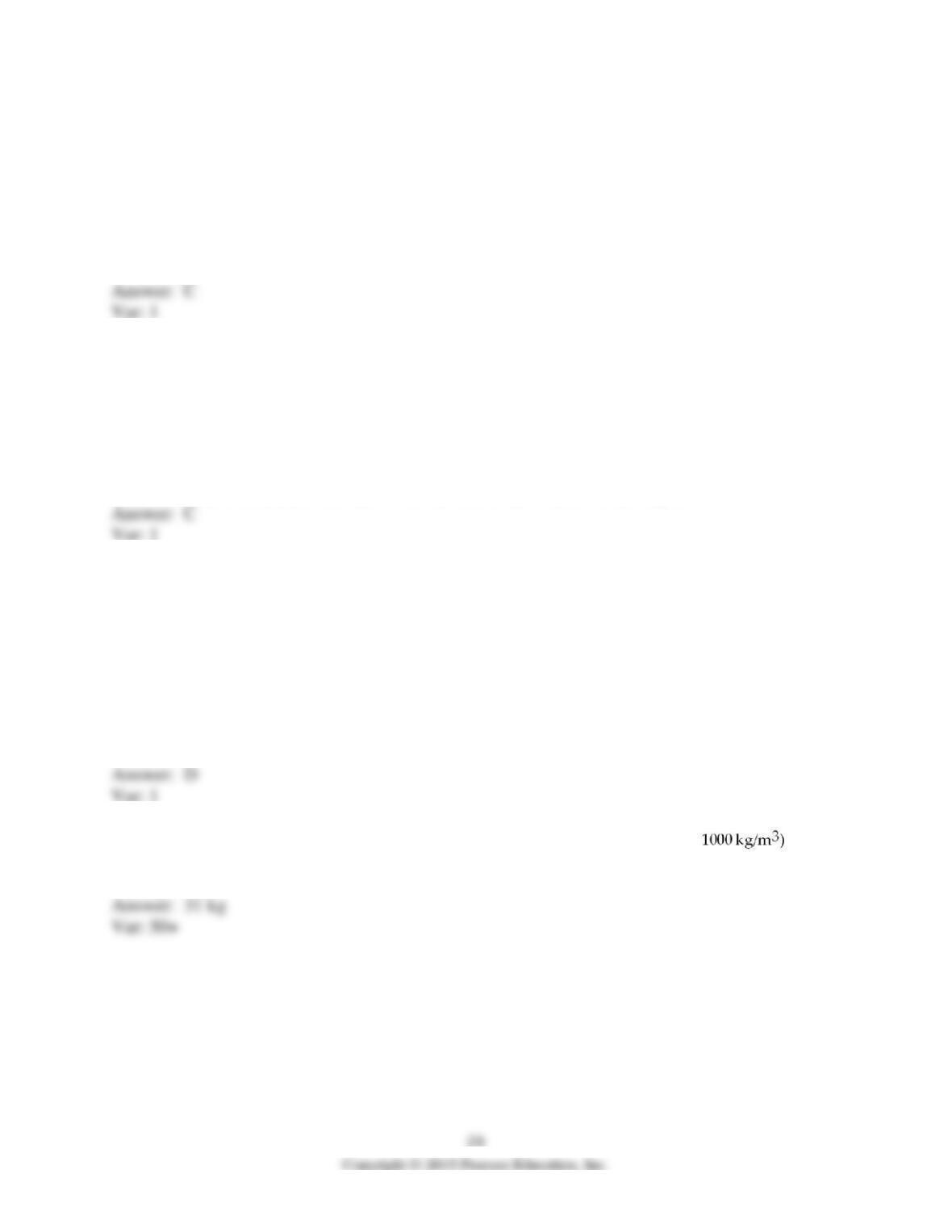
48) A wooden raft has a mass of 55 kg. When empty it floats in water (density with
64% of its volume submerged. What maximum mass of sand can be put on the raft without
sinking it?
49) A hollow steel ball of diameter 3.0 m just barely floats in water. What is the wall thickness
of the ball? (ρFe = 7.87 g/cm3, ρwater = 1.00 g/cm3)
A) 6.6 cm
B) 37 cm
C) 131 cm
D) 79 cm
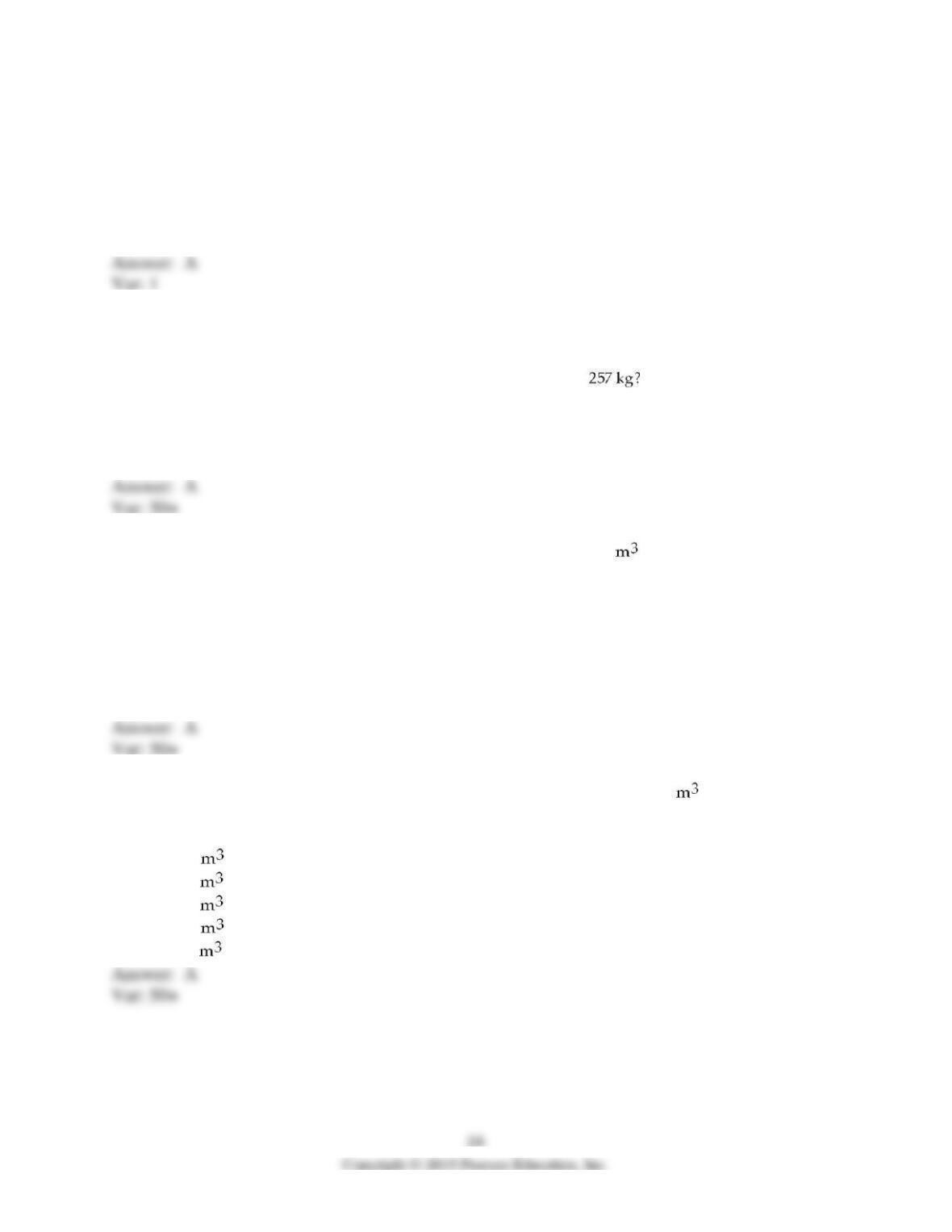
50) A 200-kg flat-bottomed boat floats in fresh water, which has a density of 1000 kg/m3. If the
base of the boat is 1.42 m wide and 4.53 m long, to what depth is the bottom of the boat
submerged when it carries three passengers whose total mass is
A) 7.10 cm
B) 7.53 cm
C) 7.95 cm
D) 8.52 cm
51) A 4.7-kg solid sphere, made of metal whose density is 4000 kg/ , hangs by a light cord.
When the sphere is immersed in water, what is the tension in the cord? The density of water is
1000 kg/m3.
A) 35 N
B) 40 N
C) 46 N
D) 52 N
E) 58 N
52) A solid sphere of mass 8.6 kg, made of metal whose density is 3400 kg/ , hangs by a cord.
When the sphere is immersed in a liquid of unknown density, the tension in the cord is 38 N. The
density of the liquid is closest to which one of the following values?
A) 1900 kg/
B) 1700 kg/
C) 1600 kg/
D) 1500 kg/
E) 1400 kg/
53) A barge is 10 m wide and 60 m long and has vertical sides. The bottom of the boat is 1.2 m
below the water surface. What is the weight of the barge and its cargo, if it is floating in fresh
water of density 1000 kg/m3?
A) 3.5 MN
B) 6.4 MN
C) 6.8 MN
D) 7.1 MN
E) 9.5 MN
54) A barge with vertical sides is 10 m wide and 60 m long and is floating in fresh water of
density 1000 kg/m3. How much deeper into the water does the barge sink when 3.0 x 10⁵ kg of
coal are loaded on the barge?
A) 25 cm
B) 50 cm
C) 75 cm
D) 1.0 m
E) 1.5 m
55) A hot air balloon along with its cargo has a mass of 4.0 x 10⁵ kg, and it holds 7.0 x 10⁵ m3
of hot air. It is floating at a constant height in air with a density of 1.29 kg/m3. What is the
density of the hot air in the balloon?
A) 1.4 kg/m3
B) 0.72 kg/m3
C) 0.57 kg/m3
D) 0.86 kg/m3
E) 0.43 kg/m3
56) A person who weighs 550 N empties her lungs as much as possible and is then completely
immersed in water of density 1000 kg/m3 while suspended from a harness. Her apparent weight
is now 21.2 N. What is her density?
A) 1050 kg/m3
B) 1040 kg/m3
C) 1030 kg/m3
D) 960 kg/m3
E) 56.1 kg/m3
57) The bathyscaphe Trieste consists of a thin-walled but very strong cylindrical hull, 15.2 m
long and 3.66 m in diameter, filled with gasoline with a density of 880 kg/m3 to make it buoyant.
If it is totally submerged in seawater with a density of 1025 kg/m3 and neither rising nor sinking,
what is the weight of the Trieste craft?
A) 127 kN
B) 227 kN
C) 327 kN
D) 427 kN
E) 527 kN
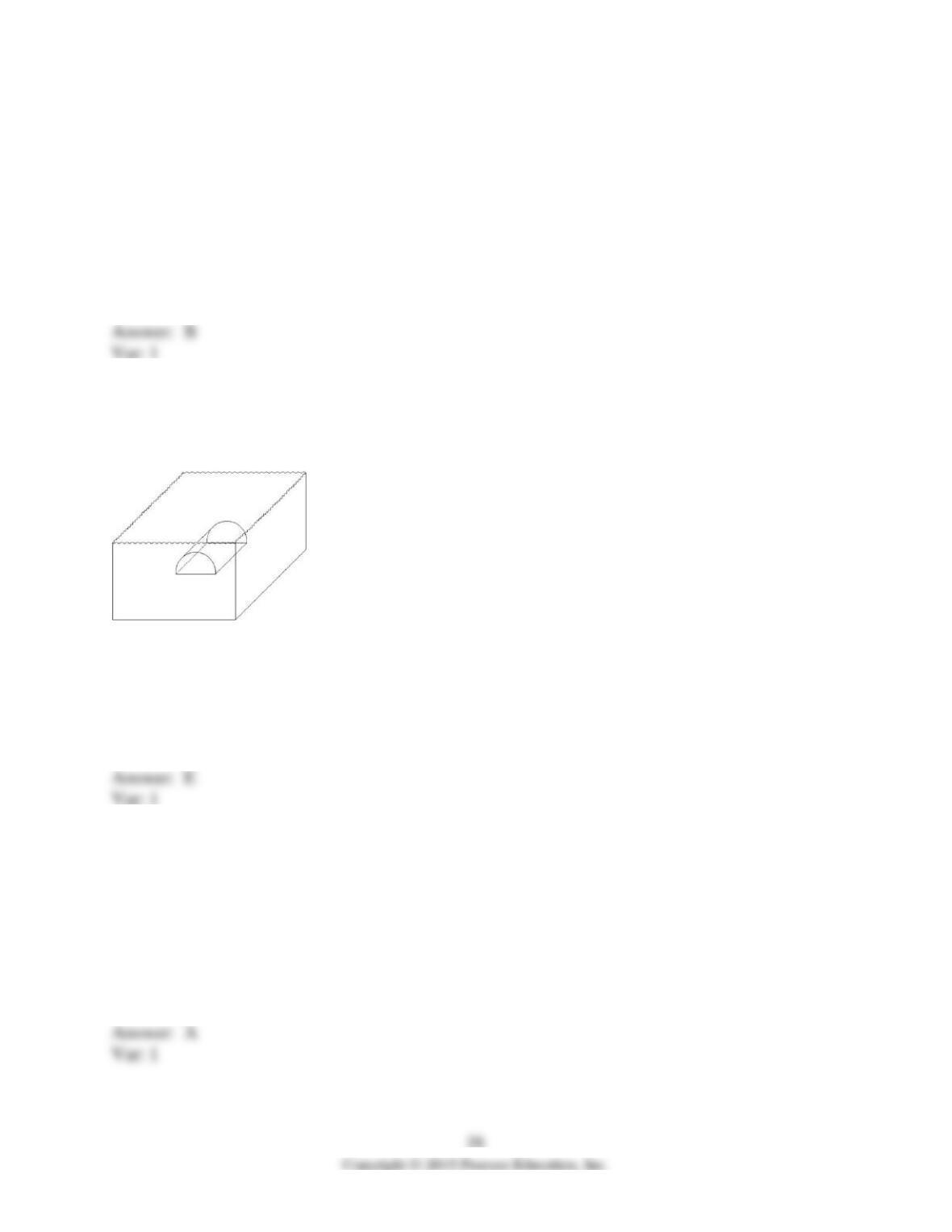
58) A cylinder, semicircular in cross-section, is 10 m long and 5.0 m in radius. It is completely
submerged, with its flat bottom side horizontal and 8.0 m below the water surface, as shown in
the figure. What is the magnitude of the net force on the curved upper surface of the half-
cylinder? Neglect atmospheric pressure.
A) 2.0 × 10⁶ N
B) 2.5 × 10⁶ N
C) 3.0 × 10⁶ N
D) 3.5 × 10⁶ N
E) 4.0 × 10⁶ N
59) A rectangular wooden block measures 10.0 cm × 4.00 cm × 2.00 cm. When the block is
placed in water, it floats horizontally, with its bottom face 1.65 cm below the surface. What is
the density of the wood? The density of water is 1.00 g/cm3.
A) 0.825 g/cm3
B) 1.21 g/cm3
C) 1.65 g/cm3
D) 0.606 g/cm3
E) 0.350 g/cm3
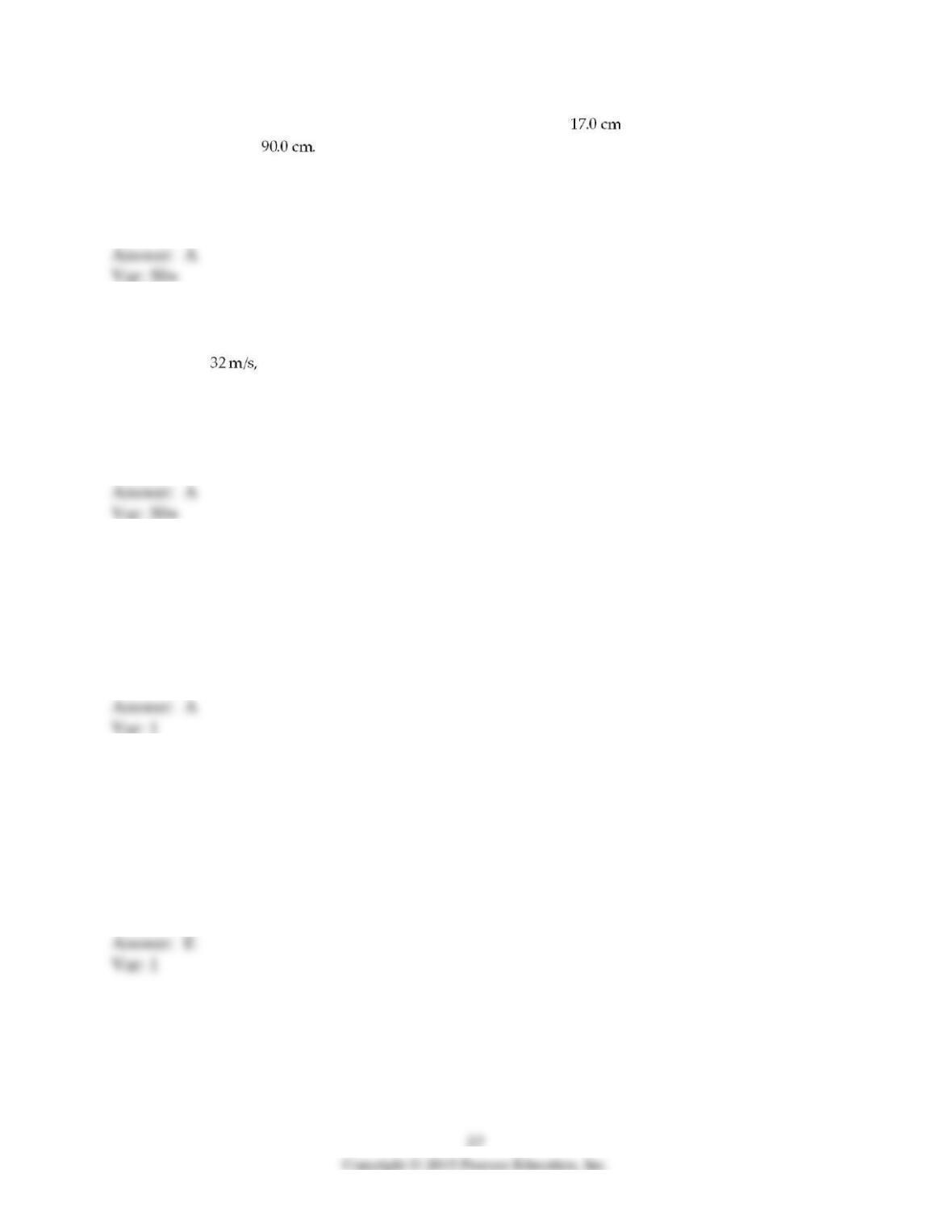
60) Consider a very small hole in the bottom of a tank that is in diameter and filled with
water to a height of Find the speed at which the water exits the tank through the hole.
A) 4.20 m/s
B) 17.64 m/s
C) 44.1 m/s
D) 48.3 m/s
61) Water flowing through a cylindrical pipe suddenly comes to a section of pipe where the
diameter decreases to 86% of its previous value. If the speed of the water in the larger section of
the pipe was what is its speed in this smaller section if the water behaves like an ideal
incompressible fluid?
A) 43 m/s
B) 37 m/s
C) 28 m/s
D) 24 m/s
62) A pump uses a piston of 15 cm diameter that moves at 2.0 cm/s as it pushes a fluid through a
pipe. What is the speed of the fluid when it enters a portion of the pipe that is 3.0 mm in
diameter? Treat the fluid as ideal and incompressible.
A) 50 m/s
B) 50 cm/s
C) 6.0 cm/s
D) 22 cm/s
63) An incompressible ideal fluid flows steadily through a pipe that has a change in diameter.
The fluid speed at a location where the pipe diameter is 8.0 cm is 1.28 m/s. What is the fluid
speed at a location where the diameter has narrowed to 4.0 cm?
A) 0.32 m/s
B) 0.64 m/s
C) 1.3 m/s
D) 2.6 m/s
E) 5.1 m/s
64) Fluid flows at 2.0 m/s through a pipe of diameter 3.0 cm. What is the volume flow rate of the
fluid?
A) 1.4 × 10⁻³ m3/s
B) 5.7 × 10⁻³ m3/s
C) 14 m3/s
D) 57 m3/s
65) Ideal incompressible fluid flows through a 4.0-cm-diameter pipe at 1.0 m/s. There is a 2.0
cm diameter constriction in the line. What is the speed of the fluid in this constriction?
A) 0.25 m/s
B) 0.50 m/s
C) 2.0 m/s
D) 4.0 m/s
66) Water, which we can treat as ideal and incompressible, flows at 12 m/s in a horizontal pipe
with a pressure of 3.0 × 10⁴ Pa. If the pipe widens to twice its original radius, what is the
pressure in the wider section?
A) 3.0 × 10⁴ Pa
B) 4.9 × 10⁴ Pa
C) 7.4 × 10⁴ Pa
D) 9.8 × 10⁴ Pa
67) A hole of radius 1.0 mm forms in the bottom of a very large water storage tank that holds
water to a depth of 15 m. At what volume rate will water flow out of the hole?
A) 5.4 × 10⁻⁴ m3/s
B) 5.4 × 10⁻⁵ m3/s
C) 5.4 × 10⁻⁶ m3/s
D) 5.4 × 10⁻⁷ m3/s
68) Ideal incompressible water flows through a horizontal pipe of cross-sectional area 10.0 cm2
at a pressure of 0.250 atm with a volume flow rate of 1.00 × 10⁻³ m3/s. At a valve, the effective
cross-sectional area of the pipe is reduced to 5.00 cm2. What is the pressure at the valve?
A) 0.112 atm
B) 0.157 atm
C) 0.200 atm
D) 0.235 atm
69) For a certain patient, the build-up of fatty tissue on the wall of an artery has decreased the
arterial radius by 10%. By how much would the pressure provided by the heart have to be
increased to maintain a constant volume of blood flow? Model the blood as an ideal
incompressible fluid.
A) 48%
B) 52%
C) 46%
D) 54%
70) An ideal incompressible fluid flows at 0.252 m/s through a 44-mm diameter cylindrical pipe.
The pipe widens to a square cross sectional area that is 5.5 cm on a side. Assume steady flow
throughout the system.
(a) What is the speed of the fluid through the square section of pipe?
(b) What is the flow rate in liters per minute?
71) Ideal incompressible water is flowing in a drainage channel of rectangular cross-section. At
one point, the width of the channel is 12 m, the depth of water is 6.0 m, and the speed of the flow
is 2.5 m/s. At a point downstream, the width has narrowed to 9.0 m, and the depth of water is 8.0
m. What is the speed of the flow at the second point?
A) 2.0 m/s
B) 2.5 m/s
C) 3.0 m/s
D) 3.5 m/s
E) 4.0 m/s
72) Water is flowing in a drainage channel of rectangular cross-section. The width of the channel
is 15 m, the depth of water is 8.0 m, and the speed of the flow is 2.5 m/s. What is the mass flow
rate of the water? The density of water is 1000 kg/m3.
A) 2.0 × 10⁵ kg/s
B) 2.0 × 10³ kg/s
C) 3.0 × 10⁵ kg/s
D) 3.0 × 10³ kg/s
E) 3.0 × 10² kg/s
73) In a section of horizontal pipe with a diameter of 3.0 cm, the pressure is 100 kPa and water is
flowing with a speed of 1.5 m/s. The pipe narrows to 2.0 cm. What is the pressure in the
narrower region? Treat the water as an ideal incompressible fluid.
A) 95 kPa
B) 48 kPa
C) 44 kPa
D) 230 kPa
E) 67 kPa
74) Water flows through a horizontal pipe of cross-sectional area 10.0 cm2 at a pressure of 0.250
atm with a flow rate is 1.00 L/s. At a valve, the effective cross-sectional area of the pipe is
reduced to 5.00 cm2. What is the pressure at the valve? The density of water is 1000 kg/m3, and
treat it as an ideal incompressible fluid.
A) 0.110 atm
B) 0.235 atm
C) 0.200 atm
D) 0.157 atm
E) 7700 Pa
75) An ideal incompressible fluid flows at 12 m/s in a horizontal pipe. If the pipe widens to twice
its original radius, what is the flow speed in the wider section?
A) 12 m/s
B) 6.0 m/s
C) 4.0 m/s
D) 3.0 m/s
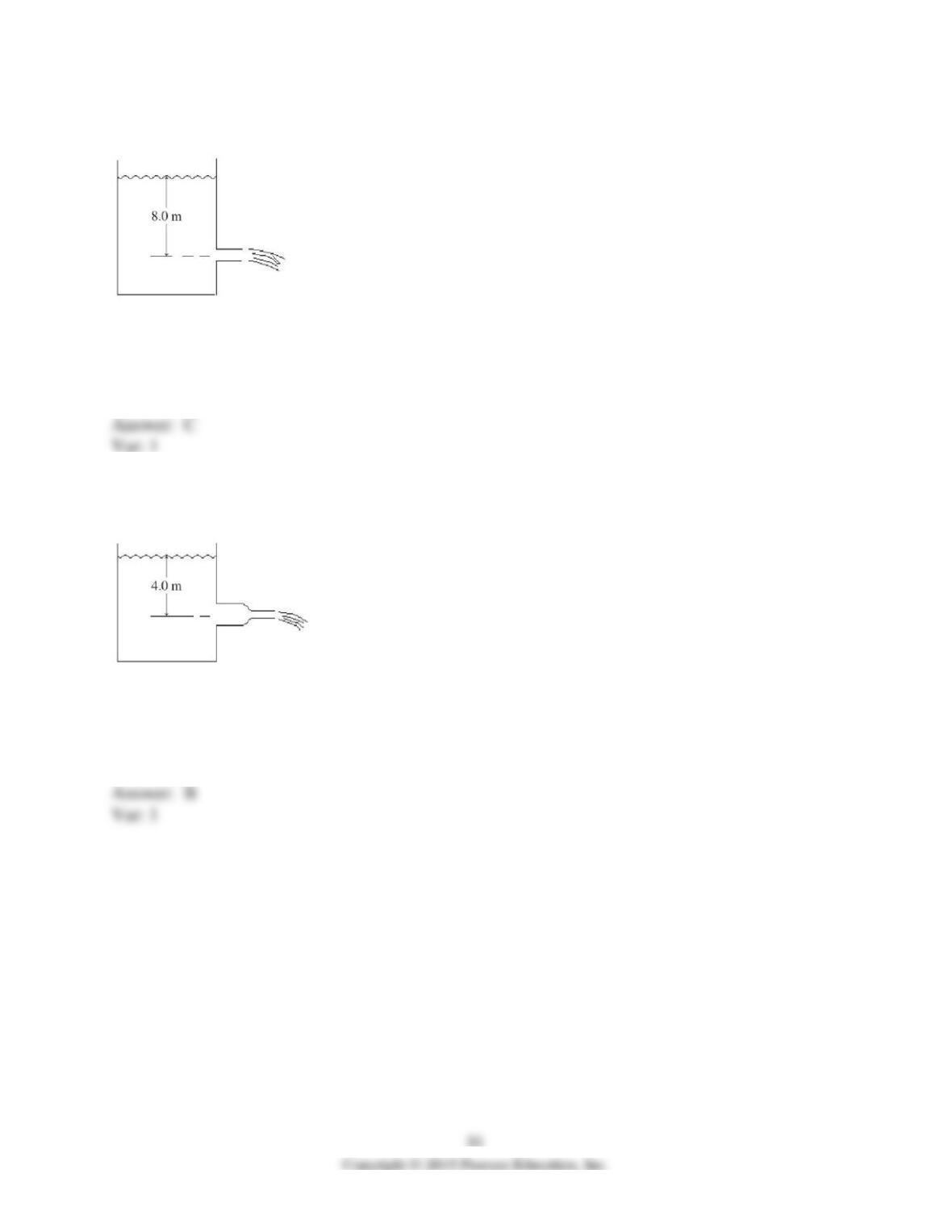
76) Water flows out of a large reservoir through an open pipe, as shown in the figure. What is the
speed of the water as it comes out of the pipe?
A) 8.9 m/s
B) 9.9 m/s
C) 13 m/s
D) 14 m/s
E) 16 m/s
77) Water flows out of a large reservoir through 5.0-cm diameter pipe. The pipe connects to a
3.0-cm diameter pipe that is open to the atmosphere, as shown in the figure. What is the speed of
the water in the 5.0-cm pipe? Treat the water as an ideal incompressible fluid.
A) 2.3 m/s
B) 3.2 m/s
C) 3.9 m/s
D) 8.9 m/s
E) 10 m/s
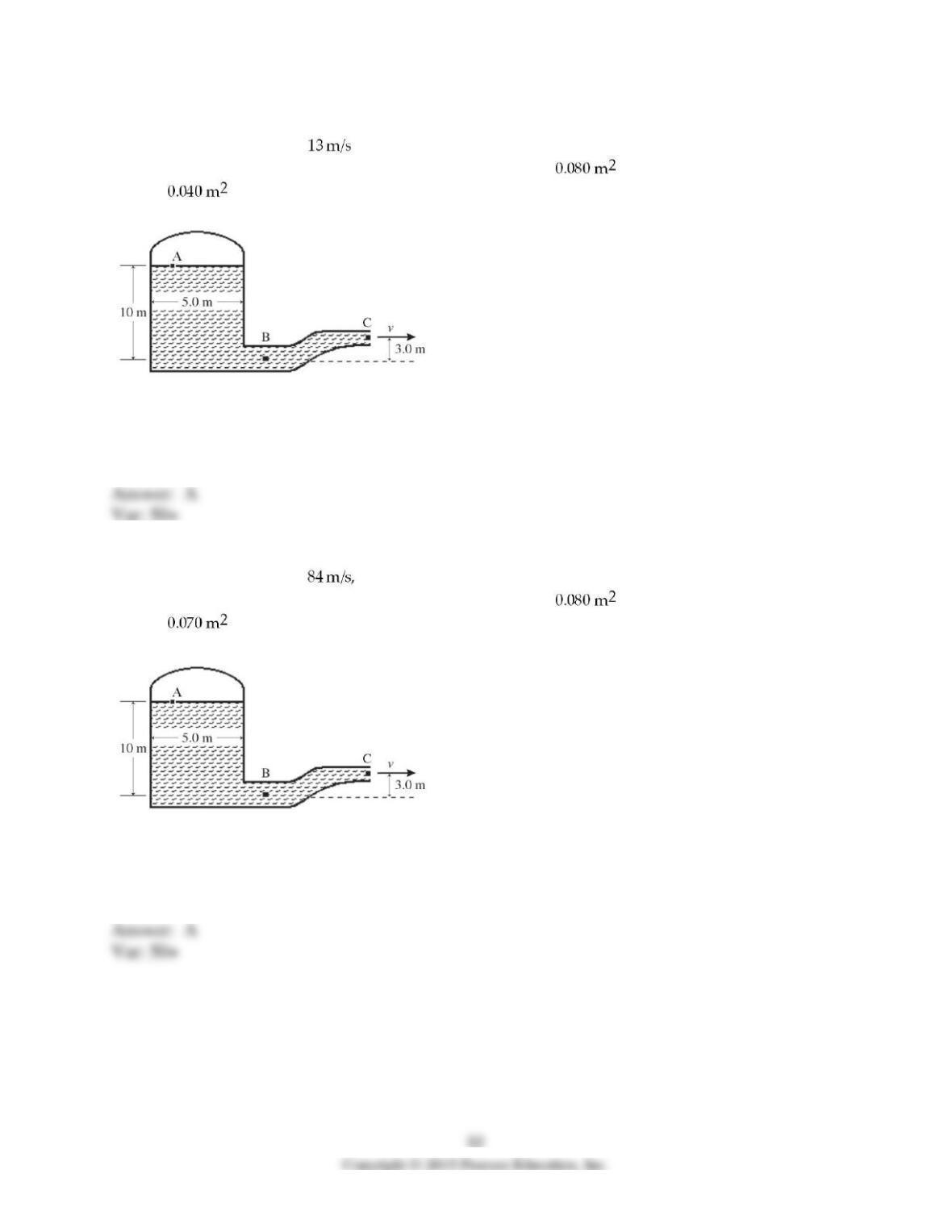
78) A pressurized cylindrical tank, 5.0 m in diameter, contains water that emerges from the pipe
at point C with a speed of as shown in the figure. Point A is 10 m above point B and point
C is 3.0 m above point B. The area of the pipe at point B is and the pipe narrows to an
area of at point C. Assume that the water is an ideal fluid in laminar flow. The density of
water is 1000 kg/m3 The mass flow rate in the pipe is closest to
A) 520 Kg/s.
B) 470 Kg/s.
C) 420 Kg/s.
D) 360 Kg/s.
E) 310 Kg/s.
79) A pressurized cylindrical tank, 5.0 m in diameter, contains water that emerges from the pipe
at point C with a speed of as shown in the figure. Point A is 10 m above point B and point
C is 3.0 m above point B. The area of the pipe at point B is and the pipe narrows to an
area of at point C. Assume that the water is an ideal fluid in laminar flow. The density of
water is 1000 kg/m3. The rate at which the water level is falling in the tank is closest to
A) 300 mm/s.
B) 340 mm/s.
C) 250 mm/s.
D) 210 mm/s.
E) 160 mm/s.
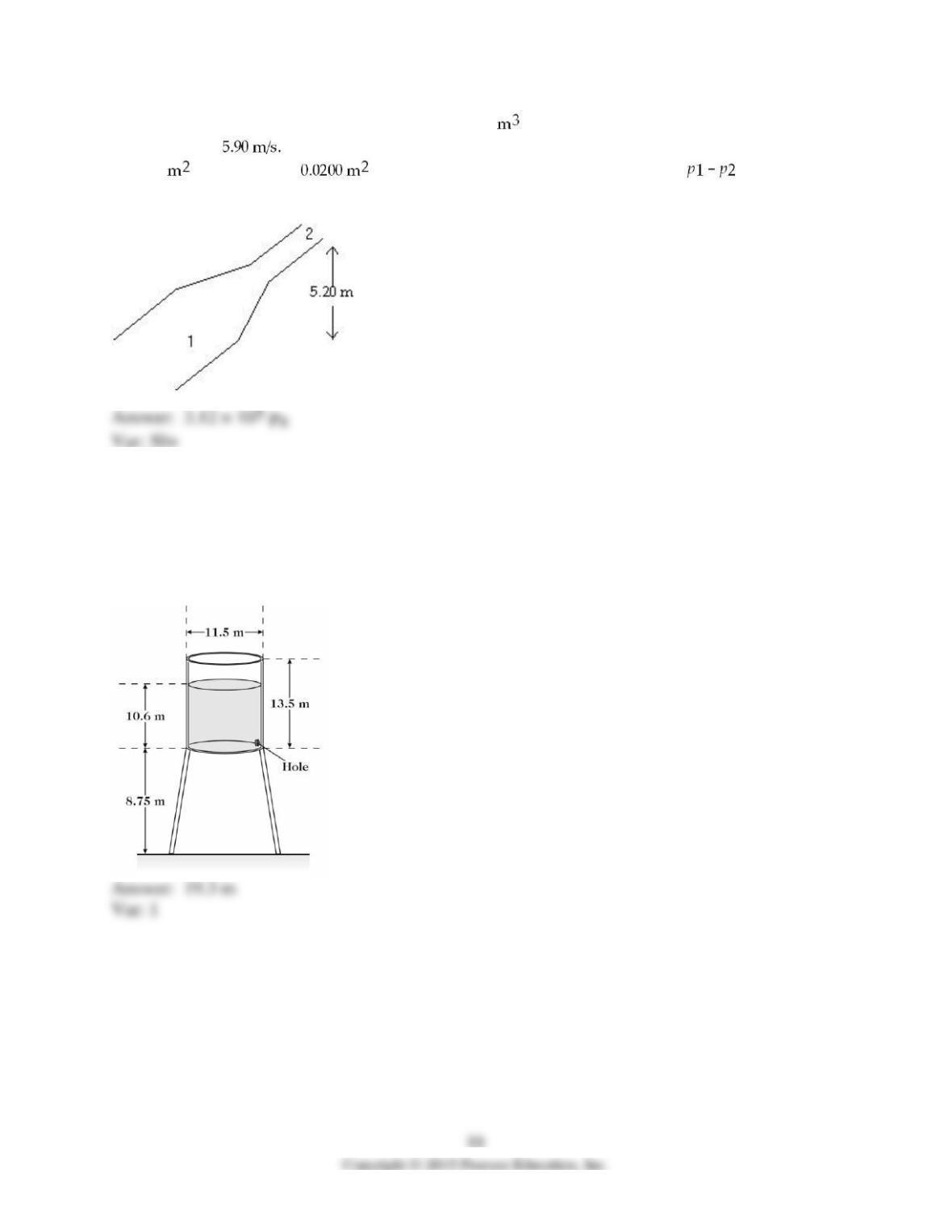
80) As shown in the figure, water (density 1000 kg/ ) is flowing in a pipeline. At point 1 the
water speed is Point 2 is 5.20 m above point 1. The cross-sectional area of the pipe is
0.0800 at point 1 and at point 2. What is the pressure difference between
points 1 and 2? Treat the water as an ideal incompressible fluid.
81) A large cylindrical water tank 11.5 m in diameter and 13.5 m tall is supported with its base
8.75 m above the ground by a stand as shown in the figure. The water level in the tank is 10.6 m
deep, and the density of the water in the tank is 1.00 g/cm3. A very small hole is formed at the
base of the vertical wall of the tank, and water is squirting out of this hole horizontally. When
this water hits the ground, how far has it traveled horizontally from the hole, assuming no air
resistance?
82) Glycerin, with a viscosity of 1.5 N ∙ s/m2, is flowing with an average speed of 1.2 m/s
through a tube that has a radius of 5.0 mm and is 25 cm long. What is the drop in pressure over
the length of this pipe?
A) 140 kPa
B) 46 kPa
C) 72 kPa
D) 76 kPa
E) 130 kPa
83) Motor oil, with a viscosity of 0.25 N ∙ s/m2, is flowing through a tube that has a radius of 3.0
mm and is 1.0 m long. The drop in pressure over the length of the tube is 200 kPa. What is the
average speed of the oil?
A) 0.80 m/s
B) 0.90 m/s
C) 1.0 m/s
D) 1.1 m/s
E) 1.2 m/s
84) Motor oil, with a viscosity of 0.25 N ∙ s/m2, is flowing through a tube that has a radius of 5.0
mm and is 25 cm long. The drop in pressure is 300 kPa. What is the volume of oil flowing
through the tube per second?
A) 0.00038 m3/s
B) 0.025 m3/s
C) 0.0012 m3/s
D) 4.7 m3/s
E) 7.5 m3/s
85) A fluid is flowing with an average speed of 1.5 m/s through a tube that has a radius of 2.0
mm and is 18 cm long. The drop in pressure is 967 Pa. What is the viscosity of the fluid?
A) 0.0018 N ∙ s/m2
B) 0.0056 N ∙ s/m2
C) 0.028 N ∙ s/m2
D) 0.013 N ∙ s/m2
E) 0.0034 N ∙ s/m2