
ch13 Key
1. An analysis of outsourcing requires an analysis of quality as well as costs.
2. To properly use price-led costing, a company needs to study only its cost.
3. Most not-for-profit organizations have a zero overall target profit.
4. Charging varying prices for the same product is always illegal because it is discriminatory.

5. To achieve target costing, organizations are often required to redesign their systems.
6. The target price is found by multiplying the target cost times one plus the target profit percentage.
7. It is important in decision making to focus only on future decisions; decisions made in the past should not be
considered.
8. In decision making, feedback is important because it enhances learning.

9. Because facility costs are fixed and do not change with volume changes, these cost are never relevant in
considering alternatives.
10. Target pricing can be found at the intersection of the demand and supply curve.
11. Tangible Objectives are abstract goals of the organization.
12. Not-for-profit organizations do not need goals and objectives.

13. The target profit equals the desired return on sales times the contribution margin.
14. Cost management is a powerful activity including a proactive attitude.
15. Variable costs are always relevant in decision making and are the only costs that should be considered.
16. Avoidable costs are often a good approximation of the relevant costs between alternatives.
17. In accepting a special order, it is important to consider unused capacity.

18. Sunk costs are relevant to decision-making.
19. Relevant costs and revenues are those costs and revenues that occur in the future and are the same among
alternatives.
20. Some costs will continue to be incurred if the company outsources a particular function.
21. Costs that could be avoided if a business unit is dropped are not relevant to the decision.
22. Price discrimination involves temporarily setting a price below cost to broaden demand for a product and
injure competition.
23. A business has complete freedom when setting prices for products and services.
24. In making special order pricing decisions, generally only unit costs and batch-costs need to be considered
assuming excess capacity exists.
25. When using a decision tree, the outcomes of each decision are shown with their costs and benefits.
26. Because it lacks complete objectivity, subjective information is not useful in good decision making.
27. Which of the following costs are relevant in the decision to drop a business unit?
28. When deciding on special order pricing, it is important to consider
29. To be useful for decision making, information must be
30. The first step in the decision making process is to
31. In differential analysis, changes in the cost of direct materials among alternatives is an example of
32. You purchase baseball tickets last month when the team was doing poorly. You paid $100 a non–refundable
ticket. Your best friend offered you $130 for the ticket now that the team is doing well. The opportunity cost of
going to the game is
33. TwoWheels (TW) manufactures hi-tech bicycles that sell for $600 each. They sell 1,000 bicycles per year.
Fixed higher-level costs amount to $100,000. Break-even for TW is 300 bicycles. TW‘s margin safety is
34. Bommarito Company plans to introduce an automatic vacuum cleaner that senses dirt, turns its motor on,
vacuums the dirt and shuts the motor off. Because they will have no competition, they believe they can set
prices very high. In setting the price they should consider
35. Relevant costs exclude
36. When making decisions based upon relevant costs, it is important to ignore
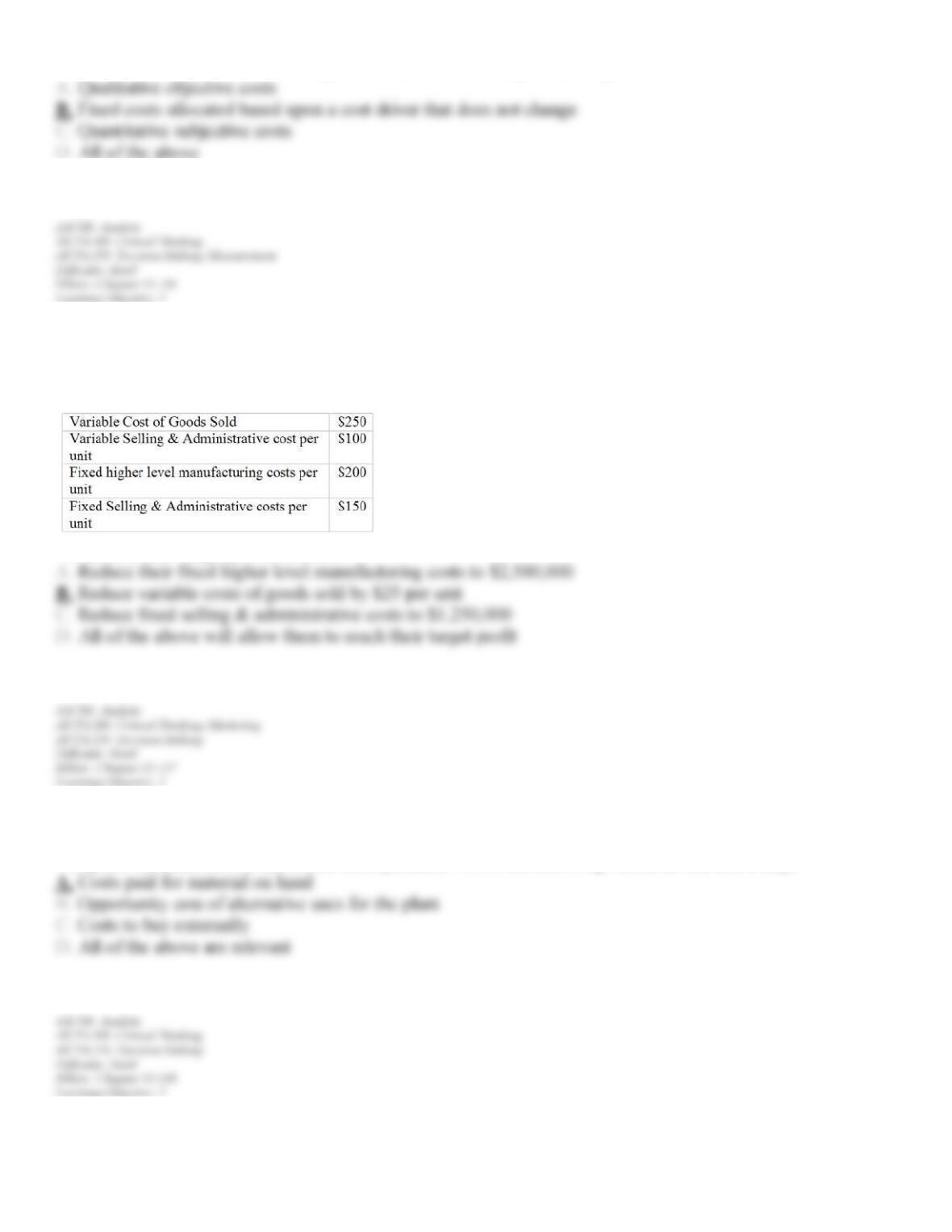
37. Box Industries (BI) produces computers. They believe the market will not longer support their current price.
A new price of $900 per computer is suggested by the marketing department. BI requires a 25% return on sales.
BI can produce and expects to sell 11,000 units. Their current costs are as follows:
To achieve their target profit, BI must
38. Karl Kady, the controller of a nation wide manufacturing company is considering closing a plant in Texas.
The plant manufactures containers for their products. All of the following would be relevant except
39. Rosenblatt Enterprises used decision tree analysis and cost-benefit analysis in their decision to keep open
their current plant. The quantitative costs of keeping the plant open were $5,000,000, while the quantitative
benefits of keeping the plant open were only $3,000,000. Rosenblatt decides to keep the plant open. The
decision to keep the plant open is appropriate if:
40. Consider the following case:
Management is considering purchasing a Model B300 machine to use in addition to the company’s present
Model B100 machine. This will increase the company’s production and sales. The increase in volume will be
large enough to require increases in fixed selling expenses and in general administrative overhead, but not in the
fixed manufacturing overhead.
Which of the following items would be considered relevant to the case?
41. Edison Company has 5,000 obsolete desk lamps that are carried in inventory at a manufacturing cost of
$45000. If the lamps are reworked for $20,000, they could be sold for $37,000. Alternatively, the lamps could
be sold for $9,000 for scrap. In a decision model analyzing these alternatives, the sunk cost would be:
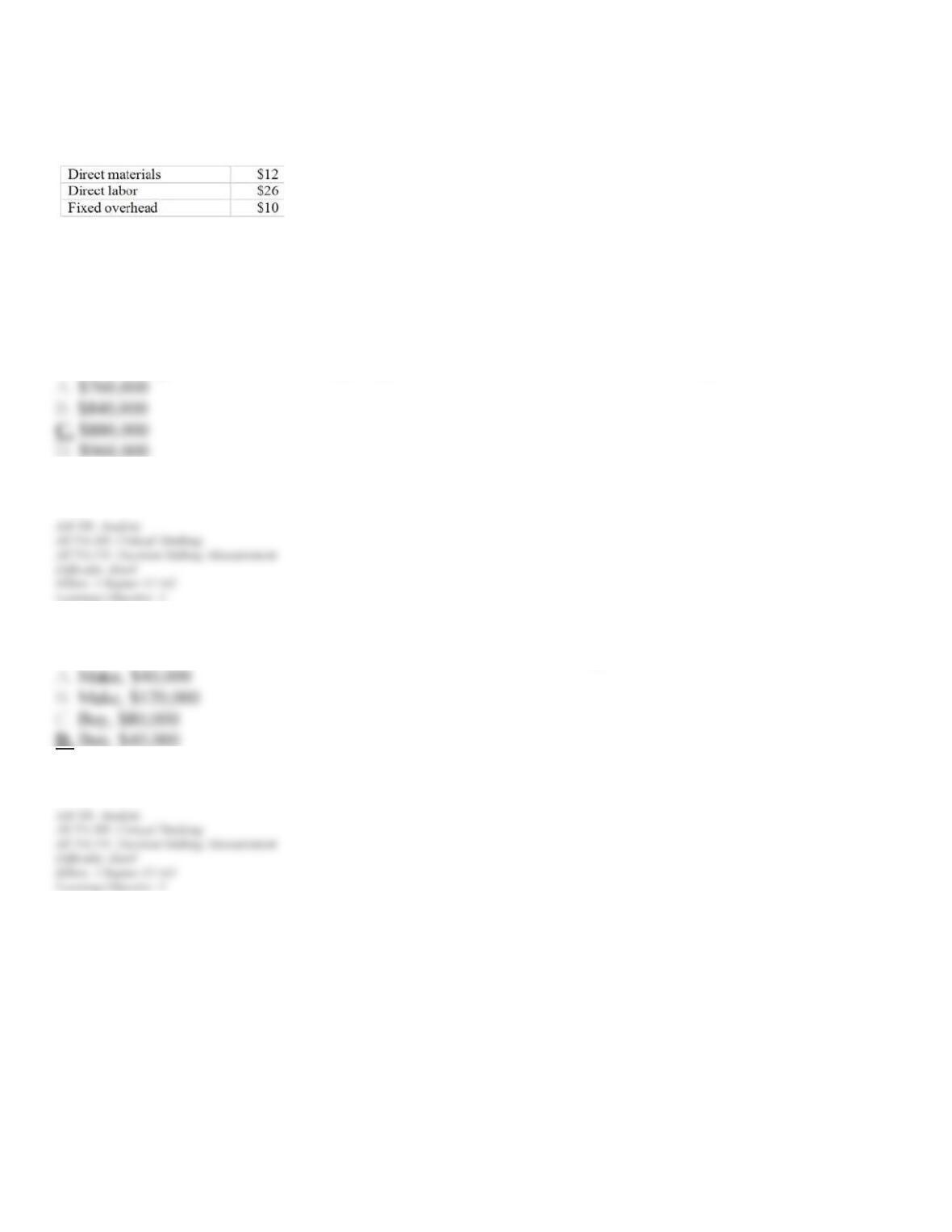
Use the following to answer questions 42-43:
Rams Company needs 20,000 units of a certain part to use in its production cycle. If Rams buys the part from
Steelers Company instead of making it, Rams cannot use the excess capacity for another manufacturing activity.
Forty percent of the fixed overhead will continue regardless of what decision is made.
Cost to Rams to make the part: (per unit)
Cost to buy the part from Steelers Company – $42 per unit
Hilton – Chapter 13
42. In deciding whether to make or buy the part, Rams’ total relevant costs to make the part are:
43. What decision should Rams make, and what is the total cost advantage that would result?
44. Albert Company plans to discontinue a division that generates a total contribution margin of $20,000 per
year. Fixed overhead associated with this division is $50,000, of which $5,000 cannot be eliminated.
If the division is discontinued, how would Albert’s operating income is affected?
Use the following to answer questions 45-46:
Hoffman Corp. currently sells 40,000 dental tools to its normal customers, but it has a capacity to produce
50,000 tools. Its product sells for $30 per tool and the variable costs incurred in manufacturing and selling the
product are as follows on a per tool basis:
Direct materials – $8; Direct labor – $4; Sales commission – $2.
A customer has proposed a special order to purchase 10,000 tools at a special price of $20 per unit. If Hoffman
accepts the order, the company would not have to pay its sales people their normal commission of $2 per unit,
but the company would incur a shipping cost of $3 per unit.
Hilton – Chapter 13
45. If Hoffman accepts the special order, how would operating income is affected?
46. What is the minimum price per unit below which Hoffman should reject the order?
47. The cost for Toyota to design a new vehicle is an example of a:
48. When analyzing relevant information which items should not be included in the decision?