Chapter 13
The Complete Income Statement
MULTIPLE CHOICE QUESTIONS
1. Which one of the following events is an operating transaction?
a. Purchase of equipment
b. Payment for equipment rental
c. Purchase of land
d. Issuing bonds for cash
2. Which one of the following events is an operating transaction?
a. Payment of utilities
b. Debt refinancing
c. Purchase of another company for stock
d. Property dividend
3. The result of changing from FIFO to average cost is
a. included in operating revenues and expenses.
b. included in other revenues or expenses.
c. handled retrospectively.
d. ignored.
4. Financing transactions include
a. exchanges with shareholders.
b. revenues.
c. expenses.
d. most transactions that impact the income statement.
13-2 Test Bank – Chapter 13 – The Complete Income Statement
5. On the income statement, the loss of equipment caused by the eruption of a volcano in
the northeastern United States is found in
a. operating revenues and expenses.
b. cost of goods sold.
c. disposal of a business segment.
d. other revenues or expenses.
6. Which one of the following events is not an operating transaction?
a. Disposal of a business segment
b. Purchase of equipment
c. Payment for equipment maintenance
d. Purchase of inventory
7. All of the following are considered to be operating revenues or expenses that are
persistent except
a. the sale of furniture by a furniture company.
b. interest expense related to financing with bonds.
c. depreciation expense on machinery.
d. cost of delivering goods.
8. Which one of the following is a nonoperating event that must be reported on the income
statement?
a. Acquisition of a plant asset to be used in operations
b. Interest revenue
c. Recognition of inventory expense
d. Consumption of office supplies
9. Non-operating expenses are found in the
a. asset section of the balance sheet.
b. liability section of the balance sheet.
c. cash flows from financing section of the cash flow statement.
d. income statement.
Test Bank – Chapter 13 – The Complete Income Statement 13-3
10. A summary of operating events is found
a. only in the asset section of the balance sheet.
b. only in the cash flows from operations section of the cash flow statement.
c. only in the income statement.
d. in the cash flows from operations section of the cash flow statement, and in the
income statement.
11. Operating events include
a. the payment of dividends and accounting principle changes.
b. inflows and outflows of assets due to the generation of revenues.
c. purchases, sales, and exchanges of long-term assets.
d. expenses and costs of acquiring plant assets .
12. On the income statement, interest revenue is found in
a. operating revenues and expenses.
b. other revenues or expenses.
c. the disposal of a business segment section.
d. the cost of goods sold section.
13. On the income statement, marketing expenses are reported as
a. operating revenues and expenses.
b. other revenues or expenses.
c. the disposal of a business segment.
d. part of cost of goods sold.
14. On the income statement, a gain from the sale of stock is reported as
a. operating revenues and expenses.
b. other revenues or expenses.
c. a disposal of a business segment.
d. a cumulative effect of a change in accounting principle.
13-4 Test Bank – Chapter 13 – The Complete Income Statement
15. On the income statement, the loss from selling an independent business component of
the company is reported as a(n)
a. operating revenue or expense.
b. other revenue or expense.
c. disposal of a business segment.
d. sales revenue
16. Which of the following statements is false regarding diluted earnings per share?
a. Reporting diluted earnings per share is required by GAAP when potentially
significant dilution of EPS exists.
b. Diluted earnings per share can be used to reflect the extent of potential share
dilution.
c. Diluted earnings per share is not reported by some companies.
d. Diluted earnings per share is always the same as basic earnings per share.
17. Recognition of bad debt expense is an event considered to be
a. transitory.
b. nonoperating
c. persistent
d. a financing cash flow.
18. On the income statement, the result of selling equipment is reported as a(n)
a. operating revenue or expense.
b. other revenue or expense.
c. disposal of a business segment.
d. cumulative effect of a change in accounting principle.
19. On the income statement, interest expense is reported as a(n)
a. operating revenue or expense.
b. other revenue or expense.
c. disposal of a business segment.
d. cumulative effect of a change in accounting principle.
Test Bank – Chapter 13 – The Complete Income Statement 13-5
20. On the income statement, persistent events are found in
a. operating revenues and expenses.
b. other revenues or expenses.
c. disposal of a business segment.
d. cumulative effects.
21. On the income statement, infrequent expenses are found in
a. operating revenues and expenses.
b. other revenues or expenses.
c. disposal of a business segment.
d. cumulative effects.
22. Which one of the following is true about earnings per share?
a. Must be calculated as earnings per ‘preferred’ share
b. Must be calculated as earnings per ‘common’ share
c. May be increased or decreased because of outstanding stock options or convertible
debt
d. Appears with the gross profit percentage on the income statement
23. Below are five categories of transaction. Generally accepted accounting principles
consider which of these as financing transactions?
1. Purchases, sales, and exchanges of assets
2. Exchanges with shareholders
3. Revenues and expenses
4. Exchanges of liabilities and shareholders’ equity
5. Issuance and payment of debt
a. 1 only.
b. 3, 4, and 5.
c. 1, 2, and 3.
d. 2, 4, and 5.
13-6 Test Bank – Chapter 13 – The Complete Income Statement
24. Which one of the following should be NOT reported net of income taxes?
a. Loss on disposal of segment
b. Cumulative adjustments resulting from a change in principle
c. Bad debt expense associated with a bankrupt customer
d. Gains on disposal of segment
25. Mountain Corp. experienced the following events and transactions during 2017:
1 = Dividends declared and paid to Mountain’s shareholders
2 = Cost of goods sold
3 = Gain on disposal of a major segment of the business
4 = Depreciation expense
5 = Gain from early debt retirement
Using the numbers of the events and transactions, identify which of the following
sequences is the correct order for presenting the items on the income statement.
a. 5, 1, 3, 2
b. 2, 4, 5, 3
c. 4, 5, 2, 3
d. 2, 4, 3, 5, 1
26. If a loss is unusual in nature but not infrequent in occurrence, the loss should be
disclosed
a. net of taxes.
b. only in the footnotes.
c. as a separate component of income from continuing operations.
d. as a separate item after disposal of segment, net of taxes.
27. Carman, Inc. properly reported a change in accounting principle during 2017. This
company must
a. have violated GAAP by not applying accounting principles consistently.
b. have convinced its auditors that the environment in which it operates has changed
and another method is more appropriate.
c. be trying to cover up accounting errors.
d. have initially used the wrong method.
Test Bank – Chapter 13 – The Complete Income Statement 13-7
28. Publicly held companies must disclose earnings per share for all of the following except for
a. income from continuing operations.
b. losses from discontinued segments of a business.
c. other revenue and expense items.
d. cumulative effects resulting from changes in accounting principles.
29. Comprehensive income
a. may be reported on a separate statement or on the face of the income statement.
b. is the same as net income.
c. does not include any revenue and expense items that are part of continuing
operations.
d. can be presented instead of the shareholders’ equity section of the balance sheet.
30. Paulson, Inc. reported net income of $60,000 during 2017. Throughout 2017, 20,000
shares of common stock and 5,000 shares of preferred stock were outstanding. The
preferred stock has no dividend preference. Paulson reported earnings only for
continuing operations items. How much is earnings per share for 2017?
a. $ 3.00
b. $12.00
c. $ 2.00
d. Not enough information is provided.
Solution: $60,000 / 20,000 = $3.00
31. Intraperiod tax allocation
a. is applied to each income statement item to provide creditors and investors a better
indication of the company’s true revenues and expenses.
b. is a method of allocating income taxes over multiple accounting periods.
c. is applied only to revenues since expenses are not taxed.
d. is applied to net income from continuing operations.
13-8 Test Bank – Chapter 13 – The Complete Income Statement
32. Which one of the following items is considered part of comprehensive income but not
reported as part of net income?
a. Accounting principle changes
b. Foreign currency translation adjustments
c. Gain on sale of land
d. Dividend revenue
33. Why is income so important to both investors and stock analysts?
a. It is strongly correlated to the market price of stock and bond prices.
b. It is equal to the amount that shareholders will receive as dividends.
c. Income is tied directly to revenue, i.e., a company that reports a large amount of
revenue will always report a large amount of income.
d. It identifies if the company will be able to pay its current debts when they become
due.
34. Which one of the following is true concerning discontinued operations?
a. It relates primarily to product changes in a company.
b. The gain or loss associated with the disposal is shown separately as a component of
continuing operations on the income statement.
c. It is reported with ‘other revenues and losses’ on the company’s income statement.
d. One of two separate disclosures required is income or loss from the segment’s
operations from the beginning of the current accounting period to the date of
disposal.
35. An income statement prepared with separate components
a. enables users to distinguish transactions that are due to operations from those that
are not useful as predictors of future performance.
b. is prepared only for income items that are frequent and usual.
c. is used primarily by companies involved with complex financing transactions.
d. may replace a statement of cash flows.
.
Test Bank – Chapter 13 – The Complete Income Statement 13-9
36. Diluted earnings per share
a. is required for companies that have the potential for liquidation.
b. is a financing and investing activity.
c. shows the effects of possible increases in the number of outstanding common
shares.
d. is reported for the ‘other revenues and expenses’ category on the income statement.
37. A company should report a cumulative effect of an accounting principle change when
a. consistency has been violated.
b. errors are made and subsequently corrected.
c. FASB mandates a change from one method to another.
d. international reporting standards differ from GAAP methods.
38. One objective of financial reporting is to provide information that is
a. helpful in assessing the amounts, timing, and uncertainty of future cash flows.
b. useful for competitors who need to assess economic activities.
c. a forecast of future operations.
d. unavailable to management.
39. Changes in accounting methods must be disclosed in three prominent places. These are
a. the auditor’s report, financial statement notes, and the balance sheet.
b. financial statement notes, the income statement, and the auditor’s report.
c. the balance sheet, the income statement, and the statement of cash flows.
d. notes to financial statements, the management letter, and the income statement.
13–10 Test Bank – Chapter 13 – The Complete Income Statement
40. Damron Inc. has the following transactions reported in the financial statements:
1. Recognized a loss when the government expropriated land to build a bridge.
2. Declared a dividend valued at $100,000.
3. A lender covenant required the company to appropriate a portion of retained
earnings.
4. Received dividends on stocks held as short-term investments. The dividends were
declared and paid on the same day.
5. Recognized the cost of inventory sold during the year under the periodic method.
6. The company paid rent for the current year.
Which of the above transactions would be considered as “usual and frequent” for income
statement purposes?
a. Transactions 2, 4, 5, & 6
b. Transactions 2 through 6
c. Transactions 4, 5, & 6
d. Transactions 5 & 6
41. Damron Inc. has the following transactions reported in the financial statements:
1. Recognized a loss when the government expropriated land to build a bridge.
2. Declared a dividend valued at $100,000.
3. A lender covenant required the company to appropriate a portion of retained
earnings.
4. Received dividends on stocks held as short-term investments. The dividends were
declared and paid on the same day.
5. Recognized the cost of inventory sold during the year under the periodic method.
6. The company paid rent for the current year.
Which of the above transactions would be considered as “unusual or infrequent” for
income statement purposes?
a. Transaction 1
b. Transaction 4
c. Transactions 3 and 4
d. None of these transactions

Test Bank – Chapter 13 – The Complete Income Statement 13-11
42. Sunrise Designs maintains a credit line with Ohio River Bank that allows the company to
borrow up to $1 million. A covenant associated with the loan contract limits the
company’s dividends in any one year. The 2017 income statement data for the
company is as follows:
Net sales
$840,000
Less: Cost of goods sold
500,000
Gross profit
$340,000
Selling and administrative expenses
120,000
Net operating income
$220,000
Gain on sale of securities
24,000
Interest expense
(4,000)
Net income from continuing operations before tax
$240,000
Less: Income tax
51,200
Net income from continuing operations
$188,800
Disposal of segment (net of tax)
22,000
Net income before change in accounting principle
$210,800
Income effect due to change in accounting principle
52,000
Net income
$262,800
What is the maximum amount of dividends Sunrise can pay if the covenant associated
with the credit line is expressed as 20 percent of net income?
a. $55,000
b. $60,000
c. $52,560
d. $53,700
Solution:
13–12 Test Bank – Chapter 13 – The Complete Income Statement
43. Sunrise Designs maintains a credit line with Ohio River Bank that allows the company to
borrow up to $1 million. A covenant associated with the loan contract limits the
company’s dividends in any one year. The 2017 income statement data for the
company is as follows:
Net sales
$840,000
Less: Cost of goods sold
500,000
Gross profit
$340,000
Selling and administrative expenses
120,000
Net operating income
$220,000
Gain on sale of securities
24,000
Interest expense
(4,000)
Net income from continuing operations before tax
$240,000
Less: Income tax
51,200
Net income from continuing operations
$188,800
Disposal of segment (net of tax)
22,000
Net income before change in accounting principle
$210,800
Income effect due to change in accounting principle
52,000
Net income
$262,800
What is the maximum amount of dividends Sunrise can pay if the covenant is expressed
as 20 percent of income before change in accounting principle?
a. $55,000
b. $60,000
c. $65,700
d. $42,160

Test Bank – Chapter 13 – The Complete Income Statement 13-13
44. Sunrise Designs maintains a credit line with Ohio River Bank that allows the company to
borrow up to $1 million. A covenant associated with the loan contract limits the
company’s dividends in any one year. The 2017 income statement data for the
company is as follows:
Net sales
$840,000
Less: Cost of goods sold
500,000
Gross profit
$340,000
Selling and administrative expenses
120,000
Net operating income
$220,000
Gain on sale of securities
24,000
Interest expense
(4,000)
Net income from continuing operations before tax
$240,000
Less: Income tax
51,200
Net income from continuing operations
$188,800
Disposal of segment (net of tax)
22,000
Net income before change in accounting principle
$210,800
Income effect due to change in accounting principle
52,000
Net income
$262,800
What is the maximum amount of dividends Sunrise can pay if the covenant is expressed
as 20 percent of income before disposal of segment and change in accounting principle?
a. $37,760
b. $60,000
c. $65,700
d. $52,700
13–14 Test Bank – Chapter 13 – The Complete Income Statement
45. Sunrise Designs maintains a credit line with Ohio River Bank that allows the company to
borrow up to $1 million. A covenant associated with the loan contract limits the
company’s dividends in any one year. The 2017 income statement data for the
company is as follows:
Net sales
$840,000
Less: Cost of goods sold
500,000
Gross profit
$340,000
Selling and administrative expenses
120,000
Net operating income
$220,000
Gain on sale of securities
24,000
Interest expense
(4,000)
Net income from continuing operations before tax
$240,000
Less: Income tax
51,200
Net income from continuing operations
$188,800
Disposal of segment (net of tax)
22,000
Net income before change in accounting principle
$210,800
Income effect due to change in accounting principle
52,000
Net income
$262,800
What is the maximum amount of dividends Sunrise can pay if the covenant is expressed
as 20 percent of net operating income?
a. $44,000
b. $60,000
c. $47,200
d. $52,700
Test Bank – Chapter 13 – The Complete Income Statement 13-15
46. Gleeson Industries consists of four separate divisions: compressed wood products,
chemicals, stone products, and plastics. On March 15, 2017, Gleeson sold the
chemicals division for $625,000 cash. Financial information related to the chemicals
division follows:
Period from 1/1/17 to 3/15/17
Sales
$175,000
Operating expenses
160,000
Net operating income (loss)
$15,000
As of 3/15/17
Assets
$1,850,000
Liabilities
1,400,000
The journal entry to record the sale of the chemicals division will include:
a. a debit to Loss on Disposal of Segment for $175,000.
b. a debit to Net Assets of Chemicals Division for $450,000.
c . a debit to Unusual Gain for $175,000.
d. a credit to Gain on Disposal of Segment for $175,000.
13–16 Test Bank – Chapter 13 – The Complete Income Statement
47. Gleeson Industries consists of four separate divisions: compressed wood products,
chemicals, stone products, and plastics. On March 15, 2017, Gleeson sold the
chemicals division for $625,000 cash. Financial information related to the chemicals
division follows:
Period from 1/1/17 to 3/15/17
Sales
$175,000
Operating expenses
160,000
Net operating income (loss)
$15,000
As of 3/15/17
Assets
$1,850,000
Liabilities
1,400,000
If the income tax rate for the company is 35%, what amount of income tax liability on the
disposal of the business segment will be recognized?
a. $218,750
b. $ 61,250
c. $ 5,250
d. $157,500
Solution:
Test Bank – Chapter 13 – The Complete Income Statement 13-17
48. The management of Hammer Enterprises shares in a bonus that is determined and paid
at the end of each year. The amount of the bonus is based on 12% of income from
continuing operations after tax. The bonus is not used in the calculation of income from
continuing operations. During 2017, Hammer was sued and was ordered to pay
$480,000 over and above the amount covered by insurance. The loss is tax deductible
and the company’s tax rate is 35%. The company was last involved in a lawsuit five
years ago. Income from continuing operations before tax for 2017, excluding the lawsuit
loss, was $750,000.
What would management’s 2017 bonus be if the lawsuit is considered unusual but not
infrequent?
a. $175,500
b. $ 32,400
c. $ 21,060
d. $ 20,160
13–18 Test Bank – Chapter 13 – The Complete Income Statement
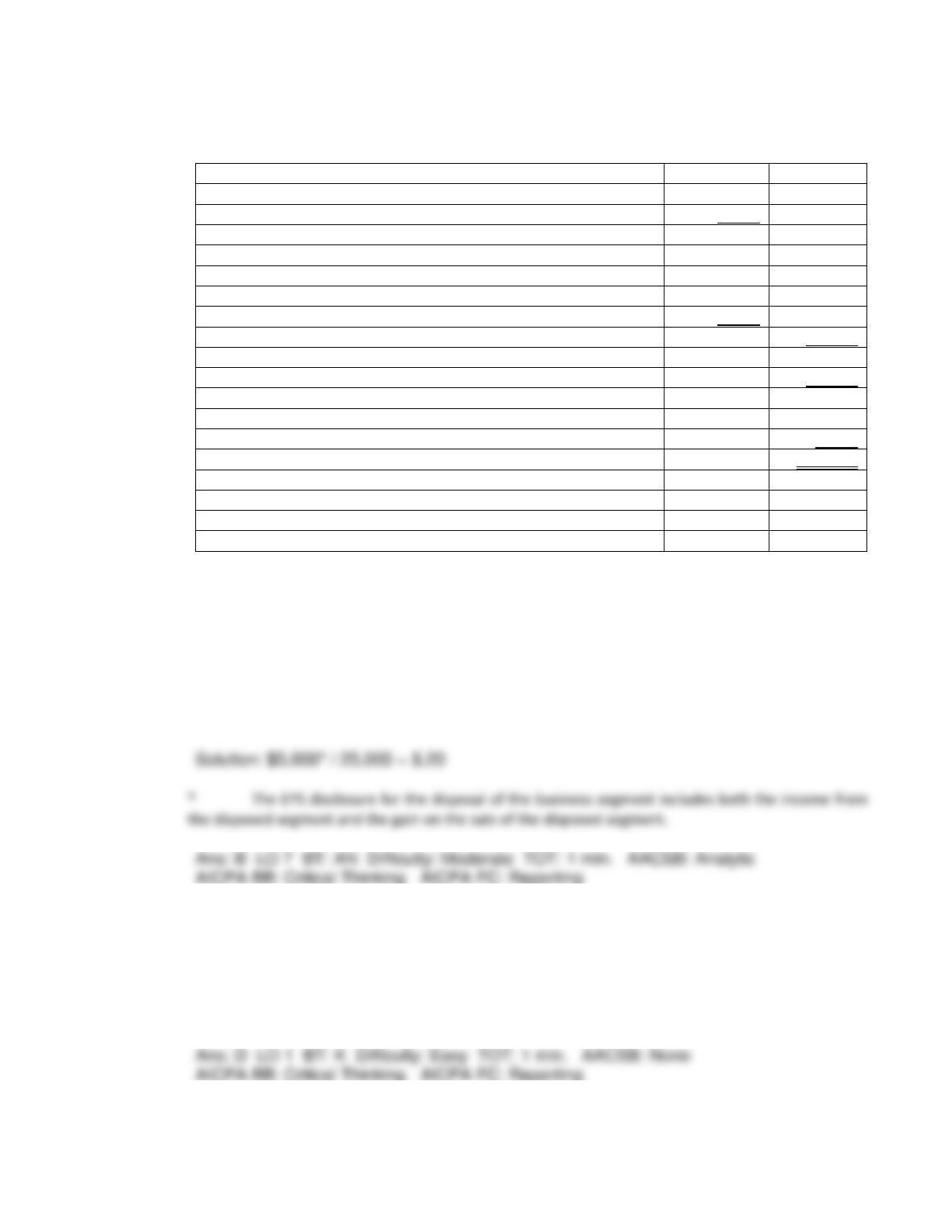
49. The following income statement was reported by Snappy Seacraft Company for the year
ending December 31, 2017:
Sales
$85,000
Rent revenue
23,000
Interest income
7,000
Total revenues
$115,000
Cost of goods sold
$52,000
Operating expenses
24,000
Interest expense
12,000
Loss on sale of fixed asset
6,000
Total expenses
94,000
Income from continuing operations (before tax)
$21,000
Less: Income tax
10,000
Income from continuing operations
$11,000
Income from disposed segment (net of tax)
3,000
Gain on sale of disposed segment (net of tax)
2,000
Net income
$16,000
Assume Snappy has an average of 15,000 shares of common stock outstanding during
2017. Based on this information, what amount of earnings per share would be reported
on the income statement for the disposal of the business segment?
a. $0.33
b. $0.20
c. $1.00
d. $0.73
Test Bank – Chapter 13 – The Complete Income Statement 13-19
50. The following income statement was reported by Snappy Seacraft Company for the year
ending December 31, 2017:
Sales
$85,000
Rent revenue
23,000
Interest income
7,000
Total revenues
$115,000
Cost of goods sold
$52,000
Operating expenses
24,000
Interest expense
12,000
Loss on sale of fixed asset
6,000
Total expenses
94,000
Income from continuing operations (before tax)
$21,000
Less: Income tax
10,000
Income from continuing operations
$11,000
Income from disposed segment (net of tax)
3,000
Gain on sale of disposed segment (net of tax)
2,000
Net income
$16,000
Assume Snappy has an average of 25,000 shares of common stock outstanding during
2017. Based on this information, what amount of earnings per share would be reported
on the income statement for the disposal of the business segment?
a. $0.12
b. $0.20
c. $0.08
d. $0.60
51. The measurement of income does not affect
a. stock prices.
b. bond prices.
c. management contracts.
d. estimate of uncollectibles.
13–20 Test Bank – Chapter 13 – The Complete Income Statement
52. Probable future economic benefits obtained or controlled by a particular entity as a result
of past transactions or events are
a. assets.
b. investments by owners.
c. revenues.
d. gains.
53. “Decreases in equity (net assets) from peripheral or incidental transactions of an entity
and from all other transactions and other events and circumstances affecting the entity
during a period except those that result from expenses or distributions to owners”
defines
a. liabilities
b. distributions to owners.
c. expenses.
d. losses.
54. The matching process measures net income by comparing
a. the fair market value of net assets at two points in time.
b. assets and liabilities..
c. revenues and expenses.
d. gains and losses.
55. The fair market value of Borke Company’s net assets was $250,000 and $325,000 at the
beginning and end of the year. The book value of the same net assets was $200,000
and $260,000. Revenues for the year were $317,000, and there were no transactions
with owners. What is net income for the current year?
a. $ 60,000
b. $ 75,000
c. $377,000
d. $392,000