13-1: Overhead Variances
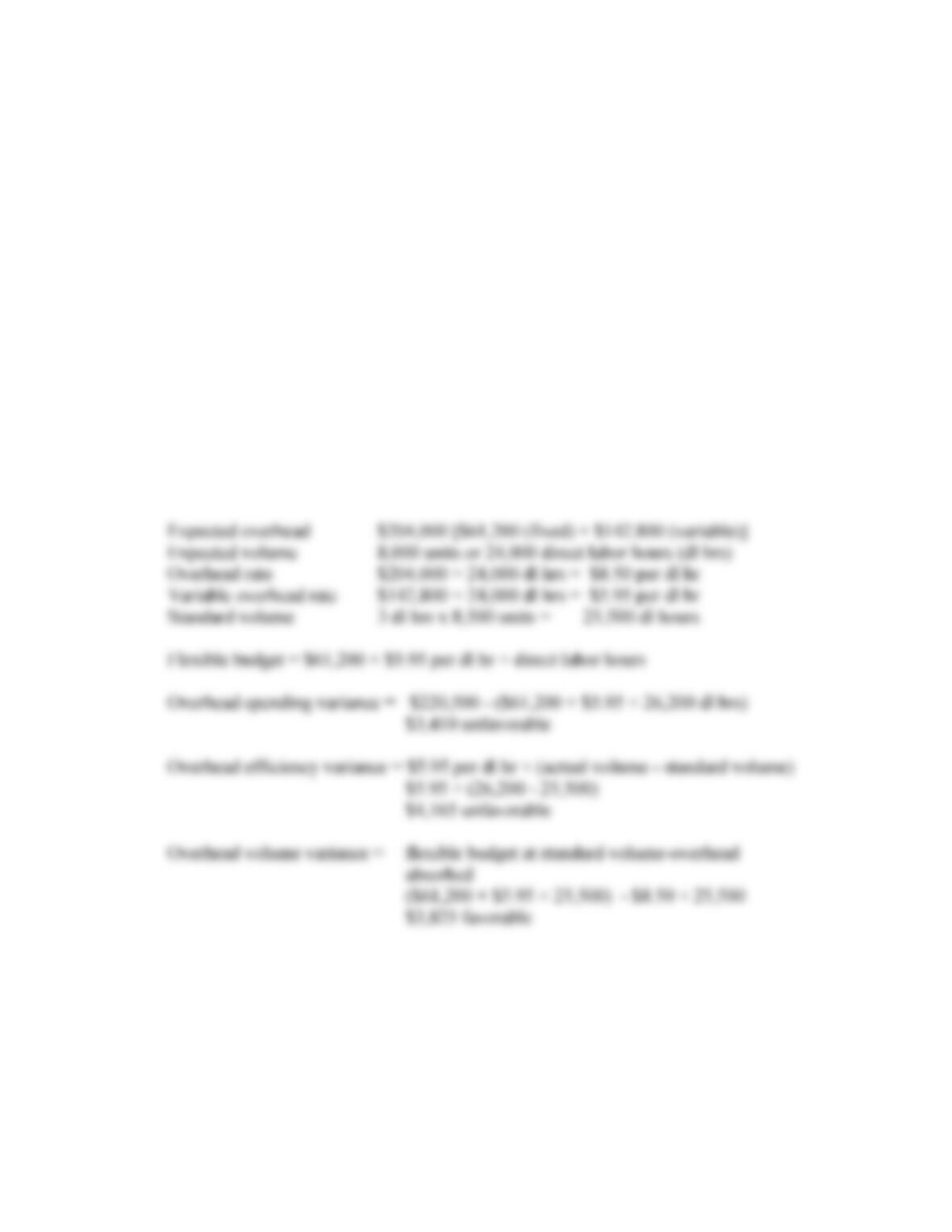
Overhead is applied on the basis of direct labor hours. Three direct labor hours are required
for each product unit. Planned production for the period was set at 8,000 units. Manufacturing
overhead for the period is budgeted at $204,000, of which 30 percent is fixed. The 26,200 hours
worked during the period resulted in production of 8,500 units. Manufacturing overhead cost
incurred was $220,500.
Required:
Calculate the following three overhead variances:
a. Overhead volume variance.
b. Overhead efficiency variance.
c. Overhead spending variance.
13-1: Solution to Overhead Variances (20 minutes)
13-2: Overhead Variances
The following information is for the third quarter of this year:
Planned Actual
Production 92,000 units 87,000 units
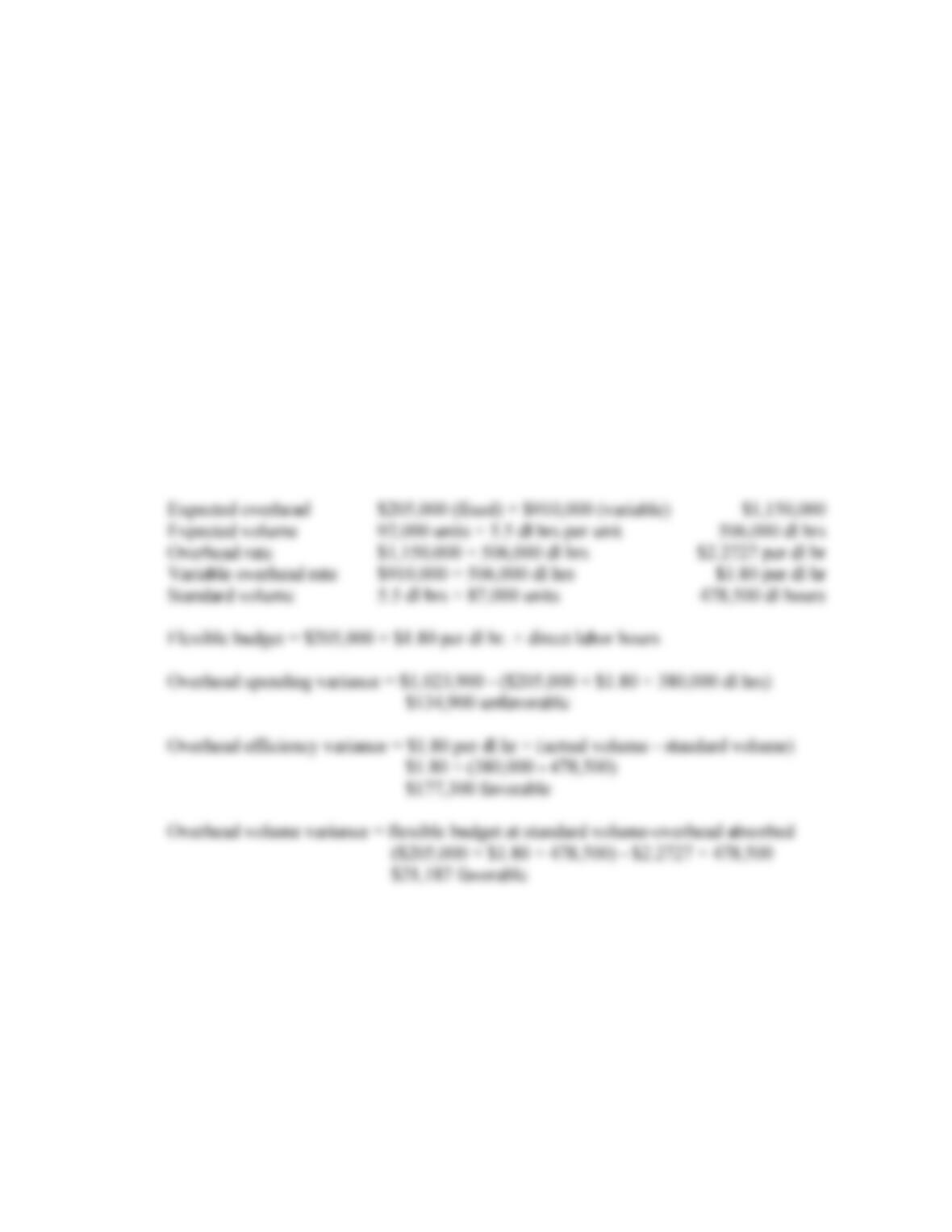
Direct labor hours 506,800 DL hrs 380,000 DL hrs
Fixed manufacturing overhead $205,000 $182,400
Variable manufacturing overhead $910,000 $841,500
Standard direct labor hour per unit 5.5
Required:
Calculate the following three overhead variances:
a. Overhead volume variance.
b. Overhead efficiency variance.
c. Overhead spending variance.
13-2: Solution to Overhead Variances (20 minutes)
13-3: Basic Overhead Variances
Derf Company applies overhead on the basis of direct labor hours. Two direct labor hours
are required for each product unit. Planned production for the period was set at 9,000 units.
Manufacturing overhead for the period is budgeted at $135,000, of which 20 percent is fixed. The
17,200 hours worked during the period resulted in production of 8,500 units. Manufacturing
overhead cost incurred was $136,500.
Required:
Calculate the following three overhead variances:
a. Overhead volume variance.
b. Overhead efficiency variance.
c. Overhead spending variance.
Source: CMA adapted.
13-3: Solution to Basic Overhead Variances (CMA adapted) (20 minutes)
13-4: Developing Additional Variances for Performance Evaluation
Maidwell Company manufactures washers and dryers on a single assembly line in its main
factory. The market has deteriorated over the last five years and competition has made cost control
very important. Management has been concerned about the materials costs of both washers and
dryers. There have been no model changes in the past two years, and economic conditions have
allowed the company to negotiate price reductions for many key parts.
Maidwell uses a standard cost system in accounting for materials. Purchases are charged
to inventory at a standard price, and purchase discounts are considered an administrative cost
reduction. Production is charged at the standard price of the materials used. Thus, the price
variance is isolated at time of purchase as the difference between gross contract price and standard
price multiplied by the quantity purchased. When a substitute part is used in production, a price
variance equal to the difference in the standard prices of the materials is recognized at the time of
substitution. The quantity variance is the actual quantity used compared with the standard quantity
allowed, with the difference multiplied by the standard price.
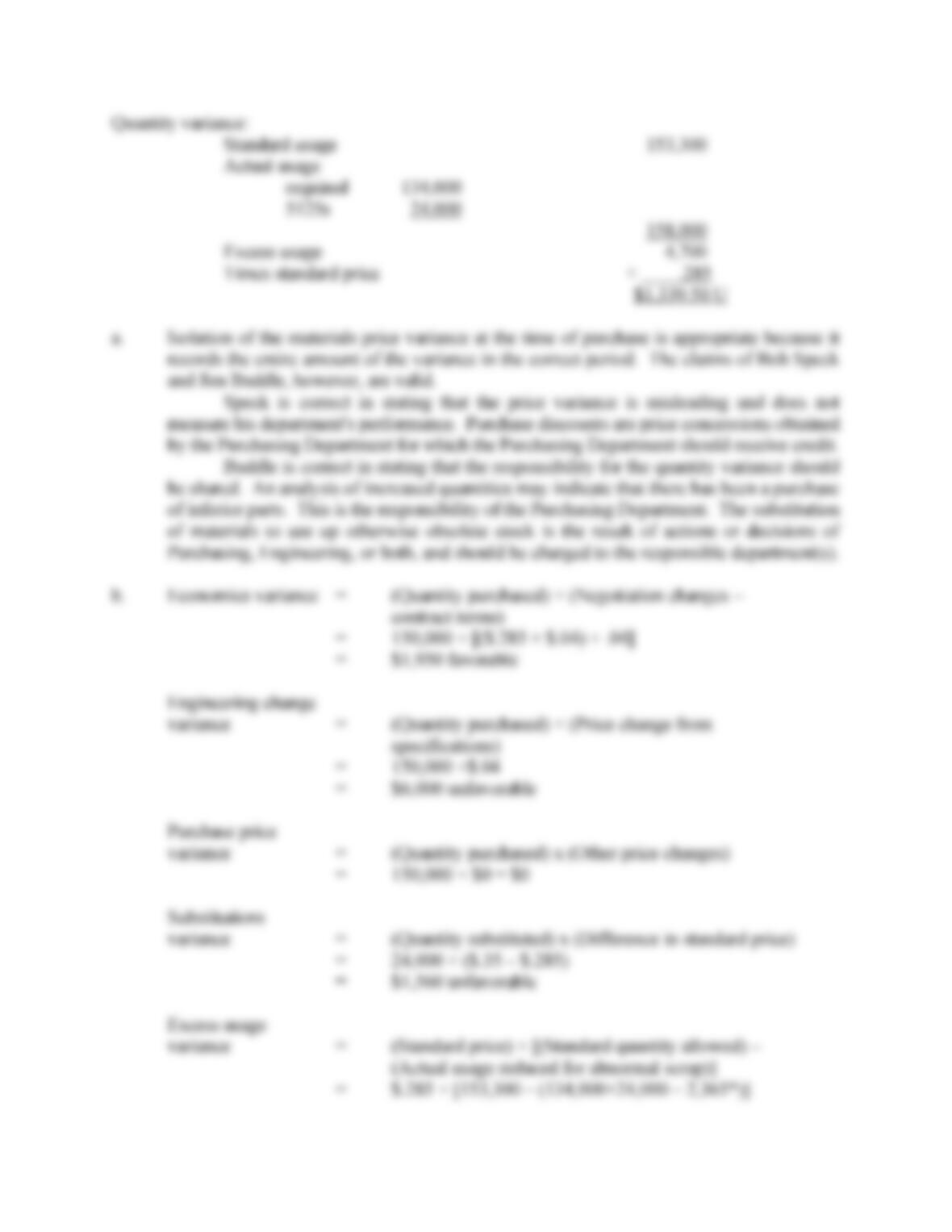
The materials variances for several of the parts Maidwell uses are unfavorable. Part #4121
is one item that has an unfavorable variance. Maidwell knows that some of these parts are defective
and will fail. The failure is discovered during production. The normal defective rate is 5 percent
of normal input. The original contract price of this part was $0.285 per unit; thus, Maidwell set
the standard unit price at $0.285. The unit contract purchase price of Part #4121 was increased to
$0.325 from the original $0.285 due to a parts specification change. Maidwell chose not to change
the standard; it treated the increase in price as a price variance. In addition, the contract terms were
changed from payment due in 30 days to a 4 percent discount if paid in 10 days or full payment
due in 30 days. These new contractual terms were the consequence of negotiations resulting from
changes in the economy.
Data regarding the use of Part #4121 during December are as follows.
• Purchases of Part #4121
150,000 units
• Unit price paid for purchases of Part #4121
$0.325
• Requisitions of Part #4121 from stores for use in products
134,000 units
• Substitution of Part #5125 for Part #4121 to use obsolete
stock (standard unit price of Part #5125 is $0.35)
24,000 units
• Units of Part #4121 and its substitute (Part #5125)
identified as defective
9,665 units
• Standard allowed usage (including normal defective
units) of Part #4121 and its substitute based on output for
the month
153,300 units
Maidwell’s material variances related to Part #4121 for December were reported as follows:
Price variance
$7,560.00U
Quantity variance
1,339.50U
Total materials variances for Part #4121
$8,899.50U
Bob Speck, the purchasing director, claims the unfavorable price variance is misleading.
Speck says that his department has worked hard to obtain price concessions and purchase discounts
from suppliers. In addition, Speck says engineering changes in several parts have increased their
prices, even though the part identification has not changed. These price increases are not his
department’s responsibility. Speck declares that price variances no longer measure purchasing’s
performance.
Jim Buddle, the manufacturing manager, thinks the responsibility for the quantity variance
should be shared. Buddle states that manufacturing cannot control quality associated with less
expensive parts, substitutions of material to use up otherwise obsolete stock, or engineering
changes that increase the quantity of materials used.
The accounting manager, Mike Kohl, suggests that the computation of variances be
changed to identify variations from standard with the causes and functional areas responsible for
the variances. Kohl recommends the following system of materials variances and the method of
computation for each:
Variance
Method of Calculation
Economics variance
Quantity purchased times the changes made after
standards were set. Standards were the result of
negotiations based on changes in the general
economy.
Engineering change variance
Quantity purchased times change in price due to part
specifications changes.
Purchase price variance
Quantity purchased times change in contract price
due to changes other than part specifications or the
general economy.
Substitutions variance
Quantity substituted times the difference in standard
price between original part and part substituted.
Excess usage variance
Standard price times the difference between the
standard quantity allowed for production minus
actual parts used (reduced for abnormal scrap).
Abnormal failure rate variance
Abnormal scrap times standard price.
Required:
a. Discuss the appropriateness of Maidwell Company’s current method of variance analysis
for materials and indicate whether the claims of Bob Speck and Jim Buddle are valid.
b. Compute the materials variances for Part #4121 for December using the system
recommended by Mike Kohl.
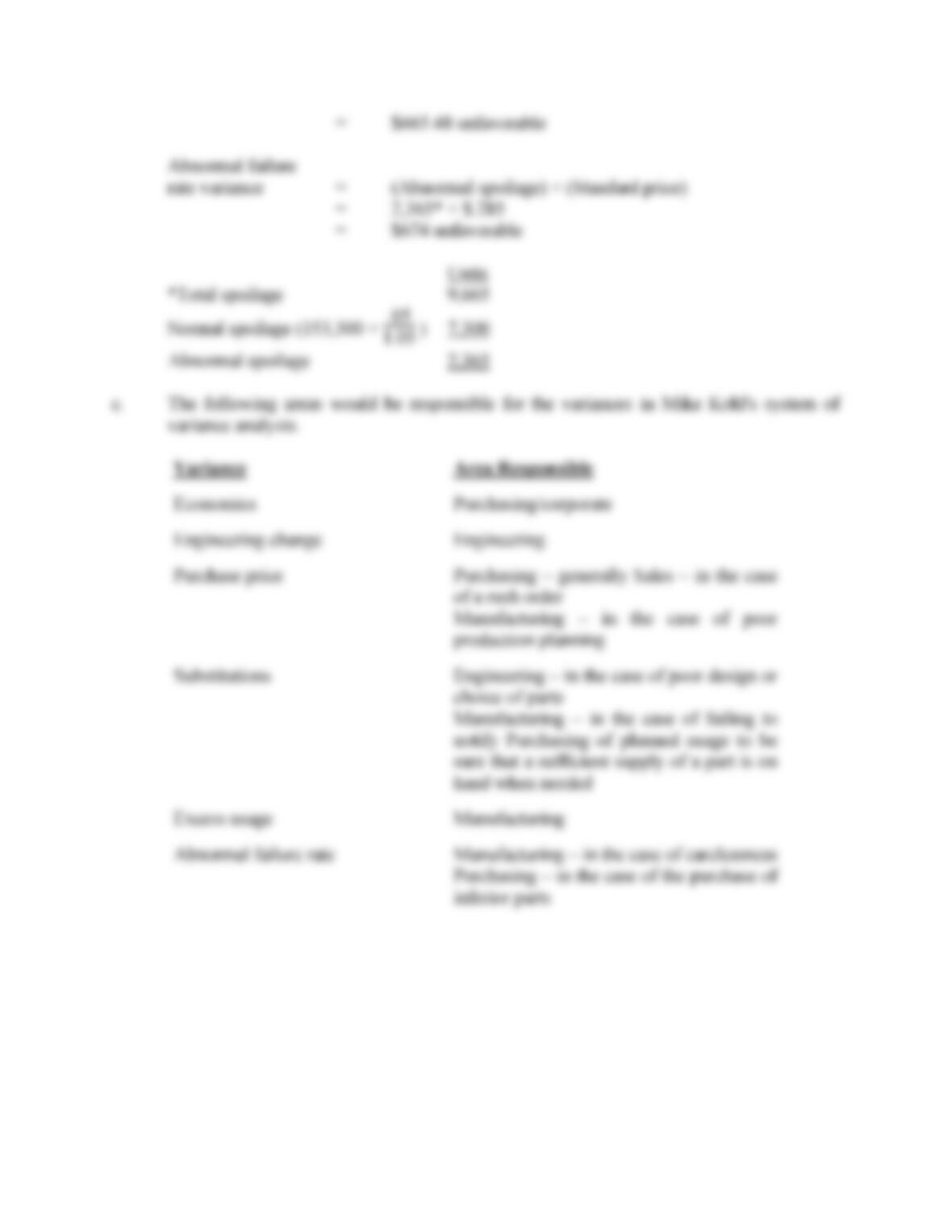
c. Who would be responsible for each of the variances in Mike Kohl’s system of variance
analysis for materials?
Source: CMA adapted.
13-4: Solution to Developing Additional Variances for Performance Evaluation (CMA
adapted) (60 minutes)