CHAPTER 13
Performance and Portfolio Assessments
ITEMS
1. A single performance assessment task assesses a number of learning objectives while a traditional
test item assesses only one learning objective.
(a) True
(b) False
2. Using authentic performance tasks in the classroom ensures that most students will attain the
learning objectives.
(a) True
(b) False
3. What is meant by an authentic assessment?
(a) An assessment that authenticates a student’s knowledge in an area of study.
(b) An assessment that indicates how well a student can perform in real-life situations.
(c) An assessment that shows the ability to explain a point of view logically.
3. A performance assessment requires students to
(a) demonstrate their declarative knowledge.
(b) apply their knowledge and skills in doing something.
(c) explain how they would go about performing a task.
5. Which of the following describe performance assessments?
I. A mathematics teacher gave each student ten geometric shapes and required
them to classify the shapes according to their characteristics and to label the
categories.
II. A social studies teacher asked students to write a short essay describing the
importance of the Corn Belt to the US economy.
III. A history teacher asked students to collect data on family life during the
American Civil War and to prepare a summary of their findings.
(a) I and II
(b) I and III
(c) II and III
(d) I, II, and III
6. Any performance activity by students in the classroom is a useful assessment task.
(a) True
(b) False
7. As part of their science grade, students observed the clouds between 10:00 and 10:45 a.m. on a
particular day, reported their observations, and predicted the next day’s weather. What type of
assessment task is this?
(a) A structured, on-demand performance
(b) A naturally occurring performance task
(c) A demonstration
(d) A project
8. In naturally occurring performances students usually do not know that they are being assessed
while the opposite is true with structured tasks.
(a) True
(b) False
9. The primary advantage of using naturally occurring events to assess students is that they give all
students the opportunity to demonstrate their ability to apply their learning in nearly identical
natural settings.
(a) True
(b) False
10. Individual student projects are used to assess the student’s ability to
(a) recall what was taught in class.
(b) follow specific directions given by a teacher.
(c) craft a product that requires using a variety of knowledge and skills.
11. The main reason for using group projects to assess students is to determine their ability to work
together.
(a) True
(b) False
12. A teacher must have a good management plan in order to use projects effectively.
(a) True
(b) False
13. An advantage of performance assessment over the traditional objective formats is that
performance assessment
(a) requires students to apply their knowledge and skills in doing things.
(b) is more objective than the traditional formats.
(c) is more related to abstract knowledge than traditional formats.

14. One major disadvantage of performance assessment procedures is that they are more time-
consuming for the teacher and the student.
(a) True
(b) False
15. A major problem with using performance assessment methods is that students do not perform
consistently from one task to another.
(a) True
(b) False
16. A major problem with assessing students using portfolios is that two teachers often assign quite
different grades to the same student’s portfolio.
(a) True
(b) False
17. When deciding whether to use performance assessments the first thing you must consider is how
many times you want to assess students during the marking period.
(a) True
(b) False
18. Which of the following questions has the LEAST priority when you are in the first stages of
crafting performance assessments?
(a) What type of scoring procedure shall I use?
(b) Will students with different backgrounds interpret the tasks in the same way?
(c) How should the task be crafted in order to assess the specific learning objectives?
19. For which of the following is it probably BEST to evaluate the process or procedure a student
used instead of the product produced?
(a) The student writes a poem.
(b) The student solves a complex mathematics problem.
(c) The student makes models of simple machines.
20. Which of the following is NOT an important quality dimension for designing performance
assessments?
(a) Complex thinking
(b) Subject-matter content
(c) Effective communication
(d) Information recall
21. Which of the following procedures is least practical for a teacher to use as a way of improving the
quality of assessment tasks?
(a) Requesting a colleague in the same subject area to review the tasks.
(b) Trying out the tasks on a sample of current students before using them for evaluating the
full group.
(c) Revising the tasks for use next year based on students’ performance this year.
22. What does scaffolding mean in performance assessment?
(a) Alternate strategies a student uses to complete a task
(b) Degree of group participation in completing a task
(c) Directions provided by the task to guide the student
(d) Support obtained from the scoring rubrics
23. Which of the following types of tasks is the most unstructured?
(a) There are many possible processes leading to many equally justifiable solutions.
(b) There are many possible processes that lead to the same correct solution.
(c) There is one best process to use but many solutions can be arrived at.
24. Which of the following factors is LEAST important in deciding how many tasks to include on a
summative classroom performance assessment?
(a) Whether to use holistic or analytic scoring
(b) Time at the teacher’s disposal for administering the assessment
(c) The nature of the learning objective to be assessed
(d) The type of decisions to be made using the assessment
25. A good performance task should give students the details on how their performance will be
evaluated.
(a) True
(b) False
26. What is the last step in the sequence when crafting a performance assessment?
(a) Writing the tasks to be performed
(b) Writing the rubrics for scoring
(c) Stating what you want to assess
27. Scoring rubrics define different levels of quality the teacher will use to evaluate the students’
performance.
(a) True
(b) False
28. What is the most appropriate way to score a performance assessment that is used to identify
students’ problems which need remediation?
(a) Analytic scoring
(b) Annotated holistic scoring
(c) Holistic scoring
29. Relevant rubrics for scoring performance assessment tasks cannot be crafted until one specifies
all the quality dimensions to be assessed.
(a) True
(b) False
30. What is the major problem with using a graphic rating scale with undefined verbal labels?
(a) Raters don’t agree on what the labels mean.
(b) The scale artificially breaks up a continuous event into discrete categories.
(c) They are too complicated for most raters to use.
31. A teacher typically rates responses such that almost all students obtain very high scores. Which
type of error is the teacher likely to be making?
(a) Central tendency error
(b) Leniency error
(c) Severity error
(d) Personal bias error
32. Which of the following rating errors is likely to be made by a new teacher who does not know the
students very well?
(a) Central tendency error
(b) Leniency error
(c) Severity error
(d) Rater drift
33. A teacher knows that Linda always performs at the top of her class. On one units’ summative
assessment, Linda’s performance was not very good but the teacher gave her a high grade
reasoning that Linda just had an “off day.” Which type of error did the teacher most likely
commit?
(a) Halo effect
(b) Logical error
(c) Leniency error
(d) Personal bias error
34. A school’s report card requires teachers to report grades in each subject as A, B, C, D, or F. How
many levels should a teacher’s rating scale for writing have?
(a) 4
(b) 5
(c) 10
(d) It doesn’t matter how many levels because grades are based on average marks.
35. Mr. Jared’s mathematics performance task requires students to develop and explain two or more
ways to solve a mathematics problem. Because students will give many different but correct
solutions to the problem, Mr. Jared’s scoring rubric needs only general statements about how the
alternative solutions will be marked.
(a) True
(b) False
36. Which of the following will help ensure that a project is useful for assessing students?
(a) The project allows students to focus on nonessential but highly motivating aspects of
learning.
(b) The project provides an opportunity for a great deal of collaboration between students.
(c) The project requires the use of limited resources that are available to all students.
(d) The project allows students to create products some of which you find particularly
engaging or fun.
37. Which of the following is necessary for a classroom project to be useful for assessment purposes?
(a) Linking the project to specific learning objectives in the curriculum.
(b) Evaluating students only on the achievement dimensions defined as outcomes of the
project.
(c) Defining the weight of each achievement dimension used in calculating the grade.
(d) All of the above are necessary.
(e) Only (a) and (b) are necessary.
38. Which strategy will help you mentor students to help overcome operational problems in
completing their projects?
(a) Clarifying the outcomes you expect.
(b) Clarifying the project evaluation standards by giving students copies of the scoring
rubrics.
(c) Setting deadlines for completing each phase of the project.
(d) Requiring students to make frequent progress reports.
39. Which type of project is most likely to lead to student plagiarism opportunities?
(a) Reporting on the history, culture, geography, and political system of a country.
(b) Researching the opinions of students in the school on whether soda machines should be
eliminated.
(c) Making a crash-proof container to protect a raw egg when it is dropped from 20 feet.
(d) Constructing the views of Republicans and Democrats on the issue of tax-rebates by
analyzing statements made in the newspapers by party members.
40. Ms. Jones’s students keep all of their week’s seatwork and homework assignments in a folder. At
the end of the week they bring it home. Is Ms. Jones using a portfolio assessment method?
(a) Yes
(b) No
41. Besides monitoring a student’s progress, what other educational role does a growth-and-learning-
progress portfolio play in the academic life of the student?
(a) It fosters student learning through self-evaluation.
(b) It ensures that records of the student are always accessible.
(c) It enables parents to have input into what the student has achieved.
(d) All of the above.
42. What is the purpose of best works portfolio?
(a) To monitor learning and show development
(b) To determine where students’ problems lie for remediation.
(c) To provide evidence that students accomplished the most important learning objectives
(d) To display student responses to a teacher-generated list of tasks
43. Which of the following could be included in a sixth grade student’s electronic portfolio for a unit
on water in science class?
(a) A video clip of the student’s visit to the city water plant
(b) An electronic presentation file the student used in an oral presentation to the class
(c) An essay the student wrote on water pollution
(d) All of the above could be included
(e) Only (a) and (b)
44. The content and thinking processes that are the focus of a best-works portfolio should be decided
after all the entries are complete.
(a) True
(b) False
45. Before you decide on what content should be included in students’ portfolio, you should clearly
identify the
(a) purpose of the portfolio.
(b) scoring rubrics you will use.
(c) most appropriate way to organize each portfolio.
46. What is the most important principle to apply when crafting a growth-and-learning-progress
portfolio?
(a) Be clear about what learning objectives it will monitor.
(b) Understand the theory behind learning progress.
(c) Work cooperatively with other teachers in designing the portfolio.
(d) Use the same rubric to evaluate the portfolio over time.
47. A desirable feature of a best-works portfolio is that is should emphasize learning objectives that
are not part of a teacher’s daily instruction.
(a) True
(b) False
48. For each entry in a best-works portfolio, a teacher should require the student to write an
explanation that relates the entry to the learning objective it shows achievement on.
(a) True
(b) False
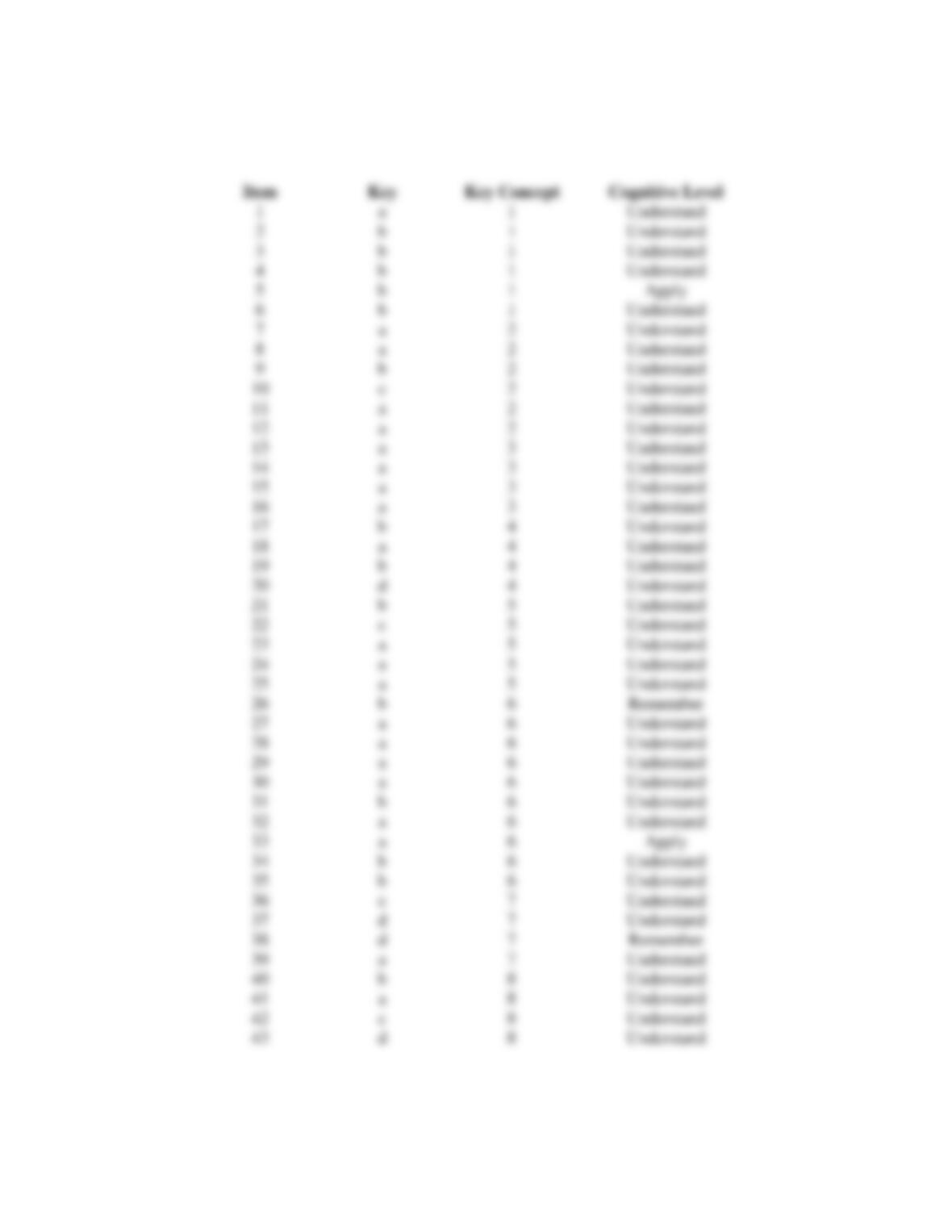
CHAPTER 13
Answers and Classification of Items