Initials __________
1
UNIVERSITY AT ALBANY
Rockefeller College of Public Affairs and Policy
PAD-646: Financial Management
Midterm Examination
Fall – 2006
Your Name: ________________________________________________
Turn off all cell phones and pagers during the exam
Directions:
4) Show all your work. I can only give you partial credit if you show how you
approached the problem! For the time value of money computations show what
information you used to calculate the answer. Do not just write down the final
answer.
5) The points for each question are indicated in parentheses next to the question.
6) Look through the exam before you begin.
Good Luck
SOLUTIONS
Initials __________
2
1. Select from the following to answer questions A through D. (Note: Some terms may not be used
in any of the answers while others may be used more than once. Also, answers to some
questions may involve multiple types of budgets.):
i. Operating
ii. Capital
iii. Flexible
iv. Cash
v. Performance
vi. Special Purpose
vii. Master Budget
2. Answer the following questions about break-even analysis:
(1 point) A. If an organization gets an unrestricted donation of $100,000 and no other
factors change, its break-even quantity for the period when the donation was
received: (circle the correct answer)
(4 points) B. Neighborhood Services offers three drug-counseling programs. The amounts it
receives from Metro City for each of the programs and the marginal costs
Initials __________
3
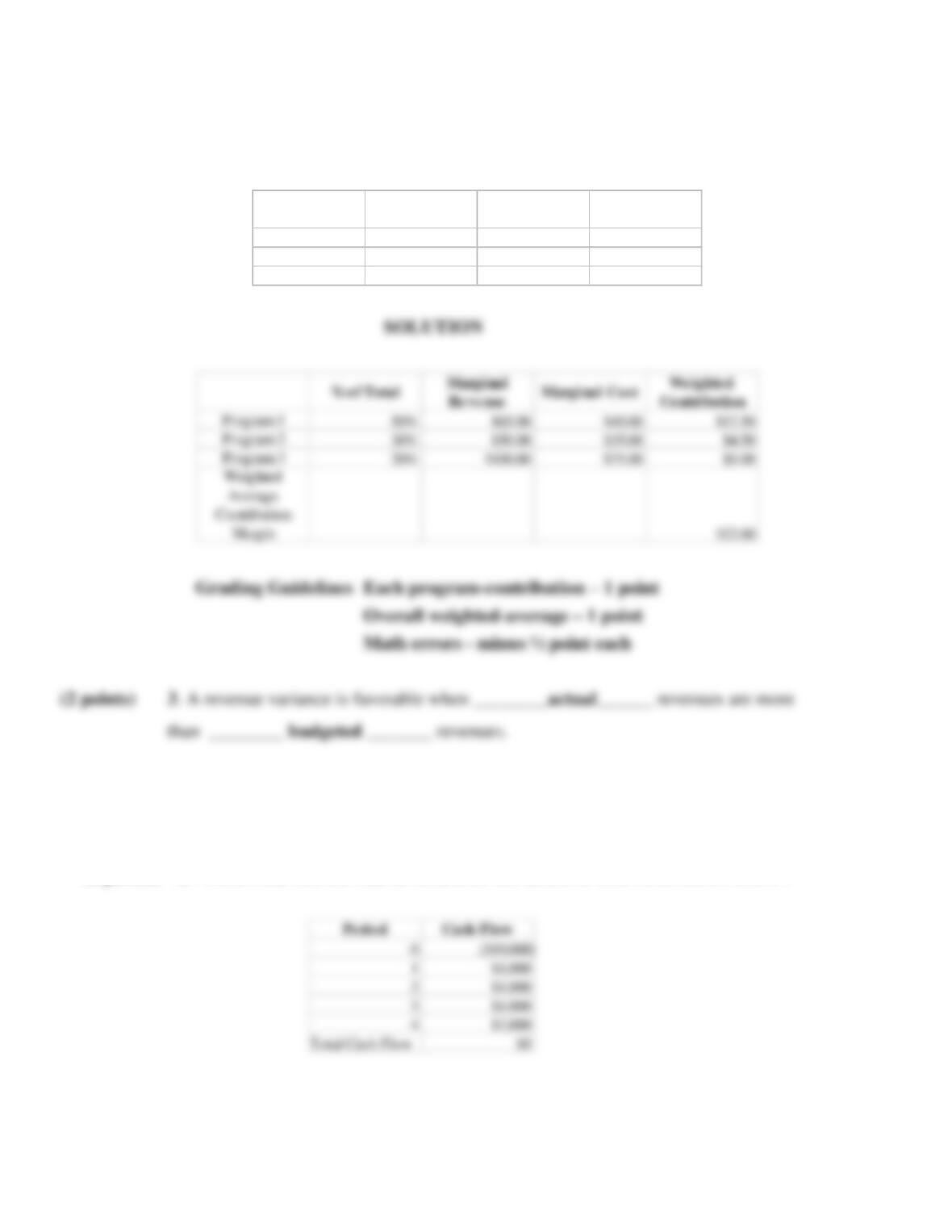
associated with those programs are shown below. Calculate NS’s overall average
contribution margin from those programs.
% of Total
Marginal
Revenue
Marginal Cost
Program 1
50% $65.00 $40.00 $12.50
Program 2
30% $50.00 $35.00 $4.50
Program 3
20% $100.00 $75.00 $5.00
Weighted
4. Answer the following questions about the time value of money.
(2 points) A. What is the Internal Rate of Return for the stream of cash flows shown below?
Initials __________
4
B. Choose from the methods listed below to answer the following questions.
a. Net Present Value
b. Net Present Cost
c. Annualized Cost
d. Break Even
(2 points) i) The Public Water Works Department (PWW) is trying to decide whether to
replace the crumbling water pipes below Metro City’s streets with plastic pipe
that it believes will last 30 years or the more-expensive concrete pipe that has a
useful life of one hundred years.
(2 points) ii) The Citizens Budget Commission is evaluating the economic viability of
Metro’s proposed bid for the 2020 Olympics. Proponents of the games argue
that the Olympics will generate substantial economic benefits for the City.
Opponents point to the high cash outlays associated with the bid and
subsequent costs of hosting the games.
(2 points) C. You deposited $10,000 in the bank at an interest rate of 3.65% per year.
How much money would you have at the end of five years if the bank
compounds interest daily?
Initials __________
5
5. Answer the following questions about costs.
(2 points) A. If there are increases in unit variable-costs and step-fixed costs over the relevant
range associated with a decision, marginal cost will be (circle the correct answer)?
B. Neighborhood Daycare Center (NDC) has fixed costs of $16,000 per week,
variable weekly costs of $25 per child and a total of 400 children under its care.
(3 points) i) What is NDC’s average total weekly cost per child?
(2 point) ii) During the school year NDC added a teaching aid at a cost of $500 per
week to accommodate ten additional children. If each teaching aid can
supervise twenty children, what is the weekly marginal cost of adding five
more children to the program?
Initials __________
6
(2 points) 6. In one sentence define an operating budget.
(2 points) 7. You are about to retire and have saved $750,000. Really Safe Insurance
Company has offered to sell you an annuity contract that will pay you a fixed
amount each month for thirty years. The interest rate on the contract is 7.5% per
year. Calculate how much you would get on the first day of each month during
those thirty years.
(8 points) 8. The Metro Ambulance Center (MAC) operates a 911-response center for Rutland
County. Under its contract with the county, MYC earns $200 per ambulance run and
pays its own cost for fuel and maintenance out of those proceeds. All of the
ambulance drivers and attendants are volunteers.
MAC’s actual revenue and expenses for the fourth quarter of fiscal year 2004 and
budgeted revenue and expenses for the first three months of fiscal year 2005 are
shown in the table below. The County pays MAC three months after it is billed and
MAC pays its suppliers one month after it uses resources. In addition, on the first day
of fiscal year 2005, MAC must pay its bank $25,000. MAC expects to start the year
with $15,000 in cash.
Prepare a properly-formatted cash-budget for the first quarter of fiscal year 2005 for
MAC. Be sure to include the following:
a. The amount MYC expects to collect from the County during the first quarter
of Fiscal Year (FY) 2005.
b. The amount MYC expects to pay its suppliers during the first quarter of fiscal
year 2005.
c. MAC’s expected cash balance at the end of the first quarter of fiscal year
2005.
FY 2004
Month 10
FY 2004
Month 11
FY 2004
Month 12
FY 2005
Month1
FY 2005
Month 2
FY 2005
Month 3
Revenue
$150,000 $200,000 $175,000 $175,000 $225,000 $300,000
Expenses
$115,000 $180,000 $170,000 $150,000 $200,000 $260,000
Gain/(Loss)
$35,000 $20,000 $5,000 $25,000 $25,000 $40,000
Initials __________
8
(20 points) 9. As the volunteer business-manager for the Rutland City Band (City Band), you
are responsible for preparing the operating budget for the organization’s upcoming
summer-concert season. Each year, City Band presents up to 20 weekend
performances, depending on weather conditions. The concerts are free to the
public but the Band hangs a pot from the bandstand and people leave small
donations in it. On average, City Band gets $100 in donations at each of its
performances. In addition to donations, the City of Rutland gives the band $3,000
per season plus $125 for each performance.
City Band also has a small endowment of $100,000 on which it expects to earn
3.5% in the coming fiscal year. City Band’s trustees have decided to use that
money to pay for operating expenses if they need to.
City Band pays its conductor $3,000 for the summer season and has an insurance
policy to protect it against any loss of equipment or damage to the bandstand. That
policy costs the band $500 for the summer plus $25 per performance. New music
costs the band $200 per year. Following generally-accepted accounting principals,
the band recognizes music acquisitions as expenses in the year the music is
acquired. In addition, City Band pays music publishers an average of $40 per
concert for the rights to perform certain of the pieces in its repertoire.
The band has an average of sixty musicians at each of its performances. Each
musician is paid $5 per performance.
(10 points) A. Prepare an operating budget for City Band for the coming fiscal year assuming
the Band performs on each of its twenty scheduled concert dates.
(5 points) B. Prepare a flexible budget showing what would happen if the band could only
perform on 80% of its scheduled concert dates. You may show the flexible budget
in a column next to the operating budget (Part A) without repeating all of the
headings.
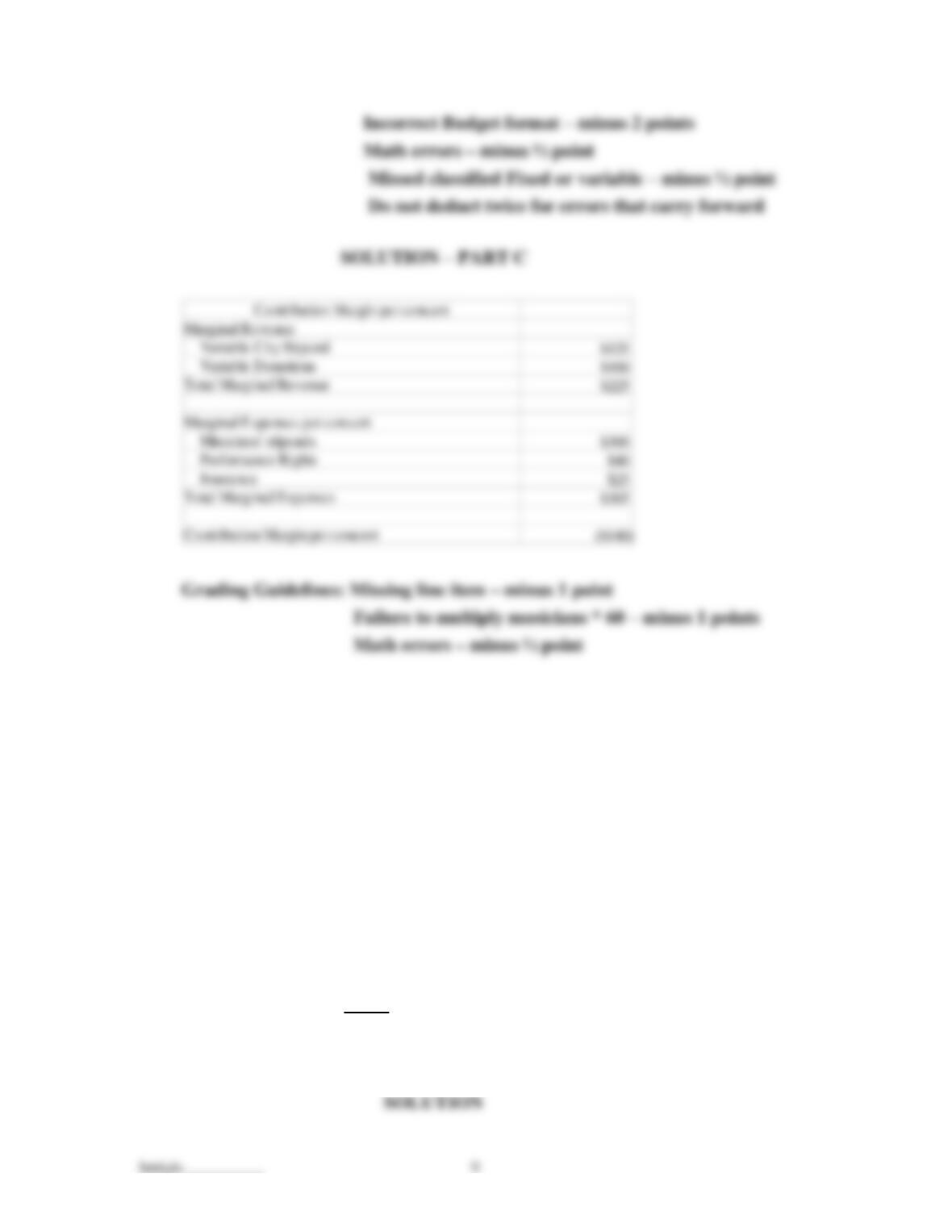
(5 points) C. Calculate City Band’s total contribution-margin-per-concert.
(12 points) 10. Lately, some of City Band’s older musicians have been having difficulty
climbing the stairs to get up to the bandstand. In addition, there are two disabled
musicians who play at all of the Band’s rehearsals but are reluctant to play at the
concerts because of the difficulty they have accessing the bandstand.
City Band’s trustees would like to accommodate both groups of musicians. They
have gotten an estimate of $10,000 to make the bandstand accessible. You have
lined up a ten-year $500-per year grant from the State Office of Disabilities and a
five-year $750-per-year grant from the Federal Office of the Ageing to help pay
for the modifications to the bandstand. In addition, the local chapter of the Knights
of Columbus has offered to donate $1,500 toward the project.
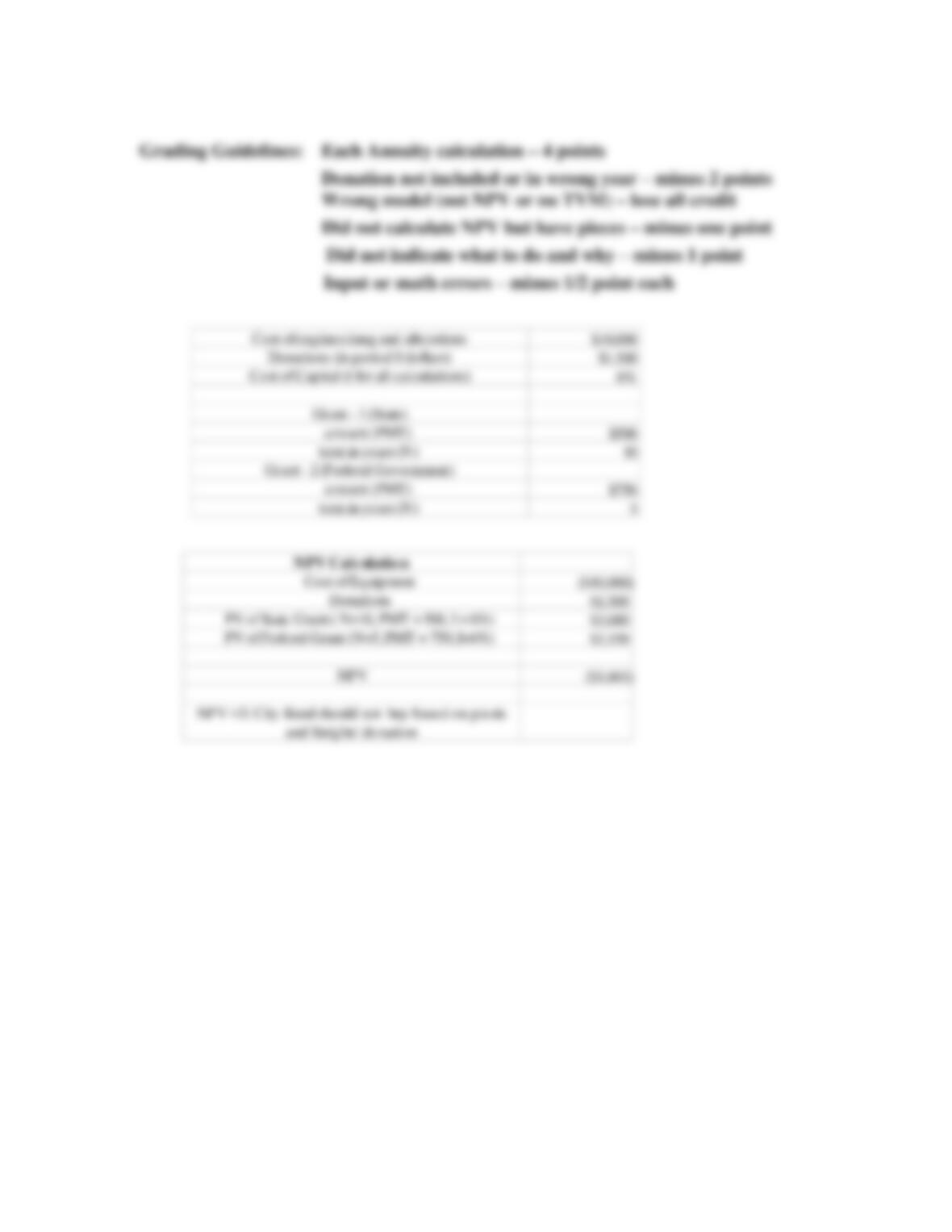
If City Band’s cost-of-capital is 6%, should they invest in the bandstand
modifications based solely on the Knight’s donation and the proceeds from the
grants? Support your answer with the appropriate time-value-of-money
calculations.
Initials __________
10
$1,661
(12 points) 11. City Band expected to hold 20 concerts during its 2004 summer-concert-season
and pay an average of sixty musicians $5 per concert for their performances. At
the end of the summer, the band had only been able to perform sixteen times. The
other four performances were rained out. Because of the shortened concert-season,
the trustees decided to pay the musicians who came to the concerts $6 per
performance. On average, 55 musicians were at each performance.
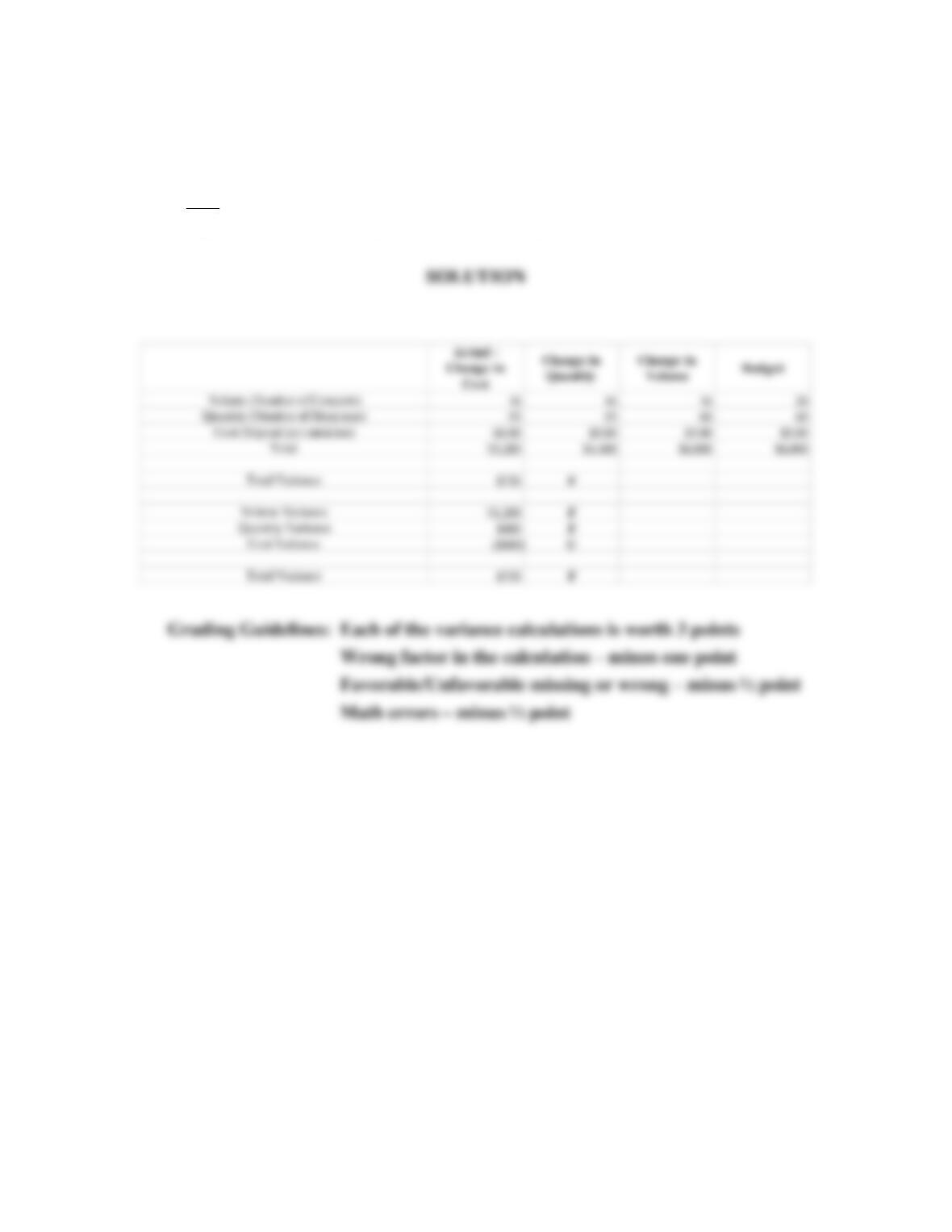
A. Calculate City Band’s total musician’s stipend expense variance for the season.
Indicate whether that variance was favorable or unfavorable.
B. Calculate the portion of that variance that was due to volume. Indicate whether
that variance was favorable or unfavorable.
C. Calculate the portion of that variance that was due to quantity. Indicate whether
that variance was favorable or unfavorable.
Initials __________
11
D. Calculate the portion of that variance that was due to cost. Indicate whether that
variance was favorable or unfavorable.
Hint: Be sure to add up the flexible (partial) variances to make sure that total
equals the total variance you calculated directly.
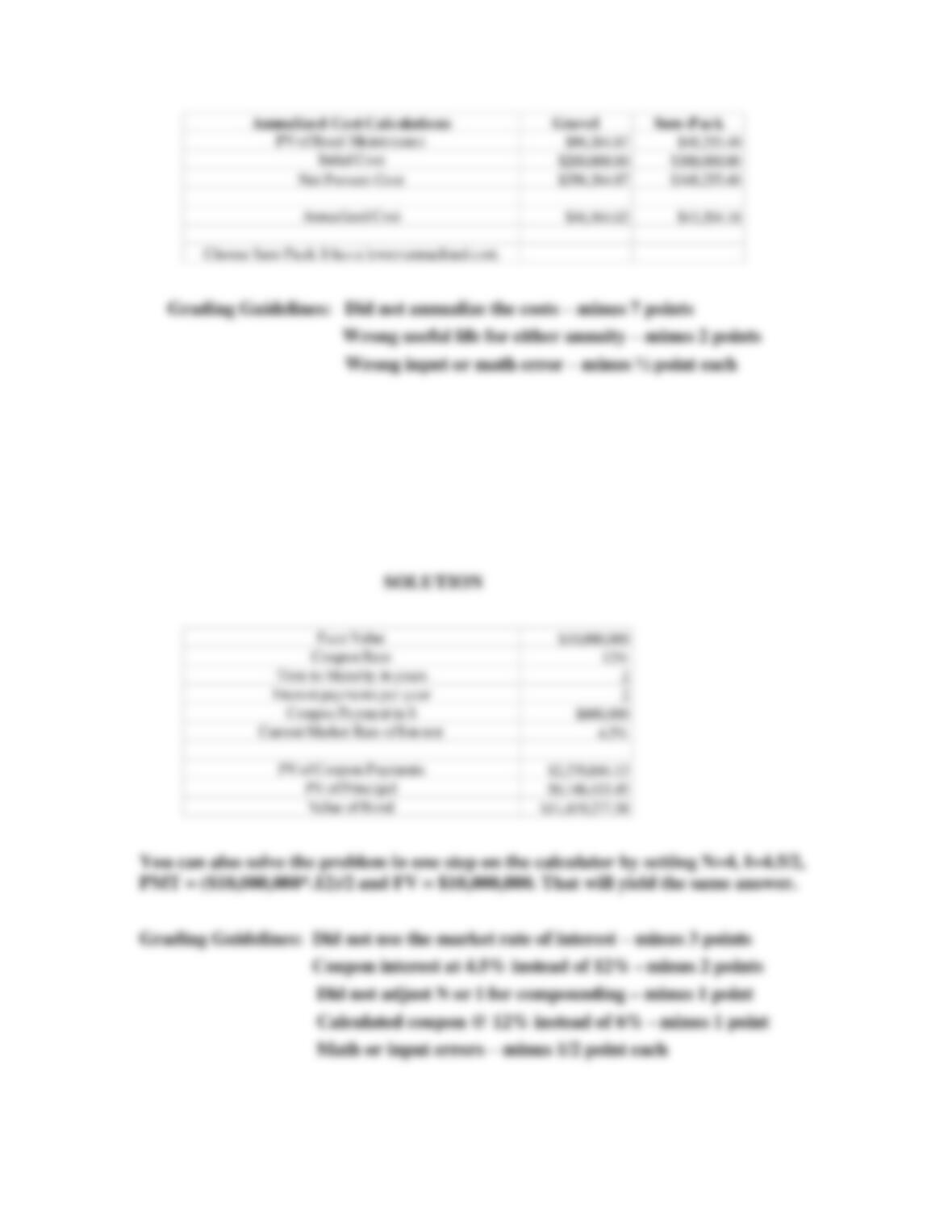
(10 points) 12. Wallingford needs to resurface a section of its roads this spring. The town
council is considering using one of two technologies. The first involves putting down
stone and gravel and grading the road on an annual basis. The second involves the
application of a road surface called sure-pack. Sure-Pack only requires maintenance
every five years. Based on experience, the counselors know the gravel road will last
ten years. The folks in Shrewsbury, the next town down route 144, Sure-Packed their
roads and expect to get 15 years from them before they will need to be resurfaced
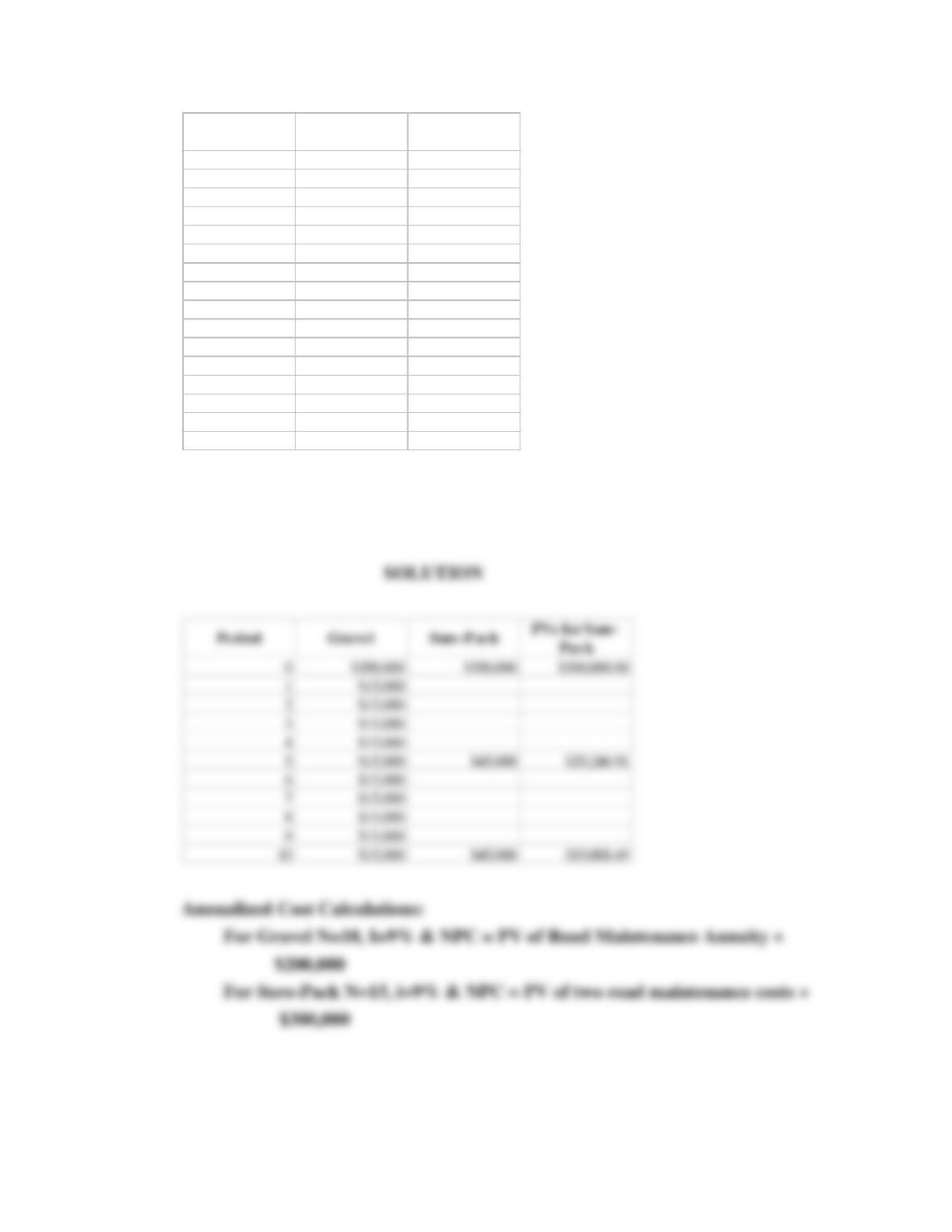
again. The cash flows for each alternative are shown in the table below.
Initials __________
12
Period Gravel Sure-Pack
0 $200,000 $300,000 $300,000.00
1 $15,000
2 $15,000
3 $15,000
4 $15,000
5 $15,000 $45,000 $29,246.91
6 $15,000
7 $15,000
8 $15,000
9 $15,000
10 $15,000 $45,000 $19,008.49
11
12
13
14
15
PV of Road Maintenance
$96,264.87 $48,255.40
If Wallingford’s cost of capital is 9%, which alternative should they choose? Support
your answer with the appropriate time-value-of-money calculations.
Initials __________
13
(5 points) 13. In1980, the United States Treasury issued a $10,000,000 par-value bond, with a
12% original-issue coupon rate and an original term of thirty years. The bond pays
interest twice each year at six-month intervals. The bond will reach final maturity on
January 1, 2008. If you were to buy that bond on December 31, 2006 with exactly
two years remaining to maturity when market interest-rates for similar Treasury
issues were 4.5%, how much would you pay for it?