Chapter 13 Capital Budgeting Decisions
13-6
Chapter 13 Capital Budgeting Decisions Answer Key
True / False Questions
1. If the internal rate of return exceeds the required rate of return for a project, then the net
present value of that project is positive.
2. In comparing two investment alternatives, the difference between the net present values of
the two alternatives obtained using the total cost approach will be the same as the net present
value obtained using the incremental cost approach.
3. The simple rate of return is the same as the internal rate of return.

Chapter 13 Capital Budgeting Decisions
13-7
4. The internal rate of return for a project is the discount rate that makes the net present value
of the project equal to zero.
5. If two projects require the same amount of investment, then the preference ranking
computed using either the project profitability index or the net present value will be the same.
6. In preference decisions, the profitability index and internal rate of return methods may
produce conflicting rankings of projects.
7. The project profitability index is used to compare the internal rates of return of two
companies with different investment amounts.

Chapter 13 Capital Budgeting Decisions
13-8
8. Preference decisions attempt to determine which of many alternative investment projects
would be the best for the company to accept.
9. Projects with shorter payback periods are always more profitable than projects with longer
payback periods.
10. One criticism of the payback method is that it ignores cash flows that occur after the
payback point has been reached.
11. A very useful guide for making investment decisions is: The shorter the payback period,
the more profitable the project.

Chapter 13 Capital Budgeting Decisions
13-9
12. If new equipment is replacing old equipment, any salvage received from sale of the old
equipment should not be considered in computing the payback period of the new equipment.
13. The simple rate of return focuses on accounting net operating income rather than on cash
flows.
14. The simple rate of return method places its focus on cash flows instead of on accounting
net operating income.
Multiple Choice Questions
Chapter 13 Capital Budgeting Decisions
13–10
15. If a company has computed the project profitability index of an investment project as
0.15, then:
16. Spring Company has invested $20,000 in a project. Spring’s discount rate is 12% and the
project profitability index on the project is zero. Which of the following statements would be
true?
I. The net present value of the project is $20,000.
II. The project’s internal rate of return is equal to 12%.
Chapter 13 Capital Budgeting Decisions
13–11
17. If the internal rate of return is used as the discount rate in computing net present value, the
net present value will be:
18. The discount rate must be specified in advance for which of the following methods?
Chapter 13 Capital Budgeting Decisions
13–12
19. An investment project for which the net present value is $300 would result in which of the
following conclusions?
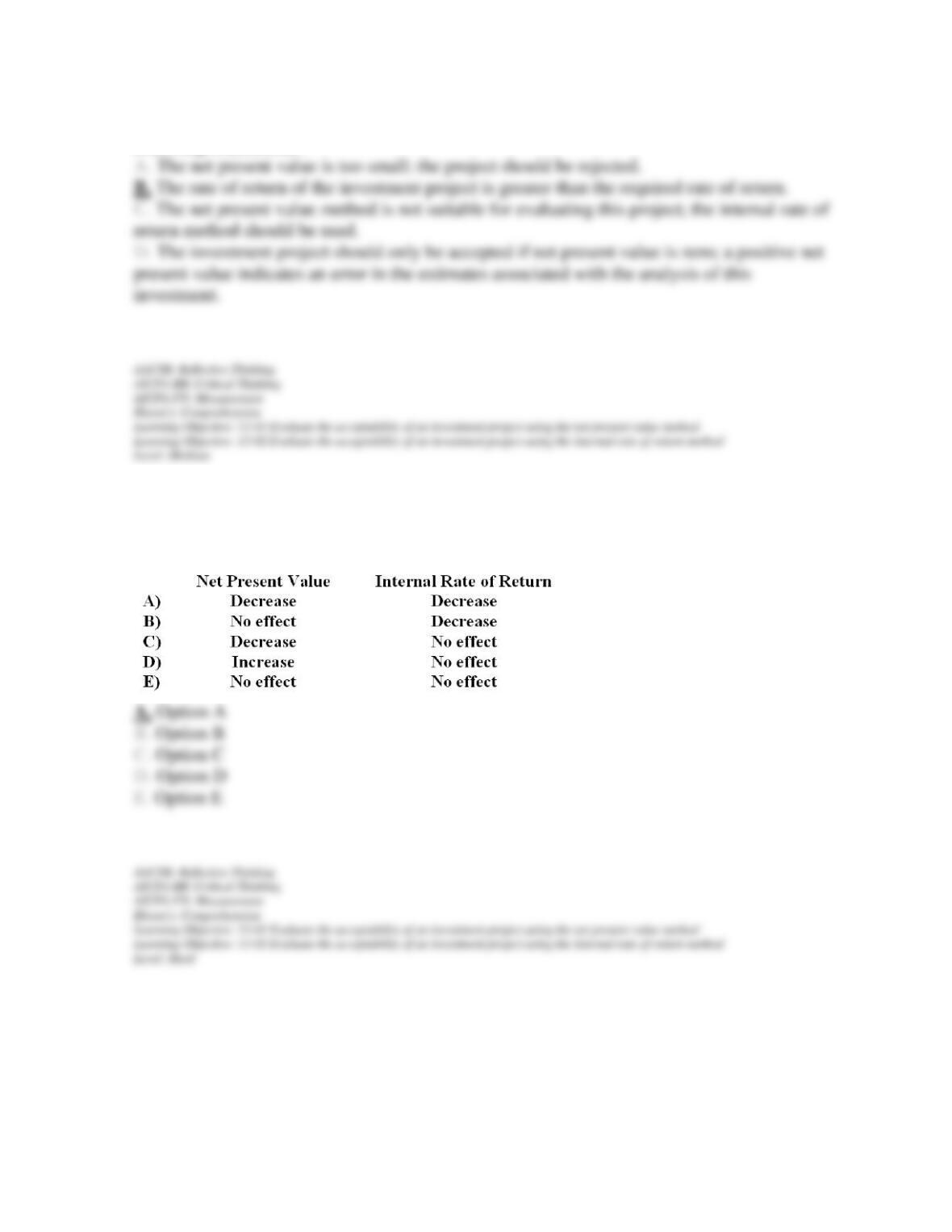
20. In capital budgeting, what will be the effect on the following if there is an increase in the
working capital needed for a project?
Chapter 13 Capital Budgeting Decisions
13–13
21. The capital budgeting method that recognizes the time value of money by discounting
cash flows over the life of the project, using the company’s required rate of return as the
discount rate is called the:
22. The internal rate of return of an investment project is the:
23. If an investment has a project profitability index of 0.15, then the:
Chapter 13 Capital Budgeting Decisions
13–14
24. If investment A has a payback period of 3 years and investment B has a payback period of
4 years, then:
25. Which one of the following statements about the payback method of capital budgeting is
correct?
26. The length of time required to recover the initial cash outlay for a project is determined by
using the:
Chapter 13 Capital Budgeting Decisions
13–15
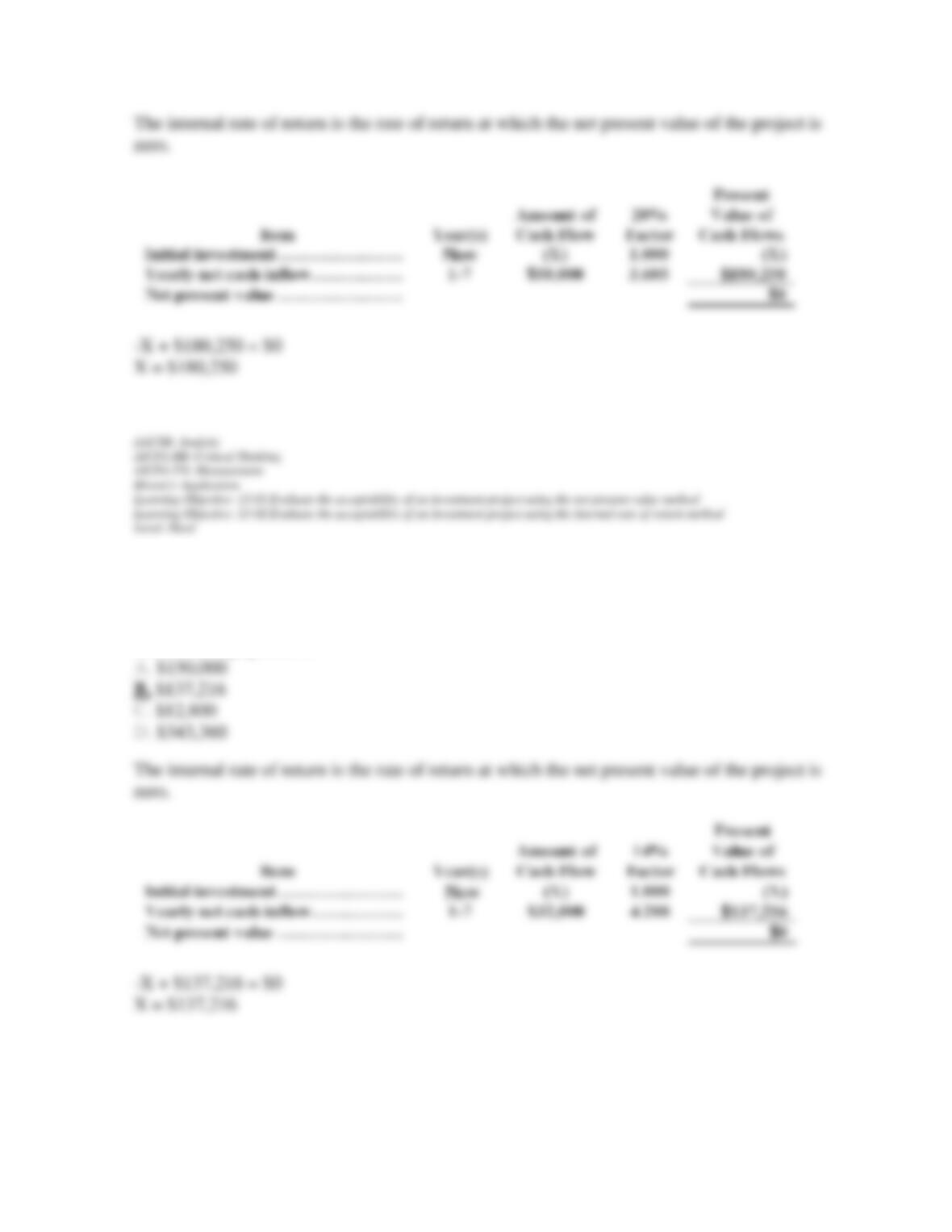
27. (Ignore income taxes in this problem.) An investment of P dollars now will yield cash
inflows of $3,000 at the end of the first year and $2,000 at the end of the fourth year. If the
internal rate of return for this investment is 20%, then the value of P is:
28. (Ignore income taxes in this problem.) The Baker Company purchased a piece of
equipment with the following expected results:
The initial cost of the equipment was:
Chapter 13 Capital Budgeting Decisions
13–16
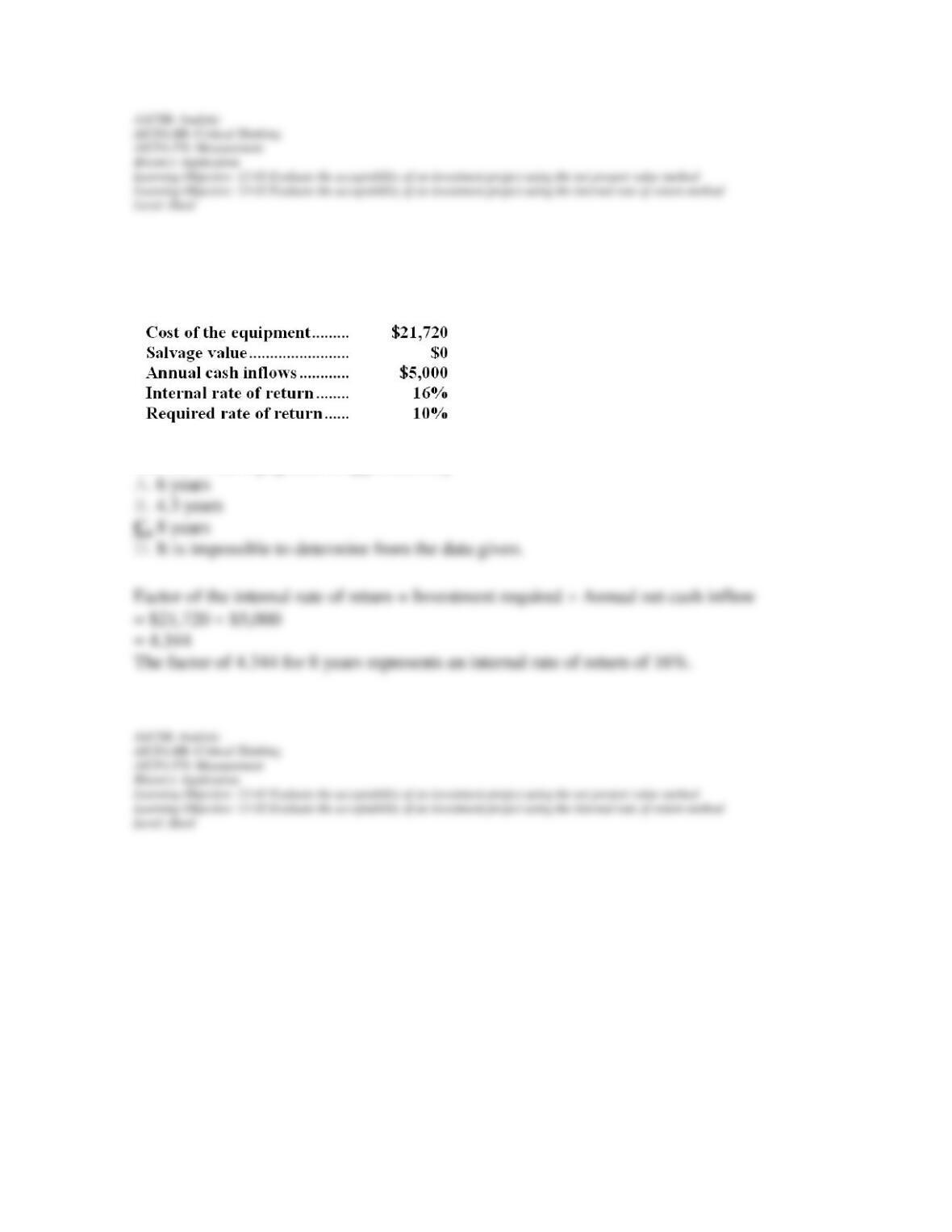
29. (Ignore income taxes in this problem.) The Yates Company purchased a piece of
equipment which is expected to have a useful life of 7 years with no salvage value at the end
of the 7-year period. This equipment is expected to generate a cash inflow of $32,000 each
year of its useful life. If this investment has a internal rate of return of 14%, then the initial
cost of the equipment is:
Chapter 13 Capital Budgeting Decisions
13–17
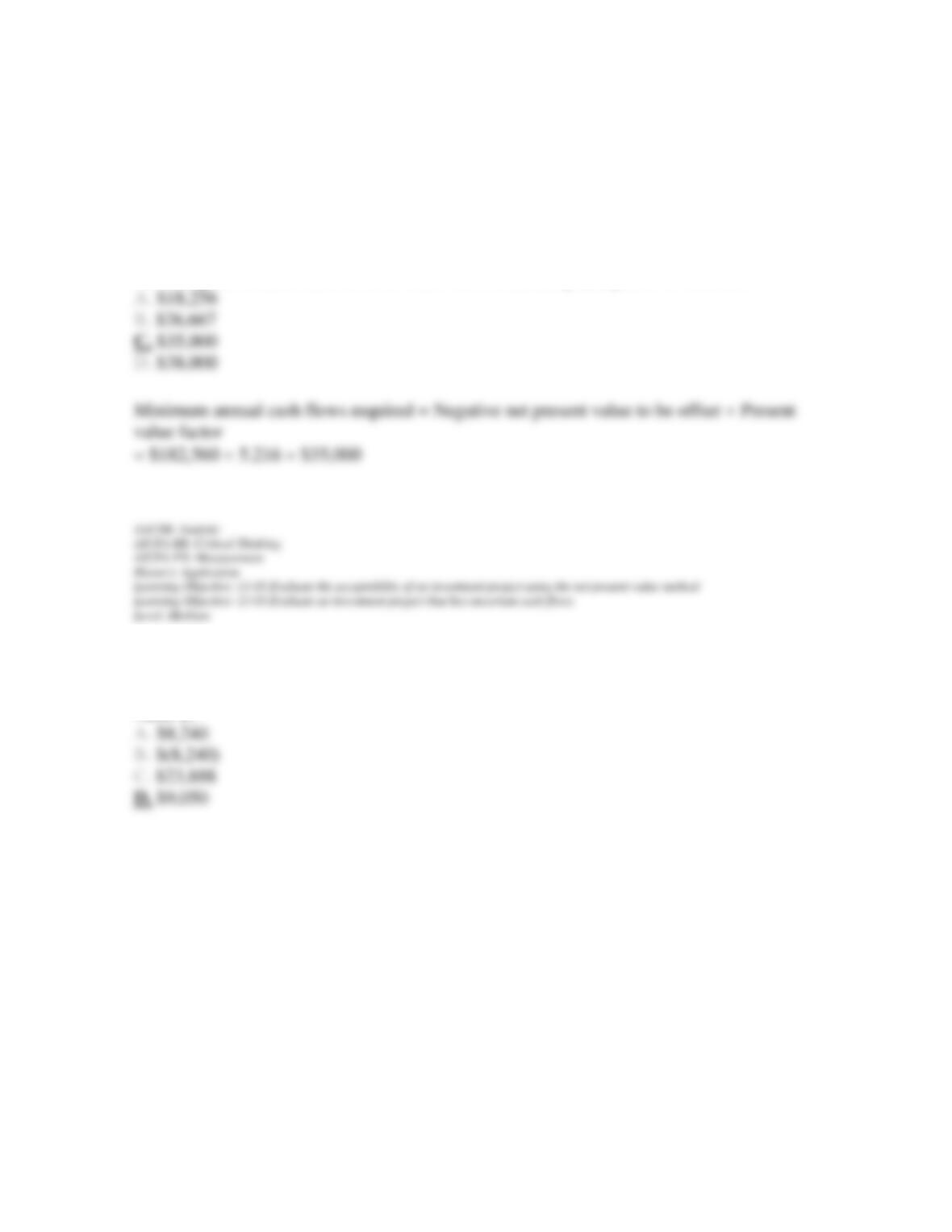
30. (Ignore income taxes in this problem.) The following information is available on a new
piece of equipment:
The life of the equipment is approximately:
Chapter 13 Capital Budgeting Decisions
13–18
31. (Ignore income taxes in this problem.) Mercredi, Inc., is considering investing in
automated equipment with a ten-year useful life. Managers at Highpoint have estimated the
cash flows associated with the tangible costs and benefits of automation, but have been unable
to estimate the cash flows associated with the intangible benefits. Using the company’s 14%
required rate of return, the net present value of the cash flows associated with just the tangible
costs and benefits is a negative $182,560. How large would the annual net cash inflows from
the intangible benefits have to be to make this a financially acceptable investment?
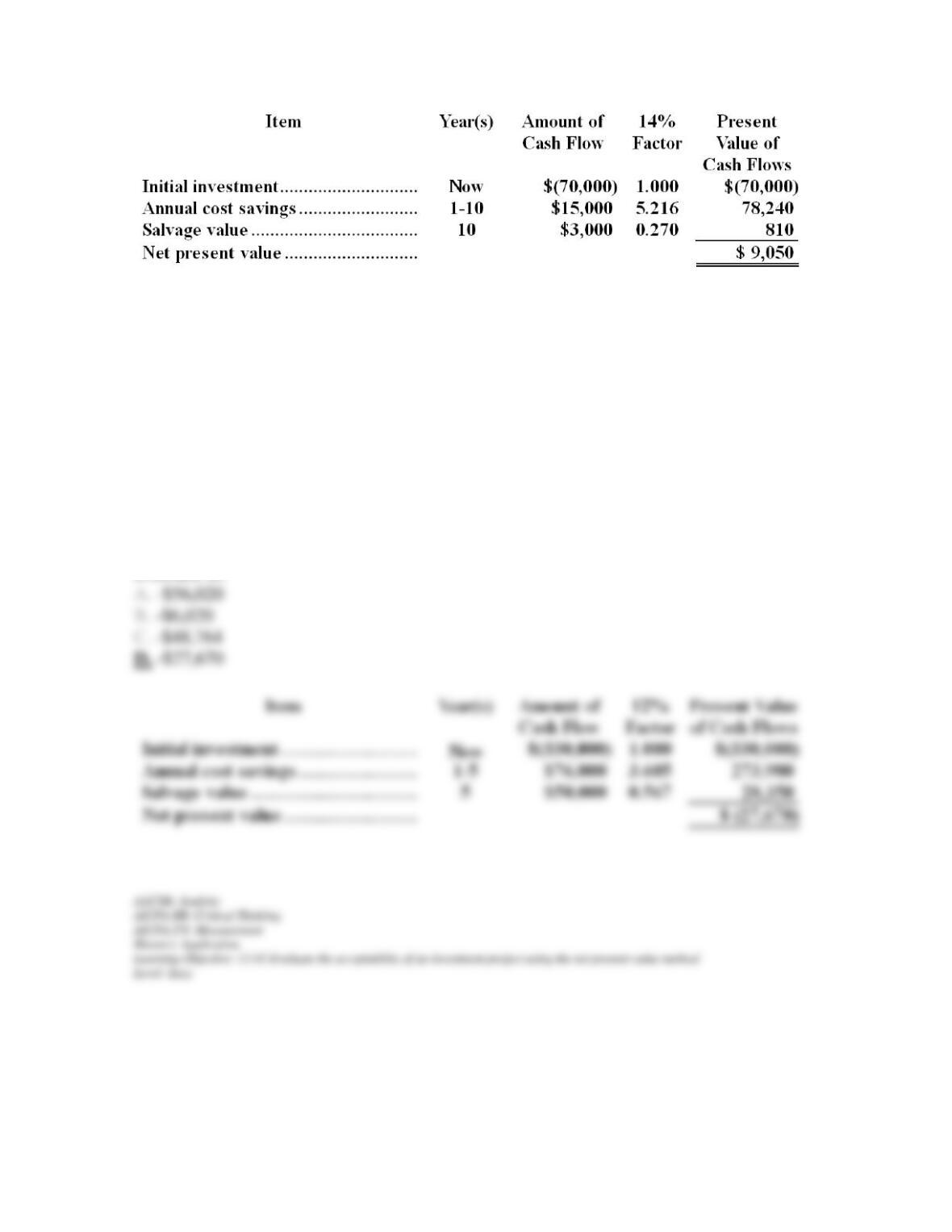
32. (Ignore income taxes in this problem.) A piece of new equipment will cost $70,000. The
equipment will provide a cost savings of $15,000 per year for ten years, after which it will
have a $3,000 salvage value. If the required rate of return is 14%, the equipment’s net present
value is:
Chapter 13 Capital Budgeting Decisions
13–19
AACSB: Analytic
AICPA BB: Critical Thinking
AICPA FN: Measurement
Bloom’s: Application
Learning Objective: 13-01 Evaluate the acceptability of an investment project using the net present value method
Level: Medium
33. (Ignore income taxes in this problem.) Sibble Corporation is considering the purchase of a
machine that would cost $330,000 and would last for 5 years. At the end of 5 years, the
machine would have a salvage value of $50,000. By reducing labor and other operating costs,
the machine would provide annual cost savings of $76,000. The company requires a minimum
pretax return of 12% on all investment projects. The net present value of the proposed project
is closest to:
Chapter 13 Capital Budgeting Decisions
13–20
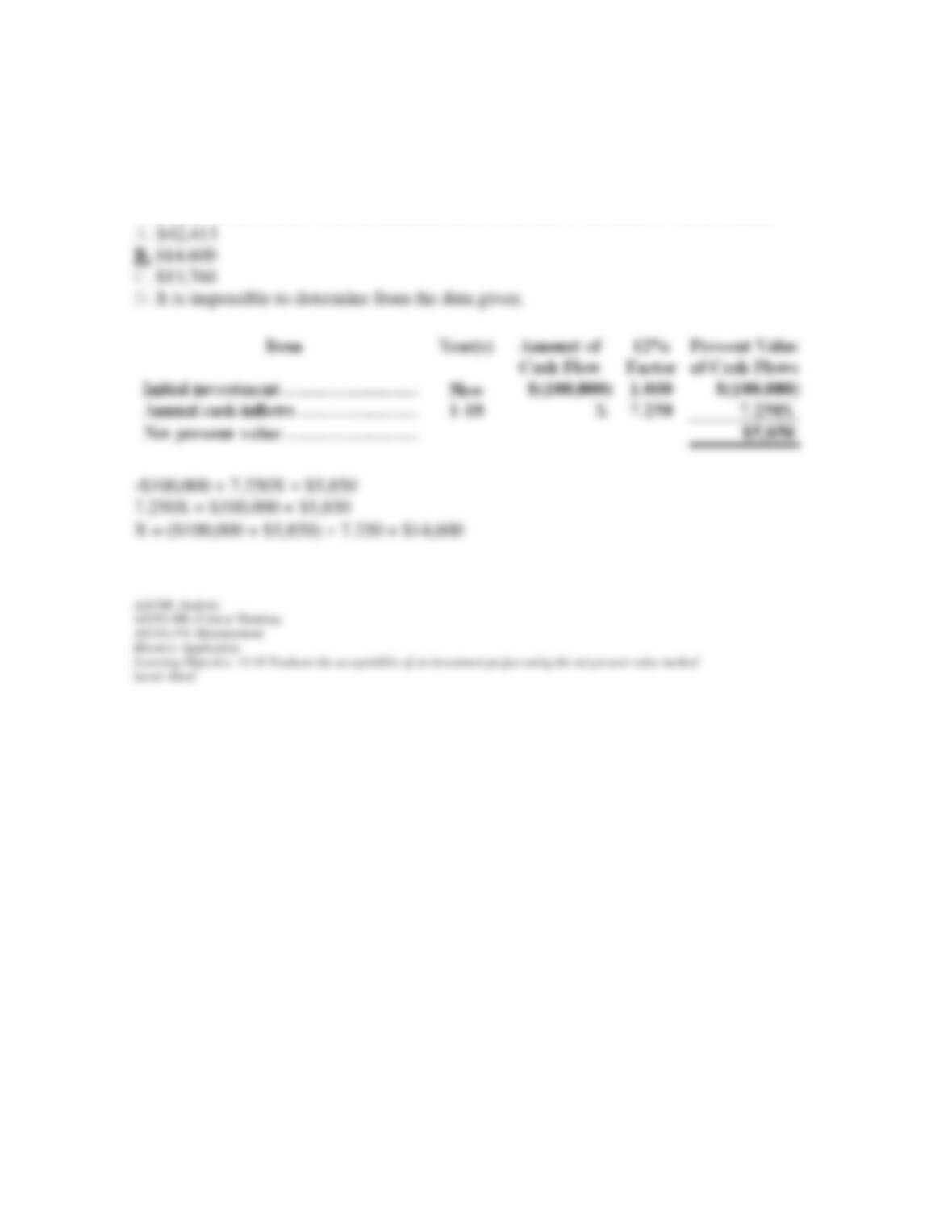
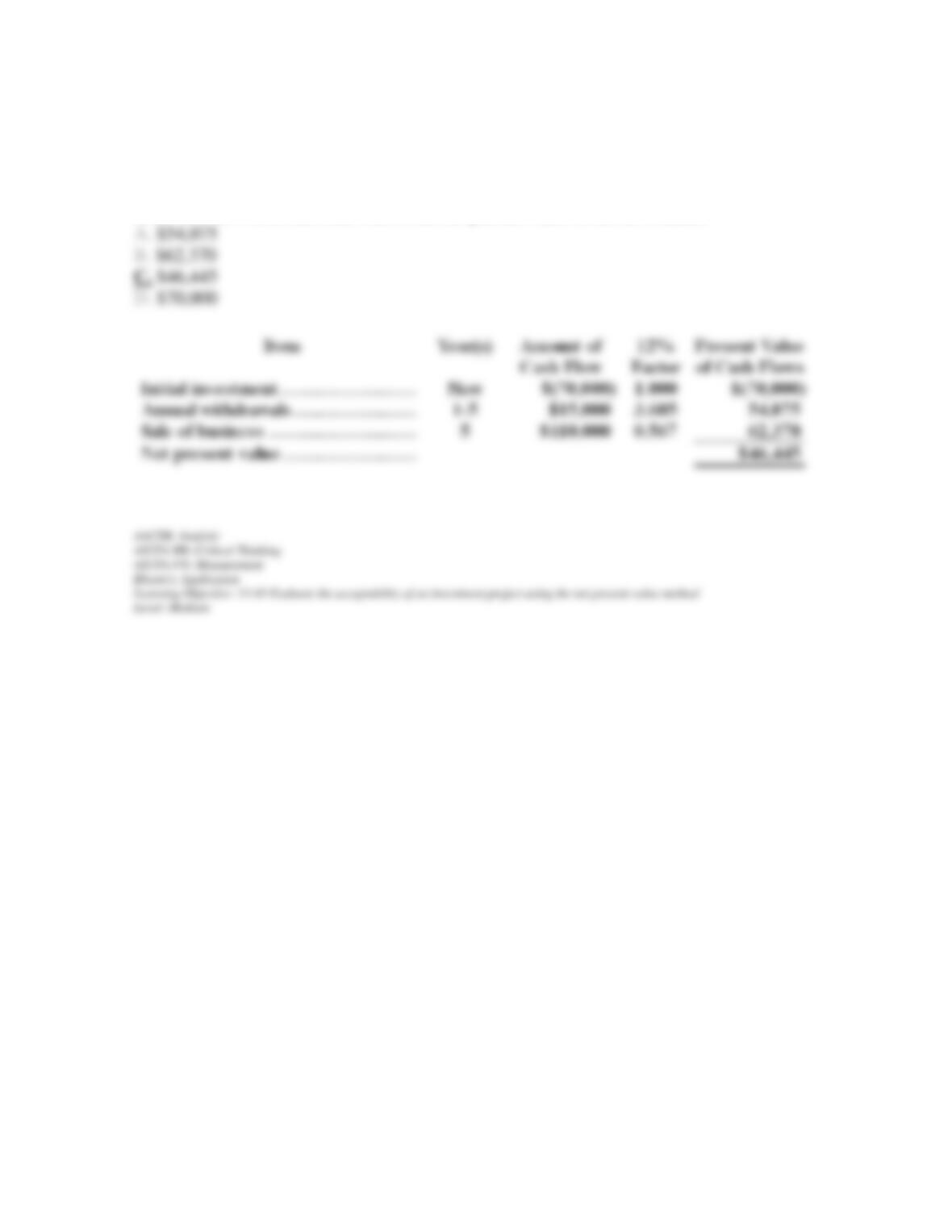
34. (Ignore income taxes in this problem.) Benz Company is considering the purchase of a
machine that costs $100,000, has a useful life of 18 years, and no salvage value. The
company’s discount rate is 12%. If the machine’s net present value is $5,850, then the annual
cash inflows associated with the machine must be (round to the nearest whole dollar):
Chapter 13 Capital Budgeting Decisions
13–21
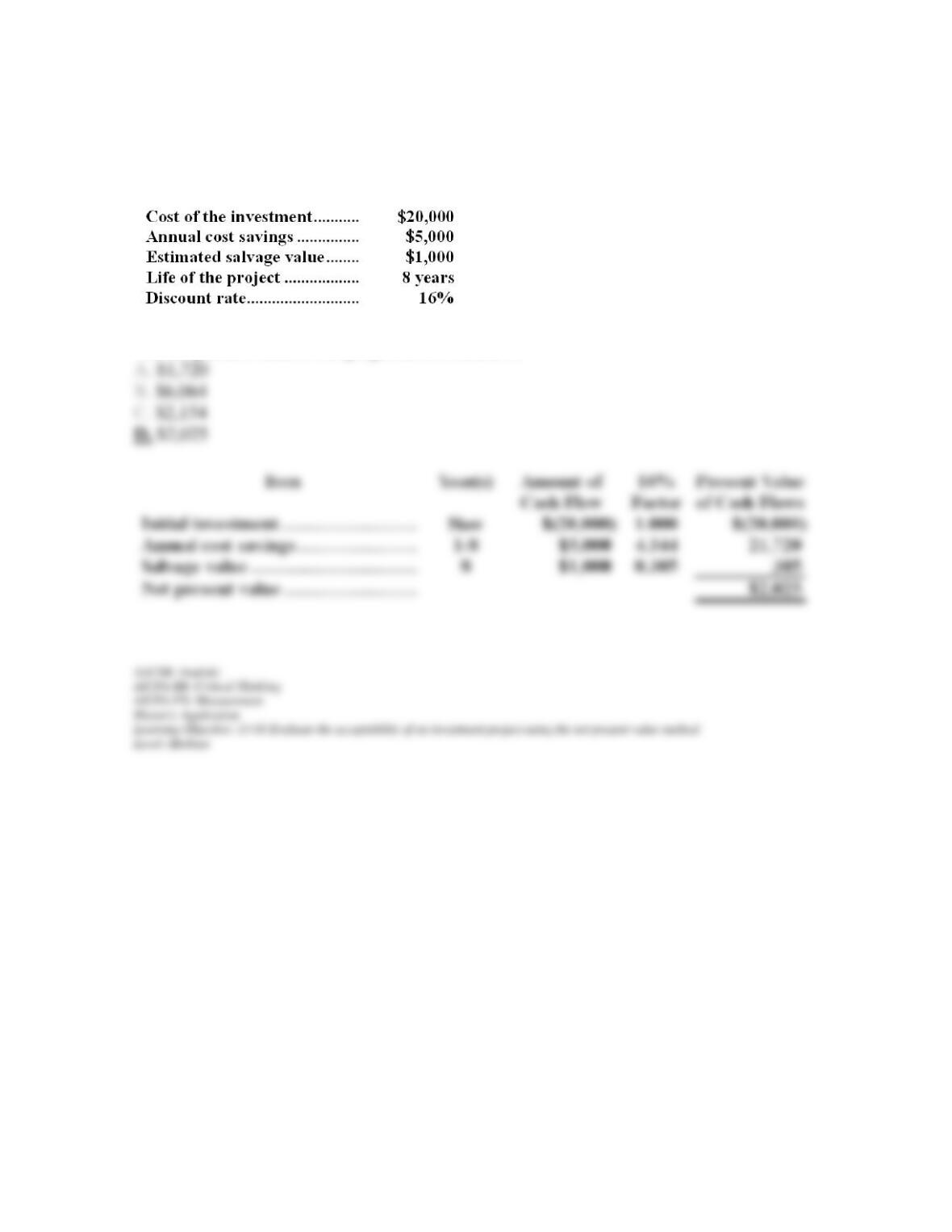
35. (Ignore income taxes in this problem.) Sam Weller is thinking of investing $70,000 to
start a bookstore. Sam plans to withdraw $15,000 from the business at the end of each year for
the next five years. At the end of the fifth year, Sam plans to sell the business for $110,000
cash. At a 12% discount rate, what is the net present value of the investment?
Chapter 13 Capital Budgeting Decisions
13–22
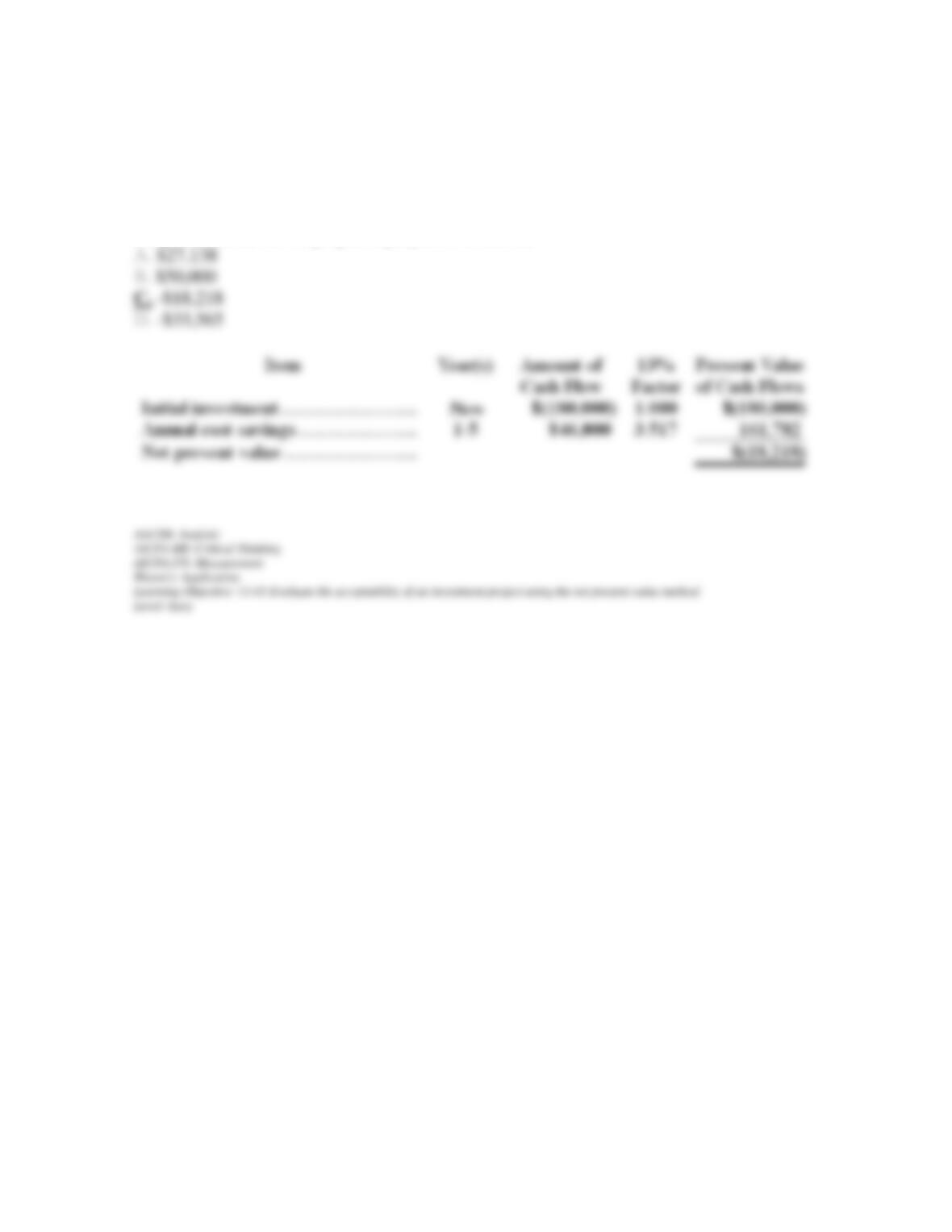
36. (Ignore income taxes in this problem.) The following data pertain to an investment
proposal:
The net present value of the proposed investment is:
Chapter 13 Capital Budgeting Decisions
13–23
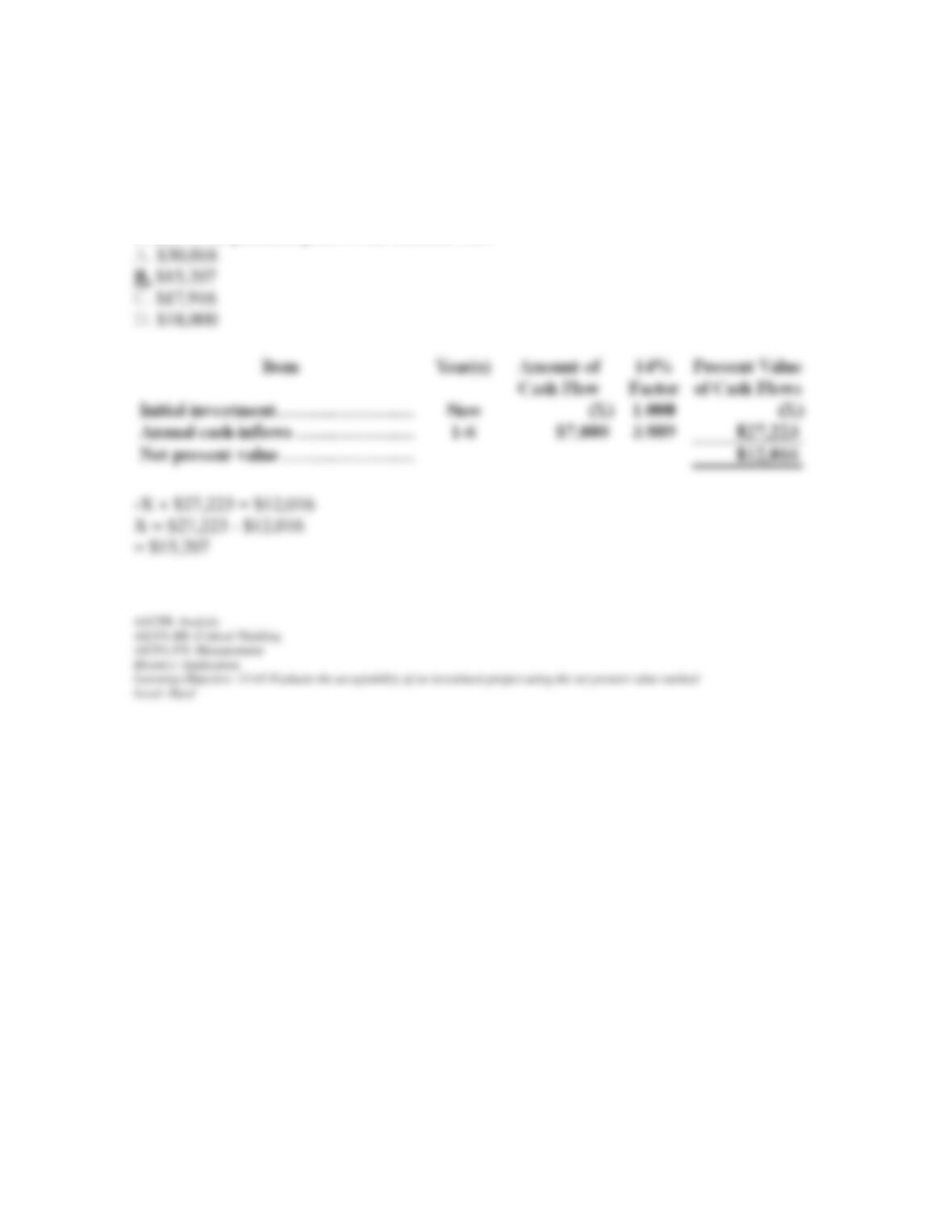
37. (Ignore income taxes in this problem) The management of Serpas Corporation is
considering the purchase of a machine that would cost $180,000, would last for 5 years, and
would have no salvage value. The machine would reduce labor and other costs by $46,000 per
year. The company requires a minimum pretax return of 13% on all investment projects. The
net present value of the proposed project is closest to:
Chapter 13 Capital Budgeting Decisions
13–24
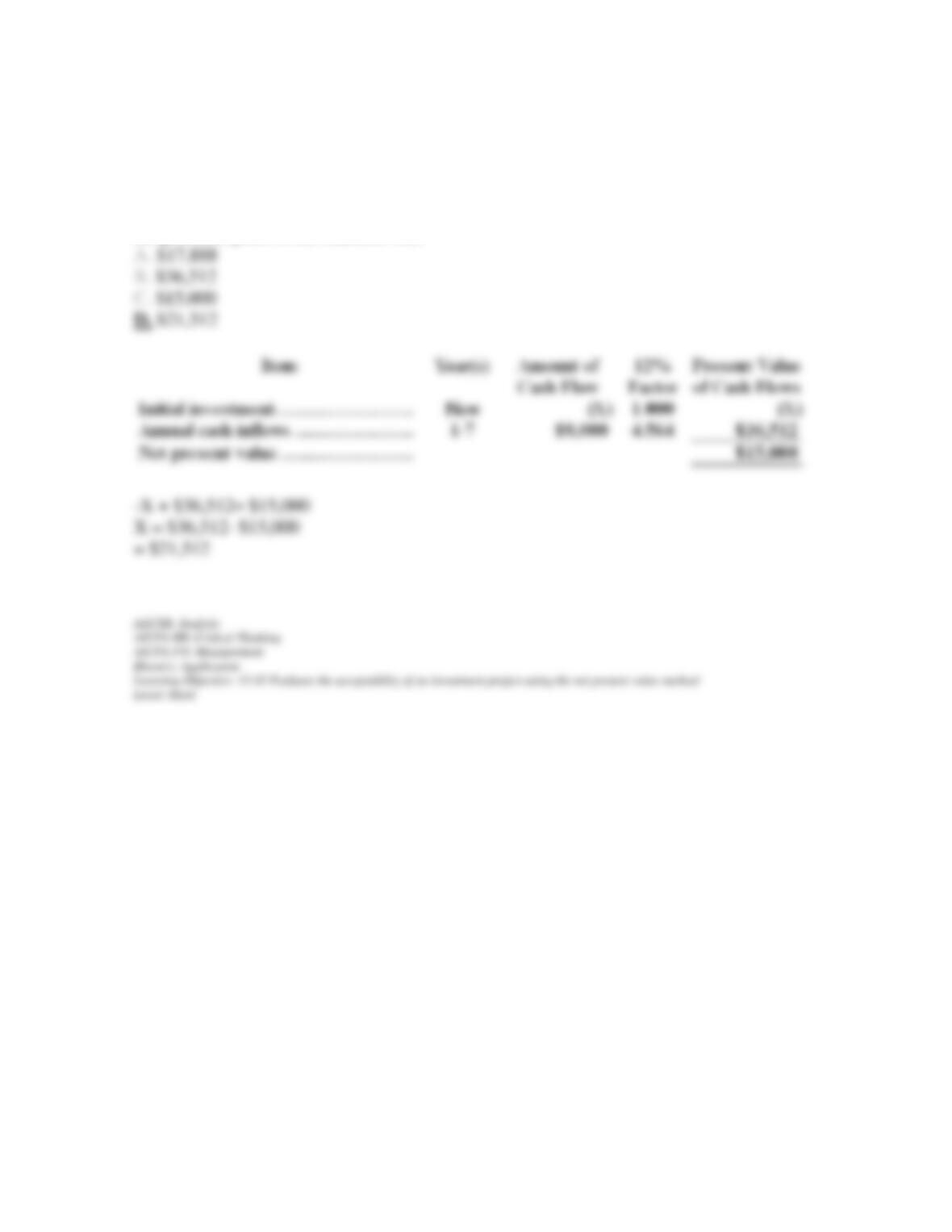
38. (Ignore income taxes in this problem.) The Gage Company purchased a machine which
will be depreciated by the straight-line method over its estimated 6 year life. The machine will
have no salvage value. It will generate cash inflows of $7,000 each year over the next 6 years.
Gage Company’s required rate of return is 14%. If the net present value of this investment is
$12,016, the purchase price of the machine was:
Chapter 13 Capital Budgeting Decisions
13–25
39. (Ignore income taxes in this problem.) Stutz Company purchased a machine with an
estimated useful life of seven years. The machine will generate cash inflows of $8,000 each
year over the next seven years. If the machine has no salvage value at the end of seven years,
if Stutz’s discount rate is 12%, and if the net present value of this investment is $15,000, then
the purchase price of the machine was: