CHAPTER 13
CURRENT LIABILITIES AND CONTINGENCIES
IFRS questions are available at the end of this chapter.
TRUE-FALSE—Conceptual
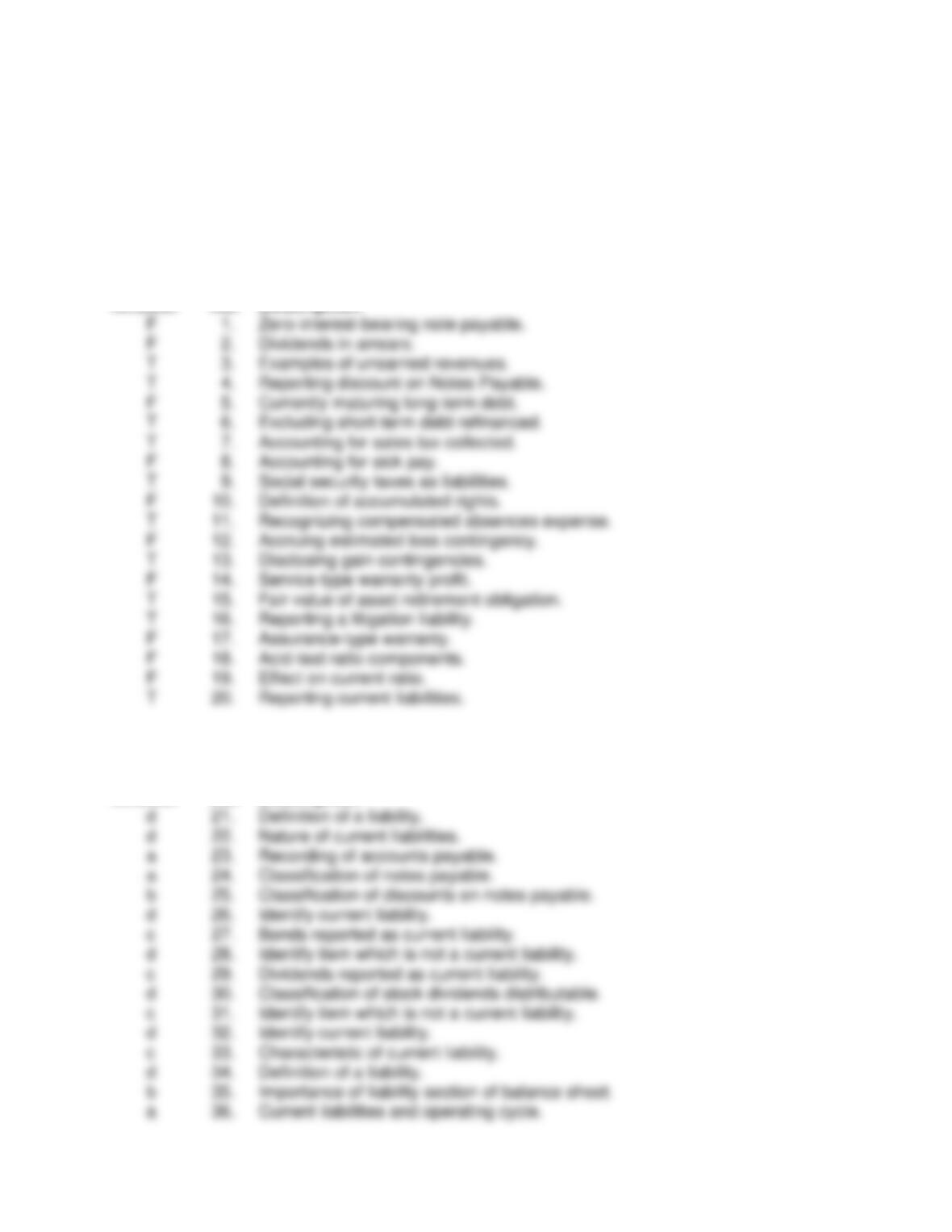
Answer No. Description
MULTIPLE CHOICE—Conceptual
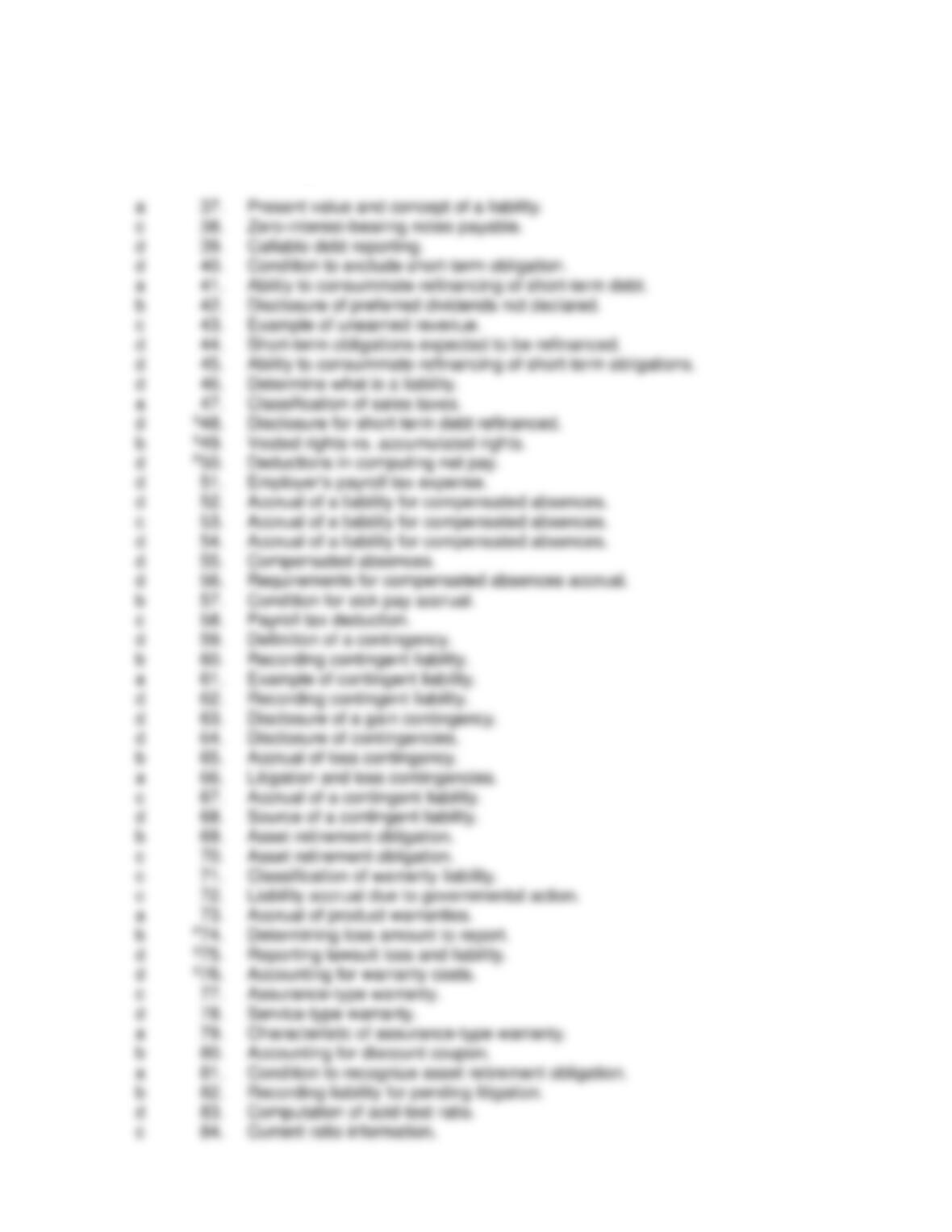
Answer No. Description
Test Bank for Intermediate Accounting, Sixteenth Edition
13 – 2
MULTIPLE CHOICE—Conceptual (cont.)
Answer No. Description
Current Liabilities and Contingencies
13 – 3
MULTIPLE CHOICE—Conceptual (cont.)
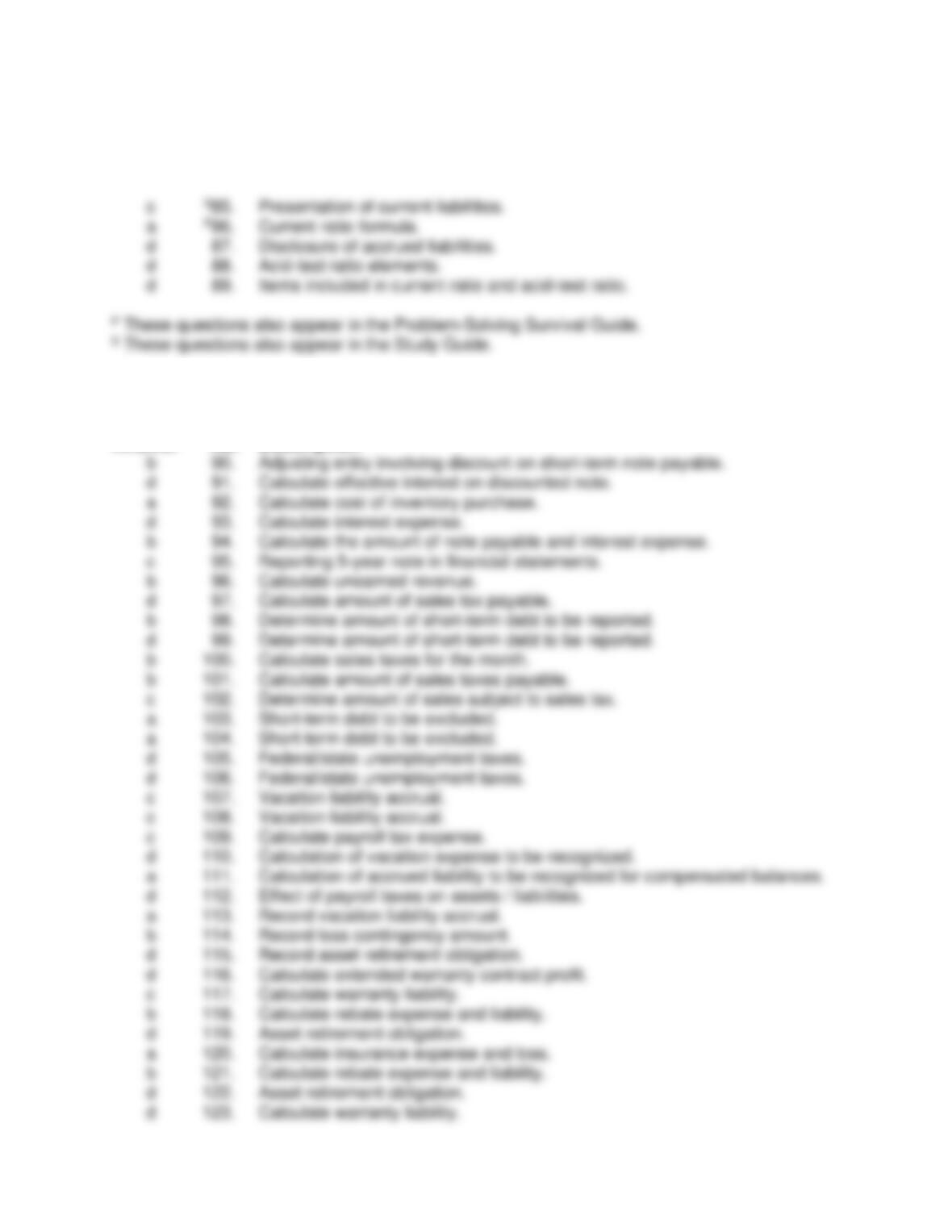
Answer No. Description
MULTIPLE CHOICE—Computational
Answer No. Description
Test Bank for Intermediate Accounting, Sixteenth Edition
13 – 4
MULTIPLE CHOICE—Computational (cont.)
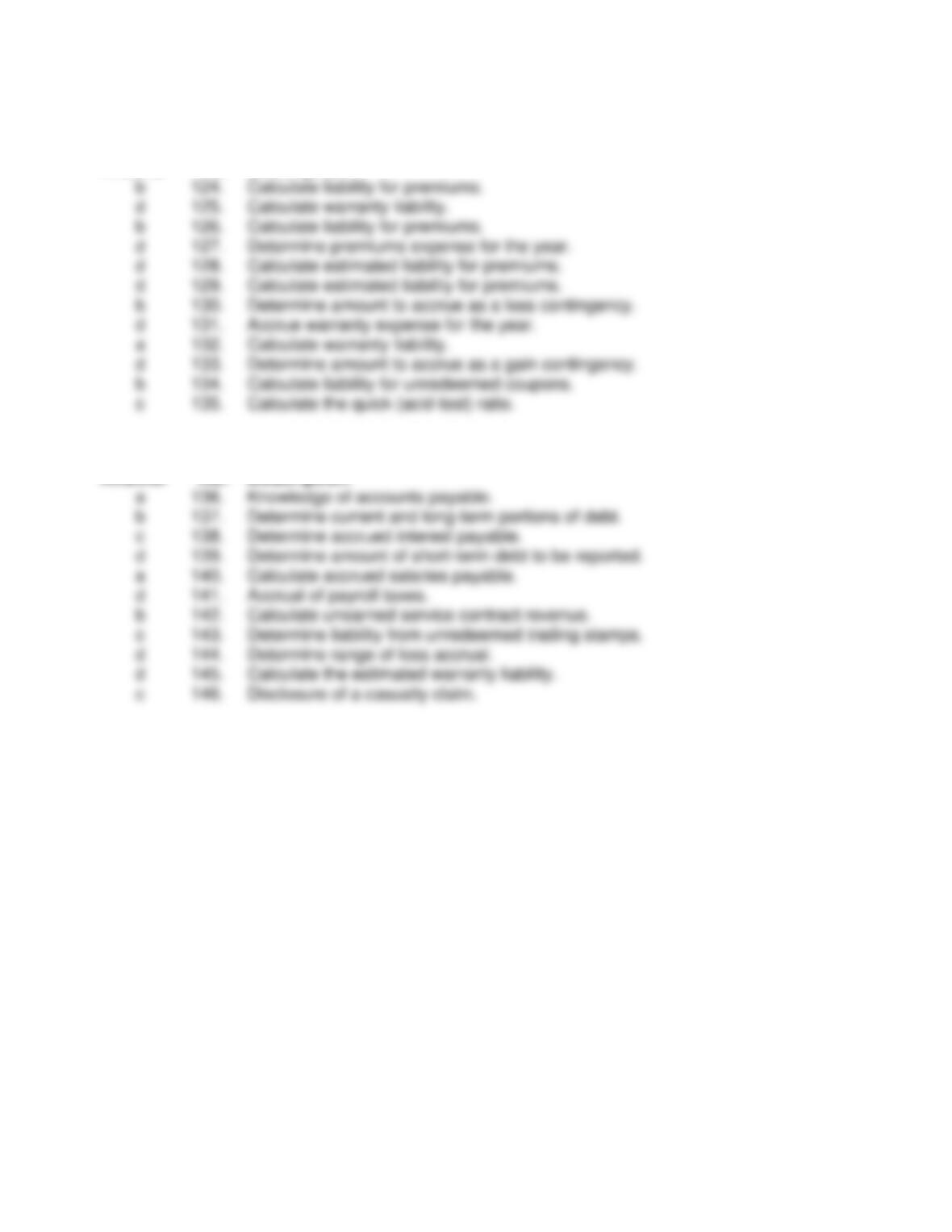
Answer No. Description
MULTIPLE CHOICE—CPA Adapted
Answer No. Description
BRIEF EXERCISES
Item Description
BE13-147 Notes payable.
BE13-148 Payroll entries.
EXERCISES
Item Description
E13-149 Compensated absences.
E13-150 Contingent liabilities.
E13-151 Premiums.
E13-152 Premiums.
PROBLEMS
Item Description
P13-153 Accounts and notes payable.
P13-154 Refinancing of short-term debt.
P13-155 Premiums.
P13-156 Warranties.

Current Liabilities and Contingencies
13 – 5
CHAPTER LEARNING OBJECTIVES
1. Describe the nature, valuation, and reporting of current liabilities.
2. Explain the classification issues of short-term debt expected to be refinanced.
3. Explain the accounting for gain and loss contingencies.
4. Indicate how to present and analyze liabilities and contingencies.
5. Compare the accounting procedures for current liabilities and contingencies under GAAP
and IFRS.
Test Bank for Intermediate Accounting, Sixteenth Edition
13 – 6
SUMMARY OF QUESTIONS BY LEARNING OBJECTIVES AND BLOOM’S TAXONOMY
Item
LO
BT
Item
LO
BT
Item
LO
BT
Item
LO
BT
Item
LO
BT
TRUE-FALSE STATEMENTS
1.
1
K
5.
1
K
9.
1
K
13.
3
K
17.
3
K
2.
1
K
6.
1
K
10.
1
K
14.
3
K
18.
4
C
3.
1
K
7.
2
K
11.
1
K
15.
3
K
19.
4
C
4.
1
K
8.
1
K
12.
3
K
16.
3
K
20.
4
K
MULTIPLE CHOICE QUESTIONS
21.
1
K
47.
1
K
73.
3
C
99.
1
AP
125.
3
AP
22.
1
C
48.
2
K
74.
3
C
100.
1
AP
126.
3
AP
23.
1
K
49.
1
C
75.
3
AP
101.
1
AP
127.
3
AP
24.
1
C
50.
1
K
76.
3
K
102.
1
AP
128.
3
AP
25.
1
K
51.
1
K
77.
3
K
103.
2
AP
129.
3
AP
26.
1
C
52.
1
K
78.
3
K
104.
2
AP
130.
3
AP
27.
1
C
53.
1
K
79.
3
K
105.
1
AP
131.
3
AP
28.
1
C
54.
1
K
80.
3
AP
106.
1
AP
132.
3
AP
29.
1
C
55.
1
K
81.
3
K
107.
1
AP
133.
3
AP
30.
1
K
56.
1
K
82.
3
K
108.
1
AP
134.
3
AP
31.
1
C
57.
1
K
83.
4
K
109.
1
AP
135.
4
AP
32.
1
C
58.
1
K
84.
4
K
110.
1
AP
136.
1
C
33.
1
K
59.
3
K
85.
4
K
111.
1
AP
137.
1
AP
34.
1
K
60.
3
K
86.
4
K
112.
1
AP
138.
1
AP
35.
1
C
61.
3
C
87.
4
K
113.
1
AP
139.
2
AP
36.
1
C
62.
3
K
88.
4
K
114.
3
AP
140.
1
AP
37.
1
C
63.
3
K
89.
4
K
115.
3
AP
141.
1
AP
38.
1
K
64.
3
K
90.
1
AP
116.
3
AP
142.
3
AP
39.
1
K
65.
3
K
91.
1
C
117.
3
AP
143.
3
AP
40.
2
K
66.
3
AP
92.
1
AP
118.
3
AP
144.
3
C
41.
2
C
67.
3
K
93.
1
AP
119.
3
AP
145.
3
AP
42.
1
AP
68.
3
K
94.
1
AP
120.
3
AP
146.
3
AP
43.
1
C
69.
3
K
95.
1
AP
121.
3
AP
44.
2
C
70.
3
K
96.
1
AP
122.
3
AP
45.
2
C
71.
3
C
97.
1
AP
123.
3
AP
46.
1
C
72.
3
AP
98.
1
AP
124.
3
AP
BRIEF EXERCISES
147.
1
AP
148.
1
AP
EXERCISES
149.
1
AP
150.
3
C
151.
3
AP
152.
3
AP
PROBLEMS
153.
1
AP
154.
2
AP
155.
3 ,4
AP
156.
3
AP
Current Liabilities and Contingencies
13 – 7
TRUE-FALSE—Conceptual
1. A zero-interest-bearing note payable that is issued at a discount will not result in any
interest expense being recognized.
2. Dividends in arrears on cumulative preferred stock should be recorded as a current liability.
3. Magazine subscriptions and airline ticket sales both result in unearned revenues.
4. Discount on Notes Payable is a contra account to Notes Payable on the balance sheet.
5. All long-term debt maturing within the next year must be classified as a current liability on
the balance sheet.
6. A short-term obligation can be excluded from current liabilities if the company intends to
refinance it on a long-term basis and demonstrates the ability to consummate the
refinancing.
7. Many companies do not segregate the sales tax collected and the amount of the sale at the
time of the sale.
8. A company must accrue a liability for sick pay that accumulates but does not vest.
9. Companies report the amount of social security taxes withheld from employees as well as
the companies’ matching portion as current liabilities until they are remitted.
10. Accumulated rights exist when an employer has an obligation to make payment to an
employee even after terminating his employment.
11. Companies should recognize the expense and related liability for compensated absences in
the year earned by employees.
Test Bank for Intermediate Accounting, Sixteenth Edition
13 – 8
12. Companies should accrue an estimated loss from a loss contingency if information available
prior to the issuance of financial statements indicates that it is reasonably possible that a
liability has been incurred.
13. A company discloses gain contingencies in the notes only when a high probability exists for
realizing them.
14. The revenue from a service-type warranty that covers several years should all be
recognized in the period the warranty is sold.
15. The fair value of an asset retirement obligation is recorded as both an increase to the
related asset and a liability.
16. The cause for litigation must have occurred on or before the date of the financial statements
to report a liability in the financial statements.
17. Under an assurance-type warranty, companies charge warranty costs only to the period in
which they comply with the warranty.
18. Prepaid insurance should be included in the numerator when computing the acid-test
(quick) ratio.
19. Paying a current liability with cash will always reduce the current ratio.
20. Current liabilities are usually recorded and reported in financial statements at their full
maturity value.
True False Answers—Conceptual
Item
Ans.
Item
Ans.
Item
Ans.
Item
Ans.
Current Liabilities and Contingencies
13 – 9
MULTIPLE CHOICE—Conceptual
21. Liabilities are
a. any accounts having credit balances after closing entries are made.
b. deferred credits that are recognized and measured in conformity with generally
accepted accounting principles.
c. obligations to transfer ownership shares to other entities in the future.
d. obligations arising from past transactions and payable in assets or services in the future.
22. Which of the following is a current liability?
a. A long-term debt maturing currently, which is to be paid with cash in a sinking fund
b. A long-term debt maturing currently, which is to be retired with proceeds from a new
debt issue
c. A long-term debt maturing currently, which is to be converted into common stock
d. None of these answers are correct.
23. Which of the following is true about accounts payable?
1. Accounts payable are also called trade accounts payable.
2. When accounts payable are recorded at the net amount, a Purchase Discounts
account will be used.
3. When accounts payable are recorded at the gross amount, a Purchase
Discounts Lost account will be used.
a. 1
b. 2
c. 3
d. Both 2 and 3 are true.
24. Among the short-term obligations of Larsen Company as of December 31, the balance
sheet date, are notes payable totaling $250,000 with the Dennison National Bank. These
are 90-day notes, renewable for another 90-day period. These notes should be classified
on the balance sheet of Larsen Company as
a. current liabilities.
b. deferred charges.
c. long-term liabilities.
d. intermediate debt.
25. Which of the following is not true about the discount on short-term notes payable?
a. The Discount on Notes Payable account has a debit balance.
b. The Discount on Notes Payable account should be reported as an asset on the
balance sheet.
c. When there is a discount on a note payable, the effective interest rate is higher than
the stated discount rate.
d. Discount on Notes Payable is a contra account to Notes Payable.
Test Bank for Intermediate Accounting, Sixteenth Edition
13 – 10
26. Which of the following may be a current liability?
a. Withheld Income Taxes
b. Deposits Received from Customers
c. Deferred Revenue
d. All of these answers are correct.
27. Which of the following items is a current liability?
a. Bonds (for which there is an adequate sinking fund properly classified as a long-term
investment) due in three months.
b. Bonds due in three years.
c. Bonds (for which there is an adequate appropriation of retained earnings) due in
eleven months.
d. Bonds to be refunded when due in eight months, there being no doubt about the
marketability of the refunding issue.
28. Which of the following should not be included in the current liabilities section of the
balance sheet?
a. Trade notes payable
b. Short-term zero-interest-bearing notes payable
c. The discount on short-term notes payable
d. All of these answers are correct.
29. Which of the following is a current liability?
a. Preferred dividends in arrears
b. A dividend payable in the form of additional shares of stock
c. A cash dividend payable to preferred stockholders
d. All of these answers are correct.
30. Stock dividends distributable should be classified on the
a. income statement as an expense.
b. balance sheet as an asset.
c. balance sheet as a liability.
d. balance sheet as an item of stockholders’ equity.
31. Of the following items, the only one which should not be classified as a current liability is
a. current maturities of long-term debt.
b. sales taxes payable.
c. short-term obligations expected to be refinanced.
d. unearned revenues.
Current Liabilities and Contingencies
13 – 11
32. An account which would be classified as a current liability is
a. dividends payable in the form of a company’s stock.
b. accounts payable—debit balances.
c. losses expected to be incurred within the next twelve months in excess of the
company’s insurance coverage.
d. none of these answers are correct.
33. Which of the following is a characteristic of a current liability but not a long-term liability?
a. Unavoidable obligation.
b. Present obligation that entails settlement by probable future transfer or use of cash,
goods, or services.
c. Liquidation is reasonably expected to require use of existing resources classified as
current assets or create other current liabilities.
d. Transaction or other event creating the liability has already occurred.
34. Which of the following is not considered a part of the definition of a liability?
a. Unavoidable obligation.
b. Transaction or other event creating the liability has already occurred.
c. Present obligation that entails settlement by probable future transfer or use of cash,
goods, or services.
d. Liquidation is reasonably expected to require use of existing resources classified as
current assets or create other current liabilities.
35. Why is the liability section of the balance sheet of primary importance to bankers?
a. To evaluate the entity’s credit quality.
b. To assist in understanding the entity’s liquidity.
c. To better understand sources of repayment.
d. To evaluate operating efficiency.
36. What is the relationship between current liabilities and a company’s operating cycle?
a. Liquidation of current liabilities is reasonably expected within the company’s operating
cycle (or one year if less).
b. Current liabilities are the result of operating transactions.
c. Current liabilities can’t exceed the amount incurred in one operating cycle.
d. There is no relationship between the two.
37. What is the relationship between present value and the concept of a liability?
a. Present values are used to measure certain liabilities.
b. Present values are not used to measure liabilities.
c. Present values are used to measure all liabilities.
d. Present values are only used to measure long-term liabilities.
Test Bank for Intermediate Accounting, Sixteenth Edition
13 – 12
38. What is a discount as it relates to zero-interest-bearing notes payable?
a. The discount represents the lender’s costs to underwrite the note.
b. The discount represents the credit quality of the borrower.
c. The discount represents the cost of borrowing.
d. The discount represents the allowance for uncollectible amounts.
39. Where is debt callable by the creditor reported on the debtor’s financial statements?
a. Long-term liability.
b. Current liability if the creditor intends to call the debt within the year, otherwise a long–
term liability.
c. Current liability if it is probable that creditor will call the debt within the year, otherwise
a long-term liability.
d. Current liability.
40. Which of the following is not a condition necessary to exclude a short-term obligation from
current liabilities?
a. Intend to refinance the obligation on a long-term basis.
b. Obligation must be due with one year.
c. Demonstrate the ability to complete the refinancing.
d. Subsequently refinance the obligation on a long-term basis.
41. Which of the following does not demonstrate evidence regarding the ability to
consummate a refinancing of short-term debt?
a. Management indicated that they are going to refinance the obligation.
b. Actually refinance the obligation.
c. Have capacity under existing financing agreements that can be used to refinance the
obligation.
d. Enter into a financing agreement that clearly permits the entity to refinance the
obligation.
42. A company has not declared a dividend on its cumulative preferred stock for the past
three years. What is the required accounting treatment or disclosure in this situation?
a. Record a liability for cumulative amount of preferred stock dividends not declared.
b. Disclose the amount of the dividends in arrears.
c. Record a liability for the current year’s dividends only.
d. No disclosure or recognition is required.
43. Which of the following situations may give rise to unearned revenue?
a. Providing trade credit to customers.
b. Selling inventory.
c. Selling magazine subscriptions.
d. Providing manufacturer warranties.
Current Liabilities and Contingencies
13 – 13
44. Which of the following statements is correct?
a. A company may exclude a short-term obligation from current liabilities if the firm
intends to refinance the obligation on a long-term basis.
b. A company may exclude a short-term obligation from current liabilities if the firm can
demonstrate an ability to consummate a refinancing.
c. A company may exclude a short-term obligation from current liabilities if it is paid off
after the balance sheet date and subsequently replaced by long-term debt before the
balance sheet is issued.
d. None of these answers are correct.
45. The ability to consummate the refinancing of a short-term obligation may be demon–
strated by
a. actually refinancing the obligation by issuing a long-term obligation after the date of
the balance sheet but before it is issued.
b. entering into a financing agreement that permits the enterprise to refinance the debt
on a long-term basis.
c. actually refinancing the obligation by issuing equity securities after the date of the
balance sheet but before it is issued.
d. all of these answers are correct.
46. Which of the following statements is false?
a. A company may exclude a short-term obligation from current liabilities if the firm
intends to refinance the obligation on a long-term basis and demonstrates an ability to
complete the refinancing.
b. Cash dividends should be recorded as a liability when they are declared by the board
of directors.
c. A zero-interest-bearing note does not explicitly state an interest rate on the face of the
note.
d. FICA taxes withheld from employees’ payroll checks should never be recorded as a
liability since the employer will eventually remit the amounts withheld to the
appropriate taxing authority.
47. Which of the following is not a correct statement about sales taxes?
a. Sales taxes are an expense of the seller.
b. Many companies record sales taxes in the sales account.
c. If sales taxes are included in the sales account, the first step to find the amount of
sales taxes is to divide sales by 1 plus the sales tax rate.
d. Sales Taxes Payable is classified as a current liability.
Test Bank for Intermediate Accounting, Sixteenth Edition
13 – 14
S48. If a short-term obligation is excluded from current liabilities because of refinancing, the
footnote to the financial statements describing this event should include all of the following
information except
a. a general description of the financing arrangement.
b. the terms of the new obligation incurred or to be incurred.
c. the terms of any equity security issued or to be issued.
d. the number of financing institutions that refused to refinance the debt, if any.
S49. In accounting for compensated absences, the difference between vested rights and
accumulated rights is that:
a. vested rights are normally for a longer period of employment than are accumulated
rights.
b. vested rights are not contingent upon an employee’s future service.
c. vested rights are a legal and binding obligation on the company, whereas
accumulated rights expire at the end of the accounting period in which they arose.
d. vested rights carry a stipulated dollar amount that is owed to the employee;
accumulated rights do not represent monetary compensation.
P50. An employee’s net (or take-home) pay is determined by gross earnings minus amounts for
income tax withholdings and the employee’s
a. portion of FICA taxes and unemployment taxes.
b. and employer’s portion of FICA taxes, and unemployment taxes.
c. portion of FICA taxes, unemployment taxes, and any union dues.
d. portion of FICA taxes and any union dues.
51. Which of these is not included in an employer’s payroll tax expense?
a. F.I.C.A. (social security) taxes
b. Federal unemployment taxes
c. State unemployment taxes
d. Federal income taxes
52. Which of the following is a condition for accruing a liability for the cost of compensation for
future absences?
a. The obligation relates to the rights that vest or accumulate.
b. Payment of the compensation is probable.
c. The obligation is attributable to employee services already performed.
d. All of these are conditions for the accrual.
Current Liabilities and Contingencies
13 – 15
53. A liability for compensated absences such as vacations, for which it is expected that
employees will be paid, should
a. be accrued during the period when the compensated time is expected to be used by
employees.
b. be accrued during the period following vesting.
c. be accrued during the period when earned.
d. not be accrued unless a written contractual obligation exists.
54. The amount of the liability for compensated absences should be based on
1. the current rates of pay in effect when employees earn the right to
compensated absences.
2. the future rates of pay expected to be paid when employees use
compensated time.
3. the present value of the amount expected to be paid in future periods.
a. 1.
b. 2.
c. 3.
d. Either 1 or 2 is acceptable.
55. What are compensated absences?
a. Unpaid time off.
b. A form of healthcare.
c. Payroll deductions.
d. Paid time off.
56. Which of the following gives rise to the requirement to accrue a liability for the cost of
compensated absences?
a. Payment is probable.
b. Employee rights vest or accumulate.
c. Amount can be reasonably estimated.
d. All of these answers are correct.
57. Under what conditions is an employer required to accrue a liability for sick pay?
a. Sick pay benefits can be reasonably estimated.
b. Sick pay benefits vest.
c. Sick pay benefits equal 100% of the pay.
d. Sick pay benefits accumulate.
Test Bank for Intermediate Accounting, Sixteenth Edition
13 – 16
58. Which of the following taxes does not represent a common employee payroll deduction?
a. Federal income taxes.
b. FICA taxes.
c. State unemployment taxes.
d. State income taxes.
59. What is a contingency?
a. An existing situation where certainty exists as to a gain or loss that will be resolved
when one or more future events occur or fail to occur.
b. An existing situation where uncertainty exists as to possible loss that will be resolved
when one or more future events occur.
c. An existing situation where uncertainty exists as to possible gain or loss that will not
be resolved in the foreseeable future.
d. An existing situation where uncertainty exists as to possible gain or loss that will be
resolved when one or more future events occur or fail to occur.
60. When is a contingent liability recorded?
a. When the amount can be reasonably estimated.
b. When the future events are probable to occur and the amount can be reasonably
estimated.
c. When the future events are probable to occur.
d. When the future events will possibly occur and the amount can be reasonably
estimated.
61. Which of the following is an example of a contingent liability?
a. Obligations related to product warranties.
b. Possible receipt from a litigation settlement.
c. Pending court case with a probable favorable outcome.
d. Tax loss carryforwards.
62. Which of the following terms is associated with recording a contingent liability?
a. Possible.
b. Likely.
c. Remote.
d. Probable.
63. Which of the following is the proper way to report some gain contingencies?
a. As an accrued amount.
b. As deferred revenue.
c. As an account receivable with additional disclosure explaining the nature of the
contingency.
d. As a disclosure only.
Current Liabilities and Contingencies
13 – 17
64. Which of the following contingencies need not be disclosed in the financial statements or
the related notes?
a. Probable losses not reasonably estimable
b. Environmental liabilities that cannot be reasonably estimated
c. Guarantees of indebtedness of others
d. All of these must be disclosed.
65. Which of the following sets of conditions would give rise to the accrual of a contingency
under current generally accepted accounting principles?
a. Amount of loss is reasonably estimable and event occurs infrequently.
b. Amount of loss is reasonably estimable and occurrence of event is probable.
c. Event is unusual in nature and occurrence of event is probable.
d. Event is unusual in nature and event occurs infrequently.
66. Jeff Brown is a farmer who owns land which borders on the right-of-way of the Northern
Railroad. On August 10, 2017, due to the admitted negligence of the Railroad, hay on the
farm was set on fire and burned. Brown had a dispute with the Railroad for several years
concerning the ownership of a small parcel of land. The representative of the Railroad has
offered to assign any rights which the Railroad may have in the land to Brown in exchange
for a release of his right to reimbursement for the loss he has sustained from the fire.
Brown appears inclined to accept the Railroad’s offer. The Railroad’s 2017 financial
statements should include the following related to the incident:
a. recognition of a loss and creation of a liability for the value of the land.
b. recognition of a loss only.
c. creation of a liability only.
d. disclosure in note form only.
67. A loss contingency can be accrued when
a. it is certain that funds are available to settle the disputed amount.
b. an asset may have been impaired.
c. the amount of the loss can be reasonably estimated and it is probable that an asset
has been impaired or a liability has been incurred.
d. it is probable that an asset has been impaired or a liability incurred even though the
amount of the loss cannot be reasonably estimated.
68. A contingent liability
a. definitely exists as a liability but its amount and due date are indeterminable.
b. is accrued even though not reasonably estimated.
c. is not disclosed in the financial statements.
d. is the result of a loss contingency.
Test Bank for Intermediate Accounting, Sixteenth Edition
13 – 18
69. To record an asset retirement obligation (ARO), the cost associated with the ARO is
a. expensed.
b. included in the carrying amount of the related long-lived asset.
c. included in a separate account.
d. capitalized over the asset’s useful life.
70. A company is legally obligated for the costs associated with the retirement of a long-lived
asset
a. only when it hires another party to perform the retirement activities.
b. only if it performs the activities with its own workforce and equipment.
c. whether it hires another party to perform the retirement activities or performs the
activities itself.
d. when it is probable the asset will be retired.
71. Assume that a manufacturing corporation has (1) good quality control, (2) a one-year
operating cycle, (3) a relatively stable pattern of annual sales, and (4) a continuing policy
of guaranteeing new products against defects for three years that has resulted in material
but rather stable warranty repair and replacement costs. Any liability for the warranty
a. should be reported as long-term.
b. should be reported as current.
c. should be reported as part current and part long-term.
d. need not be disclosed.
72. Overton Corporation, a manufacturer of household paints, is preparing annual financial
statements at December 31, 2017. Because of a recently proven health hazard in one of
its paints, the government has clearly indicated its intention of having Overton recall all
cans of this paint sold in the last six months. The management of Overton estimates that
this recall would cost $800,000. What accounting recognition, if any, should be accorded
this situation?
a. No recognition
b. Note disclosure only
c. Operating expense of $800,000 and liability of $800,000
d. Appropriation of retained earnings of $800,000
73. Information available prior to the issuance of the financial statements indicates that it is
probable that, at the date of the financial statements, a liability has been incurred for
obligations related to product warranties. The amount of the loss involved can be
reasonably estimated. Based on the above facts, an estimated loss contingency should be
a. accrued.
b. disclosed but not accrued.
c. neither accrued nor disclosed.
d. classified as an appropriation of retained earnings.
Current Liabilities and Contingencies
13 – 19
74. Martinez Co. has a loss contingency to accrue. The loss amount can only be reasonably
estimated within a range of outcomes. No single amount within the range is a better
estimate than any other amount. The amount of loss accrual should be
a. zero.
b. the minimum of the range.
c. the mean of the range.
d. the maximum of the range.
S75. Darren Company becomes aware of a lawsuit after the date of the financial statements,
but before they are issued. A loss and related liability should be reported in the financial
statements if the amount can be reasonably estimated, an unfavorable outcome is highly
probable, and
a. the Darren Company admits guilt.
b. the court will decide the case within one year.
c. the damages appear to be material.
d. the cause for action occurred during the accounting period covered by the financial
statements.
S76. Accounting for product warranty costs under an assurance-type warranty
a. is required for federal income tax purposes.
b. is frequently justified on the basis of expediency when warranty costs are immaterial.
c. charges an expense account when the seller performs in compliance with the
warranty.
d. represents accepted practice and should be used whenever the warranty is an integral
and inseparable part of the sale.
77. Which of the following best describes the accounting for assurance-type warranty costs?
a. Expensed when paid.
b. Expensed when warranty claims are certain.
c. Expensed based on estimate in year of sale.
d. Expensed when incurred.
78. In a service-type warranty, warranty revenue is
a. recognized in the year of sale.
b. not recognized.
c. recognized only in the last year of the warranty period.
d. recognized equally over the warranty period.
79. Which of the following is a characteristic of an assurance-type warranty, but not a service–
type warranty?
a. Warranty liability.
b. Warranty expense.
c. Unearned warranty revenue.
d. Warranty revenue.
Test Bank for Intermediate Accounting, Sixteenth Edition
13 – 20
80. An electronics store is running a promotion where for every video game purchased, the
customer receives a coupon upon checkout to purchase a second game at a 50%
discount. The coupons expire in one year. The store normally recognized a gross profit
margin of 40% of the selling price on video games. How would the store account for a
purchase using the discount coupon?
a. The reduction in sales price attributed to the coupon is recognized as premium
expense.
b. The difference between the cost of the video game and the cash received is
recognized as premium expense.
c. Premium expense is not recognized.
d. The difference between the cost of the video game and the selling price prior to the
coupon is recognized as premium expense.
81. What condition(s) is/are necessary to recognize an asset retirement obligation?
a. Company has an existing legal obligation and can reasonably estimate the amount of
the liability.
b. Company can reasonably estimate the amount of the liability.
c. Company has an existing legal obligation.
d. Obligation event has occurred.
82. Which of the following is not a factor that is considered when evaluating whether or not to
record a liability for pending litigation?
a. Time period in which the underlying cause of action occurred.
b. The type of litigation involved.
c. The probability of an unfavorable outcome.
d. The ability to make a reasonable estimate of the amount of the loss.
83. How do you determine the acid-test ratio?
a. The sum of cash and short-term investments divided by short-term debt.
b. Current assets divided by current liabilities.
c. Current assets divided by short-term debt.
d. The sum of cash, short-term investments and net receivables divided by current
liabilities.
84. What does the current ratio inform you about a company?
a. The extent of slow-moving inventories.
b. The efficient use of assets.
c. The company’s liquidity.
d. The company’s profitability.