
Chapter 13: Marketable Securities and Derivatives Key
1. The future value of held-to-maturity debt securities reflects the economic opportunity cost of continuing to
hold the securities.
2. Acquisition and disposition of trading securities are usually financing activities.
3. U.S. GAAP and IFRS require firms to classify marketable securities that are neither debt securities held to
maturity nor trading securities as securities available-for-sale.
4. The term marketable securities refers to the financial instruments that firms classify as held-to-maturity,
trading, or available-for-sale securities, recognizing that the term does not have a precise definition in U.S.
GAAP or IFRS.
5. The transfer of a held-to-maturity investment in debt securities to either trading securities or securities
available-for-sale would call into question the original designation of that investment.
6. A firm initially records the purchase of marketable securities at acquisition cost, which includes the purchase
price plus any commissions, taxes, and other appropriate costs incurred.
7. If a held-to-maturity security is deemed to be impaired, the investor recognizes (debits) the balance sheet
carrying value of the investment and reduces (credits) an impairment loss (included in net income).

8. Securities available-for-sale that a firm intends to sell within one year appear in marketable securities in the
current assets section of the balance sheet.
9. Management can sell securities with unrealized holding gains (or losses) and transfer through net income to
Retained Earnings the entire unrealized holding gain (or loss)—that is, management can affect the timing of
gain or loss recognition in net income for both securities available-for-sale and trading securities.
10. A derivative is a financial instrument whose value changes in response to changes in an underlying
observable variable, such as a stock price, an interest rate, a currency exchange rate, or a commodity price.
11. Both U.S. GAAP and IFRS require that firms record derivatives at their fair values on the balance sheet
date.
12. A derivative may have zero initial cost, but potentially large positive or negative fair values later.
13. In both U.S. GAAP and IFRS, hedge accounting is elective; firms need not designate any derivatives as
accounting hedges, regardless of the degree to which the derivatives mitigate the volatility of outcomes of other
arrangements.
14. Firms might use a particular derivative to hedge fair value and to hedge cash flows.
15. When accounting for a fair value hedge of a recognized asset or liability, at the end of each period, the firm
remeasures the hedged asset or liability to fair value and includes the resulting gain or loss in net income, and
the derivative instrument (hedging instrument) to fair value and includes the resulting loss or gain in net
income.
16. Gains and losses on effective cash flow hedges initially affect other comprehensive income, not net
income.
17. Firms initially record trading securities at fair value, excluding transactions costs (which firms expense as
they incur them).
18. Gains and losses on derivatives not designated as hedges of a specific risk, gains and losses on fair value
hedges, and the ineffective portion of cash flow hedges affect net income simultaneously with changes in fair
value.
19. Measurement of trading securities at fair value reflects income when it occurs in the form of a change in fair
value, not when the investor realizes a gain or loss at the time of sale.
20. Which of the following is/are true?
21. U.S. GAAP requires which of the following disclosures about marketable securities each period?
22. The provisions of U.S. GAAP require firms to classify marketable securities into which categories?
23. The provisions of U.S. GAAP require firms to classify marketable securities into the following categories
except
24. To be classified as a current asset, marketable securities must be readily convertible into cash and
25. The provisions of IFRS require firms to classify marketable securities into which of the following
categories?
26. Which of the following is/are true regarding securities classified as available-for-sale?
27. The provisions of IFRS require firms to classify marketable securities into which of the following categories
except
28. For financial reporting purposes, acquisition and disposition of trading securities are usually _____
activities.
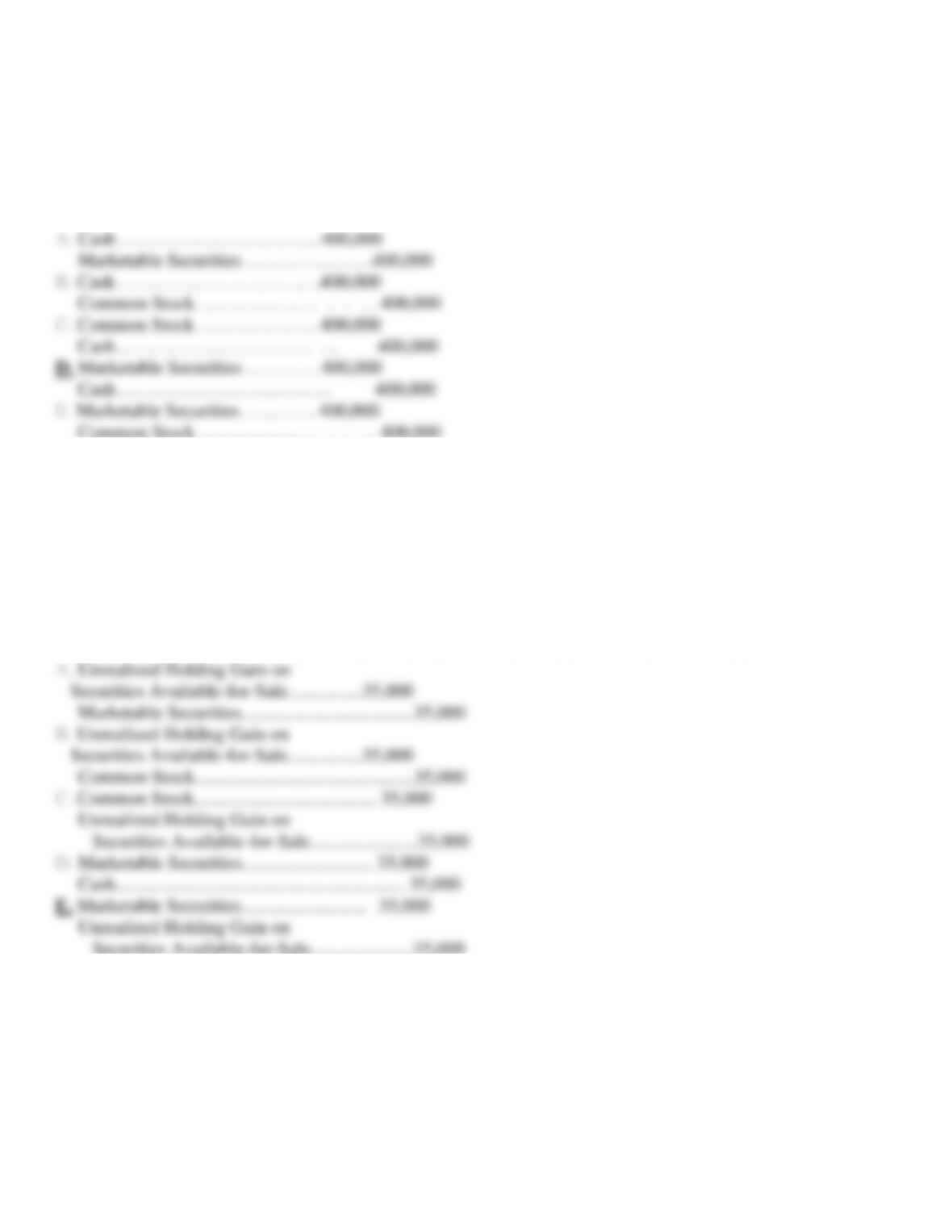
29. Kerry Corporation acquires the publicly traded debt of Jett Corporation on December 31, Year 1 as a
temporary investment of excess cash. The securities mature in 4 years. How will the securities be recorded on
Kerry’s December 31, Year 1 financial statement?
30. The term _____ implies active and frequent buying and selling with the objective of generating profits from
short-term changes in market prices.
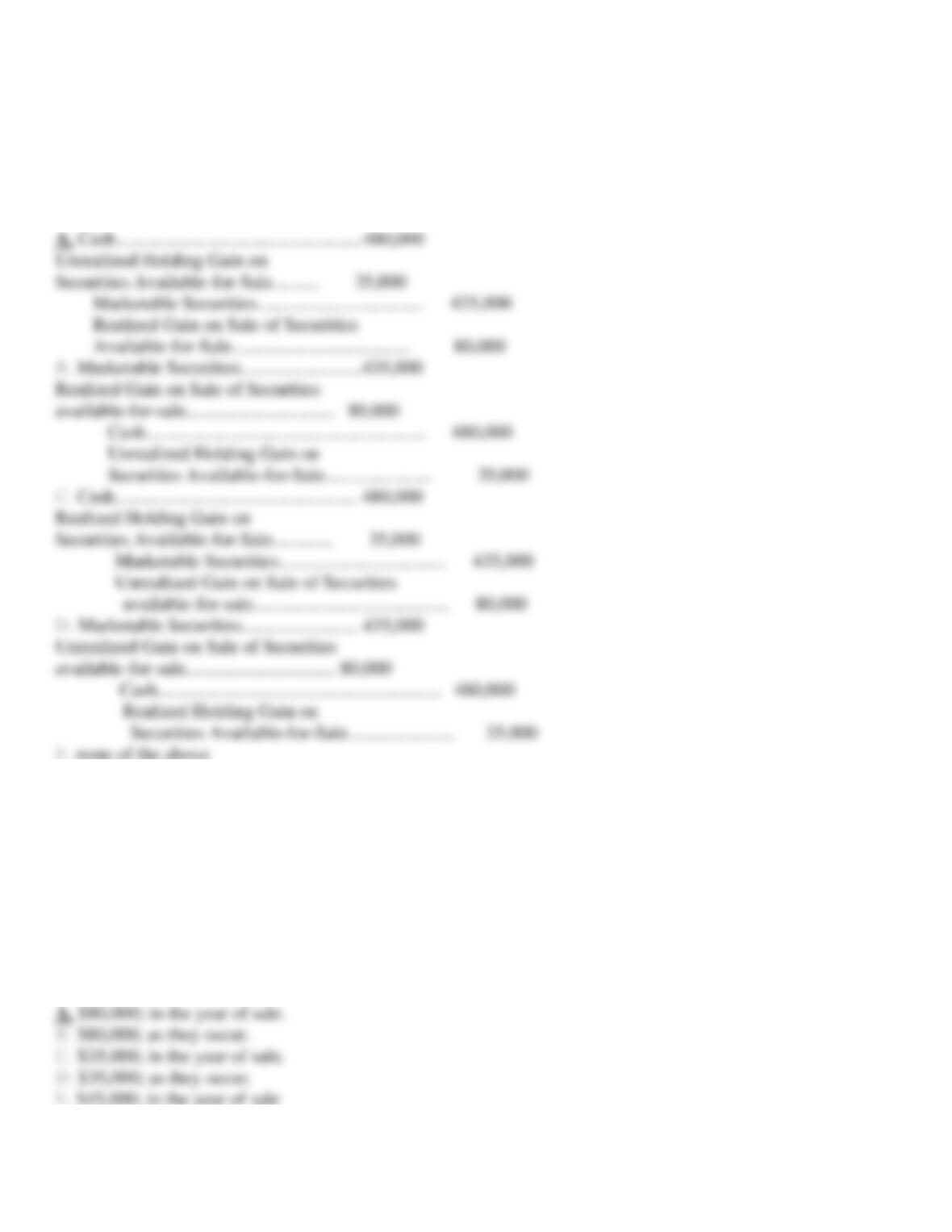
31. U.S. GAAP and IFRS require firms to classify marketable securities that are neither debt securities held to
maturity nor trading securities as _____.
32. Which of the following is/are not true?
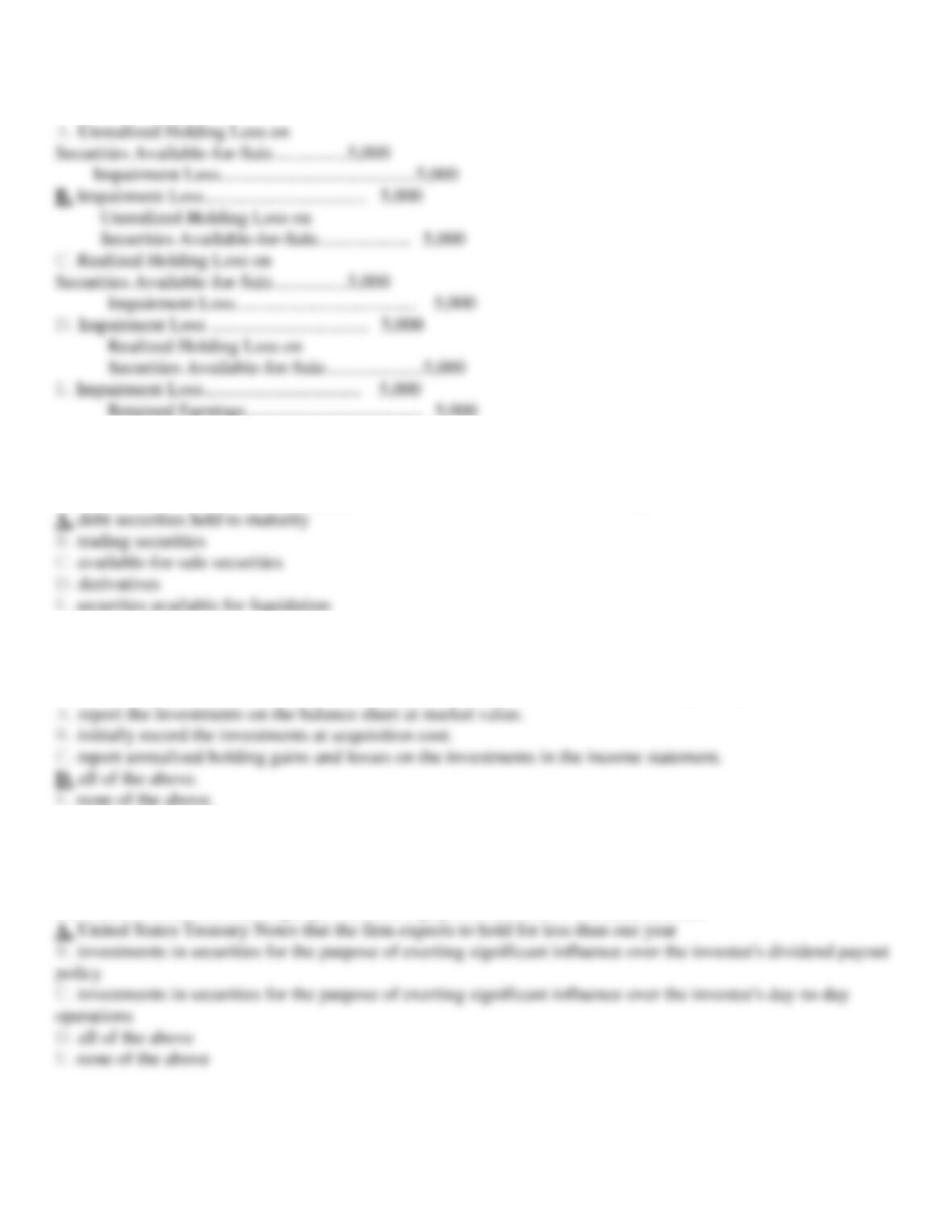
33. Which of the following is not true regarding investments in securities available-for-sale?
34. Which of the following is not true regarding investments in securities available-for-sale?
35. Alex Corporation acquires securities classified as marketable securities for $10,000. The entry is as
follows:
36. The investor recognizes dividends on equity securities as revenue when the
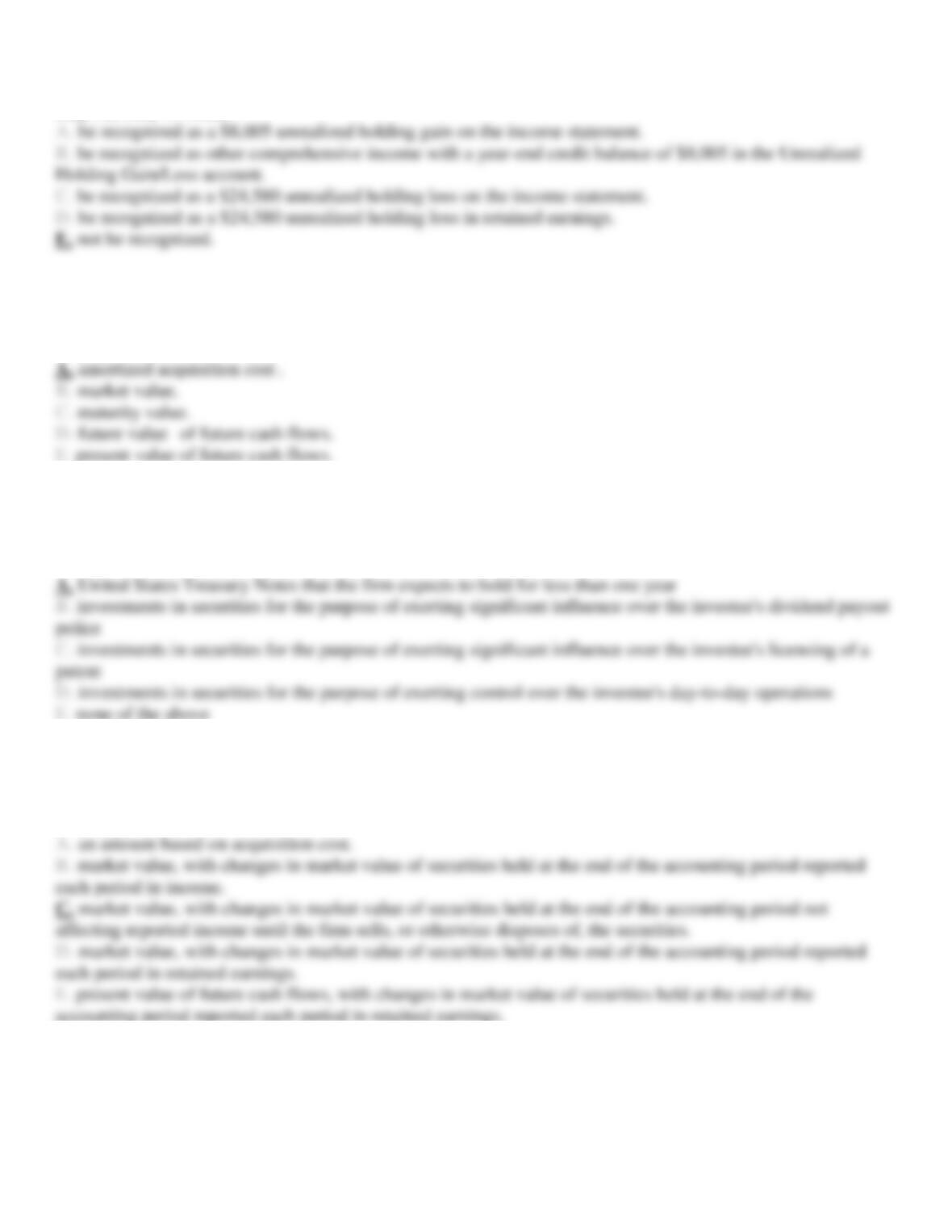
37. The investor recognizes interest on debt securities when
38. Barry Corporation holds equity securities earning $250 through dividend declarations and debt securities
earning $300 from interest earned and that it has not yet received these amounts in cash. The entry is as
follows:
39. DPC, an electric utility, has $100 million of bonds payable outstanding that mature in five years. The utility
acquires U.S. government securities whose periodic interest payments and maturity value exactly equal those on
the utility’s outstanding bonds. The firm intends to use the cash received from the government bonds to make
required interest and principal payments on its own bonds. The electric utility could also have used its cash to
purchase its bonds in the marketplace. Based on the above, DPC should treat these securities as
40. A firm records debt securities purchased at the acquisition cost. The acquisition cost will differ from the
_______ of the debt if the __________on the bonds differs from the required ________ on the bonds at the time
the firm acquired them.
41. A firm records debt securities purchases at the acquisition cost. The firm must use the _____ method to
amortize any difference between acquisition cost and maturity value over the life of the debt as an adjustment to
_____
42. Firms sometimes acquire debt securities with the intention of holding these securities until maturity. U.S.
GAAP and IFRS require firms to measure marketable securities for which firms have an intent and ability to
hold to maturity by _____. A firm initially records these debt securities at acquisition cost. This acquisition cost
will differ from the maturity value of the debt if the coupon rate on the bonds differs from the _____.
43. Using the amortization procedure, the holder of the debt securities (the investor) records interest revenue
each period at an amount equal to the _____ at the start of the period multiplied by the _____ applicable to that
debt on the day the firm acquired the debt. The bonds are classified as held to maturity.
44. Using the amortization procedure for bonds, if an investor receives cash each period, it debits Cash and
credits the Marketable Securities account. The result of this process is a new _____ (called the _____ for use in
the computations during the next period. The bonds are classified as held to maturity.
45. Using the amortization procedure, a holder of the debt securities (the investor) records interest revenue each
period by debiting the _____ and crediting _____ which after closing entries increases _____ The bonds are
classified as held to maturity.
46. The U.S. government will pay Allen $2,500,000 each six months, equal to 2.5% of the $100 million face
amount of the treasury bonds (5% annual coupon rate, paid in two installments each year), and will repay the
$100 million at the end of five years. At the time Allen purchases the bonds, the market prices these bonds to
yield Allen 6% annually (3% each six months). The bonds are classified as held to maturity. Because the market
requires a _____ than the _____ on the bonds, the bonds will sell on the market for a _____.
47. The U.S. government will pay SB Amos $2,500,000 each six months, equal to 2.5% of the $100 million
face amount of the treasury bonds (5% annual coupon rate, paid in two installments each year), and will repay
the $100 million at the end of five years. Assume that at the time SB Amos purchases the bonds, the market
prices these bonds to yield SB Amos 6% annually (3% each six months). The bonds are classified as held to
maturity. SB Amos will pay an amount equal to _____ for the bonds.
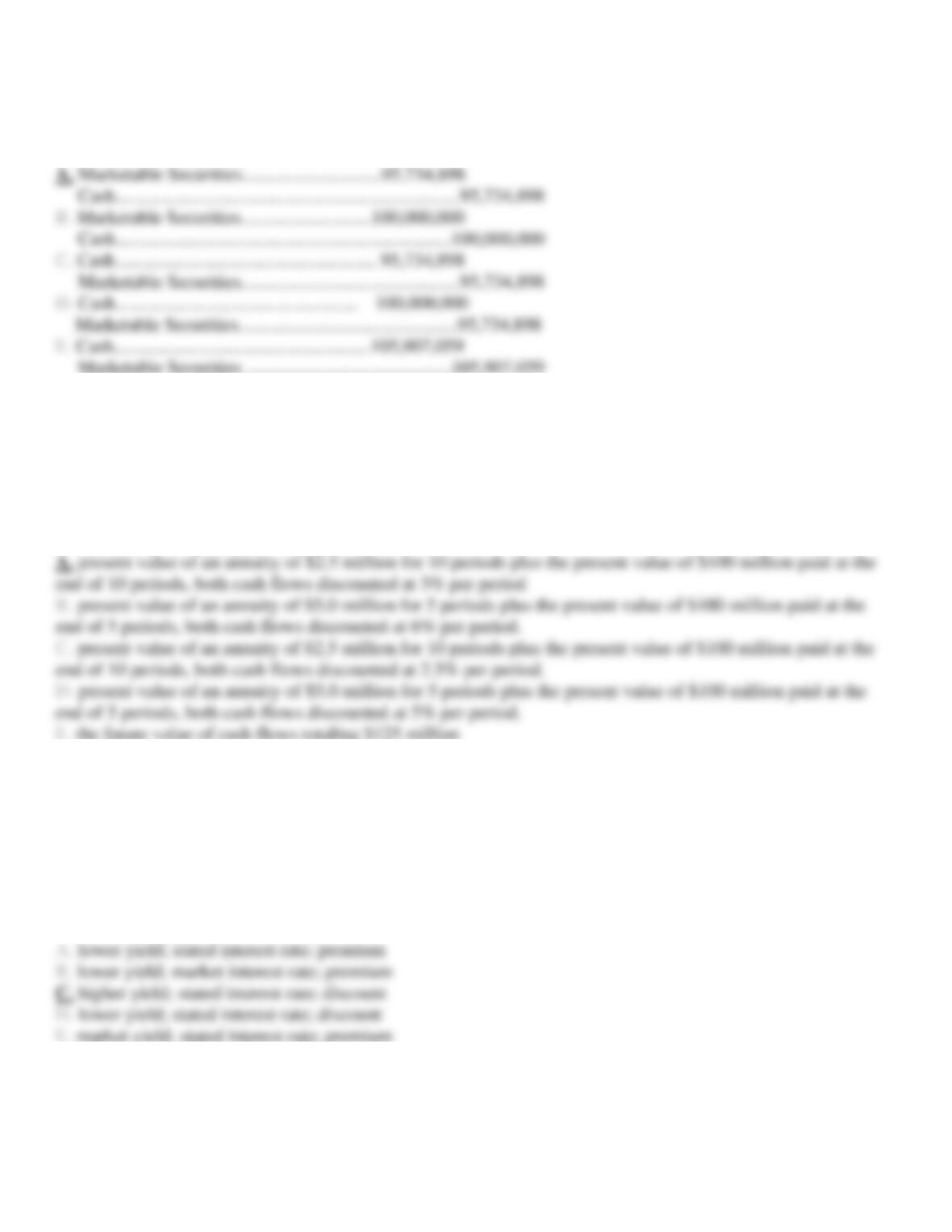
48. The U.S. government will pay Bringle $2,500,000 each six months, equal to 2.5% of the $100 million face
amount of the treasury bonds (5% annual coupon rate, paid in two installments each year), and will repay the
$100 million at the end of five years. At the time Bringle purchases the bonds, the market prices these bonds to
yield Bringle 6% annually (3% each six months). The bonds are classified as held to maturity. Bringle will
record the following entry.
49. The U.S. government will pay AirSys $2,500,000 each six months, equal to 2.5% of the $100 million face
amount of the treasury bonds (5% annual coupon rate, paid in two installments each year), and will repay the
$100 million at the end of five years. At the time AirSys purchases the bonds, the market prices these bonds to
yield AirSys 6% annually (3% each six months). The bonds are classified as held to maturity. AirSys will pay
an amount equal to _____ for the bonds.
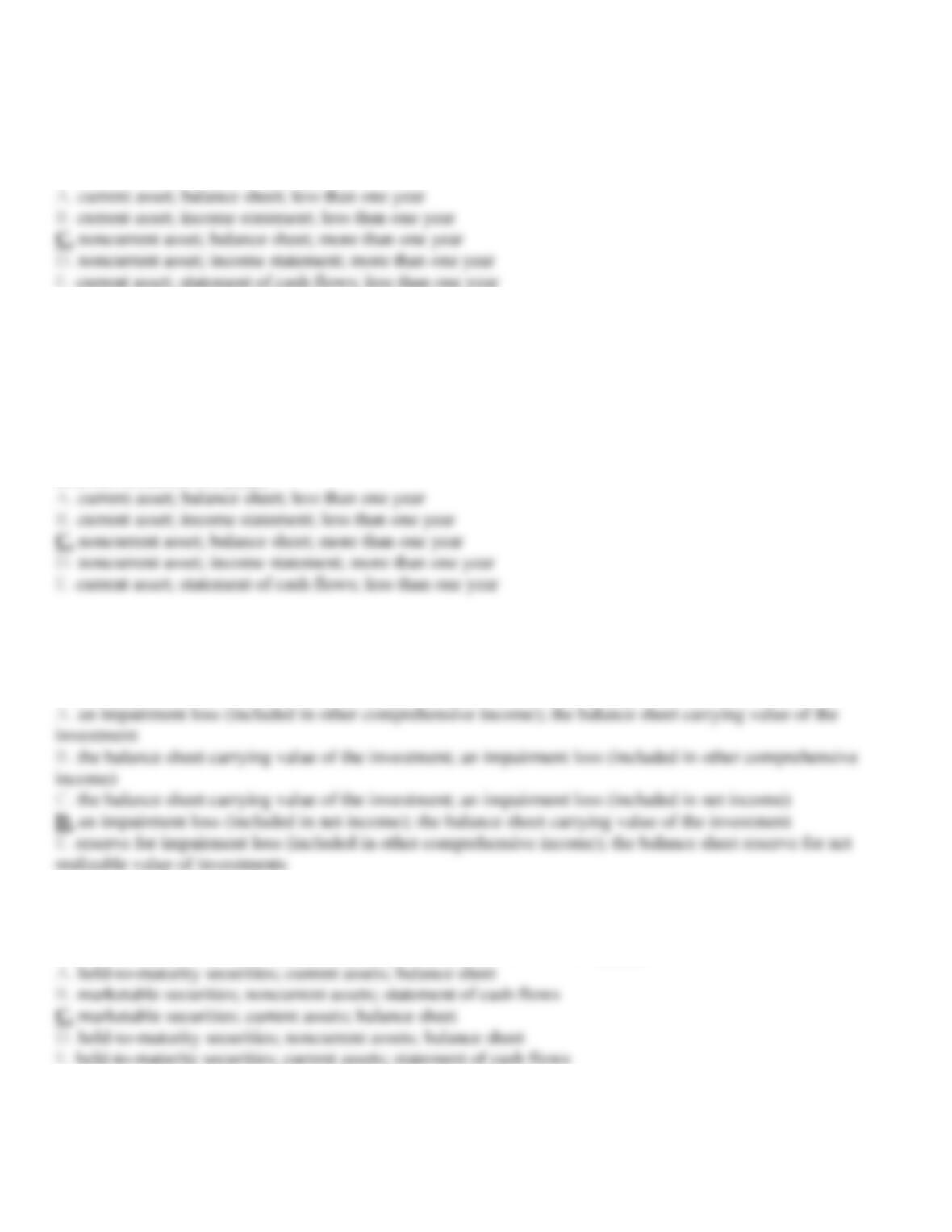
50. The U.S. government will pay Turner Company $2,500,000 each six months, equal to 2.5% of the $100
million face amount of the treasury bonds (5% annual coupon rate, paid in two installments each year), and will
repay the $100 million at the end of five years. At the time Turner Company purchases the bonds, the market
prices these bonds to yield Turner Company 6% annually (3% each six months). The bonds are classified as
held to maturity. Because the market requires a _____ than the _____ on the bonds, the bonds will sell on the
market for a _____
51. The U.S. government will pay Simpson Company $2,500,000 each six months, equal to 2.5% of the $100
million face amount of the treasury bonds (5% annual coupon rate, paid in two installments each year), and will
repay the $100 million at the end of five years. At the time Simpson Company purchases the bonds, the market
prices these bonds to yield Simpson Company 6% annually (3% each six months). The bonds are classified as
held to maturity and Simpson Company would classify this investment as a(n) _____on its _____ because it
intends to hold the securities for _____.
52. The U.S. government will pay Edie Company $2,500,000 each six months, equal to 2.5% of the $100
million face amount of the treasury bonds (5% annual coupon rate, paid in two installments each year), and will
repay the $100 million at the end of five years. At the time Edie Company purchases the bonds, the market
prices these bonds to yield Edie Company 6% annually (3% each six months). The bonds are classified as held
to maturity and Edie Company would classify this investment as a(n) _____on its _____ because it intends to
hold the securities for _____
53. U.S. GAAP and IFRS require firms to account for debt securities held-to-maturity that are deemed to be
impaired. The investor recognizes (debits) _____ and reduces (credits) _____.
54. Firms include trading securities in _____ in the _____ section of the _____.
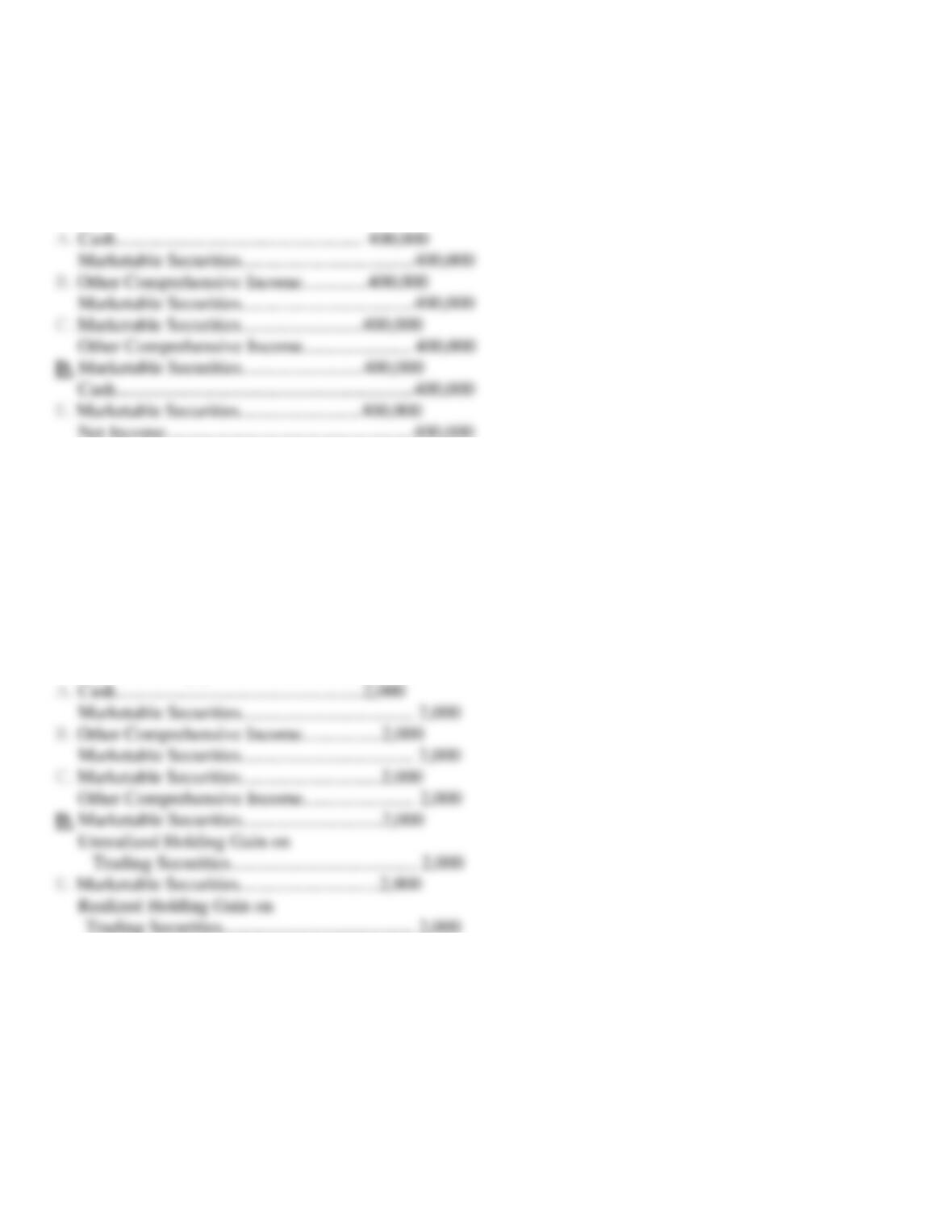
55. Marco Insurance
Marco Insurance acquired shares of Penny Systems’ common stock on December 28, 2013, for $400,000 and
classified them as trading securities. The fair value of these securities on December 31, 2013, was $402,000.
Marco Insurance sold these shares on January 3, 2014, for $405,000.
(Refer to the Marco Insurance) The journal entries to record acquisition of trading securities on December 28,
2013.
56. Marco Insurance
Marco Insurance acquired shares of Penny Systems’ common stock on December 28, 2013, for $400,000 and
classified them as trading securities. The fair value of these securities on December 31, 2013, was $402,000.
Marco Insurance sold these shares on January 3, 2014, for $405,000.
(Refer to the Marco Insurance) The journal entries to measure trading securities at fair value and recognize
unrealized holding gain in net income on December 31, 2013.
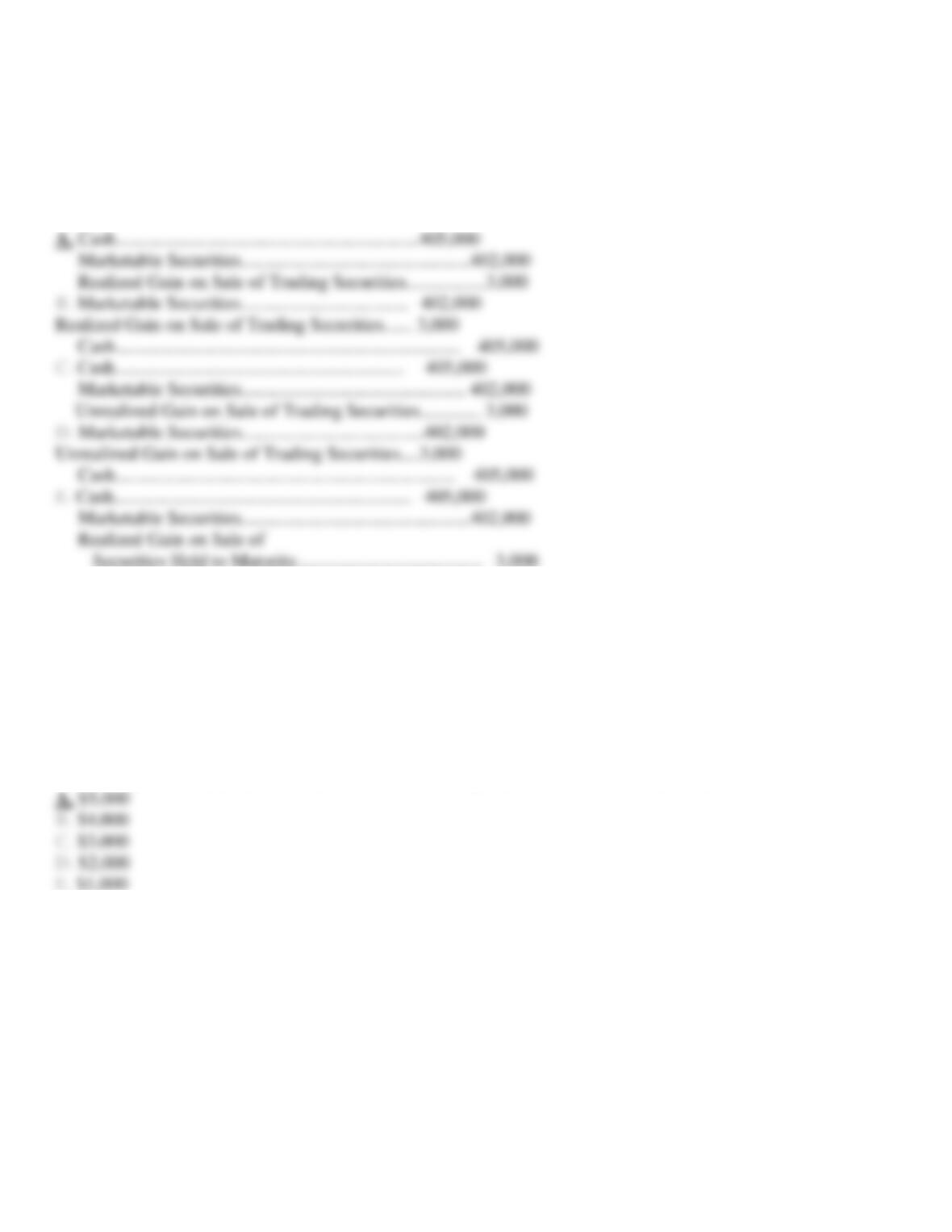
57. Marco Insurance
Marco Insurance acquired shares of Penny Systems’ common stock on December 28, 2013, for $400,000 and
classified them as trading securities. The fair value of these securities on December 31, 2013, was $402,000.
Marco Insurance sold these shares on January 3, 2014, for $405,000.
(Refer to the Marco Insurance) The journal entries to record the sale of trading securities at a gain on January
3, 2014.
58. Marco Insurance
Marco Insurance acquired shares of Penny Systems’ common stock on December 28, 2013, for $400,000 and
classified them as trading securities. The fair value of these securities on December 31, 2013, was $402,000.
Marco Insurance sold these shares on January 3, 2014, for $405,000.
(Refer to Marco Insurance.) The total income from the purchase and sale of these securities is
59. ValleyView Company
ValleyView Company acquires common stock of Kansas Enterprises for $400,000 on November 1, 2013, and
designates this investment as available-for-sale. The fair value of these shares is $435,000 on December 31,
2013. ValleyView sells these shares on August 15, 2014, for $480,000.
(Refer to ValleyView.) The journal entry to record acquisition of securities available-for-sale on November 1,
2013 is:
60. ValleyView Company
ValleyView Company acquires common stock of Kansas Enterprises for $400,000 on November 1, 2013, and
designates this investment as available-for-sale. The fair value of these shares is $435,000 on December 31,
2013. ValleyView sells these shares on August 15, 2014, for $480,000.
(Refer to ValleyView.) The journal entry to measure securities available-for-sale on December 31, 2013 is:
61. ValleyView Company
ValleyView Company acquires common stock of Kansas Enterprises for $400,000 on November 1, 2013, and
designates this investment as available-for-sale. The fair value of these shares is $435,000 on December 31,
2013. ValleyView sells these shares on August 15, 2014, for $480,000.
(Refer to the ValleyView.) The journal entries to record the sale of securities available-for-sale on August 15,
2013.
62. ValleyView Company
ValleyView Company acquires common stock of Kansas Enterprises for $400,000 on November 1, 2013, and
designates this investment as available-for-sale. The fair value of these shares is $435,000 on December 31,
2013. ValleyView sells these shares on August 15, 2014, for $480,000.
(Refer to ValleyView.) The total income from the purchase and sale of these securities is _____ reported
_____
63. Lightner Company decides that an available-for-sale security is impaired as of December 31, 2013 and has
an unrealized loss of $5,000. The journal entry to record an impairment loss on securities available-for-sale
would be:
64. Which of the following items appears in the balance sheet at amortized acquisition cost?
65. According to U.S. GAAP,firms holding debt and equity securities for short-term profit potential
66. Which of the following would most likely not be classified as Investment in Securities appearing between
the Current Assets and the Property, Plant and Equipment sections of the balance sheet?

67. Short-term marketable equity securities were acquired on July 1, Year 1 for $23,000, and classified as
available-for-sale. On December 31, Year 1, the securities had a market value of $24,000, determined as
follows:
Cost
Fair Market Value
July 1, Year 1
December 31, Year 1
Security AA
$ 9,000
$ 7,000
Security BB
5,000
10,000
Security CC
9,000
7,000
Total
$23,000
$24,000
What adjustment is required to reflect December 31, Year 1 fair value?
68. Manley Company
Information concerning Manley Company’s portfolio of debt securities at May 31, Year 6, and May 31, Year 7,
is presented below. All of the debt securities were purchased by Manley during June, Year 5. Prior to June,
Year 5, Manley had no investments in debt or equity securities.
As of May 31, Year 6
Amortized Cost
Fair Value
Camp Company bonds
$164,526
$168,300
Box Industry bonds
204,964
205,200
Messenger Inc. bonds
305,785
285,200
$675,275
$658,700
As of May 31, Year 7
Amortized Cost
Fair Value
Camp Company bonds
$152,565
$147,600
Box Industry bonds
193,800
204,500
Messenger Inc. bonds
289,130
291,400
$635,495
$643,500
(CMA adapted, Jun 97 #11) Refer to the Manley Company example. Assuming that the above securities are properly classified as available-for-sale
securities under U.S. GAAP, the unrealized holding gain or loss as of May 31, Year 7, would be
69. (CMA adapted, Jun 97 #12) Refer to the Manley Company example. Assuming that the above securities are
properly classified as held-to-maturity securities under U.S. GAAP, the unrealized holding gain or loss as of
May 31, Year 7, would
70. According to U.S. GAAP, firms holding debt securities with a positive intent and ability to hold to maturity
display such securities in the Investments section of the balance sheet at
71. Which of the following would most likely be classified as Marketable Securities in the Current Assets
section of the balance sheet?
72. U.S. GAAP requires firms holding securities available-for-sale to value the securities on the balance sheet
after acquisition at
73. U.S. GAAP requires firms holding debt and equity securities, as well as derivatives, as trading securities to
value the securities on the balance sheet after acquisition at
74. U.S. GAAP requires firms holding debt and equity securities as securities available-for-sale to treat
unrealized holding gains or losses each period as
75. U.S. GAAP requires firms holding minority, passive investments in debt and equity securities as securities
available-for-sale that the firm intends to sell within one year to report them as
76. U.S. GAAP requires firms holdingtrading securities to report unrealized holding gains and losses on the
investments