Environment: Science Behind the Stories, 2e Cdn. Ed. (Withgott)
Chapter 13 Marine and Coastal Systems and Fisheries
13.1 Graph and Figure Interpretation Questions
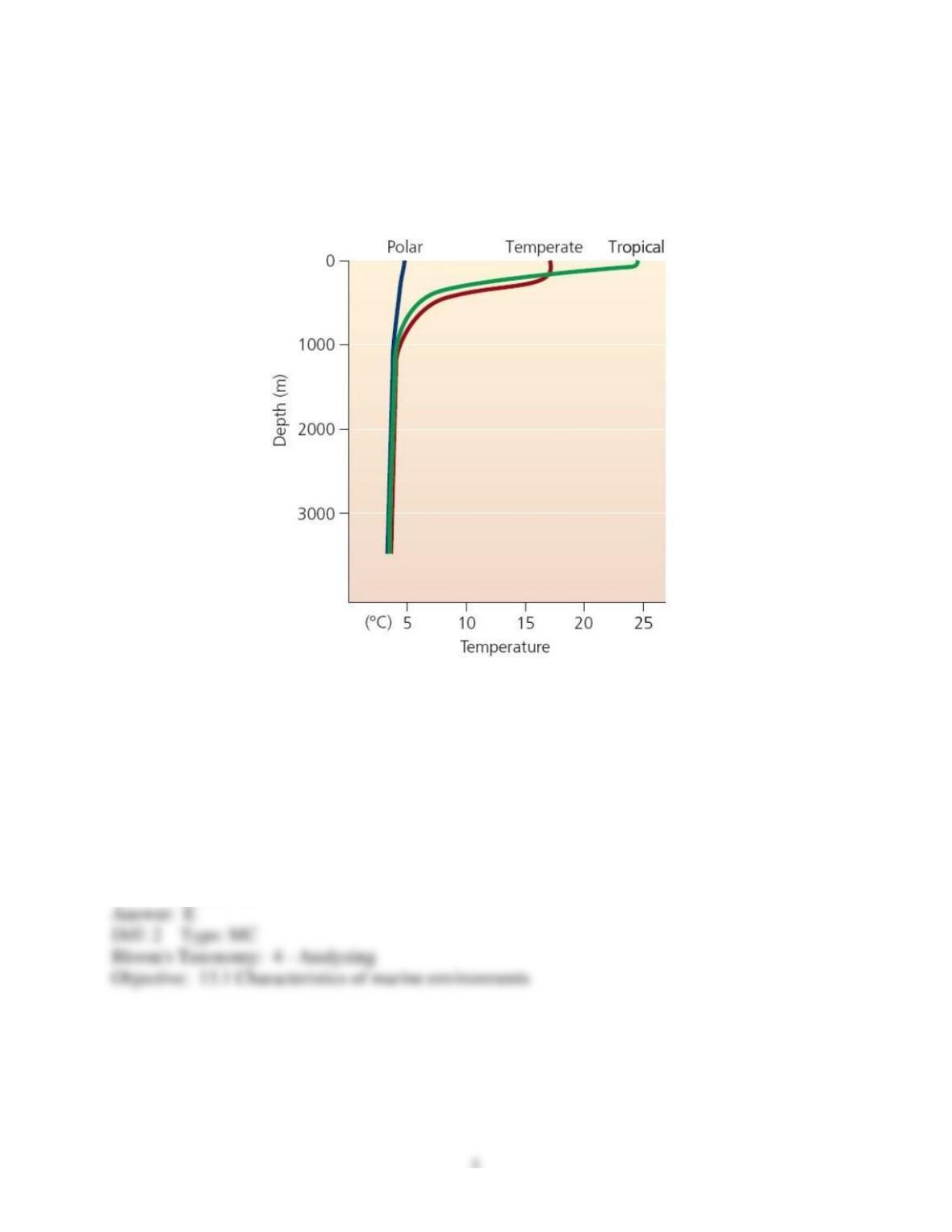
Figure 13.1
Use Figure 13.1 to answer the following questions.
1) Refer to Figure 13.1. In temperate and tropical regions, water temperature becomes rapidly
colder as a function of depth ________.
A) from 0 to 500 metres
B) in the lowest parts of the deep zone
C) in the superficial deep zone
D) in the surface zone
E) in the pycnocline


2) Refer to Figure 13.1. Areas near ________ have the greatest temperature differential with
depth.
A) the poles
B) the equator
C) the United States
D) Canada
E) Europe
3) Refer to Figure 13.1. Which of the following is TRUE?
A) Polar areas lack a distinct deep zone.
B) Polar areas lack a pronounced pycnocline.
C) Temperate areas lack a distinct deep zone.
D) Temperate areas lack a pronounced pycnocline.
E) Tropical areas lack a distinct surface layer.
4) Refer to Figure 13.1. The deep-ocean species should be able to colonize more easily the
surface waters near the coast of ________.
A) Brazil
B) Greenland
C) Nova Scotia
D) Britain
E) Florida

13.2 Matching Questions
Match the following.
A) bottom trawling
B) surface zone
C) deep zone
D) pelagic zone
E) salt marsh
F) neritic zone
G) littoral zone
H) mangrove forest
I) pycnocline zone
J) pycnocline
K) drift netting
L) estuary
1) An ecosystem that lies along the shoreline between the farthest reach of the highest tides and
the lowest reach of the lowest tide
2) Ocean zone where water is most dense
3) An ocean-land ecotone in tropical and subtropical latitudes that consists of tree-dominated
communities on the gently sloping sandy and silty coastal areas
4) Area where a river flows into the ocean, mixing freshwater and saltwater
5) Ocean zone that contains approximately 18% of the ocean’s water; where density sharply
increases and temperature decreases
6) Fishing technique used for capturing groundfish
Diff: 2 Type: MA
Bloom’s Taxonomy: 3 – Applying
Objective: 13.3 Uses of marine resources
13.3 Short Answer Questions
1) What direct and indirect damage to fish populations would you expect in marine waters near a
city with a busy port, such as Vancouver or Halifax?
2) What is meant by the term world ocean?
3) What conditions produce the diversity found in the rocky intertidal zone?
4) The Coriolis effect in the northern hemisphere deflects moving objects to the right. If you are
on the eastern coast of Newfoundland, from which direction should the wind blow to create
coastal upwelling and why?
5) How have declines in fisheries been masked in recent years?
6) What chemical compounds and physical processes make the ocean salty?
7) Explain how warmer coastal waters resulting from global climate change may affect coral
reefs.
8) Ocean temperatures in midlatitude vary only 10oC from summer to winter. Why is this ocean
temperature so stable?
9) The study of the physics, chemistry, and geology of the oceans is called ________.
10) ________ are the periodic rising and falling of the ocean’s height at a given location because
of the gravitational pull of the Moon.
11) A concept called ________ has been used to manage fish populations by allowing maximal
harvests of particular populations while keeping fish available for the future.

13.4 Multiple-Choice Questions
1) About 80% of the ocean’s water exists in the ________.
A) surface zone
B) pycnocline
C) deep zone
D) thermocline
E) euphotic zone
2) Ocean water is saltiest ________.
A) where there is a large amount of glacial melting
B) where rains are the heaviest
C) where there is high evaporation and low precipitation
D) in estuaries
E) at the equator
3) Water in the surface zone of the ocean is, for the most part, ________.
A) low in oxygen
B) the coldest
C) the densest
D) the saltiest
E) well mixed
4) Which of the following is NOT a characteristic of currents?
A) Most are faster than the speed of a walking person.
B) They are driven by density differences.
C) They are driven by temperature.
D) They are driven by gravity.
E) They are driven by wind.

5) The area that underlies the shallow water bordering continents is called the ________.
A) pycnocline
B) topographic shelf
C) continental shelf
D) bathymetric zone
E) surface zone
6) Kelp’s ecological function is most similar to those of ________.
A) corals
B) mangroves
C) littoral organisms
D) sea otters
E) sea urchins
7) What does the term groundfish refer to?
A) fish that form the base (“ground”) of the oceanic food web
B) various species that live in benthic habitats, such as haddock
C) various species that live in littoral habitats, such as tuna and whitefish
D) fish meal obtained by grounding bycatch fish of little commercial value, which is used as a
high-protein additive in livestock feed
E) fish used for bait
8) Sea otters act as keystone species in the ________.
A) salt marshes
B) mangrove forests
C) kelp forests
D) deep-ocean systems
E) coral reefs

9) Zooxanthellae are ________.
A) an endangered species of fish in the Pacific Ocean
B) symbiotic bacteria that decompose tissues of dead animals in oceans
C) symbiotic bacteria that fix nitrogen in oceans
D) symbiotic algae that provide coral reefs with energy via their photosynthetic activity
E) an invasive species of kelp in the Indian Ocean
10) Which of the following is TRUE of eutrophication in marine systems?
A) It can lead to algal blooms that kill fish.
B) It can aid corals by killing parasites.
C) It is rare and occurs only in bad weather.
D) It provides needed limiting nutrients.
E) It can aid corals by providing their symbiotic algae with nutrients.
11) Currently, the greatest ecological crisis facing marine systems is ________.
A) radiation
B) oil spills
C) plastic dumping
D) overharvesting
E) abandoned fishing nets
12) Hypoxia and eutrophication in Chesapeake Bay may in part be attributed to ________.
A) loss of kelp to take up nutrients
B) loss of otters to maintain kelp by controlling sea urchins populations
C) harvesting of oysters that previously would have filtered nutrients
D) harvesting of sea turtles that maintain sea urchin populations
E) overfishing salmon that maintain the entire system

13) A 2003 study led by researchers from Dalhousie University reported that ________% of
large-bodied fish and sharks were lost in the first decade of industrialized fishing.
A) 10
B) 20
C) 40
D) 50
E) 90
14) Which of the following areas has the most promise for a good fishery?
A) areas with no currents to disperse the fish
B) areas with an upward flow of warm water up toward the ocean surface
C) areas with an upward flow of cold water up toward the ocean surface
D) areas where winds blow at right angles toward the coastline
E) areas where oxygen is brought up toward the ocean surface
15) The temperature differences between day and night are ________ over the ocean than over
the land, because ________.
A) smaller; it takes a lot of energy to break hydrogen bonds in water
B) larger; it takes a lot of energy to break hydrogen bonds in soil
C) smaller; water is transparent
D) larger; water is transparent
E) smaller or larger; it depends on local conditions
16) Bathymetry is best defined as the study of ________.
A) earthquakes in ocean trenches
B) human populations in coastal areas
C) fish populations
D) ocean depths
E) coral reefs

17) Hydrothermal vents ________.
A) create ocean currents
B) provide nutrients to symbiotic bacteria that support ecosystems at the ocean floor
C) occur in tropical areas at the ocean surface
D) make the photic zone of ocean pelagic areas the most productive
E) are passageways for fish within coral reefs
18) Kelp ________.
A) are plants that grow on the deep ocean floor
B) increase biodiversity of coastal waters
C) are mostly found in tropical waters
D) are poisonous if ingested by fish or humans
E) are a species of endangered fish
19) Salt marshes ________.
A) contain too much salt to be inhabited by many organisms
B) occur mostly in tropical areas
C) occur mostly in arctic areas
D) occur mostly in temperate areas
E) presently have remained undisturbed by human activities
20) It is estimated that ________% of the world’s marine fish populations are fully exploited.
A) 10
B) 20
C) 30
D) 40
E) 50