College Physics: A Strategic Approach, 3e (Knight)
Chapter 13 Fluids
13.1 Conceptual Questions
1) Substance A has a density of 3 g/cm3 and substance B has a density of 4 g/cm3. In order to
obtain equal masses of these two substances, what must be the ratio of the volume of A to the
volume of B?
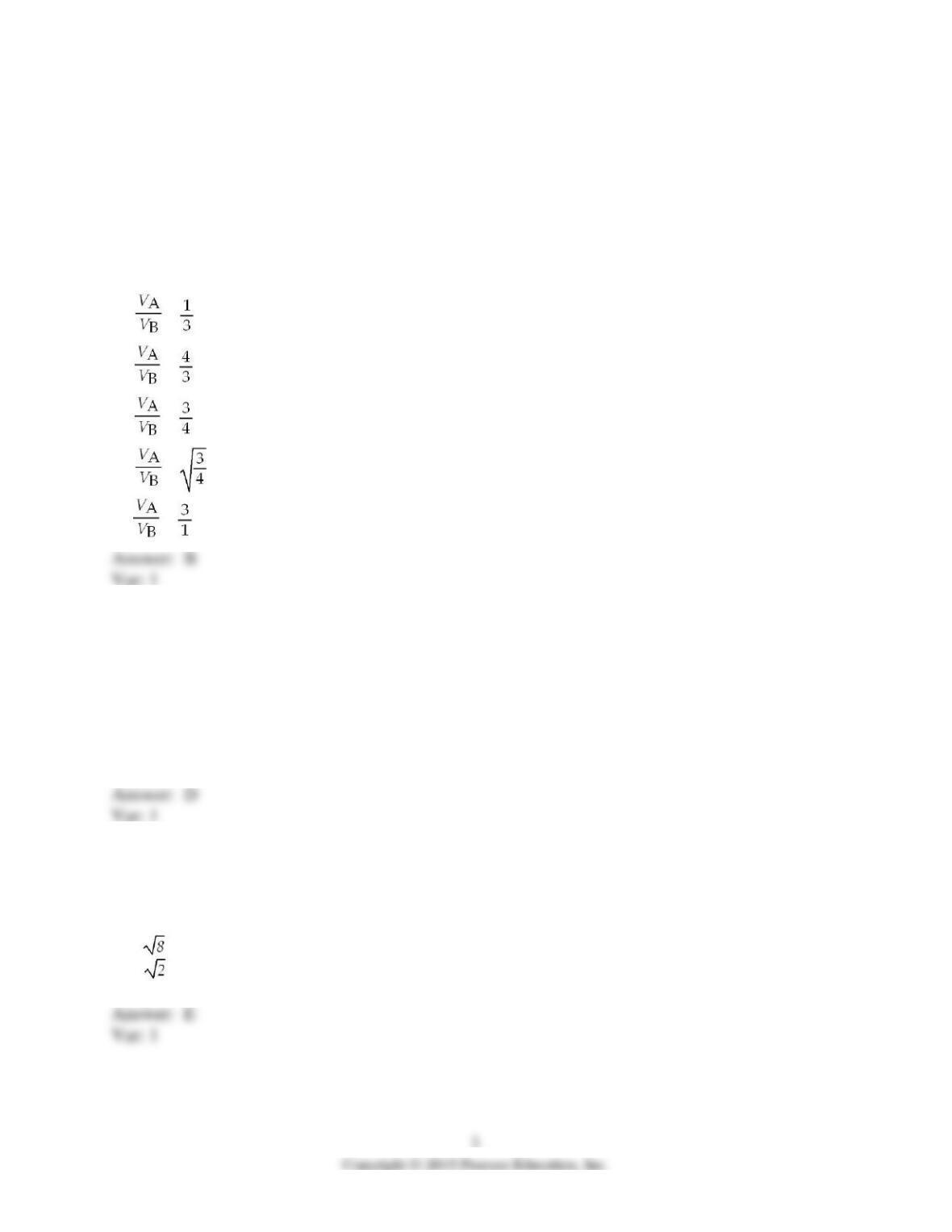
A) =
B) =
C) =
D) =
E) =
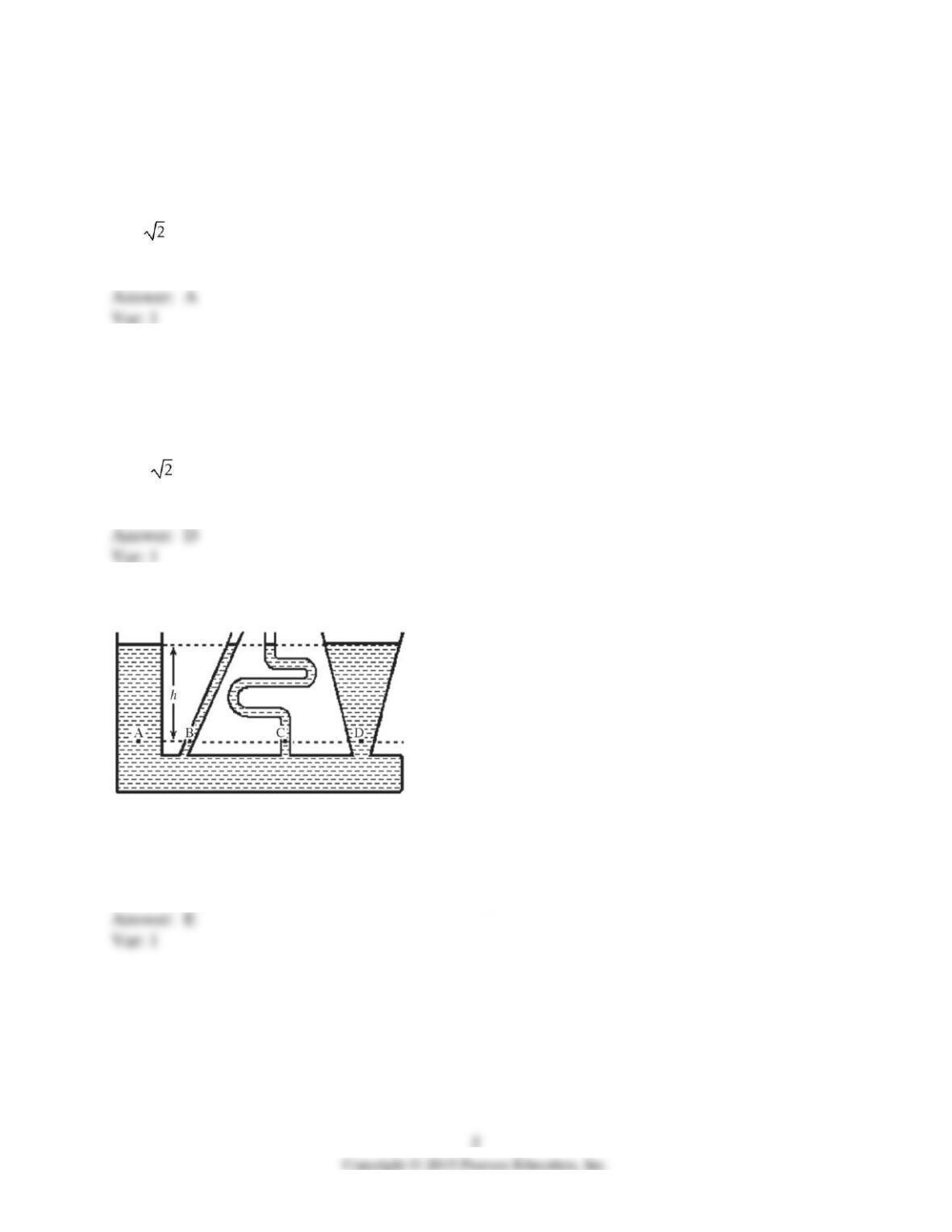
2) A hollow sphere of negligible mass and radius R is completely filled with a liquid so that its
density is ρ. You now enlarge the sphere so its radius is 2R and completely fill it with the same
liquid. What is the density of the enlarged sphere?
A) 8 ρ
B) 4 ρ
C) ρ/2
D) ρ
E) ρ/8
3) A styrofoam sphere of radius R has a density ρ. You now carefully compress the sphere so its
radius is R/2. What is the density of the compressed sphere?
A) 2 ρ
B) 4 ρ
C) ρ
D) ρ
E) 8 ρ
4) When a box rests on a round sheet of wood on the ground, it exerts an average pressure p on
the wood. If the wood is replaced by a sheet that has half the diameter of the original piece, what
is the new average pressure?
A) 4p
B) 2p
C) p
D) p/2
E) p/4
5) When a heavy metal block is supported by a cylindrical vertical post of radius R, it exerts a
force F on the post. If the diameter of the post is increased to 2R, what force does the block now
exert on the post?
A) F/4
B) F/2
C) F/
D) F
E) 2F
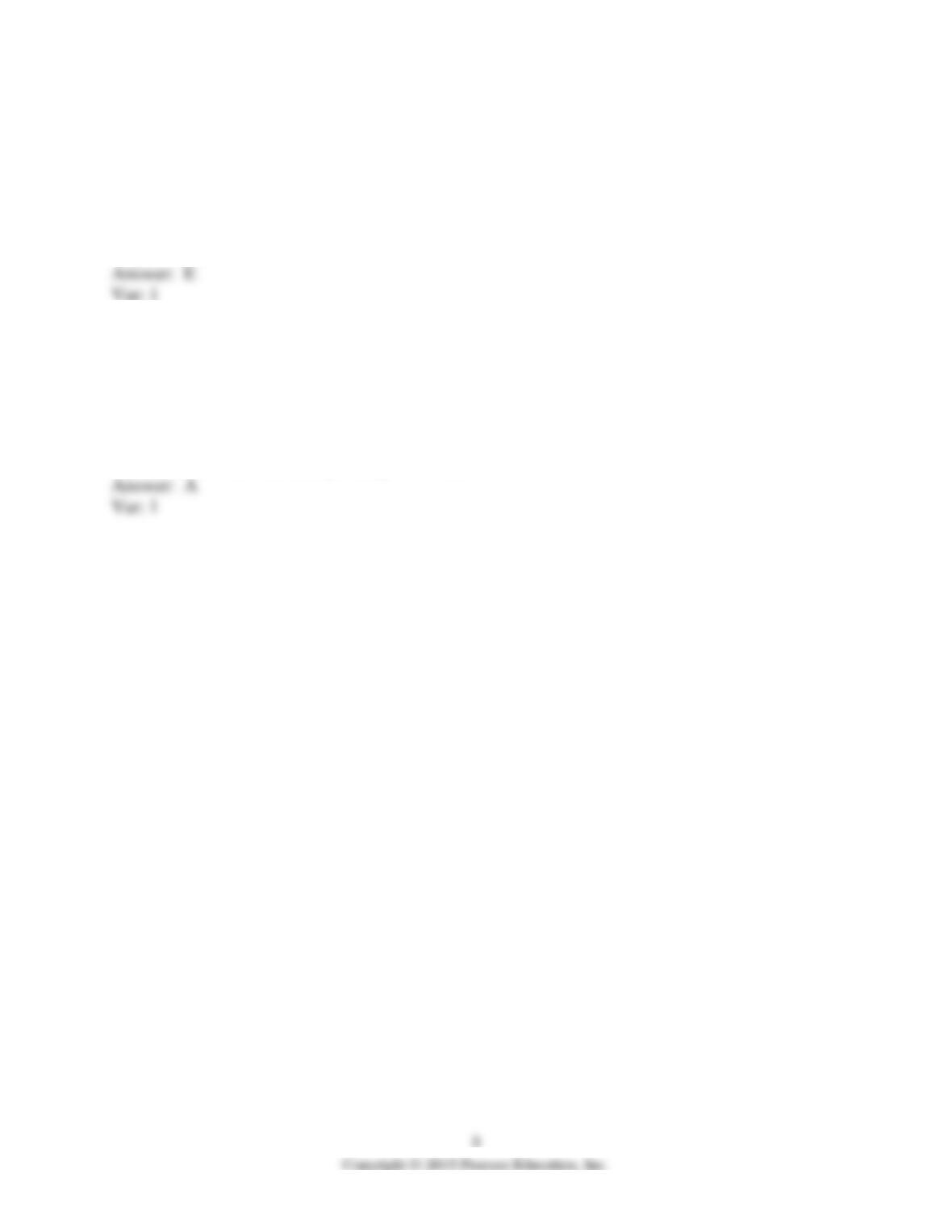
6) As shown in the figure, fluid fills a container having several sections. At which of the
indicated points is the pressure greatest?
A) A
B) B
C) C
D) D
E) The pressure is the same at each of the labeled points.
7) Consider a brick that is totally immersed in water, with the long edge of the brick vertical. The
pressure on the brick is
A) the same on all surfaces of the brick.
B) greatest on the face with largest area.
C) greatest on the top of the brick.
D) greatest on the sides of the brick.
E) greatest on the bottom of the brick.
8) An air bubble underwater has the same pressure as that of the surrounding water. As the air
bubble rises toward the surface (and its temperature remains constant), the volume of the air
bubble
A) increases.
B) decreases.
C) remains constant.
D) increases or decreases, depending on the rate it rises.
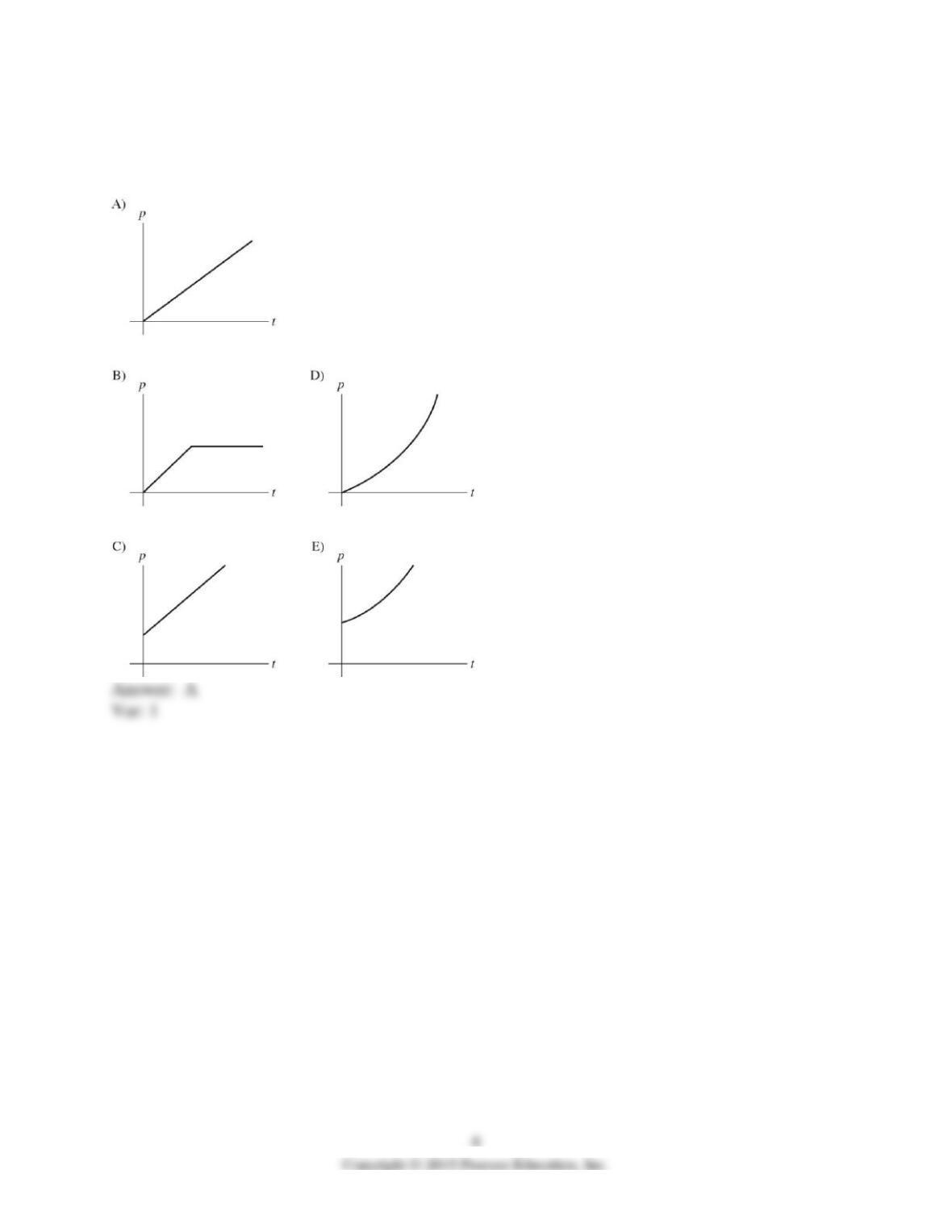
9) A cubical block of stone is lowered at a steady rate into the ocean by a crane, always keeping
the top and bottom faces horizontal. Which one of the following graphs best describes the gauge
pressure p on the bottom of this block as a function of time t if the block just enters the water at
time t = 0 s?
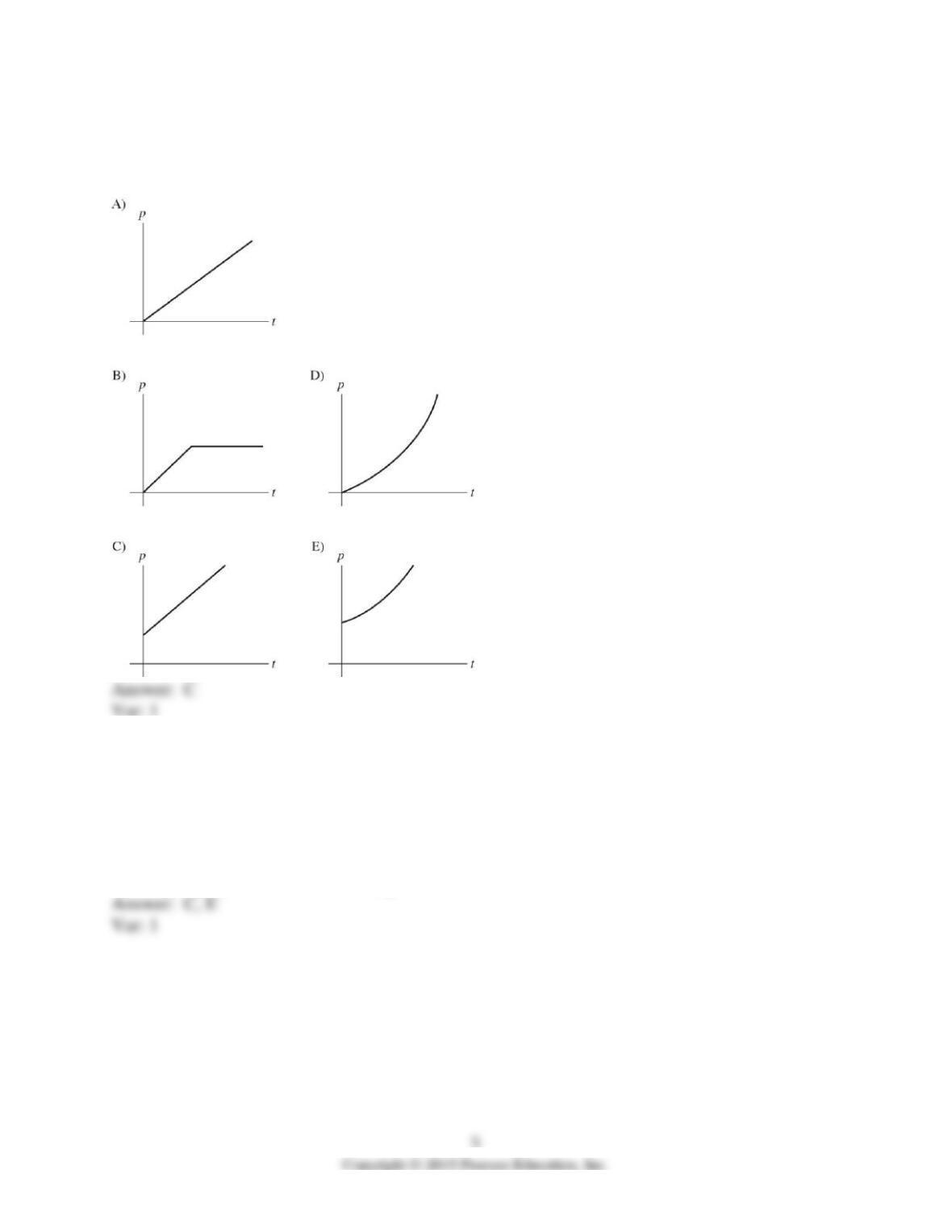
10) A cubical block of stone is lowered at a steady rate into the ocean by a crane, always keeping
the top and bottom faces horizontal. Which one of the following graphs best describes the
absolute (total) pressure p on the bottom of this block as a function of time t if the block just
enters the water at time t = 0 s?
11) If atmospheric pressure increases by an amount Δp, which of the following statements about
the pressure in a lake is true? (There could be more than one correct choice.)
A) The absolute (total) pressure does not change.
B) The absolute (total) pressure increases, but by an amount less than Δp.
C) The absolute (total) pressure increases by Δp.
D) The gauge pressure increases by Δp.
E) The gauge pressure does not change.
12) A closed cubical chamber resting on the floor contains oil and a piston. If you push down on
the piston hard enough to increase the pressure just below the piston by an amount Δp, which of
the following statements is correct? (There could be more than one correct choice.)
A) The pressure everywhere in the oil will increase by Δp.
B) The pressure at the bottom of the oil will increase by more than Δp.
C) The pressure at the top of the oil will increase by less than Δp.
D) The pressure on the sides of the chamber will not increase.
E) The increase in the force on the top of the chamber will be the same as the increase in the
force on the bottom of the chamber.
13) The water pressure to an apartment is increased by the water company. The water enters the
apartment through an entrance valve at the front of the apartment. Where will the increase in the
static water pressure be greatest when no water is flowing in the system?
A) at a faucet close to the entrance valve
B) at a faucet far from the entrance valve
C) It will be the same at all faucets.
D) There will be no increase in the pressure at the faucets.
14) A waiter fills your water glass with ice water (containing many ice cubes) such that the
liquid water is perfectly level with the rim of the glass. As the ice melts,
A) the liquid-water level remains flush with the rim of the glass.
B) the liquid water level rises, causing water to run down the outside of the glass.
C) the liquid-water level decreases.
15) A spherical ball of lead (density 11.3 g/cm3) is placed in a tub of mercury (density 13.6
g/cm3). Which answer best describes the result?
A) The lead ball will float with about 83% of its volume above the surface of the mercury.
B) The lead ball will float with its top exactly even with the surface of the mercury.
C) The lead ball will float with about 17% of its volume above the surface of the mercury.
D) The lead will sink to the bottom of the mercury.
16) A wooden block contains some nails so that its density is exactly equal to that of water. If it
is placed in a tank of water and released from rest when it is completely submerged, it will
A) rise to the surface.
B) sink to the bottom.
C) remain where it is released.
17) A boat loaded with rocks is floating in a swimming pool. If the rocks are thrown into the
pool, the water level in the pool, after the rocks have settled to the bottom,
A) rises.
B) falls.
C) stays the same.
18) Salt water has greater density than fresh water. A boat floats in both fresh water and in salt
water. Where is the buoyant force greater on the boat?
A) in salt water
B) in fresh water
C) The buoyant force is the same in both cases.
19) Salt water is denser than fresh water. A ship floats in both fresh water and salt water.
Compared to the fresh water, the volume of water displaced in the salt water is
A) more.
B) less.
C) the same.
D) Cannot be determined because we do not know the volume of the ship.
20) A steel ball sinks in water but floats in a pool of mercury, which is much denser than water.
Where is the buoyant force on the ball greater?
A) floating on the mercury
B) submerged in the water
C) It is the same in both cases.
D) It cannot be determined from the information given.
21) A 10-kg piece of aluminum sits at the bottom of a lake, right next to a 10-kg piece of lead,
which is much denser than aluminum. Which one has the greater buoyant force on it?
A) the aluminum
B) the lead
C) Both have the same buoyant force.
D) It cannot be determined without knowing their volumes.
22) A piece of iron rests on top of a piece of wood floating in a bathtub. If the iron is removed
from the wood, and kept out of the water, what happens to the water level in the tub?
A) It goes up.
B) It goes down.
C) It does not change.
D) It is impossible to determine from the information given.
23) A piece of wood is floating in a bathtub. A second piece of wood sits on top of the first
piece, and does not touch the water. If the top piece is taken off and placed in the water, what
happens to the water level in the tub?
A) It goes up.
B) It goes down.
C) It does not change.
D) It cannot be determined without knowing the volumes of the two pieces of wood.
24) As a rock sinks deeper and deeper into water of constant density, what happens to the
buoyant force on it if it started above the surface of the water?
A) The buoyant force keeps increasing steadily.
B) The buoyant force remains constant.
C) The buoyant force first increases and then remains constant.
D) The buoyant force steadily decreases.
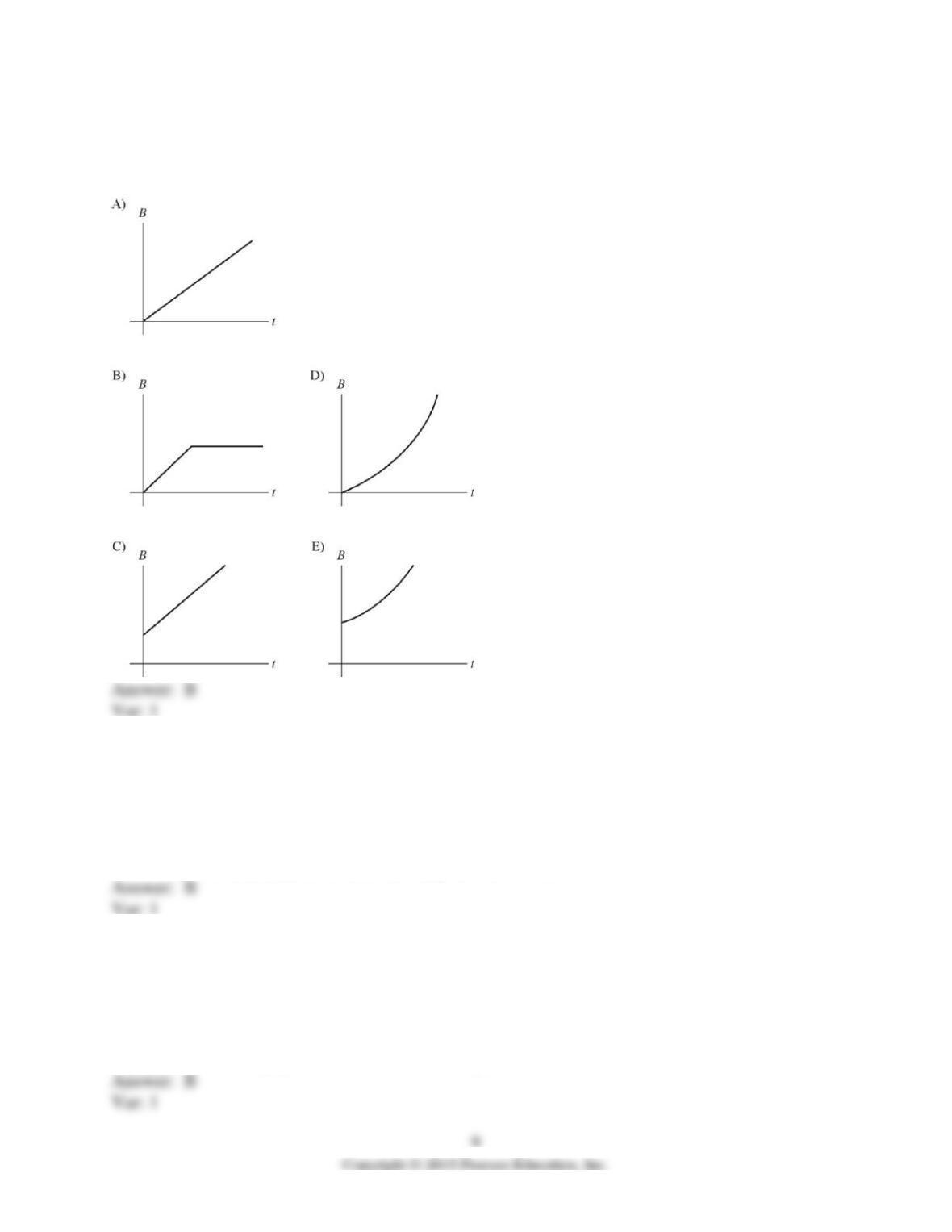
25) A cubical block of stone is lowered at a steady rate into the ocean by a crane, always keeping
the top and bottom faces horizontal. Which one of the following graphs best describes the
buoyant force B on this block as a function of time t if the block just enters the water at time t = 0
s?
26) A 50-cm3 block of wood is floating on water, and a 50-cm3 chunk of iron is totally
submerged in the water. Which one has the greater buoyant force on it?
A) the wood
B) the iron
C) Both have the same buoyant force.
D) It cannot be determined without knowing their densities.
27) When you blow some air above a paper strip, the paper rises. This happens because
A) the air above the paper moves faster and the pressure is higher.
B) the air above the paper moves faster and the pressure is lower.
C) the air above the paper moves faster and the pressure remains constant.
D) the air above the paper moves slower and the pressure is higher.
E) the air above the paper moves slower and the pressure is lower.
28) Water flows through a pipe. The diameter of the pipe at point B is larger than at point A.
Where is the water pressure greatest?
A) at point A
B) at point B
C) It is the same at both A and B.
29) Two horizontal pipes are the same length, but pipe B has twice the diameter of pipe A.
Water undergoes viscous flow in both pipes, subject to the same pressure difference across the
lengths of the pipes. If the flow rate in pipe A is Q = , what is the flow rate in pipe B?
A) 2Q
B) 4Q
C) 8Q
D) 16Q
E) Q
30) Two horizontal pipes have the same diameter, but pipe B is twice as long as pipe A. Water
undergoes viscous flow in both pipes, subject to the same pressure difference across the lengths
of the pipes. If the flow rate in pipe B is Q = what is the flow rate in pipe A?
A) 2Q
B) 4Q
C) 8Q
D) 16Q
E) Q
1) A plastic block of dimensions 2.00 cm × 3.00 cm × 4.00 cm has a mass of 30.0 g. What is its
density?
A) 0.80 g/cm3
B) 1.20 g/cm3
C) 1.25 g/cm3
D) 1.60 g/cm3
2) A compressed gas with a total mass of is stored in a spherical container having a radius
of 0.521 m. What is the density of the compressed gas?
A) 181 kg/m3
B) 110 kg/m3
C) 134 kg/m3
D) 161 kg/m3
3) The density of material at the center of a neutron star is approximately 1.00 × 10¹⁸ kg/m3.
What is the mass of a cube of this material that is on each side. (One micron is equal
to 1.00 × 10⁻⁶ m.)
A) 5.45 kg
B) 4.74 kg
C) 6.16 kg
D) 6.70 kg
4) Under standard conditions, the density of air is 1.29 kg/m3. What is the mass of the air inside
a room measuring 4.0 m × 3.0 m × 2.0 m?
A) 0.32 kg
B) 3.1 kg
C) 31 kg
D) 1.9 kg
E) 19 kg
5) A round coin has a diameter of 19.55 mm, a thickness of 1.55 mm, and a mass of 2.50 g. What
is its density?
A) 5.37 × 10³ kg/m3
B) 21.5 × 10³ kg/m3
C) 1.34 × 10³ kg/m3
D) 2.68 × 10³ kg/m3
E) 1.86 × 10⁻⁴ kg/m3
6) A 1938 nickel has a diameter of 21.21 mm, a thickness of 1.95 mm, and weighs 0.04905 N.
What is its density?
A) 1.37 × 10⁻⁴ kg/m3
B) 1.82 × 10³ kg/m3
C) 19.3 × 10³ kg/m3
D) 3.63 × 10³ kg/m3
E) 7.26 × 10³ kg/m3
7) How many grams of ethanol (density 0.80 g/cm3) should be added to 5.0 g of chloroform
(density 1.5 g/cm3) if the resulting mixture is to have a density of 1.2 g/cm3? Assume that the
fluids do not change their volumes when they are mixed.
A) 2.0 g
B) 2.4 g
C) 1.8 g
D) 4.4 g
E) 1.6 g
8) A 100-kg person sits on a 5-kg bicycle. The total weight is borne equally by the two wheels of
the bicycle. The tires are 2.0 cm wide and are inflated to a gauge pressure of 8.0 × 10⁵ Pa. What
length of each tire is in contact with the ground?
A) 1.6 cm
B) 1.8 cm
C) 3.2 cm
D) 2.4 cm
E) 6.4 cm
9) The weight of a 1200-kg car is supported equally by the four tires, which are inflated to the
same gauge pressure. What gauge pressure is required so the area of contact of each tire with the
road is 100 cm2?
A) 12 × 105 Pa
B) 12 × 104 Pa
C) 2.9 × 10⁵ Pa
D) 2.9 × 10⁴ Pa
10) One of the dangers of tornados and hurricanes is the rapid drop in air pressure that is
associated with such storms. Assume that the air pressure inside of a sealed house is 1.02 atm
when a hurricane hits. The hurricane rapidly decreases the external air pressure to 0.910 atm.
What net outward force is exerted on a square window of the house that is on each side?
(1.00 atm = 1.01 × 10⁵ Pa)
A) 4.59 × 10⁴ N
B) 5.19 × 10⁴ N
C) 4.82 × 10⁵ N
D) 5.42 × 10⁵ N
11) Calculate the pressure exerted on the ground due to the weight of person standing on
one foot. if the bottom of the person’s foot is wide and long.
A) 2.1 × 10⁴ Pa
B) 2.2 × 10³ Pa
C) 4.8 × 10⁴ Pa
D) 5.3 × 10⁴ Pa
12) A brick weighs 50.0 N, and measures 30.0 cm × 10.0 cm × 4.00 cm. What is the maximum
pressure it can exert on a horizontal surface due to its weight?
A) 1.25 Pa
B) 12.5 Pa
C) 1.25 kPa
D) 12.5 kPa
13) A person weighing 900 N is standing on snowshoes. Each snowshoe has area 2500 cm2 and
has negligible weight. What pressure does this person’s weight exert on the snow?
A) 0.18 N/m2
B) 0.36 N/m2
C) 1800 N/m2
D) 3600 N/m2
14) A water tank is filled to a depth of 10 m, and the bottom of the tank is 20 m above ground. A
water-filled hose that is 2.0 cm in diameter extends from the bottom of the tank to the ground,
but no water is flowing in this hose. The water pressure at ground level in the hose is closest to
which of the following values? The density of water is 1000 kg/m3.
A) 3.9 × 10⁵ N/m2
B) 2.0 × 10⁴ N/m2
C) 9.2 N/m2
D) The question cannot be answered because the cross sectional area of the tank is needed.
15) The Aswan High Dam on the Nile River in Egypt is 111 m high. What is the gauge pressure
in the water at the foot of the dam? The density of water is 1000 kg/m3.
A) 1.09 × 10⁶ Pa
B) 1.16 × 10⁶ Pa
C) 1.09 × 10³ Pa
D) 1.11 × 10⁵ Pa
E) 1.11 × 10² Pa
16) The deepest point of the Pacific Ocean is 11,033 m, in the Mariana Trench. What is the
gauge pressure in the water at that point? The density of seawater is 1025 kg/m3.
A) 5.55 × 10⁷ Pa
B) 8.88 × 10⁷ Pa
C) 1.11 × 10⁸ Pa
D) 2.22 × 10⁸ Pa
E) 3.33 × 10⁸ Pa
17) The Tonga Trench in the Pacific Ocean is 36,000 feet deep. Assuming that sea water has an
average density of 1.04 g/cm3, calculate the absolute (total) pressure at the bottom of the trench
in atmospheres. (1.00 in = 2.54 cm, 1.00 atm = 1.01 × 10⁵ Pa)
A) 1.1 × 10³ atm
B) 1.1 × 10⁸ atm
C) 1.1 × 10⁵ atm
D) 1.1 × 10⁶ atm
E) 2.1 atm
18) What force does the water exert (in addition to that due to atmospheric pressure) on a
submarine window of radius 44.0 cm at a depth of 9400 m in sea water? The density of sea water
is 1025 kg/m3.
A) 5.74 × 10⁷ N
B) 5.74 × 10¹¹ N
C) 2.87 × 10¹¹ N
D) 1.83 × 10⁷ N
E) 2.87 × 10⁷ N
19) A cubical box 25.0 cm on each side is immersed in a fluid. The pressure at the top surface of
the box is 109.40 kPa and the pressure on the bottom surface is 112.00 kPa. What is the density
of the fluid?
A) 1000 kg/m3
B) 1030 kg/m3
C) 1060 kg/m3
D) 1090 kg/m3
E) 1120 kg/m3
20) A circular window 30 cm in diameter in a submarine can withstand a net maximum force of
5.20 × 10⁵ N without damage. What is the maximum depth in a fresh-water lake to which the
submarine can go without damaging the window? The density of fresh water is 1000 kg/m3.
A) 680 m
B) 740 m
C) 1200 m
D) 750 m
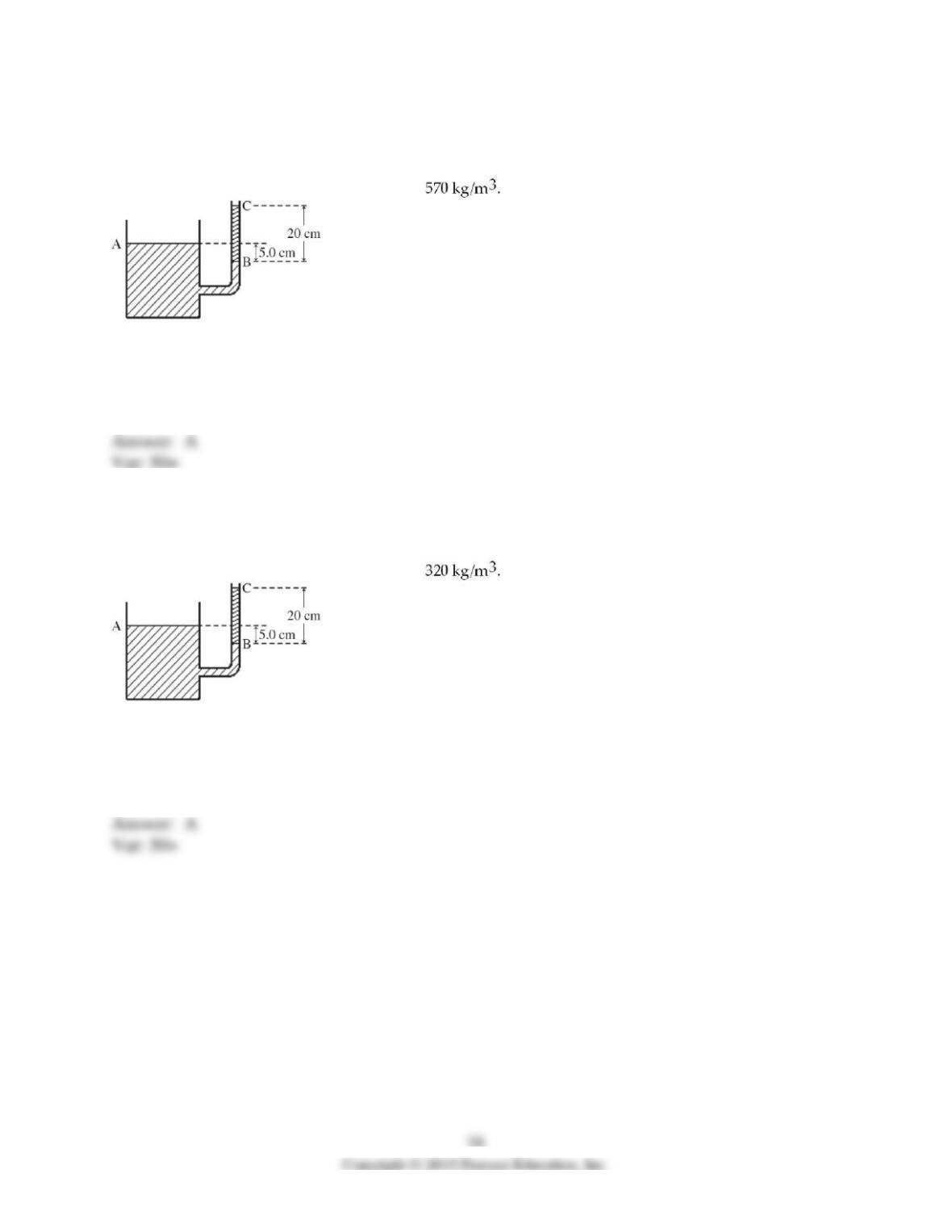
21) A container has a vertical tube, whose inner radius is 24.00 mm, connected to it at its side, as
shown in the figure. An unknown liquid reaches level A in the container and level B in the tube–
level A being 5.0 cm higher than level B. The liquid supports a 20-cm high column of oil,
between levels B and C, whose density is The mass of the oil is closest to
A) 210
B) 410
C) 620
D) 820
E) 1000
22) A container has a vertical tube, whose inner radius is 12.00 mm, connected to it at its side, as
shown in the figure. An unknown liquid reaches level A in the container and level B in the tube–
level A being 5.0 cm higher than level B. The liquid supports a 20-cm high column of oil,
between levels B and C, whose density is The gauge pressure at level B is closest to
A) 630 Pa
B) 310 Pa
C) 470 Pa
D) 790 Pa
E) 940 Pa
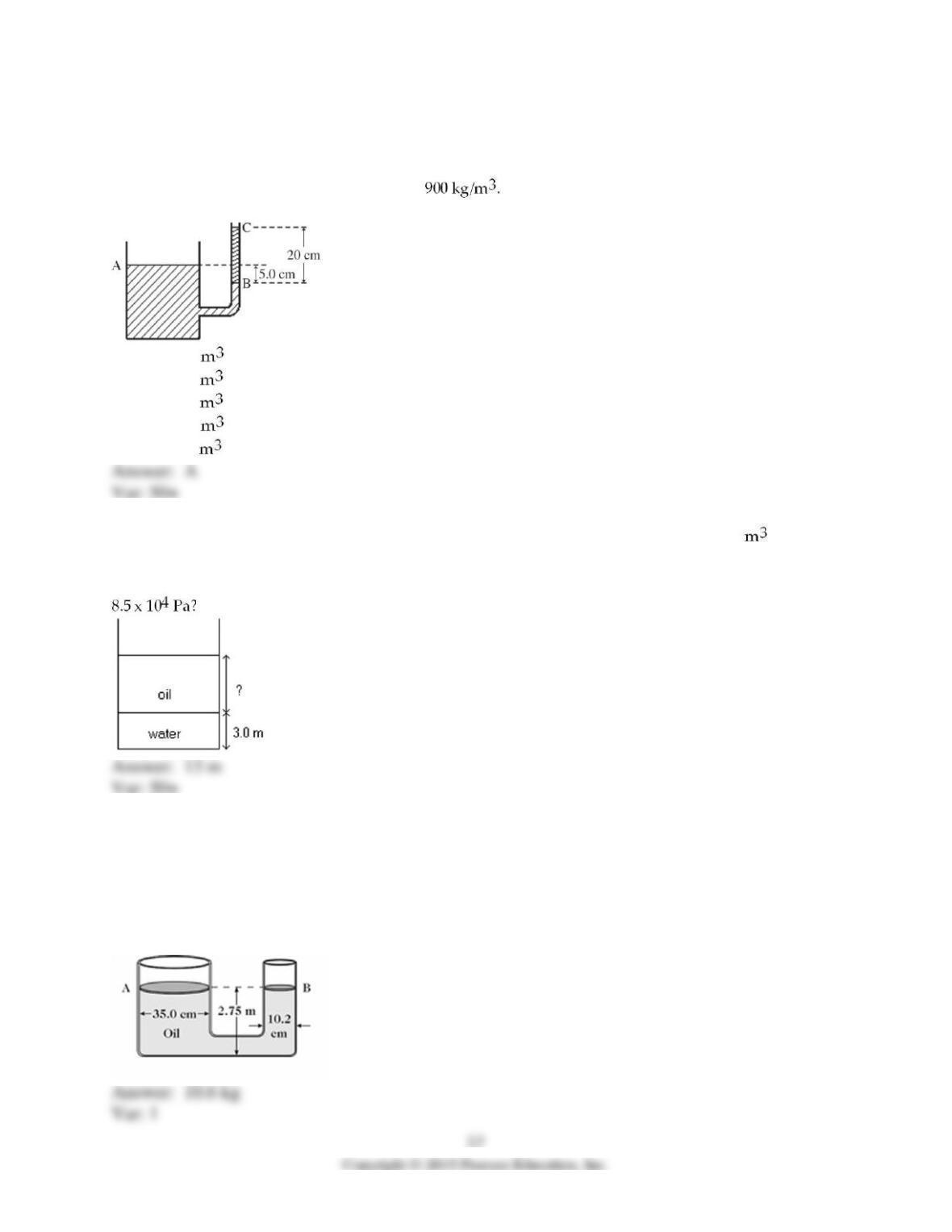
23) A container has a vertical tube, whose inner radius is 20.00 mm, connected to it at its side, as
shown in the figure. An unknown liquid reaches level A in the container and level B in the tube–
level A being 5.0 cm higher than level B. The liquid supports a 20-cm high column of oil,
between levels B and C, whose density is The density of the unknown liquid is closest
to
A) 3600 kg/
B) 3900 kg/
C) 2800 kg/
D) 3100 kg/
E) 3300 kg/
24) As shown in the figure, a large open tank contains a layer of oil ( density 450 kg/ ) floating
on top of a layer of water (density 1000 kg/m3) that is 3.0 m thick, as shown in the sketch. What
must be the thickness of the oil layer if the gauge pressure at the bottom of the tank is to be
25) A container consists of two vertical cylindrical columns of different diameter connected by a
narrow horizontal section, as shown in the figure. The open faces of the two columns are closed
by very light plates that can move up and down without friction. The tube diameter at A is 35.0
cm and at B it is 10.2 cm. This container is filled with oil of density 0.820 g/cm3. If a 125-kg
object is placed on the larger plate at A, how much mass should be placed on the smaller plate at
B to balance it?