Exam
Name___________________________________
MULTIPLE CHOICE. Choose the one alternative that best completes the statement or answers the question.
1)
The most rapid type of mass movement is a ________.
1)
A)
debris flow
B)
slump
C)
lahar
D)
rock avalanche
2)
________ involves movement on a zone of compressed air.
2)
A)
Soil creep
B)
A mudflow
C)
A slump
D)
A rock avalanche
3)
Consider a steep highway cut made by removing slightly weathered to fresh, fractured, granite
bedrock. Which of the following situations is most stable against rockslides?
3)
A)
one set of widely spaced fractures inclined towards the road cut
B)
two sets of fractures, one widely spaced and sub–horizontal, the other inclined away from the
highway cut
C)
one set of widely spaced, sub–horizontal fractures
D)
two sets of fractures, one inclined toward the road cut and the other away
4)
How do the strength and cohesion of clay–rich regolith or soil change with the addition of water?
4)
A)
Water increases the strength and cohesion.
B)
Water does not affect the cohesion but lowers the strength.
C)
Water lowers the strength and cohesion.
D)
Water reduces the strength of clays but raises the cohesion of the soil.
5)
All of the following are factors affecting mass wasting EXCEPT for ________.
5)
A)
water
B)
slope angle
C)
geologic age
D)
gravity
6)
Which one of the following operates primarily in areas of permafrost?
6)
A)
rock avalanche
B)
solifluction
C)
mudflow
D)
soil creep
7)
Which one of the following materials has the maximum, sustainable, slope angle, as determined by
the angle of repose?
7)
A)
dry sand
B)
moist, clay–rich shale layers
C)
moist, sandy soil with a clay–rich matrix
D)
dry silt
8)
Which mass wasting process has the slowest rate of movement?
8)
A)
solifluction
B)
creep
C)
slump
D)
rock avalanche
9)
Of the following, which one would most likely be triggered by an earthquake?
9)
A)
solifluction
B)
slump
C)
rock avalanche
D)
soil creep
10)
Which of the following mass movements is most likely to occur in a geologic setting where the rock
strata are inclined?
10)
A)
rockslide
B)
slump
C)
creep
D)
debris flow
11)
Where do the most rapid mass–wasting events occur?
11)
A)
rugged, geologically young mountains
B)
gently sloped mountains
C)
areas with a high occurrence of earthquakes
D)
older, gradually sloped mountains
12)
All of the following are possible indicators that creep is occurring EXCEPT for ________.
12)
A)
an extremely thick soil profile
B)
curved tree trunks
C)
cracks in roads or sidewalks
D)
tilted fences or power line poles
13)
Consider a weathered rock or soil particle lying on a slope. How will the gravitational force pulling
the particle downward along the land surface vary with the inclination of the slope?
13)
A)
It is not affected by the slope angle.
B)
It will decrease as the slope angle is lessened.
C)
It will possibly increase or decrease as slope angle is lessened, depending upon other factors.
D)
It will increase as the slope angle is lessened.
14)
During wet weather or times when snow is melting, sometimes the downhill toe of a slump
________.
14)
A)
turns into a rock avalanche
B)
stops moving because water makes the clay sticky
C)
collapses and is deposited as talus at the base of the slope
D)
becomes an earthflow
15)
A geologist wants to locate a horizontal coal bed on a soil–covered slope where soil creep is active.
A distinctive sandstone bed underlies the coal bed. On the basis of weathered sandstone fragments
in the soil, where is the coal bed?
15)
A)
just above the lowest piece of sandstone seen in the soil
B)
just above the highest piece of sandstone seen in the soil
C)
just below the highest piece of sandstone seen in the soil
D)
just below the lowest piece of sandstone seen in the soil
16)
Which of the following statements concerning mudflows is NOT true?
16)
A)
Mudflows can move and carry very large boulders and other coarse debris.
B)
Mudflows deposit talus slopes.
C)
Mudflows may be caused by heavy rains or melting snow.
D)
In hilly areas, mudflows move down the canyons and stream valleys.
B
17)
How do freezing, thawing, wetting, and drying contribute to soil creep?
17)
A)
The soil becomes much weaker when dry and frozen.
B)
Eventually, these cause the soil and regolith to suddenly slide down the slope.
C)
Gravity exerts a much stronger force when the soil is wet and thawed.
D)
The soil expands and contracts, lifting particles and dropping them a slight distance
downslope.
D
18)
Which of the following locations was affected by mudflows triggered by an earthquake in 2001?
18)
A)
Santa Tecia, El Salvador
B)
Buffalo, New York
C)
Oslo, Norway
D)
Johannesburg, South Africa
A
B
19)
Which statement best describes slumping, a mass wasting process?
19)
A)
A block or blocks of unconsolidated regolith slide downhill along a curved slip surface.
B)
Blocks of hard bedrock rapidly slide downhill along fracture surfaces.
C)
A mass of soil or regolith becomes saturated with water and suddenly flows downhill to the
base of the slope.
D)
The soil and regolith move downhill very slowly.
20)
What caused the mudflows (1985) on the Nevado del Ruiz volcano?
20)
A)
Warm weather caused rapid melting of snow and ice near the summit.
B)
A crater lake was broken during an eruption.
C)
Hot ash fell onto snow near the summit.
D)
all of the above
21)
Why was the Alaskan pipeline built above ground and insulated?
21)
A)
to keep the crude oil cool and highly fluid
B)
to protect against damage from roots of large trees uprooted in windstorms
C)
to protect the pipeline against damage due to thawing ground and to keep the crude oil hot
and fluid
D)
to protect against damage from herds of elk and deer
22)
________ denotes the exposed, crescent–shaped rupture surface at the head of a slump.
22)
A)
Sole
B)
Toe
C)
Scoop
D)
Scarp
23)
As an erosional process, how is mass wasting unique from wind, water, and ice?
23)
A)
Mass wasting affects particles of all sizes whereas the others affect only smaller particles.
B)
Mass wasting affects much larger geographic areas than does wind, water, and ice.
C)
Mass wasting does not require a transporting medium.
D)
All of the above make mass wasting unique compared to wind, water, and ice.
24)
Which of the following was a major factor leading to the Gros Ventre, Wyoming, slide?
24)
A)
Dry weather caused the clay–rich strata to compact, allowing the overlying sandstone to slide
into the valley.
B)
Erosion by the river had undercut the slope–forming shale and exposed the underlying
sandstone.
C)
Soils and shallow bedrock were very wet and locally saturated.
D)
A strong earthquake caused the unstable rock layers to move.
SHORT ANSWER. Write the word or phrase that best completes each statement or answers the question.
25)
Unconsolidated, granular materials such as gravel and sand will support maximum slope
angles of about 33 to 35 degrees. What is the name for this maximum slope angle?
25)
Word Analysis. Examine the words and/or phrases for each question below and determine the relationship among the
majority of words/phrases. Choose the option that does not fit the pattern.
26)
a. slope angle b. water c. vegetation d. earthquake
26)
27)
________ denotes the downslope movement of soils and regolith.
27)
Word Analysis. Examine the words and/or phrases for each question below and determine the relationship among the
majority of words/phrases. Choose the option that does not fit the pattern.
28)
a. earthquake b. lahar c. liquefaction d. landslide
28)
29)
a. solifluction b. fall c. slide d. flow
29)
30)
________ denotes the exposed portion of the slip surface beneath a slump block.
30)
31)
What is the fastest moving of the mass wasting processes?
31)
32)
________ involves the downslope movement of a block or blocks of unconsolidated soil
and regolith along a curved, slip surface.
32)
Word Analysis. Examine the words and/or phrases for each question below and determine the relationship among the
majority of words/phrases. Choose the option that does not fit the pattern.
33)
a. wind b. water c. mass wasting d. ice
33)
c
34)
a. rockslide b. debris flow c. creep d. slump
34)
c
35)
Which process of mass wasting occurs primarily in permafrost regions?
35)
36)
________ is the basic force that moves or accelerates soil and regolith down a slope.
36)
37)
What is another name for volcanic mudflows, like those formed during the Mount St.
Helens and Nevado del Ruiz eruptions?
37)
38)
Talus slopes are associated with what type of motiona fall, a slide, or a flow?
38)
TRUE/FALSE. Write ‘T’ if the statement is true and ‘F’ if the statement is false.
39)
Slump describes the very slow, downhill movement of soil and regolith.
39)
a
40)
A scarp is the exposed portion of the rupture surface beneath a slump block.
40)
41)
Repeated freezing and thawing can be important in soil creep movements.
41)
42)
The steepest, stable, slope angle possible in unconsolidated, granular materials (e.g., sand and
gravel) is called the angle of retention.
42)
43)
Solifluction is an important mass wasting process in areas of permafrost.
43)
44)
A triggering mechanism, such as heavy rains or an earthquake, are necessary for mass wasting to
occur.
44)
45)
Solifluction occurs during the warmer summer months.
45)
46)
Lahars are essentially mudflows associated with volcanoes and volcanism.
46)
47)
Bedding planes and fractures can both act as slip surfaces for rockslides.
47)
48)
The Gros Ventre slide of 1925 was actually a mudflow triggered by an earthquake.
48)
49)
Earthflows and slumps generally involve movement of unconsolidated or weakly consolidated soil
and regolith.
49)
ESSAY. Write your answer in the space provided or on a separate sheet of paper.
Critical thinking and discussion questions. Use complete sentences, correct spelling, and the information presented in
chapter 12 to answer the questions below.
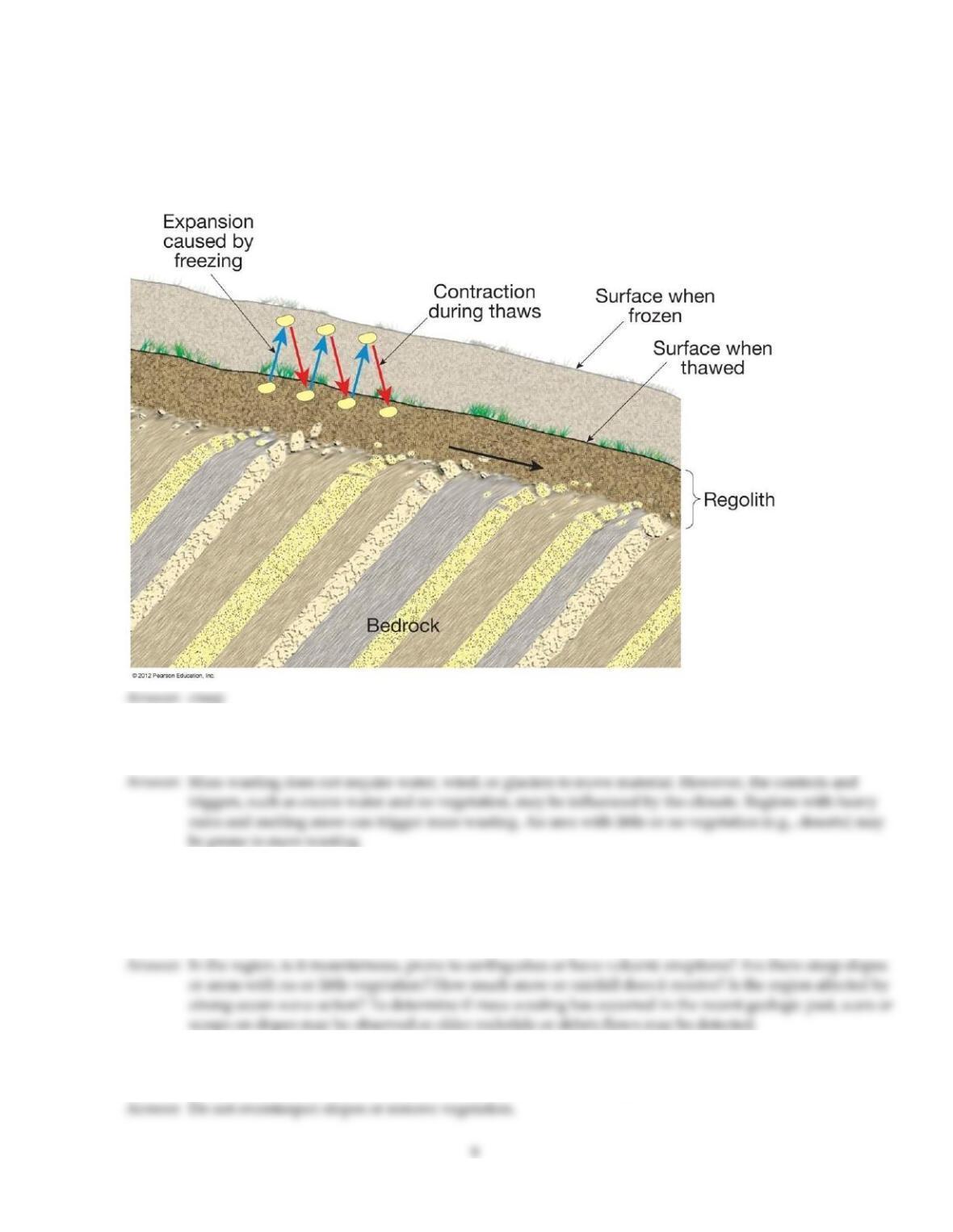
50)
What process of mass wasting is illustrated in the diagram below?
51)
Based on the examples and discussion in chapter 12, what is the relationship of climate to mass wasting? Also,
are certain climates more susceptible to mass wasting? Why?
52)
As a geologist working in a foreign country for the first time, you are asked to assess the potential for rapid
mass wasting in a particular region. In what aspects or characteristics (geologic, geographic, biologic, etc.) of the
region do you need for your assessment? Also, how could you possibly determine if mass wasting has been
active in the recent geologic past (hundreds or thousands of years)?
53)
Although it was not discussed in chapter 12, what are some preventive measures that can be done to reduce or
lessen the impact of mass wasting? (Hint: Think about the controls and triggers of mass wasting.)
10
Answer Key
Testname: C12