
Chapter 12 Test Bank KEY
1. Which of the following best describes the growth of public sector employment since 1950? As a
percentage of total employment,
2. Since 1950, government employment has grown
3. As a percentage of total employment, government employment in the U.S. is currently about
4. Which of the following best explains the growth of public sector employment relative to the private
sector since 1950?
5. A partial explanation of the change in public sector employment since 1950 is that
6. Which one of the following is not an explanation for the growth of public employment?
7. Among the countries listed below, relative public sector employment is greatest in

8. In a 1977 study that controlled for union status, education, and other characteristics, Smith found that
federal workers earned
9. Research by Moulton and by Gittleman and Pierce found that
10. In the public sector,
11. Compared to their private sector counterparts, government workers
12. Empirical studies of public sector pay conclude that
13. In the U.S. volunteer army, a typical male enlistee’s pay over his military career is comparable to the
median wage of a full-time worker who
14. Because a lottery draft selects individuals with opportunity costs randomly drawn from the general
population, while an all-volunteer military enlists only those with opportunity costs less than the military
wage,
15. Compared to a conscripted military, an all-volunteer military
16. Refer to the following graph of the demand for and supply of armed forces personnel.
The height of the supply curve (S) measures
17. Refer to the following graph of the demand for and supply of armed forces personnel.
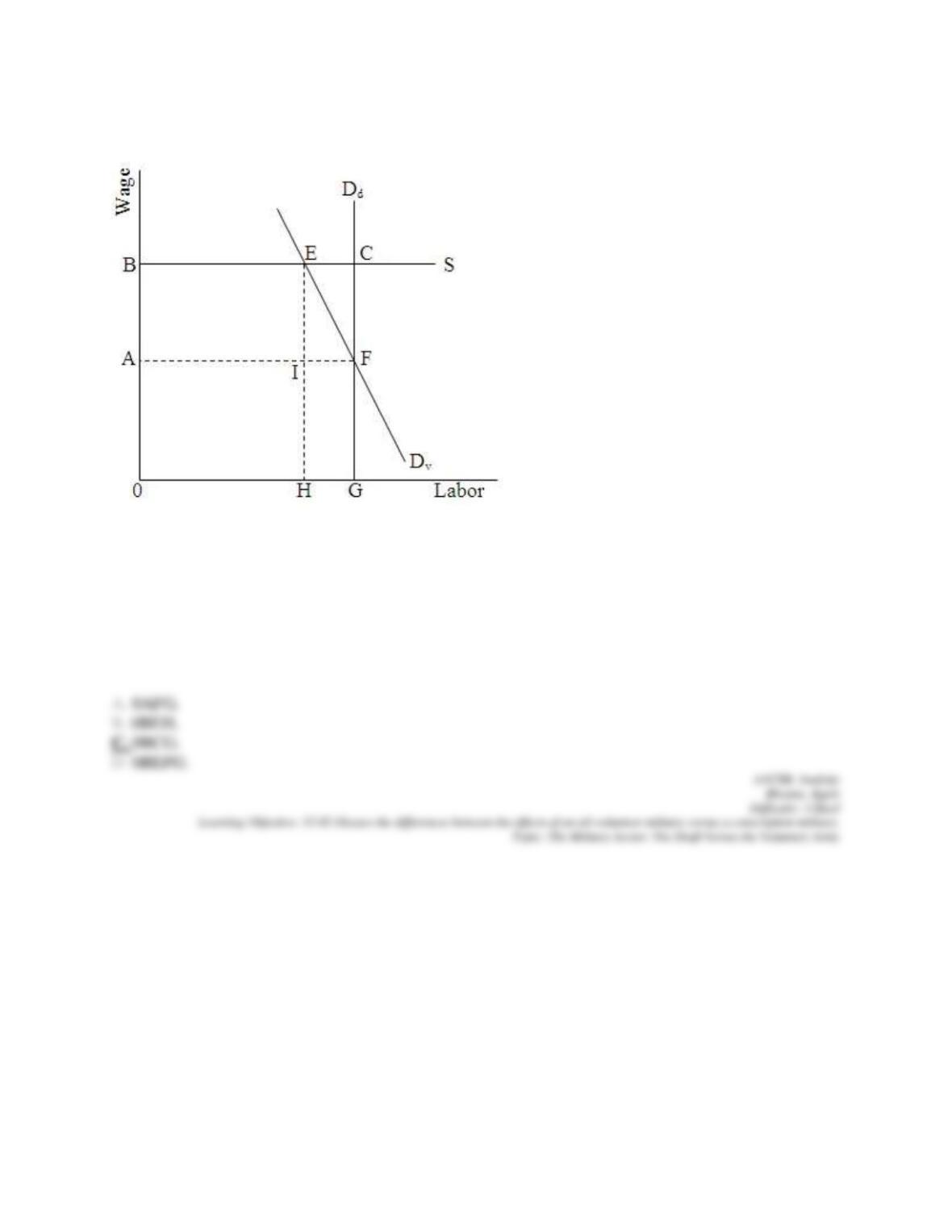
Suppose the government’s demand for military personnel is Dd and that it wishes to draft G persons at a
wage of $A. The full cost to society of this proposal is area
18. Refer to the following graph of the demand for and supply of armed forces personnel.
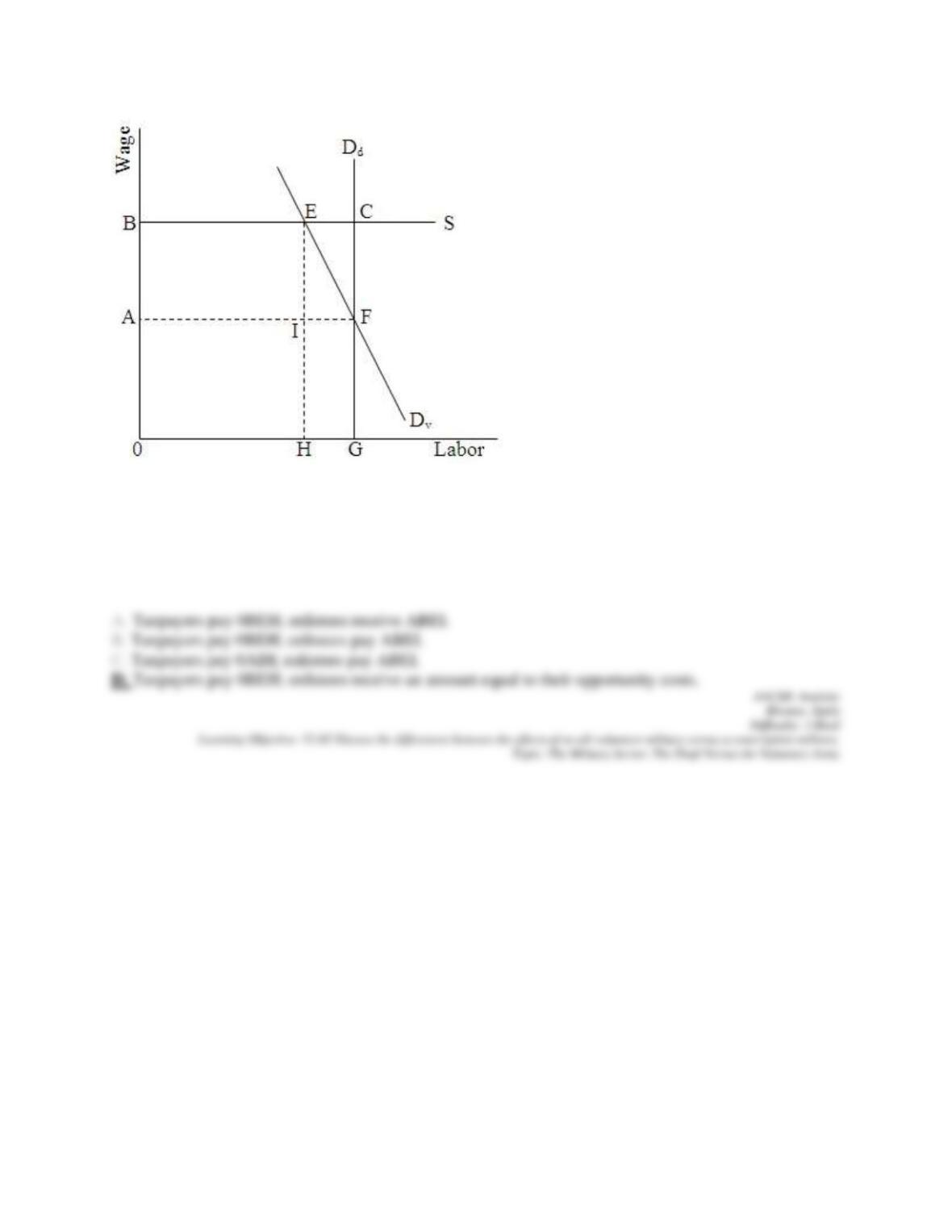
Suppose the government uses a voluntary system. Its demand for labor is Dv and it wishes to attract H
workers at a wage of $B. Which of the following best describes the distribution of costs that will result?
19. Refer to the following graph of the demand for and supply of armed forces personnel.
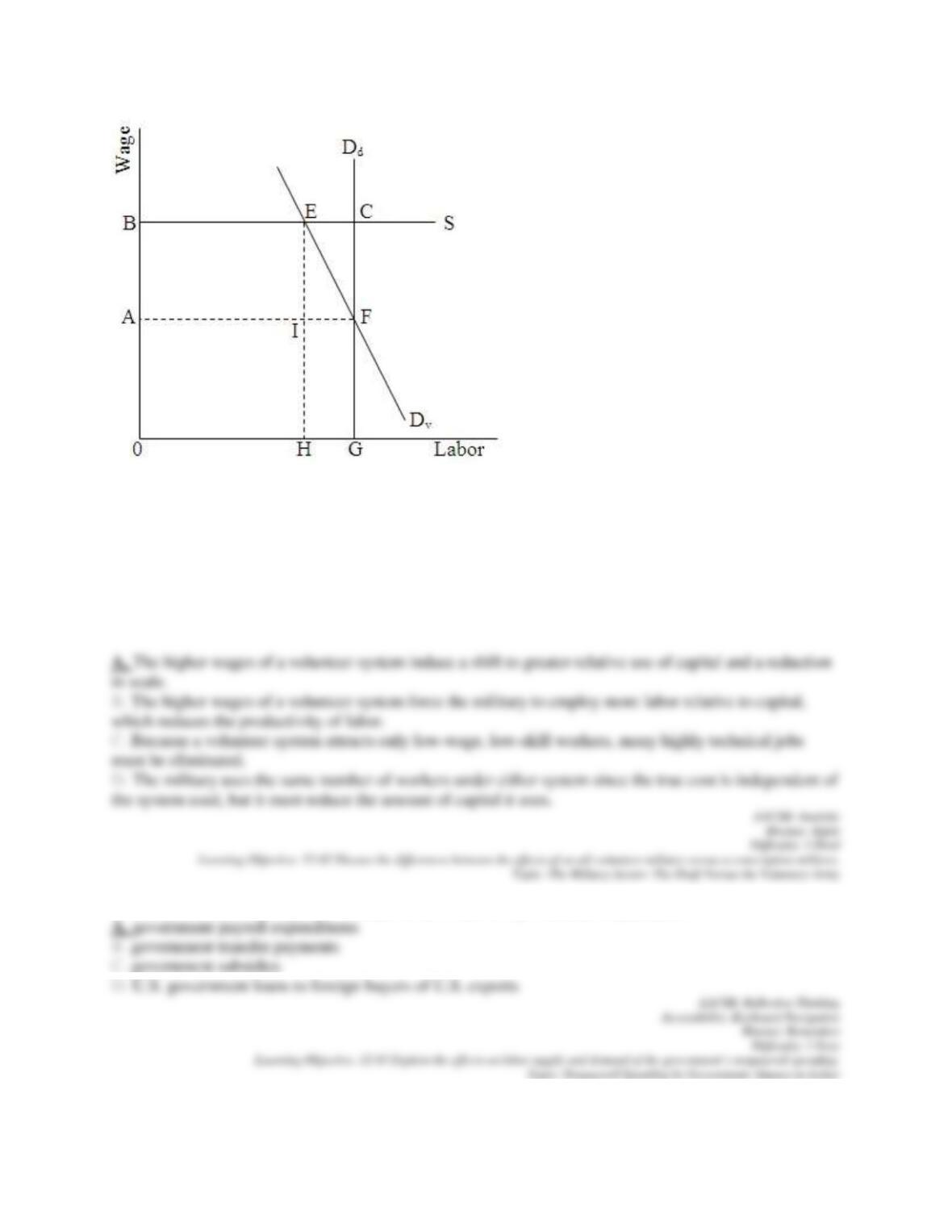
Which of the following best explains why the government demands fewer persons for the armed forces
under the volunteer system than under a draft system (that is, H as compared to G)?
20. Which of the following is an example of an exhaustive government expenditure?
21. Which of the following is an example of a nonexhaustive (transfer) government expenditure?
22. Consider the effects of a government transfer payment that falls as income rises (such as food
stamps). Economic theory predicts that
23. Which of the following best describes the impact of government transfers on human capital
investment decisions?
24. Suppose the federal government builds a new flood control project that takes thousands of acres of
land out of agricultural production. Which of the following is most likely to occur as a result?
25. The public provision of a good that is a substitute for a private good will
26. Independent of taxes raised to finance it, the provision of a public good most likely
27. The provision of a public good that is complementary to leisure will
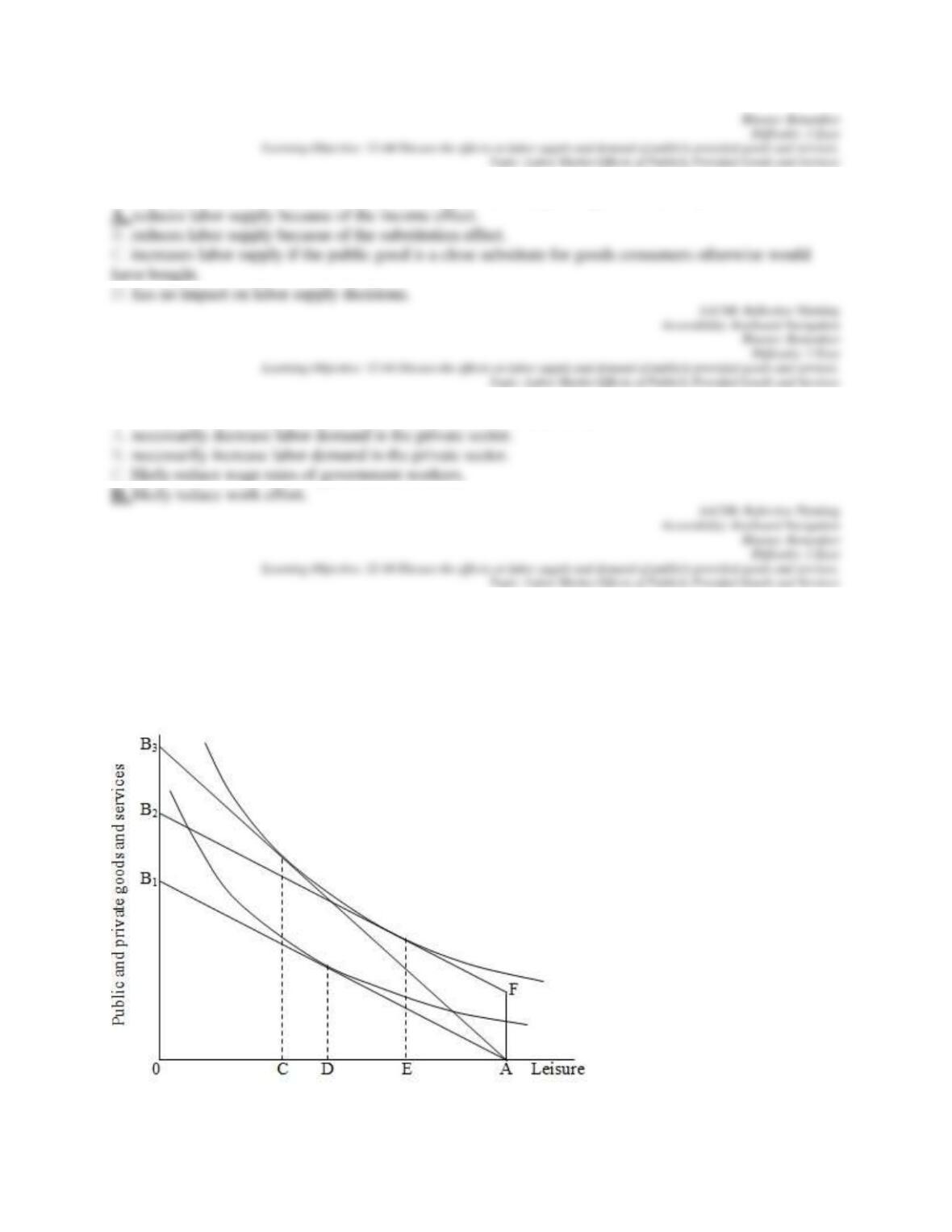
28. Refer to the following labor-leisure diagram. The worker’s current budget line is given by line AB1,
and she is working AD hours.
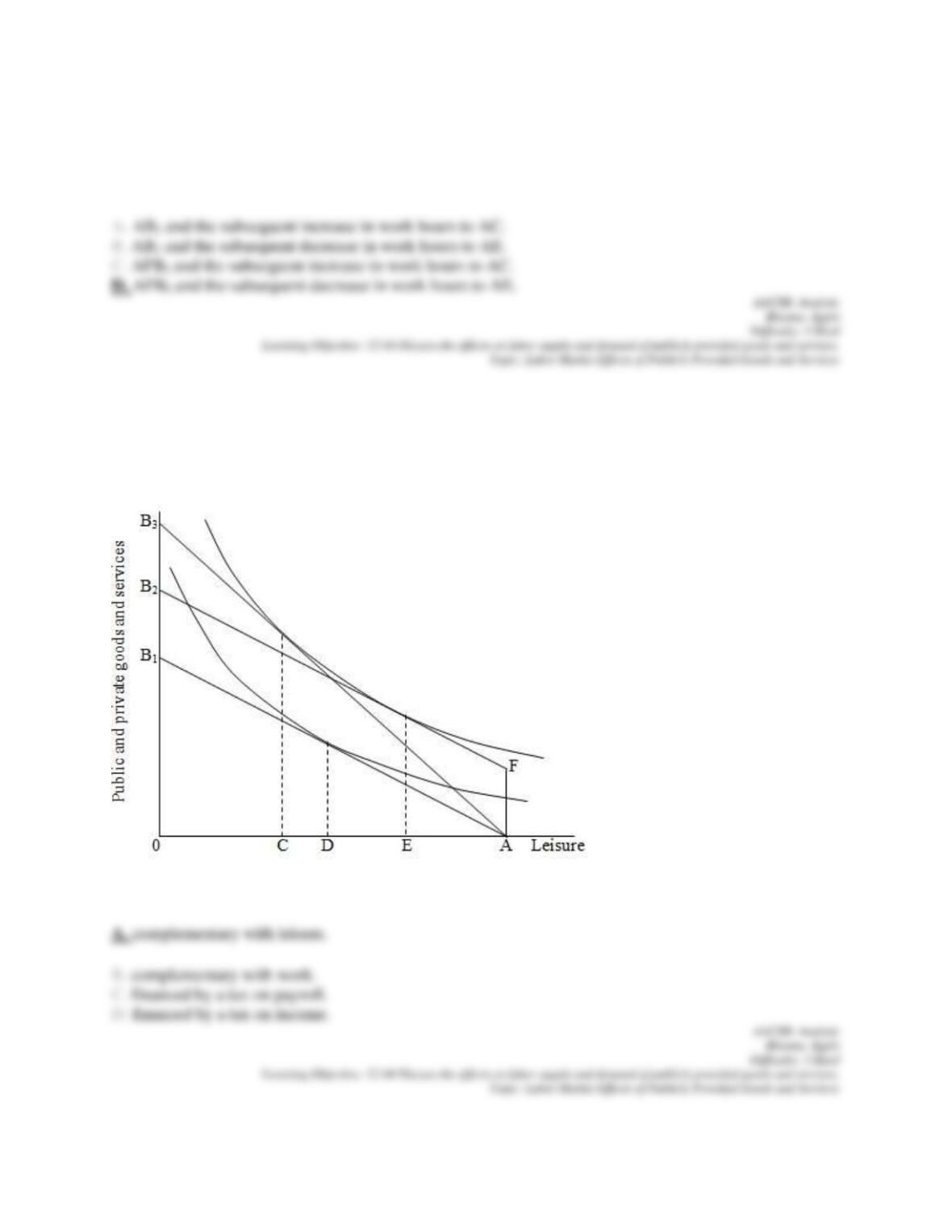
The provision of a public good is best modeled by the shift to budget line
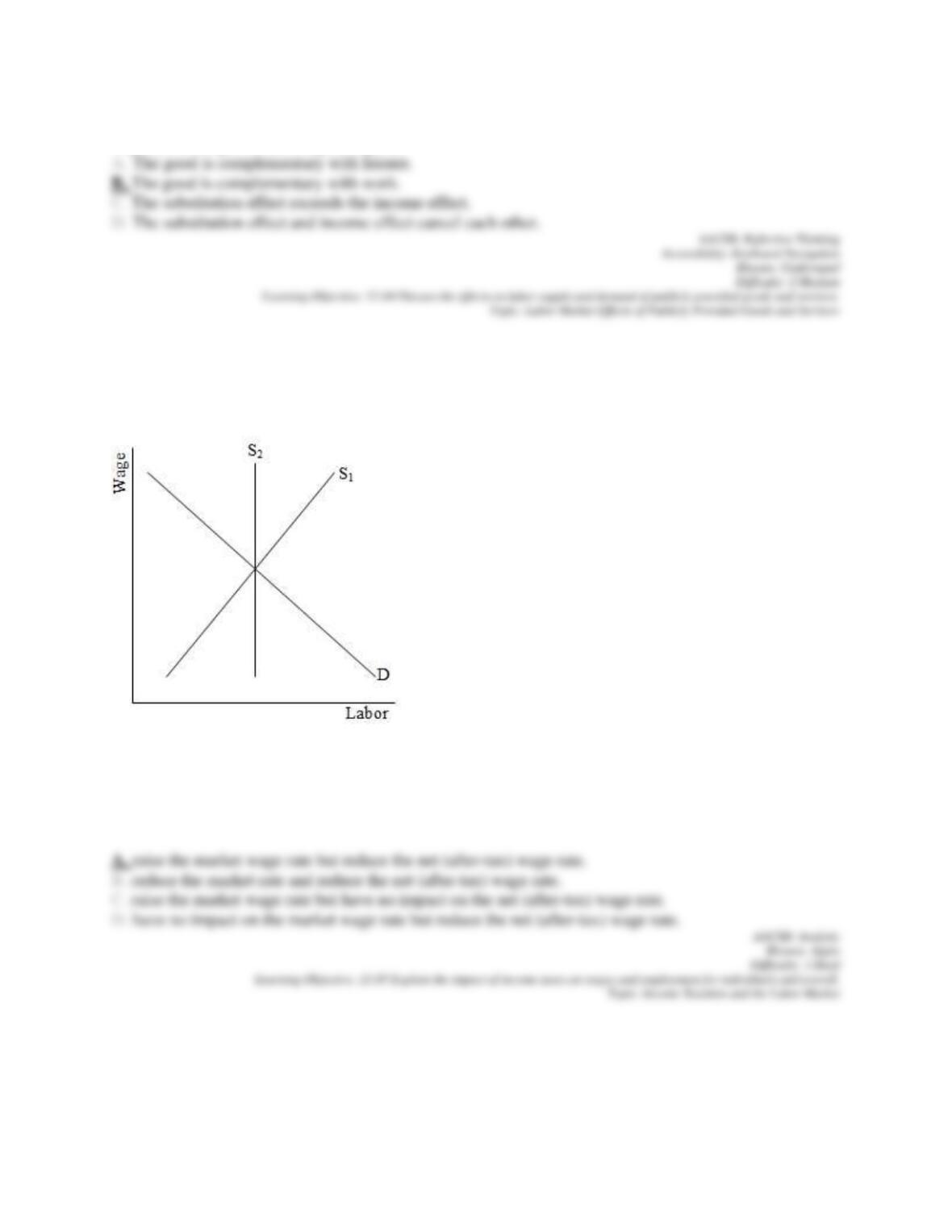
29. Refer to the following labor-leisure diagram. The worker’s current budget line is given by line AB1,
and she is working AD hours. As illustrated, this public good is likely
30. Ignoring the tax consequences of its provision, what might we conclude if people work more hours in
response to the provision of a public good?
31. Refer to the following diagram.
Assuming that labor supply is S1, imposing an income tax on this market will
32. Refer to the following diagram.
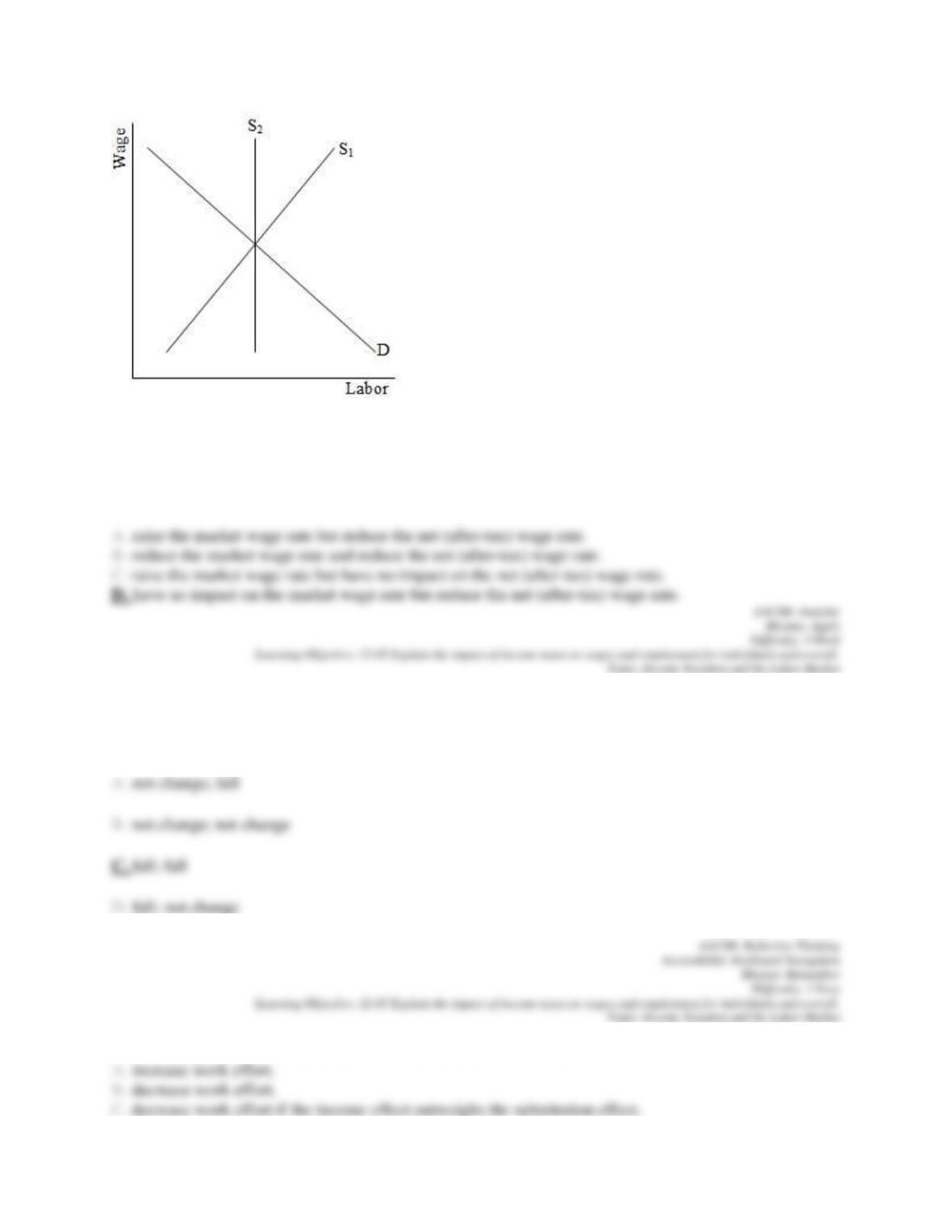
Assuming that labor supply is S2, imposing an income tax on this market will
Topic: Income Taxation and the Labor Market
33. Suppose the aggregate labor supply curve slopes upward and the income tax rate is increased.
Economic theory predicts that the employment of labor will _____ and the after-tax “take-home” wage
will _____.
34. For any given individual, an increase in the income tax rate will
35. According to the theory of individual labor supply, a reduction in income tax rates leads to
36. Suppose income tax rates are reduced. As a result, Smith works more hours per week while Jones
works fewer hours per week. We can conclude that
37. Suppose a tax is levied on Muhammad which reduces his real income. The money collected is used to
provide a public good which restores his utility to exactly the same level it had been prior to the tax.
Compared to his original work effort, Muhammad will now work
38. Most studies conclude that aggregate labor supply is very
39. To pay for health care reforms, suppose a new payroll tax is levied on employers. The economic
burden of the new tax will fall
40. Suppose the payroll tax is increased. For any given labor demand, the greater the elasticity of labor
supply,
41. If labor supply is perfectly inelastic, the economic incidence of the payroll tax
42. According to empirical evidence, most of the burden of the payroll tax appears to fall on workers,
even though about half is supposedly “paid” by their employers. This observation is attributed to the
finding that
43. Which function currently accounts for the greatest percentage of state and local workers?

44. According to research on the incidence of Social Security payroll taxes,
Chapter 12 Test Bank Summary
Category
# of Questi
ons
AACSB: Analytic
7
AACSB: Reflective Thinking
37
Accessibility: Keyboard Navigation
36
Blooms: Apply
7
Blooms: Remember
29
Blooms: Understand
8
Difficulty: 1 Easy
29
Difficulty: 2 Medium
8
Difficulty: 3 Hard
7
Learning Objective: 12-
01 Compare and contrast public sector compensation and employment growth with that
of the private sector.
13
Learning Objective: 12-02 Discuss the differences between the effects of an all-
volunteer military versus a conscription military.
7
Learning Objective: 12-
03 Explain the effects on labor supply and demand of the government’s nonpayroll spe
nding.
5
Learning Objective: 12-
6
04 Discuss the effects on labor supply and demand of publicly provided goods and serv
ices.
Learning Objective: 12-
05 Explain the impact of income taxes on wages and employment for individuals and o
verall.
13
Topic: Income Taxation and the Labor Market
13
Topic: Labor Market Effects of Publicly Provided Goods and Services
6
Topic: Nonpayroll Spending by Government: Impact on Labor
5
Topic: Public Sector Employment and Wages
13
Topic: The Military Sector: The Draft Versus the Voluntary Army
7