62. On January 1, 2012, Newton Corporation purchased $200,000 of 10-year, 10 percent bonds for $227,184 to
yield 8 percent annually. The bonds pay interest on January 1, and July 1 of each year. If Tomas uses the
effective interest method of amortization, how much interest revenue will the company record for the first six
months? (rounded)
63. On January 1, 2011, the Nevada Company purchased $800,000 of Utah Company’s 10 percent, 20-year
bonds at 104 and classified the investment as held-to-maturity securities. The bonds pay interest on January 1
and July 1 of each year. Nevada uses straight-line amortization for all premiums and discounts. The entry for
the receipt of the semiannual interest on July 1, 2011, is
64. Cleveland purchased $200,000 of Clair Company’s 10-year, 9 percent bonds for $166,100 on July 1, 2012.
Cleveland purchased the bonds to yield 12 percent interest. If Cleveland uses the effective-interest method to
amortize discounts, how much interest revenue should Cleveland recognize for 2012 as a result of the
investment?
65. Simpson Corporation purchased $30,000 of Tekservice Corporation’s 12 percent bonds for $27,345 plus
accrued interest on March 1, 2012. The bonds mature on January 1, 2022, and interest is payable on June 30 and
December 31. How much discount or premium should be amortized on June 30, 2012, under the straight-line
method?
66. On January 2, 2011, Oakwood, Inc., purchased $800,000 of 10 percent, 10-year bonds for $872,000. The
bonds pay interest on January 1 and July 1 of each year. Oakwood uses straight-line amortization for all
premiums or discounts. On July 1, 2014, Oakwood sold the bonds for $832,000. How much gain or loss should
Oakwood record on the sale?
67. When the equity method is used to account for long-term investments in stock, the receipt of dividends is
recorded as a credit to
68. When an investor uses the equity method to account for investments in common stock, the investment
account will be increased when the investor recognizes
69. When an investor uses the equity method to account for investments in common stock, cash dividends
received by the investor from the investee should be recorded as
70. Bart Corporation purchased 1,200 of the 3,000 outstanding shares of Starr Company common stock for $50
per share. Given this information, when Bart Corporation receives a cash dividend from Starr Company, which
of the following accounts should be credited?
71. On February 19, 2012, Jose Inc. acquired 18,000 shares of Luis Corporation stock at $45 per share. Jose has
50,000 shares outstanding. On December 31, 2012, Luis common stock had a closing market price of $26 per
share. Assuming that the decline in market price is considered to be temporary, at December 31, Luis would
72. Sasser Inc. had the following activities related to long-term investments during 2012:
July 6
Purchased 24,000 shares of Trudie Company for $30 per share.
August 16
Received a $2.40-per-share cash dividend from Trudie Company.
December 31
Trudie announced earnings for the year of $333,600. Trudie has 72,000 shares of stock outstanding.
Given this information, how much revenue should Sasser report in 2012 for its investment in Trudie stock?
73. In 2012, Rune had the following activities in long-term investments:
April 6
Purchased 2,000 shares of Arledge stock for $3.25 per share plus brokerage fees of $500.
July 7
Received a cash dividend of $0.70 per share on Arledge stock.
December 31
Arledge reported net income of $50,000. Arledge has 8,000 shares of common stock outstanding.
What should be the balance in the Investment in Equity Method Securities-Arledge Stock account as of December 31, 2012?
74. On January 2, 2011, U.S. Buyers, Inc. purchased 5,000 shares of the 20,000 shares outstanding of Latino
Corporation stock for $15,000. The following information was reported by Latino during 2011:
Net Income
$45,000
Dividends
$1.75 per share
Market Price, 12/31/11
$2.50 per share
U.S. Buyers, Inc. sold all of its Latino Corporation stock on March 1, 2012, for $3.10 per share. The total amount U.S. Buyers, Inc. should report on
the sale is
75. Financial statements in which financial data for two or more companies are combined as a single entity are
called
76. Johnson Company owns 90% of the outstanding stock of Smith Company. The equity of the remaining 10%
of Smith Company stock is called the
77. In general, consolidated financial statements should be prepared
78. Stanger Company owns 85% of the outstanding stock of Willden Company. At the end of the year, Willden
Company reported revenues of $2,500 and expenses of $1,800. How much will Stanger Company report on its
own financial statements as income from Willden Company?
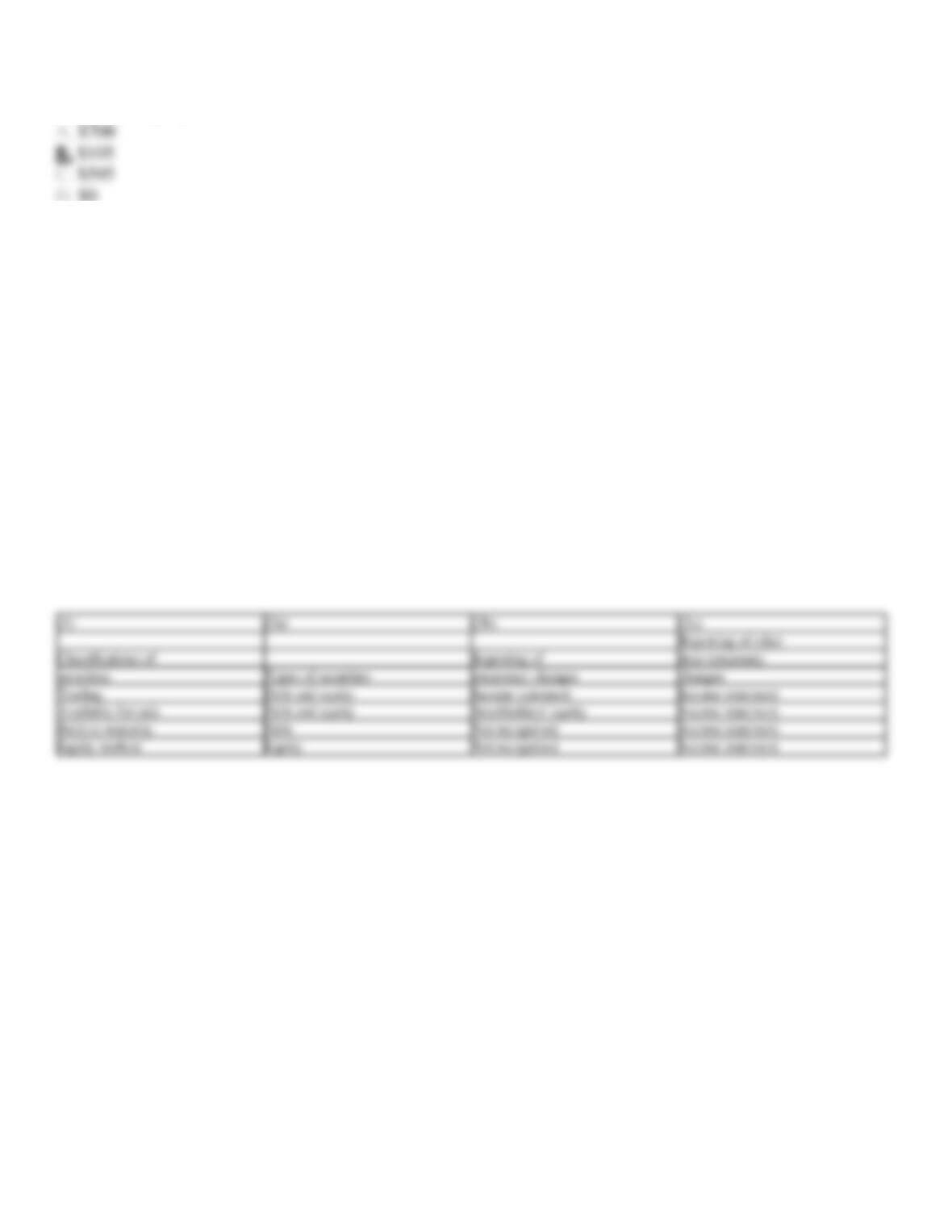
79. Stanger Company owns 85% of the outstanding stock of Willden Company. At the end of the year, Willden
Company reported revenues of $2,500 and expenses of $1,800. How much minority interest will be reported on
Stanger Company’s financial statements?
80. Answer the following questions with respect to classifications of security:
1.
List the four different
classifications of
securities.
2.
For each classification of
security:
a.
What type(s) of securities
are included in this
classification?
b.
Where are temporary
changes reported?
c.
Where are other than
temporary changes
reported?
Reporting of other
Classifications of
Reporting of
than temporary
securities
Types of securities
temporary changes
changes
Trading
Debt and equity
Income statement
Income statement
Available-for-sale
Debt and equity
Stockholders’ equity
Income statement
Debt
Not recognized
Income statement
81. Dixie Corporation recorded the following transactions for its long-term investments during 2012:
April 30
Purchased 3,000 shares of Enigma Corporation stock at $22 per share plus brokerage fees of $3,000 and classified the
shares as trading securities. Enigma Corporation has 50,000 shares outstanding.
May 31
Received a cash dividend of $2.00 per share on Enigma Corporation stock.
July 29
Sold 1,000 shares of Enigma Corporation stock for $25 per share.
December 15
Sold 2,000 shares of Enigma Corporation stock for $20 per share.
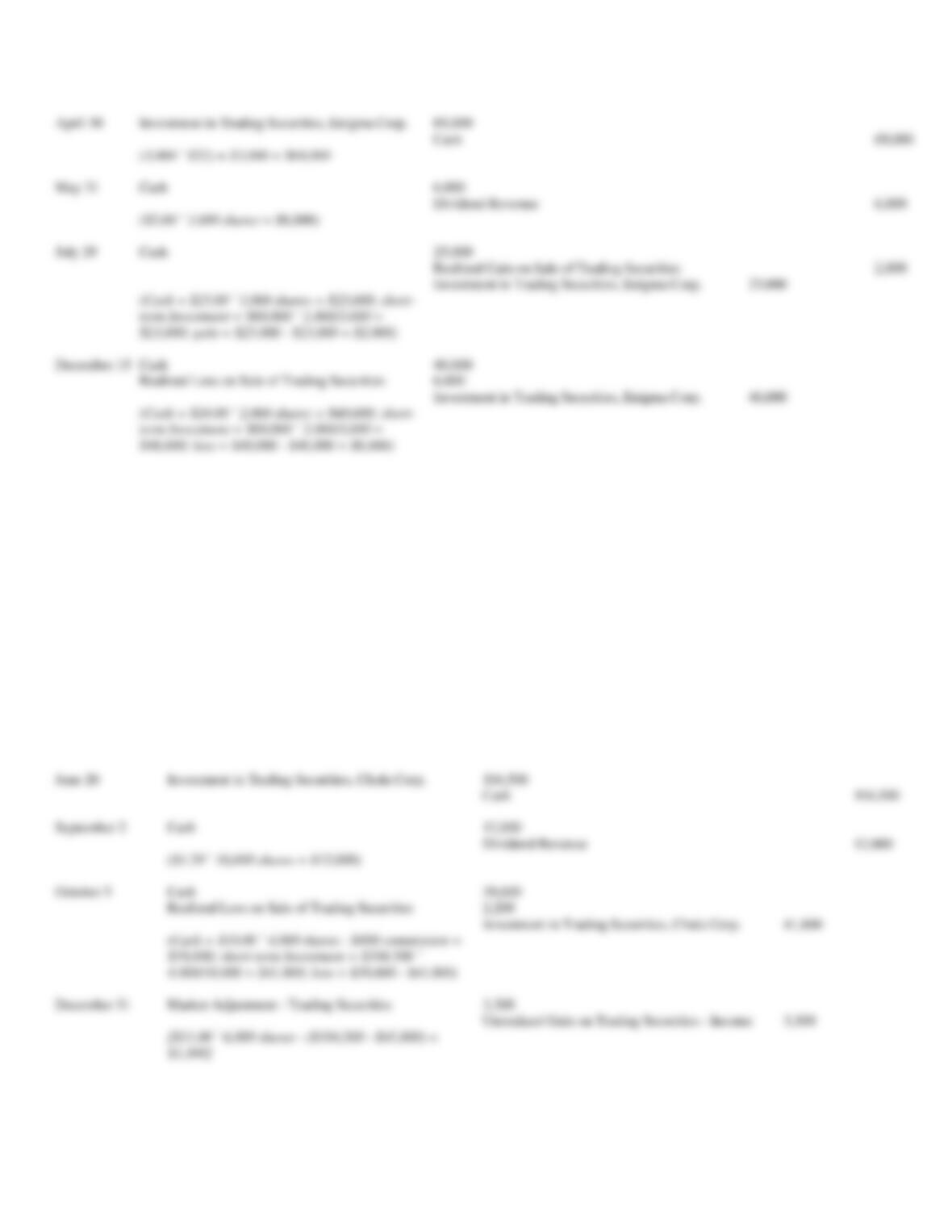
Give the journal entries necessary to account for the investment in Enigma Corporation during 2012.
82. In June 2012, Barwick Company had excess cash that would not be needed until March 1, 2013.
Management decided to invest the money in a short-term investment in trading securities. Barwick owned no
investment securities before June 2012. The following transactions relate to these investments:
June 20
Purchase 10,000 shares of Chula Corporation stock. The price paid (including brokerage fees) was $104,500.
September 2
Received a cash dividend of $1.20 per share on Chula stock.
October 5
Sold 4,000 shares of Chula stock at $10.00 per share. Paid a selling commission of $400.
December 31
The market price of Chula stock was $11.00.
Give the journal entries necessary to account for the investment in Chula Corporation during 2012.
June 20
Investment in Trading Securities, Chula Corp.
104,500
Cash
September 2
Cash
12,000
Dividend Revenue
October 5
Cash
39,600
Investment in Trading Securities, Chula Corp.
41,800
December 31
Market Adjustment – Trading Securities
3,300
Unrealized Gain on Trading Securities – Income
3,300
Cash
69,000
May 31
Cash
6,000
Dividend Revenue
6,000
July 29
Cash
25,000
Realized Gain on Sale of Trading Securities
2,000
Investment in Trading Securities, Enigma Corp.
23,000
December 15
Cash
40,000
Realized Loss on Sale of Trading Securities
6,000
Investment in Trading Securities, Enigma Corp.
46,000
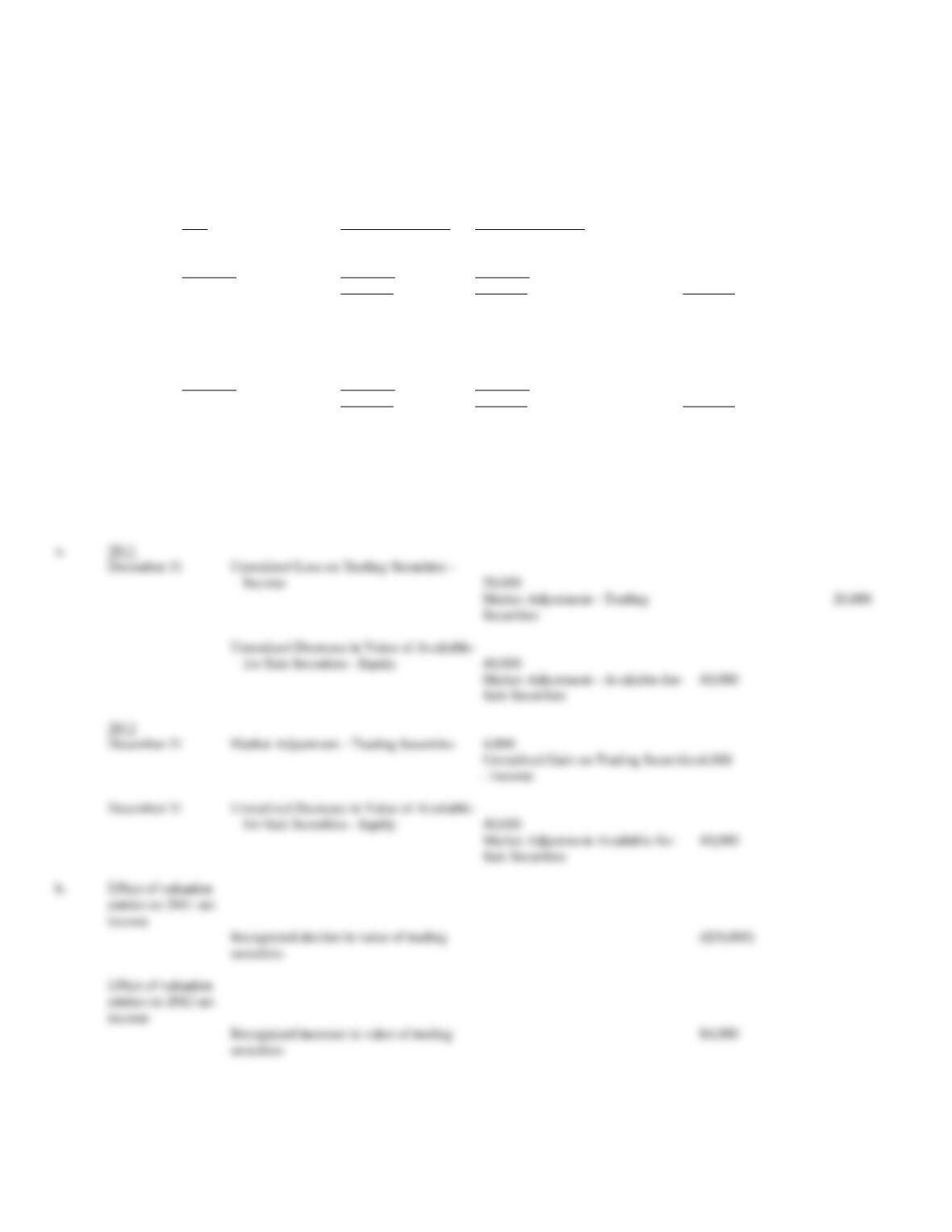
83. Barry Inc. carries the following marketable equity securities on its books at December 31, 2011 and 2012.
All securities were purchased during 2011 and there were no beginning balances in any market adjustment
accounts.
Trading Securities:
Market
Market
Cost
December 31, 2011
December 31, 2012
D Company
$ 50,000
$ 26,000
$ 40,000
E Company
26,000
40,000
40,000
F Company
70,000
60,000
50,000
Total
$146,000
$126,000
$130,000
Available-for-Sale
Securities:
G Company
$420,000
$360,000
$300,000
H Company
100,000
120,000
140,000
Total
$520,000
$480,000
$440,000
a.
Give the journal entries necessary to record the valuations for both trading and available-for-sale securities at December 31, 2011 and 2012
b.
What net effect would these valuations have on 2011 and 2012 income?
a.
2011
December 31
Unrealized Loss on Trading Securities –
Income
20,000
for-Sale Securities – Equity
40,000
Market Adjustment – Available-for-
Sale Securities
40,000
2012
December 31
Market Adjustment – Trading Securities
4,000
Unrealized Gain on Trading Securities
4,000
December 31
Unrealized Decrease in Value of Available-
for-Sale Securities – Equity
40,000
Recognized decline in value of trading
securities
($20,000)
Recognized increase in value of trading
$4,000
84. Don Ono purchased Yoko bonds with a face value of $30,000 in the secondary market on March 1, 2012, at
a price of $28,340 plus a brokerage fee of $280 and accrued interest. Interest at 10 percent is payable on January
1 and July 1 each year. The bonds were originally issued on January 1, 2011, and mature on January 1, 2014.
Don plans to amortize the discount once a year at December 31 on a straight-line basis.
a.
Prepare the journal entries to record the investment in the bonds on March 1, 2012, and the receipt of the first interest payment on July 1,
2012.
b.
Prepare the journal entry necessary on December 31, 2012, to properly report Don’s income for 2012.
c.
Compute the amount of interest revenue that Don earned on these bonds in 2012.
85. Rentz Company held a bond investment with a face value of $230,400. The company decided to sell the
bonds on April 15, 2012, at a quoted price of 104.5. On that date the carrying value of the bonds was $231,520.
The sale is subject to a brokerage commission of $1,152.
Prepare the journal entry on April 15, 2012, for the sale of the bond investment. (Ignore accrued interest.)
Cash
239,616
Investment in Held-to-Maturity Securities
231,520
Gain on Sale of Bonds
8,096
[($230,400 ´ 1.045) – 1,152 = $239,616;
$239,616 – $231,520 = $8,096]
a.
March 1
Investment in Held-to-Maturity Securities
28,620
Bond Interest Receivable
Cash
29,120
July 1
Cash
1,500
Investment in Held-to Maturity Securities
Bond Interest Receivable
Interest Revenue
1,251
December 31
Bond Interest Receivable
1,500
Investment in Held-to-Maturity Securities
376
Interest Revenue
1,876
86. Lexington Corporation purchased fifty $1,000, 12%, 5-year bonds of Jedediah Company on January 1,
2012, as a long-term investment for $55,934. Interest payments are made semiannually on June 30 and
December 31.
a.
Using the straight-line method of amortization, prepare a schedule showing the amortization of the bond premium over the 5-year life of
the bond.
b.
Using the effective-interest method of amortization, prepare a schedule showing the amortization of the bond premium over the 5-year life
of the bond. Assume an effective rate of interest earned on the bonds is 9%, compounded semiannually.
*Number is slightly off due to
b.
Effective-interest method of
*Number is slightly off due to
rounding errors
87. In 2012, Vidalia had the following activities in long-term investments:
May 10
Purchased 50,000 shares of Woodbine stock for $15 per share plus brokerage fees of $5,000.
August 24
Received a cash dividend of $2 per share on Woodbine stock.
December 31
Woodbine reported net income of $478,000. Woodbine has 125,000 shares of common stock outstanding.
88. On January 1, 2012, Shane Corporation acquired 30 percent (13,000 shares) of Matthews Services Inc.
common stock for $1,300,000 as a long-term investment. Data from Matthews’s 2012 financial statements
include the following:
Net income
$330,000
Less cash dividends paid
160,000
Increase in retained earnings
$170,000
The market value of Matthews Services Inc. common stock on December 31, 2012, was $98 per share. Shane does not have any other investments in
securities.
Prepare the necessary journal entries for Shane’s investment in Matthews Services Inc. common stock assuming Shane uses the following methods to
account for its investment in Matthews Services:
a.
Classified as available-for-sale securities.
b.
The equity method.
Cash
755,000
August 24
Cash
100,000
Investment in Equity Method Securities
100,000
Revenue from Investments
191,200
89. Johnson Company owns part of three different subsidiaries. The balance sheet and the income statement for
Johnson Company and its three subsidiaries are shown below. Johnson Company currently accounts for the
ownership of the three subsidiaries using the equity method.
Percentage of
Johnson’s Ownership
90%
60%
40%
Johnson
Subsidiary 1
Subsidiary 2
Subsidiary 3
Assets
Cash
$ 660
$ 220
$ 165
$ 330
Accounts receivable
2,750
660
495
275
Plant and equipment
5,775
2,200
880
1,650
Investment in Sub 1
1,584
Investment in Sub 2
429
Investment in Sub 3
462
Total assets
$ 11,660
$ 3,080
$ 1,540
$ 2,255
Liabilities
4,950
1,320
825
1,100
Equity
6,710
1,760
715
1,155
Total liabilities and
stockholders’ equity
$ 11,660
$ 3,080
$ 1,540
$ 2,255
Sales
35,310
16,500
16,500
44,000
Income from Sub 1
1,980
Income from Sub 2
2,640
Income from Sub 3
880
Total Expenses
(23,100)
(14,300)
(12,100)
(41,800)
Net income
$ 17,710
$ 2,200
$ 4,400
$ 2,200
a.
Prepare a consolidated balance sheet for Johnson Company and all of its majority-owned subsidiaries.
b.
Prepare a consolidated income statement for Johnson Company and all of its majority-owned subsidiaries.
Matthews Services Stock
1,300,000
Cash
Cash ($160,000 ´ 30%)
48,000
Dividend Revenue
48,000
for-sale Securities – Equity
26,000
(13,000 shares ´ $2)
Market Adjustment – Available-for-sale Securities
26,000
Investment in Equity Method
1,300,000
Cash
Cash
48,000
Investment in Equity Method Securities
Investment in Equity Method
99,000
($330,000 ´ 30%)
Revenue from Investment in Equity Method Securities
99,000