Elements of Ecology, 9e (Smith)
Chapter 12 Species Interactions, Population Dynamics, and Natural Selection
12.1 Short Answer Questions
1) When each of two species benefits from their interaction, the relationship is referred to as
________.
2) When one species reduces or adversely affects the population of another, but the affected
species has no influence in return, the relationship is referred to as ________.
3) When one species feeds on another prey species, typically killing it, the relationship between
the two interacting species is referred to as ________.
4) When the interaction is detrimental to the population of both species (- -), it is referred to as
________.
5) When individuals of two species interact, the nature of the interaction can be classified
qualitatively as positive, negative, or ________.
6) ________ occurs when two species undergo reciprocal evolutionary change through natural
selection.
7) Under certain conditions, ________ fungi live in the roots of many species of plants and have
a mutually beneficial relationship with the plants.

8) The process in which a network of species undergoes reciprocal evolutionary change through
natural selection is referred to as ________.
9) The range of physical and chemical conditions under which each species can persist (survive
and reproduce) and the array of essential resources it utilizes are referred to as its ecological
________.
10) The ________ niche is the portion of a fundamental niche in which species can exploit as a
result of interactions with other species.
12.2 Multiple-Choice Questions
1) When the trunk or limb of a tree provides the substrate on which an epiphytic orchid grows,
the arrangement benefits the orchid, which gets nutrients from the air and moisture from aerial
roots, while the tree is unaffected. The relationship is referred to as
A) amensalism.
B) commensalism.
C) competition.
D) parasitoidism.
2) When the relationship between two interacting species is detrimental to the populations of
both species, the interaction is referred to as
A) parasitism.
B) mutualism.
C) competition.
D) amensalism.

3) Which of the following interactions would be considered predation?
A) + –
B) + 0
C) – –
D) – 0
4) A remora feeds on the scraps that escape from a shark’s mouth while feeding. It has no clear
positive or negative impact on the shark. This is an example of
A) competition.
B) commensalism.
C) amensalism.
D) neutral.
5) What is the difference between a parasite and a parasitoid?
A) A parasite is larger.
B) A parasitoid is harmless to the host.
C) A parasite has only one host.
D) A parasitoid typically always kill its host.
6) The carrying capacity for species 1 is 1000 and for its competitor, species 2, it is 500. What is
the maximum abundance of species 1 if 250 of species 2 coexists with it?
A) 250
B) 1000
C) 500
D) 1250
7) As predators feed on prey, prey abundances decrease over time. This is predicted to result in
a(n)
A) increase in predator abundance.
B) decrease in predator abundance.
C) no change in predator abundance.
D) increase in predator size.
8) Owl species A has a carrying capacity of 2000, while another owl species B has a carrying
capacity of 200. What is the logical conclusion of this?
A) Species A is larger than B.
B) Species B uses more resources per individual.
C) Species A uses more habitat per individual.
D) Species B feeds on A.
9) As the population of a predator increases, the
A) population of the prey species decreases.
B) birthrate of the prey species increases.
C) mortality rate of the prey species decreases.
D) proportion of the prey population that is captured and consumed decreases.
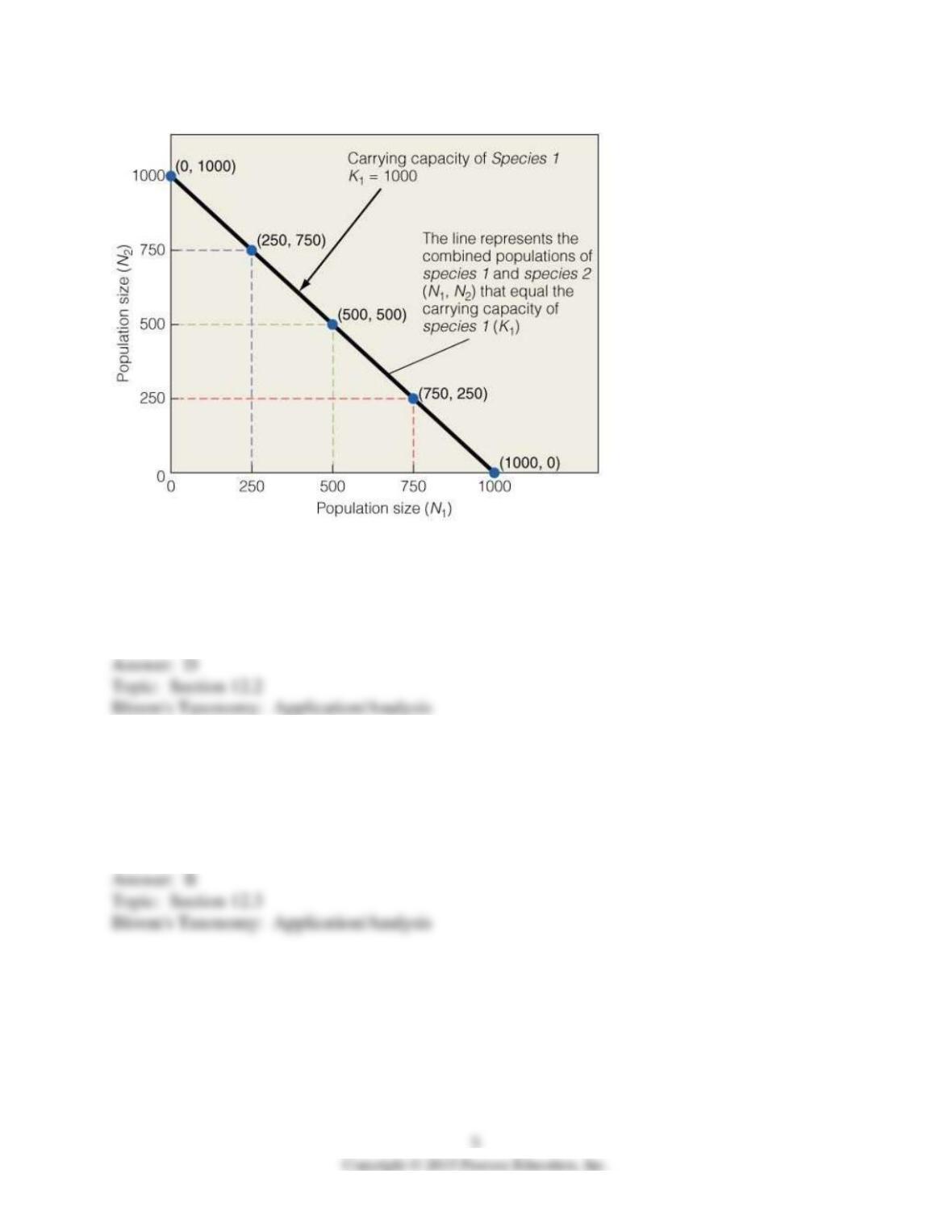
10)
Which of the following has the strongest impact on species 1 population size? N2 =
A) 0.
B) 250.
C) 500.
D) 750.
11) When a species of bird preys upon the seeds of a plant and favors the smallest seeds,
A) the prey species functions as an agent of natural selection on the predator.
B) natural selection favors individual plants that produce the largest seeds.
C) the plants compensate for their losses by producing proportionately more smaller seeds.
D) the bird species is unaffected when directional selection favors plants that produce the largest
seeds.
12) The length of a butterfly tongue perfectly matches the nectar tube of a flower it pollinates.
This is an example of
A) competition.
B) amensalism.
C) phenotypic plasticity.
D) coevolution.
13) What might happen over time if two bird species competed for the same seed resource and
one preferred larger seeds while the other species preferred smaller ones?
A) Species would repeatedly switch between small and large seeds.
B) Beak sizes might shift over time.
C) Both species would die out via competition.
D) Seed size will shift larger over time.
14) Hummingbirds are attracted to red flowers with long tubes. What might you predict would
happen to flowers if hummingbirds become the predominant species on a remote island?
A) Flowers would become gradually more red.
B) Flowers would develop shorter tubes.
C) Hummingbirds would develop longer beaks.
D) Hummingbirds would become extinct.
15) On a dare, a student challenges another student to lick a California newt (Taricha torosa).
From which population of newts should the student grab an individual to reduce his or her risk of
a toxic dose?
A) from a population with no garter snakes
B) from a population with a low abundance of garter snakes
C) from a population with a medium abundance of garter snakes
D) from a population with a high abundance of garter snakes
16) The neurotoxin that Taricha spp. possess to ward off predators is
A) TTG.
B) taricha venom.
C) tetrodotoxin.
D) thamnophis poison.
17) In an area with high soil nutrient availability, mycorrhizal fungi are
A) commensal.
B) competitive.
C) parasitic.
D) neutral.
18) Mycorrhizal fungi have a mutually beneficial relationship with plants in environments with
soils that
A) are saturated with water.
B) have a high clay content.
C) are acidic.
D) are low in nutrients.
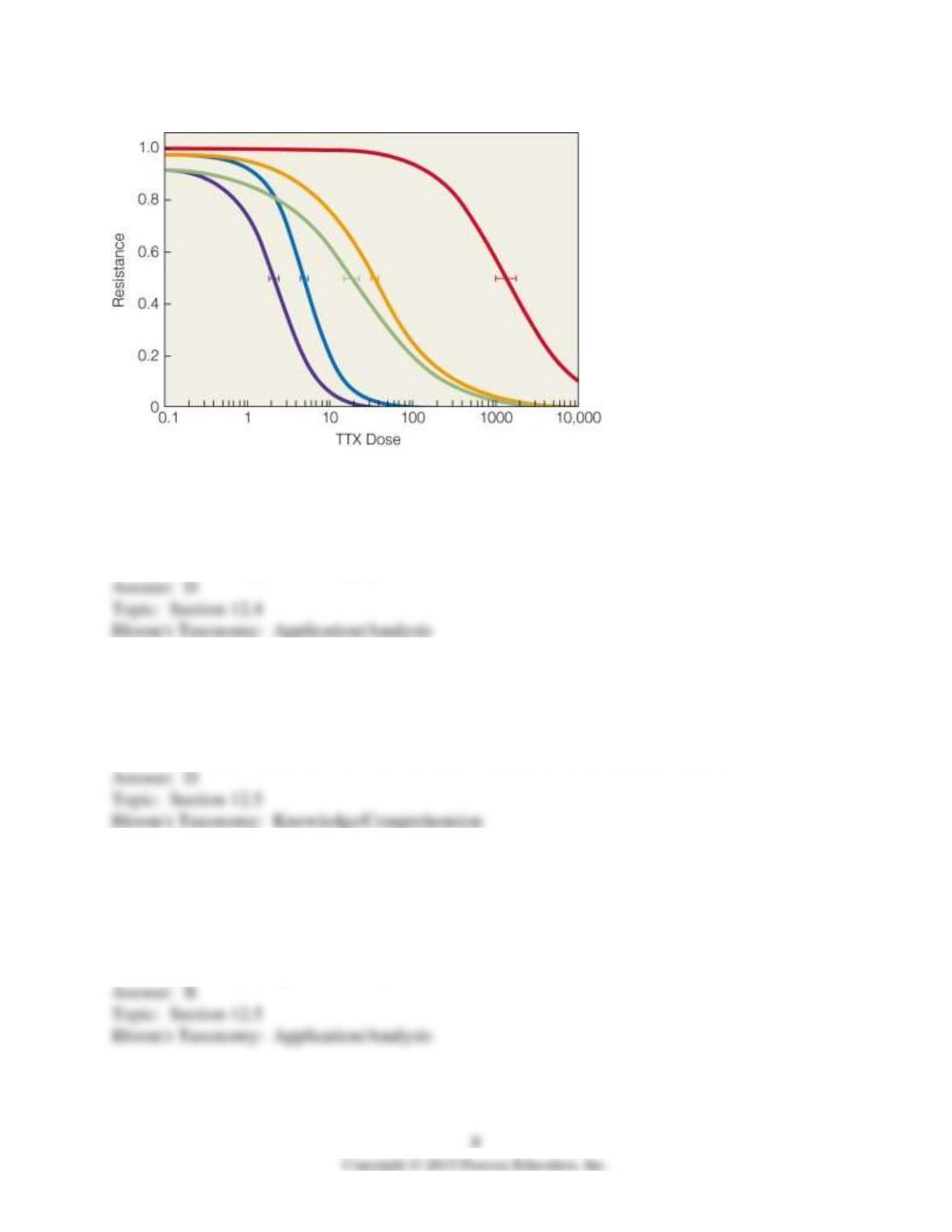
19)
The red line in the figure (the furthest to the right) represents
A) low-toxicity Taricha individuals.
B) high-toxicity Taricha individuals.
C) highly vulnerable garter snake population.
D) highly resistant garter snake population.
20) In most plant-pollinator interactions, plants species are pollinated by
A) one animal species, and each animal species pollinates one plant species.
B) one animal species, and each animal species pollinates multiple plant species.
C) multiple animal species, and each animal species pollinates one plant species.
D) multiple animal species, and each animal species pollinates multiple plant species.
21) A food web is a better representation of a community than a food chain because most
interactions among organisms
A) are specialized between particular individuals.
B) are diffuse across a range of contexts.
C) are limited to trophic levels.
D) are related to phylogenetic history.
22) A flower is not ideally matched with a pollinator that visits it daily. Why might that be?
A) The flower does not need pollination.
B) The flower is imperfect.
C) The flower does not have sufficient nutrients.
D) The flower has several other pollinators with differing traits.
23) An invasive bullfrog consumes a Taricha newt and dies immediately. What can you say
about the toxin?
A) It is toxic to general vertebrate predators.
B) It is specifically toxic only to the garter snake.
C) It likely evolved to kill the bullfrog as well after years of coevolution.
D) It is an ineffective antipredator defense.
24) An ecological niche is typically ________ dimension/s.
A) one
B) two
C) three
D) an unspecified number of
25) A species of cattail inhabits both deep and shallow water in the absence of a competitor but
only shallow water in the presence of it. This is an example of
A) a realized niche.
B) a fundamental niche.
C) carrying capacity.
D) coevolution.
26) The concept of the niche was initially developed by
A) Hutchinson.
B) Brodie.
C) Wetzel.
D) Grinnell.
27) A realized niche can be larger than a fundamental niche
A) never.
B) when a competitor is present.
C) when abiotic conditions improve.
D) when a commensal species expands another’s niche space.
28) Two species of cattail (Typha) live in shallow water along the shoreline of ponds. Although
T. agustifolia can live by itself in water 0-20 cm deep, in the presence of T. latifolia, it occurs
only in water > 20 cm deep, whereas T. latifolia occurs in shallower water. In this example, T.
agustifolia is limited by competition exploiting its
A) ecological niche.
B) fundamental niche.
C) realized niche.
D) physiological niche.
29) The process whereby one species gives rise to several others that exploit different features of
the environment is known as
A) exponential growth.
B) coevolution.
C) adaptive radiation.
D) competition.
30) Adaptive radiation is often the result of
A) lack of predation.
B) excess nutrients.
C) resource competition.
D) abiotic factors.

31) The globeflower can host
A) at least six coexisting species.
B) a single coevolved species.
C) three different coexisting species.
D) not a single insect species.
32) What does the following formula represent? dN1/dt = r1N1(1 – (N1 + N2)/K1)
A) population growth of species 1 in absence of species 2
B) population growth of species 1 in presence of species 2
C) carrying capacity of species 1 in absence of species 2
D) population size in the presence of species 2
33) As two competing species approach their respective carrying capacities, the growth rate of
the other species
A) accelerates.
B) is unaffected.
C) is doubled.
D) slows down.
34) Urbanization impacts
A) all species positively.
B) all species negatively.
C) most species negatively, but a few positively.
D) most species positively, but a few negatively.
35) In comparison to desert habitats, urban landscapes on average have a
A) higher number of bird species.
B) lower number of bird species.
C) similar number of bird species.
D) the same type of bird species.

12.3 True/False Questions
1) Predation always has a negative effect on the individual prey.
2) In a parasitic relationship between two species, the host species usually dies.
3) Parasitoidism is a form of mutualism.
4) When the population size of a prey species increases, the birthrate of a predator species should
also increase.
5) The interaction between two species usually influences all individuals within the respective
populations equally.
6) The relationship between nectar-producing flowers and nectar-feeding birds is a mutually
beneficial interaction.
7) Species having wide geographic distributions generally encounter a broader range of physical
environmental conditions than species whose distribution is more restricted.
8) Most interspecific interactions are exclusive, involving only two species.
9) An organism’s realized niche is always smaller than its fundamental niche.
10) Adaptive radiation can result from divergent adaptations to avoid predators.
12.4 Essay Questions
1) Define five types of species interactions based on their reciprocal effects.
2) Describe an example of how coevolution between a predator and a prey can lead to
specialization.
3) Define diffuse coevolution. Do most interspecific interactions occur exclusively between two
species? Provide an explanation for your answer.
4) Define a fundamental niche and a realized niche, and provide an example illustrating each. Is
one always larger than the other? Explain your answer.
5) Define adaptive radiation. Explain how it might come about using a specific example.
6) Calculate the growth rate of species 1 given the following information: r1 = 0.2, N1 = 1000,
N2 = 1000, β = 0.5, K1 = 3000, K2 = 2000. What would it be if N1 = 2000? Why is the rate
different?